Introduction
Sugarbeet is a high-value root crop cultivated for sucrose. The composition of the sugarbeet taproot is approximately 25% dry matter and 75% water; of the dry matter portion, approximately 18% is sucrose (Milford Reference Milford and Draycott2006). Weed control is an important component in profitability of sugarbeet production because sugarbeet early season growth and development is slow, resulting in a low competitive ability with weeds, especially weeds germinating and emerging early in the growing season (Dexter Reference Dexter1994; Jursik et al. Reference Jursik, Holec, Soukup and Venclova2008). The sugarbeet margin of tolerance to pesticides is also very low compared with other row crops (Soltani et al. Reference Soltani, Dille, Robinson, Sprague, Morishita, Lawrence, Kniss, Jha, Felix, Nurse and Sikkema2018).
Weeds compete with sugarbeet for light, nutrients, and water, which causes crop failure if weeds are not properly managed (Cioni and Maines Reference Cioni and Maines2011). Wicks and Wilson (Reference Wicks and Wilson1983) reported weed interference at 8 wk after planting, or 4 wk after the two-leaf stage, affected sugarbeet yields. The average sugarbeet field contains a ratio of 70% broadleaf weeds and 30% grass species (Schweizer and May Reference Schweizer, May, Cook and Scott1993). Unfortunately, annual broadleaf weeds are more competitive than annual grasses and often grow two to three times taller than sugarbeet by mid-summer.
Common lambsquarters, redroot pigweed, and waterhemp are three troublesome weed species in the Red River Valley of Minnesota and North Dakota and southern Minnesota (Peters and Lystad Reference Peters and Lystad2017) because of challenging germination periods, herbicide resistance characteristics, and immense fecundity. With few to no effective postemergence (POST) herbicide options for control of resistant biotypes of these weed species, early-season weed escapes result in late-season weed control failures (Peters et al. Reference Peters, Lueck, Mettler and Groen2017), thus increasing the weed seedbank and creating harvest challenges.
Waterhemp poses the greatest threat to sugarbeet production of the weed species mentioned because of widespread populations in the United States with herbicide resistance to six different sites of action (Heap Reference Heap2023). Three species have been confirmed in Minnesota and North Dakota, and they have a longer germination period compared to other grass and broadleaf species, especially in seasons with frequent rainfall (Hartzler et al. Reference Hartzler, Buhler and Stoltenberg1999). Consequently, management of waterhemp is essential to avoid crop yield loss throughout the growing season.
Ethofumesate is a broad-spectrum, full-season soil residual herbicide used to control broadleaf and grass weeds in sugarbeet (Edwards et al. Reference Edwards, Zinn, Prieto, Wyatt, Brown, Al-Mudallal, Morales, Hansen, McCarroll, Travaglini, Miller, Parsons and Mottl2005), providing control of common lambsquarters, redroot pigweed, and waterhemp in Minnesota and eastern North Dakota (Peters et al. Reference Peters, Lueck and Radermacher2016). Ethofumesate may be most effective for waterhemp control, especially on waterhemp that germinates in June and July in response to rainfall. Peters and Lystad (Reference Peters and Lystad2017) reported up to 100% waterhemp control with ethofumesate, including control of waterhemp germinating and emerging later and throughout the season.
Ethofumesate is applied preplant incorporated, preemergence (PRE), and POST at rates from 0.38 to 4.3 kg ai ha−1 to sugarbeet (Dexter Reference Dexter1975; Ekins and Cronin Reference Ekins and Cronin1972; Eshel et al. Reference Eshel, Zimdahl and Schweizer1976; Sullivan and Fagala Reference Sullivan and Fagala1970) with excellent sugarbeet tolerance (Dexter Reference Dexter1976). Reliable sugarbeet tolerance on prairie soils, along with full-season residual soil activity (Ekins and Cronin Reference Ekins and Cronin1972), especially on Amaranthus species (Schweizer Reference Schweizer1975), makes ethofumesate an excellent candidate for weed control in sugarbeet crops in Minnesota and eastern North Dakota.
Generic Crop Science LLC (Henderson, NV), in collaboration with the Beet Sugar Development Foundation, developed a new label for ethofumesate (Ethofumesate 4SC), that increases POST use rates from 0.38 to 4.48 kg ha−1 on sugarbeet greater than two true-leaves and decreased the preharvest interval from 90 to 45 d (Anonymous 2017). Increasing ethofumesate use rates POST may provide extended residual control of late-emerging weed species such as waterhemp, and may add a second site of action for control of common lambsquarters and redroot pigweed when tank-mixed with glyphosate applications, thus potentially reducing the onset of herbicide-resistant weeds (Patzoldt et al. Reference Patzoldt, Tranel and Hager2004).
Peters and Lystad (Reference Peters and Lystad2017) reported repeat POST applications of ethofumesate at rates up to 2.24 kg ha−1 suppressed, but did not control, emerged broadleaf weeds; however, they observed necrosis in the meristem region, which affected reproductive development and resulted in reduced seed production (TJP, personal observation). Eshel et al. (Reference Eshel, Zimdahl and Schweizer1978) reported a similar observation of ethofumesate translocating to the edges of the treated leaves; however, ethofumesate did not affect new leaves. These results suggest that ethofumesate applied POST may not be used as a stand-alone herbicide for weed control, but it could provide developmental compromises to emerged weed species, such as reduced fecundity from reproduction interference caused by ethofumesate application (Peters and Lystad Reference Peters and Lystad2017), while suppressing viable seed in the soil.
The purpose of this research was to evaluate ethofumesate at rates up to 4.48 kg ha−1 applied POST to sugarbeet. The objectives of the research were to 1) determine whether ethofumesate at increased rates applied POST, whether alone or in mixtures, increased sugarbeet injury; 2) evaluate common lambsquarters, redroot pigweed, and waterhemp control with POST application of ethofumesate at rates up to 4.48 kg ha−1; and 3) determine whether increased rates of ethofumesate applied in tank mixtures results in improved broadleaf weed control.
Materials and Methods
Site Description
Tolerance Field Experiments
Field experiments were conducted at five locations relevant to sugarbeet production in Minnesota and eastern North Dakota in 2018 and 2019. Each site-year combination was considered to be an environment, totaling seven unique environments evaluated across two seasons. Experiments were conducted near Hickson, ND (46.705150°N, 96.801097°W), Horace, ND (46.636574°N, 96.823667°W), and Prosper, ND (47.003591°N, 97.108261°W) in 2018; and near Crookston, MN (47.813219°N, 96.614108°W), Hickson, ND (46.705150°N, 96.801097°W), Prosper, ND (47.003591°N, 97.108261°W), and Wolverton, MN (46.586494°N, 96.710886°W) in 2019. All environments were fall chisel-plowed and prepared for spring sugarbeet planting by field cultivating. Detailed soil descriptions appear in Table 1.
Soil descriptions of sugarbeet tolerance and efficacy trials.

Efficacy Field Experiments
Experiments were conducted at three locations in Minnesota and one location in eastern North Dakota in 2018 and 2019. Experiments were conducted near Oslo, MN (48.194917°N, 97.058581°W) and Moorhead, MN (46.891800°N, 96.754347°W) in 2018; and Oslo, MN (48.211920°N, 96.944980°W), Moorhead, MN (46.891800°N, 96.754347°W), Lake Lillian, MN (44.905483°N, 94.954005°W), and near Minto, ND (48.338973°N, 97.447232°W) in 2019. Each site-year combination was considered an environment, totaling six unique environments evaluated. All environments were fall chisel-plowed and prepared for spring sugarbeet planting by field cultivating. Detailed soil descriptions appear in Table 1.
Experiment Procedures
Tolerance Field Experiments
Experimental treatments were arranged in a randomized complete-block design with four or six replications, depending on environment. Experimental units were 3.3 m wide by 9 m long and included six sugarbeet rows. Planting dates across environments ranged from May 3 to June 7, which is later than normal, due to wet springs in 2018 and 2019.
Betaseed ‘7540’ (KWS Seeds, Inc., Bloomington, MN) was seeded approximately 3 cm deep to a density of approximately 152,000 (± 1,000) seeds ha−1 or approximately 12-cm spacing between seeds along rows spaced 56 cm apart. The experimental area was managed weed-free using 1.96 kg ha−1 ethofumesate applied PRE followed by glyphosate (Roundup PowerMax®; Bayer Crop Science, St Louis, MO) applied at 1.26 kg ha−1 when needed. Fungicides were applied as needed to control Rhizoctonia root rot (Rhizoctonia solani Kühn) and Cercospora leaf spot (Cercospora beticola Sacc.).
Ethofumesate was applied at 0, 0.28, 0.56, 1.12, 2.24, and 4.48 kg ha−1 to the center four rows of the experimental unit at the two true-leaf sugarbeet stage using a bicycle-wheel plot sprayer with a shielded boom at 159 L ha−1 spray solution through XR8002 flat-fan nozzles (TeeJet® Flat Fan Spray Tips; TeeJet® Technologies, Glendale Heights, IL) and pressurized with CO2 at 276 kPa.
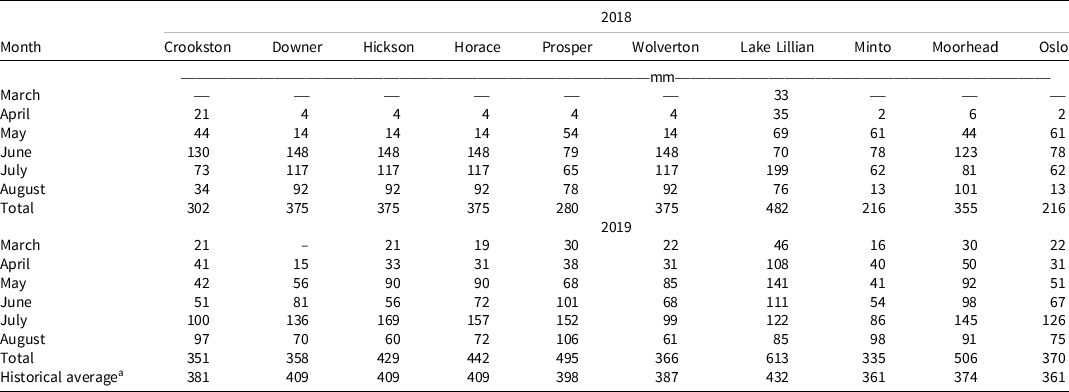
Rainfall data were collected from nearby weather stations operated by the North Dakota Agricultural Weather Network (NDAWN; https://ndawn.ndsu.nodak.edu/) and ClimateCorp FieldView (The Climate Corporation; https://climate.com/) in 2018 and 2019 growing seasons, respectively (Table 2).
Monthly rainfall at trial locations.

a Historical average monthly precipitation recorded at North Dakota Agricultural Weather Network (NDAWN) at Eldred, MN (Oslo, MN); Sabin, MN (Wolverton, MN); Campbell, MN (Lake Lillian, MN); Moorhead, MN; Warren, MN (Crookston, MN); Leonard, ND (Horace, ND); Prosper, ND; Grafton, ND (Minto, ND); and Fargo, ND (Hickson, ND).
Sugarbeet tolerance to Ethofumesate 4SC was evaluated by counting sugarbeet plants in the center two rows of the experimental unit at the 2- to 4-leaf sugarbeet growth stage and again before harvest. Visible stature reduction was observed 7, 14, and 28 (±3) d after treatment (DAT) of the POST herbicide application on a scale of 0% to 100%, with 0% reflecting no reduction in aboveground stature and 100% reflecting complete loss in aboveground stature compared with the nontreated control rows between individual plots.
At harvest, sugarbeet plants were defoliated and harvested mechanically from the center two or three rows of each plot and weighed. A 10-kg sample was collected from each plot and analyzed at American Crystal Sugar Quality Lab, in East Grand Forks, MN, for sucrose content and sugar loss to molasses. Sugarbeet root yield (kg ha−1), purity (%), and recoverable sucrose (kg ha−1) were calculated using Equations 1 to 3 based on laboratory results.
 $${\rm{Root\;yield\;(kg\;per\;ha)}} = {{{\rm{harvested\;plot\;weight\;(kg)}}} \over {{\rm{hectare\;area\;of\;harvested\;plot}}}}$$
 $$\matrix{ {{\rm{Purity}}\;(\% ) = \left[ {{{\% \;{\rm{sucrose}}\;{\rm{content}}\; - \;\% \;{\rm{sugar}}\;{\rm{loss}}\;{\rm{to}}\;{\rm{molasses}}} \over {\% \;{\rm{sucrose}}\;{\rm{content}}}}} \right]} \cr {\; \times {\rm{100}}} \cr } $$
 $$\matrix{ {{\rm{Recoverable}}\;{\rm{sucrose}}\;({\rm{kg}}\;{\rm{per}}\;{\rm{ha}}) = } \hfill \cr
{\quad \left[ {{{\left( {\left( {\% \;{\rm{purity}}\;{\rm{/}}\;{\rm{100}}} \right)\; \times \;\% \;{\rm{sucrose}}\;{\rm{content}}} \right)} \over {{\rm{100}}}}} \right] \times \;{\rm{root}}\;{\rm{yield}}} \hfill \cr } $$
Data from the field experiments were analyzed using the MIXED procedure (method=type3) with SAS software (version 9.4; SAS Institute, Cary, NC). Environment and replicate were considered random effects, while treatments were fixed effects. Mean separation was performed using least square means paired differences if an F-test was significant at P ≤ 0.05. Standard error was used to calculate F-protected LSD at a significance level of P = 0.05. In tolerance field experiments, regression analysis was performed using SAS software. Orthogonal contrasts were written to determine whether independent and dependent variables were best fit to linear, quadratic, or cubic regressions.
Efficacy Field Experiments
Experimental treatments were arranged in a randomized complete-block design with four replications. Each experimental unit was 3.3 m wide by 9 m long and included six rows of sugarbeet seeded 3 cm deep at approximately 152,000 seeds (±1,000) ha−1, resulting in approximately 12-cm spacing between seeds along rows spaced 56 cm apart. Field preparation, fertilization, and variety varied for each experiment; however, field operations were consistent with the common practices for sugarbeet production in the Red River Valley and west central Minnesota.
Rainfall data were collected from nearby weather stations operated by NDAWN and ClimateCorp FieldView in 2018 and 2019 growing seasons, respectively (Table 2).
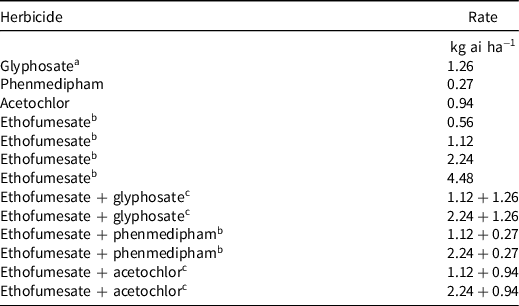
POST herbicide applications (Table 3) were timed to 5-cm weed species using a bicycle-wheel plot sprayer with a shielded boom at 159 L ha−1 spray solution through XR8002 flat-fan nozzles (TeeJet® Technologies) spaced 51 cm apart and pressurized with CO2 at 276 kPa to the center-four rows of the experimental unit at the two true-leaf sugarbeet stage.
Herbicide treatments used to evaluate sugarbeet tolerance and weed control.

a Liquid ammonium sulfate at 2.5% v/v and a nonionic surfactant at 0.25% v/v were added to treatment.
b High surfactant methylated oil concentrate at 1.8 L ha−1 was added to the treatment.
c Liquid ammonium sulfate at 2.5% v/v and high surfactant methylated oil concentrate at 1.8 L ha−1 were added to the treatment.
Evaluations included visible percent sugarbeet stature reduction (0% to 100%, 100% reflecting complete loss of stand) and visible percent weed control (0% to 100%, 100% reflecting complete weed control) 7 and 14 (±3) d after treatment (DAT). Weed density of surviving or new emergence were measured by counting a weed species within 0.25-m2 quadrats at four locations within each test plot 14 (±3) DAT.
Data from the field experiments were analyzed using the MIXED procedure (method=type3; SAS software). Environment and replicate were considered random effects, while treatments were fixed effects. Mean separation was performed using least square means paired differences if an F-test was significant at P ≤ 0.05. Standard error was used to calculate F-protected LSD at a significance level of P = 0.05.
Efficacy Greenhouse Experiments
Common lambsquarters, redroot pigweed, and waterhemp were evaluated in separate experiments conducted in the greenhouse in 2018 and 2019. The greenhouse experimental design was a randomized complete-block design with a factorial arrangement with three replications. Treatment factors were herbicide treatment and plant height at herbicide application. Herbicide treatments included glyphosate alone at 1.10 kg ha−1, ethofumesate alone at 1.12 kg ha−1, glyphosate plus ethofumesate at 1.10 plus 1.12 kg ha−1, and a nontreated control. Treatments were applied PRE and to weed species measuring 1.3, 2.5, and 5 cm in height. Experiments were repeated within each species. Plants were grown at 24 to 27 C under natural light supplemented with a 16-h photoperiod that provided 400 uE m−2s−1 light intensity.
Plastic pots (10 cm by 10 cm) were filled approximately ¾-full with a peat, perlite, and vermiculite growth medium (Sunshine Mix No. 1; Sun Gro Horticulture, Agawam, MA) at pH 5.8 with 0.1 g weed seeds planted per pot. Plants were watered and fertilized (Jack’s Professional Nutrients, Allentown, PA) as necessary. Treatments were applied when approximately 50 plants per pot reached the desired treatment height. Plants were thinned to a uniform density before herbicide application. Herbicide treatments were applied using a spray booth (Generation III; DeVries Manufacturing, Hollandale, MN) equipped with a single XR8001 nozzle (TeeJet® Technologies) calibrated to deliver 100 L ha−1 spray solution at 275 kPa and 4.8 km h−1.
Visual weed control evaluations (0% to 100%, 100% reflecting complete weed control) were completed 7 and 14 (±3) DAT. Aboveground fresh weight (grams per pot) and weed density were collected at the conclusion of the experiment or after the 14 DAT evaluation.
Data from the greenhouse experiments were analyzed using the MIXED procedure with SAS software (method=type3). The experiment was run twice for each weed species and each run was considered a fixed effect. Herbicide and weed height factors were considered fixed effects, while replicate was considered random effect. If an F-test was significant at P ≤ 0.05, mean separation was performed using least squares means paired differences. The standard error and corresponding error degrees of freedom was used to calculate LSD at a significance level of P = 0.05.
Results and Discussion
Tolerance Experiments
Sugarbeet injury, noted as visible stature reduction, ranged from 0% to 29% when evaluated 7, 14, and 28 DAT; injury was dependent on herbicide treatment and evaluation timing (data not shown). We did not observe sugarbeet stand density reduction 7, 14, or 28 DAT from ethofumesate application at any rate (data not shown).
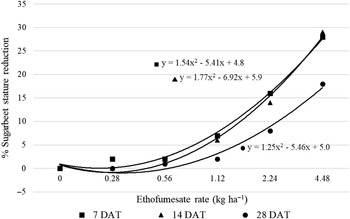
The ethofumesate rate × evaluation timing (interval in days between treatment and visual assessment) was significant (P = 0.0023), so data are presented by evaluation timing (Figure 1). Sugarbeet stature reduction increased as the ethofumesate rate increased, as indicated by the slope of the regression line. Sugarbeet injury across ethofumesate rate were similar at 7 and 14 DAT, while injury at 28 DAT was less compared with prior evaluations. Although we observed reduced sugarbeet stature with increased POST rates of ethofumesate, visible sugarbeet injury lessened as new leaves developed, and we did not observe differences in sugarbeet row closure across treatments (data not shown).
Sugarbeet visible stature reduction (%) in response to ethofumesate rate (kg ha−1), 7, 14 and 28 d after treatment (DAT) averaged across location in 2018 and 2019.

The greatest visual injury observed in these experiments was near the visual stature reduction threshold at which yield loss begins to occur in most environments (personal observation). Ethofumesate at rates greater than 2.24 kg ha−1 caused greater sugarbeet injury than lower rates of ethofumesate when evaluated 7 and 14 DAT. However, at 28 DAT, all rates of ethofumesate provided sugarbeet tolerance within acceptable range, or visible stature reduction threshold, of where yield parameters are not adversely affected. Visible sugarbeet stature reduction across ethofumesate rate was best explained by the quadratic equation (P < 0.0001).
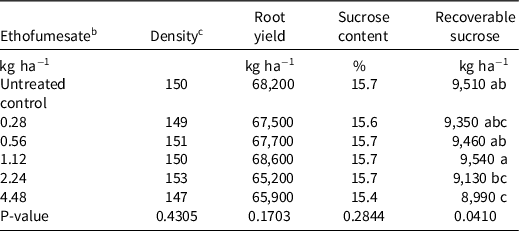
Sugarbeet stand density (P = 0.4305), root yield (P = 0.1703), and sucrose content (P = 0.2844) were not affected by ethofumesate rate at sugarbeet harvest (Table 4). However, recoverable sucrose content (P = 0.0410) was reduced by 520 kg ha−1 with ethofumesate at 4.48 kg ha−1 compared with the nontreated control. Recoverable sucrose, or the amount of pure white sugar produced per unit area, is a summation of root yield and sucrose content. Sucrose content from sugarbeet treated with ethofumesate at 4.48 kg ha−1 was approximately 0.3% less than sucrose content from other treatments and the nontreated control. Furthermore, root yield was 3% less following ethofumesate at 4.48 kg ha−1 compared with the nontreated control. Although neither of these reductions were significant on their own, the combination of numerically lower sucrose content and root yield was responsible for the reduction in recoverable sucrose following ethofumesate at 4.48 kg ha−1.
Sugarbeet density, root yield, sucrose content, and recoverable sucrose in response to postemergence ethofumesate applications. a

a Means within a main effect column not sharing any letter are significantly different by the LSD at the 5% level of significance.
b High surfactant methylated oil concentrate at 1.8 L ha−1 was added to each POST treatment.
c Number of harvestable sugarbeets counted in a 30-m row.
Although sugarbeet stature was affected by ethofumesate rate, ethofumesate did not reduce root yield in field experiments. These results were consistent with observations from other researchers (Bollman and Sprague Reference Bollman and Sprague2007; Peters et al. Reference Peters, Lueck and Carlson2019; Smith and Schweizer Reference Smith and Schweizer1983). Smith and Schweizer (Reference Smith and Schweizer1983) reported sugarbeet overcame early season injury from PRE and POST herbicides and did not affect yield. These experiments lead to the conclusion that ethofumesate applied POST at rates up to 2.24 kg ha−1 can be safely used for broadleaf weed control in sugarbeet production regions.
Several observations indicated that ethofumesate may affect surface waxes by inhibiting the biosynthesis of very-long-chain fatty acids, although the specific mechanism of action is not fully understood (Abulnaja et al. Reference Abulnaja, Tighe and Harwood1992; Devine et al. Reference Devine, Duke and Fedke1993). Likewise, Eshel et al. (Reference Eshel, Zimdahl and Schweizer1978) reported rapid ethofumesate movement upward from the base of the leaf to the tips of the leaf following POST application; however, the authors did not detect ethofumesate movement outside of the treated leaf to 15 d after application. We occasionally observed a deep green sugarbeet phenotype, which we attributed to ethofumesate effects on surface waxes. However, appearance of leaf phenotype seemed random and was not an indicator for sugarbeet injury.
Efficacy Experiments
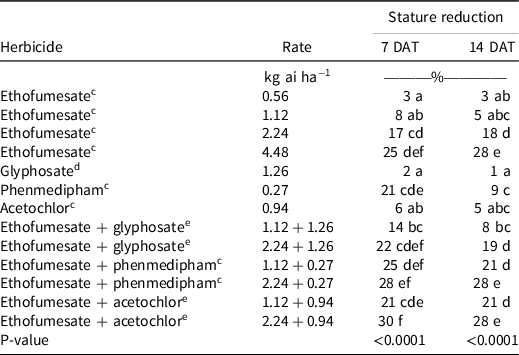
Visible sugarbeet stature reduction resulting from ethofumesate application singly and in mixtures was observed 7 and 14 DAT in experiments that were designed to evaluate the efficacy of control for common lambsquarters, redroot pigweed, and waterhemp (Table 5). Sugarbeet visible stature reduction from ethofumesate applied alone ranged from 3% to 25% and from 3% to 28%, 7 and 14 DAT, respectively; visible stature reduction was similar to what was observed in tolerance experiments described previously. Stature reduction was greater when ethofumesate was mixed with phenmedipham or acetochlor as compared with ethofumesate alone. Mixing glyphosate with ethofumesate did not affect stature reduction compared with ethofumesate alone.
Sugarbeet visible stature reduction 7 and 14 DAT in response to POST herbicide treatment. a,b

a Abbreviation: DAT, days after treatment.
b Means within a main effect not sharing any letter are significantly different by the LSD at the 5% level of significance.
c High surfactant methylated oil concentrate at 1.8 L ha−1 was added to the treatment.
d Liquid ammonium sulfate at 2.5% v/v and a nonionic surfactant at 0.25% v/v were added to the treatment.
e Liquid ammonium sulfate at 2.5% v/v and high surfactant methylated oil concentrate at 1.8 L ha−1 were added to the treatment.
Sugarbeet herbicides, especially those applied early POST (EPOST), often injure sugarbeet. Greater sugarbeet stature reduction resulting from mixtures with ethofumesate could be due to added stress of not only metabolizing increased rates of ethofumesate, but also to the addition of a second herbicide. However, sugarbeet usually recovers from early season stature reduction resulting from PRE and POST herbicide application, and loss in root yield does not occur (Peters et al. Reference Peters, Lueck and Carlson2019; Smith and Schweizer Reference Smith and Schweizer1983).
Field Efficacy
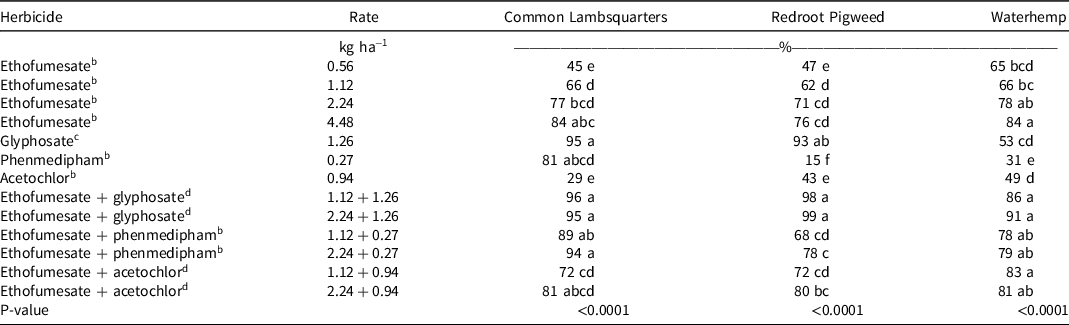
Visual control from ethofumesate applied alone across rates, glyphosate, phenmedipham, acetochlor, and mixtures of ethofumesate and glyphosate, phenmedipham or acetochlor ranged from 29% to 96% for common lambsquarters, 15% to 99% for redroot pigweed, and 31% to 91% for waterhemp, 14 DAT in field experiments (Table 6). Common lambsquarters, waterhemp, and redroot pigweed control by ethofumesate increased as the ethofumesate rate increased from 0.56 to 4.48 kg ha−1. However, increasing the ethofumesate rate greater than 1.12 kg ha−1 did not consistently improve weed control. Ethofumesate applied at 1.12 kg ha−1 controlled only 66%, 62%, and 66% of common lambsquarters, redroot pigweed, and waterhemp, respectively, indicating that ethofumesate cannot be classified as an effective POST herbicide at this rate. We generally consider 95% or greater as a threshold marker for acceptable weed control. When weeds are controlled to this threshold, yield parameters are generally unaffected due to competition (TJP, personal observation).
Common lambsquarters, redroot pigweed, and waterhemp control in response to postemergence herbicide treatments 14 d after treatment, averaged across trial locations. a

a Means within a main effect not sharing any letter are significantly different by the LSD at the 5% level of significance.
b High surfactant methylated oil concentrate at 1.8 L ha−1 was added to the treatment.
c Liquid ammonium sulfate at 2.5% v/v and a nonionic surfactant at 0.25% v/v were added to the treatment.
d Liquid ammonium sulfate at 2.5% v/v and high surfactant methylated oil concentrate at 1.8 L ha−1 were added to the treatment.
Common lambsquarters and waterhemp control was greater when ethofumesate was applied at 4.48 kg ha−1 than at 1.12 kg ha−1. Waterhemp was approximately 5 cm tall at application, but waterhemp density was not documented. We hypothesize that a significant portion of observed waterhemp control at 14 DAT was PRE control, because waterhemp germinates and emerges throughout the growing season in response to precipitation, whereas common lambsquarters and redroot pigweed emerge primarily early in the growing season (Hartzler et al. Reference Hartzler, Buhler and Stoltenberg1999; Werle et al. Reference Werle, Sandell, Buhler, Hartzler and Lindquist2014).
Glyphosate singly controlled 95% and 93% of common lambsquarters and redroot pigweed, respectively, 14 DAT, but only 53% of waterhemp, indicating that the waterhemp populations were a mixture of susceptible and resistant biotypes (Table 6). Phenmedipham singly controlled common lambsquarters to an extent that was similar to that of glyphosate, but had less redroot pigweed and waterhemp control than with glyphosate alone. Phenmedipham was registered in 1970 and marketed under the trade name Betanal for control of broadleaf weeds including common lambsquarters and wild mustard (Sinapis arvensis L.) from 1970 to 1981 in eastern North Dakota and Minnesota (Dexter Reference Dexter1994; Miller and Nalawaja Reference Miller and Nalawaja1973). Acetochlor applied singly POST provided less than 50% control of common lambsquarters, redroot pigweed, and waterhemp. Broadleaf weed control was consistent with label language, indicating that acetochlor does not control emerged weeds (Anonymous 2014).
Ethofumesate at 1.12 or 2.24 kg ha−1 mixed with glyphosate controlled 95% to 99% of common lambsquarters and redroot pigweed. When ethofumesate was mixed with glyphosate, control of either species did not significantly improve compared with glyphosate applied alone. Contrarily, when ethofumesate at either rate was mixed with glyphosate, control of waterhemp was increased compared with glyphosate alone, presumably due to both residual control from ethofumesate and controlling a glyphosate-resistant population. Phenmedipham mixed with ethofumesate at either 1.12 or 2.24 kg ha−1 did not improve common lambsquarters, redroot pigweed, or waterhemp control compared with phenmedipham or ethofumesate applied alone. When ethofumesate was mixed with acetochlor, control of common lambsquarters, redroot pigweed, and waterhemp was improved compared with acetochlor alone, but control was or tended to be the same as ethofumesate alone. Acetochlor and ethofumesate were ineffective when applied POST for burndown control of broadleaf weeds. Increasing the ethofumesate rate from 1.12 to 2.24 kg ha−1 or mixing it with glyphosate, phenmedipham, or acetochlor did not significantly improve POST broadleaf control.
Two objectives of this research were to 1) determine whether ethofumesate could be considered an effective POST herbicide for common lambsquarters, redroot pigweed, and waterhemp control; and 2) determine whether the addition of ethofumesate to other herbicides used for weed control in sugarbeet increased weed control. These data suggest that ethofumesate has only nominal POST activity, but control, especially on waterhemp, was confounded by delayed and prolonged emergence. Likewise, estimates of common lambsquarters and redroot pigweed control may have been biased due to residual activity from ethofumesate (Ekins and Cronin Reference Ekins and Cronin1972).
Greenhouse Efficacy
Greenhouse experiments were designed to determine the effects of weed height on control resulting from POST application of ethofumesate and to clarify whether control from ethofumesate occurred PRE or POST. Common lambsquarters control from herbicide treatments did not interact with timing or height at application (P = 0.5858). Common lambsquarters control with glyphosate plus ethofumesate was greater than when glyphosate or ethofumesate were used alone. Common lambsquarters control was greatest when glyphosate, ethofumesate, or glyphosate plus ethofumesate was applied PRE compared with all POST applications.
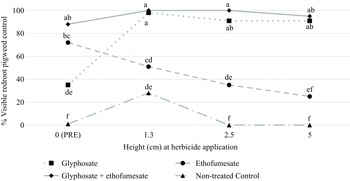
Ethofumesate plus glyphosate provided greater control of redroot pigweed PRE than ethofumesate alone (Figure 2); however, the combination did not significantly improve redroot pigweed control. Redroot pigweed control from ethofumesate was greatest either PRE or when applied POST to redroot pigweed when it was 1.3 cm in height; however, the POST application was not significantly different from that of the nontreated check at when it was 1.3 cm in height, and control decreased as redroot pigweed height increased from 2.5 to 5.0 cm. Height of redroot pigweed did not affect control from POST application of glyphosate alone or when mixed with ethofumesate.
Redroot pigweed control 14 d after treatment (DAT) in response to herbicide treatment (glyphosate at 1.10 kg ha−1 and ethofumesate at 1.12 kg ha−1) and application timing, greenhouse in 2019. Means within a main effect not sharing any letter are significantly different by the LSD at the 5% level of significance.

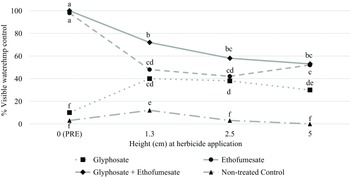
In the greenhouse, waterhemp control was different than that of common lambsquarters or redroot pigweed, because the waterhemp used in the trial was a combination of glyphosate-resistant and glyphosate-susceptible species, similar to the populations in the Red River Valley of Minnesota and North Dakota and southern Minnesota. Glyphosate mixtures with ethofumesate or ethofumesate alone applied PRE provided complete or near complete waterhemp control, respectively, 14 DAT (Figure 3). Waterhemp control from ethofumesate alone applied POST or ethofumesate with glyphosate applied POST was less than ethofumesate applied alone PRE or ethofumesate with glyphosate PRE, indicating that waterhemp control from ethofumesate occurred PRE. There was no difference in waterhemp control from ethofumesate applied POST across height at application.
Waterhemp control 14 d after treatment (DAT) in response to herbicide treatment (glyphosate at 1.10 kg ha−1 and ethofumesate at 1.12 kg ha−1) and application timing, greenhouse in 2019. Means within a main effect not sharing any letter are significantly different by the LSD at the 5% level of significance.

Waterhemp control from ethofumesate with glyphosate applied POST was greater than control from glyphosate applied POST, suggesting prolonged germination from the waterhemp seed source in greenhouse conditions. Ethofumesate may also improve overall POST waterhemp control from glyphosate compared with glyphosate alone. Ethofumesate has been known to alter surface waxes, thereby improving glyphosate uptake through the cuticle (Abulnaja et al. Reference Abulnaja, Tighe and Harwood1992; Kniss and Odero Reference Kniss and Odero2013).
In summary, glyphosate alone provided excellent common lambsquarters and redroot pigweed control in field experiments in 2018 and 2019. Likewise, waterhemp control from glyphosate with ethofumesate at 1.12 or 2.24 kg ha−1 was best when applied as an EPOST treatment. Ethofumesate applied POST at 4.48 kg ha−1 provided similar waterhemp control; however, there is a potential risk of reduction in sugarbeet stature and recoverable sucrose at the 4.48 kg ha−1 rate compared with lower rates of ethofumesate plus glyphosate.
Mixing ethofumesate with glyphosate is recommended, rather than applying ethofumesate alone POST. Mixing ethofumesate and acetochlor or two soil-applied herbicides applied POST did not provide adequate broadleaf weed control. Phenmedipham is a POST herbicide; however, mixtures with ethofumesate did not provide broad spectrum control. Overall, mixtures of glyphosate with ethofumesate at 1.12 or 2.24 kg ha−1 provided the best broadleaf control in these experiments.
Practical Implications
Controlling weeds in sugarbeet crops is challenging because of the crop’s slow early season growth, low competitive ability, and high sensitivity to pesticides (Jursik et al. Reference Jursik, Holec, Soukup and Venclova2008). Ethofumesate applied PRE does not provide season-long waterhemp control, and split applications of chloroacetamide herbicides with glyphosate applied EPOST and POST do not provide consistent control of emerged waterhemp. Furthermore, chloroacetamides are used for waterhemp control in multiple sugarbeet crops in sequence, thereby increasing selection pressure.
Excellent sugarbeet tolerance to ethofumesate applied POST was observed at rates up to and including 2.24 kg ha−1 in multiple environments. However, ethofumesate alone applied POST controlled common lambsquarters, redroot pigweed, and waterhemp by up to 84%, 76%, and 84%, respectively. As such, ethofumesate is not an effective stand-alone POST herbicide, nor does it denote a second mode of action for control for the weed species investigated here.
Ethofumesate improved POST glyphosate application efficacy, especially for waterhemp control. Ethofumesate with glyphosate applied 30 to 40 d after planting is timed with waterhemp emergence and may extend the ethofumesate residual control through canopy closure as compared with ethofumesate applied at planting. Glyphosate mixed with ethofumesate and applied EPOST is a weed management strategy for burndown and residual control of common lambsquarters, redroot pigweed, and waterhemp in sugarbeet fields as compared with ethofumesate or glyphosate applied alone. Ethofumesate applied PRE or EPOST requires rainfall to incorporate it into the soil. Additional research may be conducted to evaluate repeat glyphosate and ethofumesate treatments, which may reduce exposure to untimely rainfall.
Acknowledgments
Financial support for this research was provided by the Sugarbeet Research and Education Board, using check-off dollars from growers representing American Crystal Sugar Company, Minn-Dak Farmers Cooperative, and Southern Minnesota Beet Sugar Cooperative. Thanks to Nathan Haugrud, Jeff Stith, Charles Tvedt, Jewel Faul, Peter Hakk, Norm Cattanach, Jacob Rikhus, David Mettler, and Emma Burt for assistance in the field. Thanks to Dr. Quincy Law and Dr. Caleb Dalley for assistance with manuscript review and Dr. Jawahar Jyoti for his statistical consultation. No conflicts of interest have been declared.