Introduction
The continual changes in global temperature and precipitation, in terms of magnitude, amplitude, spatial spread and extremes, could modify the geographical distribution of ecosystems and biological populations at different scales (Sorte et al. Reference Sorte, Ibáñez, Blumenthal, Molinari, Miller and Grosholz2013). Since the last Ice Age, notable climate change has altered many species patterns, increased habitat fragmentation, and reduced genetic diversity in wild populations (Wan et al. Reference Wan, Zhang, Zhang, Yue, Huang, Cheddadi and Zheng2021). The climate has profoundly influenced species survival, dissemination and distribution (Song et al. Reference Song, Zhang, Jia, Wen, Mo and Liu2021).
Climate impacts on species patterns represent a primary conservation consideration, to which the prediction of current potential distributions and simulating historical and future distributions can contribute by identifying recovery and relocation sites for the conservation of rare and endangered plants (Zhang et al. Reference Zhang, Wang, Zhang and Ma2014, Yang et al. Reference Yang, Bai, Alatalo, Huang, Yang and Pu2021). Species distribution models (SDMs) can assess climate effects on such plants (McCune Reference McCune2016), evaluate species–environment interactions and predict habitat changes under different climate scenarios (Xie et al. Reference Xie, Huang, Jim, Han and Liu2021). Based on related theories, data formats and analytical methods, successful SDMs have been developed, such as BIOCLIM, ENFA, GARP and MaxEnt (Elith et al. Reference Elith, Graham, Anderson, Dudík, Ferrier and Guisan2006, Elith & Leathwick Reference Elith and Leathwick2009), the latter being the most widely used ecological niche model (Xie et al. Reference Xie, Huang, Jim, Han and Liu2021, Yang et al. Reference Yang, Bai, Alatalo, Huang, Yang and Pu2021).
MaxEnt uses a machine-learning technique – maximum entropy modelling – to simulate species niches and distributions (Merow et al. Reference Merow, Smith and Silander2013). It expresses a probability distribution from a set of environmental grids and georeferenced occurrence sites and predicts the suitability of conditions for the species in each grid cell (Phillips et al. Reference Phillips, Anderson and Schapire2006). Depending on the assumptions of the input data and biological sampling efforts leading to the occurrence records, the result may be interpreted as the anticipated probability of presence or expected local abundance (Phillips et al. Reference Phillips, Anderson, Dudík, Schapire and Blair2017). MaxEnt has the advantages of a simple modelling process, accurate prediction and the straightforward interpretation of results. It has been widely applied in the conservation of endangered species (Abolmaali et al. Reference Abolmaali, Tarkesh and Bashari2018, Cotrina Sánchez et al. Reference Cotrina Sánchez, Rojas Briceño, Bandopadhyay, Ghosh, Torres Guzmán and Oliva2021, Dad & Rashid Reference Dad and Rashid2022).
Cephalotaxus oliveri Mast. (Oliver’s plum yew, family Cephalotaxaceae) is a coniferous shrub endemic to southern China. Its current biogeographical range stretches from north Guangdong to east Jiangxi, Hunan, north-west Hubei, south and west Sichuan, Guizhou and south-east and north-east Yunan (Supplementary Fig. S1, available online). It is often found in the understory shrub layer of subtropical evergreen broad-leaved forests or mixed evergreen deciduous broad-leaved forests. Mainly dwelling in valleys and beside streams, it prefers warm and moist habitats (Fu et al. Reference Fu, Lu, Li and Liu2017).
C. oliveri has a wide range of uses. The alkaloids in its bark, twigs, roots and seeds (Ma et al. Reference Ma, Guo, Wang, Li, Jin and Han2020) have anti-carcinogenic properties for treating human non-lymphoid leukaemia (Zhang et al. Reference Zhang, Wang, Pan, Li, Mai, Sun and Ma1978). Its ornamental qualities suit landscape planting. The wood has been used for handicrafts, the leaves for gum-making and the seeds for extracting oil (Zhou et al. Reference Zhou, Hu, Lin and Wang1997). The species has received extensive scientific investigations in taxonomy, cytology, phytochemistry, molecular systematics, ecology, genetic diversity, propagation and population conservation (Zhou et al. Reference Zhou, Hu, Lin and Wang1997, Ai et al. Reference Ai, Chen and Liang2010). However, relatively little is known about its geographical distribution and the factors underlying this distribution.
Continual development has threatened its survival and population growth. Besides exploiting its natural products, its habitats have been disturbed or lost due to logging and farmland expansion. Its suitable actual and potential biogeographical ranges have suffered from shrinkage and fragmentation (Han et al. Reference Han, Gui, Fu, Zou and Zhao2021). In addition, some inherent biological traits have contributed to its decline. It is beset by low population genetic diversity, long seed dormancy, weak natural reproduction ability and stringent ecological requirements for growth. The wild populations of C. oliveri have declined sharply, demanding listing as a national grade II key protected wild plant in China (Pan et al. Reference Pan, Guo, Su and Wang2011, Wang et al. Reference Wang, Wang, Xia and Su2016). The International Union for Conservation of Nature (IUCN) Red List of Threatened Species has assigned it under the vulnerable (VU) category (Liao & Yang Reference Liao and Yang2022).
Our study aimed to answer two questions about the distribution of C. oliveri at the regional scale: (1) What is the predicted potential spatial distribution pattern? (2) What is the correlation between the potential suitable distribution pattern and environmental factors? Our goal is to inform conservation and management.
Materials and methods
Establishing species occurrence records
Occurrence records of C. oliveri from 1950 to 2020 were collected from key websites, including the Chinese Virtual Herbarium (http://www.cvh.ac.cn), the Plant Photo Bank of China (http://www.Plantphotophoto.cn), the Teaching Specimen Resource Sharing Platform (http://mnh.scu.edu.cn/main.aspx) and the National Specimen Information Infrastructure (http://www.nsii.org.cn/), and the published literature. The gathered data were checked to remove duplicated records. The values of spatial correlation (nugget-to-sill ratio) of <25%, 25–75% and >75% were defined as strong, medium and weak, respectively. We deleted records with strong spatial correlation. Finally, 100 valid occurrence records of C. oliveri were plotted on a map (Fig. S1).
Selecting environmental variables
Nineteen bioclimatic variables were extracted using ‘Extract value by points’ in DIVA-GIS 7.5 (data source: WorldClim, http://www.worldclim.org) (Hijmans et al. Reference Hijmans, Guarino, Cruz and Rojas2001). As the annual average temperature and annual average precipitation variables were considered too general, they were removed from the dataset (Puchałka et al. Reference Puchałka, Dyderski, Vítková, Sádlo, Klisz and Netsvetov2021). The significant associations (multicollinearity) between environmental variables could lead to model overfitting and so compromise precision (Zhang et al. Reference Zhang, Yao, Meng and Tao2018, Liu et al. Reference Liu, Huo, Tian, Dong, Xu and Qi2020). The correlations were examined using Pearson’s correlation coefficient, and highly associated environmental factors were eliminated (Pearson’s correlation value >0.80; Khanum et al. Reference Khanum, Mumtaz and Kumar2013, Xie et al. Reference Xie, Huang, Jim, Han and Liu2021), leading to nine of the 19 initial environmental variables being retained (Table 1).
Pearson correlation coefficient matrix of the nine chosen environmental variables: maximum temperature of the warmest month (Bio5), temperature annual range (Bio7), mean temperature of the wettest quarter (Bio8), mean temperature of the coldest quarter (Bio11), precipitation of the driest month (Bio14), precipitation seasonality (Bio15), precipitation of the wettest quarter (Bio16) and precipitation of the warmest quarter (Bio18).

*p < 0.05, **p < 0.01.
Modelling species distribution
The nine selected environmental variables and species occurrence records of C. oliveri were loaded into MaxEnt 3.3. The jackknife test was employed to investigate the importance of specific factors for MaxEnt predictions (Nguyen et al. Reference Nguyen, Gliottone and Pham2021). For diverse environmental variables used in prediction, the jackknife test can yield training, test and area under the curve (AUC) gains for three scenarios (without variables, with only one variable and with all variables). We used QGIS 3.12 to analyse the results generated by MaxEnt (ASCII raster grids format; QGIS 2021). Based on the optimal threshold of environmental factors (occurrence probability) generated by MaxEnt, the potential habitats of C. oliveri in China were classified into four suitability categories: excellent (>0.6), good (0.4–0.6), fair (0.2–0.4) and poor (<0.2).
This study optimized the MaxEnt model in R 4.02 using the ENMeval package (Muscarella et al., Reference Muscarella, Galante, Soley-Guardia, Boria, Kass, Uriarte and Anderson2014). We calculated the AUC of the receiver operating characteristic curve (ROC) to measure the accuracy of the generated models (Khanum et al. Reference Khanum, Mumtaz and Kumar2013). An AUC of 0.5 indicates that the model performs no better than random, whereas an AUC of 1.0 indicates perfect discrimination; the best performer is the model with the highest AUC value (Qin et al. Reference Qin, Liu, Guo, Bussmann, Ma and Jian2017, Abdelaal et al. Reference Abdelaal, Fois, Fenu and Bacchetta2019). Generally, model performance is classified as fail (0.5–0.6), poor (0.6–0.7), fair (0.7–0.8), good (0.8–0.9) and excellent (0.9–1.0) (Abolmaali et al. Reference Abolmaali, Tarkesh and Bashari2018, Ray et al. Reference Ray, Behera and Jacob2018, Zhang et al. Reference Zhang, Yao, Meng and Tao2018).
Results
Evaluating model performance
The lines of omission from the training data were close to forecasted omission rates in the model, meaning that the correct fitting of the training data and the test and training data were unique (Fig. S2a). The AUC value for the reconstructed MaxEnt model was 0.936 ± 0.074 (Fig. S2b), indicating that the current distribution of C. oliveri denoted by the selected variables was excellent.
Assessing the contributions of environmental variables
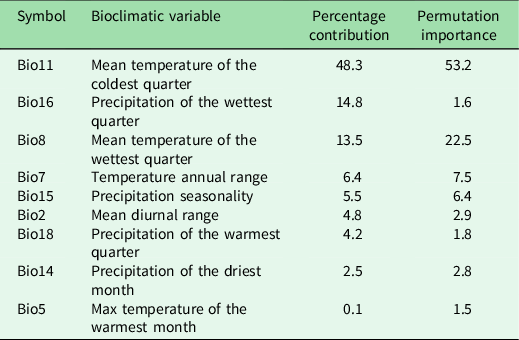
The jackknife method examined the importance of 17 environmental variables in constructing the prediction model for the distribution of C. oliveri. Of the nine chosen environmental variables (Table 1) affecting species distribution, Bio11 (mean temperature of the coldest quarter), Bio16 (precipitation of the wettest quarter), Bio8 (mean temperature of the wettest quarter) and Bio7 (temperature annual range) had the highest contributions of 48.3%, 14.8%, 13.5% and 6.4%, respectively (total contribution exceeding 80%; Table 2). The mean temperature of the coldest quarter (Bio11) had the highest contribution, indirectly indicating that variables with relatively high correlations (e.g., extreme low temperature) would also influence the distribution of C. oliveri. The four variables with the highest permutation importance values were mean temperature of the coldest quarter (Bio11), mean temperature of the wettest quarter (Bio8), temperature annual range (Bio7) and precipitation seasonality (Bio15) at 53.2%, 22.5%, 7.5% and 6.4%, respectively (Table 2). The final MaxEnt model determines the permutation importance measure, not the path taken to reach it. The above analysis shows that the main environmental factor driving the modern geographical distribution of C. oliveri is the mean temperature of the coldest quarter (Bio11).
Percentage contribution and permutation importance levels of the nine environmental variables included in the MaxEnt models, ranked by percentage contribution.

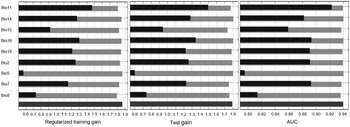
Bio11 demonstrated the highest gain in regularized training, test and AUC, indicating its leading contribution to the distribution of C. oliveri (Fig. 1). Bio16, Bio14 and Bio2 were secondary to Bio11, with a greater effect on C. oliveri under the three gain patterns. In contrast, Bio5 and Bio8 had the lowest gain and the least importance, with little effect on predicting species distribution (Fig. 1). The results showed that temperature exerted a greater effect on the distribution of C. oliveri than moisture. These environmental variables showed a good fit to the data (Fig. 1 & Table 2).
The relative predictive powers of different environmental variables based on the jackknife test of regularized training gain, test gain and area under the curve (AUC) in MaxEnt models. Light grey, black and dark grey bars represent three scenarios: without variables, with only one variable and with all variables, respectively.

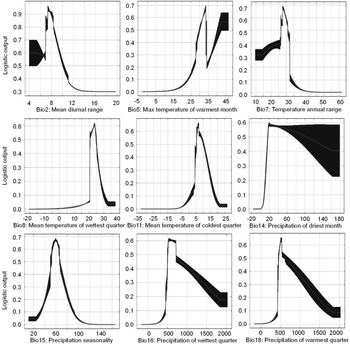
The response curves built by MaxEnt for each environmental variable showed the trend of the predicted distribution probability (Fig. 2). Bio2, Bio7, Bio8, Bio11, Bio15, Bio16 and Bio18 showed single-peaked curves, indicating that C. oliveri had significantly adapted to these environmental variables.
Mean response curves of the nine environmental variables affecting the probability of Cephalotaxus oliveri distribution (mean of 10 replicate MaxEnt runs (surrounded line in centre) ± 1 standard deviation).

The response curves of Bio11 (mean temperature of the coldest quarter) and Bio16 (precipitation in the wettest quarter) illustrated the effect of changing bioclimatic values on the distribution probability of C. oliveri (Fig. 2). Below –5°C, the distribution probability was almost zero. However, the distribution probability increased sharply when Bio11 was above –5°C (Fig. 2). The distribution probability reached the peak when Bio11 was c. 10°C, and the current temperature range was the most suitable for C. oliveri. If the mean temperature in the coldest quarter continued to rise, the distribution probability displayed a sharp drop to zero at 20°C. This result was well corroborated by Fig. 3. Therefore, the suitable range of the mean temperature of the coldest quarter for C. oliveri was c. 5–10°C (Fig. 2). Moreover, the distribution probability of C. oliveri reached a peak when the precipitation in the wettest quarter (Bio16) was 500 mm, indicating this as the most suitable rainfall amount and timing for its survival. Its suitable precipitation in the wettest quarter was 500–700 mm (Fig. 2).
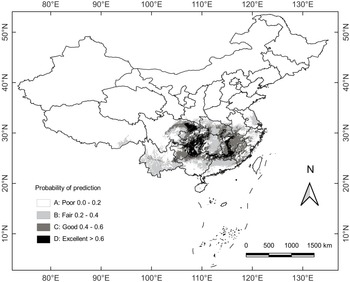
The potential distribution range of Cephalotaxus oliveri identified by MaxEnt modelling under the current climate. The prediction probability is divided into four suitability categories based on the computed habitat suitability index.

Predicting Cephalotaxus oliveri distribution in China
Under current climatic conditions, the suitable area is c. 95–120°E and 22–32°N in China’s subtropical region, extending between the Qinling Mountains, Huai River and Lingnan Mountains (Fig. 3 & Table S1). The total suitable area (probability of prediction >0.4) is 144.33 × 10⁴ km2, accounting for c. 15% of China’s territory. This distribution occupies east China (Jiangsu, Zhejiang, Anhui, Fujian and Guangdong provinces), central China (Hunan, Hubei, Jiangxi and Henan), and south-west China (Guizhou, Chongqing, Sichuan, Guangxi, Yunnan, southern Shaanxi and south-eastern Tibet) (Fig. 3). In addition, sporadic outliers are found in Taiwan, Hainan and Shanghai.
By habitat suitability, the total areas for the poor, fair, good and excellent categories are 820.41 × 10⁴ km2, 78.75 × 10⁴ km2, 45.13 × 10⁴ km2 and 20.45 × 10⁴ km2, respectively, comprising 85.04%, 8.16%, 4.68% and 2.12% of China’s total land area (Table S1). The excellent category mainly concentrates in central China and south-western China (Fig. 3). In the core suitable areas, Guizhou, Hunan and Jiangxi occupy the largest areas at 5.58 × 10⁴ km2, 4.42 × 10⁴ km2 and 4.17 × 10⁴ km2, respectively, followed by smaller areas in Chongqing, Sichuan and Hubei, each at over 1 × 10⁴ km2 (Table S1). Most of the regions mentioned above are the actual distribution areas of C. oliveri, with habitats conducive to their survival and growth. The remaining provinces’ optimal suitable areas (excellent category) are smaller and less continuous, among which Zhejiang Province has only 0.07 × 10⁴ km2. These results indicate that China’s central and south-western regions are more suitable for C. oliveri growth than other regions.
Discussion
The MaxEnt niche model showed that temperature was the crucial factor limiting the current geographical distribution of C. oliveri.
Based on the omission rate, occurrence probability and cumulative threshold generated by MaxEnt modelling (Fig. S2a), the test omission rate could better match the predicted omission rate, indicating that the training set and test set were independent. Moreover, the model fitted the training set better. In the simulation process, the AUC values of training and test were 0.962 ± 0.002 and 0.940 ± 0.021, respectively (Fig. S2b), indicating that the projected distribution matched the occurrence records. This present distribution pattern may be related to the palaeoclimate changes and impacts on distribution. During the Pleistocene glacial period, temperatures dropped abruptly. The distribution range of C. oliveri might have contracted during this time due to failing to adapt to the cold climate, thus bequeathing the legacy of the current subdued distribution (Fu et al. Reference Fu, Lu, Li and Liu2017).
Palaeobotanical data show that Cephalotaxus species were widely distributed in North America, Europe and Asia during the Cretaceous and Tertiary periods (Zhang et al. Reference Zhang, D’Rozario, Liang and Zhou2019). After the Quaternary period, the lingering influence of glaciation confined the extant Cephalotaxus species to China, Japan and other East Asian areas. C. oliveri was decimated by the last glaciation and survived only in a restricted range, becoming endemic in China (Fig. S1). After glaciation, it spread out to produce a discontinuous distribution with disjunct patches. Therefore, it could be assumed that the C. oliveri east of the Wuyi Mountains (in east China) suffered from local extinction due to the lack of suitable habitats during the glacial period. In the post-glacial time, the species encountered difficulty repopulating the vacated range east of the Wuyi Mountains due to its inherently poor dispersal (Fu et al. Reference Fu, Lu, Li and Liu2017).
C. oliveri is scarce in natural areas. The female plant does not bear fruits every year and produces only a few mature fruits in each fruiting episode (Zhou et al. Reference Zhou, Hu, Lin and Wang1997). Its seeds are dormant generally for a year, during which they are prone to decay, loss of viability and to being eaten by squirrels (Chen et al. Reference Chen, Sima and Fang2003). Therefore, the seed germination rate of C. oliveri under natural conditions is meagre, and natural regeneration is difficult for the pauperized and isolated subpopulations (Feng & Wei Reference Feng and Wei2017). Low germination contributes notably to its restricted distribution.
The model predictions showed that the core suitability areas of C. oliveri are concentrated in China’s central and south-western regions, overlapping the subtropical climatic belts (Fig. S2). The species’ geographical pattern is inextricably linked to environmental conditions, resulting from long-term species–environment interactions (Wisz et al. Reference Wisz, Pottier, Kissling, Pellissier, Lenoir and Damgaard2013). Many studies have found low temperature to be a critical factor limiting its growth and spread (Wiens et al. Reference Wiens, Ackerly, Allen, Anacker, Buckley and Cornell2010). A temperature below the ecological amplitude of a species would limit fertilization and embryo development in seed plants that could induce abortion (García et al. Reference García, Zamora, Gómez, Jordano and Hódar2000, Ruan et al. Reference Ruan, Patrick, Bouzayen, Osorio and Fernie2012). Thus, low winter temperature restricted the northward spread of C. oliveri into the northern subtropical belt.
The higher temperatures towards the south side of its range will not favour its spread. From the predicted results (Fig. 3), most areas in the southern coastal provinces of China (i.e., Fujian, Guangdong, Guangxi and Hainan) are not suitable for C. oliveri. This southward restriction could be explained by the relatively high mean winter temperature above 15°C in the southern subtropical belt. Gymnosperms have similar floral regulatory genes as angiosperms, suggesting that general bioclimatic regulation of flowering is common among perennial species (Horvath Reference Horvath2009). Low temperature has a strong effect on budburst for gymnosperms as well. For instance, eight gymnosperm species require winter chilling in subtropical China; chilling increased budburst numbers and budburst percentages for gymnosperm species, and a moderate duration of chilling days was needed to increase this budburst (Pan et al. Reference Pan, Zeng, Chen, Tang, Dai, Du and Song2021). However, areas potentially suitable for C. oliveri were also found in Yunnan and central Hainan at rather low latitudes. These sites are located at high altitudes with lower temperatures that meet the winter cold treatment requirements.
Previous studies indicated that plant distributions from coastal to inland areas in a given latitudinal belt often depend on moisture (Li et al. Reference Li, Li and Fang2018), and plant establishment and growth are directly influenced by moisture availability (Cornett et al. Reference Cornett, Reich, Puettmann and Frelich2000). Therefore, the moisture factor could impose a limiting effect on the distribution of C. oliveri. The present C. oliveri range has an average annual precipitation of >1000 mm. Our model predicts the suitable precipitation of the wettest quarter (summer, which is also the growing season) to be 500–700 mm (Fig. 2). Therefore, the distribution of C. oliveri lies in the humid zone. Comparing the growing-season precipitation and annual precipitation in the species range, the former accounts for more than 50% of the year. The humid south-east monsoon of the Pacific Ocean brings abundant precipitation in summer to the C. oliveri distribution area to satisfy its moisture requirement. This assessment indicates that C. oliveri is a subtropical species that is more sensitive to low temperatures. The widely available moisture in China’s subtropical latitudes is less limiting than temperature.
In addition to climatic factors, topography, soil, light, interspecific competition and anthropogenic disturbances can also affect species ranges synergistically and antagonistically (Eiserhardt et al. Reference Eiserhardt, Svenning, Kissling and Balslev2011). However, our existing technical and analytical capabilities may not be able to integrate the whole range of such factors into an encompassing model to simulate potential species distributions. Our study could serve as a helpful reference for the potential distribution and conservation of C. oliveri.
Some measures could be taken to enhance C. oliveri conservation, as will be discussed in the following subsections.
Ex situ conservation in tandem with in situ conservation
Given the presence of vacant niches in the potential range, conservation work could adopt a combination of defensive and offensive strategies (Helsen et al. Reference Helsen, Van Meerbeek, Honnay and Hermy2011). In situ conservation efforts can be strengthened in the current suitable range by establishing a protected area network. The delineation of protection sites could be determined according to the size and vigour of the local C. oliveri population. A primary conservation objective is maintaining and sustaining the natural habitats where the species is flourishing. Wild population enclaves with high genetic diversity and hotspot traits can be accorded special attention (Deng et al. Reference Deng, Abbott, Li, Sun and Volis2019). Habitats classified as excellent in terms of suitability can be prioritized for protection and guarded against undesirable disturbance and intrusion. Relatively natural and less disturbed subtropical forest patches that provide the essential undergrowth niche for the growth of C. oliveri should be identified as co-conservation targets.
Attempts could be made to expand the species distribution to fill the potential-range areas. The migration and dispersal of C. oliveri into favourable areas can be facilitated by creating habitat corridors or stepping stones (Baum et al. Reference Baum, Haynes, Dillemuth and Cronin2004). Where biogeographical barriers such as mountain ranges could not be crossed spontaneously due to the species’ limited dispersal capability, plantations could be created in the secluded potential range following translocation and reintroduction (Travers et al. Reference Travers, Härdtle and Matthies2021) and rewilding principles and practices (Lorimer et al. Reference Lorimer, Sandom, Jepson, Doughty, Barua and Kirby2015). More botanical gardens in the actual and potential ranges could be selected for ex situ cultivation (Mounce et al. Reference Mounce, Smith and Brockington2017). Sites with genial biotic and abiotic conditions amenable to the successful establishment and reproduction of the species could be identified and nurtured as natural nurseries and sources of propagules.
As far as is practicable, the protected areas could be planned according to the equilibrium theory of island biogeography (MacArthur & Wilson Reference MacArthur and Wilson2016). Their demarcation could follow some geometric guidelines, being relatively large and round in shape rather than linear, with a high area-to-edge ratio and a high degree of connectivity (Margules et al. Reference Margules, Higgs and Rafe1982). All other things being equal, one large patch is better than a collection of small patches. If the circumstances only permitted a number of small patches, then they would be best placed proximal to each other in order to maximize the chance of successful propagation and gene interflows amongst the local populations.
Upgrading the study of plant introductions
Plant introduction experiments could be conducted in China’s central and south-western regions containing the concentrated distributions of C. oliveri. The species also has ornamental traits that can be utilized in urban landscape planting to expand the species’ range (Affolter Reference Affolter1997). Studies and trial planting in urban habitats could select sites that match the species’ ecological requirements. Different urban stress factors could be evaluated to ascertain the optimal growth conditions. The impacts of biotic interaction and interspecific competition such as pests and diseases could be assessed to improve the survival rate. Abiotic factors such as soil texture, drainage, available water capacity and microclimatic conditions could also be assessed to identify the optimal combination of site attributes for its growth.
Reducing human interference and raising public awareness of conservation
The habitat quality of C. oliveri in its range has been degraded mainly by extensive overexploitation of the subtropical forests in the low and middle altitudes (Zhou et al. Reference Zhou, Hu, Lin and Wang1997). Human inroads have aggravated the drastic range shrinkage that occurred during the last glaciation. Anthropogenic habitat damage and loss are critical ongoing causes of population decline and threats to the species’ survival. Therefore, scientifically informed statutory protection accompanied by social and economic measures need to be developed. The plights of endangered, rare and endemic species and the needs and means of conservation could be more earnestly promoted through public education and publicity channels.
A successful conservation programme should encourage local people’s involvement, participation and engagement. Outside of designated protected areas, incentives can be offered to villagers allowing them to tap natural resources in the environs of their farmlands with constraint and without damaging undergrowth plants and their forest habitats. The less tangible but highly beneficial and sustainable regulating and provisioning services of forests (Kari & Korhonen-Kurki Reference Kari and Korhonen-Kurki2013) could be more effectively communicated to villagers, and these villagers could be drafted into co-management teams (Begum et al. Reference Begum, de Bruyn, Kristiansen and Islam2021). The more conservation-conscious villagers could be coached to become guardians or custodians of the local forests (Southammakoth & Craig Reference Southammakoth and Craig2000). Reinforcing a social forest and community forest ownership mentality could nurture the local conservation culture, allowing self-initiated and sustainable protection to take deep root (Chandra et al. Reference Chandra, Fauzi, Khatimah and Wicaksono2022).
Conclusion
The south-western and central regions of China, including mainly the provinces of Guizhou, Hunan, Jiangxi, Chongqing, Sichuan and Hubei, constitute the high-potential core suitability area for C. oliveri, accounting for 2.12% (20.45 × 10⁴ km2) of China’s total land area. There are also secondary suitability area and outlier pockets to accompany this core. In the subtropical spread of the potential species range, the middle subtropical belt is dominant, bordered contiguously by two lesser belts to its north and south (the northern and southern subtropical belts).
The most critical environmental influences on the potential distribution of C. oliveri are the mean temperature of the coldest quarter, precipitation of the wettest quarter and annual temperature range. These variables help us to pinpoint the specific conditions for the optimal growth of the species. Four suitability grades have been mapped to provide a working spatial pattern of C. oliveri. In general, temperature variables were more important than precipitation. The precipitation variables largely reflect the preference of C. oliveri for the warm and humid climate prevailing in the potential range rather than being the primary limiting factor of its distribution. These findings provide ideas that could help us to improve the management and conservation of C. oliveri.
Supplementary material
For supplementary material accompanying this paper visit https://doi.org/10.1017/S0376892922000376.
Acknowledgements
We would like to thank Dr Yao Li of the College of Biology and the Environment, Nanjing Forestry University, for help with data processing and MaxEnt model operation.
Financial support
CX and CL were supported by Special Talent Projects of Qiongtai Normal University, the Tropical Biodiversity and Bioresource Utilization Laboratory, Qiongtai Normal University (QTPT21-5) and the State Key Laboratory of Desert and Oasis Ecology, Xinjiang Institute of Ecology and Geography, Chinese Academy of Sciences.
Competing interests
The authors declare none.
Ethical standards
None.