Fārsīgraphy (FG)
We more commonly refer to any linguistic impression of modern Persian–named in the manuscripts as Fārsī, sometimes Pārsī, alongside Pahlavi and Pāzand–and its dialects, as well as written impressions of Perso-Arabic script (i.e., ḵaṭṭ-e Fārsī in MSS), under the broad title of Fārsīgraphy (hereafter FG).Footnote 1 The word equates to Fārsī-nevisī in Persian.Footnote 2
The main body of the Pahlavi corpus is primarily religious.Footnote 3 Priests as well as the laymen who wanted to understand the texts, even if not completely, have consulted this ritual literature. For instance, a text for a larger group such as Yasna and theological and jurisprudential texts, such as Bundahišn and Dēnkard, have been points of reference for a smaller group of people–i.e., religious men–and thus there is need for this group to understand and comprehend its language.Footnote 4
Pahlavi MSS, especially the ritualistic texts, are often accompanied by Avestan phrases. Hence, many readers have been compelled to annotate the text in order to make sense of its combination of languages and scripts, adding new layers to MSS. Consequently, a typical Zoroastrian MS has several layers that reveal valuable information about its annotator, the scribe, and their perception of Zoroastrian Pahlavi texts.
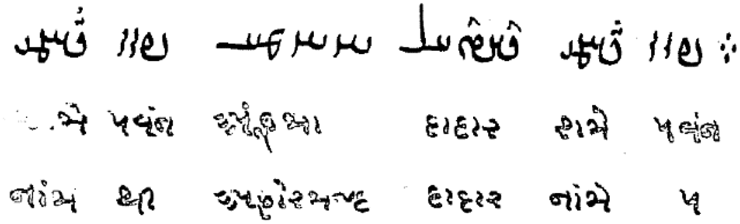
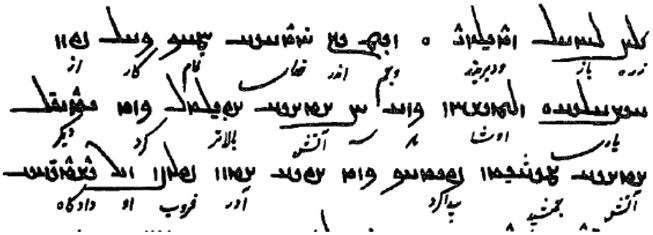
Based on historical events and their presence in Iran and India, Zoroastrians have added Persian and Gujarati (Fig. 1.1 and 1.2).Footnote 5 Interestingly, there is also the odd English annotation, the newest layer on these MSS, which may have been added by European or Parsi scholars.Footnote 6
Gujarati and FG in V. 5, R378: 1

FG in V. 27, T28: 13

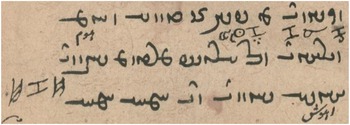
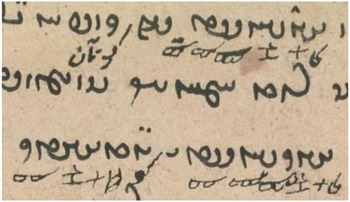
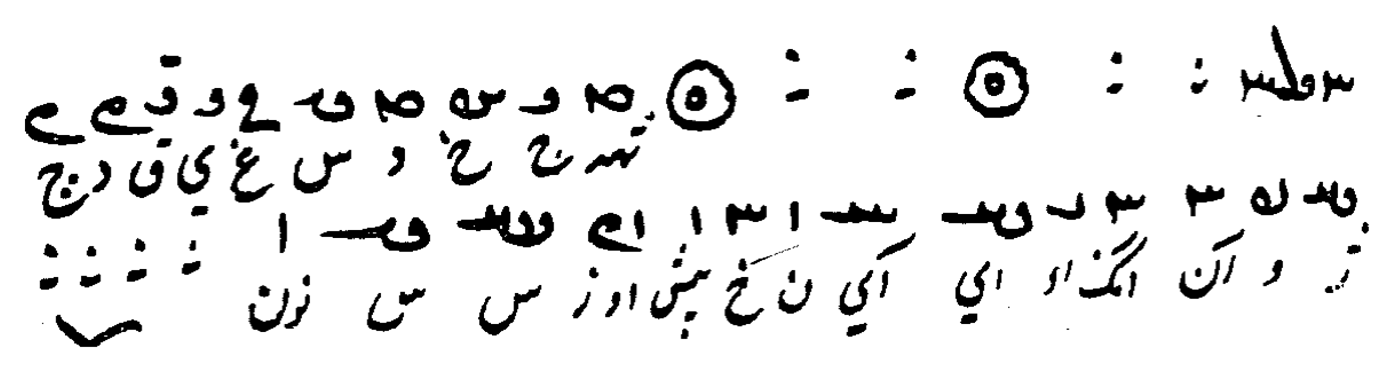
In this context, it is not so surprising to see an unknown script that appears as some type of transcription (Fig. 2.1 & Fig. 2.2):
Cod.Zend 51 b, fol. 199

Cod.Zend 51 b, fol. 198

The Persian and Gujarati layers have significant value because they represent the subscript processes, languages, and synchronic perception of the Zoroastrian texts. These documents shed light on and clarify some points of difference in the reading and perception of Zoroastrian texts between now and the time in which they were written. Thus, FG is crucial to knowing more about the times and places from which we have no documents and no more information exists.
FG Background
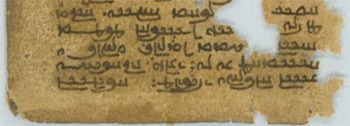
FG in Zoroastrian MSS has certain parallel traditions. Diacritical marks are not used in Inscriptional PahlaviFootnote 7 but exist as dots in Psalter Pahlavi (Fig. 3),Footnote 8 which likely adopted them from the Syriac tradition of showing distinct vowel sounds. However, the phonetic value of dots is partially different in Psalter Pahlavi from Syriac MSS.Footnote 9
F. 9r of Psalter PahlaviFootnote 10

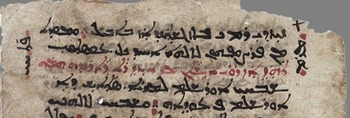
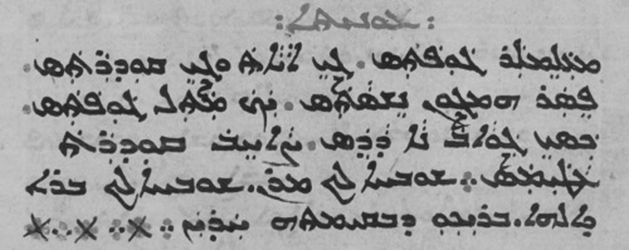
Moreover, there are also New Persian documents written in Syriac script, implying an earlier tradition upon which the Pahlavi Psalter script is based. An early New Persian translation accompanying the Syriac version of Psalter from Turfan used Syriac dots (Fig. 4).Footnote 11 Far from the Turfan, in Mardin, Iraq, another Christian text, the Palm Sunday Hymn (Fig. 5), written in Persian in the Syriac script, has a full set of diacritical marks following the tradition of Syriac orthography.Footnote 12 For example, Fig. 4, line 1 (MIC III/112) ܐܲܙ /az/ “from” vs. Fig. 5, line 2 (MS 398) ܝܲܟ݁ /yak/ “one.”
MIC III/112Footnote 13

MS 398, fol. 244 v18–22Footnote 14

Garšūnography, the tradition of writing texts–especially Arabic–in Syriac script, and the Persian Garšunī Footnote 15 MSS as such, parallel the tradition of FG in Pahlavi script. However, the latter is also influenced by New Persian written in Perso-Arabic script and is infrequently seen in Judeo-Persian.Footnote 16
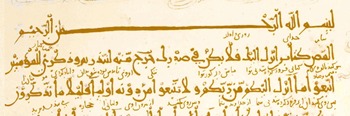
FG is also comparable with the tradition seen in early Persian translations of the Qur'an. In this tradition, a word-by-word translation and occasional annotation is added under the Arabic words (Fig. 6).Footnote 17 The same method was employed in the MSS translation of the Qur'an and other religious texts into the Tabari language.Footnote 18
Qurʾān-e Quds (Rawāqī, 1985, p. 82)

FG Process and Development
At least three types of FG can be recognized from MSS, organized based on frequency in the following categories:
-
First type: Words or phrases are written in Perso-Arabic script in Pahlavi text.
-
Second type: Diacritics of Perso-Arabic script are added to plain Pahlavi graphs.
-
Third type: Perso-Arabic letters are used for decoration and filling the blanks.
There were often long periods between the compilation of Zoroastrian texts and the production of MSS in Avestan and Pahlavi, as well as Zoroastrian texts in Perso-Arabic or Gujarati. This process developed in stages and is detectable in MSS. In general, there are three basic stages:
-
First stage: The language and script is entirely Pahlavi (Middle Persian), sometimes accompanied by the Avestan language and script.
-
Second stage: FG, corresponding to writing in Pāzand or Gujarati.
-
Third stage: The language is Middle Persian (occasionally Avestan) and the script is Perso-Arabic (corresponding to the emergence of Āẕar Kaywān).Footnote 19
In some cases, there is a guide instructing the scribe how to transliterate from Pahlavi and/or Avestan script to Perso-Arabic. An example is illustrated in Fig. 7.Footnote 20
Perso-Arabic equivalents of Pahlavi-Avestan letters, V. 4, TD23: 223

Aside from development in FG, Pahlavi letters also experienced other processes. As Prods Oktor Skjærvø stated, “d, g, y, and ǰ, which can be disambiguated by adding diacritics respectively as d̂, g̈, y̤ and g̣ and added that the caret above <d> is probably not originally a diacritic, but is the top of old form of this letter, which is in the inscriptional Pahlavi is  and in Pahlavi Psalter is
 for instance, abd “wondrous” is spelled as <ʾp̄d> or <ʾp̄d̂> and mizd “reward” is spelled as <mzd> or <mzd̂>”.Footnote 21 This view is exemplified in FG as well. In MSS with the least frequency of FG (e.g., E7 in V. 12-13), diacritics are only used on letters in words such as <ʿD̂>, <MD̂M>, and <md̂nwd̂>, as well as on the verb stems ending in <-d̂>. These examples support the proposition that the caret above <d> was an integral part of the glyph in earlier Pahlavi script, which was separated in the process of development and thus considered a diacritical mark representing <d>. Later, the use of the caret was extended to other letters. For instance, the caret above <t> apparently represents the historical spelling of <t> and its pronunciation as /d/, as in <d̂ʾt̂ʾl>, which was pronounced /dādār/ in later Middle Persian, not /dātār/.
Features
FG has various modes of occurrences in the Pahlavi corpus, the main features of which are categorized below. It is important to mention, however, that many of the features were not considered standard.Footnote 22 Thus, in many cases, it is not possible to date them exactly.
1. Transcription
Some Pahlavi words, including also the Huzwāreš, Footnote 23 have FG written under, above, and beside them.

Sometimes Persian translation and transcription is added, especially with yaʿnī (means):


2. Transliteration
Transliteration occurs either with Perso-Arabic diacritics or entirely in Perso-Arabic script, especially for Huzwāreš words:
Sometimes transliteration appears alongside translation:


3. Translation
MSS have many word-by-word translations:


4. Instructions–Gāh
In some ritualistic MSS, the Pahlavi text has FG for its Gāh (literary meaning, “time” or period”), which is used in Zoroastrianism to divide the ritual day into five sections: gāh i hāβan (dawn), gāh i rapiϑβin (midday), gāh i uzīrin (afternoon), gāh i aiβisrūϑrəm (sunset), and gāh i ušahin (midnight).
Further, the dialectal features of such instructions continued in new published books, such as Xordeh-Avesta.Footnote 24

5. Instructions for Reading the Text
In ritualistic texts–meant to be read aloud in sacramental events–there are instructions for reading recurrent verses such as aṣ̌əm vohū, frauuarāne and the bāǰs, including how many times a phrase should be read:
In V. 44, K50, both the instructions for reading and the text titles are written in Pahlavi and in front of the body; for example, <prʾc gwbyšnyh> /frāz gowišnīh/ is written with an instance of f.130, FG فراز کوشن /frāz gowišn/.

6. Basmala or pad-nām-ī
The Pahlavi MSS and their chapters occasionally start with the phrase pad nām ī (in the name of).Footnote 25 Occasionally, Pahlavi is accompanied or substituted by New Persian ba nām-e (id). It is used as transcription (of the Huzwāreš), transliteration, translation, or solely as the initial part of the text or chapter:

7. Copyist's guidance
It is not clear if there was a Zoroastrian tradition of revising MSS,Footnote 26 but Pahlavi MSS occasionally includes revision comments and, consequently, the copyist's response, as illustrated in the following examples:

8. MS's guidance
There are comments by the copyist or reader about different parts of the MS, its repetition, and shortcomings:

9. Title of the text
There are cases in which the title is added in Persian to aid in recognition of the text:

10. Intercalated FG
There are also Persian word(s) written above, below, and between Pahlavi words, not as a transcription (Feature 1, above), transliteration (Feature 2), or translation (Feature 3), but as a part of the text, and without which the sentence would be incomplete.
There are more instances of intercalated FG in V. 52, TD4a, from f. 123 to f. 137, as shown below. These occur due either to misspelled or missing words in the original text.


11. FG numbering
Pahlavi letters have numerical values used to represent the numbers. Thus, in their FG, there are two kinds of numbering: alphabetical and numerical.

12. Page numbering
To keep the folios in order, it was common to write the first word of next folio at the bottom of the current one. Additionally, there are also occasionally page numbers in Persian at the top of the page.

13. Poetry
In some MSS, Persian verses are added, in the margin, to the Pahlavi text.

14. Decorative letters
Not every Persian addition is meaningful. Indeed, Persian letters at times only serve a decorative purpose, e.g.:
• D29, p. 67, غ ; p. 131, نب and p. 90, ن used at the end of a paragraph.
• F25, which is very similar in writing to D29, p. 14, غ and p. 42, ن used at the beginning of a paragraph.
• T66, p. 187 as well as other pages, have ح between the lines.

15. Colophons
In Pahlavi MSS, the colophons are written in Pahlavi, Persian, or Gujarati.Footnote 29 In the following colophon, the completion date of the MS and the names of the copyist and benefactor are given.

16. MS's End
Pahlavi MSS usually conclude with the Pahlavi word frazaft (finished). However, there are instances where Perso-Arabic words, such as tammat or maḍā, are used as shown below.

17. Error Correction 1
Corrections are usually made by crossing out. For instance, in J3, f. 71, the FG ba nām-e is crossed out because this was not the beginning of the text, which is what this phrase implies; based on the FG in f. 73 on the following pages, “the rest of Ardā Wirāf Nāmag” still remained.

18. Error Correction 2
In MU29, f. 109, the words from previous lines repeat in the next line.Footnote 30 As a corrective measure, Arabic لا (not) is added above the line, warning that the words are incorrectly written and should be overlooked.
In V. 26, MU29, f. 112, by placing the Arabic لا over the miswritten word, the correct word, Sajastān, is written.Footnote 31


19. Error Correction 3
This measure employs diacritics to correct words. In F23, f. 45, for the original orthography <ʾcplnšt'>, nearly all the letters receive the diacritics fatḥa and sukūn to become <ʾ̄c̣̊ṗ̄l̊ṅ̄p̈š̈̇ẗ'>, with Persian translation underneath.Footnote 32

20. Historical Spellings
Diacritics in Pahlavi MSS can also represent historical spellings, when the author was aware of synchronic pronunciation. An instance is adding a caret-like symbol on the Pahlavi letter, as in improving <dʾtʾl> to < d̂ʾt̂ʾl> (and adding the Persian دادار underneath) to convey the contemporary pronunciation /dādār/.

21. Historical Information
Toponymic variation is an example of historical elucidation in Pahlavi MSS, such as Turkestān with FG equivalents: ترکستان <Turkestān> and نورستان <Nūrestān> or ترکستان <Tūrestān>.

22. Reflecting the dialect
The scribe's dialect is reflected in MSS, sometimes comparable to contemporary Zoroastrian idioms of Yazd and Kermān.
In the following instance, the phonetic shift makes the word rāspīg, the title for an assistant priest performing the Yasna, similar to the Persian rōspī (prostitute).


Conclusion
Fārsīgraphy (FG) is a tradition of annotating Zoroastrian manuscripts (mostly Pahlavi) in New Persian orthography and was used to interpret both their language and context to also comment on the text. Nearly all surviving Zoroastrian manuscripts were transmitted by copyists who lived during the New Persian period, when the Perso-Arabic script was widespread. Even manuscripts found in India, including those studied here, were profoundly influenced by the Persian language and script, notwithstanding the presence of the Gujarati tradition of annotation. However, it appears the New Persian tradition dates back earlier, overlapping with the Middle Persian and/or Pāzand tradition. Consequently, the study of FG helps us see the multiple layers of redaction in surviving Zoroastrian texts.
This study identified twenty-two features of FG in Pahlavi manuscripts. While some such features are pervasive, found in a number of manuscripts, others are limited to only a few occurrences (Table 1). None of the features follow a standard application and, in most cases, the date of the FG is obscure. Further, it is not always possible to determine how many copyists and/or annotators worked on the same manuscript, or whether the copyist transmitted some features from a previous copy. As such, this paper should be considered a preliminary step in the study of FG in Zoroastrian Pahlavi manuscripts.
Appendix: The Manuscripts
The Pahlavi codices published by the Asia Institute of Pahlavi University of Shiraz consists of fifty-three facsimile volumes of Pahlavi MSS from India.Footnote 33 In an inductive survey, FG is used in these MSS for the following purposes:
The Manuscripts

Acknowledgments
I would like to thank Faraḥ Zāhedi and Mir-Sālār Razavi for their precious comments on this paper. I am grateful to Aškān Semyāri for correcting the English text of the article. My thanks also go to Habib Borjian and the anonymous reviewers for their valuable suggestions and comments, which made a significant contribution to the draft. Last but not least, I thank Ṭannāz Aḥadi-Moqaddam, who always supports me. All errors are my own.