Although guidelines exist for establishing and sustaining effective antimicrobial stewardship programs (ASPs), Reference Pollack and Srinivasan1,Reference Barlam, Cosgrove and Abbo2 much remains unknown regarding the most effective strategies to implement them in various healthcare settings and among different patient populations. Most ASPs target inappropriate antibiotic prescribing for bacterial infections; however, inappropriate antifungal use also contributes to antimicrobial resistance and to increased morbidity and mortality from resistant fungi and unnecessary toxicity from antifungals. Reference Fridkin, Baggs and Fagan3,Reference Chou, Graber and Jones4 The incidence of invasive fungal infections (IFIs) has increased over the past 20 years. Reference Richardson5 Drug-resistant Candida spp have been categorized as a serious threat by the Centers for Disease Control and Prevention (CDC), and C. auris has recently been added as an urgent threat. 6 Furthermore, antifungal utilization is increasing in a number of healthcare settings, Reference Desai, Cavanaugh, Kelton, Guo and Heaton7,Reference Garey, Aitken and Dima-Ala8 and up to 70% of inpatient systemic antifungal use may be inappropriate. Reference Munoz, Valerio, Vena and Bouza9–Reference Sutepvarnon, Apisarnthanarak, Camins, Mondy and Fraser11 Few studies have specifically evaluated antifungal stewardship; most report cost containment or savings and decreased antifungal resistance. Reference Munoz, Valerio, Vena and Bouza9,Reference Ananda-Rajah, Slavin and Thursky12
Prior studies have described variation in ASP strategies among different healthcare networks, including the Society for Healthcare Epidemiology of America (SHEA) Research Network (SRN) Reference Livorsi, Heintz, Jacob, Krein, Morgan and Perencevich13 and the Veterans’ Health Administration. Reference Chou, Graber and Jones4 However, few studies have described specific ASP strategies that target antifungal use, which is likely to be disproportionately higher in certain patient groups. Furthermore, providers may be less familiar with appropriate indications for antifungals than for antibiotics. As a result, general ASP strategies may need to be augmented or enhanced to more effectively decrease inappropriate antifungal prescribing. In this cross-sectional survey study, we have described ASP strategies focused on antifungals and identified variability in antifungal stewardship at SRN hospitals.
Methods
In August and September 2018, a cross-sectional electronic survey was distributed to 111 SRN hospitals. The SRN is a consortium of hospitals participating in multicenter healthcare epidemiology research projects. The survey was developed by study team members using guidance from prior ASP survey studies Reference Chou, Graber and Jones4,Reference Livorsi, Heintz, Jacob, Krein, Morgan and Perencevich13,Reference Pogorzelska-Maziarz, Herzig, Larson, Furuya, Perencevich and Stone14 and with input from infectious diseases experts. The survey was reviewed by the SRN Review and Research Committee prior to deployment. The survey included 18 items on various aspects of ASP activities and specific antifungal stewardship strategies, and it was sent by e-mail to 1 representative from each SRN hospital. Because most SRN representatives are hospital epidemiologists or infection preventionists, we indicated that surveys should be forwarded to an ASP physician or pharmacist leader. Responses were anonymous but were linked via a unique identifier to demographic information about hospitals maintained by the SRN. The study was approved by the Institutional Review Board of Loyola University Chicago. Descriptive statistics summarized survey responses and hospital and ASP characteristics. The χ2 test was used to identify associations between ASP and hospital characteristics and the use of antifungal stewardship strategies. A P value ≤ .05 was considered statistically significant. SPSS version 25.0 software (IBM, Armonk, NY) was used for these analyses.
Results
The overall response rate was 41% (45 of 111 hospitals) and included 10 international sites (22%). Overall, 30 respondents (65%) were from academic medical centers, 10 respondents (22%) were from community or private hospitals, 3 respondents (7%) were from federal hospitals, 1 respondent (2%) was from a freestanding children’s hospital, and 1 respondent (2%) provided no information regarding care setting. Most respondents were from medium-sized hospitals with 101–500 beds (n = 19, 42%) or large hospitals with >500 beds (n = 22, 49%). Most hospitals care for hematopoietic stem cell (HSCT) patients (n = 33, 73%) and solid-organ transplant (SOT) patients (n = 36, 80%).
General ASP characteristics
The ASPs were mainly comprised of infectious diseases physicians (n = 43, 96%), infectious disease pharmacists (n = 36, 80%) and noninfectious disease (n = 14, 31%) pharmacists, clinical microbiologists (n = 27, 60%), and hospitalists (n = 16, 36%). Most respondents were members of large, well-established ASPs. Overall, 60% of ASPs had >5 members, 69% of ASPs had existed for ≥6 years, and 53% of ASPs had >1.0 full-time equivalent (FTE) support. Notably, 11% of ASPs had no FTE support.
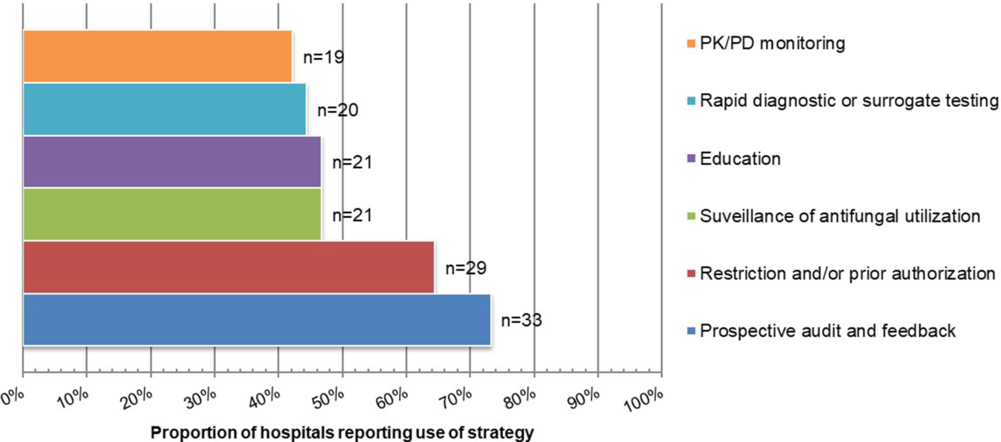
Among the 45 ASPs that responded, 43 (96%) reported using antifungal stewardship. The most commonly cited reason for incorporating antifungal stewardship into the ASP was to decrease inappropriate antifungal use (84%), followed by improving the clinical management of fungal infections (76%). The most commonly reported antifungal stewardship strategies used by ASPs were prospective audit and feedback (33 of 43, 73.3%) and prior authorization or restriction (29 of 43, 67.4%), along with a variety of other strategies (Fig. 1). Only 14 facilities (31%) using antifungal stewardship targeted strategies to specific patient populations, most commonly HSCT (11 of 14, 79%) and nontransplant hematology or oncology (11 of 14, 79%).
Percentages of survey respondents indicating use of specific antifungal ASP strategies. Percentages are expressed from a total of 45 respondents to this question and total >100% due to respondents reporting use of >1 strategy. Note. PK/PD, pharmacokinetic/pharmacodynamics.

Specific antifungal stewardship strategies
Respondents indicated that they used prospective audit and feedback most often for antifungal stewardship and that ASP pharmacists most commonly conducted it (25 of 35, 71%) between days 2 and 4 of antifungal use (22 of 35, 49%). Restriction and/or prior authorization was the second most commonly used strategy (29 of 45, 64%). Among the subset of 30 academic medical centers, 21 (70%) reported using prospective audit and feedback, and 20 (67%) used prior authorization/restriction. In comparison, of the 10 community hospitals, 8 (80%) reported using prospective audit and feedback and 6 (60%) reported using prior authorization or restriction. With regard to specific audit and feedback activities, fewer community hospitals than academic medical centers confirmed appropriate drug selection and dosing based on antifungal susceptibility testing [n = 6 (75%) vs n = 21 (100%)] or made recommendations for dose adjustments based on serum drug-level monitoring [n = 4 (50%) vs n = 14 (67%)]. Audit and feedback activities reported similarly by community hospitals and academic medical centers included guidance for intravenous therapy to postoperative step-down [n = 6 (75%) vs n = 17 (81%)], recommendations regarding potential drug–drug interactions and contraindications [n = 6 (75%) vs n = 17 (81%)], and recommendations regarding the most cost-effective agent [n = 4 (50%) vs n = 11 (52%)].
Roughly half of hospitals reported using education (47%) or creating guidelines for IFI management (51%) as an antifungal stewardship strategy. Of those facilities that create their own guidelines, most reported that the guidelines focus on candidemia (18 of 23, 78%) and/or invasive aspergillosis (13 of 23, 57%) and that these guidelines were most commonly distributed via a website (15 of 23, 65%).
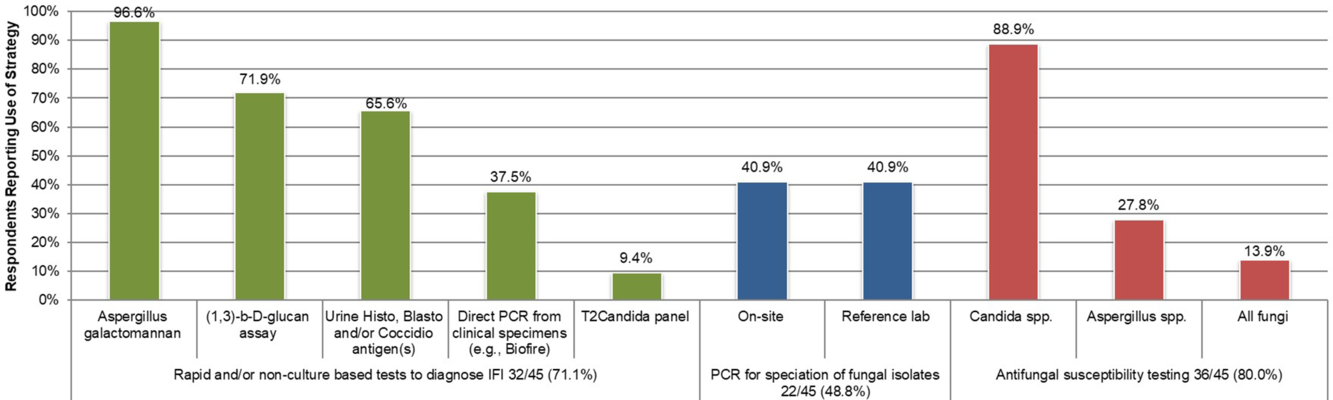
Interesting trends were observed in the laboratory diagnosis of IFIs, as demonstrated in Figure 2. Most hospitals (71.1%) reported offering at least 1 rapid laboratory test to aid in IFI diagnosis, and Aspergillus galactomannan testing was the most common (31 of 32, 97%). Polymerase chain reaction (PCR), either directly from clinical specimens (eg, FilmArray, Biofire Diagnostics, Salt Lake City, UT) or as a means of speciating fungal cultures, was reported less frequently (Fig. 2). Most hospitals (80%) reported offering antifungal susceptibility testing, most commonly for Candida spp (32 of 36, 89%), with fewer hospitals offering susceptibility testing for Aspergillus spp (10 of 36, 28%) or other fungi (6 of 36, 17%).
Percentages of survey respondents indicating use of various laboratory-based antifungal ASP strategies. Percentages for each of the 3 subcategories of laboratory-based strategies are expressed from the overall total of 45 survey respondents, whereas percentages for each strategy within the subcategories are expressed from the total number of respondents reporting use of that subcategory: n = 32 for rapid and/or non–culture-based tests to diagnose IFI, n = 22 for PCR for speciation of fungal isolates, and n = 36 for antifungal susceptibility testing. Percentages may total >100% due to respondents reporting use of >1 strategy.

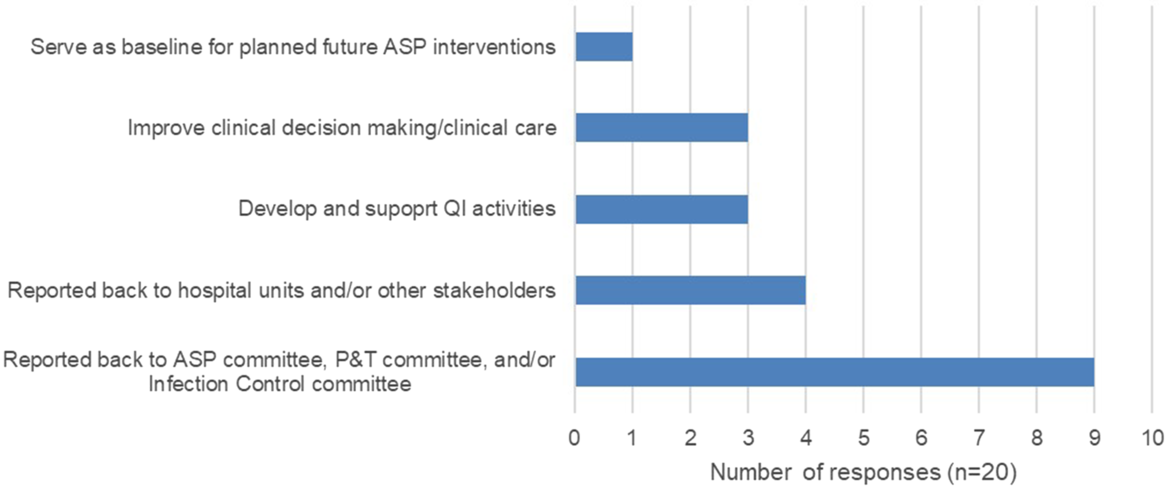
Periodic surveillance of antifungal utilization via aggregated reports occur in 29 hospitals (64%), while access to data regarding IFI incidence and/or prevalence was reported by 26 hospitals (58%). Only 9 of these hospitals (31%) reported antifungal utilization data, and only 2 (7%) reported antifungal resistance data to the CDC National Healthcare Safety Network (NHSN). Surveillance data are used to support various ASP activities (Fig. 3).
Uses described for antifungal utilization data among 20 survey respondents who reported performing surveillance. Note. ASP, antimicrobial stewardship program; QI, quality improvement; P&T, pharmacy and therapeutics.

Association of ASP characteristics and antifungal stewardship
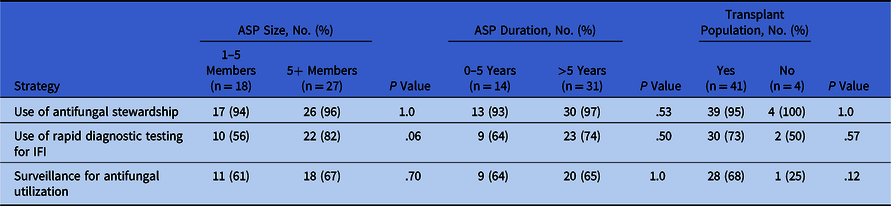
We hypothesized that larger and more well-established ASPs would be more likely to use antifungal stewardship strategies due to greater resources and support. Similarly, we hypothesized that hospitals caring for HSCT and SOT patients would be more likely to use antifungal stewardship strategies due to higher-risk patient populations. As shown in Table 1, we did not detect any significant associations among ASP size, ASP duration, presence of transplant populations, and higher likelihood of using antifungal stewardship strategies (P > .05 for all). However, we did detect a trend toward greater use of rapid diagnostic testing for IFI in hospitals with larger ASPs (P = .07).
Antimicrobial Stewardship Program (ASP) Strategies Among Survey Respondents

Note.; IFI, invasive fungal infection.
Discussion
In this cross-sectional survey of SRN hospitals, almost all facilities reported using at least 1 ASP strategy that targets antifungals. Most of our survey respondents were members of large, well-established ASPs at academic hospitals caring for patients at high risk for IFI (eg, HSCT and SOT patients). However, an important subset of respondents were from private or community hospitals with small ASPs and no transplant populations. All respondents in this latter group reported using antifungal stewardship strategies, suggesting wide acceptance of the importance of antifungal stewardship across a spectrum of hospital types and patient populations.
Overwhelmingly, prospective audit and feedback followed by restriction or prior authorization were the most commonly used strategies. This finding is reassuring given that both strategies are core components of hospital ASPs recommended in the CDC and Infectious Diseases Society of America (IDSA)/SHEA guidelines and that multiple studies have shown that they reduce inappropriate antimicrobial use. Reference Wagner, Filice and Drekonja15 In our study, we found a comparatively lower use of other guideline-recommended stewardship strategies such as education, laboratory and diagnostic stewardship, and surveillance. Such strategies reflect areas of opportunity for ASPs to expand antifungal stewardship and to further decrease inappropriate antifungal use.
Although the impact of educational materials and clinical guidelines in the absence of concomitant audit and feedback or restriction or prior authorization is low, they can effectively enhance larger multifaceted and bundled stewardship interventions. Reference Davey, Brown and Charani16 Furthermore, they are among the least difficult and least resource-intensive ASP strategies to implement. For the roughly half of the ASPs in our survey that reported not using these strategies, creating and disseminating educational materials and clinical guidelines could be an excellent opportunity to quickly and easily enhance antifungal stewardship in their ASP.
In contrast, laboratory and diagnostic stewardship interventions are time and resource intensive but can also be highly effective in reducing inappropriate antimicrobial use, especially when combined with audit and feedback and education. Reference MacVane and Nolte17,Reference Timbrook, Morton, McConeghy, Caffrey and Mylonakis18 Notably, our survey revealed that few hospitals use molecular testing (eg, PCR or T2 magnetic resonance) to identify fungi directly from clinical specimens or to speciate fungal cultures. Prior studies have shown that rapid molecular diagnostic testing from clinical specimens can reduce time to appropriate antimicrobial therapy, can improve antimicrobial de-escalation, and can decrease mortality. Reference Timbrook, Morton, McConeghy, Caffrey and Mylonakis18 Given the array of rapid molecular diagnostic tests available that include Candida and other fungi, ASPs should support and prioritize the use of such strategies.
Finally, most respondents indicated that their ASP performs surveillance for antifungal use, although few hospitals report data to the NHSN. Like laboratory stewardship, enhanced surveillance can be a costly and resource-intensive strategy for smaller or less well-supported ASPs because it often requires additional FTE or dedicated software programs. For the ~40% of respondents whose ASPs do not perform surveillance for antifungal use, implementing a targeted surveillance strategy to specific high-risk patient populations may increase antifungal stewardship in a less resource-intensive manner.
The low response rate was an important limitation of our study, although it was consistent with prior SRN survey studies. Reference Mehrotra, Gupta and Strymish19,Reference Sullivan, Morgan and Leehka20 Despite the low rate, the respondents came from a variety of hospital types and geographic locations and were predominantly from medium-to-large academic hospitals with well-established ASPs and transplant patients. Although these characteristics may have contributed to the high use of antifungal stewardship and increased the wealth of information we obtained from our survey, the generalizability of our findings to smaller community or private hospitals with less well-established ASPs may be limited.
In conclusion, we found that most hospital ASPs within the SRN have implemented antifungal stewardship strategies, including ASPs in smaller, nonacademic hospitals. Important areas for continued expansion of antifungal stewardship include education and institutional guideline development, implementation of rapid laboratory diagnostics, and surveillance of antifungal use with reporting to the NHSN.
Acknowledgments
The views expressed in this article are those of the authors and do not necessarily reflect the position or policy of the Department of Veterans Affairs or the US government.
Financial support
This work was supported by the Department of Veterans’ Affairs, Veterans’ Health Administration, Office of Research and Development, Health Services Research and Development Quality Enhancement Research Initiative (QUE 15-269).
Conflicts of interest
All authors report no conflicts of interest or financial disclosures relevant to this article.