Recent research indicates that psychiatric symptoms and disorders in preschool-aged children constitute a significant public health problem (for reviews, see Dougherty, Leppert, et al., Reference Dougherty, Leppert, Merwin, Smith, Bufferd and Kushner2015; Egger & Angold, Reference Egger and Angold2006). Preschool psychopathology occurs at similar rates to those observed in older children, is associated with significant impairment, and demonstrates stability over time (Bufferd, Dougherty, Carlson, & Klein, Reference Bufferd, Dougherty, Carlson and Klein2011; Bufferd, Dougherty, Carlson, Rose, & Klein, Reference Bufferd, Dougherty, Carlson, Rose and Klein2012; Lavigne et al., Reference Lavigne, Arend, Rosenbaum, Binns, Christoffel and Gibbons1998, Reference Lavigne, Cicchetti, Gibbons, Binns, Larsen and DeVito2001; Luby, Gaffrey, Tillman, April, & Belden, Reference Luby, Gaffrey, Tillman, April and Belden2014; Mesman, Bongers, & Koot, Reference Mesman, Bongers and Koot2001; Wichstrøm et al., Reference Wichstrøm, Berg-Nielsen, Angold, Egger, Solheim and Sveen2012). Preschool mental health problems have also been found to predict psychopathology and impairment across early childhood (Bufferd et al., Reference Bufferd, Dougherty, Carlson, Rose and Klein2012; Dougherty et al., Reference Dougherty, Smith, Bufferd, Stringaris, Leibenluft, Carlson and Klein2013; Lavigne et al., Reference Lavigne, Arend, Rosenbaum, Binns, Christoffel and Gibbons1998; Luby, Si, Belden, Tandon, & Spitznagel, Reference Luby, Si, Belden, Tandon and Spitznagel2009), middle childhood (Dougherty, Smith, et al., Reference Dougherty, Smith, Bufferd, Kessel, Carlson and Klein2015; Lahey et al., Reference Lahey, Pelham, Loney, Kipp, Ehrhardt, Lee and Massetti2004), and into adolescence (Chronis-Tuscano et al., Reference Chronis-Tuscano, Molina, Pelham, Applegate, Dahlke, Overmyer and Lahey2010; Luby et al., Reference Luby, Gaffrey, Tillman, April and Belden2014). However, there is a paucity of prospective, longitudinal studies investigating the developmental pathways and mechanisms underlying psychopathology across early childhood to school entry.
The significance of life stress in the development of psychopathology across the life span has been well documented (Latimer et al., Reference Latimer, Wilson, Kemp, Thompson, Sim, Gillberg and Minnis2012; Monroe & Reid, Reference Monroe and Reid2009). Specifically, stress associated with the early caregiving environment has been found to be a potent predictor of psychiatric disorders across childhood (Humphreys & Zeanah, Reference Humphreys and Zeanah2015) and into adulthood (Carr, Martins, Stingel, Lemgruber, & Juruena, Reference Carr, Martins, Stingel, Lemgruber and Juruena2013). The hypothalamus–pituitary–adrenal (HPA) axis, one of the body's primary stress response systems, has been hypothesized to play a role in the etiology of numerous forms of psychopathology (Gunnar & Vazquez, Reference Gunnar, Vazquez, Cicchetti and Cohen2006). The HPA axis is activated in the face of perceived threat or stress, resulting in the synthesis and release of the glucocorticoid cortisol, the primary stress hormone in humans. A dysregulated cortisol response to a psychosocial stressor has been linked concurrently to psychopathology in preschoolers, children, adolescents, and adults (Gunnar & Vazquez, Reference Gunnar, Vazquez, Cicchetti and Cohen2006; Murri et al., Reference Murri, Pariante, Mondelli, Masotti, Atti, Mellacqua and Amore2014, Pariante, Reference Pariante2003). Nevertheless, evidence has been mixed as both cortisol hyperreactivity and cortisol hyporeactivity have been linked to youths’ internalizing (hyperreactivity: Hankin, Badanes, Abela, & Watamura, Reference Hankin, Badanes, Abela and Watamura2010; Kryski, Smith, Sheikh, Signh, & Hayden, Reference Kryski, Smith, Sheikh, Singh and Hayden2013; Luby et al., Reference Luby, Heffelfinger, Mrakotsky, Brown, Hessler and Spitznagel2003; Rao, Hammen, Ortiz, Chen, & Poland, Reference Rao, Hammen, Ortiz, Chen and Poland2008; hyporeactivity: Hankin et al., Reference Hankin, Badanes, Abela and Watamura2010; Harkness, Stewart, & Wynne-Edwards, Reference Harkness, Stewart and Wynne-Edwards2011; Hastings et al., Reference Hastings, Ruttle, Serbin, Mills, Stack and Schwartzman2011) and externalizing (hyperreactivity: Obradović, Bush, Stamperdahl, Adler, & Boyce, Reference Obradović, Bush, Stamperdahl, Adler and Boyce2010; hyporeactivity: van Leeuwen et al., Reference van Leeuwen, Creemers, Greaves-Lord, Verhulst, Ormel and Huizink2011) problems; however, it is unclear what role methodological differences across studies contribute to these divergent findings. Nevertheless, little research has examined whether cortisol reactivity prospectively predicts psychopathology across the life span, and there is a particular dearth of studies in children. In a study of adults with depression, increased cortisol reactivity to a relatively minimal psychosocial stressor predicted increases in depressive symptoms 6 months later (Morris, Rao, & Garber, Reference Morris, Rao and Garber2012). In adolescent populations, increased cortisol reactivity predicted increased emotional and/or behavioral problems across 6-month (Granger, Weisz, McCracken, Ikeda, & Douglas, Reference Granger, Weisz, McCracken, Ikeda and Douglas1996) and 1-year (Susman, Dorn, Inoff-Germain, Nottelmann, & Chrousos, Reference Susman, Dorn, Inoff-Germain, Nottelmann and Chrousos1997) follow-ups.
A growing body of research has focused on vulnerability-stress models, in which dysregulated stress reactivity serves as a vulnerability marker rendering individuals more susceptible to negative outcomes when exposed to adverse environments (Belsky, Reference Belsky, Ellis and Bjorklund2005; Boyce & Ellis, Reference Boyce and Ellis2005; Monroe & Simons, Reference Monroe and Simons1991). It has been proposed that children demonstrating abnormalities in stress reactivity are at increased risk for maladaptive outcomes when they are exposed to adverse environments, including harsh parenting and high levels of family stress. For example, in a sample of adolescents, the combination of increased cortisol reactivity and greater cumulative childhood family aggression was associated with greater concurrent posttraumatic stress symptoms and antisocial behavior (Saxbe, Margolin, Spies Shapiro, & Baucom, Reference Saxbe, Margolin, Spies Shapiro and Baucom2012). Early childhood is a particularly critical developmental period in which to study these effects as children rely heavily on their primary caregiver for most basic needs, and thus the parent–child relationship is a highly influential aspect of young children's environment. A few cross-sectional studies in preschoolers have demonstrated that the combination of increased cortisol reactivity and higher levels of family stress was associated with greater emotional symptoms (von Klitzing et al., Reference von Klitzing, Perren, Klein, Stadelmann, White, Groeben and Hatzinger2012), poorer prosocial behavior (Obradović et al., Reference Obradović, Bush, Stamperdahl, Adler and Boyce2010), and greater concurrent externalizing symptomatology for boys but not girls (Hastings et al., Reference Hastings, Ruttle, Serbin, Mills, Stack and Schwartzman2011). In contrast, a recent study reported that the combination of preschoolers’ lower cortisol reactivity and greater life stress in the past year was associated with greater externalizing symptoms and poorer psychosocial functioning (Kushner, Barrios, Smith, & Dougherty, Reference Kushner, Barrios, Smith and Dougherty2016). Thus, similar to the cortisol reactivity–psychopathology associations, these cross-sectional findings show that both higher and lower cortisol reactivity in preschoolers may incur greater vulnerability to the early environment.
Very little research has examined these models using longitudinal designs. In a sample of children ages 9 to 15 years old, Badanes, Watamura, and Hankin (Reference Badanes, Watamura and Hankin2011) reported that children who demonstrated lower cortisol reactivity and high levels of life stress had increased depressive symptoms 1 year later after controlling for prior symptoms. In contrast, although cross-sectional findings were observed in two samples of 5-year-old children (Obradović et al., Reference Obradović, Bush, Stamperdahl, Adler and Boyce2010; von Klitzing et al., Reference von Klitzing, Perren, Klein, Stadelmann, White, Groeben and Hatzinger2012), the interactive effect in these studies did not predict symptoms or functioning across the kindergarten school year. However, the cortisol reactivity assessments used in the early childhood studies collected cortisol samples at only two time points (i.e., pre- and poststressor; Obradović et al., Reference Obradović, Bush, Stamperdahl, Adler and Boyce2010; von Klitzing et al., Reference von Klitzing, Perren, Klein, Stadelmann, White, Groeben and Hatzinger2012), which may limit the extent to which the assessments captured individual differences in children's cortisol responses to stress. In addition, the few longitudinal studies have only assessed children's symptoms over relatively short follow-up periods (e.g., 1 year or less), which may reduce the ability to observe changes in symptoms over time. Furthermore, previous longitudinal studies have not examined outcome measures of children's internalizing and externalizing symptoms in a single study, even though these prospective associations may vary across these different dimensions. Internalizing and externalizing psychopathology, though moderately correlated, can be differentiated even in early childhood (Olino, Dougherty, Bufferd, Carlson, & Klein, Reference Olino, Dougherty, Bufferd, Carlson and Klein2014; Sterba, Egger, & Angold, Reference Sterba, Egger and Angold2007); nevertheless, models of preschool psychopathology have also supported a single common factor shared by both internalizing and externalizing symptoms (Olino et al., Reference Olino, Dougherty, Bufferd, Carlson and Klein2014). Thus, it is unknown whether cortisol reactivity represents a vulnerability marker that is specific to one dimension or represents a general shared risk marker for both internalizing and externalizing problems across early childhood.
Using a multimethod assessment, the current study aimed to build upon this research to test the hypothesis that child cortisol reactivity at age 3 moderates associations between early negative parenting and children's internalizing and externalizing symptoms from age 3 to age 6. Drawn from a larger longitudinal study (N = 559), 160 3-year-old children were randomly recruited to participate in the early childhood cortisol reactivity assessment (Dougherty, Klein, Rose, & Laptook, Reference Dougherty, Klein, Rose and Laptook2011). Of the 160 children, 135 (84.4%) were followed-up 3 years later at age 6. At the age 3 assessment, children were exposed to stress-inducing laboratory tasks, during which we obtained four salivary cortisol samples, and parental hostility was assessed using an observational parent–child interaction task. We chose to focus on parental hostility because this parenting dimension shows consistent and strong associations with children's internalizing (McLeod, Weisz, & Wood, Reference McLeod, Weisz and Wood2007) and externalizing (McKee, Colletti, Rakow, Jones, & Forehand, Reference McKee, Colletti, Rakow, Jones and Forehand2008) psychopathology and predicts mental and physical health problems into adulthood (Repetti, Taylor, & Seeman, Reference Repetti, Taylor and Seeman2002). In addition, given that research suggests that other family stressors (e.g., socioeconomic status) impact the child via parenting (Bradley & Corwyn, Reference Bradley and Corwyn2002), our observational measure of parenting may capture broader environmental family stressors. At the age 3 and 6 assessments, child internalizing and externalizing symptoms were assessed using a structured clinical interview with parents. We hypothesized that children at age 3 who had high levels of cortisol reactivity and were exposed to high levels of parental hostility would demonstrate the highest levels of internalizing and externalizing symptoms concurrently at age 3, and the greatest increases in internalizing and externalizing symptoms from age 3 to 6 years.
Method
Participants
The sample included 160 children and their primary caregivers recruited from the community as part of a larger longitudinal study (N = 559) on early temperament and risk for psychopathology (Dougherty, Bufferd, et al., Reference Dougherty, Bufferd, Carlson, Dyson, Olino, Durbin and Klein2011; Olino, Klein, Dyson, Rose, & Durbin, Reference Olino, Klein, Dyson, Rose and Durbin2010). Children and families were assessed at ages 3 and 6 years. At the age 3 assessment, a random sample of 160 children (80 females) participated in a laboratory-based cortisol reactivity assessment. The mean age of our subsample was 3.58 years (SD = 0.24) at the age 3 assessment and 6.33 years (SD = 0.34) at the age 6 assessment. Participants identified themselves as White (95.6%), African American/Black (1.9%), Asian (1.9%), and other race (0.6%). The majority of participants came from two-parent households (98.1%) and was middle class, as measured by the Four-Factor Index of Social Status (M = 46.1, SD = 10.3; Hollingshead, Reference Hollingshead1975). Children were of average cognitive ability, as indexed by the Peabody Picture Vocabulary Test (M = 105.0, SD = 14.1; Dunn & Dunn, Reference Dunn and Dunn1997). Of the 160 participants, 135 (84.4%) parents completed the parent-reported clinical interview at the age 6 assessment. Only one significant difference emerged comparing the subsample presented in this report to the larger sample: children in the subsample had fewer internalizing symptoms at age 3 (M = 8.18, SD = 6.30) compared to the larger sample (M = 10.25, SD = 8.38), t (367.66) = 3.12, p = .002.
Procedure
At age 3, all children attended an initial laboratory session approximately 2.5 hr in duration, during which they participated with a female experimenter in 12 standardized tasks selected from the Laboratory Temperament Assessment Battery (Lab-TAB; Goldsmith, Reilly, Lemery, Longley, & Prescott, Reference Goldsmith, Reilly, Lemery, Longley and Prescott1995), and cortisol samples were obtained. The tasks were designed to elicit a range of emotions and behaviors from the child and are described in detail elsewhere (see Dougherty, Bufferd, et al., Reference Bufferd, Dougherty, Carlson and Klein2011; Olino et al., Reference Olino, Klein, Dyson, Rose and Durbin2010). Approximately 2 weeks later, parents and children returned for a second laboratory session and completed an observational parent–child interaction task to assess parental observed hostility. In between laboratory sessions, parents completed a diagnostic clinical interview on the telephone to assess children's current internalizing and externalizing symptoms at age 3. At the age 6 assessment, parents completed the clinical interview in person.
Child cortisol sampling procedure
Salivary cortisol was collected four times during the laboratory assessment. Saliva for cortisol assay was obtained by having the children dip 2-in. long cotton dental rolls into small cups containing approximately .025 g of cherry Kool-Aid®. Children were then instructed to chew the cotton rolls until they were saturated with saliva. Previous work shows that the use of Kool-Aid® does not compromise the quality of the assays when used sparingly, because it does not significantly alter the pH of the saliva (Talge, Donzella, Kryzer, Gierens, & Gunnar, Reference Talge, Donzella, Kryzer, Gierens and Gunnar2005). The collection of each sample took approximately 1–2 min. After each sample was collected, the saliva was expunged from the cotton roll into a microtube and stored at −20 °C until assayed.
The total duration of the 12 Lab-TAB tasks was approximately 2 hr. The length of time for each Lab-TAB task was standardized across all participants, and each episode was followed by a brief play break (2 min) to allow the child to return to a baseline affective state. The timing of the salivary cortisol samples was determined based on findings that salivary cortisol levels reflect the level of stress experienced in the prior 20–40 min (Dickerson & Kemeny, Reference Dickerson and Kemeny2004) and on previous studies using similar stress-inducing paradigms, which have been shown to be sensitive to individual differences in cortisol reactivity in preschool-aged children (Luby et al., Reference Luby, Heffelfinger, Mrakotsky, Brown, Hessler and Spitznagel2003; Talge, Donzella, & Gunnar, Reference Talge, Donzella and Gunnar2008). Based on these considerations, the first sample was taken after the informed consent process, approximately 20 min after arrival (baseline, Time 1). The second sample was collected 30 min following the Stranger Approach task of the Lab-TAB, the most stressful episode in the battery, during which the child was separated from his/her parent and a stranger entered the room (baseline + 60 min, Time 2). The third salivary cortisol sample was taken 30 min after Transparent Box, a frustration-inducing task in which the child was unable to unlock a box with a desirable toy inside (baseline + 90 min, Time 3). The fourth and final sample was collected 20 min after completion of all Lab-TAB tasks (baseline + 130 min, Time 4). To control for non-stress-related elevations of cortisol, laboratory assessments were conducted at either 10 a.m. (69% of the assessments) or 2 p.m. Families were instructed prior to coming to the laboratory that the child should not eat for 1 hr before the scheduled lab visit, and that children should avoid caffeine for at least 2 hr and dairy products for at least 15 min prior to arrival. No child was taking corticosteroids at the time of the assessment.
Samples were assayed using a time-resolved fluorescence immunoassay with fluorometric end point detection (DELFIA). All samples were assayed in duplicate. Samples yielding values above 44 nmol/L were excluded, which applied to four laboratory samples from four different individuals. The inter- and intra-assay coefficients of variation were between 7.1% and 9.0% and 4.0% and 6.7%, respectively.
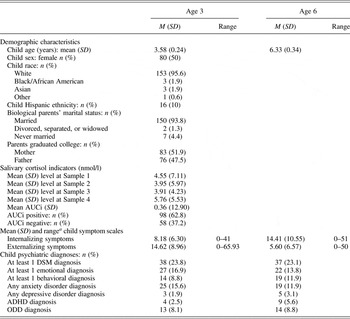
Means and standard deviations of children's cortisol values for each of the four samplings are included in Table 1. Children's cortisol responses to the laboratory stressors in this sample have been described extensively in previous papers (see Dougherty, Klein, Congdon, Canli, & Hayden, Reference Dougherty, Klein, Congdon, Canli and Hayden2010; Dougherty, Klein, et al., Reference Dougherty, Klein, Rose and Laptook2011; Kryski, Dougherty, et al., Reference Kryski, Dougherty, Dyson, Olino, Laptook, Klein and Hayden2013). As previously detailed, using multilevel modeling in HLM 6 (Scientific Software International Inc.), we observed a mean decrease (unstandardized coefficient = −0.085, SE = 0.016, t = −5.184, p < .001) in children's cortisol from arrival to the laboratory to children's cortisol levels following the separation stressor (Sample 2). Following the separation stressor, children's mean cortisol levels began to rise for Sample 3 (30 min after a frustrating task) and Sample 4 (20 min after the last Lab-TAB task), as indicated by a significant positive (i.e., concave up) quadratic effect (unstandardized coefficient = 0.030, SE = 0.004, t = 8.174, p < .001). The random error terms associated with the intercept, slope, and curvature were significant (ps < .001), demonstrating variability among children's cortisol responses. While counterintuitive, it is important to note that this pattern is frequently observed in laboratory studies of cortisol reactivity in young children (Gotlib, Joorman, Minor, & Cooney, Reference Gotlib, Joormann, Minor, Cooney, Canli and Canli2006; Luby et al., Reference Luby, Heffelfinger, Mrakotsky, Brown, Hessler and Spitznagel2003; for a review see Gunnar, Talge, & Herrera, Reference Gunnar, Talge and Herrera2009), and may reflect stress-related increases related to anticipating the laboratory visit (Gunnar & Talge, Reference Gunnar, Talge, Schmidt and Segalowitz2007), such that the baseline sample is elevated and then declines. Conversely, it has been posited that this pattern of mean cortisol responses may reflect developmental differences in how children's HPA axis responds to stress, and that hyporesponsivity may be the normative response to stress in early to middle childhood (Gunnar, Wewerka, Fenn, Long, & Griggs, Reference Gunnar, Wewerka, Frenn, Long and Griggs2009).
Characteristics of the study sample

Note: AUCi, area under the curve with respect to increase; ADHD, attention-deficit/hyperactivity disorder; ODD, oppositional defiant disorder.
a The total possible scores for the PAPA internalizing symptoms scale range from 0 to 254, and the total possible scores for the PAPA externalizing symptoms scale range from 0 to 50.
To quantify a composite measure of cortisol reactivity, we calculated the area under the curve (AUC) with respect to increase (AUCi), derived from the trapezoid formula from the four individual cortisol samples (Pruessner, Kirschbaum, Meinlschmid, & Hellhammer, Reference Pruessner, Kirschbaum, Meinlschmid and Hellhammer2003). The AUCi provides a measure of the total change in cortisol levels across the four time points, and has been used widely in the literature as an index of HPA axis response (e.g., Booji, Bouma, de Jonge, Ormel, & Oldehinkel, Reference Booij, Bouma, de Jonge, Ormel and Oldehinkel2013; Brennan et al., Reference Brennan, Pargas, Walker, Green, Newport and Stowe2008; Dougherty, Klein, et al., Reference Dougherty, Klein, Rose and Laptook2011; Dougherty, Tolep, Smith, & Rose, Reference Dougherty, Tolep, Smith and Rose2013; Kushner et al., Reference Kushner, Barrios, Smith and Dougherty2016). Children's mean AUCi was 0.36 (SD = 12.90), and scores ranged from –88.04 to 78.66, demonstrating significant variability in children's AUCi scores. Of the children, 62.8% (n = 98) demonstrated a positive AUCi (increase) and 37.2% (n = 58) demonstrated a negative AUCi (decrease). AUCi was positively skewed and was log 10 transformed. The standardized z score of the log 10 transformed AUCi variable was used in all analyses.
Observed parental hostility
At age 3, 149 of the 160 children participated in a laboratory-based parent–child interaction task with one parent (96% mothers). The observational assessment was based on a modified version of the Teaching Tasks Battery and included six standardized tasks (book reading, block building, naming objects with wheels, matching shapes, completing a maze using an Etch-a-Sketch, and gift presentation) designed to elicit parent and child behaviors (Egeland et al., Reference Egeland, Weinfield, Hiester, Lawrence, Pierce and Chippendale1995). Parental hostility, which captures a parent's expression of anger, frustration, and criticism toward the child, was rated on a 5-point scale for each task, and ratings were averaged across tasks (M = 1.17, SD = 0.27, range = 1–3). A score of 1 indicated very low hostility (no signs of anger, annoyance, frustration, or rejection), a score of 3 indicated moderate hostility (signs of hostility or rejection occurred on several occasions during the session and at least one was clear or overt), and a score of 5 indicated very high hostility (frequent and consistent expressions of hostility or rejection toward the child). Coders were unaware of the data on child psychopathology and cortisol reactivity. The internal consistency (α = 0.76) and interrater reliability (intraclass correlation coefficient [ICC] = 0.83, n = 55) of the parental hostility scale were acceptable.
Child psychopathology
At the age 3 and age 6 assessments, parents were interviewed using the Preschool Age Psychiatric Assessment (PAPA; Egger, Ascher, & Angold, Reference Egger, Ascher and Angold1999). The PAPA is a parent-reported structured diagnostic interview designed to assess a range of psychiatric disorders from DSM-IV (American Psychiatric Association, 2000) in children ages 2 to 6 years old. Interviews were conducted by telephone by advanced graduate students in clinical psychology at the age 3 assessment and in person by a master's-level clinician at the age 6 assessment. Diagnostic interviews with parents regarding their children have yielded similar results when administered by telephone and face to face (Lyneham & Rapee, Reference Lyneham and Rapee2005). For information on the interview's psychometric properties, see Egger et al. (Reference Egger, Erkanli, Keeler, Potts, Walter and Angold2006). Rates of psychiatric disorders in the current subsample are reported in Table 1 and are consistent with the rates in the full sample (see Bufferd et al., Reference Bufferd, Dougherty, Carlson and Klein2011, Reference Bufferd, Dougherty, Carlson, Rose and Klein2012).
As described elsewhere (Dougherty, Smith, et al., Reference Dougherty, Smith, Bufferd, Stringaris, Leibenluft, Carlson and Klein2013, Reference Dougherty, Smith, Bufferd, Kessel, Carlson and Klein2015), dimensional symptom scales for depression (major depressive disorder, dysthymic disorder, or depression not otherwise specified), anxiety (specific phobia, separation anxiety, social phobia, generalized anxiety disorder, agoraphobia, panic disorder, and selective mutism), attention-deficit/hyperactivity disorder (ADHD), and oppositional defiant disorder (ODD) were created by summing items in each diagnostic category. We then created total internalizing and externalizing symptom scales by summing the depression and anxiety symptom scales, and the ADHD and ODD symptom scales, respectively. To examine interrater reliability, 21 audiotaped interviews from the age 3 assessment and 35 audiotaped interviews from the age 6 assessment were randomly selected and rated by a second interviewer. Interrater reliability and internal consistency were good for the age 3 internalizing (ICC = 0.98, α = 0.84) and externalizing (ICC = 0.81, α = 0.89) symptom scales and for the age 6 internalizing (ICC = 0.73, α = 0.86) and externalizing (ICC = 0.99, α = 0.89) symptom scales.
Because of concerns about administration time at the age 3 assessment, in the first 53.2% of the full sample (n = 246) the interviewer used the Early Childhood Inventory—4 (ECI-4; Gadow & Sprafkin, Reference Gadow and Sprafkin2000) ADHD and ODD scales serve as a screen to help determine whether to complete the ADHD and ODD sections of the PAPA. The ECI-4 is a parent rating scale used to screen DSM-IV emotional and behavioral disorders in 3- to 6-year-olds (Gadow & Sprafkin, Reference Gadow and Sprafkin2000). Sprafkin, Volpe, Gadow, Nolan, and Kelly (Reference Sprafkin, Volpe, Gadow, Nolan and Kelly2002) reported that the correct classification rates for ADHD and ODD with respect to chart diagnoses were 60% and 74%, respectively. The coefficient α values for the ECI-4 were 0.79 (ADHD–inattention), 0.82 (ADHD–hyperactivity/impulsivity), and 0.85 (ODD) in the sample. All ECI-4 ODD and ADHD items were reviewed by the interviewer. When parent reports on the ECI-4 indicated a low likelihood of ODD or ADHD symptoms (i.e., most items were endorsed as never or sometimes), interviewers probed the broad domains of oppositionality, inattention, hyperactivity, and impulsivity to confirm the absence of symptoms before skipping out. When parent reports on the ECI-4 indicated a potential likelihood of ODD or ADHD symptoms (i.e., items endorsed as often or very often), the corresponding PAPA sections were administered in their entirety. In the remaining 46.8% of the sample (n = 216) and in the entire sample at age 6, the PAPA ADHD and ODD sections were administered to all parents. At age 3, ADHD and ODD dimensional scores were estimated for children for whom these sections were skipped using the ECI-4 ADHD and ODD items and maximum likelihood estimation procedures for missing values (Acock, Reference Acock2005). This is less biased than pairwise and listwise deletion procedures, even with large amounts of missing data (Navarro, Reference Navarro2003). Given the differences in the assessment of externalizing symptoms at age 3 and age 6, we cannot make direct comparisons of the scores.
Data analysis plan
We examined whether child cortisol reactivity at age 3 interacted with observed parental hostility at age 3 to predict internalizing and externalizing symptoms across early childhood. All analyses used standardized (z-scored) variables as independent variables and unstandardized variables as dependent variables. In each model, independent variables included child cortisol reactivity assessed at age 3, parental hostility assessed at age 3, and the Cortisol Reactivity × Parental Hostility interaction term. Dependent variables included internalizing symptoms at age 3 and age 6, and externalizing symptoms at age 3 and age 6. Separate models were run for each of the four dependent variables. For models with age 6 symptom scales as the dependent variable, we controlled for levels of children's internalizing and externalizing symptoms scales at age 3. Dependent variables therefore represent residuals; that is, the effects of the predictors on the dependent variables reflect change in that variable from one time point to the next. Child age at baseline, gender, and time of visit were also included as covariates if they were associated with the dependent variable.
Significant interactions were probed using simple slopes tests according to Aiken and West (Reference Aiken and West1991). To better examine the pattern of moderation, Hayes and Matthes's (Reference Hayes and Matthes2009) guidelines were used to test the regions of significance according to the Johnson–Neyman (Johnson & Fay, Reference Johnson and Fay1950) technique. This approach uses the asymptotic variances, covariances, and other regression parameters to determine the upper and lower boundaries of the moderator (cortisol reactivity) at which the relation between the independent and dependent variable is significant (p < .05).
Results
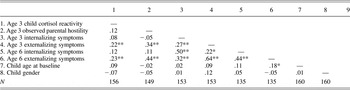
Means and standard deviations of the study variables are reported in Table 1, and correlations among study variables are presented in Table 2. Child age at baseline was positively associated with children's externalizing symptoms at age 6; thus, child age at baseline was included as a covariate in analyses with age 6 externalizing symptoms as the dependent variable.Footnote 1 Child gender and time of visit were not significantly associated with children's symptoms at ages 3 or 6 and were not included as covariates.Footnote 2 Child cortisol reactivity at age 3 was significantly positively associated with externalizing symptoms at age 3 and age 6. Observed parental hostility at age 3 was significantly positively associated with externalizing symptoms at age 3 and age 6. Internalizing and externalizing symptoms demonstrated moderate stability from age 3 to age 6, and internalizing and externalizing symptoms were significantly positively correlated from age 3 to age 6.
Correlations among all study variables

Note: Child age is reported in months at baseline (age 3 assessment); child gender is male = 1 (n = 80) and female = 2 (n = 80).
*p < .05. **p < .01.
Early childhood cortisol reactivity, parental hostility, and internalizing symptoms at ages 3 and 6 years
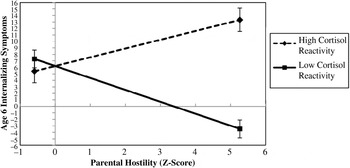
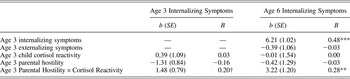
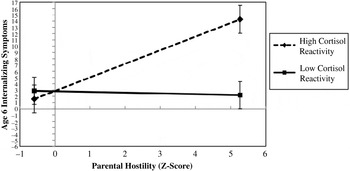
Results of the multiple linear regression models for child internalizing symptoms are presented in Table 3. The interaction between cortisol reactivity and parental hostility at age 3 was associated with age 3 internalizing symptoms at a trend level (p = .06), and the form of the interaction was consistent with the significant interaction described next. At age 6, the interaction between child cortisol reactivity and parental hostility at age 3 predicted internalizing symptoms at age 6 after controlling for internalizing and externalizing symptoms at age 3. As seen in Figure 1, for children with high levels of cortisol reactivity at age 3, parental hostility at age 3 predicted increases in internalizing symptoms at age 6 (b = 2.79, SE = 1.17, pr = .21, p = .02), whereas for children with low levels of cortisol reactivity at age 3, there was no significant association between parental hostility at age 3 and internalizing symptoms at age 6 (b = –3.64, SE = 2.20, pr = –.15, p = .10). Regions of significance testing indicated that for children with cortisol reactivity at levels greater than 0.80 (standardized z score), parental hostility at age 3 predicted increases in internalizing symptoms at age 6. Reversing the moderator, regions of significance tests also demonstrated that this moderated effect was specific to levels of parental hostility greater than 1.06 (standardized z score).
The interaction between child cortisol reactivity and observed parental hostility at age 3 predicts increases in children's internalizing symptoms at age 6 (error bars included).

Early childhood cortisol reactivity, parental hostility, and internalizing symptoms at ages 3 and 6 years

†p < .10. **p < .01. ***p < .001.
Early childhood cortisol reactivity, parental hostility, and externalizing symptoms at ages 3 and 6 years
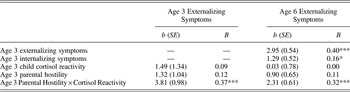
Results of the multiple linear regression models for child externalizing symptoms are presented in Table 4. The interaction between child cortisol reactivity and parental hostility at age 3 was significantly associated with concurrent externalizing symptoms at age 3. For children with high levels of cortisol reactivity at age 3, parental hostility at age 3 was significantly positively associated with externalizing symptoms at age 3 (b = 5.13, SE = 0.92, pr = .43, p < .001). In contrast, for children with low levels of cortisol reactivity at age 3, there was no significant concurrent association between parental hostility at age 3 and externalizing symptoms at age 3 (b = –2.49, SE = 1.80, pr = –.12, p = .17). Regions of significance tests indicated that for children with cortisol reactivity at levels greater than 0.15 (standardized z score), parental hostility at age 3 was positively associated with externalizing symptoms at age 3. Reversing the moderator, regions of significance tests also demonstrated that this moderated effect was specific to levels of parental hostility greater than 0.28 (standardized z score).
Early childhood cortisol reactivity, parental hostility, and externalizing symptoms at ages 3 and 6 years

*p < .05. ***p < .001.
The interaction between child cortisol reactivity and parental hostility at age 3 significantly predicted increases in externalizing symptoms at age 6 after controlling for internalizing and externalizing symptoms at age 3. As seen in Figure 2, for children with high levels of cortisol reactivity at age 3, parental hostility at age 3 significantly predicted increases in externalizing symptoms at age 6 (b = 3.21, SE = 0.60, pr = .44, p < .001). In contrast, for children with low levels of cortisol reactivity at age 3, parental hostility at age 3 did not significantly predict externalizing symptoms at age 6 (b = –1.41, SE = 1.11, pr = –.11, p = .21). Regions of significance tests indicated that for children with age 3 cortisol reactivity at levels greater than 0.22 (standardized z score), parental hostility at age 3 significantly predicted increases in externalizing symptoms at age 6. Reversing the moderator, regions of significance tests also demonstrated that this moderated effect was specific to levels of parental hostility greater than 0.61 (standardized z score).Footnote 3
The interaction between child cortisol reactivity and observed parental hostility at age 3 predicts increases in children's externalizing symptoms at age 6 (error bars included).

In order to test whether our findings could be attributed to differences in children's baseline cortisol levels, all models reported in Table 3 and Table 4 were rerun replacing the AUCi statistic with children's baseline (Sample 1) cortisol levels. No main or moderated effects involving children's baseline cortisol levels were observed. The interaction between children's baseline cortisol levels and parental hostility was not significantly associated with children's internalizing (age 3: b = –0.43, SE = –0.89, pr = –.04, p = .63; age 6: b = –1.87, SE = 1.28, pr = –.13, p = .14) or externalizing (age 3: b = –0.27, SE = 1.19, pr = –.02, p = .82; age 6: b = –0.70, SE = 0.66, pr = –.09, p = .29) symptoms at age 3 or age 6. In addition, in Appendix A we present supplementary data that includes parental supportive presence at age 3 as an additional independent variable. The interactions between parental hostility and children's cortisol reactivity remained significant in all models, whereas none of the interactions between parental support and children's cortisol reactivity were significant, indicating that our findings are specific to negative aspects of the parenting environment.
Finally, we explored whether child gender moderated associations between early child cortisol reactivity and parental hostility and children's psychiatric symptoms. We reran each of the four models described above and added child gender; the two-way interaction terms, Child Gender × Child Cortisol Reactivity and Child Gender × Parental Hostility; and the three-way interaction term, Child Gender × Child Cortisol Reactivity × Parental Hostility, as independent variables. No gender differences were observed for any of the four dependent variables.
Discussion
The current study tested whether child cortisol reactivity moderated the effects of parental hostility on children's internalizing and externalizing symptoms both concurrently at age 3 and prospectively at age 6 after accounting for prior symptoms. We found that preschoolers who exhibited high cortisol reactivity and experienced high levels of parental hostility at age 3 evidenced greater concurrent externalizing symptoms at age 3 and increases in both internalizing and externalizing symptoms from age 3 to age 6. Our findings suggest that increased cortisol reactivity in early childhood may render young children more susceptible to negative parenting and increase risk for developing emotional and behavioral problems by school entry. Identifying young children who are at greatest risk for early mental health problems is critical given that early psychopathology adversely affects young children's functioning and predicts later psychopathology and impairment across development (Bufferd et al., Reference Bufferd, Dougherty, Carlson, Rose and Klein2012; Dougherty, Smith, et al., Reference Dougherty, Smith, Bufferd, Stringaris, Leibenluft, Carlson and Klein2013; Reference Dougherty, Smith, Bufferd, Kessel, Carlson and Klein2015; Mesman et al., Reference Mesman, Bongers and Koot2001).
Our findings are consistent with cross-sectional studies in young children indicating that the combination of dysregulated cortisol reactivity and exposure to negative family contexts is associated with concurrent child internalizing symptoms, externalizing symptoms, and psychosocial difficulties (Hastings et al., Reference Hastings, Ruttle, Serbin, Mills, Stack and Schwartzman2011; Kushner et al., Reference Kushner, Barrios, Smith and Dougherty2016; Obradović et al., Reference Obradović, Bush, Stamperdahl, Adler and Boyce2010; von Klitzing et al., Reference von Klitzing, Perren, Klein, Stadelmann, White, Groeben and Hatzinger2012). However, in contrast to our findings, the only other study that observed a significant longitudinal effect found that the combination of low, rather than high, cortisol reactivity and greater family stress predicted greater internalizing symptoms 1 year later in youth ages 9–15 (Badanes et al., Reference Badanes, Watamura and Hankin2011). Taken together, these findings suggest that dysregulated cortisol reactivity may serve as a vulnerability marker across childhood. However, the association of risk with high versus low stress reactivity may vary across development, or it may vary as a function of prior exposure to earlier chronic stressors. It is important to note that to date, none of the longitudinal studies have considered whether abnormalities in children's cortisol reactivity were present prior to the environmental stressor. It will be important for future research to establish cortisol reactivity as a preexisting vulnerability marker and to test the temporal or causal associations. Nevertheless, our findings support that these early childhood markers of risk predict psychiatric symptoms 3 years later, which is the longest follow-up in the literature to date. Moreover, it is especially noteworthy that these effects were evident over and above prior symptoms given the stability of symptoms across the assessments.
We observed significant interactive effects in longitudinal models for both internalizing and externalizing symptoms, even after controlling for prior internalizing and externalizing symptoms. In concurrent models, we found a significant interactive effect on age 3 externalizing symptoms only; however, there was a trend-level interactive effect on children's concurrent internalizing symptoms at age 3. These findings suggest that cortisol reactivity to environmental stressors may represent a common or shared risk factor for both internalizing and externalizing symptoms across early childhood. Our findings also suggest that externalizing symptoms may be more sensitive than internalizing symptoms to variations in cortisol reactivity and parental hostility, in that the regions of significance tests demonstrated that it takes more extreme levels of both to produce significant effects for internalizing symptoms. It will be important to determine whether variations in cortisol reactivity and parental hostility continue to serve as a common vulnerability marker for both internalizing and externalizing problems across development or whether it becomes differentiated and specific to one form of psychopathology over time.
Our findings may have implications for understanding the developmental trajectory of psychopathology. Cortisol responses to stress appear to change across development with particularly marked changes occurring with pubertal onset and hormone fluctuations (Gunnar, Talge, et al., Reference Gunnar, Talge and Herrera2009; Gunnar, Wewerka, et al., Reference Gunnar, Wewerka, Frenn, Long and Griggs2009). Similarly, trajectories of internalizing and externalizing symptoms also change across development, with internalizing symptoms showing a marked rise in adolescence (McLaughlin & King, Reference McLaughlin and King2015) and child externalizing symptoms possibly manifesting as mood dysregulation or conduct problems in adolescence (Okado & Bierman, Reference Okado and Bierman2015). Thus, it is possible that the associations observed in the current study may also change across development. However, to date, studies examining the interactive effect of cortisol reactivity and stress on psychopathology have been mixed. In preschool-age, school-age, and adolescent youth, the combination of environmental stress and both heightened (Hastings et al., Reference Hastings, Ruttle, Serbin, Mills, Stack and Schwartzman2011; Obradović et al., Reference Obradović, Bush, Stamperdahl, Adler and Boyce2010; Saxbe et al., Reference Saxbe, Margolin, Spies Shapiro and Baucom2012; Steeger, Cook, & Connell, Reference Steeger, Cook and Connell2016; von Klitzing et al., Reference von Klitzing, Perren, Klein, Stadelmann, White, Groeben and Hatzinger2012) and blunted (Badanes et al., Reference Badanes, Watamura and Hankin2011; Kushner et al., Reference Kushner, Barrios, Smith and Dougherty2016) cortisol reactivity have been linked to both greater internalizing and externalizing symptoms. These studies have been largely limited to cross-sectional designs and have typically not examined both children's internalizing and externalizing psychopathology in the same study, making it difficult to determine whether these associations vary over time. Nevertheless, a recent study reported that in emerging adults exposed to childhood maltreatment, increased cortisol reactivity was linked to greater internalizing problems, whereas blunted cortisol reactivity was linked to greater externalizing problems (Hagan, Roubinov, Mistler, & Luecken, Reference Hagan, Roubinov, Mistler and Luecken2014), suggesting that distinct associations may emerge later in development. Taken together, these findings suggest that these associations are dynamic, and it will be important for future research to use long-term follow-up designs into adulthood to delineate the developmental progression of these associations.
Our findings suggest that child cortisol reactivity may sensitize young children to negative features of the parent–child relationship. Research suggests that cortisol reactivity is related to emotion regulation abilities (de Veld, Riksen-Walraven, & de Weerth, Reference de Veld, Riksen-Walraven and de Weerth2012; Lam, Dickerson, Zoccola, & Zaldivar, Reference Lam, Dickerson, Zoccola and Zaldivar2009), as well as other physiological indices of stress sensitivity, including respiratory sinus arrhythmia (Doussard-Roosevelt, Montgomery, & Porges, Reference Doussard-Roosevelt, Montgomery and Porges2003), neural responses to psychosocial stress (Dedovic, Duchesne, Andrews, Engert, & Pruessner, Reference Dedovic, Duchesne, Andrews, Engert and Pruessner2009), and genes involved in the susceptibility to life stress (Dougherty et al., Reference Dougherty, Klein, Congdon, Canli and Hayden2010). Therefore, children with dysregulated cortisol reactivity may have multiple underlying biological and behavioral markers of stress sensitivity that render them less able to cope with parents’ expression of anger, frustration, and criticism. Increased stress sensitivity may also contribute to children's behavioral responses within the parent–child relationship (e.g., greater distress, avoidance, or noncompliance) that evoke or exacerbate negative parenting. It will be important for future research to examine child-level risks across multiple levels of analysis and within the reciprocal context of the parent–child dyad to determine whether they represent common or unique risk markers and how they impact the parent–child relationship and child outcomes.
Although our study focused on negative aspects of the parenting environment, we ran supplementary analyses (see Appendix A) that show that parental support did not moderate children's cortisol reactivity. Nevertheless, it is possible that if we examined the effects of enriched environments (e.g., teacher/mentor supportive presence and positive sibling relationships) in children with identified vulnerability markers, our results may have differed (e.g., Essex, Armstrong, Burk, Goldsmith, & Boyce, Reference Essex, Armstrong, Burk, Goldsmith and Boyce2011; Morgan, Shaw, & Olino, Reference Morgan, Shaw and Olino2012). Recent theoretical models including biological sensitivity to context (Boyce & Ellis, Reference Boyce and Ellis2005) and differential susceptibility (Belsky & Pluess, Reference Belsky and Pluess2009) suggest that children with vulnerability markers may respond in a “for better or for worse” manner to the environment, experiencing poor outcomes when exposed to negative environments but optimal outcomes when exposed to positive environments. This work has important clinical implications as intervention studies suggest that children with increased cortisol reactivity may benefit most from treatment (van de Wiel, van Goozen, Matthys, Snoek, & van Engeland, Reference van De Wiel, van Goozen, Matthys, Snoek and van Engeland2004) and that children's HPA axis functioning may mediate the effects of a family intervention on change in children's behavior problems (O'Neal et al., Reference O'Neal, Brotman, Huang, Gouley, Kamboukos, Calzada and Pine2010). Taken together, this work highlights that children's cortisol reactivity may be involved in multiple pathways to child adjustment and holds promise in identifying children who may be most responsive to parent interventions or possibly as a mechanisms of behavioral change.
The current study had several notable strengths. This study included a 3-year follow-up assessment, which is the longest follow-up to date examining the interactive effects of cortisol reactivity and negative family influences on child, adolescent, and adult outcomes. In addition, the sample was randomly recruited from the community, and we used a multimethod approach, including an observational assessment of early parenting, multiple poststressor cortisol samplings to capture individual differences in stress responses, and a developmentally sensitive, parent-reported clinical interview to assess child internalizing and externalizing symptoms from preschool to school entry.
The study also had limitations. First, primary caregivers, typically mothers, were the sole informants regarding children's psychopathology. Future work should incorporate a multi-informant approach, including coparent and teacher reports. Second, because the combination of child cortisol reactivity and parental hostility was assessed at age 3 only, we cannot test whether their change across early childhood or whether the continued presence of high cortisol reactivity and parental hostility at age 6 influence children's symptoms. Third, children in our subsample had significantly fewer internalizing symptoms at age 3 as compared to the larger sample; this may have decreased our power to detect significant effects, as we found only a trend-level interaction effect for children's internalizing symptoms at age 3. Fourth, although we did not observe any gender differences in our sample, it is possible that our sample size was too small to detect significant differences. Further work with larger samples is needed to examine whether gender moderates the complex associations between children's stress reactivity, parenting, and child psychopathology (e.g., Hastings et al., Reference Hastings, Ruttle, Serbin, Mills, Stack and Schwartzman2011).
Fifth, we did not have sufficient power to test whether the interaction between children's cortisol reactivity and parental hostility predict psychiatric diagnoses. It will be important for future studies to examine both psychiatric symptoms and diagnoses in larger samples. Sixth, we used a screener for ADHD and ODD to reduce administration time for a portion of the sample at the age 3 assessment and employed maximum likelihood estimation procedures for missing values. However, results were comparable for the subsample of participants who did complete the full PAPA at ages 3 and 6. Nonetheless, it is possible that the use of the screener resulted in some additional error variance. Seventh, although the range of the mean parental hostility scores may be somewhat restricted to the lower end, the level of hostility is expected. The nature of the observational task, which consists of the parent and child working on teaching tasks together, would not necessarily evoke extremely high levels of parental hostility. Nevertheless, any hostility in this context appears to be meaningful.
Another possible limitation of this study is the way in which cortisol reactivity was indexed. As in other studies on young children (e.g., Luby et al., Reference Luby, Heffelfinger, Mrakotsky, Brown, Hessler and Spitznagel2003, Gunnar, Talge, et al., Reference Gunnar, Talge and Herrera2009), the laboratory paradigm did not evoke increases in cortisol responses in all children, a circumstance that creates difficulty in interpreting the results in terms of cortisol reactivity (Gunnar, Talge, et al., Reference Gunnar, Talge and Herrera2009); nevertheless, variability in children's cortisol responses was observed, and this afforded the examination of how individual differences in children's cortisol responses, alone or in conjunction with early parenting, predict children's psychiatric symptoms across early childhood. In addition, the use of the AUCi statistic as a measure of cortisol reactivity may obscure important nuances in the cortisol trajectories that may be important for understanding the emergence of psychopathology (e.g., individual differences in the initial engagement of the stress response or how prolonged the cortisol response is following the offset of the stressor). Finally, the sample was largely composed of White, two-parent, middle-class families. Thus, we cannot generalize our results to more ethnically diverse samples, clinical samples, or those with extreme forms of parental hostility (i.e., maltreatment). Future research should extend this work to more diverse samples.
In summary, we found that children with high levels of cortisol reactivity to a laboratory stressor and who were exposed to high levels of parental hostility at age 3 demonstrated greater concurrent externalizing symptoms at age 3 and increases in internalizing and externalizing symptoms from age 3 to age 6. Our findings suggest that preschoolers with increased cortisol reactivity represent a particularly vulnerable group of children when exposed to adverse parenting contexts, and might be targeted for early intervention to prevent the development of psychopathology. These interventions may be particularly effective during early childhood, a period of development characterized by a high degree of neuroplasticity.
Appendix A
We coded for parental supportive presence during the parent–child interaction task (in addition to parental hostility, which we focus on in the current paper). A mother scoring high on this scale expresses positive regard and emotional support to the child. This may occur by acknowledging the child's accomplishments on the task or unrelated tasks the child is doing, encouraging the child with positive emotional regard, and various other ways of letting the child know that he/she has her support and confidence to do well in the setting (e.g., positive reassuring voice tone). Parental support was rated on a 5-point scale for each task, and ratings were averaged across tasks (M = 4.47, SD = 0.50, range = 2.50–5.00): 1 = very low parental support (parent fails to be supportive, and may be aloof and unavailable to child when child shows need of some support), 3 = moderate support (parent does respectable job of being available but support may be lacking or unreliable for periods in the session), 5 = very high support (parent provides support throughout the session, continuously encourages child, and reinforces the child's success). The internal consistency (α = 0.88) and interrater reliability (ICC = 85, n = 55) of the parental support scale were acceptable.
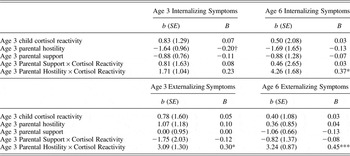
In order to further examine the specificity of our findings, we reran models and included child cortisol reactivity, parental hostility, parental support, Cortisol Reactivity × Parental Hostility interaction term, and Cortisol Reactivity × Parental Support interaction term in the same model (see Table A.1). We found that the Cortisol Reactivity × Parental Hostility interaction remained a significant predictor of internalizing symptoms at age 6 and externalizing symptoms and ages 3 and 6, while the Cortisol Reactivity × Parental Support interaction term was not significant in any of the models. These additional analyses suggest that our findings are specific to negative aspects of early parenting.
Early childhood cortisol reactivity, parental hostility, parental support, and internalizing and externalizing symptoms at ages 3 and 6 years