On July 12, 1871, the Colorado Springs Company and its largest shareholder, William Jackson Palmer, adopted a plan that divided the hundreds of acres they owned into the streets, blocks, and plots of Colorado Springs. To sell the city, the boosters of Colorado Springs marketed it as a refined resort for wealthy industrialists, health seekers, and tourists. Boosterism in Colorado Springs appealed to these audiences over the next four decades by using a changing mixture of politics, business, and religious morality. This boosterism successfully distinguished the resort of Colorado Springs from the mines, steel mills, and agriculture that defined nearby towns.
By closely following the shifting relationship between boosters and the city's religious institutions, this article shows that boosterism in Colorado Springs mixed religious concerns over “souls” with the “business sense” of advertising industrial capitalism. The result was a Western boosterism tinged with religion. Investigating the religious aspects of this boosterism holds profound implications for understanding the origins of modern conservatism, the business concerns of the later Sunbelt, and the growing importance of religion in the American West.
Vice President Theodore Roosevelt's nine-day visit to Colorado in August 1901 began and ended with speeches in the beautiful mountain resort town of Colorado Springs. From the balcony of the plush and newly renovated Antlers Hotel, he delivered his first address, “Manhood and Statehood,” at the city's celebration of the twenty-fifth anniversary of Colorado's entrance into the Union. The speech equated the greatness of the United States with the manly qualities of resolve, bravery, willpower, and perseverance. “But we need more than these qualities,” Roosevelt reasoned. “If courage and strength and intellect are unaccompanied by the moral purpose,” he insisted, “they become merely forms of expression for unscrupulous force and unscrupulous cunning.” Without morality, he argued, subtle influences would corrupt the state and the noble qualities upon which it rested, even the manly ones.Footnote 1
A week later, the popular Republican vice president delivered his final speech alongside a lecture by Alva Adams, a former and future Democratic governor of Colorado. Together, they dedicated the cornerstone of a new building for the city's Young Men's Christian Association (YMCA), an ecumenical organization dedicated to building Christian morality. Before Roosevelt spoke, Adams neatly summarized the reasons that local boosters supported the YMCA. “It promotes industry, temperance, and self-reliance,” Adams argued. And perhaps most important, “It is the taxpayer's best friend. It gives better government at less cost and this is the ultimate of political aspirations.” National business leaders understood the value of such an organization as well. “Railroads and great corporate interests are generous” in their backing of the YMCA across the country, Adams continued, “not from sentimental or religious reasons, but because they have business sense if not souls.” Morality was not just good for manly virtues and the state; it was good for corporate and capitalist interests as well. Roosevelt's short speech built on Adams's ideas. The vice president lauded the common purpose engendered by the moral vision of the YMCA. “It cultivates the spirit of clasping hands, one with the other, and pressing together in the ranks as citizens and as Americans,” he declared. “And only in this spirit can we strive hard and in good faith for the attainment of higher ideals.” With that, the vice president rolled up his sleeves and troweled the mortar for the cornerstone.Footnote 3
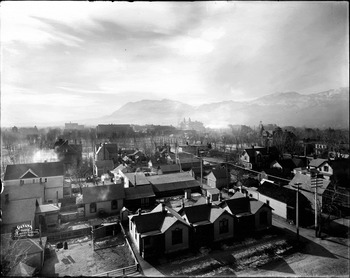
A bird's eye photograph of Colorado Springs in 1901 looking southwest toward Cheyenne Mountain. In the background toward the center of the picture, the Antlers Hotel dominates the skyline.Footnote 2

Thirty years of local politics, business savvy, and the regular invocation of a generic Christian morality in Colorado Springs came together as the mortar dried. From Colorado Springs's beginning in 1871 until long after Roosevelt's visit in 1901, civic leaders emphasized this morality to promote the town's reputation and to support its temperance laws. The founders of the city began this emphasis by providing many Protestant churches with free land. Then, arising from and drawing on the power of those churches, a series of ecumenical organizations emerged. City leaders used these ecumenical Protestant ministries as their most substantial tool for enforcing morality in the town. Through these organizations, the powerbrokers of Colorado Springs redoubled their efforts to fashion their small mountain town into a model resort community defined by clear and uncompromising values that reflected their class and race. What they established was an idealized resort vision that they fought to maintain. They insisted wealthy white residents populate and control the city as they alone understood what was best for the region and most advantageous to the health seekers and tourists who supported the city's economy. Roosevelt's endorsement of the YMCA, a key ecumenical institution in the town, heralded a decade when the articulation and enforcement of this vision was at its peak.
In the highly competitive American West, boosting a city or region could unite even conflicting interests with the promise of more customers, voters, and parishioners. This common concern brought Republicans like Roosevelt together with Democrats like Adams, Baptists together with Episcopalians, and investors together with competitors. Generic Christian morality was crucial to the mix, not as doctrinaire creeds that set local leaders against each other, but as a generalized morality that united them. The move by city leaders in Colorado Springs from privileging denominations to favoring ecumenical organizations such as the YMCA illustrated the desire to encourage a broad morality. This morality worked with boosterism to create a soul for business sense, an early fusion of Christianity with industrial capitalism.
To attract permanent residents rather than more transient boomtown settlers, Western boosters emphasized their towns’ improvements. These promoters fought popular perceptions of the frontier as rugged, ignorant, and lawless by emphasizing positive traits they shared with established towns, such as amenities, schools, and churches. To entice long-term inhabitants, Colorado Springs joined towns like Grand Junction, Colorado, in setting aside free city lots for churches. But determining why town leaders favored religion is difficult. Reality and promotion often differed. For instance, many towns supported luxurious hotels amidst even squalid conditions knowing that hotels shaped much of a traveler's local experience. Other tactics included placing all the town's amenities along the train tracks to impress passengers while hiding poorer neighborhoods. Yet, whether boosters sought to truly better their town or simply advertise it, most believed attractive features, education, and religion lured stable citizens.Footnote 4
According to historian David Hamer, “anti-frontier towns” took improvements seriously. In these cities, strong companies or founders directed growth and sought to rid or reduce negative frontier stereotypes. Chief among them was the saloon. In the nineteenth and early twentieth centuries, many believed alcohol underlie most social ills. Anti-frontier towns such as Colorado Springs; Greeley, Colorado; Humboldt, Iowa; Evanston, Illinois; and Pasadena, California; embraced temperance as a solution to a host of “frontier” problems. Concurrently, many Protestant leaders subscribed to the Social Gospel, a belief that the church should prioritize solving social problems over strictly observing doctrine. Hence, temperance united many of the municipal and religious leaders in these towns.Footnote 5
The cause of temperance marshaled civic and religious powers so effectively that a few went to extremes in its defense. Jerome “Jerry” Beebe, owner of Pasadena's first permitted saloon, armed himself and sought the protection of a Los Angeles sheriff when temperance crusaders threatened to assemble against him in November 1884. What was mere threat in Pasadena became action in Greeley. At a Sunday service in 1871, Robert Cameron, one of Greeley's founders, announced the opening of a saloon nearby. He led many of the parishioners to it, presumably to buy out the proprietor. Instead, church members burned down the saloon. Just months later, William Jackson Palmer hired Cameron to help found Colorado Springs.Footnote 6
Despite the importance of this religious morality to boosterism, urban scholars tend to treat them separately or drastically downplay religion. Carl Abbott's Colorado was the first work to provide sustained analysis of how Colorado boosterism affected economics, politics, and society in the state. Published almost thirty years later, Uniting Mountain and Plain, Kathleen Brosnan's history of Colorado, continued to center on economic, political, and promotional developments. Like much scholarship on the American West, Abbott and Brosnan pay little attention to religion in Colorado's first decades. Recent attempts to show the importance of religion in Colorado during the state's first decades, such as R. Todd Laugen's The Gospel of Progressivism, have yet to analyze the relationship between religion and boosterism. The state's motto, “Nothing without the Deity,” makes religion's absence in the boosterism of the “businessman's state” all the more glaring.Footnote 7
Religion, morality, and temperance in the early history of Colorado Springs offer a revealing corrective. Colorado Springs was “the most systematic and determined attempt,” according to Hamer, to establish an anti-frontier town. In Colorado Springs, boosters recognized that to market the city as a unique and ideal resort town, they needed to coordinate with leading local Protestant institutions. Christianity served the city's branding. It distinguished Colorado Springs from other Western cities more likely to invoke stereotypes of rough-and-tumble, morally compromised cow towns. Thus, the same “business sense” that Governor Adams believed caused corporations to support the YMCA also shaped the morality used to sell Colorado Springs's resort image. The business sense of boosterism blurred lines between the economy, politics, and religion so that competitive business leaders, politicians, and ministers could unite behind the prosperity of the resort. Together, they launched campaigns aimed at attracting wealthy industrialists, health seekers, and tourists. Meanwhile, civic leaders also developed a moral campaign against drinking, Sabbath breaking, and vagrancy, chiefly designed to exclude or police poor and working-class peoples who clashed with the residency, health, and tourism promotions. Over time, I argue, the mixture of mutually reinforcing politics, boosterism, and religion increasingly mixed “souls” with “business sense.” Eventually, the rigid moral enforcement for the good of “souls” began to trump the “business sense” of simply selling a virtuous image. In the West's most anti-frontier town, religion became so important to boosterism that it eventually imposed its aims over the very intentions that helped privilege it.
This article argues that Western boosterism not only provided common economic and political goals but also had a religious side that encouraged a generic Christian morality. Tracing the work of Colorado Springs boosters to unite these elements is significant for at least three reasons. First, boosters—local leaders of businesses, religious organizations, and politicians who marketed Colorado Springs to the nation—wielded incredible power by defining the town's sense of place. Their vision often transcended business rivalries, political parties, and religious differences, and it proved remarkably resilient. Over time, the moral piece of this vision grew stronger, and those who defined and enforced it began exercising more control over the town.
Second, ecumenical organizations—Christian associations that united religious and municipal leaders to promote a common moral code—became paramount in shaping the moral aspect of the resort vision. Just as boards of trade and chambers of commerce focused competing businesses on municipal goals, ecumenical organizations rallied different denominations and city leaders around shared aims that promoted the town. These broad aims not only appealed across doctrinal lines but also included enough “business sense” to draw political and business leaders.Footnote 8
Third, Colorado Springs in the late 1800s and first decade of the 1900s reveals important precedents for politics in the West. The origins of towns and the sense of place their boosters promoted had profound effects on their political alignment. Even as the nature of politics changed over the century and various party realignments occurred across the nation, Colorado Springs proved reliably Republican throughout the entire twentieth century. Just forty-five miles south, however, the unionized steel workers of Pueblo, Colorado, proved reliably Democratic. Leaders in Pueblo emphasized the city's factories and smoke stacks as signs of progress in the West, and these campaigns mostly drew workers from different races and cultures. Leaders in Colorado Springs, in contrast, buttressed the town's beautiful scenery with charities and steeples and used these as signs of refinement and respectability. They mainly attracted rich, white industrialists from the East Coast and Great Britain. The unique sense of place in both cities influenced politics in their respective towns for more than a century.Footnote 9
As civic leaders shaped their vision of the town, they never settled on a perfect formula for balancing their blend of boosterism, religion, and politics. Their emphasis and priorities shifted over time in response to changing conditions in the region and the nation, and these shifts continue to this day. This article follows and explains those changes near the turn of the twentieth century. Temperance serves as an important example. William Jackson Palmer, Colorado Springs's founder, believed upright people dedicated themselves to temperance. This belief manifested itself in temperance clauses for all land deeds registered in Colorado Springs. To market the town as a refined, temperate place in the West, boosters sought allies to help enforce these clauses. The first place they turned was to denominational churches that were eager to assist in the crusade, but soon local ecumenical organizations proved even more reliable and effective. Eventually they even outstripped the original intentions for temperance in the town. These organizations extended boosters’ marketing logic by equating more thorough moral enforcement with increased economic value. The city's successful booster campaigns contained important moral and religious elements, and they ultimately proved stronger and more persistent than the campaigns themselves.
William Jackson Palmer, who developed much of southern Colorado and founded Colorado Springs, had an appearance that slighted his importance. His mustache imparted little prominence to his plain face, large ears, and receding hairline, but behind the gentle features was a man of action and resolve. He was born to John and Matilda Palmer on a farm near Leipsic, Delaware, on September 18, 1836. His parents were Hicksite Quakers, members of a movement that valued agrarian ideals and emphasized the guidance of the Inner Light over all other doctrines. In 1841, the family moved to Philadelphia for young Palmer's education. Although the Palmers continued to attend Hicksite meetings, their son befriended many orthodox Quakers. He drew on these connections for the rest of his life. In the 1850s, he studied engineering, geology, and mining in England, where he continued to associate with Quakers. He also became an active abolitionist. When Palmer returned to Pennsylvania, his studies paid off. In June 1857, Palmer became confidential secretary to John Edgar Thomson, a fellow Quaker and president of the Pennsylvania Railroad.Footnote 10
The Civil War interrupted Palmer's career and his faith. Like many other Quakers in Philadelphia, Palmer was an active Republican and abolitionist. In August 1861, he decided that the Quaker principle of following his inner conscience outweighed the faith's tenet of pacifism. He left the railroad and joined the Union in its cause against the Confederacy. Instead of volunteering with a regiment, Palmer raised one and named it Anderson Troop. Like the town he later founded, he sought to recruit only respectable, temperate professionals to his unit.Footnote 11
After the Civil War, Palmer again joined the railroads. From 1866 to 1870, he acted as a treasurer and then manager of surveys for the Kansas Pacific Railroad. The height of that career was his publication in 1869 of The Report of Surveys across the Continent for the directors of the railroad. In his summary, Palmer mentioned an opportunity for private capital to build a north-south trunk line between Denver and Albuquerque. “There will be a very large health and pleasure travel,” Palmer predicted. “The numerous hot springs and other medicinal springs, and the magnificent scenery of the Rocky Mountains,” along with its mild climate, he believed, would draw residents and tourists to the area.Footnote 13
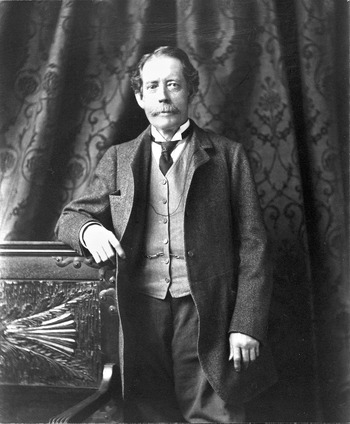
A formal portrait photograph of General William Jackson Palmer.Footnote 12

Palmer left the Kansas Pacific and began the National Land and Improvement Company to develop his idea of a north-south railroad along the plains east of the Rocky Mountains. Managed by Palmer, the company purchased vast stretches of land and secured a right of way and grounds for depots from the government. This eventually became the Denver and Rio Grande Railroad between Denver and Albuquerque. Several thousand acres of land near the base of Pikes Peak especially attracted Palmer. The company purchased the tract for eighty cents per acre, and Palmer decided to settle there and to erect a town around himself.Footnote 14
Unlike many Western towns, Palmer and his company began Colorado Springs not as an industrial or agricultural center but as a planned colony for upright residents, health seekers, and tourists. The National Land and Improvement Company deeded the swathe around Pikes Peak to a spin-off corporation called the Colorado Springs Company. Palmer was the major shareholder. In the summer of 1871, the company adopted its plan for the colony. To create a town that began with well-developed rather than makeshift infrastructure, colonists bought shares, and the profits went to improvements for the town. Palmer explained his hope for the city to Robert Cameron, the anti-saloon crusader at Greeley, who Palmer hired to manage the development of Colorado Springs. “My theory for this place,” Palmer wrote to Cameron, is that it will become “the most attractive place for homes in the West.” City boosters quickly began advertising Palmer's ideas of tourism, health, and wealth. “The general tourist would miss one of the grandest sights of his life if he passed this unnoticed,” read a plug for the city in 1874. Famous industrialists, it continued, “are here to recuperate” from tuberculosis and “are purchasing property and building permanent homes for themselves and families.” In two quick sentences, this booster hyped the tourism, health, and wealth Palmer had envisioned for the city.Footnote 15
Palmer and other planners, however, believed the city needed more than beautiful scenery, invigorating climate, and well-to-do inhabitants. The architects of the city wanted to appeal to wealthy and middle-class sensibilities as well. The Colorado Springs Company used its control of the land to impose a certain morality in the city.Footnote 16
Just as Palmer's business success guided the city's physical structure, his religious frustrations influenced the city's generic Christian morality. Quaker leaders had disowned Palmer for joining the Civil War and would only accept him back if he repented of his actions. “I have every desire to retain my connection to the Society,” confided Palmer in 1867 to his close friend and fellow Quaker Isaac Clothier. But “under the same circumstances as existed in the Summer of ‘61, I would act precisely as I did then.” Palmer could not bring himself to repent of his actions, and he stood by them when he wrote the Committee of Friends later that year. He insisted that if he had “remained at home” during the war, “I should have done great violence to my convictions of right and duty.” Despite “every desire to retain my connection with the society,” he could offer no apology. His insistence separated him from the Society of Friends for the rest of his life.Footnote 17
Palmer's broad encouragement of Christianity in Colorado Springs developed out of this break. Palmer expanded his financial support of religious institutions but he also grew more private about his spiritual sentiments. His friends debated these sentiments in the editorial section of the Evening Post in Philadelphia after Palmer died on March 13, 1909. The argument began when Reverend Samuel Bishop, an Episcopal minister who knew Palmer “some years ago,” wrote a tribute. “He,” Bishop remembered, “abjured the church as he saw it, yet his own righteous idealism and his broad sympathy made him helpful to what is good and true in the church.” It was this “broad sympathy” that motivated Palmer's backing of Christianity and morality in Colorado Springs. “Gen. Palmer,” Bishop concluded, “was the finest unconscious Christian I have ever known.”Footnote 18
Two weeks later, Palmer's close friend Isaac Clothier wrote to disagree with Bishop's “unconscious” label. “One born a Quaker,” Clothier argued, “can never wholly be anything else.” Instead, he suggested that Palmer's Quaker background animated his charity for Christian organizations and morality. Although parted from the Friends, Clothier saw Palmer's patronage of Christianity as consistent with Quakerism. “The divine guidance which is so important a part of their unwritten creed, may,” he speculated, “have created in him not unconscious, but conscious Christianity.” Unconscious or not, the lack of denominational loyalties caused Palmer to embrace a broad Christianity that mixed with his formidable business sense and his belief that religious ideas needed practical applications. Out of this came a strategy for creating, controlling, and marketing Colorado Springs.Footnote 19
It began with temperance. Colorado Springs Company leaders borrowed the language in the deeds of Greeley to write temperance into every lot they sold for the colony. “Intoxicating liquors shall never be manufactured, sold, or otherwise disposed of as a beverage” read each contract, or “this deed shall become null and void, and all right, title and interest of, in and to, the premises hereby conveyed shall revert” to the company. Like Palmer's connection between temperance and upright living with the soldiers under his command in the Civil War, early advertisements for the city linked temperance with respectable residents. “Any person” may reside in the colony, read one newspaper article, “who is possessed of good character and is of strict temperance habits.” Prohibiting liquor represented an early attempt to force a specific set of morals and values on the town.Footnote 20
A challenge to the temperance clause soon arose. In 1873, just two years after the town incorporated, the Colorado Springs Company repossessed two lots owned by D. A. Cowell. He had purchased the property and opened a billiard hall. The company claimed that Cowell served liquor, and several witnesses confirmed the allegations. Cowell's legal battle against the confiscation of his property went all the way to the United States Supreme Court. In 1880, the Court upheld the temperance clause of the Colorado Springs Company and ruled against Cowell. The temperance clause “was not unlawful nor against public policy,” argued the Court, “but, on the contrary, it was imposed in the interest of public health and morality.” The Court recognized and agreed with the morality behind the temperance clause, classifying it closely with health concerns. Just as cities could zone dangerous industries away from residents, the Court reasoned, the Colorado Springs Company could also ban alcohol in a deed.Footnote 21
During the seven-year legal battle, the leaders of Colorado Springs began cultivating allies to support and enforce their moral vision. The city planners helped establish a religious college and aided several local churches. In 1874, the company donated 160 acres to create Colorado College, a Congregationalist liberal arts school that heavily contributed to the town's moral campaign. The college provided important leaders not only to enforce temperance but also to contribute to the respectable image of the town. “Rev. Jonathan Edwards of Massachusetts,” an early promotion in 1874 exclaimed, “will open a school in the preparatory department of the Colorado college at this place on the 6th of May.” Who better to found the city's college and help instill morality than the great-grandson of the most legendary Puritan in the country's history? The allies of temperance were powerful indeed. The college continued to play a major role as the city's moral vision. As that vision crested in the first decade of the twentieth century, the college's president, William Slocum, held leadership positions in the city's three major ecumenical organizations.Footnote 22
In addition to the college, Palmer and the Colorado Springs Company followed a popular frontier trend by giving free land to several churches in the town's first two decades. Their dedication to temperance, Sabbath keeping, and vagrancy laws proved helpful for enforcing morality, and their presence helped promote the town to denominational adherents. “There is no lack of moral and religious opportunities here,” proclaimed the same advertisement that plugged Colorado College, “as the Presbyterians, Episcopalians, Baptists, Methodists Southern, Cumberland Presbyterians, and Unitarians, all have organizations.” Although the city's privileging of Christianity spanned many denominations, this quip also revealed the exclusion of Catholics, who took until 1898 to complete their church on a lot they purchased themselves. By the 1930s, the many churches and the college caused one booster to dub Colorado Springs, “The City of Churches,” a label Colorado Springs shared with dozens of other cities in the United States.Footnote 23
Although a fire in the 1890s destroyed many early deeds, surviving papers show evidence of the company's interest in facilitating the success of churches of many denominations. A copy of the Congregational Church's deed still exists. On June 3, 1879, the Congregational Church purchased a lot for a new church building from the Colorado Springs Company for one dollar. Like all deeds, the Congregational Church agreed to bar liquor from its premise or lose its title to the property. The deed contained only one small difference from the company's template contract. It cited “the quiet and peaceful purposes” of the Congregational Church as the only reason the company essentially gave the property away.Footnote 24
The Baptist Church had a more intimate, but stranger, relationship with the Colorado Springs Company. In 1871, the Colorado Springs Company hired Joshua Ambrose, a former Baptist missionary to the American West, to help plant a Baptist church in Colorado Springs. Ambrose performed well. The First Baptist Church of Colorado Springs opened the next year. On November 2, 1872, the board voted to have Ambrose “supply the pulpit for the present.” At the very next meeting, the board discussed where to build a house of worship for the congregation. “Owing to the conditions imposed by the ‘Colorado Springs Co.’ on their reservations for church lots,” the minutes recorded cryptically, “it was decided to build on some other ground.” Despite having a temporary minister who was an employee of the company, the Baptist Church was uneasy with the company's policy regarding church lots. By the next week, however, the board had resolved the issue. “In consequence of more favorable propositions from the Colorado Springs Co. in reference to their lots,” the minutes said, “the committee instructed to build on the original location, if the ‘C.S. Co.’ would give a satisfactory title.” Despite the confusing switch, the Colorado Springs Company clearly wanted to work with churches both to draw residents and to promote the image of the town.Footnote 25
In the crusade for enforcing the moral vision of the town, ecumenical associations proved even more effective allies than churches. The presence of churches, of course, attracted migrating congregants, enhanced the town with beautiful buildings, and helped advertise Colorado Springs as a refined resort in the West. Moreover, churches provided an important precedent as ecumenical ministries often drew their leadership from the churches. But these ecumenical groups lacked the churches’ distractions of denominational hierarchies, divisive theologies, and bickering parishioners. Instead, these ministries focused on a broad, shared purpose with the churches, such as charity, and used that to help enforce morality in the town.
The number and strength of ecumenical organizations in the United States drastically expanded during the nineteenth century. Many of these organizations focused on proselytizing outside the United States. Founded in 1810, the American Board of Commissioners for Foreign Missions (ABCFM), for instance, began by organizing and preparing missionaries from several denominations to proselytize all over the world. Other ecumenical associations shared similarly expansive concerns. Established in 1816, the American Bible Society formed with a purpose wide enough to include most Christian denominations: distributing copies of the Bible. Its broad support led to the creation of a related ecumenical group in 1825, the American Tract Society, which concentrated on publishing other Christian materials. After the Civil War, many new organizations emerged that dealt with personal morality—Sabbath keeping, temperance, gambling, and other such issues. Colorado Springs had branches of many of these ministries.Footnote 26
In Colorado Springs, ecumenical organizations provided a space for the town's political, religious, and business leaders to develop and find practical ways to enforce their morality. Although the town's leadership often held important positions in churches, ecumenical organizations reached a larger audience with their broad, nonsectarian purposes. Their focus on the town mingled moral and civic authority, helping impart moral weight to civic leaders and civic power to religious leaders. The mayor, chief of police, municipal judges, and prominent business leaders often held important positions in these associations. Furthermore, ecumenical organizations profited from the town's many wealthy residents. Mining and railroad tycoons such as Palmer, Winfield Stratton, James Hagerman, and Clarence Dodge donated hundreds of thousands of dollars to the city's religions institutions. These wealthy men “had business sense, if not souls.” They expected returns on their investments, and the morality these organizations helped enforce constituted those returns.Footnote 27
These favorable conditions resulted in a large number of strong ecumenical organizations. With a population of about twenty thousand in 1900, Colorado Springs had at least twelve interdenominational groups. The Prohibition League, Anti-Saloon League, Women's Christian Temperance Union (WCTU), and Anti-Cigarette League all aimed to control the vices of drinking and smoking. The Christian Endeavor Union, Sunday School Union, Young Women's Christian Union (YWCA), YMCA, and Colored YMCA focused on providing activities for youth and indoctrinating them in the Christian faith. The city held an annual Chautauqua at nearby Palmer Lake to educate and edify adults both secularly and spiritually. Finally, the Associated Charities coordinated the work of dozens of aid societies, and the Ministerial Association rallied the Protestant clergy of the town to pressing moral matters in the city, county, and state. The Associated Charities, YMCA, and the Ministerial Association represented the strongest of these organizations. They performed several functions, but each also aligned with city promotions of a healthy climate, tourist attractions, and temperate residents.Footnote 28
The Associated Charities of Colorado Springs went through many name changes in its history. Much like the YMCA and the Ministerial Association, the Associated Charities existed only episodically through the 1870s and 1880s when the town's population was small and city boosters focused on privileging churches rather than ecumenical groups. Formed as the Colorado Springs Relief Society in 1875, it reorganized on January 29, 1887, as the Women's Aid Society and on June 14, 1890, as the Colorado Springs Aid Society.Footnote 29
The consequences of the city's health campaign partially lay behind the reorganizations and name changes. One of the reasons Palmer chose the site for Colorado Springs was his belief in the health benefits of mountain climates. City boosters built on that premise in the 1870s and 1880s by attracting leading tuberculosis specialists such as Edwin Solly. He published respected medical articles and blatant booster pamphlets encouraging well-to-do consumptives to move to Colorado Springs. The town's reputation, however, also attracted many poor and working-class residents. Their struggles to find necessities and work in the resort town of Colorado Springs fell on the Associated Charities.Footnote 30
From the 1870s through 1899, only women directed and operated the organization. Many of the leaders in the charity were the wives of important leaders in the city. Some of the women who continuously held prominent positions were Annie France, Mary Gregg, Anna Hagerman, and Mary Slocum. They were the respective wives of Mayor Matthew France, Congregational Minister James Gregg, millionaire businessman James Hagerman, and college president William Slocum. The women leaders of the society often consulted male civic figures, appointed them to advisory boards, and worked closely with other ecumenical organizations such as the WCTU, YMCA, and Ministerial Association. Much like these other groups, the charity subscribed to a generic Christianity. Each meeting opened with prayers, scripture readings, and hymns. The society also periodically canvased Protestant and Catholic churches for new members. On December 29, 1888, the society voted to extend honorary, free membership to the wives of every minister in town.Footnote 31
A 1911 letter from the Brooklyn Children's Aid Society to the Associated Charities best illustrates the lure of Colorado Springs's health campaign even over those with little money. “We have a boy here who has just been put out of our public school because of tuberculosis,” the letter explained, “and we are very anxious to find a place for him in Colorado before it is too late to save his life.” But the agent of the Associated Charities revealed that the curative effects of the city's climate had an unadvertised income requirement. “Time and again,” responded Associated Charities agent Frank Bruno, destitute young men arrived in Colorado Springs to recuperate from tuberculosis. He had “yet to record a success” with this population. “That does not mean that the Colorado climate has lost its properties,” Bruno quickly continued. Rather, health seekers should “be care free as far as income is concerned” to rest fully enough to recover. The Brooklyn Children's Aid Society decided not to send the child.Footnote 32
The society's case reports provide fascinating insights into the lives of the poor and working-class people who did move to Colorado Springs. Many factors determined who received aid, but one reoccurring comment related to the image of the town—the state of the recipient's house and yard. The society tended to aid those with clean and orderly houses and withhold relief from those whose properties were not. An agent found Jason and Betty Gorman's house tidy on December 23, 1893, and decided they deserved aid. The cleanliness even caused the agent to remark that the family seemed “not of the class to ask aid.” Similarly, the orderly house of Thomas and Lucy McGrath on August 30, 1893, helped convince another agent to provide aid. Conversely, on February 4, 1896, an agent found a Mrs. Herbst living in “miserable conditions” and concluded “she was living on bread and water by choice.” This was one way the charity helped keep a well-ordered resort town.Footnote 33
Toward the turn of the century, the demand for charity had grown so large that the all-male Ministerial Association began pressuring the male leaders of the town to take over the female-led Colorado Springs Aid Society. In February of 1896, the Ministerial Association discussed starting an “associated charities” that coordinated churches and other charitable groups. “With the exception of the Colorado Springs Aid society,” the ministers observed, “there has never been anything of the kind in the city.” They recognized an associated charities organization would overlap with the Colorado Springs Aid Society but considered starting another charity run by “substantial business men” instead of strengthening the existing one.Footnote 34
Demand for charity continued to increase, which ultimately led to a coup by the town's male leaders. In 1898, Lida Touzalin, the president of the Colorado Springs Aid Society, responded to the increasing need for aid by asking “the men of the city and especially the clergymen” for more cooperation “in the benevolent activities of the city.” This request and a budget shortfall for the society of $260 gave the ministers and other male city leaders their chance to take over the organization. By the next year, the female Colorado Springs Aid Society was the male-controlled Associated Charities. Lida Touzalin was the only woman who remained on the board.Footnote 35
Through the Associated Charities, the leaders of the town combined their political and economic power with the broad moral purpose of the ecumenical organization. The organization's list of officers reads like a “who's who” of Colorado Springs. Mayor John Robinson and Colorado College president William Slocum joined ministers such as James Gregg and William Boyle and rich businessmen like William Stratton, Irving Howbert, and William Lennox in overseeing the organization from 1900 to 1910. In this decade, these men exercised unprecedented control over the working class and indigent in Colorado Springs. “We have no slums,” declared the first annual report, “and if we are on the alert we may keep our beautiful city free from such social ulcers.” They utilized many methods to assure this goal. They converted the old city jail into a homeless shelter they called the “City Hotel,” ordered the police to reduce the “tramp element,” and opened up their own tuberculosis sanatorium for the poor. In the process, they contributed to the extremely high rate of incarceration in the American West.Footnote 36
Unlike the Associated Charities, the YMCA kept the same name through its existence, yet its history also reveals its increasing importance to the moral vision Colorado Springs's local leaders. Although the branch began in 1878, it operated only seasonally and occasionally lapsed into closure during its first several years. Like the sporadic early days of the Associated Charities, the YMCA's first years corresponded to a period when city leaders focused on favoring churches and enforcing temperance through land deeds. This casual era for the YMCA ended after 1890 when the agent recorded only the housing of a consumptive and the placing of a few people into railroad jobs as the business of the entire summer.Footnote 37
Beginning in 1891, the YMCA board minutes showed a new dedication to professionalization. The board signaled its new sense of resolve by reviewing and again adopting the constitution and bylaws under which the YMCA incorporated in 1882. The board reaffirmed “the spiritual, intellectual, social and physical welfare of young men” as its ecumenical mission. Similar to the broad aim of the Associated Charities, the goal of the YMCA allowed it to draw from a wide range of city leaders and churches, though it excluded Catholics.Footnote 38
The first test of the renewed YMCA was the financial crisis of 1893. The crisis did little to hurt the YMCA or the Cripple Creek mine owners living in Colorado Springs. Through the rest of the decade, however, the city experienced an influx of poor visitors and residents with the usual crowd of tourists. Ministers “concisely and forcibly” asked congregants to fund the YMCA as it dealt with this struggling population. Winfield Stratton, the wealthiest Cripple Creek mine owner, donated new rooms to the YMCA. William Perkins, the architect of many of the lavish homes in Colorado Springs, willed $5,000 upon his death to see the YMCA through the crisis. The YMCA also convinced business owners to pay for boys’ memberships “to get them off the street,” another important way businesses funded these ministries to maintain the orderly resort image.Footnote 39
The YMCA proved itself through the downturn, and it started serving as a nexus between many of the city's churches, leadership, and numerous ecumenical organizations. In 1898, the Congregational Church donated a library collection to the YMCA, and Colorado College allowed the organization's members access to the college's athletic park. Around the same time, the general secretary of the YMCA also began serving as secretary for the Ministerial Association. The endorsement of Vice President Roosevelt in 1901 only furthered empowered the YMCA. Palmer staked a $10,000 bond for the new YMCA building, which would rest on Roosevelt's masonry work from the cornerstone celebration. While workers constructed the building, the Congregational Church and First Christian Church freely supplied space for YMCA activities.Footnote 40
On October 30, 1903, Clarence Dodge, the owner of the city's largest newspaper, became president of the YMCA. This election brought many new officers to the organization. Together with Dodge and his lavish generosity, they brought a new level of efficiency to the organization through the rest of the decade. By 1909, the YMCA had paid off its beautiful $50,000 building thanks largely to Dodge's donation of $10,000, established a branch in the “wild” mining town of Colorado City, and reached a membership of over one thousand people in a town of twenty-five thousand. For these accomplishments, the International YMCA in New York City appointed Dodge as a member of its committee. Dodge's successes helped convince him to run for U.S. Congress in 1912, but like presidential candidate William Taft, Dodge lost on a Republican ticket split by Theodore Roosevelt's new Bull Moose Party.Footnote 41
At the same time Dodge joined the YMCA International Committee, the YMCA in Colorado Springs lost William Day, its general secretary. The recommendation the board wrote for Day revealed the importance of the YMCA to the moral enforcement of the town. “We unite with the entire City,” the board explained, “in appreciation of his sound judgment and untiring efforts in the cause of civic righteousness.” The board soon found another secretary, Charles B. Hall, to replace Day. Hall won three cheers at the next annual meeting “on account of his efforts in enforcing the law—especially in the liquor cases.” Throughout the first decade of the twentieth century, Day and Hall helped the YMCA ensure civic righteousness and municipal morality.Footnote 42
A decade after the men of the Associated Charities used business efficiency to justify their takeover of the women's Colorado Springs Aid Society, the white leaders of the YMCA used similar reasons to consider “taking over the work” of the Colored YMCA among its “ninety to one hundred” members. “These people can be better reached,” the YMCA board figured in 1909, “if their organization is under our control.” But, the board had to balance cost against the ability to exert moral control over a new population. “This work must be developed slowly, owing to the financial situation.” A calculation of “business sense if not souls” had begun. “We must not,” the board cautioned, “assume more obligations than the value of the work warrants, as indicated by the interest and support of the colored people themselves.” In the end, the white YMCA leaders displaced the black leaders of the Colored YMCA. It made business sense.Footnote 43
Of all the ecumenical organizations, the Ministerial Association was most politically adept. By 1901, it had convinced the male leaders of the city to take over the Colorado Springs Aid Society and had tied itself closely to the rising star of the YMCA. By sharing the YMCA general secretary and some of its other officers, the Ministerial Association ensured much of the backing the YMCA received from churches. The association's support of the new YMCA building illustrated this connection. On November 4, 1901, both YMCA Secretary William Day and sometime board member William Slocum of Colorado College delivered speeches to the association in support of the YMCA. In response, all the ministers resolved to preach a sermon two weeks later on the needs of the YMCA. Two months later they held a “Week of Self Denial for Churches in behalf of YMCA Building.”Footnote 44
Although the Ministerial Association had been political from its inception, it grew increasingly so in the first decade of the twentieth century. Even as early as 1878, it successfully lobbied lawmakers to require businesses in the city to close on Sundays. On February 16, 1901, Colorado Springs became a City of the First Class, a municipality under “home rule.” Home rule transferred many of the powers that the state of Colorado had within the town to local political leaders. In Colorado Springs, this further empowered the “local option,” which allowed the population of cities or counties to vote whether to be “wet” or “dry” in regard to alcohol. Colorado Springs's 1901 designation additionally allowed stricter enforcement against Sabbath breaking, gambling, loitering, and indecent publications.Footnote 45
This spurred the Ministerial Association to begin meeting regularly with city officials and law enforcement to better implement their moral vision of the town. This began with vigilance committees. The association appointed the Methodist Episcopal, Presbyterian, and Baptist ministers to examine “all matters of interest which they may deem necessary for the public good.” The ministers chose to focus on the use of the city park at Prospect Lake “as a prospective resort” on Sundays “in view of the possible Sabbath discretions arising there from.” With the mayor in attendance, the association showed their support for his attempt to close the park on Sunday by “refusing to sign this lease.” When the lease passed anyway, the ministers turned to the city council and convinced them “to enact an ordinance in accord with the Christian sentiment of the city” to close Prospect Park on Sundays.Footnote 46
Next, the vigilance committees sought to address the problems of gambling, vagrancy, and lewdness. James Gregg, the minister of the Congregational Church, met with Judge L. W. Cunningham to alert him to a lottery used by the city merchants to attract customers. After Judge James Orr lectured the association on city laws concerning juvenile vagrancy, the association formed a committee “for the employment of the children of the city during the summer months.” The Ministerial Association even helped enforce censorship in the mail. A committee forwarded “the most objectionable paragraphs” of a paper called the “Pink Iconoclast” to the postmaster urging the cessation of its circulation.Footnote 47
Temperance, however, remained the association's main concern. The advice and endorsement of its leaders was crucial for securing temperance legislation and enforcement. A city mayor and judge both realized this. Mayor John Robinson sought the graces of the association in a “semi-official capacity” to dispel allegations of not enforcing temperance in the city's drug stores. Judge James Sanford also sought the support of the ministers to get a stronger “injunction against property owners when liquor has been or is intended to be sold.” Yet, as important as the Ministerial Association considered temperance in the city, creeping intemperance from outside was more alarming. When some pesky miners moved their camp close to the city, the Ministerial Association helped police temperance and Colorado Springs's refined image by trying to extend temperance to the entire county. James Gregg's investigation of “conditions existing in the coal camps north of the city” caused him to recommend organizing a county Anti-Saloon League. At the next meeting, the ministers agreed to canvas their churches for its membership.Footnote 48
With the new powers of a City of the First Class, the Ministerial Association hoped for more robust moral enforcement in Colorado Springs. But Palmer had left an ambiguous legacy of business acumen and moral dedication. Was temperance a marketing tool that required token enforcement or a moral legacy that demanded vigilance? City officials split over the question. Judge L. W. Cunningham assured the Ministerial Association he would “cooperate with the ministers in suppressing evil.” Mayor John Robinson was less sure. “Mayor Robinson,” the Ministerial Association claimed, “stated that the city ordinances are almost impossible to be enforced.” The importance of the moral aspect of the resort city was at the heart of this division. Some sided with “business sense.” They felt that a commitment to moral enforcement sufficed and allowed the city to market itself as a refined resort in the West. Others sided with a thorough moral enforcement to better the “souls” in the city. They argued that moral enforcement required employing the new powers allowed by the city's new designation.Footnote 49
In August 1904, the Ministerial Association rallied the ecumenical organizations to push the thorough enforcement of morality in the town. The ministers appointed a committee of five “to secure the nomination of good men for the various offices of the city and county in the coming primaries.” The Christian Endeavor Union and the Anti-Saloon League soon formed similar committees to meet with the Ministerial Association. “The platform on which we stand,” resolved James Gregg, “is the absolute enforcement of the ordinances of this city especially in regard to the sale of liquor.” The ecumenical organizations backed Henry Clay Hall, a teetotaler Democrat.Footnote 50
The political campaign worked. In a quest for thorough enforcement over token measures, the city's moral enforcers displaced the Republican establishment that had privileged them. Hall became one of the very few Democratic mayors in the city's history as temperance and the morality behind it shortly transcended politics. The power of the moral vision over politics even reached The Gazette-Telegraph, the city's usually staunch Republican newspaper. “The Gazette is a Republican paper, but it does not make a difference to us whether the man who happens to be Mayor of Colorado Springs is Republican, Democrat, Populist or what-not—if he enforces all the laws impartially,” the editors stated.Footnote 51
The Ministerial Association applauded the city's stricter enforcement and equated it with increased business success. “Such action not only promotes the morality and good order,” they claimed, “but will result in increased business prosperity and higher property values, and we ask that all good citizens give the administration their hearty support in this and all other needed reforms.” Endorsing temperance had been different than rigorously applying it. For Gregg, the success of Henry Clay Hall's election elevated temperance from one strategy among many in promoting Colorado Springs to the way of assuring the town's fortune. Gregg's statement erased the ambiguity and forwarded a straightforward equation: more thorough enforcement of temperance always resulted in more economic success.Footnote 52
In Colorado Springs, city leaders built a generic Christian morality right into the city's infrastructure. Unlike the hasty, makeshift setup of nearby boomtowns, the planners of Colorado Springs carefully laid and developed the foundation of their city. Adams recognized this in his YMCA speech. For him, the new YMCA building—like the town's other religious assets—represented “the Christian virtue and business sagacity of Colorado Springs.” Indeed, city leaders had created a powerful mixture of Christianity and business. With the important exception of scenery and climate, selling the city depended on little else. And this marketing campaign was effective. After all, it had drawn the former governor and nation's vice president, and it continued to help bring high-profile dignitaries to the city.Footnote 53
Like many other Western towns, early promoters of Colorado Springs often sold the town by mentioning churches along with other advancements—sometimes in the same breath. Colorado Springs enjoys “all the improvements which render a place prosperous and attractive,” a promoter claimed just two years after the town started. “Two churches,” he immediately continued, “are completed; two others—Episcopal and Baptist—are building. The foundations for a fifteen-thousand-dollar school house are laid. Trees have been set out; parks provided for, and nothing left undone to render the place pleasant and home-like.”Footnote 54 The boosters of Colorado Springs joined many others who used religion in similar promotions. Colorado Springs, however, became the most focused “anti-frontier” effort only when religious leaders turned civic morality from a booster tool to a religious mission.
Ecumenical organizations helped catalyze this change. They more efficiently coordinated church leaders, incorporated political and business leaders, and enforced morality. In his YMCA speech about business sense and souls, Alva Adams identified how ecumenical organizations built upon existing infrastructure. “The same reasons that induce the building of church and school,” he posited, “demands support for the Young Men's Christian Association.” These reasons were good morals, good government, and good business, he continued, and “a community would be justified in supporting from the public revenue institutions like the Y.M.C.A., which promote good habits and industry.”Footnote 55
During the city's early years as a colony managed by a corporation, Colorado Springs had supported “good government and good morals” by its generosity to churches. The ensuing town attracted wealthy residents who continued that support with private donations, and strong churches soon helped establish powerful ecumenical organizations. These groups provided an ideal space for leaders to more thoroughly ensure a morality for their resort town. The motives behind that morality, however, had never been clear. So, the broad aims of Christian organizations conflated with the public purposes of other infrastructure to create a nagging ambiguity.
A “business sense” was behind this ambiguity. The purpose of the town's sophisticated infrastructure—public and otherwise—was a marketable product. And moral enforcement provided a sort of quality control. Again, Adams saw this with the city's YMCA. “It is an enterprise which the Almighty underwrites and the dividends will be large and cumulative—more certain and satisfactory than [U.S.] Steel or Standard Oil.” In Colorado Springs business metaphors particularly were apt for describing the city's YMCA. The support of ecumenical organizations by business leaders in the similar temperate, health destination of Pasadena, California, suggests that funding a civic morality was especially important in wealthy Western resorts.Footnote 56
As Alva Adams predicted, the alliance of business, political, and religious leaders behind the city's Christian infrastructure did leave legacies for the town. First, the alliance conflated Christianity and business when selling the city. This fusion started with temperance. The Colorado Springs Company approached temperance as a way to market the city, while the company's allies saw temperance as an uncompromising righteous cause. These allies made the short step from selling the town by advertising temperance to arguing that thorough enforcement correlated to more business revenue and more valuable property.
The strength of ecumenical organizations was a second legacy. They proved more effective at enforcing morality than churches and sometimes the city government itself. Whereas individual churches diffused the city's religious, business, and political leaders, ecumenical organizations concentrated them. The men of the Associated Charities understood this power when they took over the Women's Aid Society. It gave them a moral platform that complemented law enforcement efforts to deal with the influx of poorer people into the city at the turn of the century. When these ministries’ moral power was at its height from 1900 to 1910, they also helped confer political power. The cause of the city's YMCA drew Roosevelt's endorsement and even helped launch the association's president in a run for U.S. Congress.
This effectiveness, however, had a price. Politics, business, and religion mixed powerfully in ecumenical organizations, but religion ultimately defined this space. Through the help of these organizations, religious leaders reinterpreted the city's moral vision. After 1904, the Ministerial Association assured that a religious commitment, not an advertising scheme, defined morality in the town. Mayor Robinson experienced the repercussions when he lost to Henry Clay Hall, the first Democratic mayor in the city's thirty-year history. Colorado Springs eventually helped contribute this Christian-heavy blend of business, boosterism, and politics to Western conservatism.
The last legacy of the city's alliance was its control over the city's image. City leaders managed to control that sense people often associated with a place through the rest of the town's history. The successors of the first city leaders used this control in subsequent economic campaigns for health, tourism, and military bases. By the end of the twentieth century, these successors courted a different kind of conservative Christian ministry. Instead of enforcing morality in the town to ensure its quality as a product, these new organizations brought the city jobs by selling a morality to the world.