Staphylococcus aureus is the most common aetiologic agent of contagious bovine mastitis, a disease that causes relevant worldwide losses in the dairy industry (Zecconi et al. Reference Zecconi, Calvinho and Fox2006a). Antimicrobial therapy is by enlarge the most frequently applied method to control contagious mastitis; however, the efficacy of this approach to control Staph. aureus mastitis is a matter of debate (Sol et al. Reference Sol, Sampimon, Snoep and Schukken1994; Sol et al. Reference Sol, Sampimon, Snoep and Schukken1997). Besides resistance factors, Staph. aureus expresses a wide array of surface-associated virulence factors such as a polysaccharide capsule and proteins that promote adhesion to mammary tissues and contribute to tissue colonization and resistance to phagocytosis (Foster, Reference Foster2005). In addition, Staph. aureus secretes various exotoxins that damage the membranes of leucocytes and favour pathogen survival in host tissues (Schuberth et al. Reference Schuberth, Krueger, Zerbe, Bleckmann and Leibold2001; Rainard et al. Reference Rainard, Corrales, Barrio, Cochard and Poutrel2003; von Eiff et al. Reference von Eiff, Friedrich, Peters and Becker2004). Taking into account the wide range and polymorphism of virulence genes present in the genome it is not surprising that Staph. aureus is the most frequently isolated contagious pathogen worldwide (Peacock et al. Reference Peacock, Moore, Justice, Kantzanou, Story, Mackie, O'Neill and Day2002; McLaughlin & Hoogewerf, Reference McLaughlin and Hoogewerf2006; Zecconi et al. Reference Zecconi, Cesaris, Liandris, Daprà and Piccinini2006b; Josefsson et al. Reference Josefsson, Kubica, Mydel, Potempa and Tarkowski2008).
Several reports suggest that virulence factors potentially represent excellent targets for vaccine development (Aarestrup et al. Reference Aarestrup, Dangler and Sordillo1995; Foster & Hook, Reference Foster and Hook1998; Schuberth et al. Reference Schuberth, Krueger, Zerbe, Bleckmann and Leibold2001) but the heterogeneous expression of these molecules in different Staph. aureus isolates influences not only virulence but could be involved in the variable success of immunization protocols. These issues have contributed to the poor outcome of the field vaccine trials against Staph. aureus mastitis in dairy cows. Therefore the importance of evaluating the combination of Staph. aureus virulence factors is gaining growing attention as an indispensable step towards the development of effective vaccines (Jarraud et al. Reference Jarraud, Mougel, Thioulouse, Lina, Meugnier, Forey, Nesme, Etienne and Vandenesch2002; Peacock et al. Reference Peacock, Moore, Justice, Kantzanou, Story, Mackie, O'Neill and Day2002; Shkreta et al. Reference Shkreta, Talbot, Diarra and Lacasse2004; Haslinger-Loffler et al. Reference Haslinger-Loffler, Kahl, Grundmeier, Strangfeld, Wagner, Fischer, Cheung, Peters, Schulze-Osthoff and Sinha2005).
We have developed a subunit peptide vaccine based on three adhesion factors, fibronectin-binding protein A (FnbpA) and clumping factor A (ClfA) that did not show genetic polymorphism, and fibrinogen-binding protein (Efb), whose limited polymorphism has been suggested to be uninfluential on immune response (Palma et al. Reference Palma, Shannon, Quezada, Berg and Flock2001). The importance of these proteins in the pathogenesis of Staph. aureus infections is described by Höök & Foster (Reference Höök, Foster, Fischetti, Novick, Ferretti, Portnoy and Rood2000). To our knowledge, studies on the influence of single gene polymorphisms on vaccine response are not available. Therefore, we used readily available anti-adhesins IgG and IgA raised in mice using a model peptide vaccine to study the relationship between the ability of anti-adhesin antibodies to recognize different Staph. aureus isolates from bovine subclinical mastitis and Staph. aureus genetic polymorphism based on a combination of virulence genes shown to be simple and informative (Zecconi et al. Reference Zecconi, Binda, Borromeo and Piccinini2005; Zecconi et al. Reference Zecconi, Cesaris, Liandris, Daprà and Piccinini2006b).
Materials and Methods
Bacteria
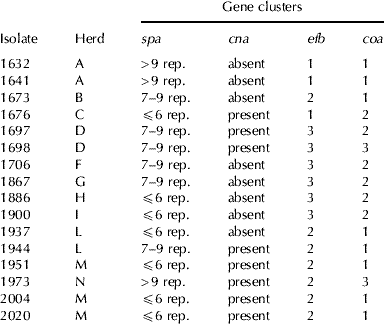
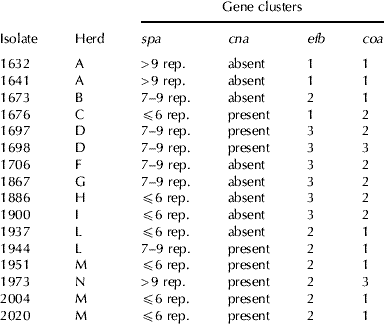
Staphylococcus aureus was isolated from routine milk samplings performed during a control programme aimed to reduce Staph. aureus intramammary infections in cows (Zecconi et al. Reference Zecconi, Piccinini and Fox2003). The isolates, randomly selected, were genetically characterized as described (Zecconi et al. Reference Zecconi, Binda, Borromeo and Piccinini2005) Isolate characteristics are reported in Table 1. To explore whether polymorphism of Staph. aureus isolates could play a role in interaction with antibodies produced following vaccination, bacteria were classified in clusters as previously described (Zecconi et al. Reference Zecconi, Cesaris, Liandris, Daprà and Piccinini2006b). As reference strain we used a Staph. aureus subsp aureus from American tissue culture collection (ATCC catalog number 29213).
Origin and genetic characteristics of the sixteen Staph. aureus isolates used in the study as reported by Zecconi et al. (Reference Zecconi, Binda, Borromeo and Piccinini2005, Reference Zecconi, Cesaris, Liandris, Daprà and Piccinini2006b)
Preparation of bacterial extracts
Single isolates were grown in Brain Heart Infusion (BHI), under aerobic conditions at 37°C and under agitation. Cells were harvested by centrifugation in the late logarithmic phase of growth and then washed in sterile phosphate-buffered saline (PBS). Bacterial pellets were resuspended in Tris-buffered saline (TBS) supplemented with a mixture of proteinase inhibitors (50 mm-EDTA, aprotinin 120 μg/ml, TLCK 150 μg/ml, pepstatin A 20 μg/ml, leupeptin 10 μg/ml, antipapain 10 μg/ml and chymostatin 10 μg/ml) (Roche, Milan, IT), lysostaphin (10 μg/ml) and DNAase (20 μg/ml) (Sigma-Aldrich, Milan, Italy). The suspension was incubated at 37°C in a rotating incubator for 30 min, then supplemented with additional 10 μg/ml of lysostaphin and incubated for further 2.5 h. Digestion was stopped by heating the mixture at 88°C for 20 min. Insoluble bacterial debris were removed by centrifugation, the supernatant was collected, the pH was adjusted to 7·4 and stored at −20°C.
Genomic DNA was extracted by standard procedures (Sambrook et al. Reference Sambrook, Fritsch and Maniatis1989) and DNA sequences encoding efb, fnbpA and ClfA were amplified by PCR using a proof reading thermostable polymerase (Vent polymerase; New England Laboratories, Beverly MA, USA). Primers and PCR conditions are summarized in Table 2. Integrity and reliability of all recombinant constructs was verified by sequence analysis.
Polymerase chain reaction (PCR) primers and conditions used in the study

Preparation of recombinant proteins
Recombinant Staph. aureus Efb (all peptide), FnbpA (1–878 aminoacids), and ClfA (1–562 aminoacids) were expressed in Escherichia coli BL21 and purified as previously reported (Castagliuolo et al. Reference Castagliuolo, Piccinini, Beggiao, Palù, Mengoli, Ditadi, Vicenzoni and Zecconi2006). The concentration of recombinant proteins was determined by micro-Bradford test using the commercial Bio-Rad protein assay, whereas integrity and purity of proteins was assessed by sodium dodecyl sulphate-polyacrylamide gel electrophoresis (SDS-PAGE) analysis (Castagliuolo et al. Reference Castagliuolo, Piccinini, Beggiao, Palù, Mengoli, Ditadi, Vicenzoni and Zecconi2006).
Immunization of mice and generation of specific anti-adhesin antibodies
Male Balb/c mice, 10 weeks old (Charles River, Oderzo, Italy) were used in all experiments. Mice were housed under controlled humidity and temperature conditions and were given free access to commercial rodent food and water. Animals studies were approved by the Institutional Animal Care and Use Committee of the University of Padua.
Three doses of vaccine were given at 2-week intervals. Purified recombinant proteins (10 μg/dose) were administered into the right tibialis anterior muscle (i.m.) emulsified with an equal volume of Freund's adjuvant in a total volume of 30 μl/dose. Four groups of animals, each of three mice, were injected either with a single recombinant protein (Efb, FnbpA or ClfA) or with the mixture of the three recombinant adhesins. Blood samples were collected before immunization (to exclude pre-existing specific immunity, by puncture of the dorsal tail vein) and than 2 weeks after the last immunization (by cardiac puncture in deeply anaesthetized animals). Antibodies present on the intestinal mucosa (mucosal IgA) were collected by washing the small intestine with 2 ml of ice-cold PBS containing the proteinase-inhibitor mixture described above. After centrifugation clear supernatants were collected and stored at −20°C.
Recognition of specific Staph aureus isolates by anti-adhesin antibodies in enzyme-linked immunosorbant assays (ELISAs)
ELISAs were developed to determine the ability of specific anti-adhesin (IgG and IgA) induced with a peptide vaccine to recognize different clinical Staph. aureus isolates. Immunoplates (96-wells) were coated overnight at 4°C with 100 μl/well of bacterial extracts prepared from the different isolates of Staph. aureus used in this study. As previously reported, to reduce the high background signal in the ELISAs using total bacterial lysate as coating antigen, the plates were pre-incubated with 20% rabbit serum in PBS–0·05% Tween 20 (PBS–T) for 90 min at 25°C to saturate immunoglobulins-protein A binding activity (Castagliuolo et al. Reference Castagliuolo, Piccinini, Beggiao, Palù, Mengoli, Ditadi, Vicenzoni and Zecconi2006). Then appropriately diluted serum and intestinal washes were added to the wells and incubated for 2 h at 22°C on an orbital mixer. Plates were washed three times with PBS–T and the immunocomplexes were detected by adding the chromogenic substrate solution (TMB, Sigma-Aldrich, Milan, Italy). The reaction was stopped after 15 min incubation with an equal volume of 1 m-H3PO4. The optical density (OD) at 450 nm was determined using an ELISA plate-reader (Spectra I Tecan, Gratz, Austria). To support the specificity of the antibodies generated we performed preliminary Western Blot assays that confirmed the ability of each immune serum to identify the recombinant protein used for immunization; to recognize a single protein band of the expected molecular weight in Staph. aureus total protein lysates; and not to recognize Esch. coli-derived total protein proteins at the dilutions used. To standardize the working dilutions of immune serum and intestinal washes to be used in ELISAs, we first determined the antibody titre against the single antigens in hyperimmune serum and intestinal washes. Immunoplates were coated with a solution (10 μg/ml) of the specified recombinant protein (Efb, FnbpA and ClfA) and probed with 2-fold serial dilutions of immune and non-immune serum and intestinal washes. The antibody titre was defined as the highest serum or intestinal wash (secretory IgA, sIgA) dilution able to generate an OD at least 2-folds greater than non-immune serum or intestinal wash, respectively. Therefore we used serum dilutions at 1:5000 for serum IgG and 1:1000 for serum IgA, whereas intestinal washes were used at 1:20 dilution.
Data analysis and statistical procedures
The electrophoretic patterns obtained from PCR for the genes considered were analysed following a three-step procedure as described elsewhere (Zecconi et al. Reference Zecconi, Binda, Borromeo and Piccinini2005). First, gels were digitally acquired and bands were identified based on position (tolerance, 2%) by means of Gel-Pro Analyzer 3.1 software (Media Cybernetics, Silver Springs MD, USA). Then gene patterns were clustered by hierarchical clustering with percent distances on SYSTAT 11.0 statistical software (Systat software, Point Richmond CA, USA). Finally, the relationship between gene patterns and immune responses after vaccination was analysed by general linear model with statistical software SAS 9.1 GLM procedure (SAS Institute, Cary NC, USA). The general linear model included as independent variables the different gene clusters and the different replicates (number of mice), while IgG, IgA and mucosal IgA were considered as response variables. Statistical significance level was 0·05.
Results
Production of specific anti-adhesin antibodies and activity against Staph. aureus isolates
Following immunization with a single recombinant Staph. aureus adhesin or with a mixture of three recombinant proteins, significant levels of anti-Efb, anti-FnbpA, and anti-ClfA IgG, IgA and mucosal IgA were detectable in the serum and in the intestinal washes of mice. Serum and mucosal surface antibodies reacted with specific recombinant proteins as well as with native proteins obtained from lysates of a reference Staph. aureus isolate as determined by ELISA. Following immunization with a mixture containing the three recombinant adhesins, the antibody titre against the various antigens present in the vaccine was comparable, suggesting the absence of significant antigenic interference (data not shown).
We next determined the ability of specific anti-adhesins IgG and IgA to recognize Staph. aureus isolated from different subclinical cases of mastitis. Three weeks after the second immunization dose, specific anti-adhesins IgG and IgA were detectable in the serum of all the immunized animals and their ability to react with different Staph. aureus isolates was assessed. As shown in Fig. 1, the ability of serum IgG to recognize specific Staph. aureus adhesins using total bacterial lysates from the different isolates, as capturing antigen, was strikingly different.
Binding of Staphylococcus aureus isolates by serum IgG directed against single adhesins. Results are expressed as means of optical density (OD) at 450 nm obtained for each Staph. aureus strain probed with serum (dilution 1:5000) from mice (n=3 each adhesin) immunized with the specific adhesin±se subtracted the OD value of non-immune serum (dilution 1:5000, n=5).

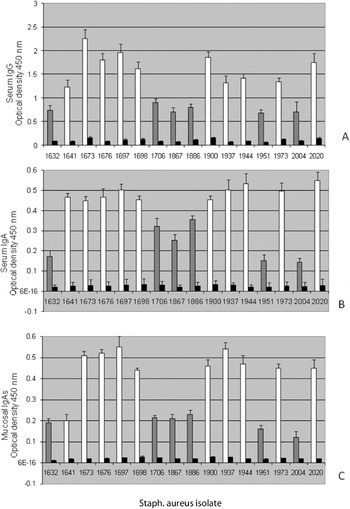
Indeed, similar results were obtained when we used hyperimmune serum raised against a mixture of adhesins (Fig. 2). Thus, taking as arbitrary cut-off an OD of 1, six Staph. aureus isolates (namely 1632, 1706, 1867, 1886, 1951, 2004) reacted less efficiently with the anti-adhesins IgG mixture, whereas the other ten isolates used in the study, reacted strongly with the immune serum.
Binding of Staphylococcus aureus isolates by serum IgG (A) and serum IgA (B) and mucosal IgA (C) anti-Staph. aureus adhesins. Results are expressed as means of optical density (OD) at 450 nm obtained for each Staph. aureus strain probed with serum from control non-immune mice (n=5) (black bars) and mice immunized with the adhesins mixture (n=3) ±se, grey bars indicate poor reactive lysates and open bars reactive lysates. Serum dilutions: 1:5000 for IgG and 1:1000 for IgA, intestinal washes dilution: 1:20.

As shown in Fig. 2, also serum or mucosal derived specific anti-adhesins IgA and mucosal IgA recognized with varying ability different Staph. aureus isolates. Indeed, applying an arbitrary cut-off OD of 0·4 we were able to separate Staph. aureus isolates in two groups. Thus, serum IgA and mucosal IgA again recognized efficiently isolates 1641, 1673, 1676, 1697, 1698, 1900, 1937, 1944, 1973 and 2020, whereas IgA reacted poorly with isolates 1632, 1706, 1867, 1866, 1951 and 2004, further suggesting a different level of adhesins immunoreactivity in specific isolates.
Genetic polymorphism in Staph. aureus isolates and reactivity to anti-adhesin antibodies
To explore the variable reactivity of different Staph. aureus isolates to immune serum, we first confirmed the presence of genes coding for fnbpA, and clfA by PCR analysis on genomic DNA extracted from highly and poor responsive isolates. The reactions produced an amplification product of the expected size from the various isolates for the different genes, and the sequences for these adhesins from high and poor responder isolates did not show any significant polymorphism for fnbpA, and clfA (data not shown).
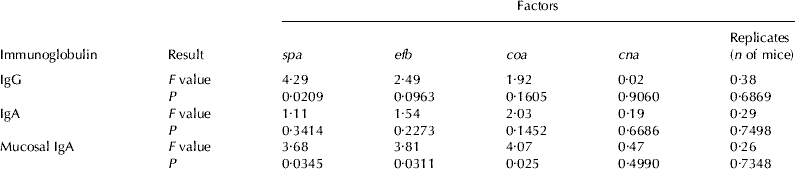
The results of the general linear model including the polymorphisms of the four genes considered and the mouse showed that this latter one had no significant influence on mean OD (Table 3). Moreover, none of the factors considered had any significant influence on serum IgA means, while significant differences were observed for IgG and mucosal IgA.
Statistical analysis by GLM model applied to estimate the influence of Staph. aureus gene polymorphism on immune response to a recombinant protein vaccine
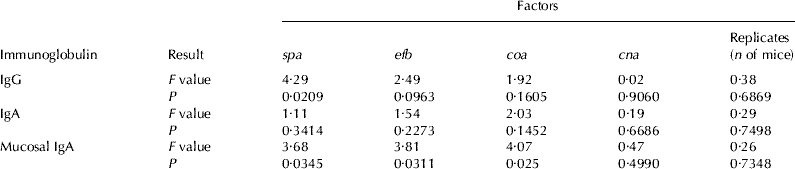
Isolates with >9 repetitions of spa X regions showed a significant lower reactivity to anti-adhesins IgG and mucosal IgA as opposed to isolates with a 7–9 repetitions. Indeed, IgG OD values were 0·97±0·23 in isolates with >9 repetitions v. 1·40±0·52 in 7–9 repetition isolates. When IgA were considered, isolates with >9 repetitions showed OD values of 0·28±0·11 v. 0·38±0·14 of 7–9 repetition isolates. Furthermore, a significant difference was observed for IgG values between efb cluster I and III, with OD values of 1·14±0·47 and 1·25±0·14, respectively. Isolates in efb cluster II showed significantly higher mucosal IgA reactivity when compared with cluster I, respectively 0·37±0·16 and 0·30±0·14. Isolates in coa cluster I showed a significant lower mucosal IgA response (data not shown). Finally, the presence of cna gene was not associated with any difference in reactivity to serum antibodies.
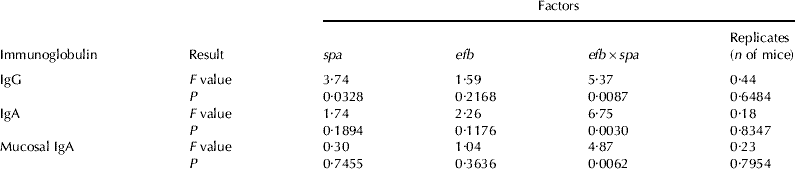
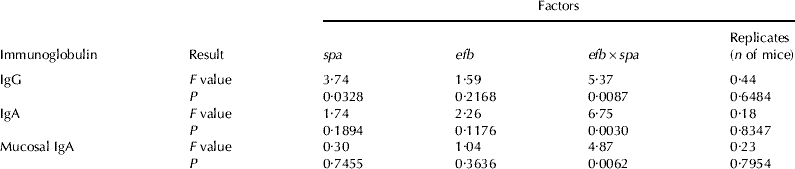
To assess the role of the interaction between the polymorphisms of the two genes (efb and spa) showing a significant influence on immune reactivity, a simplified GLM model was applied. This model included only the two genes as factors, their interactions and the replicates (mouse). The results of the statistical analysis (Table 4) showed that the interaction between the two genes had a significant influence on IgG, IgA and mucosal IgA response, while spa gene influenced significantly only the IgG response. In the other cases the immune response was not influenced by single gene clusters (efb or spa).
Statistical analysis by GLM model applied to estimate the influence of efb and spa gene polymorphisms on immune response to a recombinant protein vaccine
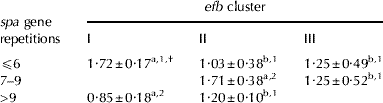
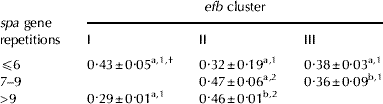
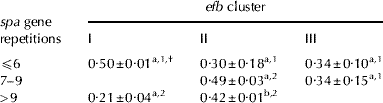
The data presented in Table 5 compare the OD values observed when isolates where classified by both efb and spa gene clusters. Isolates with >9 repetitions (spa gene) and in efb cluster I showed significantly lower OD values when compared with isolates in the other clusters. When IgA OD response was considered (Table 6) a similar pattern was observed. However, the differences between isolates with >9 repetitions and in efb cluster I reached statistical significance when compared with isolates in efb cluster II, while there were no significant differences with other spa clusters. Finally, the analysis of mucosal IgA response (Table 7) confirmed the results observed for IgG with a significantly lower mean OD in isolates with >9 repetitions (spa gene) and in efb cluster I.
Mean IgG optical density (±sd) observed for sixteen Staph. aureus isolates classified by efb gene clusters and by spa repetitions clusters
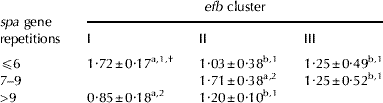
† Different letters show statistically significant difference among rows; different numbers show statistically significant difference among columns; α=0·05
Mean IgA optical density (±sd) observed for sixteen Staph. aureus isolates classified by efb gene clusters and by spa repetitions clusters
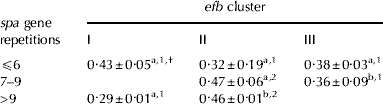
† Different letters show statistically significant difference among rows; different numbers show statistically significant difference among columns; α=0·05
Mean mucosal IgA optical density (±sd) observed for sixteen Staph. aureus isolates classified by efb gene clusters and by spa repetitions clusters
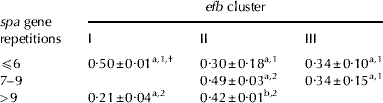
† Different letters show statistically significant difference among rows; different numbers show statistically significant difference among columns; α=0·05
Discussion
Staph. aureus is a unique pathogen, responsible of a variety of acute and chronic diseases in man and animals (Honeyman et al. Reference Honeyman, Friedman and Bendinelli2001; Zecconi et al. Reference Zecconi, Calvinho and Fox2006a). The vast array of hosts infected by this pathogen is made possible by the large number of virulence factors carried and its ability to adapt to different environments. Indeed, in recent years several reports describe relevant strain variability not only among Staph. aureus isolates adapted to diverse species but also between subjects of the same species, supporting a major role of gene polymorphism in the virulence and the ability to evade the immune system (Voyich et al. Reference Voyich, Braughton, Sturdevant, Whitney, Said-Salim, Porcella, Long, Dorward, Gardner, Kreiswirth, Musser and DeLeo2005). To address the relevance of field isolate variability, in this study we used a multidisciplinary approach to evaluate the ability of antibodies directed against surface adhesion factors to recognize Staph. aureus isolated from quarter milk samples of dairy cows with subclinical mastitis and to determine how this response correlates with the genetic heterogeneity of Staph. aureus isolates.
We used as target antigens multiple bacterial proteins involved in microbe adhesion to host tissues, since recent advances in human and veterinary medicine have underscored the role of adhesins in Staph. aureus virulence (Sutra & Poutrel, Reference Sutra and Poutrel1994; Foster & Hook, Reference Foster and Hook1998; Peacock et al. Reference Peacock, Moore, Justice, Kantzanou, Story, Mackie, O'Neill and Day2002; Zecconi et al. Reference Zecconi, Cesaris, Liandris, Daprà and Piccinini2006b). Several reports show that recombinant bacterial adhesins are effective antigens and can be used to trigger significant immune responses (Shkreta et al. Reference Shkreta, Talbot, Diarra and Lacasse2004; Castagliuolo et al. Reference Castagliuolo, Piccinini, Beggiao, Palù, Mengoli, Ditadi, Vicenzoni and Zecconi2006). Preliminary studies using recombinant Staph. aureus adhesins, such as Efb, FnbpA and ClfA have shown that they are effective in inducing specific antibody responses. Indeed, using recombinant proteins expressed in Esch. coli we also induced a strong and specific humoural and mucosal antibody response. In addition, the amplitude of the immune response towards the different antigens present in the vaccine mixture was comparable, therefore confirming the absence of relevant antigenic interferences between these proteins.
We decided to see how a number of Staph. aureus isolated from mammary glands affected by subclinical mastitis would react with immune serum obtained from mice immunized with a mixture of recombinant Staph. aureus adhesins. We observed striking differences in the reactivity of the field isolates to the antibodies present in the serum and mucosal surfaces, suggesting the existence of strains poorly recognized by the antibodies produced. Several factors could be behind these differences; among them, we explored the role of four different virulence factors. The results obtained were partly unexpected. Indeed, both coa polymorphism and cna presence did not show a consistent influence on isolate reactivity with immune serum, whereas the polymorphism of efb and spa genes seemed to be associated to a different reactivity of the isolates. Thus, our results further support the view that anti-adhesins immunoglobulin, although able to recognize field isolates, show a different reactivity against isolates with different gene patterns (Brennan et al. Reference Brennan, Jones, Longstaff, Chapman, Bellaby, Smith, Xu, Hamilton and Flock1999; Brouillette et al. Reference Brouillette, Lacasse, Shkreta, Belanger, Grondin, Diarra, Fournier and Talbot2002; Shkreta et al. Reference Shkreta, Talbot, Diarra and Lacasse2004; Castagliuolo et al. Reference Castagliuolo, Piccinini, Beggiao, Palù, Mengoli, Ditadi, Vicenzoni and Zecconi2006). This study suggests that spa gene pattern of Staph. aureus isolates plays a significant role in the efficacy of the immune response induced by a proteic subunit vaccine. These observations emphasize furthermore the importance of the association between spa gene polymorphism and Staph. aureus virulence (Frenay et al. Reference Frenay, Theelen, Schouls, Vandenbroucke-Grauls, Verohef, VanLeeuwen and Mooi1994; Dalla Pozza et al. Reference Dalla Pozza, Ricci and Vicenzoni1999; Palmqvist et al. Reference Palmqvist, Foster, Tarkowski and Josefsson2002). On the contrary efb polymorphism was reported to be of modest relevance in the immune response when used as antigen (Palma et al. Reference Palma, Shannon, Quezada, Berg and Flock2001). Also, the analysis of the interaction between efb and spa polymorphisms suggests that the spa gene plays a more relevant role than the efb gene.
Although this study confirmed that it is possible to induce an immune reaction against several Staph. aureus adhesins, the functional relevance of antibodies produced with immunization to prevent adhesion to mammary gland epithelial cells and to induce opsonization by phagocyte cells might be hampered by the variable reactivity of the field isolates. Indeed, the different reactivity of these isolates, which may contribute to their ability to escape from the immune response, can be predicted on the basis of the genetic profile (Voyich et al. Reference Voyich, Braughton, Sturdevant, Whitney, Said-Salim, Porcella, Long, Dorward, Gardner, Kreiswirth, Musser and DeLeo2005).
Conclusions
This study has several implications for the further development of Staph. aureus vaccines. Spa gene polymorphism has been confirmed to play a relevant role in Staph. aureus infection both in human and veterinary medicine (Frenay et al. Reference Frenay, Theelen, Schouls, Vandenbroucke-Grauls, Verohef, VanLeeuwen and Mooi1994; Moodley et al. Reference Moodley, Stegger, Bagcigil, Baptiste, Loeffler, Lloyd, Williams, Leonard, Abbott, Skov and Guardabassi2006; Hallin et al. Reference Hallin, Deplano, Denis, De Mendonca, De Ryck and Struelens2007). Moreover, our study suggests that it plays an important role also in the immune response to specific adhesins. The reasons for these differences should be explored further, even though the role of spa expression on Staph. aureus adhesion to platelets and on lymphocyte function has been already shown (Nguyen et al. Reference Nguyen, Ghebrehiwet and Peerschke2000; Palmqvist et al. Reference Palmqvist, Silverman, Josefsson and Tarkowski2005). This result supports the use of spa gene polymorphism not only as an epidemiological criterion to classify isolates (Moodley et al. Reference Moodley, Stegger, Bagcigil, Baptiste, Loeffler, Lloyd, Williams, Leonard, Abbott, Skov and Guardabassi2006; Hallin et al. Reference Hallin, Deplano, Denis, De Mendonca, De Ryck and Struelens2007) but also to identify the most suitable strains to be used in vaccine development. Indeed, the results of this study and the biological properties of spa gene products support the importance of this gene in the immune response.
The overall results further confirm the importance of a disease- and environment-specific analysis of isolates (Lammers et al. Reference Lammers, Kruijt, van de Kuijt, Nuijten and Smith2000; Fux et al. Reference Fux, Shirtliff, Stoodley and Costerton2005; Scherl et al. Reference Scherl, Francois, Bento, Deshusses, Charbonnier, Converset, Huyghe, Walter, Hoogland, Appel, Sanchez, Zimmermann-Ivol, Corthals, Hochstrasser and Schrenzel2005; Josefsson et al. Reference Josefsson, Kubica, Mydel, Potempa and Tarkowski2008). Indeed, the poor success of field trials can be a consequence of the huge diversity of the prevalent strains among different environments. Thus, as opposed to other pathogens, to enhance the chances of developing an effective vaccine against Staph. aureus mastitis the identification and characterization of prevalent strains in a certain area might be a strategy to implement in future studies.