

As a fundamental human motive, status is a powerful force in human life (Anderson, Hildreth, & Howland, Reference Anderson, Hildreth and Howland2015; Brickman & Bulman, Reference Brickman, Bulman, Suls and Miller1977; Chen, Peterson, Phillips, Podolny, & Ridgeway, Reference Chen, Peterson, Phillips, Podolny and Ridgeway2012). Research suggests that the fundamental human drive to compare ourselves to others and to organize ourselves into status hierarchies stems from an evolutionary logic and that status hierarchies form automatically (Barkow, Reference Barkow1989; Buunk & Gibbons, Reference Buunk and Gibbons2007; Gruenfeld & Tiedens, Reference Gruenfeld, Tiedens, Fiske, Gilbert and Lindzey2010). They are inherent to organizing (Magee & Galinsky, Reference Magee and Galinsky2008), and although the fundamental human motive for status may inspire status striving, people appear to value avoiding status loss even more than they value status gains (Pettit & Marr, Reference Pettit and Marr2020).
Status-related outcomes have been found to be beneficial to organizations and individuals (Anderson et al., Reference Anderson, Hildreth and Howland2015; Djurdjevic et al., Reference Djurdjevic, Stoverink, Klotz, Koopman, da Motta Veiga, Yam and Chiang2017; Magee & Galinsky, Reference Magee and Galinsky2008). For example, for organizations, status rankings facilitate coordination (Magee & Galinsky, Reference Magee and Galinsky2008). For individuals, higher status is associated with having more influence, greater access to or control over resources, being perceived as higher performers, and receiving greater rewards (recognition, money, etc.) (Berger, Cohen, & Zelditch, Reference Berger, Cohen and Zelditch1972; Fiske, Reference Fiske, Fiske and Gilbert2010; Foschi, Reference Foschi2000; Johnson, Dowd, & Ridgeway, Reference Johnson, Dowd and Ridgeway2006; Jost, Banaji, & Nosek, Reference Jost, Banaji and Nosek2004; Podolny, Reference Podolny2005; Thye, Reference Thye2000). However, research has also pointed to a darker side of status. Indeed, an emerging literature links status to unethical behavior, finding that higher-status individuals are more likely to engage in misconduct (e.g., Edelman & Larkin, Reference Edelman and Larkin2015; Galperin, Bennett, & Aquino, Reference Galperin, Bennett and Aquino2011) and that status threats lead to negative emotions (Kemper, Reference Kemper1991) and are associated with increased unethical behavior, such as cheating (Pettit, Doyle, Lount, & To, Reference Pettit, Doyle, Lount and To2016).
Status research has primarily conceptualized status as individuals’ (usually subjective assessment of their) rank—that is, people’s understandings of how they compare to relevant others at a static point in time on some status-related dimension (Djurdjevic et al., Reference Djurdjevic, Stoverink, Klotz, Koopman, da Motta Veiga, Yam and Chiang2017; Pettit & Marr, Reference Pettit and Marr2020). Some work has also taken an individual differences perspective and developed constructs that tap into an individual’s desire to have or acquire status, including need for status (Flynn, Reagans, Amanatullah, & Ames, Reference Flynn, Reagans, Amanatullah and Ames2006), general concern for status (Blader & Chen, Reference Blader and Chen2011), or an intrinsic “pure taste for having the best rank in the performance distribution” (Charness, Masclet, & Villeval, Reference Charness, Masclet and Villeval2014: 39). While this approach to status has yielded valuable insights regarding why people engage in unethical behavior, approaching status as an individual difference-type phenomenon is limited in offering practical implications for organizational decision makers interested in minimizing the adverse effects of status on unethical behavior.
By contrast, our research emphasizes the powerful role that perceptions of status dynamics in the work context play in influencing unethical behavior, in part because such perceptions of the work context can be influenced by organizational decision makers. That is, by making choices that highlight (or not) status differences within their organizational context, organizational decision makers can affect employees’ perceptions of the importance of status in their workplace—thus potentially reaping the benefits that are associated with status dynamics, while avoiding its darker effects. In line with recent research that has found that situational characteristics can shape people’s desire for social status (Mitchell, Bae, Case, & Hays, Reference Mitchell, Bae, Case and Hays2020), we develop the construct perceived status importance (PSI) to capture an employee’s subjective assessment of the degree to which people within one’s organization are preoccupied with status. This assessment is based on the employee’s perception of the extent to which others in the work environment express concerns about status comparisons and whether they act to maintain or gain status. We propose that when a person’s PSI is high, that employee will more vigorously monitor status changes and status-related behaviors within the work context. This will affect concerns about their own status as well as their subsequent status striving and maintaining behavior (Pettit & Marr, Reference Pettit and Marr2020). This is important because, as noted, concern for status has been associated with unethical behavior (e.g., Charness et al., Reference Charness, Masclet and Villeval2014; Pettit et al., Reference Pettit, Doyle, Lount and To2016; Reh, Tröster, & Van Quaquebeke, Reference Reh, Tröster and Van Quaquebeke2018). By focusing on employees’ perceptions of the importance of status within their work context rather than on employees’ objective rank or status-related individual differences, we offer a novel perspective on how status can affect employee conduct.
Relying on social comparison theory, we propose that the degree to which employees perceive that status is important in their work context influences employees’ experience of envy and their deviant behavior. We test our hypotheses across three studies. In study 1A, we develop a definition and measure of the new construct, PSI. In study 1B, we use a multiwave survey design to test the effects of PSI on interpersonal deviance through the mediating mechanism of workplace envy. Study 2 tests this model in an experiment that manipulates PSI, thereby providing additional support for the causal effect of PSI on interpersonal deviance through envy. In study 3, we replicate and extend our model by adding a moderator of the PSI—envy relationship. We find that a higher core self-evaluation (CSE) weakens the effect of PSI on workplace envy, suggesting a potential countervailing force to some of the negative consequences of high PSI.
Our research makes several contributions. By developing the new construct of PSI, we bring attention to employee perceptions of the importance of status within the work context. In so doing, we shift the conversation about status in organizations beyond individual rank or individual differences to focus more on people’s observations of status relations and dynamics within their social contexts. Our research brings much-needed attention to the question of how employees experience and perceive the status dynamics within their organizational contexts (Li, Chen, & Blader, Reference Li, Chen and Blader2016), contributing significantly to understanding the darker side of status that results in unethical behavior in organizations (Aquino & Douglas, Reference Aquino and Douglas2003; Djurdjevic et al., Reference Djurdjevic, Stoverink, Klotz, Koopman, da Motta Veiga, Yam and Chiang2017). Because we also find that high PSI leads to workplace envy, our research further contributes to the envy literature, which has yet to understand fully the antecedents of envy (Duffy, Lee, & Adair, Reference Duffy, Lee and Adair2021).
STATUS AND PERCEIVED STATUS IMPORTANCE
Status is often defined as “the respect, prominence, and influence individuals enjoy in the eyes of others” (Anderson, Brion, Moore, & Kennedy, Reference Anderson, Brion, Moore and Kennedy2012: 718). Given that high status has many material, social, and psychological benefits, people desire status as a goal in itself, independent of any monetary gains it might offer (Huberman, Loch, & Öncüler, Reference Huberman, Loch and Öncüler2004; Pettit, Yong, & Spataro, Reference Pettit, Yong and Spataro2010). For example, higher-status individuals are respected more and have higher self-esteem than lower-status individuals (Nagi, Reference Nagi1963). They are also awarded idiosyncrasy credits that allow them to deviate from group norms and rules without sanction (Hollander, Reference Hollander1958). Status is valued by both high- and low-status individuals, and both groups respond negatively when their status is threatened, including by engaging in unethical behavior (Chen et al., Reference Chen, Peterson, Phillips, Podolny and Ridgeway2012; Marr & Thau, Reference Marr and Thau2014; Pearce & Xu, Reference Pearce and Xu2012; Pettit et al., Reference Pettit, Doyle, Lount and To2016). Differences among people in terms of status also influence interaction patterns. Specifically, status differences induce expectations that lower-status people will defer to higher-status others (Anderson et al., Reference Anderson, Hildreth and Howland2015; Goffman, Reference Goffman1956) and wish to associate with those of higher status (Cialdini, Borden, Thorne, Walker, Freeman, & Sloan, Reference Cialdini, Borden, Thorne, Walker, Freeman and Sloan1976; Fiske, Reference Fiske2011).
Research suggests that people find status so important that they have a “compulsion to know ‘where things stand’” with regard to their status and that they monitor and update how their status compares to that of others across time and situations (Pettit, Sivanathan, Gladstone, & Marr, Reference Pettit, Sivanathan, Gladstone and Marr2013: 1579, emphasis ours; Pettit & Marr, Reference Pettit and Marr2020). People worry not just about current status threats but also about future status and potential future status loss and (preemptively) put effort into maintaining or gaining status (Bendersky & Pai, Reference Bendersky and Pai2018; Pettit et al., Reference Pettit, Sivanathan, Gladstone and Marr2013; Reh et al., Reference Reh, Tröster and Van Quaquebeke2018). Thus organizations can use attention to status to incentivize and motivate improved performance (Bendersky & Shah, Reference Bendersky and Shah2012; Magee & Galinsky, Reference Magee and Galinsky2008) by, for instance, formally or informally imposing and accentuating status differences (Pettit et al., Reference Pettit, Yong and Spataro2010), including by emphasizing status distinctions through status-indicating job titles or by offering higher-status employees visible material and immaterial benefits (e.g., better offices; Schubert, Reference Schubert2020). Conversely, other organizations intentionally downplay or blur status distinctions. For example, Ben and Jerry’s “explicitly advertises itself as a perkless company” (Morand, Reference Morand2010: 80), and Zappos has organized itself in a “Holacracy,” eliminating job titles and management layers.
Scholars are just beginning to examine how such (formal and informal) contextual influences affect status desires and status-striving behaviors (e.g., Duguid, Loyd, & Tolbert, Reference Duguid, Loyd and Tolbert2012; Hays & Bendersky, Reference Hays and Bendersky2015; Mitchell et al., Reference Mitchell, Bae, Case and Hays2020). Research has found that situations that are particularly threatening to one’s self-esteem or competence (e.g., where individuals’ performance is publicly announced) increase higher-status individuals’ desire to maintain their rank (Mitchell et al., Reference Mitchell, Bae, Case and Hays2020). The degree to which a hierarchy is perceived to be mutable (vs. stable) also matters (Duguid et al., Reference Duguid, Loyd and Tolbert2012; Hays & Bendersky, Reference Hays and Bendersky2015), such that perceptions of the ease (or difficulty) with which status can be gained or lost within a social context influences people’s preoccupation with and desire to have status. Thus different organizations make different choices about the degree to which status is highlighted, either formally or informally, and employees observe and respond to how others’ behavior is affected by those choices.
PERCEIVED STATUS IMPORTANCE, ENVY, AND INTERPERSONAL DEVIANCE
Social comparison theory helps to explain how people come to understand where they rank within social hierarchies and how others regard them (Anderson, Srivastava, Beer, Spataro, & Chatman, Reference Anderson, Srivastava, Beer, Spataro and Chatman2006; Magee & Galinsky, Reference Magee and Galinsky2008; Thibaut & Kelley, 1959/Reference Thibaut and Kelley2009). Social comparisons can be described as “comparing oneself with others in order to evaluate or to enhance some aspects of the self” (Suls, Martin, & Wheeler, Reference Suls, Martin and Wheeler2002: 159). They are a central feature of human social life (Buunk & Gibbons, Reference Buunk and Gibbons2007) and are made regularly and easily (Gilbert, Giesler, & Morris, Reference Gilbert, Giesler and Morris1995; cf. Greenberg, Ashton-James, & Ashkanasy, Reference Greenberg, Ashton-James and Ashkanasy2007). Social comparisons help to “satisfy basic human needs for certainty and esteem” (Baldwin & Mussweiler, Reference Baldwin and Mussweiler2018: E9067), and they enable people to form an understanding of where they rank—that is, assess their relative status—and, subsequently, what actions might be necessary to maintain or improve this rank (Anderson et al., Reference Anderson, Srivastava, Beer, Spataro and Chatman2006; Magee & Galinsky, Reference Magee and Galinsky2008).
Importantly, the frequency with which people make social comparisons can be influenced by situational characteristics (Brown, Ferris, Heller, & Keeping, Reference Brown, Ferris, Heller and Keeping2007), including, we argue, by the extent to which organizations highlight (or downplay) status differences. That is, highlighting status and status differences between employees creates uncertainty in employees about their own status (Reh et al., Reference Reh, Tröster and Van Quaquebeke2018), and uncertainty reduction is one of the main goals for engaging in social comparisons (Brown et al., Reference Brown, Ferris, Heller and Keeping2007; Festinger, Reference Festinger1954). In environments that highlight status differences, where people’s PSI is consequently high, people engage in more social comparisons to reduce their experienced uncertainty, to assess and ascertain where they stand vis-à-vis those others. Additionally, social comparison theory states that people respond affectively to the social comparisons they make (Smith, Reference Smith, Suls and Wheeler2000). Such social comparison–related affective responses can be contagious (Barsade, Coutifaris, & Pillemer, Reference Barsade, Coutifaris and Pillemer2018; Kulik & Mahler, Reference Kulik, Mahler, Suls and Wheeler2000). Thus, if a person observes that colleagues are concerned with status comparisons, that person will likewise be concerned about his or her status and how it compares to others’.
We suggest that an increased concern about how one compares to others can be problematic. That is, social comparisons have been found to lead people to evaluate negatively the performance of others (Garcia, Song, & Tesser, Reference Garcia, Song and Tesser2010) and to engage in unethical behavior to improve their own standing (Baumann, Eggers, & Stieglitz, Reference Baumann, Eggers and Stieglitz2018). Examples of such unethical behavior include intentionally sabotaging the performance of a coworker (Charness et al., Reference Charness, Masclet and Villeval2014) or stealing lucrative sales or customers from peer salespeople (Chan, Li, & Pierce, Reference Chan, Li and Pierce2014). People may also derogate or physically harm a superior comparison target in an attempt to increase their own relative advantage (Wills, Reference Wills1981). In this way, social comparisons can have a corrupting effect (Fiske, Reference Fiske2011) that inflicts a considerable cost to the organization (Baumann et al., Reference Baumann, Eggers and Stieglitz2018). In this light, we suggest that when people perceive that status is highly important in a particular work environment, they will be more likely to engage in misconduct. Herein we propose that PSI drives interpersonal deviance via the mediating mechanism of envy.
Perceived Status Importance and Envy
Social comparisons can have significant negative affective consequences with “damaging side effects … [such as] envy [and] dishonest behavior” in those who are concerned about how they compare to others (Alicke & Zell, Reference Alicke, Zell and Smith2008; Baumann et al., Reference Baumann, Eggers and Stieglitz2018: 2). According to Parrott and Smith (Reference Parrott and Smith1993: 906), “envy occurs when a person lacks another’s superior quality, achievement, or possession and either desires it or wishes that the other lacked it. It occurs when this shortcoming exists in a domain that is self-definitional,” which for many includes the work domain (Tai, Narayanan, & McAllister, Reference Tai, Narayanan and McAllister2012; Vecchio, Reference Vecchio2000). This negative comparison and the other person’s advantage can be real or imagined, trivial or consequential (Alicke & Zell, Reference Alicke, Zell and Smith2008). Envy is “characterized by pain at another’s good fortune that activates threat- and challenge-oriented action tendencies” (Tai et al., Reference Tai, Narayanan and McAllister2012: 110). It arises frequently among employees as they compare their own achievements, qualities, or possessions with those of others (Moore & Gino, Reference Moore and Gino2013), and it is often experienced as a threat to self-esteem (Tai et al., Reference Tai, Narayanan and McAllister2012). As such, it has been associated with feelings of inferiority (Cohen-Charash & Mueller, Reference Cohen-Charash and Mueller2007), frustration, and hostility toward others (Duffy, Scott, Shaw, Tepper, & Aquino, Reference Duffy, Scott, Shaw, Tepper and Aquino2012; Smith & Kim, Reference Smith and Kim2007; Vecchio, Reference Vecchio2000, Reference Vecchio2005).
Early research on social comparisons focused on Festinger’s (Reference Festinger1954) well-known notion of the “upward drive” of social comparisons. It found that individuals generally prefer to compare themselves to others who are slightly better off, though the strength of this upward drive varies across situations (Buunk & Gibbons, Reference Buunk and Gibbons2007). Upward social comparisons can be adaptive for the people who make them—and the organizations they work for—as they have been shown to lead to enhanced performance (e.g., Buunk, Kuyper, & van der Zee, Reference Buunk, Kuyper and van der Zee2005). But there is also a potential downside: upward comparisons can invite inherently unfavorable comparisons to the self, which can be threatening (Brickman & Bulman, Reference Brickman, Bulman, Suls and Miller1977) and trigger feelings of inferiority and envy (Alicke & Zell, Reference Alicke, Zell and Smith2008). Feelings of envy, however, are not restricted to upward social comparisons. Reh and colleagues (Reference Reh, Tröster and Van Quaquebeke2018) argued and found that people can perceive threats to their future status that emanate from lower-status individuals if those lower-status people appear to be gaining ground on them. The uncertainty about one’s standing that this causes can lead people to experience envy (Reh et al., Reference Reh, Tröster and Van Quaquebeke2018). Indeed, Yu, Duffy, and Tepper (Reference Yu, Duffy and Tepper2018) found that supervisors can experience envy toward subordinates (lower-status others) when supervisors see those subordinates as competent and experience a threat to their self-esteem as a result.
In sum, we argue that in work environments where status is perceived to be highly important, workers engage in more social comparisons and therefore experience more envy than workers in environments where status is perceived to be less important. Therefore we propose the following:
Hypothesis 1: Perceived status importance will be positively related to workplace envy.
Workplace Envy and Interpersonal Deviance
Concerns about status and status loss have important psychological and behavioral effects. Most notably, they can inspire unethical behavior (Ermer, Cosmides, & Tooby, Reference Ermer, Cosmides and Tooby2008; Pettit et al., Reference Pettit, Doyle, Lount and To2016). To the extent that status is perceived to be very important in their work context, employees’ concern about status should elicit envy and concomitant status-striving or -protecting behaviors aimed at redressing the uncomfortable situation and the negative emotions. In particular, we theorize that when status is perceived to be highly important, individuals are more likely to engage in unethical conduct, especially interpersonal misconduct (e.g., directed at coworkers), via workplace envy.
Extant research has linked envy to a variety of negative outcomes, and individuals who experience higher levels of envy have been found to want to reduce the accompanying feelings of inferiority, frustration, and hostility (Duffy et al., Reference Duffy, Scott, Shaw, Tepper and Aquino2012; Moore & Gino, Reference Moore and Gino2013; Tai et al., Reference Tai, Narayanan and McAllister2012). In organizations, people may therefore lash out or engage in behavior aimed at reducing the positive outcomes of the advantaged (Smith & Kim, Reference Smith and Kim2007), for instance, by undermining the work of colleagues (Cohen-Charash & Mueller, Reference Cohen-Charash and Mueller2007; Duffy et al., Reference Duffy, Scott, Shaw, Tepper and Aquino2012), attempting to improve their own standing by cheating (Gino & Pierce, Reference Gino and Pierce2009), or engaging in deception (Moran & Schweitzer, Reference Moran and Schweitzer2008). We argue that when people perceive that status is highly important in their work context, employees are more attentive to status concerns and subsequently experience envy, which results in more interpersonal deviance or behavior aimed at harming others. Bennett and Robinson (Reference Bennett and Robinson2000: 349) defined deviance as “voluntary behavior that violates significant organizational norms and, in so doing, threatens the well-being of the organization or its members, or both.” We suggest that envy is a hostile emotion driven by comparisons to others in the organization and that it will be positively related to interpersonal deviance. Thus we propose the following:
Hypothesis 2: Workplace envy will mediate the positive relationship between perceived status importance and interpersonal deviance.
Core Self-Evaluation: Minimizing the Impact of PSI on Envy
Though PSI can spark envy in employees, we suggest that there are factors that can lessen this effect. We focus on an employee’s CSE, which represents the “fundamental assessments that a person makes about their worthiness, competence, and capabilities,” or positive self-regard (Judge, Bono, Erez, & Locke, Reference Judge, Bono, Erez and Locke2005: 257). It consists of an aggregate of four fundamental human traits: locus of control, self-esteem, generalized self-efficacy, and neuroticism (or rather the lack thereof, also referred to sometimes as emotional stability or emotional adjustment; cf. Judge et al., Reference Judge, Bono, Erez and Locke2005). CSE has been widely studied and has garnered substantial support in the organizational behavior literature (for a review, see Chang, Ferris, Johnson, Rosen, & Tan, Reference Chang, Ferris, Johnson, Rosen and Tan2012). For example, this literature finds that people who score higher on CSE feel more capable of succeeding, think of themselves as more worthy and in control, feel better able to leverage their opportunities and resources to generate performance success, and are more satisfied with their work and life (Grant & Wrzesniewski, Reference Grant and Wrzesniewski2010; Judge et al., Reference Judge, Bono, Erez and Locke2005). Scholars also argue that people who score higher on CSE interpret negative interpersonal behavior as less threatening and are therefore less likely to respond with negative emotions (such as envy) or with negative interpersonal behavior compared to their low-CSE counterparts (Felps, Mitchell, & Byington, Reference Felps, Mitchell and Byington2006).
We have theorized that PSI increases people’s uncertainty about their status, which leads people to engage in more frequent social comparisons and subsequently to experience envy (hypothesis 1). Here we suggest also that those higher in CSE should be less affected by perceptions of status importance for two main reasons. First, individuals with high CSE believe that they have control over their own outcomes and can succeed no matter what. They are “well adjusted, positive, self-confident, efficacious, and believe in [their] own agency” (Judge, Erez, Bono, & Thoresen, Reference Judge, Erez, Bono and Thoresen2003: 304). As a consequence, those who are higher in CSE are “less likely to experience uncertainty as to their own capabilities, and thus to be less likely to engage in social comparisons as a result of this uncertainty” (Brown et al., Reference Brown, Ferris, Heller and Keeping2007: 62). As such, they should be less likely to feel envy when they have higher PSI. Second, even if persons high in CSE find themselves engaging in social comparisons, their positive self-regard is likely to shield them from drawing unfavorable self-relevant inferences from those comparisons because people higher in CSE interpret such situations as less threatening than those who are lower in CSE (Brockner, Reference Brockner1988; Felps et al., Reference Felps, Mitchell and Byington2006). Therefore they are less likely to perceive being (or to fear soon becoming) inferior to their coworkers, which is a core feature of envy (Parrott & Smith, Reference Parrott and Smith1993). Taken together, we theorize that PSI will have a smaller influence on workplace envy among those employees who score relatively higher on CSE:
Hypothesis 3: The positive relationship between perceived status importance and workplace envy is moderated by core self-evaluation such that the relationship is weaker when core self-evaluation is higher.
Jointly considering the mediating effect of envy in the relationship between PSI and interpersonal deviance (hypothesis 2) and the moderating effect of CSE in the PSI–envy relationship leads to the following moderated mediation hypothesis:
Hypothesis 4: The indirect positive relationship between perceived status importance and interpersonal deviance through workplace envy will be weaker when core self-evaluation is higher.
Overview of Studies
We test our hypotheses in three complementary studies. In study 1A, we develop and validate a scale (using three independent samples) that measures PSI, the degree to which employees perceive status to be important in their work environment. This scale development step was necessary because PSI is a new construct introduced in this article. Next, in study 1B, we examine how an employee’s perceptions of status importance in the work environment influence that person’s interpersonal deviance (Bennett & Robinson, Reference Bennett and Robinson2000) via the mediator, envy. In study 2, we test our model using an experimental design that complements study 1B and demonstrates causality. We manipulate PSI, measure envy, and provide subjects with the opportunity to engage in interpersonal deviance against a fictitious coworker. In study 3, we extend this work by replicating the previous findings in a multiwave survey study and by examining the attenuating influence of CSE on the relationship between PSI and workplace envy, thus presenting a possible counterbalance to the effects of PSI on envy and interpersonal deviance.
STUDY 1A: SCALE DEVELOPMENT AND VALIDATION
Sample and Design
In study 1A, we used three independent samples to create and validate a scale to measure PSI. Following Hinkin’s (Reference Hinkin1998: 109) recommendations, we first reviewed the extant literature to identify key components and develop a working definition of the construct, which guided item generation. Representative scale items were independently written by three of the authors and were designed to capture perceptions of general status importance in the organization as well as the perceived importance of deference to and association with higher-status others. Through an iterative process, the authors reduced redundancies and revised items for clarity, length, and content adequacy (Hinkin, Reference Hinkin1998), resulting in 40 scale items.
Following Schriesheim, Cogliser, Scandura, Lankau, and Powers (Reference Schriesheim, Cogliser, Scandura, Lankau and Powers1999), we next solicited feedback from a construct development expert who assisted in identifying and eliminating items that were inconsistent with our conceptualization of PSI, thus improving the scale’s content validity. To further refine the scale, the remaining 35 items were subjected to a series of exploratory factor analyses (EFAs; principal axis factoring) with nonorthogonal, oblique rotation (Fabrigar, Wegener, MacCallum, & Strahan, Reference Fabrigar, Wegener, MacCallum and Strahan1999) using two independent samples of part-time MBAs.Footnote 1 The scree plots and eigenvalues of these initial EFAs in both samples indicated one primary factor (accounting for 62–63 percent of the variance) along with more minor secondary factors. We removed items with high cross-loadings (>.30; Fabrigar et al., Reference Fabrigar, Wegener, MacCallum and Strahan1999) and subsequently retained 24 items. Once again, we solicited feedback from experts, evaluated the remaining items for clarity, and made additional word changes.
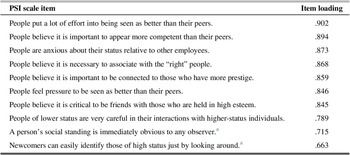
Because items had been removed or revised in the previous step (Hinkin, Reference Hinkin1998), we conducted a third EFA on the revised 24-item scale using a third independent sample of 290 working adults. These data were collected as part of a separate multiwave data collection that surveyed employed alumni of a US state university. Forty-one percent of this sample was male, and the average age was 34 years (SD = 7.5). All items were anchored with “in this organization,” and sample items included “people put a lot of effort into being seen as better than their peers” and “it is important to be connected to those who have more prestige.” As before, the scree plot and eigenvalues indicated one primary factor (accounting for 71 percent of the variance) along with several secondary factors. We removed items with high cross-loadings >.30 (Fabrigar et al., Reference Fabrigar, Wegener, MacCallum and Strahan1999) and retained the strongest eight items (with loadings >.70) from factor 1. We also retained two items from factor 2 that addressed the extent to which status distinctions are easily observable in the work context (i.e., “newcomers can easily identify those of high status just by looking around” and “a person’s social standing is immediately obvious to any observer”). Our goal in selecting items was to create a concise measure—comprising the minimum number of items necessary to “adequately tap the domain of interest” while minimizing the potential for respondent fatigue (Hinkin, Reference Hinkin1998: 111). The final ten-item scale demonstrated high internal consistency (α = .96) in this sample, well above the minimum .70 (Hinkin, Reference Hinkin1998: 115). See Table 1 for the final scale, which respondents rated on a 5-point Likert scale ranging from 1 (strongly disagree) to 5 (strongly agree).
Items and Item Loadings from Exploratory Factor Analysis

Note. The PSI scale instructions read as follows: “Identify the extent to which each of the following statements is characteristic of the organization you currently work for. Please answer in terms of how the organization really is , rather than how you would have preferred it to be. Remember that your organization is completely anonymous to us.” Scale items were then preceded with “In this work organization.” Items were rated on a 5-point Likert scale ranging from 1 (strongly disagree) to 5 (strongly agree).
a These two items loaded on a second factor in the initial EFA analysis. We retained them in our final scale because they reflect the extent to which status distinctions are easily observable in the work context, which is an important content domain of PSI. Because we theorize PSI as a single-dimensional construct, we constrained the number of factors to be 1 in this EFA analysis.
Convergent and Discriminant Validity
We also used this same sample to assess PSI’s convergent and discriminant validity. As described earlier, extant research has tended to characterize status as a characteristic of an individual, including as an individual difference or as a person’s (perceived) rank in a workplace hierarchy. Need for prestige, for example, reflects a person’s desire or motivation to “attain influence by garnering the respect of group members” (Mead & Maner, Reference Mead and Maner2012: 577). To the extent that individuals with a high need for prestige are more attuned to status cues within their work environment, PSI should be positively related to need for prestige. However, we also expect that the need for prestige will be distinct from PSI because PSI represents a broader concept; that is, PSI is primarily driven by a person’s impressions of the status dynamics in a work context. Following prior research (e.g., Maner, DeWall, Baumeister, & Schaller, Reference Maner, DeWall, Baumeister and Schaller2007; Maner & Mead, Reference Maner and Mead2010; Mead & Maner, Reference Mead and Maner2012), we measured need for prestige with Cassidy and Lynn’s (Reference Cassidy and Lynn1989) seven-item status aspiration subscale; sample scale items include “I like to be admired for my achievements” and “I want to be an important person in the community.”
In addition to need for prestige, relative status, or a person’s subjective perception of their current rank within a workplace hierarchy (Lount & Pettit, Reference Lount and Pettit2012), should be related to, but distinct from, PSI. Specifically, extant research suggests that relative status is positively related to PSI because, for instance, people who rank near the top engage in more social comparisons and may thus be more preoccupied with status dynamics (Garcia & Tor, Reference Garcia and Tor2007) than lower-ranking individuals. Moreover, individuals of high status, by virtue of their higher status, could be more preoccupied with potential threats to status than individuals with lower status because they have more to lose, which should lead to higher perceptions of PSI. Similar to need for prestige, we expect relative status to be distinct from PSI because PSI is a broader construct, capturing not an individual difference but a perception about the importance of status in the workplace context. We measured relative status with a three-item scale, in which participants were asked to rate themselves relative to others in their organization on the dimensions of status, prestige, and admiration (Lount & Pettit, Reference Lount and Pettit2012).
To test discriminant validity, we examined whether two variables that are theoretically unrelated to PSI were also unrelated to it empirically. For this purpose, we used locus of control (LOC) (Rotter, Reference Rotter1966), which represents people’s beliefs about whether the outcomes of their actions are contingent on what they do (internals) or on outside forces (externals). LOC should be unrelated to PSI because it is unlikely to vary across contexts and has no obvious theoretical links to PSI. We measured LOC with Levenson’s (Reference Levenson1973) six-item scale (e.g., “I believe that my success depends on ability rather than luck”). Similarly, we expect age to be unrelated to PSI because it is unclear why this demographic would be systematically associated with perceptions of the workplace context. We followed a three-step process (Ferris, Brown, Berry, & Lian, Reference Ferris, Brown, Berry and Lian2008): 1) we examined zero-order correlations between PSI and the aforementioned constructs; 2) for any construct that significantly correlated with PSI, we subjected the two constructs to confirmatory factor analysis (CFA) to determine whether a single-factor model or a two-factor model was a better fit; and 3) we examined if the average variance extracted (AVE) of each latent construct is higher than the squared correlation between the two constructs (Fornell & Larcker, Reference Fornell and Larcker1981; Ferris et al., Reference Ferris, Brown, Berry and Lian2008).
Consistent with our expectations, the correlational results suggested significant relationships in the projected direction between PSI and need for prestige (r = .13, p < .05) and relative status (r = .249, p < .001). Moreover, LOC (r = .053, ns) and age (r = .052, ns) were not related to PSI. Next, for each construct significantly related to PSI, we conducted a series of confirmatory factor analyses to compare a single-factor model to a two-factor model. According to Ferris et al. (Reference Ferris, Brown, Berry and Lian2008: 1356), “if the chi-square were significantly worse for the single-factor model than for the two-factor model, this would suggest that the proper way to model the scale items would be as loading on two separate latent factors.” In both cases, a chi-squared difference test supported the two-factor model as superior to the one-factor model, suggesting that the two constructs are separable from PSI: need for prestige, ∆χ2(1) = 92.62, p < .001; relative status, ∆χ2(1) = 12.20, p < .001. The distinctiveness of PSI from the two constructs was further supported by Fornell and Larcker’s (Reference Fornell and Larcker1981) test, showing that the average squared factor loadings of the scale items on PSI (AVE = .68) was higher than the highest squared correlation between PSI and its two related constructs (i.e., .06 between PSI and relative status). Given our findings in support of a reliable and valid measure of PSI that is distinct from related constructs, this ten-item scale was used to measure PSI. We now turn to the research design and sample used for hypothesis testing in study 1.
STUDY 1B: HYPOTHESES TESTS
Sample and Design
We tested hypotheses 1 and 2 in a multiwave survey among working adults. The independent and control variables were measured in wave 1, the mediator in wave 2, and the dependent variable in wave 3. To recruit respondents, we used the StudyResponse project,Footnote 2 a service that contacted working adults via email with an invitation to participate. Individuals who agreed to participate followed a link to an online survey. Only wave 1 participants were invited to complete the wave 2 survey, and similarly, only wave 2 participants were invited to complete wave 3. Participants were paid five dollars for completing each wave of the survey. The final sample, reflecting only those who completed all three surveys, was 225 participants (55 percent female; average age of 44 years, SD = 11.7). In a supplementary analysis of PSI, envy, and interpersonal deviance(defined as “behaviors directly harmful to other individuals within the organization” (Bennett & Robinson, Reference Bennett and Robinson2000: 349)), the final sample of participants who completed all three waves did not significantly differ from respondents who completed wave 1 and/or wave 2 only. Thus the attrition across waves is unlikely to have affected our results. The majority of our sample were US residents (97 percent) and had worked at their current organizations for an average of 10 years (SD = 7.4).
Measures
We measured PSI in wave 1 of the current study using the ten-item scale presented in Table 1. Participants rated each item on a 5-point Likert scale ranging from 1 (strongly disagree) to 5 (strongly agree) (α = .94). The mediator, workplace envy, was assessed in wave 2 using Vecchio’s (Reference Vecchio and Ferris1995) widely used five-item scale (sample item: “Most of my co-workers have it better than I do”; α = .87). The items were anchored on a 5-point Likert scale ranging from 1 (strongly disagree) to 5 (strongly agree). We used Bennett and Robinson’s (Reference Bennett and Robinson2000) scale to measure interpersonal deviance in wave 3. Participants rated how often over the past year they had engaged in harmful deviant behaviors targeted at coworkers (i.e., interpersonal deviance; seven items). Behaviors were reported on a 7-point Likert scale ranging from 1 (never) to 7 (daily). A sample item is “acted rudely toward someone at work” (α = .90).
We included four control variables in our regression analysis (see the “Results” section) that may account for the relationships between the theoretical variables. The first was gender (coded as 1 for male, 2 for female), which was included because prior work suggests that responses to status concerns differ by gender (e.g., Huberman et al., Reference Huberman, Loch and Öncüler2004; Fiske, Reference Fiske, Fiske and Gilbert2010) and that gender may differentially influence deviance (e.g., Berry, Ones, & Sackett, Reference Berry, Ones and Sackett2007). Second, we measured participants’ need for social status using Flynn and colleagues’ (Reference Flynn, Reagans, Amanatullah and Ames2006) eight-item scale. Need for status emphasizes individuals’ motivation toward status. We included this variable to account for differences in people’s stable tendencies to pay attention to and desire status. Scale items were measured on a 5-point Likert scale ranging from 1 (strongly disagree) to 5 (strongly agree). Sample items include “I want my peers to respect me and hold me in high esteem” and “I enjoy having influence over other people’s decision making” (α = .83). Third, we controlled for participants’ subjective status to account for differences in envy or deviance that may occur because an individual perceives that the individual occupies a lower or higher position in the hierarchy (Edelman & Larkin, Reference Edelman and Larkin2015; Galperin et al., Reference Galperin, Bennett and Aquino2011). Using a measure from Lount and Pettit (Reference Lount and Pettit2012), participants rated the degree to which their own status, prestige, and admiration differed from peers’ in their work environment on a 7-point Likert scale ranging from 1 (much less) to 7 (much more) (α = .93). Last, because the dependent variable was self-reported interpersonal deviance, we also controlled for social desirability bias using the thirteen-item short form of the Marlowe–Crowne Social Desirability Scale (Crowne & Marlowe, Reference Crowne and Marlowe1960; Reynolds, Reference Reynolds1982). A sample item is “I’m always willing to admit it when I make a mistake.” Following prior research (e.g., Hays, Hayashi, & Stewart, Reference Hays, Hayashi and Stewart1989; Moore, Detert, Treviño, Baker, & Mayer, Reference Moore, Detert, Treviño, Baker and Mayer2012), extreme answers were coded as 1 and summed, with the highest possible score (reflecting high social desirability bias) being 13.
Results
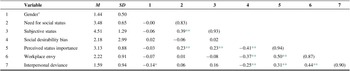
Table 2 includes the correlations, means, standard deviations, and scale reliabilities (where applicable) for the variables in our model. To assess construct independence among the study 1B variables, we conducted a CFA with maximum likelihood estimation on the items representing PSI, workplace envy, subjective status, need for status, and interpersonal deviance. The expected five-factor structure, χ2(485) = 1417.4, had superior model fit compared to any alternative models in which we combined two or more factors into one, including a four-factor model that combined PSI and workplace envy, ∆χ2/∆df = 462.4/4, p < .01, and a three-factor model that combined PSI, envy, and subjective status, ∆χ2/∆df = 544.5/7, p < .01. The final five-factor model showed acceptable fit based on the root-mean-square error of approximation (RMSEA = .09) and standardized root-mean-square residual (SRMR = .08) (Browne & Cudeck, Reference Browne, Cudeck, Bollen and Long1993; MacCallum, Browne, & Sugawara, Reference MacCallum, Browne and Sugawara1996). The comparative fit index (CFI = .84) and Tucker–Lewis index (TLI = .83) fit indices fell marginally below the conventional cutoff of .90Footnote 3 but were stronger for the theorized five-factor model than for the alternative models.
Means, Standard Deviations, Correlations, and Reliabilities for Study 1B

Note. Reliability estimates appear on the diagonal. N = 211.
a Male = 1; female = 2.
* p < .05.
** p < .01.
Hypothesis 1 proposed a direct and positive relationship between PSI and workplace envy. Using multivariate regression, we tested this hypothesis by regressing envy onto PSI while controlling for participants’ gender, need for social status, subjective status, and social desirability bias.Footnote 4 Referring to Table 3, the results support hypothesis 1, β = 0.44, p < .01.
Results of the Regression Analyses for Study 1B

Note. Unstandardized coefficients are reported (standardized coefficients are in parentheses).
a Male = 1; female = 2.
* p < .05.
** p < .01.
In hypothesis 2, we predicted that envy would mediate the relationship between PSI and interpersonal deviance. Following Preacher and Hayes (Reference Preacher and Hayes2004; cf. Hayes, Reference Hayes2009, Reference Hayes2013), we used bootstrapping procedures with ten thousand resamples to estimate the indirect effect of PSI on employee deviance through envy. The 95 percent bias-corrected bootstrap confidence interval (hereinafter CI) did not include zero (CI [.11, .33]), indicating a significant indirect effect of PSI on interpersonal deviance through envy (indirect effect = .20). Thus hypothesis 2 is supported.
Study 1B Discussion
The results of study 1B support hypotheses 1 and 2, suggesting that individual employee perceptions of the importance of status in a work context are associated with envy and that envy mediates the relationship between PSI and interpersonal deviance. However, study 1B used self-report survey data, and our results were unable to demonstrate causality. To address this concern, we designed study 2 as an additional test of our model (PSI → envy → interpersonal deviance) using an experimental design that directly manipulates PSI and measures coworker undermining behavior (a form of interpersonal deviance).
STUDY 2
Sample and Design
In study 2, we tested our mediation model using a 1 × 2 experimental design. Respondents in an online survey were instructed to take on the role of a coworker and provide a peer evaluation for another employee with whom they had recently worked. We used a scenario to manipulate the independent variable, PSI; the mediator, workplace envy, was rated by the respondent; and the dependent variable, interpersonal deviance, was assessed by giving the respondent the opportunity to undermine the coworker with a poor peer evaluation, which would ostensibly be used by a manager to decide who would be assigned to a desirable subsequent project. The peer evaluation asked the subject to rate whether the coworker was a team player and to provide open-ended, written comments, which were later coded for undermining by a three-person expert panel who were unaware of the purpose of the study.
We used Amazon’s Mechanical Turk to recruit participants. Participants were required to be employed full-time (35 hours or more) and were paid two dollars for their participation. We removed 11 participants for failing both attention checks or for failing to complete the performance review (dependent variable). Our final sample consisted of 191 participants.Footnote 5 Twenty-five percent of participants were female, 68 percent held a managerial or supervisory role in their own organizations, and the average age was 35 years (SD = 8.99).
We developed a scenario with two manipulated conditions (high PSI and low PSI) that was presented to participants in two parts (see the appendix). In part 1, we manipulated participants’ perceptions of the importance of status using a vignette that described the extent to which employees in a marketing firm were paying attention to status and status differences among each other. The vignette in the low-PSI condition read that status differences were not emphasized and people cared little about status, whereas participants in the high-PSI condition read about how status differences were strongly emphasized and people were very preoccupied with status. We instructed participants to imagine they had been working for that organization for a few years. After completing the manipulation check and workplace envy scales (described later), participants were presented with part 2 of the vignette. Part 2 instructed participants to imagine that they had recently completed a project with a coworker, Alex (a gender-neutral name). The vignette described the project as successful and delivered on time and noted both pluses and minuses of working with Alex (e.g., Alex had valuable skills, but Alex and the participant’s work styles differed). The information provided was purposefully ambiguous, thus allowing participants flexibility in what to focus on and/or report in the peer evaluation. The dependent variable, collected next, was participants’ peer evaluation of their coworker.
As a manipulation check, and after reading the company description, participants completed the ten-item PSI scale (developed in study 1). Participants were instructed to “imagine that you are a member of this organization” and respond to the scale items on a 5-point Likert scale ranging from 1 (strongly disagree) to 5 (strongly agree) (α = .98). The means of the PSI conditions followed the expected pattern (Mlow PSI = 2.15 vs. Mhigh PSI = 4.25), and results from a one-way analysis of variance comparing the low- and high-PSI conditions were significant, F = 226.04, p < .01, suggesting that the PSI manipulation was successful.
Measures
Workplace Envy
We adapted the five-item workplace envy measure used in study 1 (Vecchio, Reference Vecchio and Ferris1995) to capture participants’ expected feelings of workplace envy in the hypothetical scenario (“Please indicate the likelihood you would feel or think the following”). For instance, one of the original items was “It is somewhat annoying to see others have all the luck in getting the best assignments,” which we adapted to “I imagine I would be annoyed to see other coworkers getting the best assignments.” Participants rated items on a 5-point Likert scale ranging from 1 (not at all likely) to 5 (extremely likely) (α = .90).
Interpersonal Deviance
Participants were instructed to complete a peer evaluation of Alex (“As is customary in your organization, you’re now being asked to evaluate the performance of your coworker on this recent project”) and informed that this evaluation would be read by the boss and used to determine whether Alex or the participant would be selected for an “important new team project with a high-profile client” that “would certainly help advance your [the participant’s] career.” We used participants’ peer evaluations of Alex to measure interpersonal deviance in two ways. First, respondents were given the opportunity to undermine Alex by rating Alex on a three-item scale of teamwork that we developed for this study and which we told the respondents would be used by a manager to decide on who (the respondent or Alex) would be assigned to work on a new, attractive, high-profile, and exciting project. The items were “Was able to work well with others,” “Displayed a cooperative attitude,” and “Worked well with fellow employees without friction,” α = .88, rated from 1 (unsatisfactory) to 5 (exceptional). An evaluation of Alex on teamwork was a subtle way of capturing potential undermining because the description of Alex’s teamwork in the vignette was purposefully written to be ambiguous—it offered both strengths and potential weaknesses of Alex, so choosing to focus on weaknesses and ignoring strengths by rating Alex lower in teamwork is suggestive of undermining.
In the second measure of undermining, participants were instructed to provide open-ended performance feedback using the following prompt: “In your own words, what feedback about Alex’s performance do you think is important for your boss to know when deciding which of you will be assigned to the new high-profile project?” Sample responses include “Alex can be a bit stubborn about his opinions. He doesn’t like to compromise when clashing on ideas with a coworker. He thinks his way is the right way” and “Alex did a great job, and was essential to getting this project completed. Alex can definitely be trusted with more responsibility, as they have shown their ability in this project.” An expert panel comprising three doctoral students with research experience, but who were unaware of the purpose of the study, rated the 177 open-ended responsesFootnote 6 on two dimensions of deviance: “To what extent do you think the respondent intended to harm Alex’s chances of being assigned to the new team project?” and “To what extent do you think the respondent intended to undermine Alex’s chances of being assigned to the new team project?” Items were rated on a scale from 1 (I don’t think the respondent intended to harm/undermine Alex’s chances) to 5 (I think the respondent had a very clear intention to harm/undermine Alex’s chances). The mean interrater agreement (rwg (j)) for this two-item deviance measure was .88 (median rwg (j) = .96), suggesting high levels of agreement.
Results
Table 4 presents the correlations, means, standard deviations, and scale reliabilities (where appropriate) for the variables in study 2. To test the direct and positive relationship between PSI and workplace envy (hypothesis 1), we regressed envy on the PSI manipulation. Referring to Table 5, the results support hypothesis 1, β = 0.44, p < .01.
Means, Standard Deviations, Correlations, and Reliabilities for Study 2

Note. Reliability estimates appear on the diagonal. N = 191.
a High PSI condition = 1; low PSI condition = 0.
b The sample size was 177 for correlations involving this variable.
c The reliability was based on the average ratings across the three expert raters for the two items.
* p < .05.
** p < .01.
Results of Regression Analyses Testing Hypotheses for Study 2

Note. Unstandardized coefficients are reported (standardized coefficients in parentheses).
a N = 191.
b N = 177.
c High PSI condition = 1; low PSI condition = 0.
d 95% bias-corrected confidence intervals based on bootstrapping with 10,000 replicates.
* p < .05.
** p < .01.
To test hypothesis 2, we used bootstrapping procedures with ten thousand resamples (Preacher & Hayes, Reference Preacher and Hayes2004) to estimate the indirect effect of PSI condition on interpersonal deviance through envy. For the first measure (teamwork evaluation), the 95 percent bias-corrected bootstrap confidence interval did not include zero for ratings of envy target’s teamwork (CI [−.40, −.07]), indicating a significant indirect effect of the PSI condition on this measure of interpersonal deviance through envy (indirect effect = −.22). The second measure of interpersonal deviance (expert ratings of the open-ended responses), however, was not related to interpersonal deviance, β = −.12, n.s. Thus the indirect effect of PSI on this deviance measure was insignificant (CI [−.29, .03]). However, the direct effect of the PSI manipulation on the expert raters’ measure of interpersonal deviance was significant and in the expected direction, β = 0.29, p < .001.
Study 2 Discussion
Study 2 was designed to complement study 1B by establishing causality and reducing concerns about common method bias. We manipulated PSI, assessed workplace envy via self-report, and gave participants the opportunity to undermine a coworker using a peer evaluation that would ostensibly determine which of the two would be assigned to a high-profile team project that would likely advance that person’s career. The results provide additional support for our hypothesized model, demonstrating that a high-PSI environment has a significant indirect effect on undermining (i.e., rating a coworker with whom one is competing for an important opportunity poorly on teamwork) via workplace envy. Although the indirect effect using ratings of undermining by an expert panel was not significant, our results did reveal a significant and positive direct effect of the PSI manipulation on the expert panel’s ratings of undermining, consistent with our theorizing. We speculate that the expert ratings did not have the expected effect on envy because it was difficult for the raters to ascertain intentions (which we asked them to do) based on the written responses.
STUDY 3
Sample and Design
In study 3, we used a survey-based field study to again replicate our model and also examined the attenuating effect of CSE on the relationship between PSI and envy. Invitations to participate in a multiwave survey study were sent to a random sample of 4,820 alumni from a large US public university in the Midwest. Alumni received a letter through the mail explaining the purpose of the study and inviting those who were currently employed to complete the first wave of an online survey using the link and unique ID provided in the letter. Participants were informed that for each wave of the survey they completed, they would receive an art print from a local artist connected to the university. Only participants who completed the wave 1 survey received an invitation to participate in wave 2, and so forth. Each wave of the survey was separated by approximately three months. In total, 409 participants completed wave 1, 363 participants completed wave 2, and 221 participants completed wave 3. The final sample included a total of 195 participants with matched responses across the three waves. A supplementary analysis showed that the final analysis sample did not differ from those excluded from our analysis in terms of the sample statistics of the four study variables. Thus the attrition is unlikely to have affected our results. Owing to missing values in some of the study variables, the final sample for analyses testing the hypotheses was 191. Among them, 59 percent were female, with an average age of 33.72 years.
Measures
The independent, dependent, and mediator variables were measured using the same scales as in study 1. PSI was measured in wave 2 (α = .88) and workplace envy (Vecchio, Reference Vecchio and Ferris1995; α = .83) and interpersonal deviance (Bennett & Robinson, Reference Bennett and Robinson2000; α = .81) were measured in wave 3.
The moderator, CSE, was created by averaging four scales—self-esteem, LOC, general self-efficacy, and neuroticism (reverse scored). All four scales were measured in wave 1 using a 7-point Likert scale ranging from 1 (strongly disagree) to 7 (strongly agree). Self-esteem and generalized self-efficacy were measured using six items each from the International Personality Item Pool (IPIP; Goldberg, Reference Goldberg, Mervielde, Deary, De Fruyt and Ostendorf1999). Sample items for self-esteem and generalized self-efficacy include “I know my strengths” (α = .81) and “I complete tasks successfully” (α = .88), respectively. LOC was measured using Levenson’s (Reference Levenson and Lefcourt1981) six-item scale (e.g., “A great deal of what happens to me is probably just a matter of chance” [reverse scored], “I believe that my success depends on ability rather than luck”; α = .66). Finally, neuroticism was measured using ten items from Goldberg’s (Reference Goldberg, Mervielde, Deary, De Fruyt and Ostendorf1999) IPIP. Sample items included “I get stressed out easily,” “I often feel blue,” and “I worry about things” (α = .89).
As with study 1, we controlled for gender (coded as 1 for male, 2 for female), need for social status (eight items; α = .83), and subjective status (three items; α = .82). The same measures described in study 1 were used to measure the latter two variables in wave 1. The results testing the hypotheses were unchanged when we included fewer or none of these three control variables.
Results
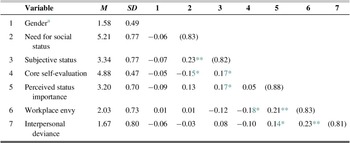
Table 6 includes the descriptive statistics and zero-order correlations for the variables in our model. We conducted a CFA to test the measurement model that includes CSE, PSI, workplace envy, subjective status, need for status, and interpersonal deviance. In this model, CSE was specified as a higher-order factor represented by four subdimensions (i.e., self-esteem, general self-efficacy, neuroticism, and LOC), which were further indexed by the corresponding items. This higher-order factor was specified to covary with the other five factors representing the remaining constructs in our study. This hypothesized factor structure did not fit the data well, χ2(1,750) = 3090.01, with some fit indices (i.e., RMSEA = .06, SRMR = .08) passing the conventional cutoff values, but others falling below the cutoff values (i.e., CFI =.76, TLI = .75). The low values of CFI and TLI were attributed to the relatively low factor loadings of the reverse-scored items. Because we had a total of 11 reverse-scored items out of the 61 items, the results for CFI and TLI are not surprising. In addition, the hypothesized factor structure had a superior model fit compared to any alternative models in which we combined two or more factors into one, including a model that combined PSI and workplace envy, ∆χ2/∆df = 375.3/5, p < .01, and a model that combined PSI, envy, and interpersonal deviance, ∆χ2/∆df = 767.47/9, p < .01. Given that we used established measures and that the hypothesized model is superior to alternative models, we kept the reverse-scored items in computing the scales.
Means, Standard Deviations, Correlations, and Reliabilities for Study 3

Note. Reliability estimates appear on the diagonal. N = 189 (listwise).
a Male = 1; female = 2.
* p < .05.
** p < .01.
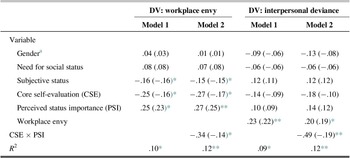
Hypothesis 1 predicts a positive relationship between PSI and workplace envy. As reported in Table 7 (model 1), the results support hypothesis 1, β = .23, p < .05. Consistent with hypothesis 2, workplace envy was positively related to interpersonal deviance, β = .22, p < .05 (model 1 of Table 7). To test hypothesis 2, which predicts a positive and indirect effect of PSI on interpersonal deviance through envy, we used bootstrapping procedures with ten thousand resamples. We found that the 95 percent bias-corrected bootstrap confidence interval of the indirect effect (indirect effect = .06) did not include zero (CI [.02, .14]). Results thus support hypothesis 2.
Regression Results Testing the Hypotheses (Hypotheses 1–4) for Study 3

Note. Unstandardized coefficients are reported (standardized coefficients in parentheses).
a Male = 1; female = 2.
* p < .05.
** p < .01.
Hypothesis 3 predicts that CSE moderates the relationship between PSI and workplace envy. As reported in Table 7 (model 2), the proposed interaction effect was significant, β = −.14, p < .05. We plotted this interaction in Figure 1. Simple slope analyses showed that PSI was positively related to workplace envy when CSE was low (−1SD), b = .43, se = .12, p <.001, but this relationship was not significant when CSE was high (+1SD), b = .11, se = .10, p =.29. Results thus supported hypothesis 3. Although not hypothesized, the interaction between CSE and PSI was significant in predicting interpersonal deviance, β = −.19, p < .01 (model 2). As presented in Figure 2, PSI contributed to interpersonal deviance among employees with relatively low CSE (−1SD; simple slope = .37), se = .12, p <.01, but it did not affect those with high CSE (+1SD; simple slope = −.09), se = .10, p =.39.
Study 3 the Interaction between Perceived Status Importance (PSI) and Core Self-Evaluation in Predicting Workplace Envy

Study 3 the Interaction between Perceived Status Importance (PSI) and Core Self-Evaluation in Predicting Interpersonal Deviance

To test the proposed moderated mediation effect (hypothesis 4), we examined the conditional indirect effects, that is, the indirect effect of PSI on interpersonal deviance at both high (+1SD) and low (−1SD) levels of CSE. We used bootstrapping procedures with ten thousand resamples to obtain the 95 percent confidence interval of the conditional indirect effect. Results showed that the indirect effect of PSI on interpersonal deviance as mediated by workplace envy was positive and significant when CSE was low (conditional indirect effect = .09; CI [.02, .19]). However, this indirect effect was not significant when CSE was high (conditional indirect effect = .02; CI [−.01, .09]). Hypothesis 4 was therefore supported.
GENERAL DISCUSSION
Scholars are paying increasing attention to the “dark side” of status. Whereas much of this work has treated status as an individual ranking, we have focused on better understanding employee perceptions of the importance of status in their work environments. We developed a new status-related construct, PSI, and offered a reliable, valid measure that can be used in future research. We also drew on social comparison theory to suggest that PSI will affect unethical conduct (harm to fellow employees) by triggering workplace envy. Across three complementary studies (two multiwave survey studies and an experimental study), our results supported the idea that when employees perceive that others in their work environment are highly preoccupied with status (i.e., when employees’ PSI is high), they are more likely to experience envy and, subsequently, to engage in interpersonal deviance. Study 3 found that a person’s CSE attenuates this effect of PSI on envy—thus suggesting that people who think more positively about themselves are less negatively influenced when they perceive that others within their work environment are highly preoccupied with status. Overall, our research suggests that, despite the ubiquity of status hierarchies in organizations, differences in perceptions of the importance of status in work contexts matter for how employees feel and for how they treat others. Thus PSI provides a new lens for behavioral ethics scholars and others interested in understanding the relationship between status and unethical behavior in organizations.
Contributions
Our research makes several contributions. First, while the dark side of status has previously received attention within the behavioral ethics literature, this work has focused on status as an individual’s rank position in the organization (Djurdjevic et al., Reference Djurdjevic, Stoverink, Klotz, Koopman, da Motta Veiga, Yam and Chiang2017). This rank-oriented approach, though valuable, is unable to provide a complete picture of status dynamics in the workplace and leaves organizations relatively powerless to mitigate the potential negative effects that are associated with status (with the desire to gain it or to avoid losing it). Thus our research moves the conversation (for both behavioral ethics scholars and organizational decision makers) in a direction that considers the idea that employees perceive the importance of status within their work context by observing their colleagues’ preoccupation with status and that such perceptions influence their unethical behavior.
Second, our research draws on social comparison theory to develop our hypotheses and highlights the importance of considering how organizational members acquire and process relevant social information—processes that seem relevant for understanding ethical and unethical conduct. However, in the behavioral ethics literature, social comparison theory has rarely been used, except in studies, like ours, that examine envy (Duffy et al., Reference Duffy, Lee and Adair2021; Moore & Gino, Reference Moore and Gino2013), even though social comparison was integral to equity theory (Adams, Reference Adams1965), an organizational justice domain related to organizational ethics (for a review and encouragement to revitalize social comparison theory in organizational studies, see Greenberg et al., Reference Greenberg, Ashton-James and Ashkanasy2007). We believe that behavioral ethics scholars could benefit from considering the relevance of social comparison theory in future work. For instance, research on social comparison processes finds that people sometimes choose to assimilate themselves to external standards and sometimes choose to diverge from those standards (Mussweiler, Reference Mussweiler2003; Mussweiler, Rüter, & Epstude, Reference Mussweiler, Rüter and Epstude2004). Future work might, therefore, consider how social comparison processes could inform when employees adopt unethical standards from comparison others like peers, allowing unethical behavior to spread (cf. Ashforth & Anand, Reference Ashforth and Anand2003; Den Nieuwenboer & Kaptein, Reference Den Nieuwenboer and Kaptein2008). It might also help us understand how others’ ethical behavior can become the more compelling standard to adopt.
Third, classic research in behavioral ethics has focused on the importance of employees’ perceptions of the work context—including individual employee perceptions of ethical culture (Treviño, Butterfield, & McCabe, Reference Treviño, Butterfield and McCabe1998) and ethical climate (Victor & Cullen, Reference Victor, Cullen and Frederick1987)—for explaining and predicting different types of unethical conduct. In recent years, relatively little attention has been given to the influences of employee perceptions of the organizational context (Mitchell, Reynolds, & Treviño, Reference Mitchell, Reynolds and Treviño2017). While the idea that employee perceptions of context matter for understanding employee unethical behavior is not new, what we offer to behavioral ethics scholarship is the importance of considering perceptions of the status dynamics in an organization, which can trigger powerful negative emotions and harmful interpersonal behavior. Understanding perceptions of status dynamics at work may be relevant in other ways. For example, perceptions of status dynamics may raise distributive and procedural fairness issues among employees, with unfortunate consequences, or they may lead to less problematic outcomes when other aspects of the ethical infrastructure are strong (a point to which we return shortly).
Fourth, this research enhances scholars’ understanding of status more broadly. According to Anderson and colleagues (Reference Anderson, Brion, Moore and Kennedy2012), little research has examined the antecedents of status-striving behavior, and much of this work has treated variables related to status seeking as dispositional, such as the need for status (Flynn et al., Reference Flynn, Reagans, Amanatullah and Ames2006), a general concern for status (Blader & Chen, Reference Blader and Chen2011), and the need for prestige (Cassidy & Lynn, Reference Cassidy and Lynn1989; Mead & Maner, Reference Mead and Maner2012). PSI instead proposes that we should think about the emphasis on status in the workplace and how much perceptions of fellow employees’ preoccupation with status in the work environment matter. We found support for the proposed model while controlling for the individual’s subjective status, or the perception that the individual occupies a lower or higher position in the hierarchy (Edelman & Larkin, Reference Edelman and Larkin2015; Galperin et al., Reference Galperin, Bennett and Aquino2011), suggesting that PSI is predictive of envy and interpersonal deviance beyond the influence of a person’s status ranking (the focus of previous research). Thus we demonstrate empirically the value of going beyond individual status rank to study status-related phenomena in organizations from the perspective of perceived status dynamics.
Fifth, this research expands scholars’ understanding of the role of envy in the workplace. Envy has previously been related to negative outcomes, such as undermining of fellow employees (Duffy et al., Reference Duffy, Scott, Shaw, Tepper and Aquino2012). But much less is known about the antecedents of envy in the workplace. The results support the idea that PSI operates as an antecedent of workplace envy such that employees who perceive that people within their work environment are preoccupied with status will be more aware of their standing vis-à-vis others, thus enhancing social comparisons and the likelihood that the employee will experience envy. Consequently, our research answers calls within the behavioral ethics literature (e.g., Duffy et al., Reference Duffy, Lee and Adair2021; Duffy, Shaw, & Schaubroeck, Reference Duffy, Shaw, Schaubroeck and Smith2008) to further consider (both conceptually and empirically) the antecedents of envy. Understanding the antecedents, as well as how envy might be attenuated, is particularly important because of the mostly negative outcomes associated with envy in organizations (e.g., Cohen-Charash & Mueller, Reference Cohen-Charash and Mueller2007; Duffy et al., Reference Duffy, Scott, Shaw, Tepper and Aquino2012).
Future Research Opportunities
This research suggests additional opportunities for future scholarship. Given our findings linking PSI to envy and interpersonal deviance, future research may wish to explore more precisely the specific status-related characteristics of work environments that influence employees’ perceived preoccupation with status (Li et al., Reference Li, Chen and Blader2016). For example, performance management systems may be particularly important. Engaging in highly interdependent work should also increase perceptions of status importance because such work requires frequent interaction, which invites more social comparison and more opportunities for status concerns. The type of work may also influence the amount and usefulness of the information that is available to make social comparisons (Goodman & Haisley, Reference Goodman and Haisley2007) and thereby affect PSI. For example, with shift work, distributed work, or work in virtual contexts, status is more difficult to assess because less information is available to make status comparisons (Greenberg et al., Reference Greenberg, Ashton-James and Ashkanasy2007). Given the ubiquity of status in organizations, does this difficulty reduce or increase the importance of these status comparisons? This question seems particularly relevant for the pandemic and postpandemic work environments.
Future scholarship could also investigate whether the effects of PSI are different depending on a person’s rank or level within the organization. For example, some might argue that higher-status employees may be less concerned with status than others. However, existing research suggests that status attainment, threats, and maintenance matter to people of all ranks. For example, Pettit and colleagues (Reference Pettit, Doyle, Lount and To2016) found that status threats have similar effects on higher- and lower-status individuals. Both groups are more likely to engage in cheating in response to such threats. This is consistent with the idea that people tend to compare themselves to similarly positioned others and not necessarily with others of (much) higher status (cf. Buunk & Gibbons, Reference Buunk and Gibbons2007). Thus higher-status individuals are likely to be similarly concerned about losing status as lower-status individuals.
Researchers may also consider whether high levels of PSI are always associated with negative outcomes. For example, is it possible for a benevolent ethical climate (Victor & Cullen, Reference Victor, Cullen and Frederick1987) to coexist alongside perceptions of higher PSI and thus temper some of the latter’s negative effects? Indeed, PSI could be unrelated to envy in contexts where people earn status by acting in prosocial ways. Or, akin to work on the effects of extrinsic rewards on motivation (Gagné & Deci, Reference Gagné and Deci2005), it may matter how employees perceive the systems for attaining status in their organizations. If employees believe that attaining status is possible, and that the systems for doing so are transparent and fair, how does this influence their response to seeing others in their work environment being highly preoccupied with status? Furthermore, researchers may wish to investigate whether an optimal level of attention to status can be achieved, one that motivates employees without producing negative effects.
Last, research on status in organizations more generally (Magee & Galinsky, Reference Magee and Galinsky2008) may inform future thinking about the relationship between status and ethics. For example, behavioral ethics scholars have begun to consider how symbols might be used to communicate an employee’s values and influence others’ (including leaders’) behavior (e.g., Desai & Kouchaki, Reference Desai and Kouchaki2017). Future work might consider if one’s status in the organization plays a role in this relationship. For instance, to what extent do symbols have the same outcomes across low- and high-status organizational members? Might ethical symbols lead a person to be viewed as low status in certain environments (similar to the dynamics seen in the Enron scandal)? Related to status and ethics more generally, does having higher status automatically implicate perceptions of one’s ethics? Might observers wonder what one “had to do” to achieve a higher status in the organization, especially in environments where people are generally very concerned about their status? Finally, to what extent are those who are perceived to have higher status (formal or informal) more likely to be able to influence the ethical conduct of other organizational members?
Implications for Managers
While status remains ubiquitous in organizations, we find that employees vary in their perceptions of how important status is in their work contexts and that these perceptions significantly impact envy and employee interpersonal deviance. Thus our research has important implications for organizational decision makers who wish to prevent employee interpersonal deviance. In particular, managers should be concerned about employees’ perceptions of status importance and should evaluate how the organization (intentionally or unintentionally) communicates status differences among employees. Managers may also consider surveying employees to better understand how employees perceive their work environments with regard to PSI and whether changes are warranted. For example, if PSI is high among some employees or in some parts of the organization, the prominence of symbols and signals that convey status information might be altered through management action as well as policy and culture change. Future research can, it is hoped, inform such action and change by providing more specific guidance.
CONCLUSION
Organizations differ in the extent to which they emphasize the importance of status. Some go to great lengths to minimize status differences, whereas others explicitly overemphasize differences in status. This research aimed to examine these differences and to shift behavioral ethics scholars’ conversation about status and unethical conduct from concerns about individual status rank to an approach that examines people’s perceptions of the status context in their work environments and the impact of those perceptions on interpersonal deviance. In so doing, we offer a new take on the “dark side” of status that not only has practical implications for organizational decision makers but also encourages future scholarship aimed at better understanding status dynamics and ethics in the workplace.
Supplementary Materials
To view supplementary material for this article, please visit http://doi.org/10.1017/beq.2022.2.
Acknowledgments
We extend our thanks to David Harrison, Stephen Humphery, and Nathan Pettit, as well as to the participants of the 2014 Behavioral Ethics Workshop at the University of Central Florida, for their helpful feedback on earlier drafts. We also thank Scott Reynolds and our anonymous reviewers for their constructive feedback throughout the review process. We extend our appreciation to the Markkula Center for Applied Ethics at Santa Clara University, which supported this research with a Hackworth Research Grant, and to the Alumni Association of the University of Arkansas, which also helped fund some of this research.
Niki A. den Nieuwenboer (niki@ku.edu, corresponding author) is an associate professor of organizational behavior and business ethics at the University of Kansas School of Business. Her primary research focus is behavioral ethics. More recently, she has begun working on dignity and dyslexia in the workplace. Den Nieuwenboer’s research has been published in Organization Science, Organizational Behavior and Human Decision Processes, the Annual Review of Psychology, and the Journal of Business Ethics. Dr. Den Nieuwenboer received her PhD from the Rotterdam School of Management, Erasmus University in the Netherlands. Prior to obtaining her degree, she worked for KPMG Forensic in Belgium.
Jennifer J. Kish-Gephart is an associate professor of organization studies at the Isenberg School of Management at the University of Massachusetts in Amherst. Her research interests include behavioral ethics, social class, and inequality. Kish-Gephart’s research has been published in top-tier management outlets, including the Academy of Management Journal, Academy of Management Review, and the Journal of Applied Psychology. In 2013, Kish-Gephart was a finalist for the 2013 Academy of Management Review Best Paper of the Year award. She also serves on the editorial board of the Academy of Management Journal, Business Ethics Quarterly, and the Journal of Management.
Linda K. Treviño is University Distinguished Professor of organizational behavior and ethics in the Smeal College of Business at Pennsylvania State University. She has published more than ninety peer-reviewed articles and three books, including a textbook in its eighth edition. She is an elected member of the Academy of Management Fellows. Ethisphere named her one of business ethics’ one hundred most influential people in 2015. In 2018, her research was named among the most impactful because of its representation in management textbooks, and it was ranked in the top 1 percent by citations in Web of Science from 2006 to 2016.
Ann C. Peng is an associate professor of management and the Raymond W. Lansford Distinguished Professor of Leadership at the Trulaske College of Business of the University of Missouri. Peng’s research interests include leadership, stress, and employee performance. She has published her research in reputable journals like the Academy of Management Journal and the Journal of Applied Psychology. Peng serves on the editorial boards of the Academy of Management Journal, the Journal of Applied Psychology, Personnel Psychology, and the Journal of Organizational Behavior, and she is currently an action editor at the Journal of Leadership and Organizational Studies.
Iris Reychav is a professor of industrial engineering and management and head of the Collaborative Learning Technology Lab at Ariel University. Her current research interests include knowledge management technologies, mobile learning, and big data technologies in health and education. She recently coedited a book titled Impacts of Information Technology on Patient Care and Empowerment.