Nancy Stark Smith and the Early Years of Contact Improvisation
Nancy Stark Smith first encountered Contact Improvisation in January 1972. Smith was an undergraduate at Oberlin College and the avantgarde dance collective The Grand Union was visiting from New York City for a month-long residency. This gave Smith, an eager undergraduate student of writing and dance, an opportunity to study with performers such as Yvonne Rainer, Steve Paxton, Barbara Dilley, David Gordon, Nancy Lewis, and Lincoln Scott.Footnote 1 For Smith, the improvised performances and workshops offered by these downtown dance luminaries instigated a “total mind and body swerve” (in Koteen and Smith Reference Koteen and Smith2008:60). The work was adventurous and unlike anything she’d ever seen, full of thrilling new energies and possibilities for dance.
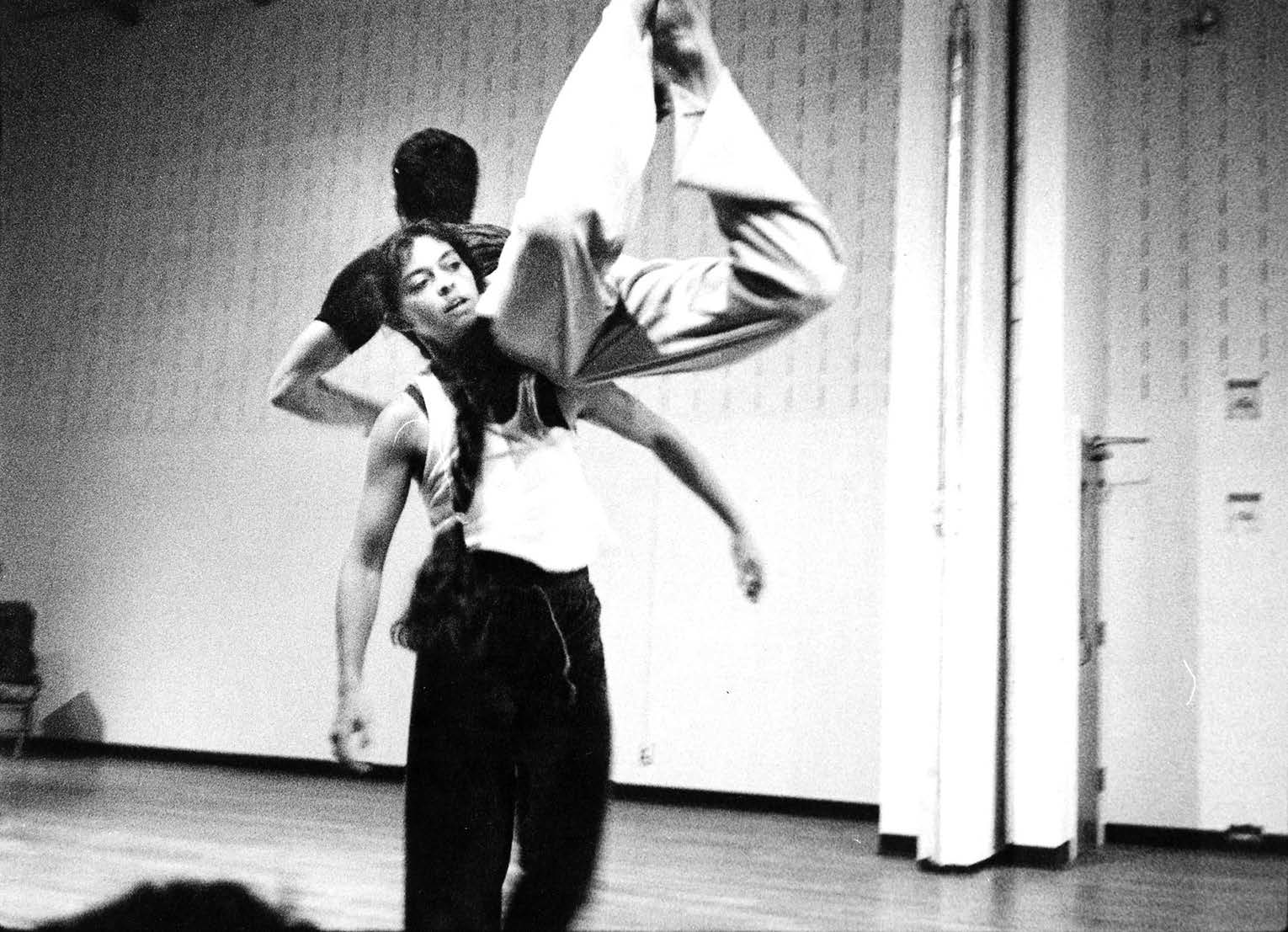
Nancy Stark Smith and Steve Paxton, Reference Smith1984. (Photo by Bill Arnold)

Smith passed away due to ovarian cancer on 1 May 2020. But her dedication to contact improvisation for nearly half a century—as a dancer, teacher, writer, and editor—contributed to its development and will continue to inform its ongoing vitality in incalculable ways. From the vantage point of the early years, one likely wouldn’t have imagined contact improvisation’s global reach or longevity, the magnitude of its influence on choreography and late-20th- and early-21st-century concert dance aesthetics, or its relevance for healing practitioners and disability studies. But now much remains uncertain. Given the improvisatory and mutual nature of contact improvisation, complicated by the challenges of Covid-19, we don’t know precisely what sort of bodies will result from future practice, or how the form itself might change.
Although Smith was not able to take Paxton’s afternoon performance class for men at Oberlin in 1972, she eagerly joined his daily “Soft Class,” where a small group of students gathered in the school’s old wooden gymnasium during the predawn darkness for a standing meditation directed by Paxton, who gently encouraged the group to notice the sensations of balancing and breathing, a practice that would come to be known as the “small dance.” Gradually, over the course of the morning meditation, sunlight would begin to stream through the gymnasium windows. As Smith recalls, “I was touched by this experience in a way that sometimes made me want to weep though I didn’t know why” (28). During that time, Smith also witnessed a performance of Magnesium, a kinetically charged improvisation that Paxton constructed for 11 men from his afternoon class. Drawing from his studies in aikido, and extending his Judson-era interest in movement scores and pedestrian action, Paxton created a structure that involved bodies crashing into each other and then falling, followed by five minutes of standing. As Paxton recalls, “I just wanted to be able to leave the planet and not worry about the re-entry… to get up into the air in any crazy position and somehow have the skill to come back down without damage” (in Perron Reference Perron2020:140). After seeing the performance, which Paxton describes as the “prototype” for contact improvisation (Paxton Reference Paxton, Koteen and Smith2008:86), Smith told Paxton, “If you ever work like this with women, I’d love to know about it” (in Perron Reference Perron2020:150).
She got her chance. Paxton recalls being “startled” by Smith’s forthrightness, her genuine interest in the explorations presented in Magnesium: “It had not occurred to me that such a rough-and-tumble dance would be of interest to a woman” (Paxton Reference Paxton, Koteen and Smith2008:86). A few months later, Paxton invited Smith to join a two-week performance project called “Contact Improvisations” at the John Weber Gallery in New York City. According to Paxton, he called the dancing contact improvisation because “it accurately and objectively described what we were doing” (in Novack Reference Novack1990:64). Together with a group of New York City dancers as well as students from Oberlin, the University of Rochester, and Bennington College, Smith spent a week exploring the possibilities of the improvisatory practice proposed by Paxton. Continuing the work developed in Paxton’s “Soft Class,” the dancers engaged in extended standing meditations, training their attention and becoming increasingly attuned to their bodily reflexes. They also experimented with throwing and catching exercises, jumping into the air and hoping to be caught by a partner. Sometimes, they’d practice sub-tler improvisations, where dancers would move while connected head-to-head in an inti-mate duet, attempting to follow through touch the minor movements of their partners. The following week the dancers shared their work informally with the public. As Smith recalls:
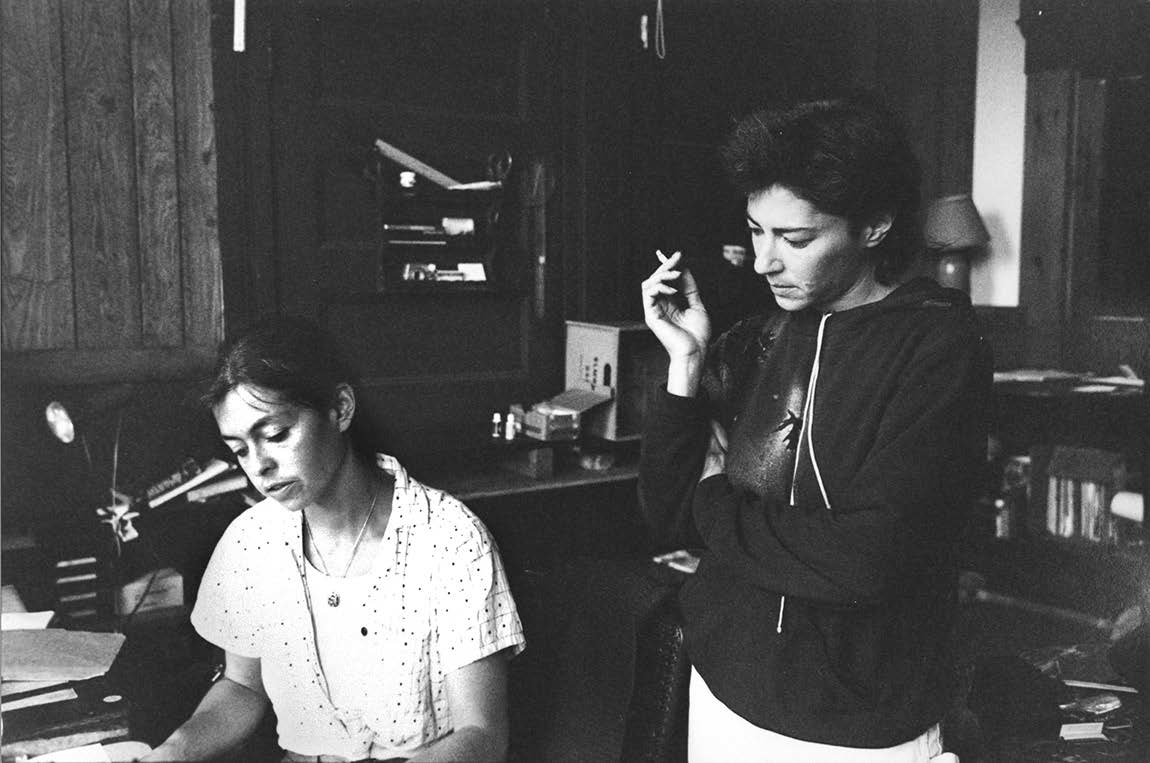
Nancy Stark Smith and Lisa Nelson making an issue of Contact Quarterly in Northampton, MA, 1984. (Photo by Bill Arnold)

These dances, watched attentively by others, were improvised interactions. They were contact improvisations exploring what was possible with two people in physical contact, moving with each other, throwing, catching, sliding, falling, rolling, balancing, exploring what was possible while moving in tandem with another body with the gravity system. (in Koteen and Smith Reference Koteen and Smith2008:23)
These would become the tenets of contact improvisation.
Over the next several years, full of desire and curiosity, Smith and a growing network of dancers continued to practice contact improvisation through pickup engagements, tours, and teaching. In 1973, Smith, Paxton, Curt Siddall, Nita Little, and Karen Radler performed and taught under the name, You Come, We’ll Show You What We Do. In 1975, Paxton, Siddall, and Smith founded ReUnion, the first contact improvisation company, which met once a year to perform and lead workshops on the West Coast. Looking back on that era, Paxton remarks
Truth to tell, when I think of those early years, I am apt to remember things like sliding down brown sand dunes between Arizona and Cal, coast-to-coast jaunts undertaken like trips to the corner store, understandings found in eyes, laughing at things in ESP — not so much the Contact Improvisation itself as the human contexts that made it possible to pursue. They seem conditional, personal, you-had-to-be-there-ish. (2008:87)
Yet the form did develop and spread beyond those who were there.
Eager to foster communication among dancers and create a record of their experimentation, the group involved in ReUnion also began the Contact Newsletter, which Smith, who had been interested in both dance and writing since her student days, edited and produced with the help of Diane di Prima, a feminist Beat poet who lent Smith the use of her office and typesetting equipment in Point Reyes, California (in Koteen and Smith Reference Koteen and Smith2008:35). In time, what began as a modest newsletter developed into a robust quarterly journal, which Smith coedited with Lisa Nelson from 1975 to 2020, and which continues to this day. Committed to an ethos of improvisation and resistant to single authorship and fixed understandings of their dancing, Smith and Nelson included a different definition of contact improvisation in every issue throughout the first decade of what became Contact Quarterly (Smith Reference Koteen and Smith2008:xii). The definitions variously highlighted the improvisational nature of the practice, the complexities of two bodies moving while in physical contact, and the dancers’ relationship to physical realities such as gravity, centripetal force, momentum, friction, and inertia. Contact improvisation was an expansive practice that was similar yet distinct from other dance duets. As one early definition proposed, “CONTACT IMPROVISATION is an activity related to familiar duet forms such as the embrace, wrestling, surfing, martial arts, and the jitterbug, encompassing a wide range of movement from stillness to highly athletic” (xii).
Luckily for dance historians and others interested in the early years of contact improvisation, several key performances throughout the 1970s were captured on video by Steve Christiansen. In grainy black-and-white footage, one can watch men colliding and rolling with clunky abandon in Paxton’s Magnesium (Christiansen 1972); dancers practicing “he stand” and Nancy Stark Smith with her signature long braid engaging in early throwing-and-catching exercises, exploring her body’s relation to gravity, and expanding the possibilities available through touch. Available as extended performance documents edited by Christiansen, Paxton, Smith, and Lisa Nelson, excerpts of several performances are also included in the documentary Fall After Newton (Paxton and Smith Reference Paxton, Smith, Christiansen, Nelson, Paxton and Smith1987), which traces the first 11 years of the form’s development as practiced by Smith, dancing with Paxton and others.Footnote 2 The emphasis on partnership is significant. Historically, both the aesthetic innovation and political potential of contact improvisation had to do with the notion that any two bodies could dance together, regardless of ability, age, gender, race-ethnicity, or past training. As Cynthia Novack explains in Sharing the Dance: Contact Improvisation and American Culture, “In a contact duet, each member, male or female, must be ready to give or take weight, to support, to resist, or to yield, as called for by the interaction” (1990:128). In Fall After Newton, Paxton elaborates, “Each partner posed their own kinetic puzzles, which were danced through, contributing new elements to the body of work, the network of contact improvisation” (in Paxton and Smith Reference Paxton and Smith1988:38).
Paxton and Smith had a remarkable partnership: “Steve’s influence on me was sly, so much so that it wasn’t until several decades later, when we weren’t actively dancing or teaching together anymore, that I realized he had been — and still was — one of my most significant teachers” (Smith Reference Smith, Koteen and Smith2019:87). Paxton notoriously resisted conventional exercises of authority. He invited others to join him rather than teaching top-down. He never claimed ownership of the explorations he helped to instigate. Smith came to realize: “I learned sideways from him, as co-pilots, deeply internalizing both his thought processes and his body’s sequencing from literally dancing up against his body (and mind) for so many years” (2008:53). As Smith’s remarks suggest, dancers are shaped by their practices, and with contact improvisation, those practices unfold by definition in contact with others. As Paxton has said, “It’s a mutual form” (Paxton and Smith Reference Paxton and Smith2018:36). Towards the end of Fall After Newton, Paxton remarks:
As a member of the first generation to study Contact Improvisation, Nancy not only learned it but helped to define it by the direction her training took her. When she began, no one knew what sort of body would result from the practice, nor what properties would be developed. (in Paxton and Smith Reference Paxton and Smith1988:39)
A Distanced Mourning
The future of contact improvisation is particularly unpredictable at this moment, autumn 2020, given a pandemic whose mitigation requires social distancing. As dancers involved in the contact improvisation community are painfully aware, the announcement of Smith’s passing appeared on Contact Quarterly’s website as Covid-19 forced the world into quarantine. Following horrific death tolls in Italy and Spain, New York City was at the time the epicenter of the coronavirus within the United States, with roughly 3,000 new cases reported each day in early May, down from the ghastly peak of approximately 12,000 a few weeks prior. The Northeast was in lockdown. As of 20 March, Governor Andrew Cuomo ordered all non-essential businesses in New York to close; other states were taking similar measures despite the lack of a coordinated federal response to the virus. New York schools began to close their physical campuses and shift to remote learning. Because Covid-19 spreads through respiratory droplets produced when an infected person talks or coughs or sneezes, the Centers for Disease Control and Prevention (CDC) recommended that people practice social distancing and wear masks in any public setting. If one began to experience symptoms of the coronavirus, or if one discovered they’d come in contact with someone who had tested positive, total isolation was, and remains, the recommended course of action. Particularly insidious, the virus can be spread by people who are asymptomatic, who do not realize they are infected. As of mid-October 2020, more than 215,000 people have died of Covid-19 in the United States. Surges are occurring in a number of states. Even New York, which had seen new cases fall for months, began to record an increase as the weather turned cooler and people returned to indoor activities.
Like so many people who lost loved ones during the early months of the coronavirus, when stay-at-home orders were still in effect and social distancing was required, those who mourned the passing of Nancy Stark Smith found ways to honor her life and gather with community from afar. Contact Quarterly posted links to writings by and about Smith on its website and created a public Facebook page entitled “Nancy Stark Smith Harvest” where people could post photos and share memories as a way to celebrate Smith’s life. On 7 June 2020, in what was dubbed a “Reading Jam for Nancy Stark Smith,” over one hundred people from around the world gathered on Zoom to share memories and read aloud from Smith’s writings. Framed in what have become familiar Zoom squares, some participated from their living rooms, while others were outside draped in blankets, and at least one participant appeared in front of a virtual background of a dramatic sky. Fittingly for an event honoring Smith and the dancing she loved, the spoken words were punctuated by individuals raising their arms or rolling on the ground in spontaneous dances of mourning and remembrance.
By June, when the reading jam occurred, dancers all over the world had begun to experiment with ways of dancing with each other remotely. Teachers in universities as well as those who maintained private practices or taught for local studios found ways to offer classes online. Sofas and kitchen counters replaced ballet barres. With theatres closed and seasons canceled, arts organizations offered virtual programming and opened their archives for online streaming. From one’s personal computer, one could watch videos of iconic works by Trisha Brown or Martha Graham, access the library of dance films collected by OntheBoards.TV, or watch a rotating selection of talks and performances from the archives of the Bill T. Jones/Arnie Zane Company. Choreographers and dancers also began to post new work online, many of them solos. Others edited together video footage shot from disparate locations or experimented with coordinated action via Zoom. An online performance that garnered particular attention involved 10 dancers from the Alvin Ailey American Dance Theater dancing excerpts of “I Been Buked” from Revelations, each in their own environment, isolated in their performance of a signature company work. Ailey dancer Miranda Quinn described the experience as “very vulnerable and about creating and nurturing hope through community” (in Kourlas Reference Kourlas2020). Still, the challenges that dancers face, like so many workers, are not merely artistic or pragmatic, but existential. As the choreographer Miguel Gutierrez wrote in an open letter to performing arts organizations:
Real talk. All my remaining spring gigs and one summer gig are cancelled (postponed). More pending. I’m not alone. In NONE of the cancellation emails does anyone mention a partial payment of the fee or acknowledge the commitment and the economic implication of losing the income. These are challenging times for everyone, but I want to remind all the presenters, universities, summer dance festivals, etc. (I’m speaking for many here)… THIS IS MY FULL TIME JOB. I don’t do this on the side. I am not independently wealthy. I HAVE NO SALARY OTHER THAN THE ONE I STITCH TOGETHER FROM THESE GIGS. (2020)
The precarity of dance and its institutions has been laid bare, and however brave and determined dancers have been in response to the coronavirus, dancing cannot possibly remain the same. What it will be once there is a vaccine, who knows? For now, what I write is not meant to be nostalgic, but rather an invitation to think critically about dance in a time of social distance. In “Choreography Under Lockdown,” Jennifer Homans writes,
The basic structures — where and how dance is performed — are not all that will be questioned. The virus has already changed our sense of our bodies, which seem suddenly mysterious, weakly defended. Our sense of time, the dancer’s tool and trade, has also been jarringly disrupted, but in this, at least, dancers are prepared. Living in the present is part of the training. “What’s the matter with now?” George Balanchine famously said. “You might be dead tomorrow.” (2020)
Balanchine’s remark sounds a bit cheeky, particularly in the midst of a global health crisis. Yet dance scholars have reckoned with the ephemerality of dance and its deep ties with an awareness of one’s own mortality. Long before Covid-19, in 2006, André Lepecki argued that the fleetingness of dance has led not only to an emphasis on the present, but also to a pervasive melancholy among dancers and dance scholars. Lepecki wrote that choreography as a means of writing dance down for posterity emerged precisely to counteract its disappearance. According to Lepecki, “Western theatrical dance’s coming into being was profoundly tied to a very modern affect: the mournful perception of the temporality of the present as an ongoing, ceaseless passing away of the now” (2006:123). Related to these ontological discussions are ones of history and circumstance. Homans notes that dance has been closely linked with death at least since the Middle Ages. She describes depictions of the “dance of death4 during the bubonic plague of the 14th century and notes how choreographers such as Balanchine and Mary Wigman were influenced by war and disease. There was the emergence of butoh after the bombing of Hiroshima and Nagasaki, and, as Homans notes, there were many dances made during the HIV/AIDS crisis of the 1980s and ’90s.
Comparisons between Covid-19 and AIDS were abundant throughout spring 2020, particularly within the US dance field, which suffered immensely from AIDS. As the author and activist Sarah Schulman reminds us in The Gentrification of the Mind: Witness to a Lost Imagination, AIDS is not over. There is both AIDS of the past and ongoing AIDS (2012:42). But for many who survived the plague of mass deaths between 1981 and 1996, the coronavirus has brought about a discomfiting return. Parallels between the viruses are fraught because one would not want to elide significant differences or generalize particular anguish. But as Masha Gessen writes,
[W]e continue to compare, because AIDS was a global pandemic that killed millions of people, and because of that mixture of grief and fear that feels so familiar. “The main feeling I have when I wake up each morning is palpable, physical,” Gregg Gonalves, who was an AIDS activist before he was an epidemiologist, tweeted. “It’s a weight behind the eyes for tears that never come.” (Gessen Reference Gessen2020)
For dancers, comparisons between Covid-19 and AIDS largely have to do with notions of risk and contagion in a craft that is insistently bodily. In How to Make Dances in an Epidemic: Tracking Choreography in the Age of AIDS, David Gere explains the irrational yet powerful chain of meanings that linked dance with homosexuality and with AIDS during the mid-1980s:
By historical coincidence AIDS was, from the time of the first recorded cases in the United States, associated with gay men and their sexual practices, including anal sex. Meanwhile, as dance scholar John Jordan has argued, the male dancer has been associated with effeminacy and homosexuality at least since the 1750s. […] Hence, with nary a flip of the wrist, male dancer=gay=AIDS. (2004:41)
Gere lays out a set of pervasive fears surrounding the body and its fluids, which made dancing particularly fraught, especially during the early years of the epidemic:
[I]t is not only the well-documented stigma associated with homsexuality in the contemporary United States that makes dance the ground zero of AIDS. It is also the fear-inducing notion of the body as leaky container, as permeable border, and as potential spreader of deadly contagion. Dance, then, is where AIDS and the body implode. (41)
Underscoring the intimacy of many postmodern dance performances at the time, where audiences sat in close proximity to performers, Gere details the bodily swelling brought about by increased blood flow as dancers exert themselves, as well as discharges such as sweat and fluid-laden exhalation, which could be seen in flushed faces, damp garments, and glistening skin. Gere notes that an audience in a studio or small black box theatre might actually feel a spray of sweat as a dancer passes by. Of course, one cannot contract or transmit HIV through sweat. Only blood, semen, preseminal fluid, rectal fluids, vaginal fluids, and breast milk from a person who has HIV can transmit HIV. Transmission occurs mostly either through sex or shared needles. Nevertheless, particularly during the early to mid-1980s when the science of HIV transmission was not widely understood, fear of contagion circulated within dance performances, rehearsals, and daily classes, even among friends and lovers — and company members.
The intimacy of contact improvisation and other postmodern dance practices in the time of the novel coronavirus has rekindled anxiety regarding the body’s permeability and the unpredictability of shared physical practices, especially those that embrace improvisation — the most unpredictable mode of embodied exploration. Without set choreography to dictate the next move, dancers never know precisely how their bodies will interact. It’s what gives improvised dance its intrigue and thrill, as well as its volatility. At The New School, where I teach and direct the undergraduate dance program, a class in contact improvisation taught by K.J. Holmes was the first studio class that we realized back in early March 2020 couldn’t continue as an in-person practice. Both “contact” and “improvisation” seemed untenable given what we knew about Covid transmission. Too “risky.” Of course, this makes sense. It’s in discussions of risk, though, that turning back to the AIDS era can offer more than comparisons and familiar feelings of grief. There were hard fought lessons learned in the battle for survival that pertain to present circumstances. As Barbara Browning argued back in 1998 in Infectious Rhythm: Metaphors of Contagion and the Spread of African Culture, “One thing that it [AIDS] has taught us is the speciousness of categories, including those of ‘risk’ ” (1998:11–12). Browning pointed out that during the beginning of the AIDS epidemic in the United States, four “risk groups” were asserted: homosexuals, heroin users, hemophiliacs, and Haitians. The categorization resulted in devastating material effects and social discrimination for members of these so-called risk groups, regardless of their HIV status (198). In the case of Covid, to question “risk” is not to deny science or to arrogantly flout medical precautions, but to recognize that determining risk and how one should act in the face of it is always a complex calculation, the terms and effects of which are seldom universal.
Calculating Risk and Choreographies of Protest
Reflecting on the AIDS crisis and its effects on downtown dance communities in New York City, the choreographer and noted improviser Ishmael Houston-Jones writes:
We were baffled. We were angry. We were terrified. We were wary of sharing a glass of water. But we also learned how to nurture and care for the sick and the dying. We made art, those of us who were dying and those of us who survived. Surviving love and death … But we also rallied; we shouted; we marched in the streets. (2016)
In “What Lessons Does the AIDS Crisis Offer for the Coronavirus Pandemic?” Gessen similarly explains and draws from personal experience, underscoring the distinct challenges that protesters face in the context of Covid-19:
One lesson from AIDS was about the power of communities coming together to take care of one another, to touch one another, to act, using bodies — often frail bodies, always endangered bodies, sometimes even dead bodies—to fight. This lesson is difficult to apply in the era of social distancing, though some ACT UP veterans are managing to stage direct actions even now, standing six feet apart. (2020)
During April 2020, when Gessen wrote their article, the experience of shouting and marching through the streets seemed difficult to imagine for many who were staying at home in attempts to “flatten the curve.” New York City streets were eerily empty. With the advent of Covid-19, ridership in the subways that Browning more than 20 years ago described as “ordinarily great snaking veins where diverse riders meet every day body to body” (1998:112) was down 90% and the MTA halted its overnight service for the first time in its history in order to sanitize trains and equipment. New York City, normally a city of bustling crowds, was becoming strange to itself as a result of mandatory isolation, moving to new 2020 “infectious rhythms.” Of course, attempts at a well-governed, hygienic city are not without precedent and they tend to have an epidemiological foundation. In writing about AIDS, Browning evoked Foucault:
Foucault has argued, “the utopia of the perfectly governed city” is “the plague-stricken town.” That is to say, the disciplined metropolis, the hygienic city which contains populations, emphasizes individualism, eradicates crowds, is based on an assumption of infectiousness, which becomes, in effect, its reason for being. The notion of epidemia must be maintained. (112)
It’s striking how relevant her analysis remains. Browning’s discussion of contagion anxieties within a “disciplined metropolis” was part of her broader analysis of the riots that erupted in 1991 after the beating of Rodney King by LAPD officers. Violence inflicted by the police on black people brought protesters to the streets again after George Floyd, a 46-year-old African American man, died on 25 May 2020 after Derek Chauvin, a white Minneapolis police officer, handcuffed him, threw him to the ground, and choked him to death by pressing a knee to Floyd’s neck for over eight horrific minutes. Bystanders filmed the murder on their cell phones. But no one, neither the other police officers present nor any civilian, intervened.Footnote 3 Floyd’s long, agonizing death hauntingly recalled what happened to Eric Garner in 2014. Garner, strangled by NYPD Officer Daniel Pantaleo’s choke hold, repeatedly cried out, “I can’t breathe.” Footage of Floyd’s murder went viral on social media. On 26 May, protests began in Minneapolis, swiftly spreading to other cities. Over the next several weeks, Black Lives Matter activists took to the streets across the United States. Many thousands expressed rage and sorrow over the death of Floyd, as well as the deaths of Breonna Taylor and Ahmaud Arbery in 2020, and the many other named and unnamed black men and women who have been killed by police.
Mass protests initially seemed impossible in this time of social distancing. But protesters insisted that the pandemic and racism were intertwined existential threats that required the recalibration of dominant narratives of “risk.” In the early days of Covid-19, narratives asserted that the coronavirus “did not discriminate,” that everyone was equally vulnerable. Then it became obvious that the elderly and the infirm were more likely to die of Covid-19 than young healthy people. After Floyd’s murder, protesters and others pointed to statistics showing that the pandemic was disproportionately affecting people of color due to structural racism. In a controversial action, many doctors and health care workers took to the streets in their lab coats, joining other individuals and groups to insist that racial injustice is a public health issue that both predates and contributes to the uneven devastation caused by Covid-19: “[A]s public health advocates, we do not condemn these gatherings as risky for Covid-19 transmission. We support them as vital to the national public health and to the threatened health specifically of Black people in the United States” (in Simon Reference Simon2020).
Just as many health professionals participated in Black Lives Matter seeking ways to protest within a pandemic — they wore masks, they tried to keep six feet apart from each other — many theatres and arts service organizations whose doors had been closed for months opened their lobbies as places where protesters could rest and shelter. A group of young theatre artists, administrators, and organizers who had been protesting on the streets and saw a need for arts institutions to do more than put out statements in support of the Black Lives Matter movement created an anonymous Twitter account @openyourlobby. From 3 June-6 July 2020, @open-yourlobby offered guidelines and daily maps of spaces that would be opening their lobbies throughout Brooklyn and Manhattan, and to a lesser extent in other cities including Chicago, Washington, DC, Portland, and Seattle. New York Theatre Workshop, an off-Broadway theatre company based in Manhattan’s East Village, was one of the first institutions to advertise on their exterior walls that they would be open to protesters in need of water or bathrooms. The Public Theater, also in downtown New York, quickly followed suit, providing hand sanitizer, water, use of its restrooms, and the assurance of social distancing within their spacious lobby. These actions, while important, were only part of a larger reckoning demanded within the arts, which like much of US society, are systemically racist. As Abou Farman, Assistant Professor of Anthropology at The New School and founder of Art Space Sanctuary explains:
It’s great to see them [arts organizations] opening their doors and spaces. But the major arts organizations have a great responsibility, because inequality is concentrated so strongly in their boards and acquisitions and buildings, and the violence of that inequality is washed by art. (in Di Liscia Reference Di Liscia2020)
What bodies can do and how they are understood are social and historical matters. Since the 1960s, dance artists and performance scholars have argued that choreographies onstage and the choreographies of daily life are interrelated. What is possible in one realm affects what is possible in another, and the meanings of one’s actions are shifting and contingent. It’s also evident that protests in particular entail choreographic and somatic dimensions. In “Choreographies of Protest,” Susan Foster suggested that we ask of protests “the kinds of questions that a dance scholar might ask.” For example:
[W]hat kind of significance and impact does the collection of bodies make in the midst of its social surround?; how does the choreography theorize corporeal, individual, and social identity?; […] how have these bodies been trained, and how has that training mastered, cultivated, or facilitated their impulses?; what do they [the protesters] share that allows them to move with one another?” (2003:397)
The same questions are urgent today, and they have everything to do with the future of dance, contact improvisation especially.
On 18 June 2020, artist and organizer dia bùi joined choreographer and dancer Orlando Zane Hunter Jr., Angie Pittman, and Danspace Project in convening a zoom gathering, “Decolonizing Somatic Care Practice for the Body in Protest.” A few days earlier, on 14 June, an estimated 15,000 New Yorkers demonstrated for “Brooklyn Liberation: An Action for Black Trans Lives,” a protest that aimed to protect and amplify the voices of black trans people who are disproportionately affected by police violence and harassment on the streets. Reminiscent of the 28 July 1917 Silent Protest Parade, where nearly 10,000 people marched down New York City’s Fifth Avenue silently to demand an end to antiblack violence, a sea of protesters peacefully assembled in front of the Brooklyn Museum, stretching for blocks down Eastern Parkway and to the west toward Grand Army Plaza. After the rally, the protestors marched silently to Fort Greene Park. Dressed in white like their 1917 forebears, these protesters, acknowledging the coronavirus, also wore face masks. There were many ways that the protest drew on dance expertise, even if it wasn’t discussed in those terms. Because the march was silent, organizers and participants devised gestures to communicate with one another. Community volunteers who served as marshals crossed their arms to indicate when marchers should stop; lowered their arms in a percussive diagonal to signal it was time for a break; and were ready to wave flags to signal an emergency. Of course, marching in and of itself entails technique and is a form of structured action.
The choreography expressed the somatic dimensions of this protest and street protesting in general. Marching through the streets as part of a mass is a felt experience. Acknowledging the intensity, uncertainty, trauma, and joy that can be a part of direct action, both Hunter and bùi emphasized the importance of care for self and community, suggesting that dance practitioners, who spend their lives addressing physical and emotional issues for both themselves and fellow performers, know a lot about these. This is undoubtedly the case. There are multiple ways of understanding the body; there are varied approaches to care, each embedded in culture and history. As Hunter and bùi pointed out, Western dance institutions, particularly in higher education, tend to take a narrow approach to somatic practices eliding or wholly overlooking African, Latinx, Caribbean, Asian, First Nations, and Indigenous understandings of the body. Overlooking, that is, all non-Western practices. Dancers are taught Paxton’s stand, for example, or the Alexander Technique, or Body-Mind Centering, all of which are instrumental in the development of contact improvisation, but it’s unlikely that one will encounter a serious study of African or Native American cosmologies in Western university dance departments. Hunter explained:
In the dance world, specifically, […] some folks have an understanding of body-mind centering practices. I know for myself going into those spaces, they have been generally filled with older white women. And when we’re thinking about the body in protest, you know, people can engage in whatever way they want, obviously, but I know coming from the diaspora that I come from, we have movement vocabulary that already has instilled knowledge within it, embodied knowledge. I’m also a part of Get Dis War Dance, and we are advocating for our black communities to organize around our black war dances, which we do in social dance, which we do in ritual, which we do for joy or harvesting. (Danspace Project 2020)
Hunter urged protesters, particularly those from the African diaspora, to draw from the embodied knowledge and techniques embedded in black dance as a means to ground themselves in the midst of direct action. Paradoxically, the discussion between Hunter and bùi about touch, trauma, and embodied knowledge took place remotely via Zoom. Nevertheless, they showed how the urgent actions of BLM in spring 2020 drew from dancerly expertise — and pushed dancers and scholars to think differently. With regards to contact improvisation, it’s important to recognize not only what improvisers share — a term that Foster invokes in her questions about protest and that Novack employs in Sharing the Dance—but also what they don’t share when they venture to improvise a dance.
Improvising While Black and the Regulation of Touch
For research on her forthcoming book, Unmaking Contact: Towards a New Intercultural Politics of Choreographic Touch, Royona Mitra interviewed Steve Paxton to better understand the influence of contact improvisation on partnering aesthetics in British contemporary dance. Trained in kathak, a north Indian classical dance, Mitra performs solo. She recounts for Paxton “the moments of rupture that defined [her] own disorientating, terrifying yet liberating experiences of making physical contact with other dancing bodies” when she was a university student in the UK during the late 1990s and early 2000s (Mitra Reference Mitra2018:7). Recognizing that her own experience of being simultaneously thrilled and frightened by contact improvisation was an experience shared by other dancers of color, particularly South Asian dancers trained in primarily solo classical forms, Mitra asked Paxton about the fact that contact improvisation has remained a predominantly white movement practice throughout its history with few black and brown people participating in the practice. Paxton, who notes that he has thought about the issue for a long time, responded
As the recent Black Lives Matter movement signals to us, what we once considered was institutionalized racism as practiced by the police is in fact systemic in our society, our culture. So, it might well be that rubbing skins with your oppressors is not an appealing prospect within contact. It seems to be a bit of a canary-in-a-coal-mine situation, this. It warns us that something might be up, and has been, for the whole time that contact has been around. (in Mitra Reference Mitra2018:13)
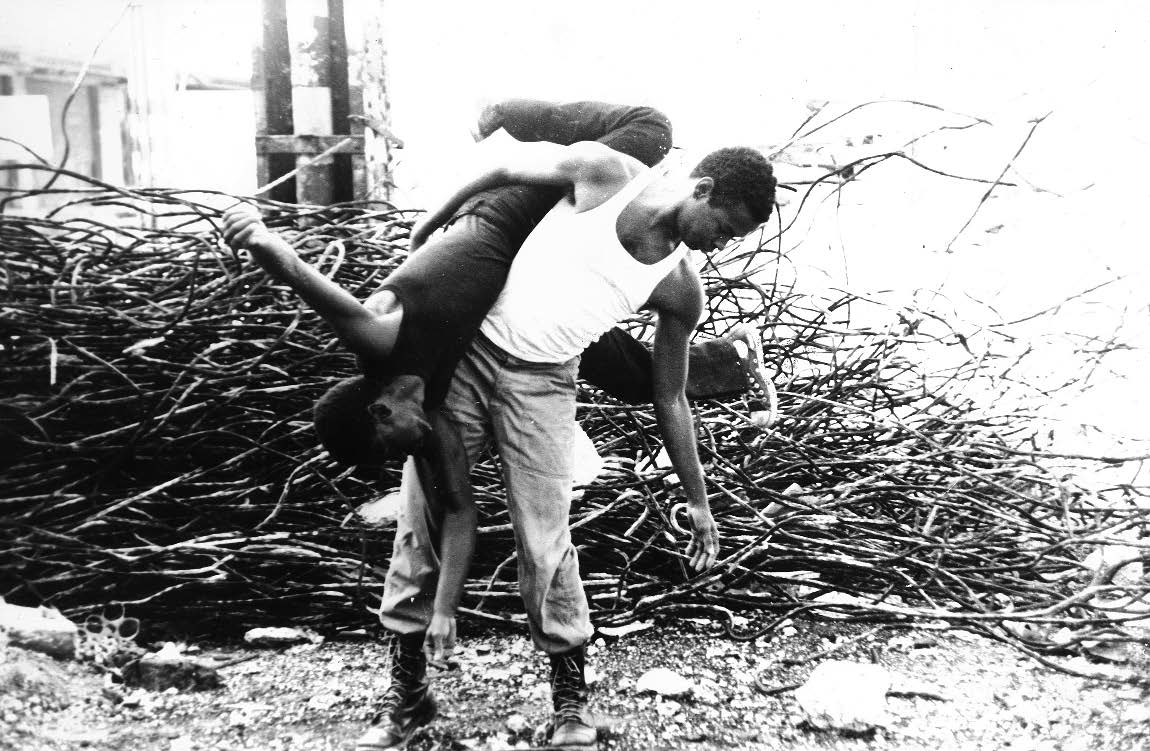
Indeed, a number of dancers dating back to the early 1980s have drawn attention to the whiteness of contact improvisation. In June 1983, the final year documented in Fall After Newton, Ishmael Houston-Jones and his frequent collaborator Fred Holland participated in a contact improvisation series called Contact at 10th and 2nd, the address of St. Mark’s Church in Manhattan’s East Village where the performances took place.Footnote 4 They performed their untitled duet on two evenings as part of “Partners,” a program that also included improvisations by Jackie Shue and Kirstie Simson, Steve Paxton and Nancy Stark Smith, Melanie Hedlund and Jennifer Smith, and Alan Ptashek and Nancy Stark Smith. At the time, the notion that any body could improvise with any other body was appealing to Houston-Jones. But he recognized that the reality of the social scene did not align with contact improvisation’s democratic potential. Houston-Jones and Holland were the only artists of color in the program; the spectators were mostly white. For “Untitled Duet” (which they also called “Oo-Ga-La”), they created a private manifesto that challenged many of contact improvisation’s unspoken orthodoxies:
We are Black
We will wear street clothes
We will wear heavy boots
We will play a loud, abrasive sounds score
We will have non-performative conversations
We will fuck with flow
We will stay out of physical contact as much as possible. (Houston-Jones and DeFrantz Reference Houston-Jones, Houston, Rawls and Coan2016)
Just a few months later, in December 1983, Mary Overlie moderated a discussion between Steve Paxton and Bill T. Jones. According to Nancy Stark Smith, who included the transcript in Contact Quarterly (Overlie et al. Reference Overlie, Jones and Paxton1984) and reflected upon it in her editor’s notes, “Several times during the talk [between Jones and Paxton], I felt myself wincing at the action as one might while watching a boxing match when the swing connects” (Smith Reference Smith1984:3). The discussion covered a lot of ground, but Jones clearly suggested that contact improvisation, especially with its rejection of narrative and illusion in performance, was more exclusionary than its practitioners liked to admit. Although contact improvisation influenced much of Jones’s early partnering work with Arnie Zane and others during the 1970s and early ’80s, he nevertheless called Paxton’s attention to its limitations: “I think there is a thing which is that there are people who are Contact people. Is this true?” (in Overlie et al. Reference Overlie, Jones and Paxton1984:33).
A publicity photograph for Ishmael Houston-Jones (right) and Fred Holland’s Babble: First Impressions of the White Man, Dance Theater Workshop, 1983. (Photo by Pamela Moore, courtesy of Ishmael Houston-Jones)

Why has contact improvisation not made more progress with regards to race? Part of the answer is surely sociological and systemic. White dancers tend to invite their white friends and colleagues to dance in white spaces. But what of Paxton’s comment to Mitra that perhaps “rubbing skins with one’s oppressors is not appealing within contact”? Since the mid-’90s, there have been significant discussions about gender, sexuality, and sexual violence with regards to touch in contact improvisation, but there remains an insufficient reckoning with how these conversations intersect with race.Footnote 5 Notably, mayfield brooks’s ongoing Improvising While Black project,Footnote 6 which began in 2014 as an MFA thesis performance and written document at UC Davis, now comprises performances, workshops, gatherings, and critical writing that “finds futurity in the hustle, the fugitive, the ancestor, the queer outlaw, the flesh, and improvisatory modes of dance as resistance” (brooks Reference brooks2020a). brooks draws attention to cultural assumptions surrounding touch, particularly within contact improvisation, which brooks began to explore in 1992 at La MaMa’s theatre and dance program with Nina Martin. brooks is attuned to the political potential of improvisation, which in certain instances “allows the body to go against its own expectation of itself” (2016:34):
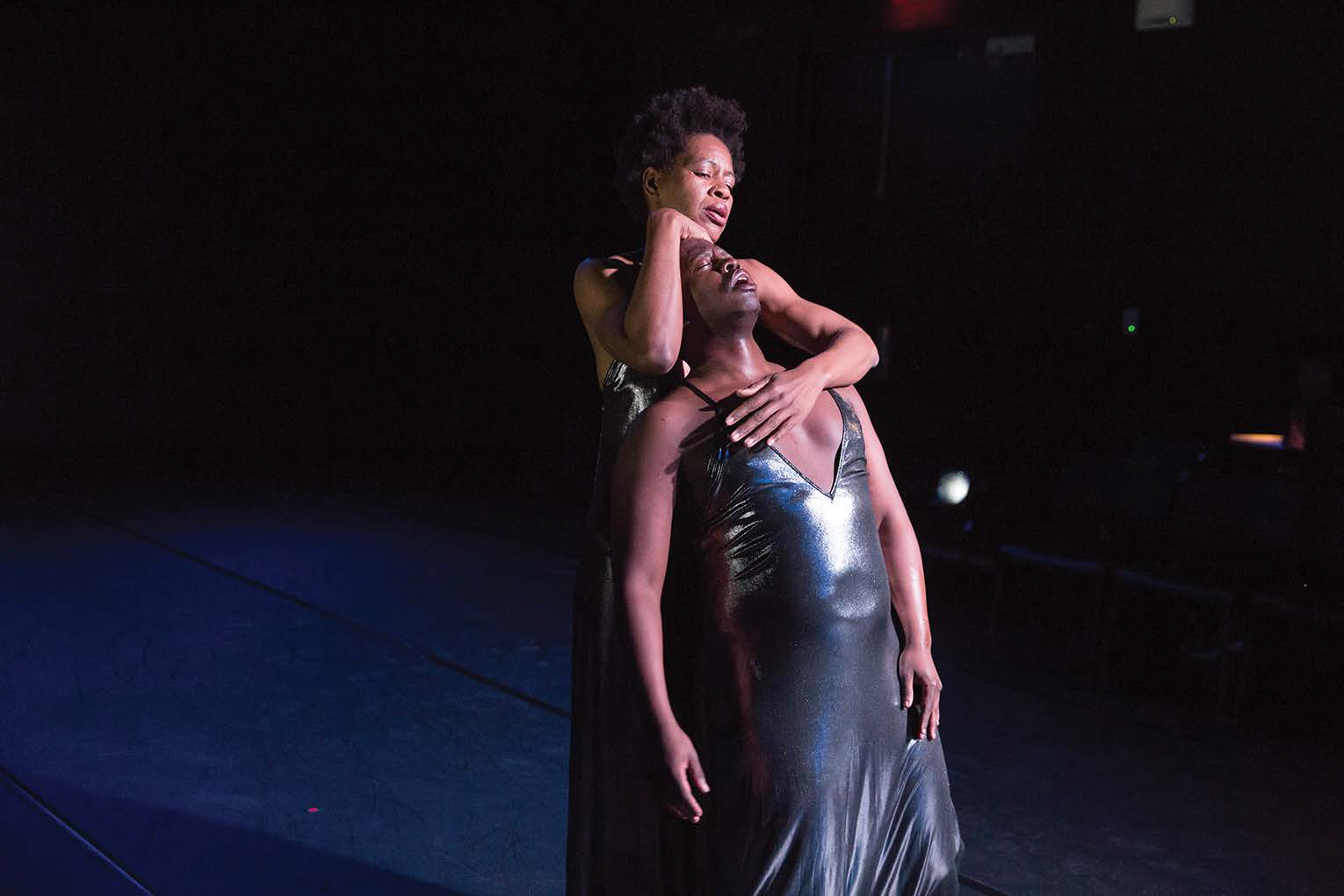
mayfield brooks dancing with Mlondolozi Zondi. Improvising While Black (IWB): Dancing in the Hold, Gibney Agnes Varis Performing Arts Center, 12 April 2018. (Photo by Scott Shaw, courtesy of mayfield brooks)

I just get really turned off by the way that there’s an assumption around touch, instead of an invitation. There are underlying issues like aggression and sexuality within the realm of touch. In jams, I can feel all these things, but there seems to be no awareness around the historical trauma that is inside of touch. With black people in this country, that distress is just part of the landscape. What would happen if that traumatic history was acknowledged in a Contact jam? In our society? This could be a powerful place for artists to start having a discourse around race. (2016:35)
Of course, contact improvisation is not the only dance that entails touching. In a range of Western art dance genres, performers lift one another, support each other in turns, clasp hands, and embrace. As Mitra notes, touching is commonplace in the choreography practiced and performed by late-20th- and early-21st-century multiracial dance companies in the West. But this is not to suggest that all dancers, who inevitably bring their own personal and cultural histories and reasons for dancing to the stage, experience these choreographies of touch and the processes that produce them in identical ways. If one turns to the realm of social dance, especially in the context of urban nightlife, the history of cross-racial proximity and desire is even more extensive, but still fraught with complexity.
Perhaps, then, in order to better understand what is at stake when dancers come together to improvise within contact improvisation, and to consider in more specific terms precisely what is missing for them in a time of social distance, it is important to distinguish between “touch” and “contact.” According to Paxton:
Touch is a particular kind of contact and form of physiological communication between bodies that is integral to the movement form that we have been talking about. […] And the contact part of that has something to do with being aware that you are touching someone, so the kind of touching that happens on crowded public transport which makes you withdraw from noticing the intimacy of the situation, is not the kind of contact we are talking about. (in Mitra Reference Mitra2018:14–15)
In other words, touch is a necessary part of contact improvisation, but it is not sufficient for “contact,” which is engaged and intimate, and entails a mutual awareness between dancers. Paxton continues:
I think I should also mention that within contact improvisation, touch must also give and bear weight. Touch augmented in this way is what starts the danced dialogue. Where your weight is located and carried is an incredibly important and personal factor in your life. So, when you have an opportunity to give weight to somebody else, it really makes you feel like you are donating an important aspect of yourself and trusting someone else to manage it for you. (15)
Although there is slippage between the terms “touch” and “contact” in general conversation, taking the insights of Mitra, Paxton, and brooks together suggests that cross-racial contact improvisation is challenging precisely because the contact required by the form does not allow one to easily shut out or ignore the intensities and ranges of racial trauma that touch often elicits. Unlike most forms of partnered dance, where one person leads and the other follows, contact improvisation is a mutual form where both dancers attend to the movement created by their improvised dancing and follow that. As Paxton explains:
mayfield brooks at MoMA, 2019. The performance reflects their approach to contact improvisation via IWB, emphasizing “collective dancing with support and care, trickster tactics, laying on of hands, and Black care” (brooks Reference brooks2020b). (Photo by Nicolas J. Harris, courtesy of mayfield brooks)

There was to be the creation of a third entity in the dance, which was the mutual movement paths and timing and all of that […]. It still requires two people, but it’s not a question of leader; it’s a question of follower. So if you have two people who are followers, what are they following is the question. (2018:38)
The rigor of contact improvisation, then, involves training one’s attention in order to follow the movement spontaneously created between two partners, remaining sensitive to unexpected possibilities within the dance.Footnote 7
Contact Improvisation in Untouching Times
For contact improvisers, touch is most obviously stopped by social distancing. One cannot touch another person via Zoom or from a distance of six feet. But contact through touch, in the meaningful way Paxton describes it, is even more impossible to achieve from a distance. So, too, is the improvised mutuality that makes the practice possible. So how to proceed? Even if a vaccine is ready by 2021, how long will it be before it is widely enough available for contact improvisation to “return to normal”? Social distancing could become the new normal. It’s hard to imagine when, if ever, people will feel comfortable shaking hands with strangers, or sitting in a crowded movie theatre, let alone participating in a contact improvisation jam.
But it’s not a time to throw up one’s hands. One of Nancy Stark Smith’s most meaningful contributions to understanding contact improvisation was her theory of something she called “the gap.” “Being in a gap,” she wrote, “is like being in a fall before you touch bottom. You’re suspended — in time as well as space — and you don’t really know how long it’ll take to get ‘back’ ” (1987:113). One could say that we are currently living through a profoundly disorienting gap, brought about by the coronavirus, charged with loss, uncertainty, and waves of unrest. But drawing from years of practice in improvisation, Smith has left us with these prescient words: “Where you are when you don’t know where you are is one of the most precious spots offered by improvisation. It is a place from which more directions are possible than anywhere else” (113).
Rather than lamenting a lost past, or wishing for a “return to normal” that was never good enough, contact improvisers ought to use this period of being apart to prepare for a time when people can dance together again, but with the knowledge and the tools for doing so differently—in a way that attends to racial and cultural difference, a way that moves contact improvisation towards a fuller enactment of its promise. This work will likely take different forms, and indeed many of these actions have already been taking place: protest, conversation, study, and care. Rather than being understood as separate from contact improvisation, all these acts can be harnessed as necessary and ongoing preparation, not for a perfectly polished dance, but for a radically unfinished one. Contact improvisation is an improvised practice, which means that dancers’ next steps are conditioned by history and social forces but not wholly determined in advance. Without being overly romantic or naïve about what is possible, it is powerful to insist that contact improvisation’s future is what its practitioners will make it. Take Nancy Stark Smith’s wisdom, rendered newly important in a world forced apart by the coronavirus: remain attuned to possibilities within the gap.