An extensive literature predicts the issue agendas of parties and candidates during election campaigns. Election-oriented elites attempt to emphasize issues on which their party has ‘issue ownership’Footnote 1 and avoid issues on which another party has an advantage. Parties are not wholly free to achieve this ‘selective emphasis’.Footnote 2 The issue agenda of an election campaign is a matter of competition between rivals, as well as the wider campaign context of media attention, policy events, and what voters already care most about and decide upon. But insofar as a party’s owned issues (the issue associations voters hold about different political parties and their reputation for trust and competence) overlap with their partisan priorities – those issues on which elites, members and activists care most aboutFootnote 3 – a party that achieves its goal of winning office should try to pursue the party’s owned issues in the legislature. A governing period is precisely the time when PetrocikFootnote 4 expects a party to demonstrate its ownership of issues via legislative attention and commitment.
Issue ownership evaluations have been found to shape the issues focused on in presidential rhetoric,Footnote 5 in parliamentary debate,Footnote 6 by individual congressmen/womenFootnote 7 and in congressional legislative outputs.Footnote 8 But there is much we do not know about the transmission of owned issues into legislative priorities. For one, we remain uncertain about the extent to which executives and political parties focus on their owned issues in legislation. Is this a small effect that can be outweighed by other factors, or does it account for a large amount of variation in executive and legislative attention? We lack information on whether there is a greater impact of issue ownership on executive speeches or whether issue ownership effects are equally strong in legislation, which is subject to the constraints of institutional competitors and the legislative process. Nor do we know whether these incentives are generalizable across countries and institutional settings.Footnote 9 There is also a significant theoretical gap relating to the conditions under which issue ownership incentives do not apply for executives and legislatures. After all, governing implies responsiveness to policy problems and issues of broad public concern,Footnote 10 rather than to the issues that advantage a particular party. If it were not so, the broad argument that executives and legislatures are governed by their owned issues, or partisan priorities, would pose a significant challenge to a notion of political representation that denotes responsiveness beyond partisan priorities to the wider electorate.
This article considers the effects of public opinion about party issue competence or ownership on executive and legislative agendas from a reverse perspective. We ask the question, when is it not possible for political elites to focus executive and legislative attention on partisan issue priorities – on a party’s best-rated issues? Given what we know about countervailing legislative and executive pressures to respond to issues of public concern and to work within ever-present political and institutional constraints,Footnote 11 we advance a theory that incorporates competing political incentives. We reveal how the issue context and the political and institutional context condition executive and legislative attention to policy issues on the basis of ratings of issue ownership. We extend the theory and analysis across two institutional systems – one presidential and one parliamentary (the United States (US) and the United Kingdom (UK)) and across executive and legislative agendas. The analysis also contributes to existing research by creating measures of issue competence on multiple policy categories,Footnote 12 which provides an assessment of ownership and/or competence effects across the policy agenda. We recognize that issue ownership comprises two components – one that relates to the idea of commitment and association, where ‘party constituency ownership of an issue is much more long-term (although it can change and occasionally exhibits fluctuation)’,Footnote 13 and another that is associated with performance or ‘a “lease” – short-term ownership – of a performance issue’.Footnote 14 Both aspects of public opinion about party competence, or ownership, create incentives to focus on a party’s ‘best’ issues. We measure a party’s best issues using a novel issue-rank measure that combines long-term and relatively short-term notions of issue ratings.
The findings reveal that issue ownership is an important explanatory factor in governing policy agendas in the US and the UK. Issue ownership is particularly influential on the issue agenda of the US State of the Union address, and stronger overall in the US. While data do not exist to compare a greater number of countries, the results suggest that a focus on greater issue control and greater partisan influence under presidentialism may be in evidence, compared to the weaker evidence in the UK’s parliamentary system.
The evidence supports our theory of the conditionality of issue ownership effects. The effects of issue competence on executive and legislative agendas are outweighed by salient policy issues, and they are also outweighed when the incumbent party is riding higher in the polls. We theorize that an owned issue agenda is more likely when a party has only its relatively strong or beneficial issues to demonstrate a relative electoral advantage, and when the party faces heightened pressure from its base. More popular incumbents can pursue a broader issue agenda, in addition to issues the party owns. Support for this theoretical prediction holds important consequences for the abilities of popular parties to further build on their success, but also for unpopular parties to be forced to appeal to their base.Footnote 15 Finally, we reveal how parties’ reputations on issues have weaker explanatory power under divided US government. Divided government also weakens the conditional relationship between public issue salience and issue ownership. These contributions add to the literature on the general effects of divided government on legislative outcomes and agendas.Footnote 16
ISSUE OWNERSHIP AND EXECUTIVE AND LEGISLATIVE AGENDAS
The issue ownership theory of electionsFootnote 17 provides a widely accepted narrative to explain candidate and party issue emphasis in campaigns. Also known as saliency or selective emphasis theory,Footnote 18 and consistent with Riker’s dominance-dispersion principle,Footnote 19 issue ownership theories predict that parties win votes (and presidents gain support)Footnote 20 by emphasizing issues on which they have the greatest public trust, association and a reputation for competence.
Scholars have debated the degree to which selective issue emphasis occurs,Footnote 21 whether ownership strategies are successfulFootnote 22 and whether ownership campaign strategies can always be adopted in place of a focus on salient issues.Footnote 23 However, the empirical contribution and explanatory power of these evaluations on party and candidate issue strategies has made the theory foremost in agenda-based accounts of vote-seeking party, president and candidate campaign-related behavior.
The concept of issue ownership has been translated into the executive and legislative domain, although in only a handful of cases. HolianFootnote 24 analyzed presidential remarks in public and congressional hearings, identifying how a president is able to use issue framing and rhetoric to neutralize an opponent’s ownership of an issue and gain a relative issue advantage. SulkinFootnote 25 revealed how individual congressmen/women take up issues in Congress to neutralize an opponent’s issue advantage. These studies demonstrate how elites use a period in office to compete on issues their party does not own, trespassing onto an opponent’s best issues. CumminsFootnote 26 uses issue ownership expectations to explain the president’s issue agenda and finds that presidents promote party-owned issues in their State of the Union addresses, especially when conditions are less favorable to their agenda. In comparative work applying the concept of issue ownership to collective legislative agendas, Green-Pedersen and MortensenFootnote 27 analyze the content of parliamentary speeches and motions, finding party issue emphasis of owned issues. EganFootnote 28 identifies an effect of incumbent party issue ownership on legislative outputs in Congress, demonstrating correspondence between ‘partisan priorities’ and the issues given legislative attention.Footnote 29 These studies find that elites will use a period in office to focus on their party’s owned issues.
The existing evidence raises a number of questions. We need to further examine whether elites use a period in office to focus on their parties’ issues, or whether the incentive is stronger to focus on issues a party does not own. We need to better answer the obvious and yet unanswered question concerning the extent to which parties, governments and presidents are able to shape the issue agenda to issues on which they have an advantage, and the extent to which this occurs across executive and legislative agendas. We further need to understand the extent to which issue ownership incentives are confined to the US. A president may have particular incentives to be associated with the party’s owned issues, and the polarized partisan nature of US politics in recent decades may condition the basis for strong issue associations in the minds of voters toward parties. Moreover, existing studies imply that issue ownership incentives may be conditional on a number of factors. Green-Pedersen and MortensenFootnote 30 highlight how the incumbent party will be particularly constrained by the need to respond to salient policy problems. CumminsFootnote 31 highlights the relevance of unified and divided government for a president’s incentives to focus his State of the Union address on issues that appeal to co-partisans. Egan,Footnote 32 in his definition of issue ownership, reveals how the party base and party elites prioritize the issues the public come to associate with the party – the issues a party owns. The partisan context may therefore condition the relevance of issue ownership explanations in relation to executive and legislative agendas.
A CONTEXTUAL THEORY OF HOW PARTY ISSUE REPUTATIONS INFLUENCE POLICY AGENDAS
Our starting point is to state the expectation that parties’ reputations on issues will, in general, exert an effect on the issues that are prioritized in executive and legislative agendas. There are three reasons. First, election-oriented parties and presidents will try to gain ownership of issues, retain ownership of issues, and focus public and media attention on issues which advantage their electoral position during a period in office. This implies that incumbents predominantly pay greater attention to issues on which they are more positively rated – whether via short-term associations, as parties come to have a temporary advantage on an issue via competition for ownership or via performance on specific issues, or via long-term reputations for issue ownership. Secondly, ownership of an issue assumes a long-standing party commitment to that issue; hence owned issues are associated with ‘partisan priorities’.Footnote 33 We should expect policy-seeking politicians to advance issues on which they have a long-standing commitment and interest, and therefore for that long-standing commitment to be demonstrated in office. Thirdly, we know that parliamentary parties (a) tend to focus on party-owned issues in manifestos and campaigns, at least to some degree, and (b) deliver the priorities of their manifestos in government policy.Footnote 34 We therefore hypothesize issue ownership effects as follows.
Hypothesis 1: Executive and legislative policy agendas will be predicted by issue ownership – measured by public ratings of incumbent party issue competence.
We also note that issue ownership evaluations may arise from legislative attention over the longer term.Footnote 35 For now, our focus is on the shorter-term effects of issue ownership on legislative attention.
Our theory hypothesizes limits on the contexts under which Hypothesis 1 will hold. Election campaigns’ themes and agendas are decided with electoral incentives at the forefront. However, the business of government is to respond to policy issues and problems – the concerns considered most salient among the wider public.Footnote 36 Government, presidential and legislative incentives differ from party or candidate election incentives. A government, president and legislative party acts on calls from pressure groups, party coalitions, media and public opinion, and must respond to the wider policy environment in the form of perceived deterioration (or otherwise) in public services the economy and foreign policy and other policy ‘events’.Footnote 37 Yet government and legislative attention is scarce because policy priorities require considerable legislative attention and time.Footnote 38 Policy makers must therefore selectively allocate attention to issues, such that incentives to attend to a party’s owned issues must be considered alongside incentives to attend to salient policy issues and problems. Given the influence of issue salience on government attention, we hypothesize that changes in issue salience, most often due to exogenous shifts in problem status,Footnote 39 should trump electoral considerations and a party’s long-standing priorities. Hypothesis 2 predicts that the effect of issue ownership on policy agendas will, ceteris paribus, be weakened when the explanatory power of issue salience is heightened.
Hypothesis 2: The effects of issue competence evaluations on executive and legislative policy agendas will be attenuated by the salience of policy issues.
If incentives exist because political elites wish to prime and highlight areas of party policy strength,Footnote 40 these incentives should be greater when there are stronger electoral pressures on the incumbent; that is, when party popularity is low. When a party loses popular support, its owned issues represent its remaining issue advantages, forcing it to compete on a relatively narrow set of owned issues.Footnote 41 When popularity is high, incumbents trespass onto an opponent’s issue(s), convincing the electorate of their superior handling abilities and potential ‘ownership’ via presidential persuasion and rhetorical tools.Footnote 42 There will still be a focus on owned issues for popular incumbents, but the issue agenda should be broader. A party’s owned issues are those that the party elite and the party’s voters consider most consistently important.Footnote 43 We therefore posit that an issue ownership focus will be more likely when a party is forced back onto its electoral base, during periods of relatively low popularity. Such incentives may be reinforced due to an increased need for co-partisan support for legislation: legislators will support a party’s policy agenda more readily on issues that those legislators deem most important. This leads us to Hypothesis 3a.
Hypothesis 3a: The effects of issue competence evaluations on executive/legislative policy agendas will be attenuated by the electoral popularity of the incumbent/majority party.
There is also a body of research that points in the opposite direction. This research suggests that popular presidents, feel less pressure to be responsive to public opinion.Footnote 44 In this case, incumbents may use periods of increased electoral popularity to focus attention on those issues they care most about – those issues the party owns. Therefore we alternatively consider that ownership effects can be enhanced when party popularity is high.Footnote 45 We consider Hypotheses 3a and 3b in light of these countervailing expectations.
Hypothesis 3b: The effects of issue competence evaluations on executive/legislative policy agendas will be increased the higher the electoral popularity of the incumbent/majority party.
Petrocik’sFootnote 46 issue ownership theory expects parties to do better when their owned issues are salient. We recognize that popularity at t − 1 may be partly a product of ownership and salience at t − 2.
The US institutional system places a further constraint on the translation of an incumbent party’s issue priorities – the presence of divided government.Footnote 47 Scholars demonstrate significant effects of divided government on the passing of fewer agenda items,Footnote 48 on unpassed laws, on laws without presidential backing,Footnote 49 on reduced quantities of significant enactments and weaker responsiveness to the public mood.Footnote 50 Congressional party fortunes are tied to a president’s successful policy agendaFootnote 51 and to the party’s collective reputation, established through legislative victories.Footnote 52 We therefore expect divided government to weaken the transmission of a president’s party’s owned issues into the policy agenda, resulting in a weaker effect of issue ownership (Hypothesis 1). Such effects should be stronger with respect to the legislative agenda, but presidents may also anticipate these constraints and moderate their policy agendas in executive speeches. We therefore specify Hypothesis 4 to the policy agenda in general.
Hypothesis 4: The effects of issue competence evaluations on policy agendas will be weaker under periods of divided government.
It should also hold that the trade-off between issue salience and issue competence (either in the direction of Hypothesis 3a or 3b) should be weaker under divided government. A divided government is less able to achieve its policy goals. A majority congressional party may share the incentives of a president to be responsive to high-salience public concerns, but parties can share priorities yet differ on their ideal policy positions, which may result in heightened chances of gridlock on salient issues. The transmission of issues into legislation will therefore be stronger when the House and presidency are unified than when government is divided, consistent with findings of lower responsiveness to public opinion under divided governmentFootnote 53 and the pursuit of narrower agendas by incumbent parties and presidents.Footnote 54
Hypothesis 5: The attenuating relationship between issue ownership and salience will be weaker under divided government.
DATA AND MEASURES
We examine our hypotheses in two countries and in two different institutional arenas – for the executive and the legislature in the US and the UK. We expect differences across institutions to give rise to variation in the strength of issue ownership effects.
The State of the Union address is a high-profile vehicle for communicating the president’s agenda,Footnote 55 and is subject to relatively few institutional constraints, or less ‘friction’,Footnote 56 that limit the issues a president can attend to – although presidents can incur costs from talking about policy issues.Footnote 57 The address is a major set piece event of the political calendar, providing incentives for the emphasis of partisan-owned issues, while its format offers relative scope for short-term responses to increases (or decreases) in the salience of issues. We therefore expect strong issue ownership effects on the State of the Union address, stronger than on congressional legislation, and also strong attenuating effects of issue salience, and popularity.
In the US, lawmaking requires co-operation between both houses of Congress and the president, which imposes higher decision costs,Footnote 58 even in situations of unified control of government. This need for co-operation is likely to mitigate emphasis on partisan priorities and may to a lesser extent limit responsiveness to the salience of issues to the public. Pressures of electoral competition on representatives might lead to equally strong levels of sensitivity to popularity, as we would expect from electoral incentives on the State of the Union address.
The UK’s parliamentary system might be expected to give rise to fewer party issue ownership incentives. The fusion of legislative and executive powers means that governing parties face fewer constraints due to institutional friction on the issues they can attend to, but at the same time are generally insulated from electoral pressures that might otherwise create incentives to emphasize party issue strengths. It also reduces lawmakers’ propensity to be responsive in the short term to changes in issue salience or popularity.
We test our hypotheses in the UK using acts of Parliament and the content of the Speech from the Throne (the Queen’s Speech), and in the US using data on major congressional legislation and the content of the State of the Union address.Footnote 59 Data on policy attention are from the US Policy Agendas Project and its UK counterpart.Footnote 60 They range from 1950 to 2010 in the UK and from 1947 to 2012 in the US. Each piece of legislation is coded with a single topic, indicating the primary focus of the legislation, and the observed time point is the date on which the act or bill was signed into law. The dependent variables can take a value between 0 per cent and 100 per cent. For the US, legislation is weighted according to its importance using a measure of ‘most important laws’ based on the amount of coverage received in the Congressional Quarterly Almanac (following Adler and Wilkerson).Footnote 61 We use this weighting to avoid any overestimation of divided government effects, but this adjustment is not required in the UK (where the dependent variable represents major government legislation whereas minor legislation tends to be enacted through statutory instruments). The contents of the State of the Union address and the Queen’s Speech are divided into ‘quasi-sentences’; expressions of a single policy idea or issue (commonly used in analysis of executive speeches).Footnote 62 The unit of analysis is therefore the proportion of each speech allocated to a particular topic (the economy, minorities and rights, health, labor, employment and immigration, education, environment, law and order, welfare and housing, defense, foreign affairs or government). Issue categories are combined to match topics with our dataset on public evaluations of competence, and to make these comparable across countries.Footnote 63 While data on policy agendas are available in many other countries, the survey data on public opinion about party competence are only available for sufficient issue categories and over a long enough time period for the US and UK, providing a unique opportunity to examine these variables over repeated electoral and legislative cycles.
We gathered responses to over 8,000 survey items about party competence to handle particular issues or policy problems. The data consist of 5,098 administrations of 1,297 different questions by fifty-eight polling organizations in the US, and 2,922 administrations of 170 different questions by six polling organizations in the UK. In the US the question wording often asks which party the public ‘trust to do a better job of handling’ a given issue, while in the UK the wording tends to focus on the party that is ‘best able to handle’ defined issues or problems.Footnote 64 The data are categorized into the same eleven policy categories as the dependent variables.Footnote 65 Most questions require respondents to choose between specified political parties – typically between the Republican and Democratic Party in the US, with the option of a non-response (‘none’ or ‘don’t know’). In the UK the options tend to be Labour, Conservatives and Liberals or Liberal Democrats. We drop responses for the Liberals or Liberal Democrats, other parties and non-responses and calculate issue competence scores as the percentage of the two-party share. Issue competence is based in the US on evaluations of the president’s party (for the executive agenda) or the majority party in the House (for the legislative agenda).
We take all available observations for each of the eleven topics for the previous election cycle.Footnote 66 Using the current cycle could violate the temporal ordering of the variables (since some of the issue ownership ratings are observed prior to the policy agenda and some are observed after) and could also lead to endogeneity. Taking the average issue competence score across the previous election cycle also ensures our measure of ownership is less sensitive to sparse/missing data in some periods.
Our measure of party competence captures the relative strengths and weaknesses of the incumbent party across the eleven policy categories – the issues a party is considered to handle best relative to other issues, according to the level of public confidence in the incumbent party on each issue. We take the ranking of each issue from 1 to 11 using the mean level of competence for each issue to determine which is rated best relative to another in each electoral cycle. This rank measure is distinctive in the issue ownership literature, which tends to take the mean rating of a party on an issue, or the lead of one party over another on an issue, or the mean rating of a party on an issue subtracting the party’s popularity. The rank measure reflects four conceptually based operationalization decisions. (1) It is less sensitive to parties’ gains or losses in popularity than most traditional measures. If a party gains or loses popularity, its overall competence on every issue rises and falls.Footnote 67 (2) The possibility of variance in public opinion about issues. We argue that elites focus on issues to gain ownership, to reflect changes in evaluations on performance (which benefit them electorally) and to reflect long-standing partisan priorities. We therefore use a measure that captures changes in issue evaluations, as well as over-time strengths on owned issues, concepts that are captured in Petrocik’sFootnote 68 definition of issue ownership. (3) The need to explain relative issue attention using relative issue evaluations. The ordering of a party’s best and worst issues will provide the most meaningful explanation of the relative ordering, or prioritization, of issues by the executive or legislature. (4) The need to estimate the effects of ownership across issues, rather than on an issue-by-issue basis. The measure takes a value between 12−k and 11, where k is the total number of topics for which competence evaluations are available during a given election cycle; 11 refers to the top-ranked issue and 1 to the lowest ranked. We provide additional support for our theory using alternative measures of issue competence in robustness checks. However, as expected, the results are less consistent across each of the analyzed cases, although they are equally consistent in our analysis of the State of the Union address.
The salience of policy issues is measured using aggregate data on public responses to the survey question about the ‘most important problem’,Footnote 69 available between 1947 and 2012 in the US and between 1950 and 2010 in the UK. Responses are standardized for each survey to total 100 per cent and then averaged across the calendar year where multiple surveys are available.Footnote 70
Popular support for the governing party is measured using data on vote intentions for each country by calendar year. A dataset of 3,464 polls from national surveys on vote intentions is used in the UK for the period between 1945 and 2010; respondents were asked which party they would vote for ‘if the election were held tomorrow’.Footnote 71 We use support for the president’s party or the majority congressional party in the generic congressional ballot in the US consisting of 1,997 polls from 1942,Footnote 72 supplemented with data from the Roper Center for Public Opinion Research’s iPoll databank.
The measure of divided government in the US is coded 1 if the presidency and House are controlled by a different party, and 0 if they are controlled by the same party.Footnote 73
METHOD OF ANALYSIS
Time-series cross-sectional first-order autoregressive, AR(1), models are estimated for all issue categories (that is, panels) for each country and policy agenda. These panels consist of the eleven issue categories for the US executive (the State of the Union address) and then the legislature (most important laws). In the UK the panels consist of eleven issue categories for the legislative agenda (acts of UK Parliament) and for the executive agenda (the Queen’s Speech). The models take the following form:Footnote 74
 $$\eqalignno{ {\rm AGENDA}_{{{\rm it}}} {\equals} & {\rm }\alpha ^{{\asterisk}} _{0} \cr & {\plus}{\rm }\alpha ^{{\asterisk}} _{{\rm 1}} {\rm OWNERSHIP}_{{{\rm it}{\minus}{\rm c}}} \cr & {\plus}{\rm }\beta ^{{\asterisk}} _{{\rm 1}} {\rm SALIENCE}_{{{\rm it}}} \cr & {\plus}{\rm }\beta ^{{\asterisk}} _{{\rm 2}} {\rm SALIENCE}_{{{\rm it}}} {\times}{\rm OWNERSHIP}_{{{\rm it}{\minus}{\rm c}}} \cr & {\plus}{\rm }\beta ^{{\asterisk}} _{{\rm 3}} {\rm POPULARITY}_{{\rm t}} \cr & {\plus}{\rm }\beta ^{{\asterisk}} _{{\rm 4}} {\rm POPULARITY}_{{\rm t}} {\times}{\rm OWNERSHIP}_{{{\rm it}{\minus}{\rm c}}} \cr & {\plus}{\rm }\beta ^{{\asterisk}} _{{\rm 5}} {\rm DIVIDED}_{{\rm t}} \cr & {\plus}{\rm }\beta ^{{\asterisk}} _{{\rm 6}} {\rm DIVIDED}_{{\rm t}} {\times}{\rm OWNERSHIP}_{{{\rm it}{\minus}{\rm c}}} \cr & {\plus}{\rm }\beta ^{{\asterisk}} _{{\rm 7}} {\rm DIVIDED}_{{\rm t}} {\times}{\rm SALIENCE}_{{{\rm it}}} \cr & {\plus}{\rm }\beta ^{{\asterisk}} _{{\rm 8}} {\rm DIVIDED}_{{\rm t}} {\times}{\rm SALIENCE}_{{{\rm it}}} {\times}{\rm OWNERSHIP}_{{{\rm it}{\minus}{\rm c}}} \cr & {\plus}{\rm }\gamma ^{{\asterisk}} {\rm ELECTION CYCLE}_{{{\rm itj}}} $$
where AGENDAit refers to the proportion of the policy agenda assigned to a given issue i at time t, α* 0 represents the intercept, OWNERSHIPit−c refers to issue competence ranking in the previous electoral cycle (hence t − c, not t − 1), SALIENCEit refers to the percentage of respondents assigning each issue as the most important in the current period, and POPULARITYt refers to the share of popular support for the governing party, also at time t.Footnote 75 For the US policy agenda, DIVIDEDt refers to periods of divided government and is also interacted with SALIENCEit and OWNERSHIPit−c. We include time fixed effects by election cycle j to control for election period variation in parties’ competence ratings over time. The models including DIVIDEDt are presented with and without time-period effects due to covariance between some of these periods and the DIVIDEDt variable.
The model is estimated using panel-corrected standard errors,Footnote 76 which control for panel heteroscedasticity and contemporaneous correlations of the errors. It is fitted with the Prais–Winsten method to test for serial autocorrelation (μit), with the rho estimated separately for each panel as the first-order autoregressive process: μit=ρμit−1+εit. This allows the rate of persistence to vary across units (panels), consistent with the expectation that there will be greater stability in policy makers’ attention to some issues compared to others.Footnote 77
RESULTS: USA
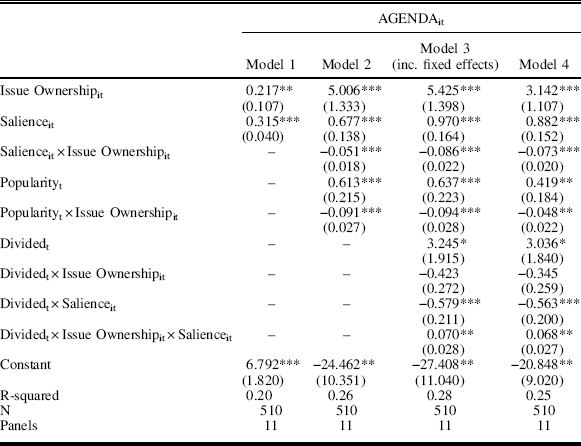
The results are presented first for the policy agenda of the State of the Union address. Model 1 includes the results for the main effects of issue ownership and salience. Model 2 includes the results for the interactions relating to Hypothesis 2 (the salience moderation hypothesis) and Hypothesis 3 (the popularity moderation hypothesis), and Model 3 addresses the interactions pertaining to Hypotheses 4 and 5 (the divided government hypotheses). Model 4 includes the full model but omits the election cycle dummies for comparison.Footnote 78
Table 1 reveals support for Hypothesis 1: differences in issue competence evaluations for a president’s party predict the policy attention of the president in the State of the Union address. The main effect of issue competence is significant in all four models, and the addition of extra variables enhances the effect of issue competence on the policy agenda of executive speeches. In terms of substantive interpretation, a one-point rank increase leads to an increase of 5.43 percentage points in executive attention to the issue, in Model 3. The lowest-ranked issue, on average, receives 54.3 percentage points less attention than the highest-ranked issue (5.43×(11−1)). The main effects of issue salience are also significant in each model, consistent with Baumgartner and JonesFootnote 79 and Jones, Larsen-Price and Wilkerson,Footnote 80 who reveal that the president’s policy agenda is responsive to issues of public concern.
Time-Series Cross-Sectional AR(1) Model of Issue Ownership and the State of the Union (President’s Party)

Note: *p<0.1; ** p <0.05; ***p<0.01
Table 1 also reveals support for Hypothesis 2, which predicted that the effects of issue competence would be moderated by issue salience. The term SALIENCEit×OWNERSHIPit−c is negative and significant when entered into Model 2, and remains significant when additional variables are included in the equation in Model 3 (and when the time fixed effects are removed in Model 4). Figure 1a displays the marginal effect of issue competence rank over values of issue salience (Model 3).
Marginal effects of issue ownership for values of issue salience in the US State of the Union address

The slope in Figure 1a indicates a drop in effect size from around 5.0 to just less than 3.0 (where confidence interval values do not cross 0) and a significant effect of relative issue competence when values of issue salience are between 0 and 27. As issues become more salient, the explanatory power of issue competence is removed, but issue competence effects are significant at low values of issue salience. Reversing the x- and y-axis (not shown in Figure 2a), the effect of issue salience is removed when parties are ranked highest on policy issues. These relationships support the theorized relationship: there is a trade-off between whether incumbents emphasize their own issues vs. whether they emphasize salient issues.
We hypothesized two further conditions under which relative issue competence evaluations would be weaker: (1) when electoral popularity is higher (Hypothesis 3a) or lower (Hypothesis 3b) and (2) under conditions of divided government (Hypothesis 4). Models 2, 3 and 4 address these hypotheses. The results in all three models support Hypothesis 3a rather than Hypothesis 3b. The significant and negative relationship on the OWNERSHIPit−c×POPULARITYt interaction reveals that the effects of issue competence are weaker when electoral popularity is higher. This relationship is demonstrated using marginal effects (based on Model 3) in Figure 1b.
Marginal effects of issue ownership for values of popularity in the US State of the Union address
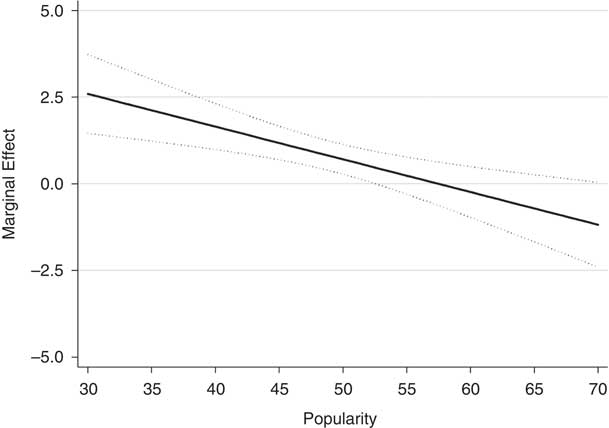
Figure 1b demonstrates a substantial drop in issue competence effect size as party popularity increases, crossing 0 at around 50 per cent in vote intention share.Footnote 81 The president is more likely to attend to owned issues in the State of the Union address when his party faces a weaker position in the polls, but relative issue competence has no effect when the party is more popular. Issue ownership incentives disappear at higher levels of electoral support.
Model 3 in Table 1 suggests some tentative support for Hypothesis 4, which predicted that the effects of issue competence will be weaker under divided government. The coefficient for the OWNERSHIPitc×DIVIDEDt interaction is negative and just misses significance at the 90 per cent level (p=0.12). These results indicate that divided government does not significantly reduce presidents’ tendency to focus attention on their party’s owned issues, although there is some suggestion of an effect in the expected direction. However, it is interesting to observe the moderating effect of divided government on issue salience effects on executive speeches, which suggests that presidents may avoid high-salience issues because they cannot expect policy successes on those issues, or because those issues become salient due to policy problems and attributable failings – more likely under divided government than when government is unified – which a president would rather not bring attention to.
Our final hypothesis (Hypothesis 5) predicted that the relationship between issue salience and competence would be weaker under divided government. The significant three-way interaction in the final row of Table 1, in Models 3 and 4, supports this hypothesis. Further examination of the marginal effects for SALIENCEit×OWNERSHIPitc when DIVIDEDt=0 or 1 (not displayed) reveals that the relationship between salience and competence is weaker when the House and presidency are divided, and stronger when they are unified. While incentives to respond to salient issues will moderate presidents’ tendency to attend to their party’s owned issues, this moderating relationship no longer holds when the president faces a House controlled by the opposing party.
We next examine the hypotheses by analyzing the effects of relative issue competence and the hypothesized contextual relationships on the policy agenda of Congress. We argued earlier that it might be expected that the effects of issue competence will be stronger in executive speeches. The executive speech is especially partisan, and is also subject to fewer institutional constraints and ‘friction’.Footnote 82 However, it should also be true that issue competence effects remain influential in Congress due to the priority that party elites give to owned issues. We expect divided government to exert a stronger attenuating effect on the transmission of issue ownership incentives in legislation than in speeches.
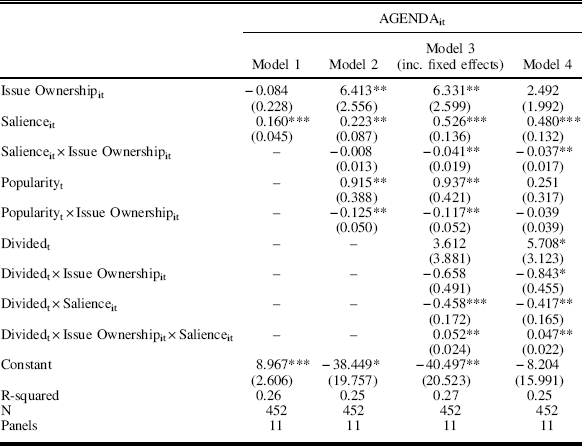
The first row of Table 2 provides evidence in support of Hypothesis 1. Issue competence has a significant effect on the policy agenda of most important laws in Congress. Evidence for this is found in Models 2 and 3, which include election period fixed effects and the additional variables for party popularity (Model 2) and divided government (Model 3). There is a large increase in effect size between Models 1 and 2 as variables for party popularity and interactions are added. In terms of substantive interpretation, the coefficient size for issue competence in Model 2 denotes that a one-point increase on the issue ownership scale leads to an increase of 6.41 percentage point increase in attention of Congress to that issue.
Time-Series Cross-Sectional AR(1) Model of Issue Ownership and Most Important Laws (Majority Party)
Note: *p<0.1; ** p <0.05; ***p<0.01
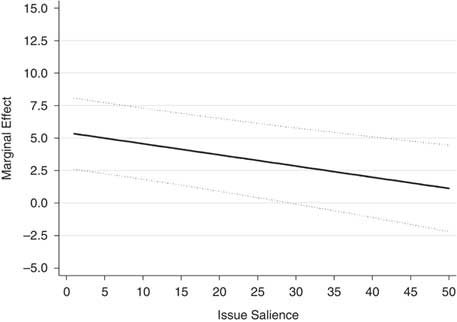
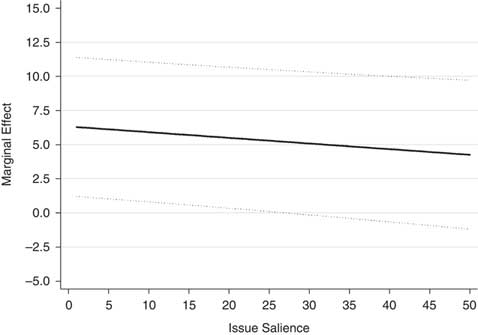
Table 2 also provides support for the contextual hypotheses. Significant effects for the interaction term SALIENCEit×OWNERSHIPit−c are found in Models 3 and 4. The significant negative interaction coefficients confirm the hypothesized trade-off between ownership effects and salience. In order to interpret this relationship, Figure 2a presents the marginal effect of issue competence across values of issue salience, based on Model 3.
Marginal effects of issue ownership for values of issue salience in major legislation in Congress

Figure 2a reveals that issue competence evaluations exert a significant effect on the policy agenda in most important laws when issues are low in salience. The confidence intervals cross 0 at a salience score of 25, revealing a similar pattern of effects to those identified in the policy agenda of State of the Union speeches (in Figure 1a, above).
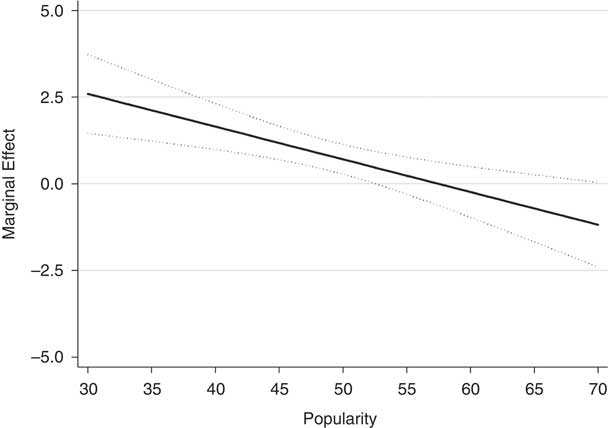
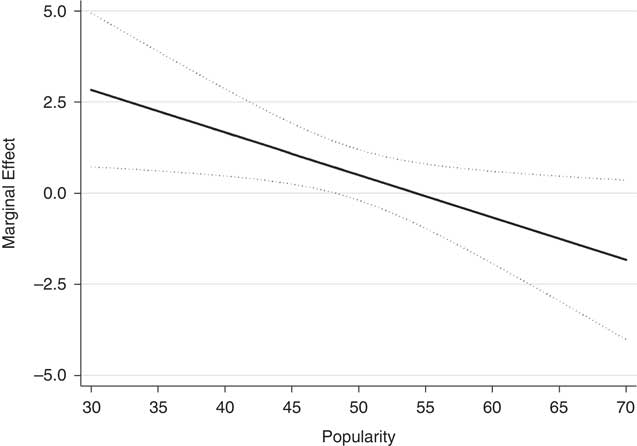
Support is also found in Table 2 for Hypothesis 3, which relates to the relationship between issue competence and electoral popularity. Models 2 and 3 in Table 2 reveal significant negative effects for the OWNERSHIPit−c×POPULARITYt interaction, indicating that issue competence effects on congressional legislation are weakened when the majority party’s electoral popularity is higher and made stronger when the majority party is weaker in the polls. This relationship is illustrated in Figure 2b, which exhibits the marginal effects.
Marginal effects of issue ownership for values of popularity in major legislation in Congress

There are very strong parallels in these effects, comparing Figure 2b for legislation, above, and Figure 1b for executive speeches. These findings jointly reveal that electorally popular parties in the US are less influenced by the public’s relative issue competence evaluations than electorally unpopular parties, which supports Hypothesis 3a but not 3b.
The remaining hypotheses predicted that issue competence effects would be weaker under divided government (Hypothesis 4), and that the moderating effect of issue salience on issue competence would also be weaker under divided government (Hypothesis 5). These hypotheses are supported in Model 3 (Hypothesis 5) and in Model 4 (Hypotheses 4 and 5).
Note that the effect of divided government on attention to salient issues is strongly significant in Table 2, as it was in Table 1. Thus one of the additional observations made possible by these analyses is that of reduced congressional responsiveness to salient issues under divided government, and reduced responsiveness in executive speeches. These findings support existing scholarship that highlights the constraints on opinion responsiveness under divided government.Footnote 83 However, support for Hypothesis 4 (relating to weaker issue ownership effects under divided government) is weaker across analyses of the two dependent variables. Our overarching measure of issue competence suggests that the general effect of divided or unified government is more limited. Where our evidence is strongest, however, it points to an effect on congressional legislation rather than on executive speeches.
RESULTS: UK
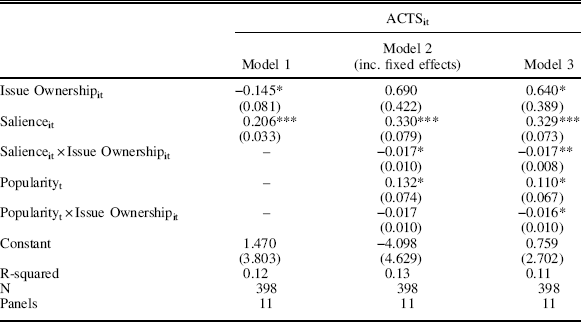
Here we examine the effects of issue ownership on acts of the UK Parliament, reflecting the legislative agenda of the UK Government. We do not include variables for divided government (given the UK’s fusion of executive and legislative powers). We therefore test Hypothesis 1 (which predicted issue competence effects on the policy agenda), Hypothesis 2 (which predicted the moderating effect of issue salience on issue competence effects) and Hypothesis 3 (which predicted the moderating effect of party electoral popularity on issue competence effects). The results for the policy agenda of the UK Government for acts of Parliament are presented in Table 3.
Time-Series Cross-Sectional AR(1) Model of Issue Ownership and Acts of the UK Parliament (Majority Party)

Note: *p<0.1; ** p <0.05; ***p<0.01
The results for the UK bear resemblance to those for the US, revealing that issue ownership incentives – and their contextual explanations – exist outside the US presidential context, but are stronger within the US setting.
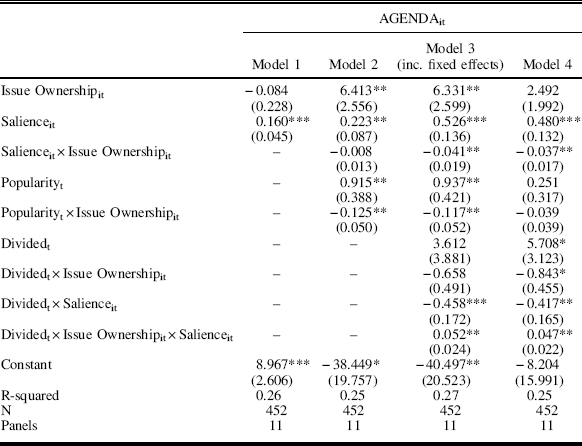
The first row of Table 3 reveals partial support for Hypothesis 1. The effect of issue competence in Model 1 is, counter to expectations, significant and negative. However, once governing party popularity and the interaction terms (with salience and popularity) are included, the coefficient for issue competence is positive and near significant in Model 2 (p=0.102), and positive and significant in Model 3, suggesting support for Hypothesis 1.Footnote 84 The instability of our results for UK acts requires caution about inferences that can be derived due to possible multicollinearity, but there is some evidence that relative issue competence evaluations of the governing party exert an effect on the policy agenda of acts of Parliament.
The third row of Table 3 reveals more consistent support for Hypothesis 2 for UK Acts. The effect of issue competence is moderated by the salience of issues, where the interaction term SALIENCEit×OWNERSHIPit−c is negative and significant, in both Models 2 and 3. These results mirror those found in the US. The incentive to focus on the governing party’s owned issues is weaker when the effect of responsiveness to salient issues is greater. There is also some support in Model 3 in Table 3 for Hypothesis 3a, which predicted that issue competence effects would be moderated by incumbent party electoral popularity (in Model 2 the effect of the interaction between issue competence and popularity is near significant at p=0.107). Examining the marginal effects (not shown), relative issue competence ratings exert a significant effect on executive and legislative policy agendas when parties are electorally weaker, but the effects are no longer significant when parties are electorally strong, just as in the US analyses. Thus while incumbent parties may use a period in office to focus on their partisan priorities, those priorities are more likely to be associated with legislative policy agendas for electorally vulnerable parties. Incumbents with a larger electoral mandate may still attend to their owned issues in legislation, but their broader issue agenda, as well as the tendency to trespass onto other parties’ issues when incumbents have broad public appeal, results in weaker correspondence between issue competence evaluations and government policy agendas – in both the US and the UK.
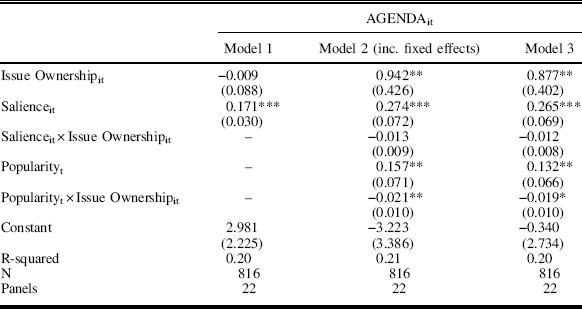
One way of dealing with and investigating multicollinearity is to add data. In the UK the fusion of powers between the executive and the legislature means that we can also test the effect of issue ownership on the policy agenda set out in the Queen’s Speech in combination with acts of Parliament. The results for this model are presented in Table 4. These provide stronger support for Hypothesis 1. The direct effect of issue competence in Model 1 (the linear-additive model) is not significant, meaning there is no sign reversal in terms of statistical significance. Furthermore, the effect of issue competence is positive and significant in Models 2 and 3, indicating that relative issue competence evaluations of the governing party exert an effect on the government’s policy agenda. In the aggregated model of the UK executive and legislative agenda, we find less support for Hypothesis 2, that issue competence is moderated by the salience of issues, though the coefficients are signed (negatively) in the expected direction and just outside the 90 per cent confidence level. Finally, there is much stronger support for Hypothesis 3a, that issue competence effects are moderated by government popularity, with negative and significant effects in both Models 2 and 3. By adding data we observe more consistent results, though these still are not as strong as in the US, in particular for the State of the Union address.Footnote 85
Time-Series Cross-Sectional AR(1) Model of Issue Ownership and the Queen’s Speech and Acts of the UK Parliament (Majority Party)

Note: *p<0.1; ** p <0.05; ***p<0.01
UK government policy attention and US executive and legislative attention is explained by incumbent party issue competence rankings. Our contextual theory of issue ownership effects is also given support. These effects are attenuated by the salience of issues and by the electoral popularity of the incumbent party. US findings bearing on institutional variation concerning unified and divided government also suggest that issue ownership effects – and issue salience effects – are stronger under unified government, as is the moderating effect of issue salience on issue ownership. It is both interesting and important that the results hold across both country cases. Our results suggest that partisan priorities – where these are measured using public opinion about party reputations on issues – translate into legislation outside the US context. We therefore contend that similar issue ownership incentives are likely to exist across country and party systems, but our contextual theory suggests that constraints are important.
Our findings are stronger and more robust in the US case, and stronger for the State of the Union address than for acts of US Congress. This pattern fits with our expectations regarding differences between political institutions. Strong results for the State of the Union address are consistent with its agenda-setting function and low levels of institutional friction – enabling presidents to both seek to emphasize partisan issue strengths and react to issues of public concern. The slightly weaker results for congressional lawmaking are consistent with the greater constraints for the majority party in passing legislation. The even weaker findings of issue ownership effects for the UK are also consistent with our expectations, which suggested that the relative absence of electoral pressure might reduce incentives to stress party issue strengths in the government policy agenda, and to respond to short-term changes in issue salience or electoral popularity. Overall, then, the evidence indicates that issue ownership effects are shaped by their institutional context.
ROBUSTNESS (AND LIMITATIONS) OF RESULTS
We argued above that a rank measure of issue ownership should be particularly useful when predicting the relative attention of executives and legislatures, and such a measure also minimizes the issue of endogeneity and shared variation in issue evaluations.Footnote 86 However, Petrocik’sFootnote 87 original measure took the mean ratings of parties on issues, and other linear measures have been used subsequently. We therefore subjected our theory to additional tests using these measures. The first applied a measure of relative issue strengths and weaknesses, akin to our rank measure of issue competence, but taking the difference of each mean competence evaluation by issue from the mean evaluation across all issues for each election period, divided by the standard deviation (a standardized interval level measure of issue competence). This measure should be expected to control for some of the endogeneity in issue competence evaluations, since the mean of all issues can fluctuate, but the relative strengths are recorded by standardized distance from the mean. Using this measure we found support for four of our hypotheses (Hypotheses 1–4), although without consistency across country and institutional contexts. The results were robust in analyses of the State of the Union address, suggesting that our theory applies most reliably to executive speeches in the US, and is not as sensitive to measurement in this context. Second, we estimated the models using the governing party lead over the opposition for each issue. This found equally strong results (if not stronger) for the executive agenda in the US, but no effects for the legislative agenda in either the US or the UK, perhaps reflecting the endogenous nature of the lead of one party over another. Together these checks give us reassurance that our theory is supported over different operationalizations of issue ownership. The US executive arena appears to be most reliably explained across measures of issue ownership, although our results using the rank measure are confirmatory across institutional contexts. Therefore our second conclusion is that a rank measure of competence best explains the relative prioritization of issues in different contexts. A categorical definition in which an issue is better or worse than other issues provides strong (and the most robust) insights into executive and legislative attention. It is reassuring that a relative measure, computed differently, also gives support to our theory.
The findings using the rank measure are robust to a very wide range of alternative modeling specifications and underlying data checks. For example, to determine whether the greater availability of survey data on issue competence in later time periods had substantive consequences for the findings, we restricted the models to the period between 1970 and 2012 and the effects remained consistent. We tested whether the effects could be different across periods, particularly before and after 1995 in the US, which marked the end of an otherwise unbroken period of Democratic control of the House. Those checks resulted in no differences to the main effects or to the conclusions drawn from other variables.
We took alternative operationalizations of governing party popularity into account (based on the proportion of presidential and majority party seats in the legislature (in the House or UK Parliament)) and this made no substantive difference to the results. We used a different operationalization of divided government in the US, in which either the House or Senate was controlled by a different party to the president. These checks resulted in the same substantive conclusions with equivalent model fit. The same held true when controlling for the party of the incumbent, and for Democratic control of the House in the US before and after 1995. We also checked for collinearity in our interaction models – splitting the samples into low- and high-salience issues, where possible, and into periods of united or divided government – and found support for our findings.
Finally, we examined support for our theory on two alternative cases for which the data were sparser. We used congressional hearings as our measure of the dependent variable in the US and the Queen’s Speech alone as the dependent variable in the UK, finding a significant and positive effect of issue ownership and a significant and negative interaction of salience and issue ownership using congressional hearings, and a significant negative interaction of salience and issue ownership using the Queen’s Speech.
CONCLUSIONS
Issue ownership theories of party and candidate campaigning – specifying the tendency of political elites to seek to shift public attention to their ‘partisan priorities’Footnote 88 or their ‘owned issues’Footnote 89 – account for the policy issues given greater attention in executive and legislative agendas. We expected that the public’s relative ranking of parties’ issue ownership would result in a tendency to legislate on higher-ranked issues for the president, the majority party in Congress and for the government in a parliamentary system. These predictions were supported in analyses spanning six decades in the US and to a lesser but still significant extent in the UK.
Our contextual theory of issue ownership specified three conditions under which issue ownership incentives would be constrained: when political elites are responsive to issues prioritized by the public (salient issues), when a party has a stronger electoral mandate and is less constrained by issues most important to the base (its ‘partisan priorities’)Footnote 90 and under divided government in the US. The results support these hypotheses.
The tension between issue ownership and salience effects reveals an important trade-off between pursuing partisan vs. public priorities, representing an encouraging democratic tension. Our contextual theory therefore has desirable normative implications in both countries’ institutional contexts and adds a new dimension to existing studiesFootnote 91 of how partisan priorities shape policy agendas in the US.
The attenuating effect of party popularity on issue ownership explanations also reveals an important democratic tension: a president emphasizes the party’s owned party issues when his party’s electoral position is weaker, and majority legislative parties attend more to their owned issues in legislation when they are weaker in the polls. This is an important finding. For a popular party there is an additional benefit of being able to reach out on an opponent’s issues, to potentially gain ownership of other issues (or a short-term benefit on an issue) and to appeal to a broad variety of issue publics. There is a competitive and issue-based strategic advantage that comes with electoral popularity. An unpopular leader or incumbent party, however, cannot afford this luxury. Unpopular parties have to play to their base, further rendering an appeal to a broad constituency potentially more difficult and making it harder to gain an advantage on new issuesFootnote 92 . Our findings suggest that issue-trespassing findingsFootnote 93 may apply especially to popular parties rather than for leaders and parties already lacking strong popular appeal.
Finally, our theory predicted that a divided US government would weaken the effects of issue ownership evaluations and public priorities. This institutional context was found to have some effect on translating issue ownership incentives into congressional legislation, providing further reassurance concerning this democratic constraint on the use of office to pursue a party’s owned issues, although with weaker effects than found in other analyses of this question.Footnote 94 However, divided government significantly constrains the moderating effects between issue ownership and issue salience (and the direct effect of salient issues). These findings highlight the positive and negative consequences of divided government in tandem – the constraint on an otherwise unfettered executive in pursuing his or her partisan policy priorities, but the dual constraint of a divided executive and legislature in responding to issues of broad public concern.
Should new data become available, or should the analytic lens be on single-country case studies, future research might explore the application of these findings to different party systems, particularly where coalition government hinders the ability of any party to influence issue attention, where shared government and legislative compromise is commonplace. We would expect the same incentives to hold, but for the size of any effects to potentially be reduced. Further research might also further explore the results in the US and the UK. Scholars might consider presidential and legislative responsiveness on an issue-by-issue basis, identifying instances in which presidents are more responsive to salient issues under divided or unified government, and owned issues on which an incumbent party chooses not to place center stage in legislation. Our general measure of issue ownership effects does not preclude the possibility of individual exceptions, but it reveals how effects are observed across available institutional contexts in general. Our results hold over a range of operationalizations of issue ownership – a rank measure, an interval-level standardized measure and a measure based on the governing party’s competence lead – but the results are not consistent in all contexts using the latter two. This caveat might lead to interesting questions concerning the meaning and measurement of issue ownership. Our results are most strongly robust in the analysis of State of the Union addresses, which suggests that this high-profile salient context is particularly well explained by issue ownership considerations, and that it is also subject to fewer institutional constraints. The results in the US are in general stronger than for the UK.
Political elites operate within a vast array of competing incentives. Those competing incentives – relating to public responsiveness on important and salient policy issues, and the competing incentives of emphasizing issues that appeal to the base (and which constitute remaining electoral strengths) – condition the importance of issue ownership theories for governing agendas. Combining the insights of theories on attention-driven choice in government with theories on the role of selective emphasis, issue ownership and competence has the potential to increase understanding of when governments attend to their party-based ownership strengths, and when other issues are prioritized.