Introduction
The appropriateness of a person’s home environment is a key determinant of wider health and wellbeing (Ellaway and Macintyre, Reference Ellaway and Macintyre1998; Macintyre et al., Reference Macintyre, Ellaway, Hiscock, Kearns, Der and Mckay2003; Sixsmith et al., Reference Sixsmith, Fang, Woolrych, Canham, Battersby and Sixsmith2017). International literature outlines how factors associated with ageing often lead to people needing to reassess their home environment in later life (Langan et al., Reference Langan, Means and Rolfe1996; Heywood et al., Reference Heywood, Oldman and Means2001; Blackman, Reference Blackman2005; Donald, Reference Donald2009; Granbom et al., Reference Granbom, Lofqvist, Horstmann, Haak and Iwarsson2014, Reference Granbom, Slaug, Lofqvist, Oswald and Iwarsson2016; Buffel and Phillipson, Reference Buffel and Phillipson2016; Smetcoren et al., Reference Smetcoren, De Donder, Dury, De Witte, Kardol and Verte2017). While not exhaustive, the need to reassess the home environment is often contingent on a combination of factors such as proximity to friends or family, increased fragility, challenges navigating and maintaining the home environment, and economic difficulties following the death of a partner or relationship breakdown. These factors are commonly expressed as ‘push, pull or stay put’ factors (Heywood et al., Reference Heywood, Oldman and Means2001), or environmental press (Peace et al., Reference Peace, Wahl, Oswald, Mollenkopf, Bond, Dittmann-Kohli, Peace and Westerhof2007).
While the need to reassess the home in later life is a global issue, the range of alternatives to mainstream housing and the individual considerations around reassessing the home will vary country by country. In the UK, specialist housing provides a key alternative to mainstream dwellings. Often used in conjunction with ‘retirement housing’, specialist housing is an umbrella term for many forms of housing outside of mainstream accommodation. In a UK context, most specialist housing is subdivided into ‘sheltered housing’ and ‘extra care housing’. Both enable independent living in later life through offering support with building maintenance and repair, social isolation, security, onsite wardens, communal facilities and alarm services (Nocon and Pleace, Reference Nocon and Pleace1999). Extra care housing offers a more comprehensive service for those with increasingly complex needs (HousingCare.org, 2014a, 2014b).
It is critical that support services are able to inform and empower older people when they reassess their home in later life, especially as reassessing the home often occurs against a backdrop of emotive and challenging individual circumstances. Empowerment of the older person, through confidence building, (Perkins and Zimmerman, Reference Perkins and Zimmerman1995), is the intended outcome of information and advice services in the UK but little is known about the individual outcomes for the older person and the circumstances that influence these. Despite calls within the sector for better information and advice (Oldman, Reference Oldman2006a, Reference Oldman2006b, Reference Oldman2012; Adams and Green, Reference Adams and Green2015), two recent literature reviews have highlighted that there is no research on the outcome of information and advice services in the context of specialist housing for older people (Harding et al., Reference Harding, Parker, Hean and Hemingway2018a, Turnpenny and Beadle-Brown, Reference Turnpenny and Beadle-Brown2014). This article addresses this gap through reporting a qualitative realist evaluation of a telephone information and advice arm of a housing options service for older people considering specialist housing in the UK.
Background
To contextualise the realist evaluation reported on, it is important to 1) outline the conceptual models and typologies of support available to older people, 2) provide an overview of the context around the UK specialist housing market and 3) to describe the policy context surrounding support services.
Models of service support
In the field of housing, Dean et al. (Reference Dean, Goodlad and Rosengard2000) outline three models of ‘access to social rights’ that act as potential models for the configuration of support services. Firstly, ‘the institutional rights’ model, based on the seminal post-war welfare state texts (Marshall, Reference Marshall1950; Titmuss, Reference Titmuss1958), places a primacy on both information and education in order to secure rights for the individual. In the post-war period, where the creation of the welfare state created a new minimum level of social rights across income, employment and housing, information along with education was regarded as critical to inform people of their rights and empower them to achieve change. While information is regarded as generic material (Margiotta et al., Reference Margiotta, Raynes, Pagidas, Lawson and Temple2003), education implies more substantive support including a reflexive element in the pursuit of learning (Grant, Reference Grant1996; Age Concern and HACT, 1999; Cowie and Wallace, Reference Cowie and Wallace2000).
Secondly, influenced by a neo-liberal marketisation of welfare, ‘the market efficiency’ model proposes that information alone enables people to navigate a plurality of options in a marketplace and make informed choices, even in emotional circumstances (Becker, Reference Becker1976). However, providing information on the range of options available in this way can only be presented generically and is not bespoke or tailored to individual need (Margiotta et al., Reference Margiotta, Raynes, Pagidas, Lawson and Temple2003) and does not provide forms of substantive support beyond the provision of information.
Where the ‘institutional rights’ model provides more substantive and bespoke education to compliment information, ‘the market efficiency’ does not promote education. Education is not needed as the efficiency of the market is used as the mechanism to distribute resources. This is built on the assumption that the market provides adequate choice in the first place, that it is responsive to consumer demand and that the processes of attaining resources are transparent. It is assumed, that if these conditions are achieved, then generic information alone will be adequate to inform choice and empower individuals.
A third model challenges the post-war welfare paradigm and the neo-liberal market alternative, both of which in different ways assume a level playing field in terms of resource allocation – i.e. that the state or market allocate resources effectively and efficiently (Dean et al., Reference Dean, Goodlad and Rosengard2000). Based on a feminist view of social inequities and relative lack of access to resources, the ‘radical challenge’ model points out the inequities and inequalities in access to rights and resources. Underpinned by a Habermasian (Habermas Reference Habermas1992a, Reference Habermas1992b) critique of the neo-liberal systems influence on individual agency practices, this model involves the provision of services that advocate on behalf of disadvantaged people (Dean et al., Reference Dean, Goodlad and Rosengard2000). Not only is support exclusively tailored and bespoke to individual need, but support involves acting on behalf of another and is likely a substantive and resource intensive activity. An example of such a service is substantive casework and advocacy that is sometimes required to support the housing needs of those in disadvantaged circumstances (Margiotta et al., Reference Margiotta, Raynes, Pagidas, Lawson and Temple2003; Grenier, Reference Grenier2007; Burgess and Morrison, Reference Burgess and Morrison2015).
With different economic system-based assumptions underpinning calls for generic or more tailored and substantive models of support, it is worthwhile considering the conditions that underpin the organisation and allocation of specialist housing in the UK and outline the key forms of support designed to enable market entry for older people. While we outline a thorough supply-side review of the specialist housing economy elsewhere (Harding et al., Reference Harding, Parker, Hean and Hemingway2018b), it is nevertheless important to provide a brief overview of the specialist housing economy here.
UK context: UK specialist housing economy
An overarching macro issue in the specialist housing sector is a chronic shortage of supply (Best and Porteus, Reference Best and Porteus2016; International Longevity Centre, 2016; Javid, Reference Javid2017; Select Committee on Public Services and Demographic Change, 2013). We argue that because demand outstrips supply, providers of specialist housing are not adequately incentivised to act transparently or to be responsive to older people. A key example of such conditions is highlighted by investigations in recent years by the Office for Fair Trading and Law Commission on the terms of leasehold arrangements in the private sector (Office of Fair Trading, 2013; The Law Commission, 2017). In the social sector, local authorities and housing associations have been negatively affected by austere public policies. This has led to reduced services in existing schemes (Gray, Reference Gray2014, Reference Gray2017; Gray and Worlledge, Reference Gray and Worlledge2018) and put a stop to plans to build others (Harding et al., Reference Harding, Parker, Hean and Hemingway2018b). These market conditions are complex, non-transparent and unresponsive to the needs of older people. The corollary of these challenging market conditions is that effective delivery of support services becomes particularly important.
Policy context: key role of third sector telephone information as supporting market entry in the UK
Devolution has led to the four countries in the UK adopting different policies and practices on the provision of housing support for older people. There exists a mixed-economy of support involving information, advice, advocacy, education and peer support (Age Concern and HACT, 1999; Grenier, Reference Grenier2007; Burgess, Reference Burgess2010; Green, Reference Green2012; Adams and Green, Reference Adams and Green2015; Burgess and Morrison, Reference Burgess and Morrison2015; Scottish Government, 2018). However, while differences are evident across the UK, there are also some similarities. One similarity is that both local and national information and advice services have a central role across the UK, although there are some differences in their delivery.
Focusing on England and Wales, The Care Act 2014 obliges local authorities to provide information and advice across areas of welfare, including on housing in later life. Yet, the quality and coverage of local authority provision has previously been criticised from an older person’s housing perspective (Spiers, Reference Spiers2012). While local authorities also provide support in Scotland (Scottish Government, 2018), the Scottish government and the NHS directly provide a national information and advice service. Care Information Scotland is an information and advice service delivered by telephone, webchat and a website (https://careinfoscotland.scot/). Materials include information on housing schemes and providers, and reports by the Care Inspectorate on specialist housing schemes.
The UK government does not directly provide or manage services in generic terms, but does provide funding for a third sector organisation to deliver a telephone housing options service. This service has recently been referred to as ‘the national advice service’ (Secretary of State for Housing, Communities and Local Government, 2018: 5) and the organisation manages an information directory on UK housing options for older people. There is evidence that some local authorities signpost older people to this particular third sector telephone information service rather than provide a service of their own (Harding et al., Reference Harding, Parker, Hean and Hemingway2018a).
The information imparted by this telephone service is followed up in the post with printed information. The information tends to be of a generic character (Margiotta et al., Reference Margiotta, Raynes, Pagidas, Lawson and Temple2003) and typically includes factsheets about sheltered or extra care housing, how to access options when a low priority (such as when a person does not meet local authority criteria to access social sector housing), and a list of specialist housing schemes in a person’s desired locality. This is an example of generic information, assumed to be adequate when informing choices and empowering individuals in an efficient market (Dean et al., Reference Dean, Goodlad and Rosengard2000). More detail about the information outputs of this service can be found elsewhere (Harding, Reference Harding2017).
Financial efficiency is a primary concern among third sector organisations, given their finite resources. There is evidence that, when compared to more costly face-to-face advice and counsel, telephone services offer a financially efficient means of imparting information and advice on housing (CCHPR, 2012). On account of their financial efficiency, national coverage, central government support, endorsement and signposting from local authorities, this particular third sector telephone service providing information on specialist housing is of central importance. However, as two reviews demonstrate (Harding et al., Reference Harding, Parker, Hean and Hemingway2018a; Turnpenny and Beadle-Brown, Reference Turnpenny and Beadle-Brown2014), there is a lack of research on the outcomes or efficacy of information services for older people and specialist housing, let alone the circumstances that impact on the efficacy of such services. Subsequently, the research question pursued here is as follows:
How, why, for whom, and in what context is a third sector telephone information and advice (I&A) service efficacious in empowering older people considering specialist housing?
Methods
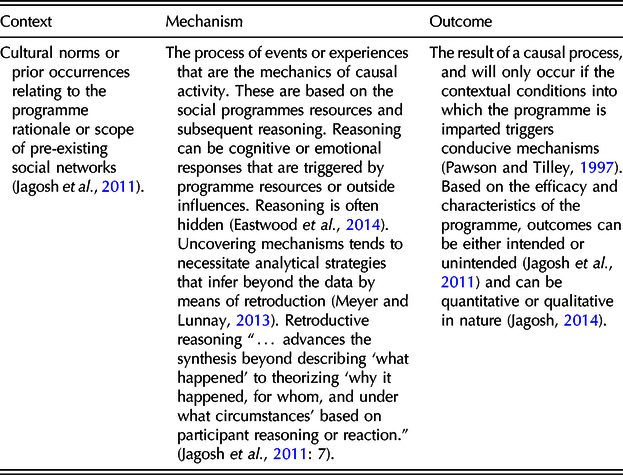
Existing research on this area gives inadequate consideration to the context and wider processes behind outcomes (Harding et al., Reference Harding, Parker, Hean and Hemingway2018a). A realist philosophy (Bhaskar, Reference Bhaskar1978, Reference Bhaskar1979) and realist evaluation (Pawson and Tilley, Reference Pawson and Tilley1997) address these weaknesses (Harding et al., Reference Harding, Parker, Hean and Hemingway2018a). Our data collection, therefore, was framed around the context, mechanism and outcome configuration (CMOc) framework of realist evaluation (Pawson and Tilley, Reference Pawson and Tilley1997).
Table 1 presents definitions of context, mechanism and outcome.
Definition of context, mechanism and outcome

Realist evaluation is best approached using a case study approach, as this ‘advocate(s) the use of multiple methods for data collection, and recognises the importance of context.’ (Rycroft-Malone et al., Reference Rycroft-Malone, Fontenla, Bick and Seers2010: 6). A single explanatory case study approach was used in this study (Yin, Reference Yin2012). A key task in realist evaluation is to form theory concerning for whom and under which circumstances a programme does or does not achieve identified aims. Primary data is then used to test, refine and develop theory (Pawson and Tilley, Reference Pawson and Tilley1997).
As the intended outcome of support services, empowerment means different things to people in different circumstances (Perkins and Zimmerman, Reference Perkins and Zimmerman1995). It is difficult, therefore, to ‘measure’ empowerment with quantitative tools. In this study, multiple, qualitative primary research methods were adopted (Cross et al., Reference Cross, Woodall and Warwick-Booth2019). For example, observations of key meetings, staff and key company documents were scrutinised to contextualise and embed the researcher in the case study site. The key means of data collection however were a focus group with service provider staff and realist interviews with older clients.
The focus group was undertaken with four telephone service advisors (out of a total of six) with the aim of forming a programme theory (Pawson and Tilley, Reference Pawson and Tilley1997). The programme theory largely assumed that information adequately empowers older people when reassessing their home in the context of specialist housing. The development of this programme theory is described elsewhere (Harding, Reference Harding2017).
Theory emerging from the focus group was developed and refined through two rounds of realist interviews (31 in total) (Manzano, Reference Manzano2016) with sixteen older people. Participants were sampled purposively (Emmel, Reference Emmel2013) from across the UK, and interviews conducted one (n=16) and four months (n=15) after the client had engaged with the service. Realist interviews seek the views of participants on the CMOc in question to validate, refine or develop theory (Manzano, Reference Manzano2016). This strategy was used during the interviews, but was preceded and combined with less didactic approaches around open questioning and indirect queries in order to explore other possibilities and alternative explanations based on participants’ reflexive accounts (Smith and Elger, Reference Smith, Elger, Edwards, O’Mahoney and Vincent2014).
The primary inclusion criteria was that older people were sixty-five years or older and had received an ‘accommodation listing’ (a list of specialist housing in the participants’ desired locality) from the organisation under study. This group was described by the service as their core client group.
The researcher also had access to audio recordings of telephone calls between the information seeker and advisor and electronic copies of imparted information that had been sent in the post. This provided information to inform in-depth questioning during the interviews. A research diary was kept, capturing notes, reflections and memos throughout the research (Bloor and Wood, Reference Bloor and Wood2006; Yin, Reference Yin2011). All qualitative focus group and interview data was audio recorded, transcribed and analysed in NVIVO Version 11. The study received ethical approval through the researcher’s University Research Ethics panel.
Analytical approach
It is important to employ analytical approaches that limit the possibility of bias by the researcher imposing theory (programme theory or other ideas) on to the data. Pre and open coding was used so that alternative ways of making sense of the data were not overlooked (Meyer and Lunnay, Reference Meyer and Lunnay2013). Therefore, an inductive thematic analysis was first undertaken (Barber, Reference Barber2014). Initially, this produced a large number of themes and sub-themes. It is important to note that realist interviews test theory with participants by seeking their views on the CMOc in question. Thus the programme theory in question is discussed and forms part of the qualitative data. The combination of realist interviews and open coding not only addresses the development of theory but also elicits data where alternative explanations may be found.
In the second stage of analysis, retroductive reasoning (Pawson and Tilley, Reference Pawson and Tilley1997; Sayer, Reference Sayer2000; Danermark et al., Reference Danermark, Ekstrom, Jakobsen and Karlsson2002) was used to infer beyond the data and to test, refine and develop theory and configure the themes that emerged from the first stage of analysis into context, mechanism and outcome.
Outline of the service
The service manages a comprehensive national database of specialist housing (Pannell et al., Reference Pannell, Aldridge and Kenway2012), and operates three distinct service delivery models:
1) An online directory of UK housing providers and care services
2) A team of advisors who manage telephone enquiries
3) A small number of local partner agencies who deliver more intensive advocacy, casework and face to face support in a limited number of localities
Enquiries to the service and requests for information are already consumer-driven, and enquiries tend not be based on any formal assessment by a housing or care professional. The telephone service draws on the online directory for the generic information that advisors post to information seekers. The service has received Ministry of Housing, Communities and Local Government funding (including when the department was known as the Department for Communities and Local Government (DCLG)), who initially set a new public management style target (Ferlie et al., Reference Ferlie, Ashburner, Fitzgerald and Pettigrew1996) as an initial condition of funding:
‘At least 22,500 customers receiving personal housing related advice from a [service] advisor’ (CCHPR, 2012: 7)
The role of this target in shaping how the service operates will become increasingly clear as the findings are presented.
Findings: interviews with older people
The analysis of interviews with information seekers uncovered six CMOc driven by two key contextual factors. First it showed experiences tended to be dependent on the tenure of the information seeker and the sector in which they resided. Information seekers in the social sector (n=7), some of whom were already in specialist housing and limited to that particular sector, felt themselves to be a low priority and reported a lack of transparency when attempting to navigate the system. Implicit in these circumstances is their prior experience and knowledge of the system. Indeed, all participants in the social sector stated that, before contacting the service, they had already unsuccessfully pursued alternatives through regular social channels such as local authorities and housing associations. Many also reported negative experiences of engaging with local authorities and housing associations.
In contrast those in mainstream housing (n=9), typically owner-occupiers, tend to be unfamiliar and often had less knowledge and experience of navigating the specialist housing market. The lack of wider transparency experienced by those in the social sector was also experienced by this group. This group placed a high value on continued discussion, deliberation and exchanging views, but did not attain this from the service.
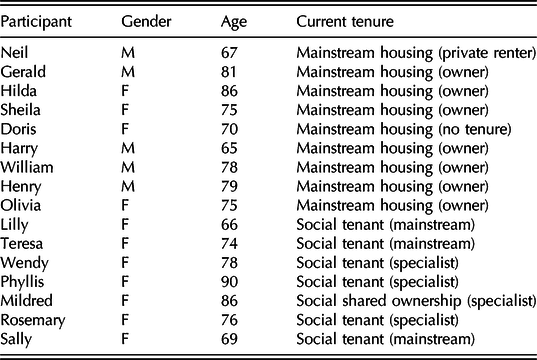
These contextual factors of tenure and the value attributed to discussion and deliberation had a significant bearing on the nature of mechanisms and outcomes. The first four CMOc pertain to older people who live in mainstream housing and the last two relate to older people residing in the social sector. Pseudonyms are used to protect the participants’ identities, and a breakdown of participants’ is presented in Table 2.
Breakdown of participants

CMOc1 – 4: Seeking information when living in mainstream housing
CMOc1: ‘…floating around’
Context
These individuals were at a relatively early and uncertain stage in their decision making process (i.e. around knowing what they want, what is suitable and or how to attain it) and had a relatively poor knowledge about specialist housing. They were typically not readily able to draw on any social networks with whom they might discuss their situation (e.g. family and friends).
Mechanisms
In these circumstances, the older person engaging with the service triggered three mechanisms, leading to the outcome of being uncertain how to proceed. Some participants, such as Neil, were apprehensive (mechanism 1) and uncertain how to proceed:
‘Well it’s a difficult problem I’ve got really that can’t really be answered in an information pack I don’t think because it’s quite sort of, you know, knotty and there’s a lot of emotional attachment to this place… so it’s a difficult problem which you can’t really answer in this report…’ (Neil)
Doris, on the other hand, felt uncertain because she remained unfamiliar with specialist housing alternatives. Doris reported not adequately understanding the information given to her by the service and thus demonstrated a general lack of comprehension (mechanism 2). Others such as Sheila remained uncertain despite the fact that they reported trusting (mechanism 3) the information provided implicitly and being heavily reliant on it to inform their search for housing:
‘ I don’t even know any other organisations [who could provide information and support]. I don’t know anything else, I’m sure there is stuff that you could do, but I don’t know of it and you know, I don’t know where you find out….’ (Sheila)
Outcome
The participants in these circumstances were in one participant’s words ‘…floating around.’ (Gerald) and not making progress in reassessing their home. Participants tended to either seek out further support, or saw it as desirable. Specifically participants saw a need for further support from the service to provide more opportunity for discussion and deliberation around their specific issues. For example, Neil had pursued local face to face support and suggested how he would like to access peer support. In another example, Hilda sought additional support after accessing the service from another third sector organisation in order to provide more discussion and deliberation when visiting accommodation:
‘… because you see she might be looking and bringing out more questions when we’re there than I might bring myself. But it’s going to take me a while I know.’
In another example, Gerald outlined how he benefited from using the interviews with the researcher to discuss his situation:
‘I mean I’ve talked it over with you now, but that sort of getting over the emotional situation when one’s looking and having to leave or go somewhere different for the rest of your life that would be a useful service – you know… just chat over these things with somebody.’
Overall, the provision of generic information was inadequate for these individuals and they did not feel empowered. In many cases, uncertainty tended to act as a trigger for people to seek out more substantive support from other sources.
CMOc2: ‘Speculate to accumulate’
Context
Similarly to CMOc1, Olivia was resident in mainstream housing and at an early stage in decision making. However, unlike those in CMOc1, Olivia had access to a deliberative social network.
Mechanism and outcome
Olivia did not use the information within the timeframe of data collection (outcome), and instead gave the information away to a member of her social network. Olivia’s reasoning was that in order to accumulate wider perspectives through discussion and deliberation with a member of her deliberative network, she first needed to speculate and give it away because:
‘… Like all relationships you can’t take, take, take. You’ve got to sort of give as well.’
Thus exhibiting the mechanism ‘speculate to accumulate’ (mechanism):
‘You know, my first thing is don’t panic, you know, I’ll phone so and so and get their opinion… And maybe you’ll get an opinion from another friend who’s totally opposite in their life style, in their outlook on life but through these opinions you take your information etc…’
Like CMOc1, CMOc2 outlines the importance attributed to the role of discussion and deliberation in relation to instilling empowerment, including giving information away in order to accumulate it.
CMOc3: People with Negative prior experiences of the housing market
The third CMOc relates to individuals with previous negative experiences of navigating the specialist housing market.
Context
Harry resided in mainstream housing and was at an advanced stage of decision making. This meant he already had a clear idea of what he wanted information on from the service (i.e. on a specific form of housing). However, he had negative experiences of navigating the market (context), including becoming informed.
Mechanism and outcome
In this context, Harry suggested trusting (mechanism) in the information given by the service, seeing it as providing a more reliable perspective than other sources of information:
‘…when I read the government website I thought… I’ll be alright with this’. But then I spoke to [the service], and realised…that you had to apply a lot of hard work to it.’
However, four months after speaking to the service, he was no closer to resolving his housing issue. Like CMOc1, Harry continued to ‘…float around’. Like others residing in mainstream housing, with the system being complex to navigate, non-transparent and unresponsive, Harry perceived he would benefit from increased support directed at increasing understanding.
‘So what [the service] could do, it’s raison d’être could be the company who tells it like it is… They have an opportunity here. Because the system is such shit, they could be the shit busters.’
Ultimately Harry did not gain adequate understanding or empowerment from engaging with the information outputs of the service.
CMOc4: Reinforcement of what is already known
Context
The last CMOc for those living in mainstream housing is illustrated through the experiences of Henry and William. Both contacted the service and were imparted with information when at an advanced stage of decision making. Both had substantial prior knowledge of the housing market that they had accrued over a lengthy period involving many prior enquiries (context).
Mechanism and outcome
In this context, Henry found nothing new in the information he was given. However, he still appreciated the information, taking it on trust (mechanism) that the information reinforced what he already knew (outcome):
‘…their comments were reinforcing what I had already found out. So I suppose in that way it was a good thing.’
However, considering the complex and unresponsive nature of the market, Henry was unable to resolve his issue. Henry said he would have valued a more substantial service with a focus on discussion and deliberation in order to ‘…exchange views…’ about his situation. He actively sought this out after engaging with the service.
Another participant in this context, William, reflected that being stuck in the system led to uncertainty which more substantive discussion and deliberation could have helped:
‘…it would have been very helpful because there were lots of stages where I was stuck with the system and I didn’t know what to do about it.’
Whether at advanced or less advanced stages of decision making, all participants residing in the mainstream housing sector highlight the importance of discussion and deliberation and suggest this is not supported by the current provision of information by the service in its current form. CMOc5 and CMOc6 pertain to people in the social sector.
CMOc 5-6: Seeking information when in the social sector
CMOc5: Little of the housing available is viable
Context
Older people already residing in the social sector, and whose circumstances meant they were limited to the social sector, had already pursued options through their regular social channels (i.e. local authorities and housing associations). This has three important implications for the nature of participant enquiries. Firstly, and in contrast to the situations of people discussed in CMOc1-3, these people often had good knowledge of alternatives and the social sector. Secondly, participants had engaged previously with social channels, but had been unsuccessful in their attempts to move and often shared negative experiences of engaging with local authorities and housing associations. Thirdly, in a sector based on allocation and rationing, participants in this context saw themselves as being treated as a low priority and this motivated them to contact the service.
Mechanism
Contacting the service triggered a sense of trust (mechanism) relative to prior negative engagements with local authorities and housing associations. For example, one month after engaging with the service Sally stated that:
‘[the service] is probably the only organisation I now know of that helps me and makes my equation more workable… Now to get that in the real world is very few and far between… I can’t tell you how refreshing it was.’
The participants reported that information was only of use if schemes listed in the information accepted direct applications outside of local authority allocation systems. As one participant, Sally, said: ‘… so if you take it out of that forty probably six or eight are possibilities.’
Outcome
Unsurprisingly, being imparted with information – sometimes including schemes that Sally already knew about or for which she was not eligible for – meant that little was viable (outcome):
‘I did a lot of ringing around at the time and there were only about six options actually…I have rung round the six possibilities, most had no vacancies, one I had registered with already – Anchor – and another Anchor I didn’t like because it was very tiny and there was no ground outside at all… I don’t think there’s much else in my situation I can do ….’
Sally outlined how only a small number took direct applications and she was encountering barriers. Ultimately, there were few specialist housing options viable for her (outcome). This highlights how, in these circumstances, housing options included in the information provided had already been pursued. Reflecting earlier discussion, it also highlights that there is an overall shortage of options.
CMOc6: Resilience: reconsidering the need to move
Context
Participants in CMOc6 were also resident in the social sector. However, unlike CMOc5 participants in CMOc6 were only beginning to consider specialist housing. Their experiences of engaging with social channels to access specialist housing had been limited. Subsequently unlike CMOc5, prior enquiries have not been made and were not characterised by unsuccessful enquiries and negative experiences (context).
Mechanism and outcome
As their need to access specialist housing is not urgent, participants such as Lilly found the information on specialist housing triggered a sense of resilience (mechanism) and that she could remain in her current housing. Specialist accommodation was no longer seen as desirable. Lilly subsequently chose not to act on the information provided (outcome):
‘… I’m not ready to go into assisted living or warden based living…I’m not ready for that. It’s like giving up you know! And I’m not ready for that yet.’
Lilly’s sense of resilience is illustrated by her reconsidering her original motives for seeking support. In relation to the stairs, described as a ‘nuisance’, Lilly commented:
‘…but that’s all they are – they’re not insurmountable – do you know I can manage, I can make three trips up and down from the car, and have a sit down in between you know! It’s not insurmountable, it’s not a reason to give up.’
Ultimately the provision of information was unable to change people’s fortunes when limited to a social sector with few, if any, viable and sometimes undesirable alternatives. However, others at an earlier stage in decision-making chose not to act after reflecting on the relative undesirability of housing options.
The length of time participants residing in both sectors spoke with an advisor was often only a matter of minutes and in one case it was under three minutes. A lack of meaningful engagement likely reflects a service driven need and desire to attain a high quantity of engagements in order to meet the new public management style (Ferlie et al., Reference Ferlie, Ashburner, Fitzgerald and Pettigrew1996) target that was set by DCLG. This underlines how the substantive and relational engagements that are central to deliberation and discussion, often sought out independently or deemed desirable by participants, were not supported by the service or in the conditions set out by their key funding agency.
Discussion
The empirical findings presented in this article highlight older people’s experiences of considering specialist housing with generic information against a backdrop of complexity, non-transparency and unresponsiveness that is characterised by a shortage of supply. We argue that these market conditions are failing older people (Harding et al., Reference Harding, Parker, Hean and Hemingway2018a). Juxtaposing Dean et al.’s (Reference Dean, Goodlad and Rosengard2000) typologies of social rights against the service under study relative to market conditions highlights the efficacy of generic information (Margiotta et al., Reference Margiotta, Raynes, Pagidas, Lawson and Temple2003) in a market with a shortage of supply. Given the provision of information makes an assumption that the market allocates resources efficiently, there is a clear dichotomy in configuring support around a ‘market efficiency’ model where generic information is positioned to enable people to navigate a system where little market efficiencies are evident.
Subsequently there are two substantial and interlinked points for discussion concerning the supply and specialist housing and support designed to enable market entry. Firstly, this study underlines the conclusions of others who widely note that more specialist housing is needed (Select Committee on Public Services and Demographic Change, 2013; International Longevity Centre, 2016). In simple terms, older people require more housing options than are currently being provided. Secondly, the shortage of options and challenging supply-side conditions are key reasons why the outcome of engaging with generic information was largely ineffective and service planners and funders need to consider conditions when designing support services. This is particularly the case for information seekers already in the social sector, already with a good understanding of the sector, but for whom many alternatives were not viable. These challenging aforementioned conditions in the sector are also a central factor as to why those in mainstream housing were not empowered by information. Yet, also a factor was the relative inexperience of mainstream dwellers and subsequent lack of knowledge when compared to those in the social sector. On this basis, substantive support allowing more discussion, deliberation and exchanging views was desired by those with low levels of knowledge, for whom forms of support that provide an educational aspect is clearly a pressing need. Such support was commonly desired, so much so that one participant chose to give away the information that she was sent in the hope it would prompt discussion among her social network (CMOc2). Advocacy, a form of support associated with those in disadvantaged circumstances, is also of interest in the context of the findings reported in this article, such are the problems in engaging with the specialist housing sector. These findings support the established proposition that increased communication that is tailored and bespoke is central to individual agency (Habermas, Reference Habermas1992a, Reference Habermas1992b), something that is seemingly not valued by the service under study or arguably in their new public management style conditions of funding set out earlier.
Referring back to Dean et al.’s (Reference Dean, Goodlad and Rosengard2000) typologies of support again, communicative forms of support fall under the ‘institutional rights’ and ‘radical challenge’ models’, with the latter offering a better reflection of inequitable and inaccessible conditions associated with the specialist housing market. These models place a primacy on education and support or advocacy as well as information, which this research suggests could better empower older people when reassessing their home. The need for more substantive deliberative services seems consistent with increasing support delivered in local settings.
Limitations and areas for further research
Inherent in the adoption of Bhaskar’s (Reference Bhaskar1978, Reference Bhaskar1979) notion of realism and Pawson and Tilley’s (Reference Pawson and Tilley1997) initial realist evaluation framework is the acknowledgement that this study is able to provide partial truths that pertain to the case study and the research participants in the period in which data was collected. This may be applicable to others, but is non-generalisable. However, the findings do offer an explanatory and ‘reusable conceptual platform’ (Pawson, Reference Pawson2013) that will likely be of interest to further related studies.
While the use of qualitative research methods, realist and case study approaches have highlighted in detail the role of context and its configuring relationship with mechanisms and outcomes, further studies could consider using quantitative and mixed-methods approaches to conduct larger scale evaluations. Given this study has highlighted the likely efficacy of communicative forms of support, this is a priority for further research, along with evaluations that compare the efficacy of different forms of support.
Conclusion
Many acknowledge the need for better information, advice and support services for older people reassessing their home, although there is a lack of critical engagement with what might make these services better in practice. The empirical material presented in this article suggests that funders and service planners need to consider the conditions that characterise the markets that their services are designed to facilitate entry into. In the UK context that this article outlines, the provision of generic information alone to older people cannot be considered effective. More substantive support, an increased building rate and more viable and desirable housing options are needed if older people are to be empowered when reassessing their home in the context of UK specialist housing.
While more substantive support is desirable, it is critically important to acknowledge that specialist housing provision in the UK is currently relatively inaccessible, quite possibly regardless of how substantive support mechanisms are or become. However, reassessing the home in later life should not merely be about considering specialist housing. For example, as part of a broader and more substantive dialogue involving discussion and deliberation, considering wider alternatives could include making adaptions or modifications to the existing home – something which may be more attainable.