

Introduction
The modern Veneridae are the most speciose family of the Bivalvia, with ~750 species in 135 genera, outnumbering the next most diverse families, the Galeommatidae and Tellinidae, each with ~500 species in 100 genera (Huber, Reference Huber2015; Collins et al., Reference Collins, Edie, Hunt, Roy and Jablonski2018; Edie et al., Reference Edie, Jablonski and Valentine2018). Molecular analyses have established a backbone phylogeny for Veneridae (Mikkelsen et al., Reference Mikkelsen, Bieler, Kappner and Rawlings2006; Chen et al., Reference Chen, Li, Kong and Zheng2011), but species coverage within the group is still insufficient to confirm monophyly of some long-established taxonomic groupings, such as subfamilies. A further complication (or source of interest) is the high level of homoplasy in infaunal bivalve shell form owing to the functional requirements of burrowing method and life habit. Consequently, systematics within the Veneridae has been unstable, with species frequently moved between genera and with a much-revised subfamilial classification system (e.g., Keen, Reference Keen and Moore1969; Harte, Reference Harte1998; Huber, Reference Huber2010; Alvarez, Reference Alvarez2019). The classification of Bivalvia in the ongoing revision of the Treatise on Invertebrate Paleontology demotes many historically accepted venerid subfamilies to tribes, some of which, including Tapetini (=Tapetinae), are thought to be paraphyletic (Carter et al., Reference Carter, Altaba, Anderson, Araujo and Biakov2011), although subsequent studies continue to use subfamilies, and recent molecular work recovered a monophyletic Tapetinae (Kappner and Bieler, Reference Kappner and Bieler2006; Mikkelsen et al., Reference Mikkelsen, Bieler, Kappner and Rawlings2006; Chen et al., Reference Chen, Li, Kong and Zheng2011).
Despite their taxonomic richness, the modern Veneridae are not as morphologically diverse as other species-rich bivalve families (e.g., the Pectinidae and Tellinidae), particularly if specialized rock-boring Petricolinae (subtribe Petricolini in Carter et al., Reference Carter, Altaba, Anderson, Araujo and Biakov2011) are omitted from consideration. Soft-bottom infaunal venerids are equivalve, inequilateral, and prosogyrous. Most of their variation in form derives from posterior elongation, but even in this they are conservative compared to other heterodont bivalves such as the Tellinidae or the razor clams in the superfamily Solenoidea, and Veneridae lack anteriorly elongate forms, such as occur in the fast-burrowing families Donacidae and Mesodesmatidae.
Legumen Conrad, Reference Conrad1858, a Cretaceous venerid genus, comprises ~22 valid species, most of which are small, extremely posteriorly elongate, and very compressed, and thus a morphological outlier to the family. The genus has been placed in the Tapetinae since Stoliczka (Reference Stoliczka1871; as “Tapesinae”), following the designation of Venus (Tapes) fragilis d’Orbigny, Reference d'Orbigny1845 as the type of his new genus Baroda, subsequently synonymized with Legumen by Stephenson (Reference Stephenson1923). That synonymy was retained by Keen (Reference Keen and Moore1969, p. N682), who diagnosed Tapetinae as “Ovate to elongate, shell surface somewhat polished, inner margins smooth on at least posterior third; hinge plate narrow, with cardinals 3a entire, 3b normally entire, others frequently bifid; lateral teeth wanting.” The first appearance of Legumen is given as ‘lower Cretaceous’ in Keen (Reference Keen and Moore1969), which may have been a reference to “Tapes” parallela Coquand, Reference Coquand1865 (Aptian) or to an unnamed Albian Angolan Legumen sp. (Rennie, Reference Rennie1929; see Dartevelle and Freneix, Reference Dartevelle and Freneix1957). Since the Treatise on Invertebrate Paleontology, a potential Albian species has been named as L. iraniense Collignon, Reference Collignon1981, but this is based on a single poor specimen with no hinge preserved. Because of the extremely thin, delicate nature of the shell of most Legumen species, this is not an uncommon situation: few specimens are available in museum collections and even fewer with interior characters (i.e., hinge plate, teeth, muscle scars, pallial line, and sinus) preserved. Illustrations of internal characters in the literature are sparse for all known species. Our aim here is to provide, for the first time, high-resolution images of the hinge of this genus, and to place this unusual venerid in a broader context in terms of shell and hinge morphology. We find that the form of the dentition in Legumen, while it mostly conforms to Keen's broad diagnosis of Tapetinae, is very distinctive.
We use 3D micro-CT scans to digitally ‘excavate’ the hinge of two specimens of L. ellipticum Conrad, Reference Conrad1858, one embedded in matrix and the other articulated. This technique, along with a well-preserved single valve of L. ellipticum and two of L. carolinense (Conrad, Reference Conrad and Kerr1875), has allowed us to include Legumen in a 3D morphometric dataset. Using landmark/semilandmark morphometrics on the interior surface of the shell and on hingeplate configurations, we quantify and compare the form and hinge position in Legumen to an exemplar species from each extant genus in Veneridae (excluding the rock-boring Petricolinae) and to the related and superficially Legumen-like heterodont families Pharidae and Solenidae, colloquially known as ‘razor-clams.’ This analysis of form, plus close observation of hinge anatomy, suggests that Legumen fits poorly within the Subfamily Tapetinae (=Tribe Tapetini). This analysis also suggests that Legumen was a fast, vertically burrowing, deep-infaunal siphonate, silty-sand dweller similar to the smaller species of Pharidae. This represents a distinct life-habit within the Veneridae that was vacated at the Cretaceous-Paleogene boundary when Legumen went extinct, and has not been re-occupied by other, surviving lineages within the family.
Materials and methods
Specimens
The dataset consists of micro-CT scans of 151 Recent and Cretaceous bivalve specimens (138 non-petricoline venerids, 10 pharids, and three solenids), representing all extant sediment-burrowing genera in the three families, plus a small number of morphologically representative Cretaceous specimens from the southeastern USA. We exclude the Petricolinae because they are a monophyletic and functionally restricted group that occupies a hard substratum, requiring special modifications of the shell. We treat bivalve subgenera as operational genera (hereafter “genera”), following general paleobiological practice (e.g., Sepkoski, Reference Sepkoski2002). Genera are represented by one valve of a single adult specimen, most often of the type species (where available), and usually a left valve. Right valves were operationally mirrored about the plane of the commissure for inclusion in shape analyses when a left valve was unavailable for study.
Two species of Legumen are included in this dataset: L. ellipticum (N = 3: USNM 76669, Nacatoch Sand, Kaufman County, Texas; UFIP 180951, “Ripley” [presumably Owl Creek] Formation, Owl Creek, Tippah County, Mississippi; USNM 728210, Coon Creek Formation [or Coon Creek Member, Ripley Formation], Lee's Old Mill Site, Union County, Mississippi) and L. carolinense (N = 2: USNM 31947 and 31802, Tar Heel Formation, Snow Hill, Greene County, North Carolina) (Fig. 1). Other species of Legumen and other Cretaceous venerids (N = 114) that were unavailable to us for scanning are included in our dataset using published shell heights and lengths, which we use to compare them to all other taxa using the commonly used metrics of aspect ratio and size, as geometric mean of length and height, a metric closely correlated to centroid size (Kosnik et al., Reference Kosnik, Jablonski, Lockwood and Novack-Gottshall2006).
Exemplar specimens of Legumen and other Veneridae. Each specimen is illustrated as the whole valve with scalebar (10 mm) and an oblique close-up of the hingeplate (below, with a 2.5 mm scalebar) to facilitate comparison of dentition. Note that in Legumen ellipticum, unlike in the other modern and fossil Tapetinae illustrated here, teeth 1, 2b, and 3b are not bifid, and tooth 4b is extremely elongate. In Legumen carolinense, tooth 3b only is bifid, and the bifurcation is unlike that of true Tapetinae in orientation and character (see text). (1, 4) Legumen ellipticum Conrad, Reference Conrad1858 (USNM 76669, Nacatoch Formation, Kaufman County, Texas), left valve. (2, 5) Legumen ellipticum Conrad, Reference Conrad1858 (USNM 728210, Coon Creek Formation, Lee's Old Mill Site, Union County, Mississippi) left valve. (3, 6) Legumen carolinense (Conrad, Reference Conrad and Kerr1875) (USNM 31947, “Black Creek Formation” (now Tar Heel Formation), Snow Hill, Greene County, North Carolina) left valve. (7, 10) Legumen ellipticum Conrad, Reference Conrad1858 (also USNM 76669) right valve (not included in the 3D analyses). (8, 11) Legumen ellipticum Conrad, Reference Conrad1858 (UFIP 180951, “Ripley Formation” (Owl Creek Formation), Owl Creek, Tippah County, Mississippi) right valve. (9, 12) Legumen carolinense (Conrad, Reference Conrad and Kerr1875) (USNM 31802, “Black Creek Formation” (now Tar Heel Formation), Snow Hill, Greene County, North Carolina), right valve (not included in the 3D analyses). (13, 16) Irus irus (Linnaeus, Reference Linnaeus1758) (FMNH-IZ 176432, Recent, Monterey, California) left valve. (14, 17) Eurhomalea rufa (Lamarck, Reference Lamarck and Chevalier de1818) (FMNH-IZ 218326, Recent, Coquiambo, Chile) left valve. (15, 18) Tapes literatus (Linnaeus, Reference Linnaeus1758) (FMNH-IZ 293275, Recent, Broome, Western Australia) left valve. (19, 22) Ruditapes philippinarum (Adams and Reeve, Reference Adams, Reeve and Adams1850) (UF 173943, Recent, Pearl Harbor, Hawaii) right valve. (20, 23) Cyclorisma sp. (USNM 728211, “Black Creek Formation” (now Tar Heel Formation), Snow Hill, North Carolina) right valve; (21, 24) Eumarcia (Opimarcia) healyi (Marwick, Reference Marwick1948) (USNM 728212, Otahuhu Formation,Otahuhu Brewery Well, Auckland, NZ), right valve.

Shape analyses
Shapes of the interior surface of the shell are characterized using an automated semi-landmarking procedure adapted from the ‘eigensurface’ procedure of Polly and MacLeod (Reference Polly and MacLeod2008), following the method detailed in Collins et al. (Reference Collins, Edie, Gao, Bieler and Jablonski2019). The interior surface of the shell best represents the general shell form used to infer life modes within the Bivalvia, without adding noise related to sculptural variation (Collins et al., Reference Collins, Edie, Gao, Bieler and Jablonski2019). A grid of semilandmarks is placed over the digitized 3D surface of the shell, superimposed across specimens using a Generalized Procrustes Analysis, and then summarized into a morphospace using Principal Components Analysis (PCA).
Hinge configurations are captured using a minimal set of user-defined landmarks designed to capture the mechanical shape of the hingeplate without relying on specifics of tooth homology, which is violated by the comparison of species from two distantly related superfamilies (or even simply inclusion of both left and right valves in the dataset). The first three landmarks describe the beak and cardinal teeth, delineating the area of the hinge that acts to reduce shear during active burrowing. In order to capture variation in the position of this cardinal area relative to the rest of the hinge area, four more landmarks are included: the junctions of the adductor muscle scars with the hingeplate and the anterior- posterior-most points on the shell commissure parallel to the vector joining the adductor muscle landmarks (i.e., the vector commonly used to define the shell length). These anterior and posterior commissure points were computationally determined by finding the largest magnitude vector connecting two points along the shell commissure that is parallel to the vector defined by the two adductor muscle scar landmarks (Fig. 2).
Landmarking scheme. The landmarks delineating the cardinal area and the line of the hingeplate are user-defined, the landmarks delineating the anterorposterior axis are placed automatically (see text). Figured specimen is Recent chionine venerid Chione cancellata (Linnaeus, Reference Linnaeus1767) (FMNH-IZ 184007, Guadalupe)

Repositories and institutional abbreviations
Specimens examined in this study are deposited in the following institutions: The National Museum of Natural History, Smithsonian Institution (USNM), the Field Museum of Natural History (Invertebrate Zoology) (FMNHIZ), the Florida Museum of Natural History (Invertebrate Zoology [UFIZ] and Paleontology [UFIP]), the Natural History Museum (NHM) London, and the California Academy of Sciences (CASIZ).
Results
The Appendix contains descriptions of the morphology and dentition of Legumen ellipticum and L. carolinense, and additional images of their dentition (Appendix Fig. 1).
Aspect ratio
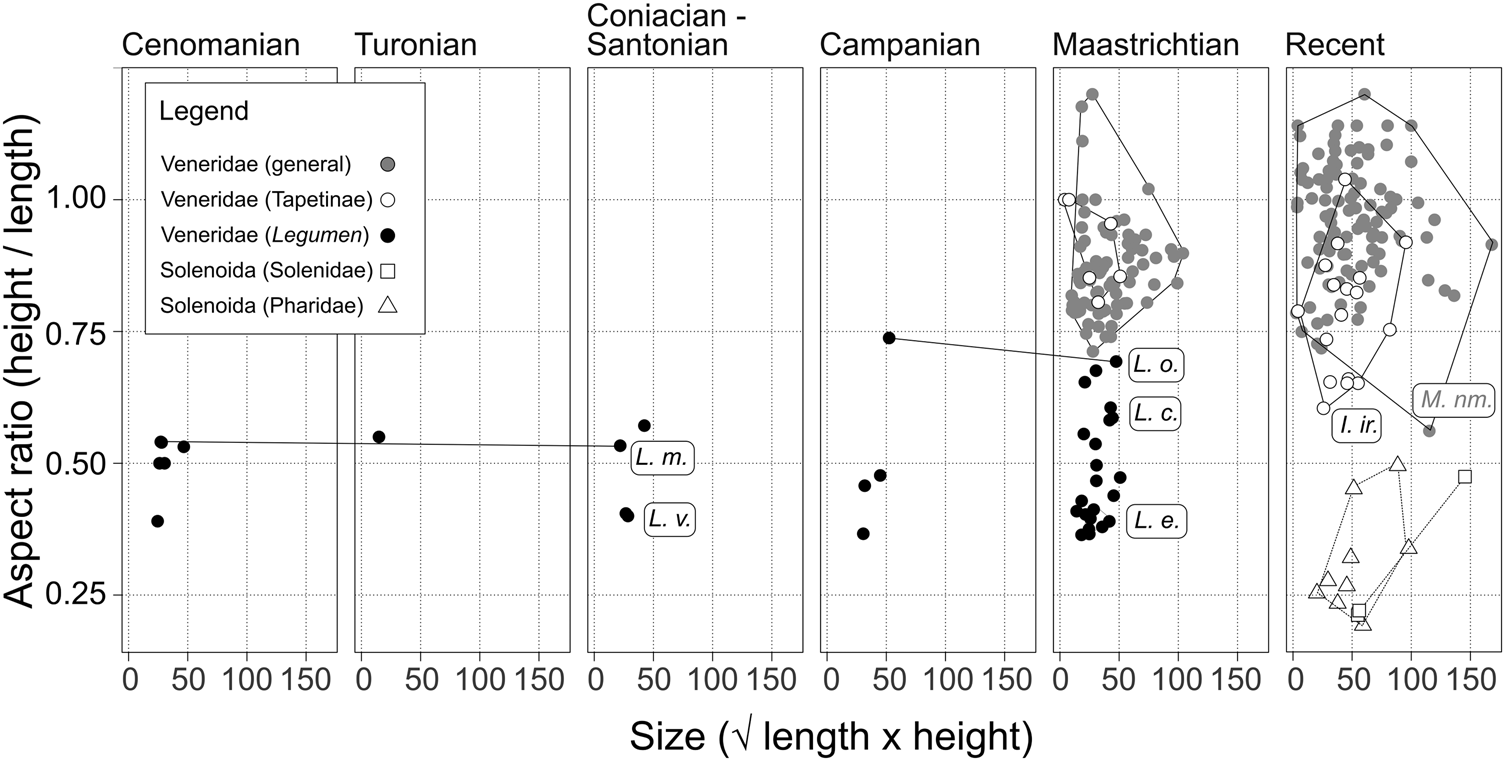
Figure 3 shows that Legumen species occupy a portion of the size/aspect ratio space intermediate between the Veneridae and the families in the Solenoida. Other species placed in the Tapetinae are also highlighted in this plot in the Maastrichtian and the Recent (although the Veneridae first appear in the Jurassic and the Tapetinae in the Albian, these occurrences are omitted from the plot for clarity). In the Maastrichtian, these other species are encompassed wholly within the same area of the size/aspect ratio space as the rest of the Veneridae, and in the Recent, they are scattered, but still generally lie in the same space as the other Veneridae. Of the species of Legumen scanned for this study, L. carolinense plots within the range of sizes and aspect ratios exhibited by the other Tapetinae, and L. ellipticum overlaps the sizes and aspect ratios of the Solenoida, closest to the smaller Pharidae. Confirmed occurrences of Legumen begin in the Cenomanian, where specimens are already small and elongate relative to most of the modern venerids, and their morphospace expands to include a less elongate, more ‘veneriform’ extreme (Fig. 3). By the Campanian, the full range of aspect ratios known from this genus is in place, from the “veneriform” Legumen ooides (Gabb, Reference Gabb1864) (“L. o”. in plots) to the “phariform” Legumen ellipticum. By the Maastrichtian, diversification and/or improved sampling shows a wide range of Legumen forms between these extremes, clearly separable from the rest of the Veneridae.
Size versus aspect ratio morphospace for specimens of Legumen and the modern venerid, solenid and pharid fauna (all lengths and heights from the published literature, for the species included in the 3D dataset, plus additional specimens of Legumen that were unavailable for scanning). Panels decrease in age left to right from the Cenomanian (base 97 Ma) to the Recent (today). Note the increase in the range of aspect ratios displayed by Legumen through time, without a concomitant increase in the range of sizes. Species of Legumen with more than one specimen represented are indicated by labels and lines: “L. m.” = L. martinianus (Matheron, Reference Matheron1843), “L. v.” = L. venei d’Archaic, Reference d'Archaic1854, “L. o.” = L. ooides (Gabb, Reference Gabb1864), “L. c.” = L. carolinense (Conrad, Reference Conrad and Kerr1875), “L. e.” = L. ellipticum Conrad, Reference Conrad1858. Also indicated are venerids “I. ir.” = Irus irus (Linnaeus, Reference Linnaeus1758), and “M. nm” = Macrocallista nimbosa (Lightfoot, Reference Lightfoot1786).

Shell form morphospace
Figure 4 illustrates the shell form morphospace (the shapes of the interior surface of the shell), Principal Component (PC) 1 describes 49% of the total variance in shell form, mostly anteroposterior elongation of the shell with a small component of inflation; equilateral species such as Tivela tripla (Linnaeus, Reference Linnaeus1771) plot at high positive values, and posteriorly elongate forms such as the Solenoida plot at extreme negative values. PC2 describes 16% of the total variance, dominantly shell height and inflation, with tall and inflated forms plotting at extreme negative values and low, compressed forms at high positive values. It is immediately apparent that the Veneridae and the Solenoida are well separated in this morphospace—except for Legumen ellipticum (Conrad, Reference Conrad1858), which plots close to Siliqua and Neosiliqua (Pharidae). Its congener, L. carolinense (Conrad, Reference Conrad and Kerr1875), is much more like a “typical” venerid in outline, although notably compressed compared to other Tapetinae of similar outline. The callocardiine venerid Macrocallista nimbosa (Lightfoot, Reference Lightfoot1786) also plots in this space. Macrocallista is elongate, but considerably larger and more inflated than Legumen.
The morphospace for the PCA of the internal shell-shapes. The upper panel shows the distribution of taxa within the space, with exemplar specimens at the margins. The lower panel shows the simulated shapes for points across the space. The central configuration (shown at [0,0] and enclosed in a box) is the mean shape. Note that Legumen ellipticum (F, N = 3) groups closely with the Pharidae, whereas L. carolinense (G) plots within the venerid point cloud. Point shapes and colors are as given in the legend to Figure 3.

Hinge morphospace
Figure 5 shows the morphospace of the cardinal area relative to the hingeplate and overall shell elongation (“hinge geometry”). PC1 describes 39% of the variance in shape, mostly posterior elongation (unsurprising, given that the vast majority of heterodont bivalve shape variation is related to this trait), but also relative size of cardinal area: shells with large cardinal areas have high PC1 scores and are more equilateral overall. Shells with small cardinal areas have low PC1 scores and tend to be posteriorly elongate. PC2, which explains 15% of the variance, includes a component of cardinal area size, but dominantly describes the rotation of the cardinal area relative to the hingeplate—the cardinal area being delineated by a triangle where the “apex” (relative to the shell) is the proximal end of whichever cardinal tooth is closest to the beak (in practice, almost always the anterior cardinal 2a), and the “base” of the triangle is formed by the distal end of the anterior cardinal and the distal end of the posterior cardinal. Low PC2 scores indicate a small cardinal area with a base subparallel to the line of the hingeplate, and high scores on PC2 indicate a larger cardinal area with a base at ~45° to the line of the hingeplate. In this hinge geometry space, a pattern similar to the shell morphospace (Fig. 4) emerges, where L. ellipticum groups with the Pharidae and L. carolinense with the Veneridae, but in this space various other venerids (including non-tapetine M. nimbosa), also approach the Solenoida.
The morphospace for the PCA of the hinge configuration. The upper panel shows the distribution of taxa within the space, with exemplar specimens at the margins. It should be noted that the PCA was performed on the landmark configuration shown in Figure 2, not on the full specimen shown (for the morphospace of the full internal shell-shape, see Fig. 4). The lower panel shows the simulated shapes for points across the space. The central configuration (shown at [0,0] and enclosed in a box) is the mean shape. Note that in this morphospace the Veneridae are much closer to the Solenoida, and that Legumen bridges the space between groups. Point shapes and colors are as given in the legend to Figure 3. Macrocallista nimbosa is indicated (“M. nm.”), though not illustrated (see Fig. 4 for an image) as a point of comparison.

Discussion
Evaluation of the position of Legumen within the Tapetinae
These new images of the dentition of species assigned to Legumen suggest two genus-level groups of species have been included under this name. A revision of the group is accordingly now in progress—however, we accept monophyly faute de mieux in this study because the species included are undoubtedly each other's closest relatives, regardless of how many genera are involved (Fig. 1). Hinge tooth differences strongly suggest that all species currently assigned to Legumen should be excluded from Tapetinae (Fig.1). The narrow ligamental area and extreme elongation and perfect straightness of the posterior cardinal (teeth 4b [LV], 3b [RV]) even in the more “veneriform” L. carolinense contrasts with the hinge morphology of modern Tapetinae, in which a broad, curved ligamental area has a slightly raised edge and the posterior cardinal is confined to be short, and directed closer to subvertical. The striking, widely separated cardinals are described as bifid in both Legumen ellipticum and L. carolinense by Stephenson (Reference Stephenson1923, Reference Stephenson1941), but despite examining and scanning some of the specimens he illustrated (Fig.1.1–1.6), we cannot confirm this in L. ellipticum, and only cardinal 3b (usually entire in Tapetinae according to Keen, Reference Keen and Moore1969) is bifid in L. carolinense. Cardinal teeth 2a and 2b in Legumen are very dissimilar in orientation and form to the bifid cardinals of other Tapetinae (see Fig.1.4–1.6, 1.10–1.12 Legumen versus Fig. 1.16–1.18, 1.22–1.24 other Tapetinae) where a single tooth is grooved or divided only part of the way down to the hingeplate (Fig.1). A selection of other Cretaceous Tapetinae (e.g., Cyclorismina, Flaventia, Sinonia, Cyclorisma; Fig. 1.20, 1.23) are also illustrated in Keen (Reference Keen and Moore1969), all of which fit the diagnosis of Tapetinae better. The grouping of Cretaceous tapetines Cyclorismina, Cyclorisma, and Amakusatapes with other Cretaceous venerids in the size/aspect ratio plot (Fig. 3) suggests that the group was well established by mid-Cretaceous time and highlights the unusual character of Legumen. Developmentally based tooth homologies and more densely sampled molecular analyses are needed to truly understand the systematics of modern Tapetinae and their precursors. We suggest that Legumen is certainly a venerid, but placement in the Tapetinae is difficult to defend morphologically. Given the currently uncertain view of subfamilies in the Veneridae and the ongoing molecular work attempting to build a more stable systematic understanding of the family (e.g., Lemer et al., Reference Lemer, Bieler and Giribet2019 and references therein), we refer Legumen to Veneridae incertae subfamiliae, rather than erect a monogeneric subfamily for it. We contend that Legumen represents a venerid lineage that was lost in the K/Pg extinction. The similarities of form between Legumen and the Solenoida are due to convergence, promoted by similar modes of life, as discussed in the next section.
Ecomorphology of Legumen and the contraction of shell disparity within the Veneridae
The intermediate position of Legumen between the Solenoida and the rest of the Veneridae in all three morphospaces (Figs. 3–5) indicates that, whereas the genus contains members that are similar in outline to modern infaunal venerids, although distinctively compressed (e.g., L. carolinense, L. ooides), it also includes a number of species that represent a form-group that is entirely absent in the modern venerid fauna. We will devote most of this discussion to the ecomorphology of the scanned representative of this group, Legumen ellipticum Conrad, Reference Conrad1858.
Bivalve shell morphology is tightly linked to life habit (Stanley, Reference Stanley1970, Reference Stanley1975; Seilacher and Gishlick, Reference Seilacher and Gishlick2014); anecdotal examples of convergence in form can be seen in even a glance at any large collection of shells. Shell anatomy can be broken down into a number of functional structures related to life habit, such as overall form and sculpture, which interact with the substratum, and the ligament, adductor muscles, and hinge teeth, which operate together to open and close the shell. The position of the hinge relative to the muscle scars and the overall longest axis of the shell controls both the orientation of the shell during the burrowing period, and the amount of “rocking” the animal is capable of during a burrowing sequence.
Legumen ellipticum is strikingly close to the smaller Pharidae (e.g., Siliqua) in shell form and hinge geometry, and given the strong relationship between shell form and life habit, we infer similar life modes for the two genera. The reduced cardinal area in L. ellipticum, which would have much diminished resistance to shear during burrowing compared to, for example, Dosinia, which are fast burrowers, but have large cardinal areas, suggests that, like the pharids, its burrowing method did not have a significant rocking component, so that it did not need to expend resources on structures for counteracting shear.
Pharids and the related solenids have an anterior pedal gape, which allows them to burrow almost vertically in semi-permanent tubes, and to make fast escapes from their burrows if disturbed (Stanley, Reference Stanley1970). Lack of a pedal gape indicates that Legumen were likely not tube dwellers, but their thin, smooth shell, small size, and long posterior all suggest adaptation for unconsolidated, muddy sediment (Stanley, Reference Stanley1970), and the small size and truncation of the posterior suggests a more vertical final life position than that occupied by Macrocallista nimbosa, which is otherwise the most comparable venerid. Limited literature exists on the life habits and ecology of the smaller Pharidae, but L. ellipticum plots most consistently with Siliqua, Neosiliqua, and Sinonovacula, all of which live buried sub-vertically in shallow-marine or estuarine, muddy or silty sand substrata, and L. ellipticum evidently lived in similar sediments (e.g., Sohl and Koch, Reference Sohl and Koch1983, Reference Sohl and Koch1984, Reference Sohl and Koch1987; Ebersole, Reference Ebersole2016).
Modern Veneridae occupy a wide variety of habitats today across most available shelf sediments. Many species of venerid co-occur, with co-existence perhaps mediated by predation pressure, by micro-partitioning their habitats, or simply because competition is low between filter-feeders (e.g., the striking diversity of Chioninae in western North America; Roopnarine Reference Roopnarine2001; Coan and Valentich-Scott, Reference Coan and Valentich-Scott2012). Despite this species richness, in the 66 Myr since the K-Pg extinction, no living venerids have recapitulated the shell form of Legumen to re-occupy this area of morphospace and exploit this life-habit, currently occupied by the smaller Pharidae. Cretaceous venerids were less diverse taxonomically, with 21 known genera in the upper Maastrichtian (Edie et al., Reference Edie, Jablonski and Valentine2018), but encompassed a considerable range of shell forms, including the one described and illustrated here that has been lost to the family. Diversity-disparity relationships are an important aspect of biodiversity (Jablonski, Reference Jablonski2017), and the current “under-disparity” of this hyperdiverse bivalve family is a mystery that warrants further study.
Conclusions
The Cretaceous venerid Legumen exhibits a hinge morphology that despite superficial similarity is not closely comparable to the modern subfamily Tapetinae, and represents a shell-form not seen in the modern venerid fauna. Based on morphological comparison to the superfamily Solenoida, we hypothesize that Legumen was a fast burrower, adapted for living subvertically in soft, muddy sediment. No Cenozoic or extant species of venerid exhibits this combination of morphological features. Legumen appears to represent both a lineage and a unique mode of life for venerids that was lost in the K/Pg extinction.
Acknowledgments
We thank R.W. Portell and C. Milagros Thompson at the Florida Museum of Natural History, T. White, A. Salvador and J.D. Taylor at the Natural History Museum London, P.D. Roopnarine, E. Kools, and C. Piotrowski at the California Academy of Sciences, M. Florence, J. Nakano, and D.H. Erwin (Paleobiology), and E.E. Strong and C. Walters (Invertebrate Zoology) at the National Museum of Natural History, Smithsonian Institution, and R. Bieler, J. Gerber, and J. Jones at the Field Museum of Natural History for their assistance in collections and with specimen loans. We also thank A. Neander and the Paleo-CT facility at the University of Chicago for access to and assistance with CT scanning, and are grateful to E.M. Harper and A. Sartori for their valuable reviews. Research supported by the National Aeronautics and Space Administration (NASA) (EXOB08-0089) and the National Science Foundation (NSF) Sedimentary Geology and Paleobiology Program (EAR-0922156) (to D.J.).
Accessibility of supplemental data
All metadata, measurement data, and the PCA scores for both morphospaces are available from the Dryad Digital Repository: https://doi.org/10.5061/dryad.ncjsxksqs.
CT scans of Legumen are available on Morphosource: http://www.morphosource.org/Detail/ProjectDetail/Show/project_id/773.
Appendix: Additional descriptions of the morphology of Legumen Conrad, Reference Conrad1858
The original description of the genus Legumen Conrad, Reference Conrad1858 is as follows: “Shell equivalve, very inequilateral, flattened; hinge with two very slender teeth in the right valve under the beak, and one posterior very oblique prominent lamelliform tooth. This genus is perhaps most nearly related to Cultellus, Schum. It can readily be distinguished by external characters; its flat valves, straight and more produced anterior side, &c.” In the Treatise on Invertebrate Paleontology (Keen, Reference Keen and Moore1969, p. N683), the genus is diagnosed as “Elongate, slender, subelliptical, beaks at anterior fourth; sculpture concentric only; no lunule or escutcheon; hinge plate narrow; pallial sinus moderate.” Both diagnoses rely on the markedly plain exterior, rather than the extremely distinctive dentition. We provide an updated diagnosis, and descriptions for the two species imaged by micro-CT as part of this study.
Diagnosis
Shell elongate, equivalve, beaks at the anterior quarter to anterior fifth; sculpture weak concentric to absent with growth lines; cardinals thin, prominent, the anterior cardinal always vertical to subvertical; posterior cardinals thin and oblique, following the straight dorsal margin; no lunule or escutcheon; ligamental nymph thin, present in the left valve; pallial sinus broad, wedge-shaped; inner margins smooth.
Appendix Figure 1.1–1.8
Description
Equivalve, inequilateral, with umbones at the anterior fifth. Highly compressed. Exterior smooth with fine growth lines. In the right valve, cardinals 3a (anterior) and 1 (median) are thin, subvertical, and very prominent; cardinal 3b (posterior) is thin, prominent, at least four times the length of 3a, and directed extremely obliquely, paralleling the posterior of the shell. In the left valve, cardinals 2a (anterior) and 2b (median) are thin and widely divergent. Cardinal 4b (posterior) is partly coalescent with the thin ligamental nymph. Ligamental groove long and narrow. Lunule and escutcheon absent. The adductor muscle scars are subequal, oval, with the posterior slightly larger. The pallial line and sinus are thin and not impressed. The pallial sinus is widely V-shaped with a rounded apex, nearly horizontal, extending past the posterior muscle scar to one third of the length of the shell from the posterior margin. The inner margin is smooth.
Appendix Figure 1.9–1.16
Description
Equivalve, inequilateral, with umbones at the anterior quarter. Neither strongly compressed nor particularly inflated. Exterior smooth with occasional strong growth lines. In the right valve, cardinals 3a (anterior) and 1 (median) are thin, subvertical, and very prominent; cardinal 3b (posterior) is thin, prominent, unequally bifid, the anterior partition being shorter. In the left valve, cardinals 2a (anterior) and 2b (median) are narrowly triangular and divergent. Cardinal 4b is partly coalescent with the ligamental nymph. Lunule and escutcheon absent. Ligamental groove long, narrow, and well marked, with narrow nymph below. The adductor muscle scars are subequal with the posterior slightly larger, oval, and slightly impressed. The pallial line is wide and follows the curvature of the ventral margin. The pallial sinus is V-shaped, nearly horizontal, extending to about the midpoint of the internal disc. The inner margin is smooth.
(1–8) Legumen ellipticum Conrad, Reference Conrad1858 (USNM 76669, Nacatoch Sand, Kaufman County). (1) Right valve, dorsal view; (2) right valve, internal view; (3) right valve, anterior view; 10 mm scale bar applies to (1–3); (4) closeup of right valve hingeplate, cardinal teeth annotated; (5) left valve, dorsal view; (6) left valve, internal view; (7) left valve, anterior view; (8) closeup of left valve hingeplate, cardinal teeth annotated. (9–12) Legumen carolinense (Conrad, Reference Conrad and Kerr1875) (USNM 31802, Tar Heel Formation, Snow Hill, North Carolina). (9) Right valve, dorsal view; (10) right valve, internal view; (11) right valve, anterior view; (12) closeup of right valve hingeplate, cardinal teeth annotated (13–16) Legumen carolinense (Conrad, Reference Conrad and Kerr1875) (USNM 31947, Tar Heel Formation, Snow Hill, North Carolina). (13) Left valve, dorsal view; (14) left valve, internal view; (15) left valve, anterior view; (16) closeup of left valve hingeplate, cardinal teeth annotated. 10 mm scalebar applies to (1–3, 5–7, 9–11, 13–15); 5 mm scale bar applies to (4, 8, 12, 16).