Introduction
Obsessive-compulsive disorder (OCD) is a prevalent mental illness, affecting approximately 2%–3% of the population. It typically manifests as a chronic condition and often exists with comorbidities, responds partially to treatment, leading to significant impairment.Reference Mathews1, Reference Pampaloni, Marriott and Pessina2 A large network meta-analysis evaluating the efficacies of psychotherapeutic interventions and pharmacotherapies in OCD has revealed that the serotonergic medications, including selective serotonin reuptake inhibitors and clomipramine, exhibit similar efficacy, while the combination of pharmacological and psychotherapeutic interventions are more effective than individual treatment modalities.Reference Skapinakis, Caldwell and Hollingworth3 After the initiation of treatment with serotonergic medications, significant clinical improvements can be observed (in comparison to placebo) within the initial 2 weeks. However, over time, clinical improvement gradually diminishes.Reference Issari, Jakubovski and Bartley4 For individuals with OCD who did not respond favorably to conventional therapy or medication, neuromodulation techniques such as deep brain stimulation (DBS) and repetitive transcranial magnetic stimulation (rTMS) are proving to be promising therapeutic options.Reference Mathews1
Neuroimaging studies consistently indicate the involvement of the cortico–striato–thalamo–cortical (CSTC) circuitry in patients with OCD.Reference Ahmari and Dougherty5-Reference Pauls, Abramovitch and Rauch7 Various neuromodulation techniques, ranging from invasive techniques like deep brain stimulation to convulsive techniques like electroconvulsive therapy, have been used in the management of OCD.Reference Bais, Figee and Denys8 Studies report that among patients with OCD, all the neuromodulation techniques are used as an add-on treatment to ongoing pharmacological treatment.Reference Rapinesi, Bersani and Kotzalidis9 Among these neuromodulation techniques, evidence suggests that DBS, targeting the ventral capsule, nucleus accumbens, or subthalamic nucleus, exhibits the highest efficacy. Low-frequency rTMS over the supplementary motor area (SMA) or the orbitofrontal cortex has also been found effective in reducing the symptoms of OCD.Reference Rapinesi, Bersani and Kotzalidis9, Reference Bergfeld, Dijkstra and Graat10
rTMS has gained increasing popularity in the past decade as a means to manage OCD. Targeted brain areas for rTMS treatment include the dorsolateral prefrontal cortex (DLPFC), SMA, orbito-frontal cortex (OFC), medial prefrontal cortex (mPFC), and anterior cingulate cortex (ACC).Reference Kammen, Cavaleri and Lam11 Notably, no major side effects were reported in the patients during or after rTMS sessions.Reference Kammen, Cavaleri and Lam11 In most studies, rTMS treatments consisted of 10–30 sessions, with a frequency of five sessions per week.Reference Kammen, Cavaleri and Lam11 In 2018, US Food and Drug Administration (FDA) permitted the use of BrainsWay Deep TMS as an adjunctive treatment for OCD, following positive results from a multicenter study.Reference Lefaucheur, Aleman and Baeken12-Reference Voelker14
Both excitatory and inhibitory rTMS have been explored for the treatment of OCD. Low-frequency rTMS application is considered to have an inhibitory effect on the underlying cerebral cortex, while high-frequency rTMS exhibits an excitatory effect.Reference Kammen, Cavaleri and Lam11 Recent developments of theta burst stimulation (TBS), in which bursts of three 50-Hz pulses each are delivered at a frequency of 5 Hz, have been found to produce similar effects on the underlying cortex. Continuous theta burst stimulation (cTBS) produces cortical inhibition, while intermittent theta burst stimulation (iTBS) leads to cortical excitation.Reference Kammen, Cavaleri and Lam11
OCD trials of rTMS targeting various brain areas such as DLPFC, SMA, OFC, mPFC, and ACC have reported varying response rates. According to Acevedo et al.,Reference Acevedo, Bosanac and Pikoos15 stimulation of the SMA has the best response rate. However, most trials suffer from limitations, including small sample size and concomitant administration of pharmacotherapy. Several meta-analyses and systematic reviews have discussed the safety and efficacy of rTMS in the management of OCD. Here, we conduct an umbrella review [systematic review of the meta-analyses of randomized controlled trials (RCT)] to specifically examine the safety and efficacy of rTMS in OCD treatment.
Methodology
This study presents a systematic review of all meta-analyses on TMS in OCD available in the PubMed database from inception until 15 September 2023. The systematic review was conducted following the Preferred Reporting Items for Systematic Reviews and Meta-Analyses (PRISMA) guidelines. Two authors (SKK & AA) independently conducted a comprehensive search in the PubMed database using the search terms: (((obsessive compulsive disorder) OR (OCD)) AND ((((TMS) OR (Transcranial magnetic stimulation)) OR (repetitive transcranial magnetic stimulation)) OR (rTMS))), along with applying the filter for Meta-Analysis. A total of 22 articles were identified from the search. One more article was included after manual search. Only articles published in English were included. The metadata of these articles were extracted and imported into the Rayyan software. Two researchers independently screened these articles, blinded to the screening performed by the other researcher. All articles that are meta-analyses on the use of TMS intervention in patients with OCD, regardless of their clinical outcomes (e.g., safety, efficacy, comparative effectiveness), were included. Additionally, some meta-analyses that discuss non-invasive brain stimulations in the management of psychiatric disorders, but analyzed the role of TMS in OCD, specifically, were also included. After the independent screening, both investigators discussed the screened articles to reach a consensus. Figure 1 shows the PRISMA guidelines in a graphical flow.
PRISMA flow diagram showing the selection of the meta-analyses.

Results
A total of 12 meta-analyses were included in this systematic review after screening 23 articles. The excluded articles were primarily focused on psychiatric disorders other than OCD. Of the 23 screened articles, 20 were meta-analyses, and a systematic review was conducted in 12 of these articles. Of the 23 articles screened, 22 were in English and one was in Dutch. Table 1 provides a summary of the meta-analyses included in this study.
Summaries of the Meta-Analyses on the Use of TMS in OCD

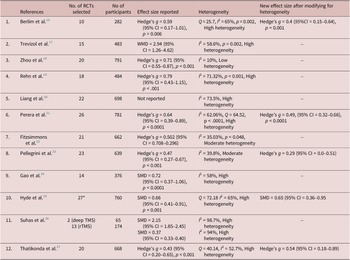
The number of studies included in the meta-analyses ranges between 10 and 27. The majority of these meta-analyses (8 of 12) were published in the past 2 years (2021–2022). Among the studies, DLPFC emerged as the most frequently targeted region of interest, followed by SMA and OFC. The meta-analyses consistently conclude that rTMS applied to DLPFC and SMA effectively reduces the symptoms of OCD. Targeting mPFC and ACC through dTMS gives encouraging results. The reported effect sizes of the meta-analyses range between Hedge’s g of 0.42 and 0.79 and after correcting the heterogeneity, it ranges between 0.29 and 0.49. The summary of the common targets and outcomes of the meta-analyses are provided in Table 2.
Efficacy of rTMS in OCD and the Targets of Intervention

Abbreviations: ACC, anterior cingulate cortex; BL DLPFC, bilateral dorso-lateral prefrontal cortex; HF, high frequency; LF, low frequency; Lt DLPFC, left dorso-lateral prefrontal cortex; mPFC, medial prefrontal cortex; OFC, orbito-frontal cortex; RCT, randomized control trial; ROI, region of interest; Rt DLPFC, right dorso-lateral prefrontal cortex; rTMS, repetitive transcranial magnetic stimulation; SMA, supplementary motor area.
a Subgroup analysis based on stimulation parameters plus ROI.
The meta-analyses included here have number of participants ranging from 282 to 791. The majority of the meta-analyses (9 of 12) report high heterogeneity of the findings. The effect sizes reported are moderate to large (Table 3).
Reported effect Sizes Comparing Active vs Sham rTMS across Studies

Abbreviations: I 2, I 2 Index; Q, Cochrane’s Q Statistic; SMD, standardized mean difference; WMD, weighted mean difference.
The majority of the meta-analyses reported about estimating the risk of bias of the published studies included. However, only 6 of the 12 meta-analyses gave a detailed account of the risk of bias estimation (Table 4).
Risk of Bias Assessed in Meta-Analyses

Discussion
This systematic review examines the safety and efficacy of different rTMS protocols for the treatment of OCD, based on meta-analyses of randomized controlled trials. Twelve eligible meta-analyses were included in this review.Reference Berlim, Neufeld and Van den Eynde16–Reference Thatikonda, Vinod and Balachander27 The different rTMS stimulation procedures were organized according to two main categories: (1) the prefrontal area stimulated: DLPFC, SMA, OFC, and mPFC/ACC; including their respective laterality (right, left, or bilateral); and (2) the type of paradigm of stimulation: Low-frequency rTMS (= < 1 Hz); High-frequency rTMS (> = 5 Hz); Theta-burst Stimulation (TBS)—either continuous-TBS (cTBS) or intermittent-TBS (iTBS); Deep TMS (it is a form of high-frequency rTMS, it just uses a different coil to target the mPFC/ACC).
According to all the meta-analyses included, rTMS for OCD is safe. The reported side effects were mild (mostly mild headache, discomfort, or neck pain), and the dropout rate was low.
A significant milestone in the history of rTMS in OCD treatment was the 2018 FDA approval,Reference Voelker14 which was based on the multicenter, prospective, randomized, double-blinded placebo-controlled trial. This trial examined the efficacy of bilateral, high-frequency (20 Hz)) deep-TMS targeting the mPFC/ACC using an H7 coil, combined with personalized symptom provocation at the beginning of each stimulation sessions.Reference Carmi, Tendler and Bystritsky28 Results showed that at 1-month follow-up, 45.2% of the patients in the active treatment group responded, compared to 17.8% in the sham treatment group.Reference Carmi, Tendler and Bystritsky28 All the studies conducted before and after the FDA approval of TMS for OCD treatment have focused on the abnormal function of the cortico-striato-thalamo-cortical (CSTC) circuitry, which plays a crucial role in the mechanisms of OCD.Reference Jalal, Chamberlain and Sahakian6, Reference Pauls, Abramovitch and Rauch7 Similar abnormal neural oscillations have also been observed in other brain areas associated with neuropsychiatric conditions.Reference Silva-Dos-Santos, Bruno Sales and Venda29, Reference Silva-Dos-Santos, Sales and Sebastião30 In OCD, an imbalance between the direct and indirect pathways of the CSTC circuitry contributes to the generation and perpetuation of obsessions and compulsions, which are the key symptoms of OCD. It was found that the mPFC/ACC is hyperactive in OCD patients. Interestingly, the type of stimulation used was high-frequency, which is thought to be excitatory, and does not further hyperactivate this region. Instead, it is believed that the high-frequency stimulation may disrupt the abnormal circuitry activity in OCD,Reference Carmi, Alyagon and Barnea-Ygael31 which is consistent with the literature on using high-frequency stimulation to disrupt abnormal brain oscillations in other neuropsychiatric disorders, such as the use of 500-Hz stimulation to disrupt abnormal brain oscillation in epilepsy models.Reference Silva-Dos-Santos32, Reference Pais-Vieira, Yadav and Moreira33 In addition to the stimulation protocol targeting the mPFC/ACC, the remaining target areas that have been studied include bilateral and right DLPFC, which have shown the highest quality of evidence according to Zhou et al, Liang et al, Perera et al, and Fitzsimmons.Reference Zhou, Wang and Wang18, Reference Liang, Li and Bu20-Reference Fitzsimmons, van der Werf and van Campen22. On the other hand, results for left DLPFC, SMA, and OFC have been more heterogeneous.Reference Berlim, Neufeld and Van den Eynde16, Reference Rehn, Eslick and Brakoulias19, Reference Liang, Li and Bu20 According to the meta-analysis of Perera et al., the reason for the largest significant effect size in the BL-DLPFC group, in contrast to meta-analyses reporting a higher effect size for the SMA group, is that Perera et al. included an additional study with a high effect size to the BL-DLPFC group and four studies with low effect size to the SMA group. Similarly, Hyde et al., reported that BL-DLPFC produces maximum therapeutic efficacy in the management of OCD.Reference Hyde, Carr and Kelley25 The most recent meta-analysis by Thatikonda et al., emphasizes the superiority of DLPFC targets than non-DLPFC targets.Reference Thatikonda, Vinod and Balachander27 Suhas et al., in their network meta-analysis found the superiority of deep TMS than conventional TMS treatments in the management of OCD.Reference Suhas, Malo and Kumar26
Regarding the type of stimulation paradigm, both HF and LF rTMS are effective. The more recent TBS, either continuous or intermittent, was ineffective, at least according to the few RCTs on this paradigm. Similar results are also obtained from other research.Reference Harika-Germaneau, Rachid and Chatard34, Reference Liu, Shao and Liao35 The reasons, why conventional rTMS is effective, but, cTBS and iTBS are ineffective in the management of treatment-refractory OCD is illusive and needs more research.
Regarding bias, all the eligible meta-analyses reported the presence of publication bias, indicating that small studies favoring sham or no effect are less likely to be published. However, Perera et al.Reference Perera, Mallawaarachchi and Miljevic21 considered the publication bias low after removing two outlier RCTs. Pellegrini et al.Reference Pellegrini, Garg and Enara23 noted the presence of researcher allegiance in favor of the intervention, and recommended caution in interpreting the reported effect sizes. Liang et al. and Gao et al.Reference Liang, Li and Bu20, Reference Gao, Du and Tian24 reported detection and attrition bias in their analyses. However, Fitzsimmons et al. reported a high-to-moderate level of certainty in their assessment of the evidence using the GRADE criteria.Reference Fitzsimmons, van der Werf and van Campen22
In terms of study heterogeneity, nine studies reported high heterogeneity,Reference Berlim, Neufeld and Van den Eynde16, Reference Trevizol, Shiozawa and Cook17, Reference Rehn, Eslick and Brakoulias19-Reference Perera, Mallawaarachchi and Miljevic21, Reference Gao, Du and Tian24-Reference Thatikonda, Vinod and Balachander27, two studies found moderate heterogeneity,Reference Fitzsimmons, van der Werf and van Campen22, Reference Pellegrini, Garg and Enara23 and only one reported low heterogeneity.Reference Zhou, Wang and Wang18 Several factors may contribute to the significant differences in the RCT outcomes: (1) the intrinsic heterogeneous nature of the disorder: OCD has four subtypes––symmetry (26.7%), taboo thoughts (21.0%), contamination (15.9%), and hoarding (15.4%).Reference Pauls, Abramovitch and Rauch7 Each of these clusters of OCD symptoms is related to distinct neural substrates. However, only a few RCTs included in the meta-analyses clearly state the subtype of OCD symptoms; (2) The degree of resistance to SSRIs: According to Pellegrini et al.,Reference Pellegrini, Garg and Enara23 patients with stage 1 or 2 of SSRI resistance tend to have better responses to TMS, while the effect is not significant in patients with stage 3 or 4 of SSRI resistance; (3) Frequency of the stimulus: Low-frequency (= < 1 Hz) is considered to be inhibitory, and high frequency (> = 5 Hz) is considered to be excitatory. However, different RCTs use different frequency ranges (e.g., 10 Hz, 20 Hz, or stimulation synchronized with alpha wave activity); (4) Number of TMS pulses per session: the amount of TMS pulses administered in each session varies among studies; (5) Total number of TMS sessions delivered in total (summation of total number of pulses delivered in all sessions); (6) Application of symptom provocation: Not all RCTs applied this method as Carmi et al.Reference Carmi, Tendler and Bystritsky28, Reference Carmi, Alyagon and Barnea-Ygael31 in the deep TMS, HF, for mPFC/ACC; (7) Timing of assessment; and (8) Comorbid depressive symptoms at baseline: the presence of comorbid depressive symptoms can impact the outcomes.
Our study has limitations that should be acknowledged. First, the search for articles was conducted only in the PubMed database, and only meta-analyses in English were included. This decision was made considering that most of the meta-analyses are published in English and indexed in PubMed. Second, since the meta-analysis included RCTs with significant heterogeneity and publication bias, including researcher allegiance, caution should be taken when interpreting the results.
The findings of our systematic review, which encompassed 12 meta-analyses evaluating the effects of rTMS stimulation of different prefrontal regions and various paradigms of stimulations in OCD patients, revealed that both low- and high-frequency rTMS to be effective. In contrast, TBS, either continuous or intermittent, was found to be ineffective. Bilateral and right DLPFC, and mPFC/ACC are the most effective areas to be stimulated in the TMS treatment of OCD. However, the left DLPFC, SMA, and OFC stimulation results are heterogeneous. Moreover, TMS in OCD patients with low SSRI resistance (stage 1 or 2), in other words, in the early stages of the course of the illness, is more effective than in patients with more resistance to SSRI (stage 3 or 4). According to Pelligrini et al.,Reference Pellegrini, Garg and Enara23 the use of TMS in OCD patients with less resistance should be considered in future guidelines for TMS in OCD treatment. Deep TMS is another emerging modality, found to have superiority over the conventional TMS modalities; however, the number of studies using deep TMS is less. More research using deep TMS in OCD may give better insight into its efficacy in the management of OCD.
Conclusion
This systematic review provides insights into the positive and negative aspects of the existing evidence on the effectiveness of rTMS in OCD. These findings can guide clinicians in their decision-making process when considering the use of rTMS in OCD, as well as assist researchers in planning future studies. The intensity of OCD symptoms, such as obsessional thoughts, compulsive behaviors, and anxiety, is significantly decreased by rTMS treatment that targets the DLPFC and SMA. However, there is significant heterogeneity in the trial results, leading to varying conclusions regarding the efficacy of rTMS for OCD. This heterogeneity can be attributed to differences in study design, patient characteristics, rTMS parameters, outcome measures, and timing across studies. Consequently, it is difficult to draw definitive conclusions about rTMS effectiveness. To determine the ideal parameters and identify predictors of response to rTMS in OCD, further research is warranted, especially large-scale randomized controlled trials with standardized techniques. While existing research suggests that rTMS can reliably alleviate OCD symptoms, additional research is needed to determine the best procedures and variables affecting therapy response in OCD sufferers.
Author contribution
Conceptualization: A.S., S.K.K.; Methodology: A.S., A.A., Z-D.D., S.K.K.; Project administration: A.S., Y.G.; Supervision: A.S., Z-D.D.; Validation: A.S., Z-D.D., S.K.K.; Writing – original draft: A.S., A.A., Z-D.D., S.K.K.; Writing – review & editing: A.S., A.A., Z-D.D., S.K.K.; Data curation: A.A., Y.G., S.K.K.; Formal analysis: A.A., Y.G., S.K.K.; Resources: A.A., S.K.K.; Investigation: S.K.K.
Financial support
Z.-D. Deng is supported by the National Institute of Mental Health Intramural Research Program (ZIAMH002955).
Competing interest
The authors declare none.