


Introduction
Depression and anxiety are common disabling conditions with significant social and economic impacts. These disorders are experienced by up to 1 in 6 of the UK population (National Statistics, 2000). The National Institute for Clinical Excellence (NICE) found cognitive behavioural therapy (CBT) to be the most effective psychological therapy for both conditions (NICE, 2004a,b). However, despite the significant demand for CBT and the evidence of its efficacy, only 8% of the population treated for depression receive psychotherapy (Bebbington, Reference Bebbington, Andrews and Henderson2000).
A potential solution to increase access to psychological therapies is the use of CBT self-help materials (Williams and Whitfield, Reference Williams and Whitfield2001). The aim of CBT self-help is to develop patient knowledge, skills and coping strategies to allow efficient self-management with minimal therapist contact. CBT self-help is recommended in the NICE guidelines for anxiety and depression (NICE, 2004a,b) as part of the stepped care model. Although most CBT self-help is delivered in the written format (Keeley, Williams and Shapiro, 2002), self-help interventions can be administered in a variety of ways, including audiotape, video, the internet, and Computerized Cognitive Behavioural Therapy (CCBT) as recommended by the NICE guidelines (2006).
Deficits in our knowledge
Although CBT self-help is an evidence-based option, there are significant gaps in the research (Lewis et al., Reference Lewis, Anderson, Araya, Elgie, Harison, Proudfoot, Schmidt, Sharp, Weightman and Williams2003). More needs to be known about the characteristics of patients who will complete and benefit from this type of intervention. Although outcome data show that self-help packages can be very effective, up to 50% of those starting a self-help treatment for depression drop out at some stage (Holdsworth, Paxton, Seidel, Thomson and Shrub, Reference Holdsworth, Paxton, Seidel, Thomson and Shrub1996). Drop-out rates for face-to-face CBT, however, have also been reported as high as 38%, and for antidepressant medication at 30% (Kaltenthaler et al., Reference Kaltenthaler, Sutcliffe, Parry, Beverley, Rees and Ferriter2008).
The NICE guidelines account for patient characteristics in their recommendations for antidepressant use. However, perhaps due to the relatively new introduction of the stepped care model, no such equivalent exists for the use of self-help (NICE Guidelines, 2004a,b). In addition, there has been little research into the drawbacks and problems of self-help. Furthermore, if dissemination of self-help is to make a significant clinical impact, the current knowledge and attitudes of practitioners must be assessed in order to identify challenges for service delivery. A variety of factors affecting patient selection have been suggested in the past but have largely represented author opinion. For example, successful outcome has been reported to be associated with youth, high socio-economic status and education (Lewis, 2003), and with high self-efficacy and an internal locus of control (Mahalik and Kivlighan, Reference Mahalik and Kivlighan1988).
We have therefore reviewed practitioner attitudes to patient selection and potential drawbacks and problems of self-help by completing a national survey of expert CBT practitioners. There have been two previous national surveys of BABCP members that addressed CBT self-help (Keeley et al., Reference Keeley, Williams and Shapiro2002; Whitfield and Williams, Reference Whitfield and Williams2004), which allows us to also examine change in attitudes over time in this field.
Aims
Our aims were as follow:
1. To assess expert practitioners' attitudes and knowledge of self-help.
2. To identify those patient factors felt to predict success with self-help in anxiety and depression.
3. To identify any potential drawbacks and problems of self-help in anxiety and depression.
Method
The British Association for Behavioural and Cognitive Psychotherapies (BABCP) is the lead body for CBT in the UK. On the 3 November 2004 there were 883 BABCP-accredited practitioners. The survey questionnaire was sent to 50%, the random sampling of these 441 practitioners being carried out by BABCP staff. Questionnaires were initially sent in mid-January 2005, around a month after the publication of the NICE anxiety and depression reviews (NICE 2004a,b). Identification numbers on questionnaires allowed initial responders to be identified, and non-responders were again mailed after 4 weeks to enhance response rates.
Materials
The questionnaire included 13 questions: nine questions (15 items) addressed practitioner use and attitudes, two questions (19 items) addressed patient selection, and two questions (9 items) asked about the adverse consequences of self-help. The questions were drawn from four sources:
• From two previous national surveys of BABCP members that addressed CBT self-help (Keeley et al., Reference Keeley, Williams and Shapiro2002; Whitfield and Williams, Reference Whitfield and Williams2004).
• Possible factors regarding patient selection and adverse consequences identified by Lewis et al. (Reference Lewis, Anderson, Araya, Elgie, Harison, Proudfoot, Schmidt, Sharp, Weightman and Williams2003).
• Additional questions on patient selection and potential problems included after discussion within the research team.
The questions used Likert-style rating scales, open response, multiple response and restricted choice items. A copy of the questionnaire is available online in the table of contents for this issue: http://journals.cambridge.org/jid_BCP
Results
In total, 254 of the 441 practitioners responded (57.6%). The professional groups most strongly represented by respondents were nursing (42.5%, n = 108), clinical psychology (25.2%, n = 64), counselling (10.2%, n = 26), psychiatry (7.9%, n = 20) and social work (2% n = 5). Other professional groups comprised 9.8% (n = 25), while the remaining 2.4% (n = 6) did not identify any professional group.
Practitioner use and attitudes
Only one practitioner replied as “never” recommending self-help; 12 (4.7%) people rarely use self-help, and 240 (94.9%) use it sometimes or often. Overall, 99.6% of the practitioners who responded to the questionnaire recommend self-help. Self-help is principally used to supplement individual therapy (97.2%, n = 247), although more than two-thirds use it in relapse prevention (67.3%, n = 171). Almost half recommend self-help to patients on a waiting list (47.2%, n = 120), 31.9% (n = 81) as an alternative to a therapist, and 26% (n = 66) to supplement group therapy.
Most of the self-help materials used are written in form (94.1%, n = 239), or audio (42.1%, n = 107). Fewer use self-help delivered by group (29.5%, n = 75), voluntary sector (23.2%, n = 59), video (11.4%. n = 29), computerized package (10.6%, n = 27) or internet (9.1%, n = 23). The vast majority of recommended materials use a CBT approach (99.2%, n = 252).
Only 97 (38.2%) reported having received training in self-help. While only 58.2% of those who are not trained recommend self-help “often”, 80.4% of those trained “often” recommend self-help (Chi squared 15.388, p < .001). The majority of therapists considered self-help to be less effective than treatment with a therapist in terms of compliance (76.5%, n = 179), expectancy of success (74.6%, n = 176), overall effectiveness (73.5%, n = 172), potential benefits (72.8%, n = 171) and patient satisfaction (62.9%, n = 149). A significant positive correlation is present between the extent of belief in the materials' effectiveness and how often they are recommended (Spearman rho 0.184, p = .004).
Regarding potential harm, the most common response was “don't know” (33.9%, n = 79). However 27% (n = 63) believed the potential for harm was less than when seeing a therapist, 24% (n = 56) felt there was an equal chance of harm, and 15% (n = 35) a higher likelihood with self-help.
Patient selection
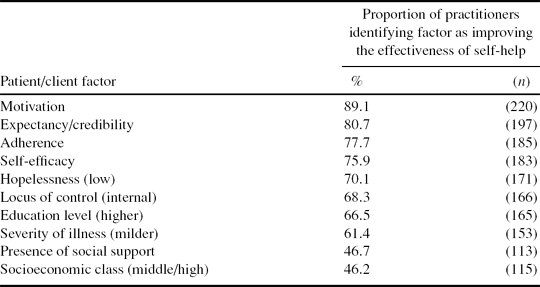
Of the 14 client/patient factors present in the questionnaire, the five factors most commonly believed to predict the effectiveness of self-help were motivation, expectancy/credibility that self-help will help, likely adherence, self-efficacy and degree of hopelessness (see Table 1). The factors that were identified as having no difference on the effectiveness of self-help were: gender, use of medication, age or travel difficulties.
Factors identified as improving the effectiveness of self-help

When practitioners were asked to state any additional patient/client factors that they felt may be related to the effectiveness of self-help, the most frequently specified factor (in an open ended question) was that a higher literacy level would improve effectiveness.
Drawbacks and problems in using self-help
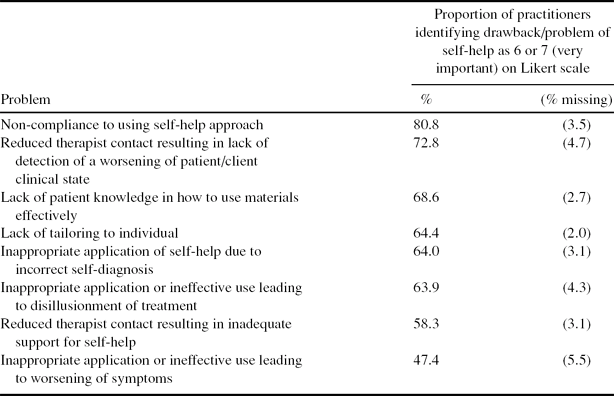
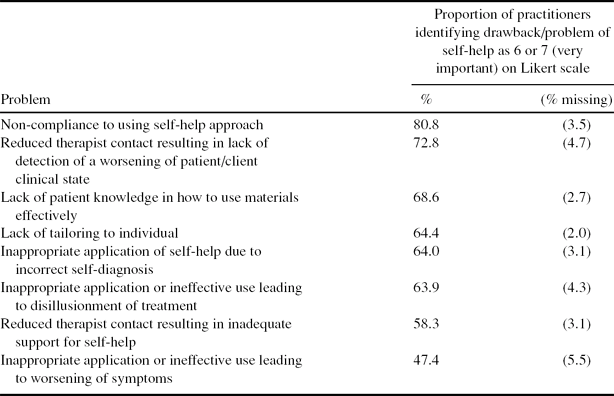
Table 2 summarises the proportion of practitioners identifying each potential drawback/problem of self-help as 6 or 7 on the Likert scale (i.e. as a “very important” potential problem of self-help). Participants were also asked to state any other possible problems of using written or computerized self-help. The most common responses identified for the use of written CBT self-help were: lack of support to maintain compliance and motivation and to notice problems/relapse, poor literacy levels, and patient feeling rejected due to lack of therapist contact.
Drawbacks and problems identified in CBT self-help use
With regards to the use of computerized CBT self-help, the most commonly identified difficulties were: lack of availability, lack of technical expertise, missed opportunity for “non-specifics” (i.e. the therapeutic relationship, to discuss and to ask questions, with the emotive component of care and attention), lack of confidentiality, and lack of motivation on the part of the patient.
Discussion
The principal findings of this research are that self-help is widely used by accredited CBT practitioners in a variety of clinical settings, mainly in written form to supplement individual therapy. Higher levels of motivation, expectancy/credibility, likely adherence, self-efficacy and a lower degree of hopelessness are the patient factors most commonly identified as predicting a more successful outcome with self-help. It should be noted that there may be some overlap between these factors. Practitioners identified low compliance and lack of detection of a worsening of patient clinical state as potential problems of using CBT self-help.
Practitioner use and attitudes
Since a previous survey on CBT practitioners' use of CBT self-help 5 years ago (Keeley et al., Reference Keeley, Williams and Shapiro2002) a number of significant changes have occurred. There has been a notable increase in the recommendation of self-help materials, rising from 88.7% to 99.6%. The reported difference in use may be due to the improving evidence of the effectiveness of self-help, its enhanced dissemination following the recommendations in the current NICE guidelines (2004a,b), previous successful practitioner experience using this approach, increased training in self-help, or the increasing demand for treatment of depression and anxiety. However, this use of CBT self-help seems to be almost entirely focused on supplementing one-to-one work with a practitioner. There is as yet little evidence to support the development of self-help interventions as a waiting list initiative. Similarly, there has been little change in the proportion of practitioners who offer self-help as an alternative to therapist treatment (29.2% 5 years ago to 31.9% now). These results reflect that the implementation of the stepped care model remains a challenge in clinical practice.
There are encouraging signs that the use of self-help is becoming more acceptable to practitioners. In the previous survey 73.1% felt client satisfaction with self-help was less than with a therapist, whereas this has dropped to 62.9% in the present survey. Computerized CBT (CCBT) is the format recommended least (10.6%); however this usage has increased compared to the findings of two previous surveys, where CCBT was used by 6.9 and 2.4% respectively (Keeley et al., Reference Keeley, Williams and Shapiro2002; Whitfield and Williams, Reference Whitfield and Williams2004). The lower rates of this approach may reflect costs, a poorer evidence base, and practical issues in delivering CCBT. It would be interesting to follow up this survey of practitioner attitudes following the NICE (2006) treatment guideline for CCBT.
Despite the generally positive attitude to self-help, it is surprising to find only 38.2% have received specific training in its use. This represents a marginal increase compared to the figure of 36.2% 5 years ago. The implications of this in terms of service delivery are important. Training has been shown in this survey to be associated with the use of this modality of treatment, and has implications for the utilization and dissemination of CBT self-help in health care settings.
Patient selection
The survey identified higher levels of motivation, expectancy/credibility, likely adherence, self-efficacy and lower degrees of hopelessness as the five patient/client factors most likely to predict a positive outcome in self-help. Internal locus of control, average/high education and mild severity were also identified as important patient factors by over 60% of those surveyed.
Problems and drawbacks in using CBT self-help
Papers have hitherto focused on effectiveness, not problems of delivering CBT self-help. Despite the general uncertainty in this area, it should be noted that 27% of respondents considered the potential for harm from CBT self-help as less than with a therapist, compared to the 15% who felt it was more than with a therapist (15%). However, the potential for harm would depend on other factors, such as the severity of the condition for which self-help is given, or the degree of therapist contact.
The identification of compliance as the potential problem that most practitioners felt to be important is not surprising; this was the factor most felt was less in self-help in comparison to treatment with a therapist, and this factor was also identified as the third most important factor in predicting who does well with self-help. Compliance is of utmost importance in self-help, and is a factor that may be enhanced with some degree of therapist contact (Gellatly et al., Reference Gellatly, Bower, Hennessy, Richards, Gilbody and Lovell2007).
The lack of detection of worsening of clinical state was felt by practitioners to be a significant problem with self-help. Although some materials include items to assess the patient's clinical state, these methods lack the personal review so central to practitioner judgement. Other problems, such as patient misunderstanding in how to use self-help, misapplication of self-help due to incorrect self-diagnosis, lack of tailoring to individual needs, and ineffective use leading to disillusionment in treatment were also identified as potential problems.
The recent MRC funded review of CBT self-help for depression has identified that practitioner support leads to significantly improved outcomes in the use of self-help (Gellatly et al., Reference Gellatly, Bower, Hennessy, Richards, Gilbody and Lovell2007). Importantly, the support does not need to focus on therapy, but more on clinical monitoring and encouragement with the use of the self-help materials. Thus self-help with minimal therapist contact could be the solution, providing adequate support for patients while also monitoring progress and altering the level of stepped care if needed.
Limitations
The response rate of 57.6% is very acceptable for a postal survey of this type. This response rate is comparable to that of 53% in an earlier similarly conducted survey, (Keeley et al., Reference Keeley, Williams and Shapiro2002). There is a lack of previous knowledge on patient factors and potential problems. Although a survey such as this provides relatively low quality of evidence from an evidence-based perspective, in view of the lack of previous research directly addressing this area, we hope that these findings have helped identify specific areas that should be examined in more detail in future patient-based studies.
It should also be noted that this survey was carried out in 2005, and as this is a rapidly moving field, the influence of the NICE guidelines for depression published shortly before this survey (2004b) and for Computerized CBT (2006) may have further helped to change practitioner attitudes in this time.
Conclusion
It is evident that there is an increasing use of self-help. This study has begun to identify patient characteristics that may predict a successful outcome. Importantly, potential problems and adverse consequences have been identified by expert practitioners. The subsequent step of this research would be to conduct a follow-up study of patients to review the efficacy of a clinical checklist for patient selection and the likelihood of the identified drawbacks and adverse consequences. The results of this would be to provide the optimal selection and care possible for a very distressed but highly treatable population.
Acknowledgements
We thank Howard Lomas for supplying the randomized list of the BABCP-accredited members. Competing interests: CW has written several book and computer based self-help packages.
Appendix: Survey of the use of self-help materials for the treatment of anxiety and depression
Please indicate your professional group:
( ) Clinical psychology ( ) Counselling ( ) Psychiatry ( ) Nursing ( ) Social work ( ) Other
Practitioner use of self-help materials in anxiety and depression
1. How often do you recommend self-help materials to patients/clients?
2. In what format are the materials you recommend? (please tick all that apply):
3. In which of the following situations do you recommend self-help? (please tick all that apply):
4. What are the main approaches applied by the self-help materials you recommend? (please tick all that apply):
5. Please specify any self-help materials you currently recommend:
6. Have you received any training in self-help?
7. In the last 6 months how often have patients/clients asked you for information on self-help materials?
8. To what extent do you believe that self-help materials can be effective in helping patients/clients overcome anxiety and depression?
9. How would you rate self-help materials on the following factors in comparison to treatment with a therapist?

Patient selection for self-help materials in anxiety and depression
10. The following are patient/client factors that may be of importance in selecting who does well with self-help. Based on your own clinical experience, please indicate for which group(s) you find self-help methods to be most effective:
11. The following can appropriately identify which patients/clients need self-help materials:
Adverse consequences of self-help materials in anxiety and depression
12. Based on your own clinical judgement, please indicate to what extent you think the following are important in predicting a poor/adverse outcome when using self-help:
13. Please state any other possible drawbacks and problems of using written or computerised self-help in anxiety and depression.



Comments
No Comments have been published for this article.