INTRODUCTION
As broadly known, an initial public offering (IPO) is when a private firm first sells stock to the public, usually with the assistance of an underwriter or a syndicate of underwriters. This period of transition is a critical stage of development for any firm, especially in the case of resource dependent high-tech firms that require substantial capital investments (Finkle, Reference Finkle1998). The unique challenge facing IPO firms is that these private firms are in the process of entering the public sphere, and thus have not yet demonstrated clear performance records with the public markets (Certo, Reference Certo2003; Certo, Holcomb, & Holmes, Reference Certo, Holcomb and Holmes2009). IPO firms are often mysterious and therefore investors find it difficult to purchase shares in firms with uncertain worth (Rock, Reference Rock1986). The risks associated with high-tech firms undergoing an IPO are especially high. These firms are considered risky since they not only have limited histories, but also typically have short technology and product cycles, must rapidly institute defensible market positions in highly competitive segments, require large investments, and the markets themselves are difficult since they are often emerging and hence ill defined (Carpenter, Pollock, & Leary, Reference Carpenter, Pollock and Leary2003). As a result, the Securities and Exchange Commission mandates that the risk factors to a firm's survival and performance must be recorded, as accurately as possible, by upper management within its prospectus as the firm prepares for its IPO (Beatty & Zajac, Reference Beatty and Zajac1994). Investors often base their decisions on the information provided within the prospectus, which includes risks pertaining to past financial performance, ownership details, firm products and resources, competitors, and risks associated with the investment. ‘The investment community recognizes that the most detailed and precise information about the issuing firm is found in the offering prospectus’ (Bhabra & Pettway, Reference Bhabra and Pettway2003).
In general, higher risks should imply a lower initial investor valuation and a higher probability of firm failure (Hensler, Rutherford, & Springer Reference Hensler, Rutherford and Springer1997; Jain & Kini, Reference Jain and Kini1999). All firms face numerous risks to their survival and generally investors are willing to pay higher premiums for firms that offer lower levels of risk (Rasheed, Datta, & Chinta, Reference Rasheed, Datta and Chinta1997). However, the question remains as to whether meaningful systematic differences exist across particular types of risk factors. Therefore, the purpose of this longitudinal study is to determine how differences among firm risk factors, as listed by the top managerial team, affect short-term investor valuations and long-term firm survival rates. Specifically, we extend previous research (Arthurs & Busenitz, Reference Arthurs and Busenitz2006; Abdou & Dicle, Reference Abdou and Dicle2007) by analyzing six categories of firm risk: management risks, operational risks, technical risks, market risks, legal risks, and government regulations. In general, we argue that external risk factors (market risks, legal risks, and government regulations) will have a more negative effect on short-term investor optimism and valuations, while internal risk factors (management risks, operations risks, technical risks) will have a more negative effect on post-IPO long-term firm survival.
This paper contributes to the literature in a number of significant regards. Our research shows that the risk factors which impact short-term investor valuation and those which impact long-term firm survival systematically differ based upon whether the risk-factor is internally or externally focused. In doing so, this study goes beyond the simple pricing of risk factors to discuss specifically which risk factors are valued by investors and which ones might affect the firm's chances of survival. This study adds to our understanding of where managers should concentrate their efforts while undergoing an IPO to achieve the highest valuation and informs managers which factors must be guarded against as potentially strong determinants of their firm's ultimate long-term success or failure. Lastly, although IPO literature has received significant amount of attention both in finance (Ritter & Welch, Reference Ritter and Welch2002) and in strategy (Nelson, Reference Nelson2003), only a few studies have focused on IPO firm failure or delisting after the offering (Jain & Kini, Reference Jain and Kini2000; Fischer & Pollock, Reference Fischer and Pollock2004). Researchers have been largely concentrating their efforts on discovering factors that affect initial pricing of IPO stocks and their market returns over differing periods of time (Fischer & Pollock, Reference Fischer and Pollock2004).
BACKGROUND AND LITERATURE
At the time of IPO, most firms – especially those from high-tech industries – are characterized by high information asymmetry problems, a lack of publicly available records of their stock price, conflicts of interests, significant intangible assets, risk associated to the size of the firm, years of negative or weak earnings, and an uncertain future (Beatty & Zajac, Reference Beatty and Zajac1994; Welbourne & Andrews, Reference Welbourne and Andrews1996; Certo, Reference Certo2003; Nelson, Reference Nelson2003; Reuer & Shen, Reference Reuer and Shen2003; Arthurs & Busenitz, Reference Arthurs and Busenitz2006; Hasan, Kobeissi, & Wang, Reference Hasan, Kobeissi and Wang2011). Many of these firms will require large investments in R&D over several years before they can reap the rewards of their hard work. Some might even have a product, but still might need FDA approval before their product release. The lag that exists between introducing a product to the market and an improvement in firm performance could be substantial (Finkle, Reference Finkle1998). Therefore, IPO firms confront numerous liabilities of market newness (Certo, Reference Certo2003), and it is, perhaps, not surprising that investors are often reluctant to purchase shares of an IPO firm given these challenges and the uncertainty they present (Rock, Reference Rock1986). As such, investors heavily rely on standardized methods of reporting and disclosure to evaluate IPO firms correctly. On the other hand, IPO firms need to signal to potential investors that they are economically rational and that they will perform strongly in the future (Zimmerman & Zeitz, Reference Zimmerman and Zeitz2002; Certo, Reference Certo2003).
At IPO, top managers are forced to reflect on what risks are facing their company and record this information within a particular section of their IPO prospectus, that is, the risk factors, where managers must list all potential risks that face the firm and may prevent its success (Husick & Arrington, Reference Husick and Arrington1998). The Securities Act of 1933 gave investors the power to bring lawsuits against IPO firms for any material untruths or omissions in the document (Lowry & Shu, Reference Lowry and Shu2002). Based on this act, all firms going public must disclose accurate information to potential investors to give them the chance to assess the focal firm (Finkle, Reference Finkle1998). The act directly impacted the top management team's (TMT) presentation of risk factors in the registration statement, where a greater number of risk factors denote a higher degree of riskiness to the IPO firm's success (Feltham, Hughes, & Simunic, Reference Feltham, Hughes and Simunic1991). From the eyes of the investment bankers involved in the IPO process ‘willful failure to include all material information in the offering documents constitutes criminal fraud, for which the penalties are severe’ (Perez, Reference Perez1984). Therefore, thorough analysis is usually carried out to ensure that ‘when the investment banker brings out an issue of common stock in a small, relatively new company, the offering prospectus will contain complete, unbiased disclosure of all material facts…’ (Perez, Reference Perez1984).
Previous research on IPO firms has shown that the risk factors section is a useful way to code risk (Beatty & Zajac, Reference Beatty and Zajac1994; Rasheed, Datta, & Chinta, Reference Rasheed, Datta and Chinta1997; Martens, Jennings, & Jennings, Reference Martens, Jennings and Jennings2007; Welbourne, Neck, & Meyer Reference Welbourne, Neck and Meyer2012) and that they are useful in predicting the likelihood of whether a firm will survive or fail (Bhabra & Pettway, Reference Bhabra and Pettway2003). Others used risk factors as a proxy for ‘firm problems’ and used it study its impact on firm performance (Welbourne, Neck, & Meyer, Reference Welbourne, Neck and Meyer2012). We suggest that a distinction between internal and external risk factors may prove insightful for better understanding the possible influence of differing risk categories upon firm valuation and survival. Internal risks may include issues regarding difficulty with managing expected growth while external risk factors may include possible fluctuations in market demand. It is surprising that research has not more extensively investigated whether systematic differences among such risk factors may manifest meaningful consequences for short-term IPO investor valuations and longer-term firm survival.
There are a limited number of studies that have focused on investigating differences among risk factors declared in the prospectus. Two notable studies are the work of Abdou and Dicle (Reference Abdou and Dicle2007) and Arthurs and Busenitz (Reference Arthurs and Busenitz2006). Abdou and Dicle (Reference Abdou and Dicle2007) measured how 32 different types of risk factors affected stock prices over the 4 weeks after IPO. Their study focused on the internet bubble period and yielded mixed findings, with some factors negatively and others positively affecting stock prices. Arthurs and Busenitz (Reference Arthurs and Busenitz2006) looked at the effect of four types of risk factors (management-related, product-related, legal liability-related, and government regulation-related) on 1-year stock performance, along with the effect of VC backing. Arthurs and Busenitz's (Reference Arthurs and Busenitz2006) findings concerning the direct effects of risk factors on stock performance are difficult to interpret, with only management-related risk factors being significant predictors at the p < .05 level. In their study they interpreted the positive affect of management-related risks as an indication that the firms properly identified management-related risks and then developed dynamic capabilities in these areas. This rationale, while intriguing, can certainly be questioned and should be confirmed by further research.
Some studies have used the number of risk factors in the registration statement as a proxy to measure firm risk (Beatty & Zajac, Reference Beatty and Zajac1994). Often the number of risk factors is used as a single control variable to capture the level of firm's risk (Welbourne & Andrews, Reference Welbourne and Andrews1996; Certo, Covin, Daily, & Dalton, Reference Certo, Covin, Daily and Dalton2001; Carpenter, Pollock, & Leary, Reference Carpenter, Pollock and Leary2003; Kor, Mahoney, & Watson, Reference Kor, Mahoney and Watson2008). For example, in order to gauge and control for risks associated with global intent, Carpenter, Pollock and Leary (Reference Carpenter, Pollock and Leary2003) developed a measure that incorporated both actual international risks and management's estimation of the potential consequences of the firm's strategy. They constructed their measure by adding all the risk factors listed in the prospectuses that were unique to international business. Similarly, Certo et al. (Reference Certo, Covin, Daily and Dalton2001) used the aggregate number of risk factors reported in the prospectus as an overall measure of firm risk. The assumption being that even though not all risk factors have an equal impact, more risk factors normally show a higher risk position.
Moreover, while a few studies have examined the reasons for IPO firm failure, none have explicitly linked differences among risk-factors to long-term firm survival rates. In one key article, Hensler, Rutherford, and Springer (Reference Hensler, Rutherford and Springer1997) explored the relationship between several characteristics and survival using a sample of IPOs between 1975 and 1984. The authors found that the age, size, percentages of shares owned by insiders, and IPO activity in the market at the time of listing are all positively related to survival. The study further found that survival time lessens with the total number of risk factors listed in the prospectus and also with general market level at the time of listing. Jain and Kini (Reference Jain and Kini1999) looked at the life cycle of IPOs utilizing a sample of firms listed from 1977 to 1990. The authors observed the sample over 5 years and they found that 69% survived as independent entities. They focused on determining factors that influenced the transition into one of these three states. Their findings demonstrate that size, operating performance – before the IPO – and underwriter prestige are all positively related to survival, whereas other factors, including firm risk, showed a negative relationship with survival.
Another study looked at the relationship between prospectus information and IPO firm survival after 5 years of going public utilizing a random sample of 242 IPO firms from 1987 to 1991 (Bhabra & Pettway, Reference Bhabra and Pettway2003). They found that the prospectus information is an important and useful predictor of survival. More specifically, they found that collectively pre-IPO profitability, R&D spending, relative offer size, firm size, and the number of risk factors in the prospectus are helpful – significant – in predicting survival. Moreover, Wilbon (Reference Wilbon2002) studied the effects of technology management on high-technology US IPO firm survival; he found that high-tech firms that survive have more intellectual property rights, more experienced senior executives, and spend less on R&D as a proportion of sales in comparison to peers at the time of IPO. Finally, Jain and Kini (Reference Jain and Kini2000) found support for their contention that VCs have the ability to influence mangers on strategic resource allocation decisions that may affect their attainment of competitive advantage, and thus affect post-IPO survival.
We believe that the limited attention devoted to long-term survival has been a significant oversight in the literature on risk factors for several reasons. While the substantial cash infusion from an IPO may be used to facilitate growth, despite this capital, post-IPO firms often still fail to meet performance expectations and are discontinued at remarkably high rates (Welbourne & Andrews, Reference Welbourne and Andrews1996; Jackson & Hambrick, Reference Jackson and Hambrick2003). Failure rates of IPO firms are comparable to those of start-ups (Andrews & Welbourne, Reference Andrews and Welbourne2000) where on average only two-thirds survive (Zeune, Reference Zeune1993; Jain & Kini, Reference Jain and Kini1999). Clearly, it is challenging for IPO firms to succeed long-term, and developing a better understanding concerning which factors predict failure rates would be of significant theoretical and practical importance.
HYPOTHESIS DEVELOPMENT
Our objective in this study is to compare how systematic differences among firm risk factors may affect IPO investor valuation, which is driven by investor optimism, and long-term survival, which requires firms to successfully develop organizational capabilities that support their competitive strategy. We propose that investors will interpret different types of risk factors differently. This also applies to managers who have shown that they do perceive risks differently (Delerue, Reference Delerue2004). Investors are likely to perceive some risks as more of a threat to profitability than others based upon at least two rationales. First, we argue that external risk factors beyond the control of firm managers will dampen investors’ optimism to a greater degree than internal risk factors that may be considered more controllable. Investors may assume that the listing of internal risk factors means that the TMT has identified its own shortcomings and should be able to obtain the resources and capabilities to overcome these weaknesses. If the firm identifies that it has unqualified management, inadequate operations equipment or a lack of technical expertise, investors will see these risk factors as issues that can be fixed, especially if VC are involved to guide the process (Arthurs & Busenitz, Reference Arthurs and Busenitz2006). Additionally, underwriters could influence the board to making certain adjustments as they make their concerns clear given the importance of appealing to outside investors (Arthurs, Busenitz, Hoskisson, & Johnson Reference Arthurs, Busenitz, Hoskisson and Johnson2009).
The second reason investors will interpret internal and external risk factors differently is based on signaling theory. It is difficult for investors to evaluate firms’ internal strengths and weaknesses before IPO and even harder for them to predict future performance amid the uncertainty the firms maybe confronted with. Thus, investors rely on signals from the entrepreneurs to guide their investment decisions (Certo, Reference Certo2003; Nelson, Reference Nelson2003; Busenitz, Fiet, & Moesel Reference Busenitz, Fiet and Moesel2005). Signaling is even more important when there is information asymmetry between the TMT of the firm and the investors (Spence, Reference Spence1974; Certo, Reference Certo2003; Janney & Folta, Reference Janney and Folta2003; Busenitz, Fiet, & Moesel Reference Busenitz, Fiet and Moesel2005). This information asymmetry exists even if the TMT is trying to fully disclose all information to the investors, because some knowledge will be tacit, embedded in the employees’ skills and organizational routines, and not able to be explained to others (Busenitz, Fiet, & Moesel Reference Busenitz, Fiet and Moesel2005). Even though top managers, by law, must provide accurate information, laws cannot require full disclosure of all material information (Cohen & Dean, Reference Cohen and Dean2005). Also, most of the information received by investors is initially screened by managers who might be incented to misrepresent the firm to potential investors (Downes & Heinkel, Reference Downes and Heinkel1982). Further, most of these firms are ‘a complex of leadership, culture, technology, products, and strategy, placed within an industry context that adds to that complexity therefore leaving substantial space for less than perfect information’ (Cohen & Dean, Reference Cohen and Dean2005).
Concerning risk factors, there is more information asymmetry between the TMT of the firm and investors concerning internal risk factors than external risk factors. The TMT is more knowledgeable than the investors about internal risk factors, such as the quality of the management team, the adequacy of operations equipment and the level of technical expertise. Thus, the investors must rely on signals that the firm's internal problems can be properly managed. One such signal comes from the investment banker that has agreed to underwrite the IPO; their agreeing to be the underwriter guarantees to a degree that the firm is strong enough to overcome the internal risk factors. If venture capitalists have invested in the firm before the IPO, that also signals investors that the firm's internal operations are of high enough quality to meet their requirements. Arthur and Busenitz (Reference Arthurs and Busenitz2006) further explain, ‘Making it to IPO stage signals the successful application of entrepreneurship capabilities in the startup stage.’
The information asymmetry is less concerning external risk factors and may even be in the favor of the investors, who may be more knowledgeable than the TMT about external risk factors such as legal liability issues within the industry, government regulations that adversely affect firms, and market uncertainty. They do not need to rely on signaling and base their analysis of external risk factors on their own expertise and experience. The investors’ knowledge may be based on their involvement with other firms in the industry. Details about such industry issues are also often accessible through public media and are generally known by investors. Clear examples of firms failing in the specific industry due to these external risks are probably well known to investors. Further, IPO syndicates include one or more co-manager and several non-managing underwriters that increase their chances of understanding the opportunities and threats that might face any particular firm. These underwriters are included or excluded based on previous relationships with the issuer, personal ties between the TMT and the underwriter, ability to provide analyst coverage or market making, access to a different client base and a complementary distribution system, and specific knowledge of a local market (Corwin & Schultz, Reference Corwin and Schultz2005). Without any doubt, underwriters must have a good understanding of the environment and the industry in order to accurately value IPO firms. One of the popular methods recommended by academicians and practitioners for these firms is the use of accounting numbers in conjunction with comparable firm multiples where they consider recent IPOs in the same industry and comparable firms selected by a research boutique that specializes in valuing IPOs (Kim & Ritter, Reference Kim and Ritter1999). Thus, external risks will have a stronger effect than the internal risks in framing the overall risk level of the firm, since external risks are likely to be more easily understood and, thus, are interpreted more ominously.
Hypothesis 1 : External risk factors (market risks, legal risks, and government regulations) will have a more negative impact on IPO investor valuation than internal risk factors (management risks, operational risks, and technical risks).
Over the years, many have argued whether industry factors or firm factors are most important in determining long-term performance (Schmalensee, Reference Schmalensee1985; Rumelt, Reference Rumelt1991; Roquebert, Phillips, & Westfall, Reference Roquebert, Phillips and Westfall1996; McGahan & Porter, Reference McGahan and Porter1997; Hawawini, Subramanian, & Verdin Reference Hawawini, Subramanian and Verdin2003; Short, Ketchen, Palmer, & Hult Reference Short, Ketchen, Palmer and Hult2007). The industrial organization economics view has argued that industry structure predominates and that firms are assumed to be mostly similar, with the exception of scale issues. The field of strategic management has acknowledged the importance of industry effects, but has stressed the importance of firms’ management. Specifically, the resource-based theory of the firm (Wernerfelt, Reference Wernerfelt1984; Barney, Reference Barney1991; Peteraf, Reference Peteraf1993) and the dynamic capabilities (Teece, Pisano, & Shuen, Reference Teece, Pisano and Shuen1997; Eisenhardt & Martin, Reference Eisenhardt and Martin2000) literatures have explained the importance of firm resources and capabilities in the development of sustainable competitive advantages. These sustainable competitive advantages are the key drivers of long-term profitability, especially if they are rare, inimitable, non-substitutable and valuable (Barney, Reference Barney1991). In an applicable study, Short et al. (Reference Short, Ketchen, Palmer and Hult2007) determined that industry effects are more important for short-term profitability than long-term profitability; firm effects account for 66% of short-term performance variance and 90% of long-term performance variance. Moreover, Short, McKelvie, Ketchen, and Chandler (Reference Short, McKelvie, Ketchen and Chandler2009) determined that firm effects accounted for 98% of variance concerning survival of new venture firms
Extending this discussion to IPO risk factors, we expect both internal and external risk factors to negatively influence long-term survival. However, as previously suggested, risks associated with the internal operation of the firm have a stronger effect on failure rates than external risk factors. The internal risk factors deal directly with the firm's ability to create and sustain competitive advantages. Firms that have risks concerning their ability to develop core competencies in management, manufacturing and technology are likely to find it exceedingly challenging to create competitive advantages and will be more likely to fail over the long term.
External risk factors however are also important in that they help define the environment for all of the firms in the industry; they create many of the ‘rules of the game’ that firms must understand to develop effective strategies; and they influence overall industry profitability. However, firms that understand these risks may still develop effective strategies which enable their survival within such adverse environments. Even in high-risk industries with low industry profitability where all firms have lower profit margins, firms can still survive and thrive if they can develop sustainable competitive advantages. In sum, we propose that in the long run it will be more difficult for firms to overcome risks that affect their ability to develop sustainable competitive advantages than it will be to manage external risks that serve to create a more challenging competitive environment.
Hypothesis 2 : Internal risk factors (management risks, operations risks, and technical risks) will have a stronger impact on post-IPO firm failure than external risk factors (market risks, legal risks, and government regulations).
METHODS
Sample
The sample includes all US high-tech ventures that went public between 2001 and 2005. The time-period was chosen to avoid selection bias given the dot com bubble of 1999–2000 and later the economic downturn of 2008 and 2009. Firms were identified as operating in high-technology industry sectors based on their Standard Industrial Classification codes (Daily, Certo, & Dalton, Reference Daily, Certo and Dalton2005). High-technology firms are defined as those in Standard Industrial Classification codes 28 (biotechnology and drugs), 35 (computer and related), 38 (medical equipment), 73 (software), 36 (electronics and communication), and 48 (telephone equipment and communications services) (Carpenter & Petersen, Reference Carpenter and Petersen2002; Loughran & Ritter, Reference Loughran and Ritter2004). The dependent variable IPO Investor Valuation and all the independent and control variables were carefully coded from the prospectuses found on the Securities and Exchange Commission's Electronic Data Gathering and Retrieval system for IPOs. The data related to the second dependent variable, IPO Firm Failure, were collected from the University of Chicago Center for Research and Securities Prices database. Foreign firms were excluded from the sample because research has identified national difference in IPO survival (Espenlaub, Reference Espenlaub1999). Consistent with prior research in the field, holding companies, financial institutions, and real estate investment trusts were also excluded from the sample as well (Fischer & Pollock, Reference Fischer and Pollock2004). Three firms were excluded because prospectuses could not be found for them, leaving 172 firms.
Measures
We relied in this study on the perceived market potential as our measure of IPO Investor Valuation (percent premium), as our first dependent variable. Investors thus may be willing to assign higher premiums to firms that offer lower levels of risk (Rasheed, Datta, & Chinta, Reference Rasheed, Datta and Chinta1997). This measure has been applied by a number of researchers in the IPO field (Welbourne & Andrews, Reference Welbourne and Andrews1996; Nelson, Reference Nelson2003; Lester, Certo, Dalton, Dalton, & Cannella, Reference Lester, Certo, Dalton, Dalton and Cannella2006) and accounts for the lack of asset weighting in other IPO short-term performance measures (Certo, Holcomb, & Holmes, Reference Certo, Holcomb and Holmes2009). Investor valuation provides a more robust estimate of investor perceived future-value (Lester et al. Reference Lester, Certo, Dalton, Dalton and Cannella2006). This variable was calculated as follows: Percent Premium = ([share price–book value per share]/share price). For the long-term performance measure we used IPO Firm Failure given that a principal focus of this study is the measurement of the probability of firm failure in the years following the firm's IPO up to December 2008. This allowed us to examine the outcomes after each firm in the data set had at least three years to delist (Fischer & Pollock, Reference Fischer and Pollock2004). IPO failure was defined as delisting from the primary exchange on which a firm traded (Fischer & Pollock Reference Fischer and Pollock2004). We constructed a dichotomous variable (one or 0) for all firms that determined whether or not they were traded as an independent entity at the end of 2008. Firms that were delisted from the trading exchange for negative reasons (e.g., bankruptcy, liquidation, failure to meet financial guidelines to list) were all classified as non-survivors (Hensler, Rutherford, & Springer Reference Hensler, Rutherford and Springer1997; Jain & Kini, Reference Jain and Kini2000). As was appropriate with our modeling strategy, a firm was dropped from the sample after it was delisted, while the others would remain ‘right-censored.’
We measured IPO firm risk, our independent variable, using risk factors described in the IPO final prospectus (Beatty & Zajac, Reference Beatty and Zajac1994). All independent variables were coded – similar to other studies that examined risk factors (Arthurs & Busenitz, Reference Arthurs and Busenitz2006) – as the total number of risk factors in the designated risk category. We reviewed, identified, and classified the risk factors for each IPO firm. The external variables include market risk, legal risk, and government regulations. The market risk factor category was a count of the number of the organization's specific concerns related to how a new product would be received in the market, product acceptance rates by the market, or how devastating the rejection of this product could be to the company's overall success. The legal risk factor category was a count of the number of times the organization recognized that their firm will become subject to (or is currently involved in) some sort of litigation (e.g., patent infringement, product liability claims, employment litigation, claims relating to disclosed trade secrets, or not complying with government regulations) and that the risk of litigation will strain the firm financially. The government regulation risk factor category was a count of the times that an organization acknowledged that government regulation would represent a concern for future success (e.g., obtaining regulatory approval for a new product, environmental regulation, regulation specific to industry, being subject to continued regulatory review). The internal risk factors also included three categories. The management risk factor category was a count of the number of times a firm specified that its management lacked experience (e.g., specific experience related to running a public company). The operations risk factor category was also a count of the number of times a firm identified concern related to effectively managing their operations to meet the demands related to rapid growth and change in customer preferences. Finally, the technical risk factor category was a count of the number of times an organization specified that their company's network, computer system, or product(s) could contain a technical problem therefore impacting future success.
The study controls for Firm Age (Beatty, Reference Beatty1989; Beatty & Zajac, Reference Beatty and Zajac1994; Finkle, Reference Finkle1998; Lester et al., Reference Lester, Certo, Dalton, Dalton and Cannella2006) which was calculated as the number of years from founding to the end of 2008. We also controlled for Firm Size. This variable was operationalized as the total number of employees (Deeds, DeCarolis, & Coombs, Reference Deeds, DeCarolis and Coombs2000; Carpenter, Pollock, & Leary, Reference Carpenter, Pollock and Leary2003). This variable was found to affect outcomes in other IPO survival research (Welbourne & Andrews, Reference Welbourne and Andrews1996). R&D Intensity, was measured by taking R&D spending as a percentage of firm assets for all firms. Normally this variable is measured as a percentage of sales. However, we divided by assets since many IPO firms are very young and have little or no revenue data (Deeds, DeCarolis, & Coombs, Reference Deeds, DeCarolis and Coombs2000). Because the extent of voluntary disclosure that an IPO firm provides has been found to be significantly related to IPO performance (Leone, Rock & Willenborg, Reference Leone, Rock and Willenborg2007), we controlled for Use of Proceeds. By being more specific about how it will use IPO proceeds, a firm can improve its IPO performance. However, management has to balance this benefit with the costs of disclosing such information to rivals. This variable was measured by counting the uses of proceeds each firm listed within their prospectus (Rasheed, Datta, & Chinta, Reference Rasheed, Datta and Chinta1997). Further, we chose to control for Founder because founders may affect the survival and performance of new ventures (Certo et al., Reference Certo, Covin, Daily and Dalton2001; Nelson, Reference Nelson2003). We used a dummy variable to operationalize whether any founders were part of the TMT (1 = founder, 0 = non-founder).
RESULTS
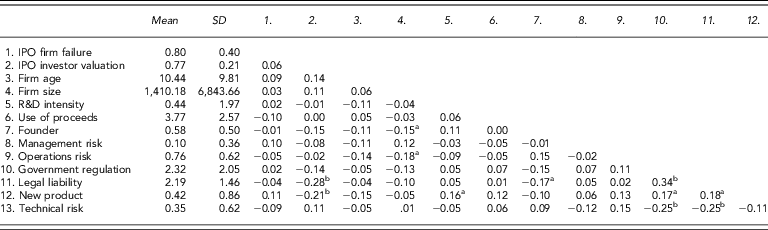
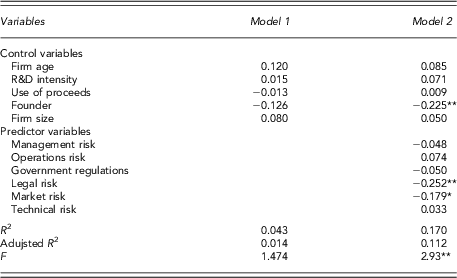
Table 1 presents the descriptive statistics and correlation matrix for all variables. After examining variance inflation factors and condition indices, we determined that multicollinearity was not a concern. Table 2 presents the results of the regression analysis using investor valuation as dependent variable. Two types of the external risk factors, legal liability and market risk, are significantly negatively associated with IPO investor valuation. None of the internal risk factors are significantly associated with IPO investor valuation. This finding supports Hypothesis 1. Interestingly, having a founder on the TMT also has a significantly negative effect on IPO investor valuation. This finding indicates that investors would prefer to have a professional managers brought into the TMT.
Means, standard deviations and correlations

Notes. aCorrelation is significant at the 0.05 level (two-tailed).
bCorrelation is significant at the 0.01 level (two-tailed).
Regression analysis using IPO investor valuation as dependent variable
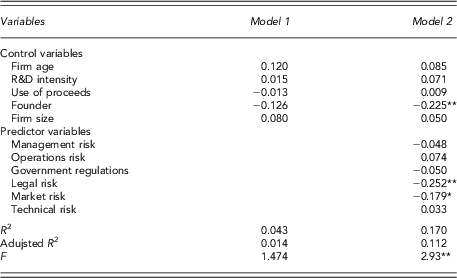
Notes. n = 172. Standardized coefficients are reported.
*p < .05, **p < .01.
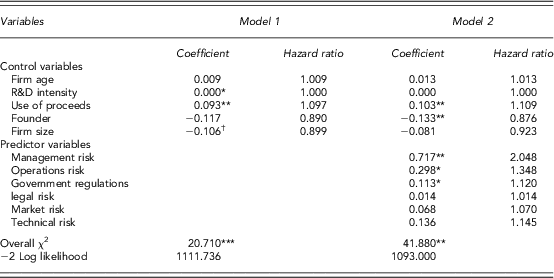
Table 3 presents the results of the Cox proportional hazard analysis (Cox, Reference Cox1972; Jain & Kini, Reference Jain and Kini2000; Busenitz, Fiet, & Moesel Reference Busenitz, Fiet and Moesel2005; Jain, Jayaraman, & Kini Reference Jain, Jayaraman and Kini2008). Overall, the results indicate that an increase in two types of internal risk factors, Management Risk and Operations Risk, and one type of external risk factor, Government Regulation, at the IPO are associated with an increase in the probability of firm failure. This finding partially supports Hypothesis 2, which predicted that internal risk factors would be stronger predictors of firm failure than external risk factors. Concerning the control variables, R&D Intensity is positively associated with an increase in the probability of firm failure and Use of Proceeds is negatively associated with an increase in the probability of firm failure.
Cox regression analysis using IPO firm failure as dependent variable
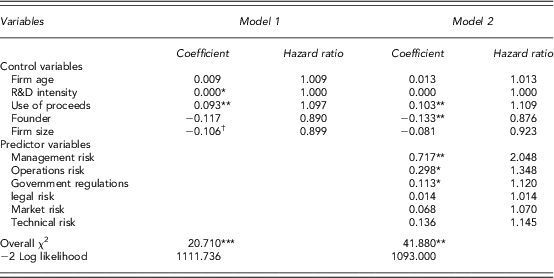
Notes. Two-tailed tests for controls and hypothes ized variables, n = 172.
†p < .10, *p < .05, **p < .01, ***p < .001.
So far, we have identified the variables that significantly influence the probability of IPO firm failure. It also is important to assess the impact on the risk or hazard rate of an average IPO firm's failure. The column labeled Hazard ratio (in Table 3) shows the impact on the hazard rate, given a unit change in the explanatory variable. Here, the hazard ratio represents the estimated percent change in the hazard of the event (failure) for a one unit increase in the covariate of interest (controlling for other covariates). Therefore, the hazard ratio for management risk Exp(B) = 2.048 indicates that a 1% increase in management risk is expected to affect the probability of failure by 104.8%. One more item identified as a risk related to operations increases the probability of failure by 34.8% (Exp(B) = 1.348). The results also show that a one unit increase in government regulation would increase the chances of failure by 12% (Exp(B) = 1.120). Thus, the internal risk factors that are significant predictors of firm failure have a higher hazard rate than the significant external risk factor, which is consistent with Hypothesis 2.
DISCUSSION
Theoretical contributions
The findings of this study provide several meaningful contributions to the literature. First, we observe that IPO risk factors (five of the six we measured) have a negative effect on either IPO investor valuation or long-term firm failure. Intriguingly, a strong negative impact is what might be expected but has not been observed in previous research exploring multiple types of IPO risk factors. For instance, Arthurs and Busenitz (Reference Arthurs and Busenitz2006) found that the direct effect of management-related risk factors was a significant positive predictor of 1-year returns, and the effects of management-related risk factors and product-related risk factors were positively moderated by the existence of venture capitalist backing. Their primary finding that venture capitalists assist firms with developing the dynamic capabilities necessary to overcome risk factors is a substantial contribution. However, a major assumption that they make – that if there is a positive relationship between a risk factor and performance, then one can assume that the firm developed a new dynamic capability in that area – is a theoretical leap that requires further corroboratory research. It is not apparent why none of the risk factors examined within their study possessed a significant negative direct effect on performance. In the present study, finer-grained analysis of the risks factors listed within IPO firm prospectuses was provided, the results of which generally contrasted internal and external risk factors on short and long-term outcomes.
In another study, Abdou and Dicle (Reference Abdou and Dicle2007) measured how 32 different types of risk factors affected five different dependent variables, which measured stock prices from 1 day to 4 weeks after an IPO. Their results were mixed, with some risk factors having no influence upon stock price, other risk factors negatively affecting stock prices, and still some positively affecting the prices. Approximately the same number of risk factors positively affected the price as negatively affected the price. The reasons why a risk factor would have a positive effect on price were not discussed, except to say that that type of risk factor must have been seen as an opportunity. We believe that our findings build upon the work of Abdou and Dicle (Reference Abdou and Dicle2007); by using IPO offer price as our dependent variable, we offer an additional meaningful indicator of investor optimism in contrast to the firms’ stock price days or weeks later.
Second, our study determined that the risk factors that most significantly influence investor optimism and investor valuation are different than the risk factors that most appreciably influence long-term survival. Initial investors appear to focus mostly on threats associated with external risk factors that are beyond the control of firm managers and less on firm weaknesses associated with internal risk factors that may be considered more controllable. It appears investors assume that the listing of internal risk factors means that the TMT has identified its own shortcomings, and to speculate, that the team will be able to develop the resources and capabilities necessary to overcome these weaknesses – for instance, through the assistance of VC support (Arthurs & Busenitz, Reference Arthurs and Busenitz2006). However, our findings regarding long-term survival indicate that these would not constitute appropriate assumptions. The internal risk factors, and not the external risk factors, were observed to be more significant predictors of long-term survival. In light of these findings, investors should weight such internal risk factors appropriately. Similarly, managers in the IPO firms must realize how important such internal risk factors are and make it a high priority to develop capabilities that overcome these weaknesses.
Third, our finding that internal risk factors have a negative impact on long-term survival while external risk factors generally do not, adds to the debate concerning whether industry or firm effects influence performance more. This debate has focused almost entirely on large, established firms, not on new ventures, with the exception of Short et al. (Reference Short, McKelvie, Ketchen and Chandler2009). Our study supports Short et al. (Reference Short, McKelvie, Ketchen and Chandler2009) finding that internal issues are more important to new ventures than external environment factors when considering long-term performance. From a theoretical perspective, this debate has focused on the internal resources of a firm, not discussing specific risks to a firm. Our research expands the discussion of firm effects to include unique risks firms face in addition to their resource base. Our findings indicate that the discussion of industry effects should not only include industry structure variables, such as the factors that make up Porter's (Reference Porter1980) five-forces model, but also include a discussion of industry risk factors.
Fourth, this study also confirms Abdou and Dicle's (Reference Abdou and Dicle2007) finding that not all risk factors are necessarily important. For instance, our results suggest that technical risk factors listed on an IPO prospectus have no effect on adding to a premium at IPO, nor an effect on long-term firm survival. To further speculate, our non-significant risk factor findings may support the claim that since management was wise enough to realize that these particular risk factors might be an issue, they have time to prepare against such traps (Arthurs & Busenitz, Reference Arthurs and Busenitz2006).
Fifth, these results show that scholars must be cautious when working with IPO firm risk factors, especially when using them as control variables. As mentioned earlier, many studies (Beatty & Zajac, Reference Beatty and Zajac1994; Certo et al., Reference Certo, Covin, Daily and Dalton2001) have summed all risk factors while assuming that even though ‘all risk factors are not equally impactful, more risk factors generally indicate a risk position’ (Certo et al., Reference Certo, Covin, Daily and Dalton2001). Even though our results broadly support this conclusion, some risk factors may have longer-term consequences than others may, and only a few seem to have a direct impact on short-term IPO firm performance.
Managerial implications
This study aimed to answer the question, how do internal and external risks affect investor valuations and firms’ long-term failure rates? Managers have long been concerned with how factors internal to the firm (Cabrera-Suárez & Martín-Santana, Reference Cabrera-Suárez and Martín-Santana2013; Díez-Vial & Fernández-Olmos, Reference Díez-Vial and Fernández-Olmos2013; Mousa & Wales, Reference Mousa and Wales2012) alone, or in the context of external considerations (Lee & Chu, Reference Lee and Chu2013), influence firm performance. Yet, less is known about the trade-offs and possible differing effects of such internal and external factors. Examining such considerations in aggregate, we found that external risk factors directly affect the premium assigned, where it seems that investors have less confidence in IPO firms facing external risks. For firms planning an IPO, it is thus critical to understand and fully explain the extent of these potential external risks on the firm, and convincingly demonstrate how they intend to mitigate them. This appears especially critical when it comes to legal liability and market risks. Upper management should take extra time during the ‘road show’ to explain how their firm is ready to deal with external market and legal liability risks. Absent this insight, it seems logical to assume that managers may choose to spend more time discussing internal risk factors, given that they are most directly responsible for decision making within their own company. Yet, investors are seemingly skeptical of firms that have high market risk where questions remain concerning whether and when the market will accept its products. Such market-related risks would be amplified for firms that have only one or a few products with long cycle times. Risks associated with legal liability cause a similar reaction from investors, a lower price premium at IPO. Legal liabilities represent dangerous waters that no firm wishes to face, especially after an IPO. For instance having to combat a patent infringement lawsuit could be devastating for a young company. Many of these high-tech IPOs would probably not be able to survive a lengthy court dispute, mainly due to enormous litigation costs. Thus, the goal of any IPO firm, practically, should be to settle issues associated with legal liability before the IPO if they wish to maximize initial investor optimism and valuation.
The second aspect of our study focused on the effects of these risk factors on IPO firm failure. Both internal (management and operations risks) and external factors (government regulations) were observed to have direct influences on firm failure. Therefore, top managers should pay particular attention to these risks and plan early concerning how they will reduce or perhaps hopefully altogether mitigate the affect of these risks. To speculate, new environmental regulations could conceivably adversely affect a company's product(s) beyond repair, thus leading to the demise of the company. Investors would appreciate and value a firm that clearly shows how they would manage such regulations and how their firm would survive. Management risk factors mainly have to do with risks associated with a TMT that is considered not fully prepared to handle the demands of a public firm. The results are interesting in that even though such a TMT was wise enough to recognize this weakness at the time of the IPO (and record it as a risk factor), it seems that they would still fail to successfully lessen the effects of this internal risk on firm survival. It is interesting that in the short-term none of the three risk factors that were significant in predicting failure were also significant in predicting investor valuation. To speculate, investors certainly do not enjoy seeing cases of management risk, but they might not consider such risks a deal breaker. However, our results suggest that investors should pay much more attention to managerial weaknesses that might lead these firms to failure. The challenges associated with managing a public company are immense.
The other internal risk, operations risks, has to do with the failure of the TMT to deal with the potential demand/growth that the firm might face once the firm goes public. Operations risks do not appear to have a significant effect on investor optimism; investors may be willing to accept such a risk given that, perhaps, they believe that all firms which go public are likely to face some degree of operational risk. However, in the case of high-tech firms, these risks seem to have a direct affect on the chances of long-term failure. This is interesting given that one might make the assumption that since the TMT successfully identified operational risks as a potential problem, they should be able to deal with them. However, it seems that given the high demands on the TMT's time, after the prospectus is written, they may simply prioritize other issues. The present research however suggests that overlooking such issues would be a managerial mistake.
Limitations and future directions
This study has several limitations. We included a broad range of firms from different industries, where the unique characteristics of high-tech firms might have influenced the results. As such, future studies which focus on less technology-intensive IPO firms or firms in a more stable industry, although beyond the scope of this study, might reveal additional insights into the way internal and external risk factors influence short and long-term performance. Further, while we made every effort to be comprehensive and consistent in our labor-intensive data collection efforts, some subjectivity played a role while interpreting each firm's prospectus. For instance, some firms might describe a specific risk factor under unrelated headings (Abdou & Dicle, Reference Abdou and Dicle2007). Even though we were careful and consistent during the data collection process, identifying all possible inconsistencies is notably challenging.
Future studies might find it fruitful to investigate the impact of different external and internal constituents (e.g., underwriters, investors, CEOs) on the relationship between risk factors and short and long-term IPO firm performance. Other research opportunities reside in what happens next. Do these risk factors end up as major issues that these firms need to deal with? Or do these firms successfully handle such risks identified in the prospectus? Thus, future studies which continue to expand upon what managers do in response to these risk factors should add considerable value to understanding IPO performance (Certo, Holcomb, & Holmes, Reference Certo, Holcomb and Holmes2009). Future studies may also explore how differing risk factors specifically influence firm legitimacy in the pursuit of above average firm performance (Brown, Reference Brown2012; Coombs, Bierly, & Gallagher, Reference Coombs, Bierly and Gallagher2012). Extensions might explore the impact of firm risk on the ability of IPO firms to be involved in global equity offerings (Hasan, Kobeissi, & Wang, Reference Hasan, Kobeissi and Wang2011), or alliance partners’ visibility (Reuer & Tong, Reference Reuer and Tong2010). It is our hope that this study inspires such additional research further linking IPO risk factors to firm performance.
CONCLUSION
In conclusion, all firms planning an IPO must fully understand the effect of risk factors on investor opinions as well as the firms’ chances of long-term survival. Our study suggests that internal risks appear to have little effect on investor's optimism, where it seems that investors presumably believe that after vetting the TMT that such issues should be managed successfully by these highly qualified managers. However, investors seem wary about the effect of external risks on the firm. Further, our study shows that there are both internal and external risks that are positively associated with the probability of firm failure. These risks should be explored further and special attention given to them from the entrepreneur's and investor's point of view alike.
Acknowledgement
We dedicate this paper to the memory of our co-author and colleague Paul Bierly who passed away while this manuscript was in the review process. Paul was an amazing mentor, friend, colleague, scholar and teacher. We miss him tremendously.