Introduction
Bipolar (BP) affective disorder affects 0.5–1.6% of the US adult population and is frequently chronically debilitating (Goodwin & Jamison, Reference Goodwin and Jamison1990; World Health Organization, 2002). BP type I (BPI) illness is highly heritable with up to 80% of risk determined by genetic factors (Gershon et al. Reference Gershon, Berrettini, Nurnberger, Goldin and Meltzer1987; Tsuang & Faraone, Reference Tsuang and Faraone1990; Nurnberger & Berrettini, Reference Nurnberger and Berrettini1998; Potash & DePaulo, Reference Potash and DePaulo2000; McMahon et al. Reference McMahon, Simpson, McInnis, Badner, MacKinnon and DePaulo2001; Smoller & Finn, Reference Smoller and Finn2003). The characterization of BPI subtypes of persons may be helpful for early detection and for understanding course of illness, neurobiology and treatment response. Subtypes may be characterized by clinical variables, including patterns of co-morbid psychiatric symptoms and disorders (Nurnberger, Reference Nurnberger2002; Cassidy et al. Reference Cassidy, Yatham, Berk and Grof2008; Cassano et al. Reference Cassano, Mula, Rucci, Miniati, Frank, Kupfer, Oppo, Calugi, Maggi, Gibbons and Fagiolini2009). The creation of homogeneous BPI subgroups based on co-morbid conditions has modestly improved the success of genetic mapping (MacKinnon et al. Reference MacKinnon, Xu, McMahon, Simpson, Stine, McInnis and DePaulo1998; Nurnberger, Reference Nurnberger2002; Schulze & McMahon, Reference Schulze and McMahon2003; MacQueen et al. Reference MacQueen, Hajek and Alda2005; Payne et al. Reference Payne, Potash and DePaulo2005; Cheng et al. Reference Cheng, Juo, Loth, Nee, Iossifov, Blumenthal, Sharpe, Kanyas, Lerer, Lilliston, Smith, Trautman, Gilliam, Endicott and Baron2006; Saunders et al. Reference Saunders, Zhang, Copeland, Mclnnis and Zöllner2009). For example, three subtypes of BPI, as defined by co-morbidity, have provided some of the strongest evidence of linkage to genomic regions: co-morbid panic disorder, co-morbid psychotic symptoms, and pure BPI with low rates of co-morbidity (MacQueen et al. Reference MacQueen, Hajek and Alda2005). A subtype of BPI characterized by co-morbid anxiety disorders has been supported by cross-sectional, longitudinal and familial studies (Johnson et al. Reference Johnson, Cohen and Brook2000; Schurhoff et al. Reference Schurhoff, Bellivier, Jouvent, Mouren-Simeoni, Bouvard, Allilaire and Leboyer2000; Birmaher et al. Reference Birmaher, Kennah, Brent, Ehmann, Bridge and Axelson2002; Goodwin & Hamilton, Reference Goodwin and Hamilton2002; MacKinnon et al. Reference MacKinnon, Zandi, Cooper, Potash, Simpson, Gershon, Nurnberger, Reich and DePaulo2002; Wozniak et al. Reference Wozniak, Biederman, Monuteaux, Richards and Faraone2002). A BPI subtype characterized by high rates of co-morbid drug and alcohol abuse or dependence (Sonne & Brady, Reference Sonne, Brady, Akiskal and Bewick1999; Nurnberger et al. Reference Nurnberger, Kuperman, Flury-Wetherill, Meyer, Lawson and MacKinnon2007) has shown evidence for elevated genetic predisposition to substance use disorders (Winokur et al. Reference Winokur, Reich, Rimmer and Pitts1970, Reference Winokur, Coryell, Akiskal, Maser, Keller, Endicott and Mueller1995, Reference Winokur, Coryell, Endicott, Keller, Akiskal and Solomon1996; Helzer & Winokur, Reference Helzer and Winokur1974; Morrison, Reference Morrison1974, Reference Morrison1975; Gershon et al. Reference Gershon, Hamovit, Guroff, Dibble, Leckman, Sceery, Targum, Nurnberger, Goldin and Bunney1982; Kendler et al. Reference Kendler, Heath, Neale, Kessler and Eaves1993; Feinman & Dunner, Reference Feinman and Dunner1996; Maier & Merikangas, Reference Maier and Merikangas1996; Duffy et al. Reference Duffy, Grof, Grof, Zvolsky and Alda1998; DelBello et al. Reference DelBello, Strakowski, Sax, McElroy, Keck, West and Kmetz1999; Strakowski & DelBello, Reference Strakowski and DelBello2000; Nurnberger et al. Reference Nurnberger, Kuperman, Flury-Wetherill, Meyer, Lawson and MacKinnon2007). Finally, offspring of BPI patients (compared with controls) have higher rates of affective, anxiety and externalizing disorders such as conduct disorder, oppositional disorder and substance abuse (Gershon et al. Reference Gershon, McKnew, Cytryn, Hamovit, Schreiber, Hibbs and Pellegrini1985; Nurnberger et al. Reference Nurnberger, Hamovit, Hibbs, Pellegrini, Guroff, Maxwell, Smith, Gershon, Dunner, Gershon and Barrett1988, Reference Nurnberger, McInnis, Reich, Kastelic, Wilcox, Glowinski, Mitchell, Fisher, Erpe, Gershon, Berrettini, Laite, Schweitzer, Rhoadarmer, Coleman, Cai, Azzouz, Liu, Kamali, Brucksch and Monahan2011; Todd et al. Reference Todd, Reich, Petti, Joshi, DePaulo, Nurnberger and Reich1996; Lapalme et al. Reference Lapalme, Hodgins and LaRoche1997; Chang et al. Reference Chang, Steiner and Ketter2000, Reference Chang, Steiner and Ketter2003; DelBello & Geller, Reference DelBello and Geller2001).
Factor analysis and cluster analysis are complementary methods for investigating BPI clinical subtypes. They determine, respectively, whether co-morbid variables (e.g. symptoms or lifetime disorders) can be parsimoniously explained by a fewer number of factors (i.e. clusters of variables) and whether BPI persons can be subdivided into subgroups (i.e. clusters of persons) (see online Supplementary Text, Section B).
Factor analyses have been conducted on psychiatric lifetime disorders among community samples. For example, an internalizing factor and an externalizing factor were found (Kessler et al. Reference Kessler, Ormel, Petukhova, McLaughlin, Green, Russo, Stein, Zaslavsky, Aguilar-Gaxiola, Alonso, Andrade, Benjet, de Girolamo, de Graaf, Demyttenaere, Fayyad, Haro, Hu, Karam, Lee, Lepine, Matchsinger, Mihaescu-Pintia, Posada-Villa, Sagar and Ustün2011). However, no published study has used a factor analysis, cluster analysis or a latent cluster analysis (called latent class analysis; LCA) to explore or test hypotheses about the lifetime disorders co-morbid with BPI.
The first purpose of this paper was to disseminate the first published investigation of lifetime disorders (i.e. instead of symptoms) in a confirmatory test of a hypothesized factor analysis model among BPI individuals. Based on literature cited above, we hypothesized a two-factor lifetime co-morbidity model, specified before confirmatory factor analysis (CFA) was performed and then tested with CFA; in which internalizing and externalizing factors are correlated; and for which the internalizing factor explains correlations between anxiety, somatoform and eating disorders; and the externalizing factor explains correlations between alcohol use, drug use, cluster B personality, impulse control, attention-deficit and disruptive disorders.
No published study has tested hypotheses about clinical subtypes, among BPI patients, by using a confirmatory approach to LCA, neither with symptoms nor disorders. Confirmatory LCA (CLCA) provides a powerful method to test and validate hypotheses about subgroups of persons with BPI (Finch & Bronk, Reference Finch and Bronk2011).
Thus, the second, and primary, purpose of this paper was to provide a confirmatory test of a hypothesis about subgroups of BPI lifetime co-morbid disorders, specified before CLCA was performed and then tested with CLCA. Based on literature cited above, we hypothesized four co-morbidity subtypes of BPI patients: pure BPI without co-morbidity; co-morbidity with only internalizing disorders; co-morbidity with only externalizing disorders; and co-morbidity with both internalizing and externalizing disorders.
Method
Study design and procedures
The National Institute of Mental Health (NIMH) Genetics Initiative Bipolar Project was active from 1989 to 2007. This article uses data from probands and relatives assessed between 1998 and 2003 using the Diagnostic Interview for Genetic Studies (DIGS) 3.0 interview and resulting Diagnostic and Statistical Manual of Mental Disorders, 4th edition (DSM-IV) diagnoses. At each of 10 sites, multiplex families were ascertained through a proband and a first-degree relative, both with a DSM-IV diagnosis of BPI or schizo-affective BP type (for the diagnostic process, see online Supplementary Text, Section A). Diagnoses were coded as binary (0 = no, 1 = yes if ‘probable’ or ‘definite’).
Statistical methods
MPLUS software (version 5.21) (Muthén & Muthén, Reference Muthén and Muthén1998–2007) was used to perform CFA and CLCA on 1156 individuals (504 probands and 652 relatives) with BPI disorder using the COMPLEX option to account for the relatedness of individuals within families. Criteria of good overall CFA model fit were the following: comparative fit index (CFI) > 0.95 (Hu & Bentler, Reference Hu and Bentler1999), root mean square error of approximation (RMSEA) < 0.06 (Hu & Bentler, Reference Hu and Bentler1999), and weighted root mean square residual (WRMR) < 1.00 (Yu, Reference Yu2002). Loadings above 0.40 indicated adequate fit for individual paths (Nunnally & Bernstein, Reference Nunnally and Bernstein1994). We tested (two-sided, 0.05 α) whether fit of the CFA model could be improved by adding or removing paths (see online Supplementary Text, Section C). The robust weighted least squares (WLSMV) estimator and the non-linear probit link were specified for CFA models. For LCA and CLCA models, maximum likelihood with robust standard error estimation was used.
An important deterministic constraint in CLCA models is the hypothesized ‘zero’ class for which the probabilities of endorsing all co-morbid disorders are fixed to be zero (e.g. ‘pure BP’ class) (Muthén & Asparouhov, Reference Muthén and Asparouhov2006). Our BPI subtyping hypothesis required two other deterministic constraints: an ‘externalizing only’ class for which the probabilities of endorsing the externalizing disorders were freely estimated and the probabilities of endorsing the internalizing disorders were fixed to zero, and an ‘internalizing only’ class for which the probabilities of endorsing the internalizing disorders were freely estimated and the probabilities of endorsing the externalizing disorders were fixed to zero. To fix a probability to zero, the threshold of the disorder was constrained to equal 15, which fixes the probability of disorder endorsement to a value extremely close to zero (Finch & Bronk, Reference Finch and Bronk2011; Clark et al. Reference Clark, Muthén, Kaprio, D'Onofrio, Viken and Rose2013). We hypothesized a ‘both class’ of BP persons who have substantial probability of both internalizing and externalizing lifetime disorders for which probabilities were freely estimated for all internalizing and externalizing disorders.
Additionally, we used equality and inequality constraints to test two competing versions of the hypothesized four-class CLCA model, which we specified a priori before analyses. In the ‘equality’ model we used equality constraints to test the hypothesis that the probabilities of the externalizing disorders were not statistically different for the ‘both’ class and the ‘externalizing-only’ class, and the probabilities of the internalizing disorders were not statistically different for the ‘both’ class and the ‘internalizing-only’ class. In the ‘inequality’ model, we hypothesized that the probabilities of the externalizing disorders were statistically greater for the ‘both’ class than the ‘externalizing-only’ class, and the probabilities of the internalizing disorders were statistically greater for the ‘both’ class than the ‘internalizing class’. Further discussion of the equality and inequality hypotheses is contained in Section B of online Supplementary Text. These two competing four-class CLCA models amount to specifying a priori a small specific slice of the universe of possible equality and inequality constraints, deterministic constraints and number of classes.
The fit of CLCA and LCA models was evaluated based on the following criteria. Models with the lowest values for the Bayesian information criterion (BIC), and its sample size-adjusted version (aBIC), were considered the best (Lubke & Muthén, Reference Lubke and Muthén2005). The BIC and aBIC were used to compare different models with different number of classes and or parameterizations (Finch & Bronk, Reference Finch and Bronk2011). The likelihood ratio test (LRT) was used to compare the hypothesized four-class CLCA models with the exploratory four-class model, because the former is nested within the latter (Finch & Bronk, Reference Finch and Bronk2011). The LRT is not appropriate for comparing LCA models with differing number of classes (Lubke & Muthén, Reference Lubke and Muthén2005). Therefore, the Lo–Mendell–Rubin (LMR) (Lo et al. Reference Lo, Mendell and Rubin2001) LRT was used to compare nested LCA models that have differing numbers of classes but the same parameterization (e.g. our exploratory one-, two-, three-, four-, five- and six-class LCA models). The LMR p value indicates whether a model with one fewer classes can be rejected in favor of the current model. Classes with a sparse number of persons are not practically meaningful (Lubke & Muthén, Reference Lubke and Muthén2005). Therefore, we rejected models that included classes with a sample size representing less than 5% of the sample. Post-hoc modifications to the CLCA models were considered by inspecting graphs of the ‘profile’ of estimated disorder probabilities for each of the four classes.
Only the disorders that were diagnosed in at least 50 BPI participants were included as individual variables in the CFA and CLCA models to ensure estimation precision. Some clinically similar disorders (e.g. panic disorder with and without agoraphobia) were combined because, if not combined, diagnostic mutual exclusion would have prevented them from loading on the same factor. The combined variables were coded ‘1’ if any of the contributing diagnoses were ‘1’ (probable or definite), and 0 otherwise.
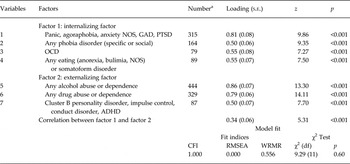
In addition, clinical judgments regarding a priori factor assignment of each variable in the hypothesized CFA model were made based on the relative importance of internalizing and externalizing symptoms for various disorders. The internalizing factor consisted largely of anxiety disorders, and the externalizing factor consisted largely of drug and alcohol use disorders. Due to sparseness of somatoform disorders, we decided a priori to include somatoform disorders and eating disorders in one variable, which we hypothesized to be explained by the internalizing factor (see Table 1).
Confirmatory factor analysis of co-morbid lifetime disorders from 1156 BPI probands and BPI relatives

BPI, Bipolar I; s.e., standard error; z, loading/standard error; NOS, not otherwise specified; GAD, generalized anxiety disorder; PTSD, post-traumatic stress disorder; OCD, obsessive compulsive disorder; ADHD, attention-deficit/hyperactivity disorder; CFI, comparative fit index; RMSEA, root mean square error of approximation; WRMR, weighted root mean square residual; df, degrees of freedom.
a Number of 1156 persons with presence (probable or definite) for each variable; each variable is defined as either an individual disorder (e.g. OCD) or presence of any disorder within a combination of disorders (e.g. any phobia disorder).
The factor scores and subject clusters for the 1156 BPI individuals were validated by testing their associations with clinical course variables known to be related to prognosis, severity and impairment (see Table 2 footnote for definitions). In each model, a clinical course variable was the dependent variable. The independent variables were the factors or clusters, adjusted for gender of BPI subject. Linear and logistic regression models were estimated using the SAS generalized linear modeling (GENMOD) procedure with the ‘generalized estimating equations’ (GEE) (Liang & Zeger, Reference Liang and Zeger1986) estimation method to account for within-family correlations. For continuous outcomes, rank scores (robust to skewness) of the outcome, the normal error distribution, and the linear link were specified. For binary outcomes, the binomial error distribution and the exchangeable log odds ratio regression structure were specified.
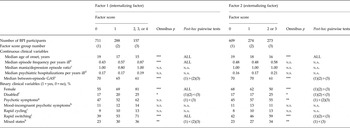
Factors and clinical course of illness variables among BPI participants (BPI probands and BPI relatives) a

BPI, Bipolar I; ALL, all three pairwise differences were significant; n.s., not significant; n.a., post-hoc pairwise tests not applicable because omnibus test not significant; GAS, global assessment score; DIGS, Diagnostic Interview for Genetic Studies.
a The sum score, computed separately for internalizing and externalizing variables, was specified in models as a categorical variable with three levels (no disorders, one variable, two or more variables) because validation results were similar for sum scores and coefficient-weighted factor scores. Each row represents a different regression model (linear and logistic, respectively, for continuous and binary clinical course dependent variables), estimated using a generalized linear model (SAS GENMOD) with generalized estimating equations to account for within-family correlations.
b Episode frequency = number of clean (i.e. episodes not likely to be caused by a specific organic factor, such as drug abuse, medication, or disease) affective episodes per years of illness.
c Mania/depression episode ratio = number of clean manic episodes over the number of clean depressive episodes.
d Psychiatric hospitalizations per years ill = number of hospitalizations divided by years of illness.
e Between-episode GAS = GAS for the past month if not hospitalized, otherwise GAS equals missing value.
f Disabled = occupationally disabled, from the present job question in DIGS 3.0.
g Presence of psychotic symptoms = at least one of five psychotic screening items in the DIGS 3.0 psychosis section definitely present and lasted persistently throughout the day for 1 day or intermittently for a period of 3 days.
h Mood-incongruent psychotic symptoms were present during either a mania or depression episode assessed in DIGS 3.0.
i Rapid cycling = four or more discrete episodes of mania or depression within 12 months demarcated by 8 weeks or more of remission.
j Rapid switching = positive on the mania screening item in the DIGS mania section: ‘ever switched quickly from high to normal or high to depressed without normal mood between’.
k Mixed states = at least three symptoms of the opposite polarity lasting 1 week or more, plus positive on stem question ‘During this episode did you have a week or more during which your mood frequently changed between irritability or elation and sadness or depression?’ in either the mania or depression sections of DIGS 3.0.
* p < 0.05, ** p < 0.01, *** p < 0.001.
For the familial analysis, only first-degree relatives were included. Four clusters of probands were compared on binary disorders of relatives using GEE with GENMOD, as described above, and on an unordered eight-category dependent variable (eight clusters in relatives) using the SAS SURVEYLOGISTIC procedure, to account for within-family correlations. The familial models were adjusted for gender and age of relatives.
All tests were two-sided with α of 0.05. Post-hoc pairwise comparisons were tested only if the omnibus test was significant (i.e. the protected version of Fisher's least significant difference).
Ethical standards
All procedures contributing to this work comply with the ethical standards of the relevant national and institutional committees on human experimentation and with the Helsinki Declaration of 1975, as revised in 2008.
Results
Participant characteristics
The 504 probands (from 504 multiplex families) with BPI disorder (96%) or schizo-affective BP type (4%) were adults; age at interview ranged from 18 to 88 years (except one was aged 17 years). The 1157 first-degree relatives of the 504 probands included mostly adults (range 18–93 years) with only eight (1%) adolescents (range 13–17 years). The high percentage of first-degree relatives with BPI or schizo-affective BP type (48.6%) was a function of multiplex family ascertainment.
The main analyses (i.e. testing CFA and CLCA hypotheses and validating against clinical course variables) were based on 1156 persons with BPI disorder or schizo-affective BP type (504 adult probands; 594 first-degree relatives; and 58 more distant relatives) (see online Supplementary Table S1). At time of interview, 44% of those with BPI were married. Their median age of onset was 18.0 years. The majority was female and Caucasian. Prevalence of co-morbid lifetime disorders is shown in online Supplementary Table S1.
Test of the CFA model
All variables demonstrated large standardized factor loadings (0.50 or greater) on their hypothesized factor (Table 1). The CFA model demonstrated excellent fit to the data (CFI = 1.000, RMSEA = 0.000, WRMR = 0.556). The null hypothesis of good fit was not rejected by the χ2 goodness of fit test [χ2 = 9.29, degrees of freedom (df) = 11, p = 0.60]. The two factors were significantly correlated as hypothesized (r = 0.34, p < 0.001). A one-factor model showed poor fit (CFI = 0.76, RMSEA = 0.094, WRMR = 1.65, χ2 = 156.63, df = 14, p < 0.001). No statistically significant improvement upon the two-factor model could be found by adding or deleting paths. The eigenvalues further supported a two-factor solution (see online Supplementary Text, Section D).
Associations between factors and clinical course variables
Comparison of factor-scoring methods
Validation with clinical course variables was initially performed for both the CFA-coefficient-weighted factor scores and the commonly used sum scale score (one point for each variable). Results were similar for the two methods (see online Supplementary Table S2). Therefore, validation results are reported next using the sum score because it can be easily computed by hand during clinical encounters and it lent itself to disseminating dose–response relationships according to three clinically sensible categories: no disorders; one variable; and two or more variables (frequencies with three or four variables were sparse).
Associations between factors and clinical course variables
A significant association with internalizing and externalizing sum scores was observed for a majority of the clinical course variables (Table 2). A complete dose–response relationship was observed for age of onset, episode frequency, gender and rapid switching, particularly for the internalizing score (all pairwise differences were significant). In addition, for inter-episode global assessment score (GAS), disability, history of psychotic symptoms and mixed states, one or two of the pairwise differences were significant and the means and percentages of clinical course variables generally showed dose–response trends (Table 2).
There were no significant interactions between the internalizing and externalizing sum scores, except for mixed states (p = 0.029). Thus, the relationship with clinical course for one factor generally did not depend on whether participants scored low or high on the other factor.
Test of the CLCA model
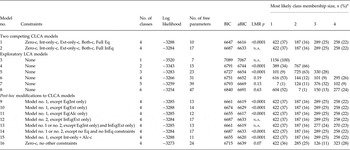
The fit of the hypothesized CLCA model was compared with a wide range of exploratory LCA models and post-hoc modified CLCA models to strongly test its resilience (Table 3). Both alternatives of the hypothesized CLCA model (models no. 1 and no. 2) fit better (lower BIC and aBIC) than all exploratory (one-class to six-class) models (models no. 3 to no. 8). The five-class and six-class exploratory models were not meaningful due to one or more classes having only 1% membership. The hypothesized CLCA model with full equality constraints (model no. 1) fit the best; its fit was slightly better than the competing CLCA model with full inequality constraints (model no. 2) and also better than all post-hoc modified CLCA models (models no. 9 to no. 16).
CLCA of seven lifetime co-morbid diagnostic variables (n = 1156 for all models)

CLCA, Confirmatory latent class analysis; BIC, Bayesian information criterion; aBIC, sample size-adjusted BIC; LMR p, Lo–Mendell–Rubin test p value; Zero-c, zero-class specified by using a deterministic constraint to fix the probabilities of endorsing each of the seven variables to be zero; Int, internalizing; Ext, externalizing; Int-only-c, internalizing-only class specified using a deterministic constraint to fix the probabilities of endorsing externalizing disorders to be zero; Ext-only-c, externalizing-only class specified using a deterministic constraint to fix the probabilities of endorsing internalizing disorders to be zero; Both-c, both-class specified by allowing all probabilities for endorsing the four internalizing and the three externalizing variables to be freely estimated; Full Eq, full equality constraints in which endorsement probabilities of externalizing variables were constrained to be equal for the externalizing-only class and the both-class, and endorsement probabilities of internalizing variables were constrained to be equal for the internalizing-only class and the both-class; Full InEq, full inequality constraints in which endorsement probabilities of externalizing variables were constrained to be less for the externalizing-only class than the both-class, and endorsement probabilities of internalizing variables were constrained to be less for the internalizing-only class than the both-class; n.a., LMR test not available for models with (non-linear) inequality constraints and not applicable for an exploratory model with one class; Eq(Int only), Eq(Ext only), Eq(Alc only), instead of full equality constraints on all variables, the equality constraint was placed on only the four internalizing variables, or only the three externalizing variables, or only the one alcohol variable, respectively; InEq(Ext only), instead of full inequality constraints on all variables, the inequality constraint was placed on only the three externalizing variables; Int-only + Alc-c, instead of an internalizing-only class, an internalizing-only-plus-alcohol class was specified using a deterministic constraint to fix the probabilities of endorsing externalizing disorders to be zero except for one externalizing variable, alcohol abuse or dependence disorders, for which the probability of endorsement was allowed to be freely estimated along with the internalizing disorders.
a The most likely class membership size was 547 (47%) for class 5 for model no. 7, and were 17 (1%) and 101 (9%) for classes 5 and 6, respectively, for model no. 8.
Further non-essential description of CLCA results in Table 3 is provided in Section D of online Supplementary Text. In summary, none of the post-hoc modified four-class CLCA models or any of the one-class to six-class exploratory LCA models fit better than the CLCA model that was hypothesized to have deterministic constraints and full equality constraints (model no. 1).
Associations between CLCA-derived BPI subtypes and clinical course variables
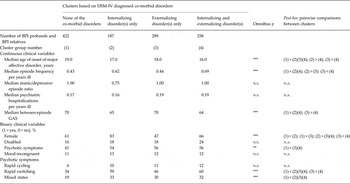
BPI subtypes, based on most likely class membership from the best CLCA model (model no. 1), were compared on clinical course variables. Significant associations were found for seven of the 12 clinical course variables and in the anticipated directions (Table 4). For example, the median age of onset of major affective disorder was highest for those with no co-morbid disorders (19.0 years) and lowest for those with both internalizing and externalizing variables (16.0 years). All pairwise differences were significant for age of onset except for the difference between ‘internalizing-only’ and ‘externalizing-only’ classes. The presence of internalizing disorders, either alone or in combination with externalizing disorders, was associated with greater episode frequency and lower GAS. Persons in class 1 (pure BPI without co-morbidity) were less likely to have a history of psychotic symptoms than persons with externalizing disorders only (class 3) or persons with both internalizing and externalizing disorders (class 4). All three groups of BPI individuals with co-morbidity had significantly greater history of rapid switching and mixed states than the cluster without co-morbidity (class 1). Rapid switching was particularly elevated for the two clusters with internalizing disorders.
Clusters and course of illness variables among BPI participants (BPI probands and BPI relatives) a

BPI, Bipolar I; DSM-IV, Diagnostic and Statistical Manual of Mental Disorders, 4th edition; n.s., not significant; n.a., pairwise tests not applicable because omnibus test was not significant; GAS, global assessment score.
a Each row represents a different regression model (linear and logistic, respectively, for continuous and binary clinical course dependent variables), estimated using a generalized linear model (SAS GENMOD) with generalized estimating equations to account for within-family correlations.
** p < 0.01, *** p < 0.001.
Familial analysis
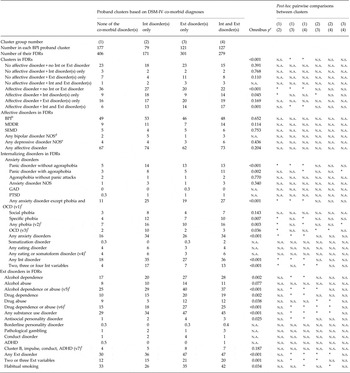
There were eight possible co-morbidity clusters of first-degree relatives defined by crossing the presence of BPI or other affective disorders with the four co-morbidity classes that were defined for BPI probands from the best CLCA model. The four clusters of probands were significantly associated with the eight clusters of relatives, indicating significant familial aggregation of the hypothesized clusters after adjusting for gender and age of relatives (Table 5; 4 × 8 omnibus test, p < 0.001). In particular, rates for three of the relative clusters differed between the four proband clusters (4 × 2 omnibus tests, p < 0.001, 0.045 and 0.001). Specifically, relatives were more likely to have pure affective disorder without other internalizing or externalizing disorders (36%) if their proband also had pure BPI (cluster 1). Relatives were also more likely to have affective disorder with both internalizing and externalizing disorders (17%) if the proband also had BPI with both internalizing and externalizing disorders (cluster 4). Finally, relatives were more likely to have affective disorders with other internalizing disorders and no externalizing disorders (18%) if the BPI proband also had internalizing disorders only (cluster 2), compared with relatives of pure BPI probands (cluster 1) or BPI probands with externalizing disorders only (cluster 3).
Familial aggregation: clusters and disorders of FDRs by BPI proband clusters a

Data are given as column percentages unless otherwise indicated.
FDR, First-degree relative; MDD, major depressive disorder; BPI, any BPI including BPI with mania and MDD, BPI manic never MDD, BPI mixed never manic, or schizo-affective bipolar; DSM-IV, Diagnostic and Statistical Manual of Mental Disorders, 4th edition; Int, internalizing; Ext, externalizing; n.s., not significant; n.a., not applicable; MDDR, MDD recurrent; SEMD, single-episode MDD; NOS, not otherwise specified; GAD, generalized anxiety disorder; PTSD, post-traumatic stress disorder; OCD, obsessive compulsive disorder; ADHD, attention-deficit/hyperactivity disorder; GEE, generalized estimating equations.
a Each row represents a different logistic regression model, accounting for within-family correlations by using GEE (SAS GENMOD with GEE) for binary dependent variables and maximum likelihood estimation with variance adjustment based on the cluster structure (SAS SURVEYLOGISTIC) for the unordered eight-category dependent variable (eight clusters in relatives).
b The number of FDRs with BPI was mostly predetermined because BPI disorder in at least one FDR of each proband was an ascertainment criterion.
c An ‘n.a.’ in the column for omnibus p indicates that the models could not converge due to low prevalence of these disorders.
d Any bipolar disorder NOS, diagnosed with bipolar disorder NOS or bipolar II SEMD or cyclothymia or hypomania.
e Any depressive disorder NOS, diagnosed with depressive disorder NOS or dysthymia or adjustment disorder.
f The seven variables (v1 to v7) were defined a priori before analyses. In the first column, the rows with (v1), (v2), (v3), (v4), (v5), (v6) and (v7) represent the seven variables analysed in the confirmatory factor analysis and confirmatory latent class analysis models.
* p < 0.05.
The remaining familial analyses in Table 5 pertain to individual disorders. To summarize, several disorders and groups of disorders among the relatives differed significantly between the four proband clusters and in the anticipated directions (Table 5).
Discussion
Synthesis of findings
The proposed two-factor CFA model showed an excellent fit to the data, suggesting inter-correlated internalizing and externalizing co-morbid factors in the context of BPI. Additional validity of the two-factor co-morbidity model was supported by significant associations in anticipated directions between higher internalizing and externalizing factor scores and a majority of the clinical course variables that typically indicate worse prognosis, severity and impairment.
For the second set of analyses, the a priori hypothesized CLCA model with full equality constraints (model no. 1) fit the data better than a range of 15 other models, including the competing hypothesized CLCA model with full inequality constraints, eight post-hoc modifications to both versions of the CLCA model, and six exploratory models. This best-fitting four-class model had a ‘zero’, ‘internalizing-only’, ‘externalizing-only’ and ‘both’ class. The four subject clusters or BPI subtypes, based on the best-fitting hypothesized CLCA model, demonstrated significant differences on a majority of the clinical course variables, supporting the meaningful interpretation of these subtypes. The findings from familial analysis offered further support for these four clusters of BPI individuals.
A remarkable aspect about the results is the differences between ‘pure’ BPI and BPI with any co-morbidity. ‘Pure’ BP runs in families, it has a later age of onset of major affective disorder in our data, generally lower episode frequency and less inter-episode impairment, fewer psychotic symptoms, and less evidence of rapid switching and mixed states. That is, many of the ‘complications’ of BP disorder that are typically regarded as evidence of more severe disorder are differentially clustered in subjects with co-morbid disorders.
More work is needed to evaluate whether the presence of co-morbid anxiety disorders in children diagnosed with BP may be a marker of very early-onset BP (Wozniak et al. 2002). Our findings suggest that the presence of either anxiety disorders (and/or other internalizing disorders) or externalizing disorders (such as substance use) is a marker of earlier onset of major affective disorder in adults diagnosed with BP.
These features may be clearly noted in the two-factor validation findings as well. Here the ‘pure’ subjects with zero trait presence on the factor score are seen to have later age of onset and fewer psychotic symptoms than those with any externalizing disorder, and lower episode frequency and evidence of mixed states than those with any internalizing disorder.
The other remarkable aspect of this analysis is the ‘dose–response’ demonstration that the presence of a greater number of co-morbid disorders, either internalizing or externalizing, is associated with a distinct worsening of course of illness. This is particularly true with regard to the incidence of disability, poor inter-episode functioning, rapid switching and mixed states. The same pattern is seen in Table 3. Those subjects in the group with both externalizing and internalizing disorders are more symptomatic in multiple areas than subjects in the other clusters.
Are subjects with only internalizing co-morbid disorders different from subjects with only externalizing co-morbid disorders? First, they are more likely to be female (Table 3). Thus, it is important to emphasize that the comparisons of other clinical course variables in Tables 2 and 3, many of which were significant, were adjusted for gender.
Additionally, at least one externalizing disorder seems to have less of an impact on course of illness compared with having at least one internalizing disorder (consider episode frequency, inter-episode GAS, rapid switching and mixed states, all of which were different from ‘pure’ BP in subjects with one internalizing disorder but not in those with one externalizing disorder; Table 2). A single externalizing disorder, on the other hand, is associated with an increased chance of psychotic symptoms, whereas having one or more internalizing disorders is not. The familial analysis is notable in that alcohol and drug use disorders both aggregate in the relatives of subjects with externalizing disorders but not in the relatives of subjects without such disorders.
The results here, using different statistical methods, are largely consistent with our previous results found in a high-risk study using a different dataset entirely; specifically, two groups of childhood disorders (anxiety and externalizing) predicted subsequent major affective illness in adolescents of families with probands with adult BP disorder (Nurnberger et al. Reference Nurnberger, McInnis, Reich, Kastelic, Wilcox, Glowinski, Mitchell, Fisher, Erpe, Gershon, Berrettini, Laite, Schweitzer, Rhoadarmer, Coleman, Cai, Azzouz, Liu, Kamali, Brucksch and Monahan2011). In the present study, the two same factors were shown through confirmatory tests of hypotheses to distinguish subtypes of adults with BPI.
Numerous studies have used exploratory factor analysis and CFA to factor analyse symptoms of BP, including the symptoms or signs of mania (Bräunig et al. Reference Bräunig, Shugar and Krüger1996; Serretti et al. Reference Serretti, Rietschel, Lattuada, Krauss, Held, Nöthen and Smeraldi1999; Perugi et al. Reference Perugi, Maremmani, Toni, Madaro, Mata and Akiskal2001; Faraone et al. Reference Faraone, Su and Tsuang2004; Krüger et al. Reference Krüger, Quilty, Bagby, Lippold, Bermpohl and Bräunig2010), other mood or psychotic symptoms (Bauer et al. Reference Bauer, Crits-Christoph, Ball, Dewees, McAllister, Alahi, Cacciola and Whybrow1991; Dilsaver et al. Reference Dilsaver, Chen, Shoaib and Swann1999; Akiskal et al. Reference Akiskal, Hantouche, Bourgeois, Azorin, Sechter, Allilaire, Chatenêt-Duchêne and Lancrenon2001; Swann et al. Reference Swann, Janicak, Calabrese, Bowden, Dilsaver, Morris, Petty and Davis2001, Reference Swann, Steinberg, Lijffijt and Moeller2008; Daneluzzo et al. Reference Daneluzzo, Arduini, Rinaldi, Di Domenico, Petruzzi, Kalyvoka and Rossi2002; Sato et al. Reference Sato, Bottlender, Kleindienst and Möller2002; González-Pinto et al. Reference González-Pinto, Ballesteros, Aldama, Pérez de Heredia, Gutierrez, Mosquera and González-Pinto2003; Berk et al. Reference Berk, Malhi, Cahill, Carman, Hadzi-Pavlovic, Hawkins, Tohen and Mitchell2007; Henry et al. Reference Henry, M'baïlara, Poinsot and Falissard2007; Adida et al. Reference Adida, Clark, Pomietto, Kaladjian, Besnier, Azorin, Jeanningros and Goodwin2008; Adler et al. Reference Adler, Liberg, Andersson, Isacsson and Hetta2008; Erkiran et al. Reference Erkiran, Sönmez, Evren, Aytaçlar and Oral2008; Harvey et al. Reference Harvey, Endicott and Loebel2008; Lindenmayer et al. Reference Lindenmayer, Bossie, Kujawa, Zhu and Canuso2008; Cavanagh et al. Reference Cavanagh, Schwannauer, Power and Goodwin2009; Gupta et al. Reference Gupta, Sinha, Praharaj and Gandotra2009; Thompson et al. Reference Thompson, Gonzalez, Singh, Schoolfield, Katz and Bowden2010; Mitchell et al. Reference Mitchell, Hadzi-Pavlovic, Evoniuk, Calabrese and Bowden2013), cognitive and energy features (Cassano et al. Reference Cassano, Mula, Rucci, Miniati, Frank, Kupfer, Oppo, Calugi, Maggi, Gibbons and Fagiolini2009), temperament (Evans et al. Reference Evans, Akiskal, Keck, McElroy, Sadovnick, Remick and Kelsoe2005), attention-deficit/hyperactivity disorder (ADHD) features (Joo et al. Reference Joo, Greenwood, Schork, McKinney, Sadovnick, Remick, Keck, McElroy and Kelsoe2010) or childhood trauma signs (Garno et al. Reference Garno, Goldberg, Ramirez and Ritzler2005). Resulting factors were shown to be modestly beneficial for genetic mapping in studies of BP, with respect to mood-disturbance factors (Faraone et al. Reference Faraone, Su and Tsuang2004; Savitz et al. Reference Savitz, van der Merwe and Ramesar2008) and an ADHD ‘inattention’ factor (Joo et al. Reference Joo, Greenwood, Schork, McKinney, Sadovnick, Remick, Keck, McElroy and Kelsoe2010). We anticipate that subtyping using clinical co-morbidity will continue to shed light on the clinical and genetic characteristics of BPI.
To date, there have been only four published studies using cluster analysis or LCA among BPI patients to determine subtypes, all using the exploratory approach (Dilsaver et al. Reference Dilsaver, Chen, Shoaib and Swann1999; Cassidy et al. Reference Cassidy, Pieper and Carroll2001; Swann et al. Reference Swann, Janicak, Calabrese, Bowden, Dilsaver, Morris, Petty and Davis2001; Sato et al. Reference Sato, Bottlender, Kleindienst and Möller2002). These studies cluster-analysed either the factor scores derived from the symptoms and behavioral ratings related to BPI or the symptoms and ratings themselves (Cassidy et al. Reference Cassidy, Pieper and Carroll2001). Their results revealed more similarities than differences (Cassidy & Carroll, Reference Cassidy and Carroll2003; Sato et al. Reference Sato, Bottlender, Kleindienst, Schröter and Möller2003). For example, all four studies found a pure (i.e. predominantly euphoric) subtype and a mixed (i.e. depressive or anxious–depressive) subtype. Using a confirmatory approach applied to lifetime disorders, we found supporting evidence for a four-class lifetime co-morbidity model in BPI individuals. A future CLCA on symptoms common to multiple co-morbid disorders among BPI patients would add beneficial knowledge to the present CLCA findings of distinct lifetime co-morbid disorders.
In previous exploratory BPI cluster analyses, differences were found between clusters on acute pharmacological treatment response (Swann et al. Reference Swann, Bowden, Calabrese, Dilsaver and Morris2002); masked independent clinical classification of mixed states but not on gender (Dilsaver et al. Reference Dilsaver, Chen, Shoaib and Swann1999); and gender, suicidality at admission, and social adjustment and residual symptoms at discharge, but not on age of onset (Sato et al. Reference Sato, Bottlender, Kleindienst and Möller2002). The present study, based on lifetime diagnoses instead of symptoms, established additional differences between classes that demonstrated confirmatory support. It should be noted that our sample size was larger, with more power to detect group differences on clinical course variables, than the previous studies which consisted of 105 (Dilsaver et al. Reference Dilsaver, Chen, Shoaib and Swann1999), 162 (Swann et al. Reference Swann, Janicak, Calabrese, Bowden, Dilsaver, Morris, Petty and Davis2001), 327 (Cassidy et al. Reference Cassidy, Pieper and Carroll2001) and 576 (Sato et al. Reference Sato, Bottlender, Kleindienst and Möller2002) BPI in-patients.
Limitations
It is possible that other variables not measured in the present study, such as traumatic stress, could improve the fit of the CFA and CLCA models. Medications could be a confounding or determining factor for clustering; however, the present dataset was not capable of addressing this issue. Test–retest reliability was not assessed for the co-morbid disorders. This multiplex sample is highly familial and the results may or may not be applicable to sporadic BPI disorders.
Conclusions
There appears to be strong evidence for the two-factor and four-cluster lifetime co-morbidity hypotheses. These hypotheses may be useful for understanding etiology and risk. The factors and clusters could be useful for parsimoniously reducing the number of variables in analyses of family, high-risk and case–control studies of persons living with BPI. These constructs may be useful for subtyping BP disorders and for prognosis by predicting course and severity of illness. Subtypes may also be useful for refining the phenotype in genetic studies. Subtypes may also have value for personalized medicine (Hamburg & Collins, Reference Hamburg and Collins2010), assuming clinical subtypes could be linked to molecularly distinct subtypes, which may lead to new therapeutic possibilities, either through the development of targeted drugs or the salvaging of abandoned or failed drugs by identifying subgroups of patients likely to benefit from them.
Supplementary material
For supplementary material accompanying this paper visit http://dx.doi.org/10.1017/S0033291715000185
Acknowledgements
The analysis and preparation of this paper were supported by National Institutes of Health grant R01 MH068009. Data and biomaterials were collected in four projects that participated in the NIMH Bipolar Disorder Genetics Initiative. From 1991 to 1998, the principal investigators and co-investigators were: Indiana University, Indianapolis, IN (U01 MH46282) – J. Nurnberger, M. Miller and E. Bowman; Washington University, St Louis, MO (U01 MH46280) – T. Reich, A. Goate and J. Rice; Johns Hopkins University, Baltimore, MD (U01 MH46274) – J. R. DePaulo Jr, S. Simpson and C. Stine; NIMH Intramural Research Program, Clinical Neurogenetics Branch, Bethesda, MD – E. Gershon, D. Kazuba and E. Maxwell. Data and biomaterials were collected as part of 10 projects that participated in the NIMH Bipolar Disorder Genetics Initiative. From 1999 to 2007, the principal investigators and co-investigators were: Indiana University, Indianapolis, IN (R01 MH59545) – J. Nurnberger, M. J. Miller, E. S. Bowman, N. L. Rau, P. R. Moe, N. Samavedy, R. El-Mallakh (at University of Louisville), H. Manji (at Wayne State University), D. A Glitz (at Wayne State University), E. T. Meyer, C. Smiley, T. Foroud, L. Flury, D. M. Dick and H. Edenberg; Washington University, St Louis, MO (R01 MH059534) – J. Rice, T. Reich, A. Goate and L. Bierut; Johns Hopkins University, Baltimore, MD (R01 MH59533) – M. McInnis, J. R. DePaulo Jr, D. F. MacKinnon, F. M. Mondimore, J. B. Potash, P. P. Zandi, D. Avramopoulos and J. Payne; University of Pennsylvania, PA (R01 MH59553) – W. Berrettini; University of California at Irvine, CA (R01 MH60068) – W. Byerley and M. Vawter; University of Iowa, IA (R01 MH059548) – W. Coryell and R. Crowe; University of Chicago, IL (R01 MH59535) – E. Gershon, J. Badner, F. McMahon, C. Liu, A. Sanders, M. Caserta, S. Dinwiddie, T. Nguyen and D. Harakal; University of California at San Diego, CA (R01 MH59567) – J. Kelsoe and R. McKinney; Rush University, IL (R01 MH059556) – W. Scheftner, H. M Kravitz, D. Marta, A. Vaughn-Brown and L. Bederow; NIMH Intramural Research Program, Bethesda, MD (1Z01MH002810-01) – F. J. McMahon, L. Kassem, S. Detera-Wadleigh, L. Austin and D. L. Murphy.
Declaration of Interest
None.