INTRODUCTION
Mild Cognitive Impairment (MCI), a condition conferring significant risk for Alzheimer's disease, is characterized by significant decline in memory and often other aspects of cognition. Awareness of cognitive dysfunction shown by MCI patients is quite variable, ranging from clear insight and marked concern about cognitive difficulties to severe anosognosia (Vogel et al., 2004). Anosognosia can be defined as a patient's unawareness of deficits resulting from brain disease or injury. In its original use, the term anosognosia specified complete unawareness of hemiplegia in stroke patients (Babinsky, 1914); however, use of this term has since expanded to denote attenuated awareness of varied sensory, motoric, and higher cognitive deficits (Ansell & Bucks, 2006; Heilman et al., 1998). In this report, the terms anosognosia and impaired awareness are used interchangeably to indicate reduced ability to make realistic or accurate appraisals regarding one's current memory/cognitive ability. Our MCI participants showed a wide range of reduced ability in this regard, and we use the term anosognosia to denote a continuum of awareness deficits ranging from mildly limited to severely impaired.
The prevalence of impaired awareness, or anosognosia, may be underestimated in the MCI literature because many researchers include the patient's subjective memory complaint as a criterion necessary for an MCI diagnosis. However, studies that do not include self-report of memory complaints in their diagnostic criteria suggest that MCI patients show impaired awareness approaching the level seen in AD (Duke et al., 2002; Vogel et al., 2005; Vogel et al., 2004). Furthermore, anosognosia may be an important prognostic index, with research indicating that MCI patients who lack awareness of functional deficits show greater conversion to AD than those who show awareness (Tabert et al., 2002). These findings indicate that diagnostic criteria requiring subjective memory complaint by the MCI patient may miss a segment of the MCI population that is at high AD-risk. Although anosognosia is being uncovered as an important clinical symptom of MCI, little is known about the brain substrates of anosognosia in this patient group.
Functional brain imaging studies of neurologically-healthy adults have uncovered a conglomerate of cortical midline structures involved in appraisal of self-relevant information (for reviews see, Amodio & Frith, 2006; Northoff & Bermpohl, 2004; Northoff et al., 2006). Specifically, orbitomedial (Brodmann's areas (BA) 11, 12), ventromedial (BA 10), dorsomedial (BA 9) prefrontal cortices (OMPFC, VMPFC, and DMPFC respectively), as well as anterior cingulate cortex (BA 24, 25, 32) show activation during tasks requiring self-referential judgments regarding trait adjectives (Fossati et al., 2003; Johnson et al., 2002; Schmitz et al., 2004; Schmitz et al., 2006). Likewise, medial parietal regions such as retrosplenial cortex (BA 26, 29, 30), posterior cingulate cortex (BA 23), and precuneus (BA 7, 31) show activation during these self-referential tasks, as well as during retrieval of autobiographical memories (Johnson et al., 2002; Maddock et al., 2001; Schmitz et al., 2004; Shah et al., 2001; Sugiura et al., 2005). Dysfunction in these medial cortical regions may underlie the impaired awareness shown by a subset of MCI patients.
Although direct investigation of the functional brain substrates of anosognosia in MCI is sparse, neuroimaging studies of other patient groups with compromised brain function (e.g., traumatic brain injury, frontotemporal dementia, AD) implicate frontal lobe dysfunction in the instantiation of anosognosia (Mendez & Shapira, 2005; Schmitz et al., 2006). Studies of AD show a relationship between decreased perfusion and glucose metabolism in frontal regions and decreased awareness of cognitive impairment (Harwood et al., 2005; Reed et al., 1993; Salmon et al., 2006) as well as correlations between anosognosia and other frontal lobe symptoms such as executive dysfunction and apathy (Derouesne et al., 1999; Lopez et al., 1994; Michon et al., 1994; Ott et al., 1996). In the first imaging study of awareness to include MCI patients, a combined group of MCI and early AD patients showed a significant correlation between anosognosia and regional cerebral blood flow in bilateral frontal inferior gyri (Vogel et al., 2005). Results of that study, together with reports of executive dysfunction and elevated frontally-mediated symptoms (e.g., apathy) in MCI (Ready et al., 2003), suggest that MCI patients exhibit reduced frontal lobe function, and this may relate to decreased self-awareness.
The potential role of medial parietal dysfunction in anosognosia seen in MCI is supported by mounting empirical evidence implicating this region in self-referential processing together with the vulnerability of this region to early AD-like changes. Investigations of resting brain function indicate that medial parietal regions such as the posterior cingulate cortex (PCC) show metabolic decline in MCI (Nestor et al., 2003), and longitudinal studies indicate that PCC metabolism and regional blood flow discriminate between individuals with MCI who soon develop AD and those who do not (Anchisi et al., 2005; Chetelat et al., 2003; Huang et al., 2002; Kogure et al., 2000). Additionally, fMRI studies of episodic recognition indicate that MCI participants show less PCC activation than age-matched controls (Johnson et al., 2005; Ries et al., 2006). However, results of one fMRI study suggest that MCI participants and age-matched controls show comparable activity during self-appraisal in a PCC location (Ries et al., 2006). In that study, the PCC was the sole location in which controls exhibited common activation during self-appraisal and episodic recognition; MCI participants did not. Further investigation of this PCC location indicated that MCI participants showed reduced BOLD response during recognition; however, activity was similar to controls during self-appraisal. Given evidence that healthy young adults show reliable PCC activity during self-referential processing (Fossati et al., 2003; Kelley et al., 2002; Ochsner et al., 2004; Schmitz et al., 2004) together with evidence that individuals with MCI are quite variable in their ability to make accurate self appraisals (Vogel et al., 2004), one possible explanation for this prior result is that PCC activity during self-appraisal is variable in MCI participants. It may be that MCI participants with intact self-awareness may show PCC activity during a fMRI self-appraisal task that is comparable to controls whereas MCI participants with anosognosia may show attenuated PCC activity. In this case, a between group comparison (MCI vs. age-matched controls) of PCC activity during self-appraisal that does not account for MCI participants' level of anosognosia may not be sensitive to the changes occurring in a subset of this patient group.
The objective of the current fMRI study is to further investigate MCI participants' brain activity associated with self-referential processing. No investigation has assessed the relationship between brain activity and level of awareness of cognitive difficulties shown by MCI participants. We hypothesized that MCI participants' activation of cortical midline structures would covary with their level of insight into their cognitive difficulties.
To fully address this hypothesis, we first compared MCI participants and age-matched controls, examining brain regions that were either conjointly or differentially active during self-appraisal at a specific statistical threshold. Secondly, we used regression to investigate the relationship between awareness of deficit and BOLD response during a self-appraisal fMRI task. Our evaluation of participants' level of awareness was based on a discrepancy score between two parallel forms of the Informant Questionnaire on Cognitive Decline in the Elderly (IQCODE). One form was given a relative or friend who had known the participant for 10 years or more (Jorm, 2004). We devised a second form with identical questions that was administered to the MCI participant. In contrast to studies of MCI and AD that have correlated resting metabolism or perfusion with awareness scores, our assessment of brain function used a functional neuroimaging paradigm requiring self-appraisal. This fMRI task reliably evokes cortical midline activity in healthy controls and may be a sensitive index of the function of these regions involved in self-appraisal.
METHODS
Participants
Sixteen healthy older control participants and 16 individuals with MCI participated in this study, and all research was completed in accordance with the guidelines of the Helsinki Declaration (http://www.wma.net/e/policy/17-c_e.html). All participants received a battery of neuropsychological tests as part of this study to verify and document the extent of any impairment in memory and other aspects of cognitive function. Participants were compensated $50.00 for time and travel. Table 1 contains descriptive demographic and neuropsychological data for our participants. MCI patients were referred from the several memory disorders clinics at a university-based medical center. Our diagnostic criteria for MCI were consistent with those proposed by Winblad et al. (2004), and they included: (a) presence of memory complaints by participant and/or informant; (b) cognitive deficits on memory testing together with subjective report of decline over time by participant and/or informant; (c) intact functional status; (d) cognitive and functional status not consistent with a diagnosis of dementia. All MCI participants were accompanied by an informant. All MCI participants were classified as amnestic on the basis of objective cognitive testing, with 12 participants showing selective memory impairment (i.e., amnestic MCI, single domain; Gauthier et al., 2006), and 4 showing impairment of memory and another aspect of cognition (i.e., amnestic MCI, multiple domains). According to the reports of participants and informants, no participant showed evidence of decline in activities of daily living. Prior to inclusion in this study, the MCI patients were presented to a diagnostic consensus panel consisting of medical professionals involved in the participants' patient care, geriatricians, and neuropsychologists for support of the diagnosis. All 16 MCI participants were taking cholinesterase inhibitors, with dosage being stable for three months prior to study participation.
Demographic and behavioral data

Older control participants were recruited from the community, predominantly by advertisement, mailings, and community outreach events. These participants exhibited normal performance across cognitive domains assessed by neuropsychological testing.
Exclusion criteria for all participants included Hachinski score greater than four, prior neurological disease or neurosurgery, report of a present or prior major psychiatric disorder, chronic major medical conditions such as insulin-dependent diabetes, poorly controlled hypertension, or cardiac disease. Participants' current mood was assessed with the Center for Epidemiologic Study-Depression (CES-D) Scale and the State-Trait Anxiety Inventory (STAI). Participants showing evidence of significant distress (CES-D > 16; STAI trait scale in >95th percentile of age & sex-corrected normative data) were excluded from this study (Radloff, 1977; Spielberger, 1983; Weissman et al., 1977). We also obtained T2-weighted images, as described later, to screen for previously undetected clinically relevant brain abnormalities.
In order to determine the areas of the brain normally active during this task we also administered our task to a reference group consisting of 105 cognitively normal, physically healthy adults ranging in age from 18 to 84 who were recruited from the University of Wisconsin, from the community via advertisement and public outreach events, and through existing registries of healthy adults who had previously expressed willingness to participate in aging research (mean age = 46.2, SD =16.2; mean education 15.8 (2.5); 37 men, 68 women).
Procedures
Neuropsychological assessment
All participants received a neuropsychological test battery assessing general mental status (Mini Mental Status Examination) (Folstein et al., 1975), an estimate of pre-morbid cognitive ability (Wide Range Achievement Test—3rd Edition) (Jastak Associates, 1993), simple and shifting attention (Trails A & B), visual and verbal memory (Brief Visuospatial Memory Test, Revised (Benedict, 1997); Rey Auditory Verbal Learning Test), semantic and phonemic fluency (Animal Naming and Controlled Oral Word Association Test), confrontation naming (Boston Naming Test, 2nd Edition (Kaplan et al., 2001)), and visuospatial ability (Judgment of Line Orientation).
Measure of anosognosia
Each participant's level of awareness was indexed by a discrepancy score between two parallel forms of the Informant Questionnaire on Cognitive Decline in the Elderly (IQCODE). One form was given to a relative or friend who had known the participant for 10 years or more (Jorm, 2004). We devised an identical form to be given to the MCI participant. Both forms of the IQCODE contain 16 items on which one rates cognitive change over the past 10 years on a scale of 1 (“much improved”) to 5 (“much worse”). The discrepancy score was obtained by subtracting each participant's average rating from the average rating of the informant.
fMRI Task
The task has been described in detail elsewhere (Ries et al., 2006; Schmitz et al., 2006). The self-appraisal fMRI task consisted of an experimental (self) condition and a baseline (semantic) condition. In the self-condition, trait adjectives were presented (e.g., calm, obnoxious, sharp, trusting, creative), and participants made quick yes/no decisions about whether each word described them by means of a button press. In the semantic condition, participants were presented with the same trait adjectives seen during the self condition (order of presentation was counterbalanced across conditions); however, they were asked to indicate whether each word was positive in valence or not. In both self and semantic decision conditions of the self-appraisal task, adjectives were presented every 4000 ms, remaining on screen for 3000 ms followed by a 1000 ms second inter-stimulus interval. An index finger button press indicated “no” and the middle finger indicated “yes.”
Two alternate forms of the task with identical timing were presented sequentially (order was counterbalanced) using a discrete 30-adjective set. Within each form, items from each of the two conditions were presented in five pseudo-randomized cycles. Adjectives were presented in blocks of six per condition. The two different conditions each appeared in a slightly different color text, and there were prompts at the top of the screen to inform participants about the condition to which they should respond on each trial. The task duration for each form of the task was four minutes and eight seconds.
Scanning procedures
Participants were provided with instruction on the fMRI tasks and underwent practice prior to scanning. They were then situated on the bed of a GE long bore 3.0 Tesla MRI scanner and outfitted with the MR-compatible button-box and a high-resolution goggle system, set at 800 × 600 from Resonance Technology (Northridge, CA, USA). Head motion was constrained by foam padding. The software Presentation (www.neuro-bs.com) was used to deliver visual stimuli from a personal computer via the goggle system and also record responses. A cable connecting the scanner to the presentation computer enabled the stimulus delivery software to be triggered by the start of the scan and also detect each slice acquisition for precise synchrony between scan acquisition and stimulus delivery.
Imaging protocol
A T2* gradient-echo, echo-planar imaging (EPI) pulse sequence was used. The homogeneity of the static magnetic field (B0) in the brain was optimized using higher order shims prior to the functional trials. The EPI parameters for both tasks were as follows: echo time (TE) = 30 ms; repetition time (TR) = 2000 ms; flip angle = 90°; acquisition matrix = 64 × 64 voxels; field of view (FOV) = 240 mm. Thirty sagittal slices of brain were acquired within each TR. Voxel resolution was 3.75 × 3.75 × 5 mm (4-mm thick slices with a 1-mm skip). One hundred and twenty-four temporal volume images were collected. The first three frames of each time series were discarded.
Although we used higher order shimming for the EPI scans, there are typically residual magnetic field (B0) inhomogenities across the brain that cause regional image distortions in echo planar images such as near the mesial temporal lobe and in the frontal and ethmoid sinuses. Image distortions were corrected by measuring 3D field maps across the brain (co-planar with the fMRI slices). This was accomplished by measuring the phase of non-EPI gradient echo images at two echo times (7 and 10 ms). The phase difference between the two echo images is proportional to the static field inhomogeneity (Jezzard & Balaban, 1995). The field map correction was calculated and applied by algorithms (“prelude” and “fugue”) (Jenkinson, 2003) that are part of the FSL software package created by the Image Analysis Group, FMRIB, Oxford, UK. This program estimates the continuous B0 field map; image unwarping is performed using a nonlinear pixel shifting and B splines interpolation algorithm.
Following the functional scans and field mapping, a T1 weighted inversion recovery prepared volume and T2 weighted anatomic images were acquired. A 3D inversion recovery prepared fast gradient-echo pulse sequence provided high-resolution T1-weighted structural images with the following parameters: inversion time = 600 ms; fast gradient-echo read-out with TR = 9 ms; TE = 1.8 ms, flip angle = 20°; acquisition matrix = 256 × 192 × 124 (interpolated to 256 × 256 × 124); field of view = 240 mm; slice thickness = 1.2 mm (124 slices); ±16 kHz receiver bandwidth.
A fast-recovery fast-spin echo 2D T2-weighted axial sequence was also acquired with the same start and stop locations as the T1-weighted images. The parameters were as follows: field of view = 240 mm; matrix = 256 × 256; TR = 9000 ms; TE = 93 ms; flip angle = 90°. Seventy slices were acquired; slice thickness = 1.7 mm with 0.3 mm skip. A neuroradiologist reviewed all images before data analysis for abnormalities that were inconsistent with the diagnosis and/or requiring clinical follow-up.
Image processing and statistics
Functional MRI analysis. Following EPI image reconstruction the 4D image time-series was motion-corrected to overcome minor head movement during the scan (only individuals with <3-mm movement in the x, y, and z planes were included in this report). The field map from each subject was then applied to each image in the time series. This was followed by spatial normalization into a standard atlas space (using the T2* weighted template) resampling to 2-mm isotropic voxels and spatial smoothing to 8 mm.
Statistical Parametric Mapping software (SPM2) was used for statistical analysis at the single subject level (Friston et al., 1995). Analyses of the time series data were performed on individual participants using a boxcar model convolved with the canonical hemodynamic response function. Low-frequency components of the fMRI data were removed through use of a 128 second high-pass filter. We employed the AR1 method of estimating temporal autocorrelation in the time series (Friston et al., 2000). The contrast SELF>SEMANTIC was computed for each participant, and these contrasts were taken to second level analysis.
For group-level analyses we constructed two regions of interest, constraining subsequent analyses to the regions of hypothesized difference in activation. These ROIs were derived from results of a one-sample t-test for the large reference group (FDR thresholding p < .05). Significant activation from the reference group within the medial prefrontal cortex (MPFC) constitutes the MPFC explicit mask, and activation within the medial parietal region constitutes the PCC explicit mask.
Using group random-effects procedures, we investigated regions of conjoint and differential activation across the MCI and control groups. A conjunction analysis was conducted to evaluate common regions of brain activation across the MCI and control groups. We employed the conjunction null method (Nichols et al., 2005). To evaluate regions showing differential activation between groups, we conducted a 2-group t-test.
An additional random-effects analysis allowed us to assess the hypothesis that self-awareness would be a significant predictor of activation of cortical midline structures in MCI participants. Using linear regression analysis in SPM2 we assessed IQCODE discrepancy scores as a predictor of activation. In order to determine whether this relationship was independent of the severity of memory impairment, we included an index of learning (i.e., total number of items learned across trials on the Rey Auditory Verbal Learning Test (RAVLT)), as a covariate of no interest in this regression analysis.
Voxel based morphometry. The T1 volume was used for voxel-based morphometry (VBM) to determine whether there were volumetric differences between MCI participants and controls that might account for any observed fMRI differences. The VBM analysis used a standard approach (Good et al., 2001). The normalization parameters were re-applied to the original image that was re-sampled using B-splines interpolation to a voxel size of 2 mm3. The normalized brain image was then segmented and the resulting GM images were modulated using the Jacobian values obtained from the spatial normalization in order to preserve GM volume. In the final step, the modulated images were smoothed using a 12-mm isotropic Gaussian kernel. A t-test was used to determine whether there were group differences in gray matter. We further examined MCI participant data, using linear regression to assess the IQCODE discrepancy score as a predictor of gray matter.
RESULTS
Behavioral Results
Self-appraisal Task
Reaction time data for the self-appraisal task is summarized in Table 1. Between group t-test comparisons revealed no group difference in reaction time in either condition of this task.
IQCODE and other neuropsychological measures. Performance on a battery of neuropsychological measures is depicted in Table 1. Standard scores reported in Table 1 were based on the Mayo's Older Americans Normative Studies (MOANS) normative data (R. Ivnik et al., 1996; R.J. Ivnik et al., 1992) and other test-specific normative data (Benedict, 1997; Jastak Associates, 1993; Tombaugh et al., 1999). One control participant completed all tests except for MMSE and Animal Naming. Consistent with expected cognitive results, individuals with MCI showed significantly poorer performance across a number of cognitive domains. MCI participants showed significantly poorer general mental status (MMSE), t (29) = 13.19, p < .001. Group memory differences were found on indices of verbal learning (RAVLT total trials 1–5), t (30) = 5.05, p < .001, verbal recall (RAVLT delayed recall), t (30) = 6.22, p < .001, visuospatial learning (BVMT-R total trials 1–3), t (30) = 6.74, p < .001, and visuospatial recall (BVMT-R delayed recall), t (30) = 7.87, p < .001. MCI participants also showed significant poorer performance on timed measures of shifting attention (Trails B), t (30) = −2.46, p < .05, phonemic fluency (COWAT), t (30) = 2.02, p < .05, and semantic fluency (Animal Naming), t (29) = 2.41, p ≤ .05. In contrast, no group differences were found on measures of reading skill (WRAT-III Reading), simple attention and processing speed (Trails A), confrontation naming (BNT-II), or visuospatial ability (JLO), p > .05.
IQCODE ratings are also reported in Table 1. Informants rated MCI participants as demonstrating significantly more cognitive decline than control participants, t(30) = −5.64, p < .001. However, analysis of self-ratings of MCI participants and control participants revealed no significant group difference, p > .05. Between group analysis indicated that IQCODE discrepancy scores were greater for MCI participants than controls, t(30) = −3.61, p < .001. There was no significant correlation between the IQCODE discrepancy score and any of the other neuropsychological measures administered and listed in Table 1 (for all correlations, p > .05).
To further characterize patients' and informants' IQCODE responses, we tallied their ratings. Seven MCI participants reported that cognitive and/or functional status had remained constant over the past 10 years (i.e., average rating of 2–3); seven indicated slight change (average rating of 3–4); two indicated substantial change (average rating of 3–4). Tallying informant ratings showed that two indicated not observing much change in the MCI participant, seven indicated slight change, and seven indicated substantial change. As depicted in Figure 1, some participant-informant pairs showed similar IQCODE ratings. However, other pairs of participant-informant ratings were discrepant, with informants generally endorsing greater decline than participants. Group analysis showed no significant correlation between participant and informant ratings (r = .31, p < .05)

Plot depicting variability in the correspondence between patient and informant ratings on the IQCODE scale. The correlation between patient and informant ratings is non-significant (r = .31, p = .24).
Imaging results
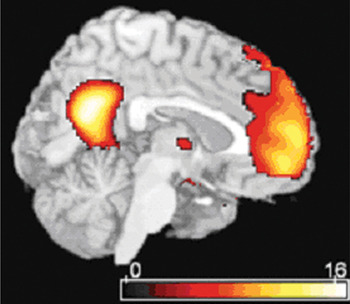
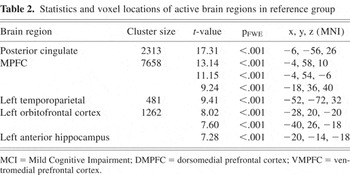
Reference group. Figure 2 and Table 2 depict the cerebral response during self-appraisal in the reference group. Significant activation to self-items was present in ventral and dorsal aspects of the medial frontal lobe as well as in the posterior cingulate region (FWE < .05). These two large regions were used to constrain the group comparisons as well as the regression analysis.

Statistical parametric map of the BOLD signal change to self-appraisal condition in reference group of 105 healthy young adults (pFWE < .05)
Statistics and voxel locations of active brain regions in reference group

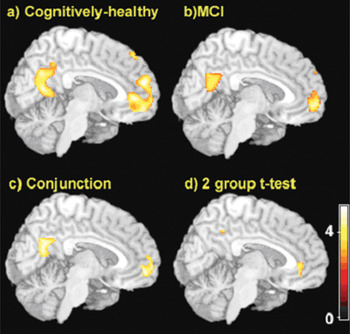
MCI and control groups: Conjunction analysis. Figure 3a to b presents a sagittal view of midline brain regions showing activation in controls and MCI participants during self-appraisal at an uncorrected threshold of p < .005. Regions showing a conjunction of activity across participants (punc < .005) are also depicted in Figure 3c. These regions of activation are also explicated in Table 3. The conjunction across groups was not present at a more rigorous statistical threshold of FDR <.05.

Statistical parametric map of the BOLD signal change to self-appraisal condition in (a) non-impaired older adults and (b) individuals with mild cognitive impairment; (c) Regions of common activation between groups as determined by conjunction analysis; (d) Regions showing less activation in individuals with mild cognitive impairment. Statistical threshold for all contrasts was punc < .005.
Statistics and voxel locations of active brain regions in controls and MCI group

MCI and control groups: 2-group t-test. Figure 3d presents a sagittal view of midline brain regions showing greater activation in controls than MCI participants during self-appraisal at an uncorrected threshold of p < .005. These regions of differential activation are also explicated in Table 3. The group difference was not significant at a more rigorous statistical threshold of FDR < .05. No brain regions were significantly more active in MCI participants than controls.
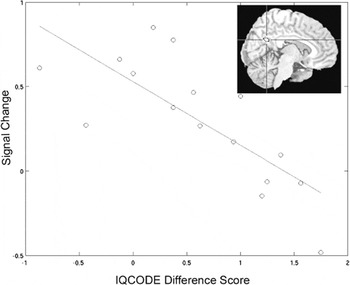
MCI group activation: Association with rating of self-awareness. We conducted a regression analysis, explicitly masking MPFC and medial parietal cortex, to examine the hypothesis that self-awareness (indexed by IQCODE difference score) is a significant predictor of CMS activity in MCI participants. Using an FDR-corrected p-value threshold of 0.05, regression analysis revealed a significant negative relationship between IQCODE difference score and activation during self-appraisal in medial prefrontal and posterior cingulate regions (depicted in Table 4). RAVLT learning performances were included as a covariate of no interest in the analysis; thus, the association between awareness and BOLD signal in these regions does not appear to relate to the MCI participants' level of predominant cognitive impairment. We also examined the relationship between IQCODE discrepancy score and fMRI response in the control group and found no significant association (punc > 0.05).
Statistics and voxel locations of brain regions showing a significant negative correlation between BOLD signal change during self-appraisal and IQCODE difference score in participants with mild cognitive impairment

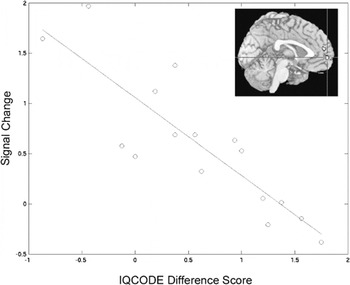
To graphically-depict the correlation, described previously, for the MCI participants, we extracted VOIs based on the MPFC and PCC clusters that were significant in the regression analysis. Figure 4 plots the significant relationship between the first eigenvariate for the MPFC VOI and the participants' IQCODE difference scores (r = −0.86, FDR-corrected p < .05). Figure 5 plots the significant relationship between the first eigenvariate for the PCC VOI and IQCODE difference scores (r = −.75, FDR-corrected p < .05).

Participants with Mild Cognitive Impairment: Plot of the negative correlation (r = −0.83, pFDR < .05) between BOLD signal change during self-appraisal and IQCODE difference score in ventral MPFC cluster.

Participants with Mild Cognitive Impairment: Plot of the negative correlation (r = −0.76, pFDR <.05) between BOLD signal change during self-appraisal and IQCODE difference score in PCC of MCI participants.
Volumetric analysis
To ensure that fMRI signal was not affected by differences in brain atrophy, voxel-based analyses of gray matter volume were performed using the models employed in the functional analyses. There was no significant difference between MCI participants and age-matched controls, even at a liberal threshold (p < .001 uncorrected). Within the MCI group, gray matter volume did not significantly covary with IQCODE difference scores (p < .001 uncorrected).
DISCUSSION
Our results reinforce the finding that cortical midline structures are involved in self-referential processing, and they indicate that a self-appraisal fMRI task is sensitive to functional brain changes associated with impaired insight in MCI. Consistent with our primary hypothesis, MCI participants showed variable insight into their cognitive difficulties, and those MCI participants with less insight showed significantly attenuated activation in MPFC and PCC during self-appraisal. Our results suggest that the regional correlations between BOLD activation and level of self-awareness were not related to the MCI participants' level of cognitive impairment. The correlations are robust even when an index of memory performance is included as a covariate in the regression analysis, and furthermore, our index of awareness in MCI participants was not correlated with their cognitive performance. Our results also suggest that the correlation between BOLD response and awareness was not attributable to variation in brain volume. A voxel-based analysis of gray matter volume showed that our MCI participants showed no differences when compared to a group of age-matched controls, and gray matter volume was not significantly related to awareness scores.
Consistent with prior findings, results of the conjunction analysis suggest that as a group, MCI participants show areas of cortical midline activity that are comparable to controls at an uncorrected threshold. Results of a between-group t-test indicate that MCI participants show attenuated activity in some neighboring cortical midline regions; although this group difference is significant only at a liberal, uncorrected threshold. Because of possible Type 1 error, these findings should be interpreted with caution. Importantly, one possible reason for these minimally significant results would be that MCI participants show heterogeneous CMS activity during self-appraisal. This idea motivated our main analyses examining the relationship between accuracy of self-appraisal and CMS activity in the MCI group.
Although the results described previously suggest that as a group, MCI participants show only minimally attenuated activity on a self-appraisal task, our follow-up regression analyses reveal a source of variability in the MCI group's BOLD response. The significant correlation between accuracy of self-referential judgments and CMS activity during self-appraisal in our MCI participants suggests that dysfunction in CMS regions is linked to anosognosia for cognitive deficit in this patient group.
The relationship between anosognosia and brain activity in MCI has received little empirical attention. The current cross-sectional study suggests that a fMRI self-appraisal task is sensitive to brain changes associated with anosognosia in the MPFC and PCC, two brain regions that are vulnerable to AD-like changes. A key question for future MCI research will be whether the magnitude of BOLD response during self-appraisal is a sensitive predictor of conversion to AD. Prior research suggests that anosognosia in MCI portends a faster rate of conversion to AD (Tabert et al., 2002). Additionally, PCC resting glucose metabolism and perfusion have been cited as prognostic indices of faster progression to AD (Anchisi et al., 2005; Huang et al., 2002; Kogure et al., 2000). Longitudinal follow-up of the current findings is needed to address the hypothesis that attenuated activity in cortical midline structures associated with anosognosia is predictive of faster cognitive and functional decline in MCI. Furthermore, fMRI tasks that directly query self-appraisal of areas of cognitive impairment may be quite useful in the study of anosognosia. These data are currently being collected in our lab.
The precise definition of and neuropsychological criteria for MCI have been a source of controversy (Davis & Rockwood, 2004; Manly et al., 2005), and diagnostic criteria continue to shift over time to accommodate burgeoning research findings (Gauthier et al., 2006; Petersen, 2004). One source of controversy regarding MCI diagnosis relates to the criterion of a self-reported memory complaint. Results of the current study suggest that MCI patients have widely varying awareness of their cognitive deficits. Thus, diagnostic decisions including the criterion of patient report of memory decline are likely to miss a large segment of the MCI population, perhaps those patients who are at particularly high risk for conversion to AD. It is clearly important to document an MCI patient's memory impairment as a decline from previous function (as opposed to a long-standing cognitive impairment) (Petersen, 2004), and thus, the subjective report of function is a critical aspect of the MCI diagnosis. Importantly, the current findings and results of other research suggest that the ideal individual to consult regarding cognitive decline would be an informant who has been in regular contact with the patient for several years (Vogel et al., 2004).
The current study is limited by small sample size, limiting our power to detect statistical effects. Because of this limitation, we restricted our correlation analysis to cortical midline regions chosen in an apriori hypothesis-driven fashion that have been shown to be normally-responsive on the self-appraisal task in a reference group of younger adults. This approach focused the analysis and helped to reduce the possibility of making spurious inferences caused by Type I errors. The drawback to this approach is that we were unable to examine any possible compensatory brain activity that may have occurred outside of the explicitly masked regions.
Another potential limitation of the current study relates to our measure of anosognosia: a score reflecting the difference in each MCI participant's self-rating and a rating given by a close family member or friend. We were careful to select informants who had known the MCI participants for over 10 years and who had regular contact with them. Despite this careful selection, informants may have varied with respect to personal bias toward the MCI participants (i.e., tendency to over- or under-report symptoms), and informants may have had varying degrees of knowledge regarding the participants' level of cognitive deficit.
CONCLUSION
This study focuses on an often overlooked aspect of the symptomatology of Mild Cognitive Impairment: accurate appreciation of one's cognitive impairment. Our findings reinforce the notion that individuals with MCI are quite heterogeneous with respect to their ability to make accurate self-appraisals of cognitive ability. Furthermore, level of anosognosia in MCI is strongly correlated with the BOLD response of frontal and parietal cortical midline structures that are involved in self-appraisal and that are vulnerable to changes associated with early AD.
ACKNOWLEDGMENTS
This study was supported by AG021155 (SCJ). The research was greatly facilitated by Dr. Ries' involvement in the Training and Education to Advance Multidisciplinary Clinical Research (TEAM) Program, a program funded through the National Institutes of Health Roadmap K-12 Initiative. This material (GRECC #2006-19) is the result of work supported with resources and use of facilities at the William S. Middleton Memorial Veterans Hospital, Madison, WI. The assistance of Michelle Fitzgerald, Gemma Gliori, Justin Dunker, Kristine Kalmoe, Allison Wichmann, Lisa Newman, Michael Anderle, and Ron Fisher is greatly appreciated.