I. INTRODUCTION
Nitrogen oxides (NO x ) are responsible for a wide range of environment problems such as acid rain, photochemical smog, and the greenhouse effect. Reference Shen, Ge and Chen1,Reference Zhao, Tang, Wan, Li, Yao, Li, Gu, Li and Shi2 Denitrification has become an active demand to protect the environment, and selective catalytic reduction of NO with NH3 (NH3-SCR) is the most widely used technique. Reference Youn, Song and Kim3,Reference Liu, Ji, Xu, Ye and Jia4 Currently, the most commercially used catalysts are V2O5(WO3, MoO3)/TiO2 catalysts. Reference Grossale, Nova, Tronconi, Chatterjee and Weibel5 However, the development of V2O5/TiO2 catalyst is limited because the second pollution of the waste catalyst needs to be solved. Consequently, more and more attention has been given to develop environment-friendly catalysts with highly NO conversion.
Al2O3 with high specific surface area, excellent dispersion, and high temperature resistance of inertia is commonly used in catalyst support. Reference Jin, Shen and Zhu6,Reference Lin and Bai7 Because of its unique redox properties and high oxygen storage capacities, CeO2 has attracted much interest in many catalytic fields, such as photocatalysis, Reference Zeng, Li, Mao, Bai, Ren and Zhao8 fuel cell, Reference Kugai, Fox and Song9 and oxygen permeation membrane. Reference Yin, Hong and Liu10 For the NH3-SCR, the oxygen storage capacity of CeO2 can be increased by the introduction of other transition and nontransition metal ions, and many ceria-based catalysts have been developed, such as Ce–Zr–O x , Reference Ding, Liu, Shi and He11–Reference Ma, Wu, Si, Weng, Ma and Xu13 CeO2/TiO2, Reference Ding, Zhong and Zhang14–Reference Liu, Zhu, Li, Ma and Woo17 Ce–W–O x /TiO2, Reference Kwon, Nam and Hong18–Reference Chen, Li, Ge and Zhu20 CeO2/Al2O3 Reference Li and Li21–Reference Ge, Liu, Liu, Yao, Cao, Tang, Gao and Dong23 and so on. These catalysts could show effective denitration activity in a wide active temperature window.
There have been various reports of the promotional effects of rare earth ions (R3+ for short, and R = La, Nd, Sm, Gd, and Tm) incorporation. Reference Xu, Miao, Song and Chou24–Reference Sudarsanam, Rangaswamy and Reddy26 However, little attention has been paid on the promotional effects of R3+ ion incorporation over Ce-based catalysts for NH3-SCR. For the CeO2/Al2O3 (CA for short) catalysts, the Van Vleck’s valence states of R3+ are all lower than Ce4+, so the oxygen defect concentration can increase with partial substitution of ions. Reference Zeng27 Moreover, according to the Tanabe acidic rule, Reference Shen, Ma and Zhu28 the additions of R elements in the CA catalysts are effective to improve the acid sites, which is beneficial for the catalytic activity. Based on the previous researches of our team, Reference Jin, Shen and Zhu6 the promotional effects of R3+ ion incorporation over CA catalyst for NH3-SCR are investigated. The catalysts have good redox properties, large amount of acid and excellent oxygen storage capacities, which results in high SCR activity.
II. EXPERIMENT
A. Catalyst preparation
The catalysts were prepared by the extrusion method, and the support was composed of 50 wt% of pseudo-boehmite (C.P, Lvye, Shandong, China) and 50 wt% of Al2O3 (A.R, Xiya, Chengdu, China). The R(NO3)3·6H2O (A.R, Sinopharm, Beijing, China) was used as precursors, and different element molar ratios of Al/Ce/R were 5:1:(0.05–0.60). An appropriate amount of deionized water and nitric acid were added into 5 wt% of pseudo-boehmite to obtain alumina gel (pH < 2), then stable at 80 °C water until the alumina gel turned to pellucid. The solution of cerium nitrate and other modifier (when used) were added into the alumina gel, and then mixed with 50 wt% of Al2O3 and the remaining 45% of pseudo-boehmite. Finally, the samples were dried at 120 °C for 24 h and calcined at 500 °C for 2 h.
B. Catalytic activity and selectivity measurement
The catalytic activity measurements of the prepared catalysts for NH3-SCR of NO were carried out in a fixed-bed quartz reactor (10 mm inner diameter), with 10 mL catalysts and 833 mL/min gas flow rate corresponding to a GHSV of 5000 h−1. The reactant gas typically consisted of 600 ppm NO, 600 ppm NH3, 200 ppm SO2 (when used), 5 vol% H2O (when used), 6 vol% O2, and balance N2. The NO concentrations at the inlet and outlet of the reactor were monitored on-line by a flue gas analyzer (MRU VarioPlus, Neckarsulm, Germany). The catalytic activity (X NO) for NH3-SCR of NO was expressed by Eq. (1). The analysis at each selected temperature was performed after 30 min since the reactor temperature was stabilized.
 $${X_{{\rm{NO}}}} = {{\left( {{{[{\rm{NO}}]}_{{\rm{inlet}}}} - {{[{\rm{NO}}]}_{{\rm{outlet}}}}} \right)} \mathord{\left/ {\vphantom {{\left( {{{[{\rm{NO}}]}_{{\rm{inlet}}}} - {{[{\rm{NO}}]}_{{\rm{outlet}}}}} \right)} {{{[{\rm{NO}}]}_{{\rm{inlet}}}}}}} \right. \kern-\nulldelimiterspace} {{{[{\rm{NO}}]}_{{\rm{inlet}}}}}} \times 100\% \quad .$$
The N2 concentration at the outlet of the reactor was monitored on-line by a gas chromatographer (GC2014, Shimadzu Corporation, Kyoto, Japan), which has been used to calculate the N2 selectivity in our previous work. Reference Jin, Shen and Zhu6
C. Characterization
Powder X-ray diffraction (XRD) patterns were obtained on the X-ray diffractometer (Smartlab TM 3Kw, Rigaku Corporation, Tokyo, Japan) using Cu Kα radiation. The 2θ scans covered the range 10–85°, and the accelerating voltage and applying current were 40 kV and 40 mA, respectively. The microstructural natures of the catalysts have been investigated using a scanning electron microscope (JSM-5900, JEOL Ltd., Tokyo, Japan). The AXIS ULTRA DLD instrument (Shimadzu Corporation) was used for XPS analysis; and monochromatic Al Kα radiation was used as the excitation source. After complete removal of moisture from the catalysts by drying at 100 °C for 24 h, the catalysts were analyzed without surface sputtering or etching so that the degree of vacuum in the XPS equipment was maintained at 10−7 Pa. Visible Raman spectra of the catalysts were collected at room temperature on the LabRAMHR800 (Horiba Jobin Yvon, Paris, France). A 514 nm diode-pumped solid-state semiconductor laser was used as the excitation source with a power output of 30 mW. The specific surface area and average pore diameter (BET method) of the samples were measured by N2 adsorption/desorption isotherms at −196 °C using a surface area analyzer (2020M V3.00H, Micromeritics, Norcross, Georgia). All the samples were degassed at 350 °C under vacuum for 3 h prior to the adsorption experiments.
The nature of the acid sites over the samples was investigated by infrared spectroscopy of adsorbed pyridine (Py-IR) based on the fact that pyridine molecules adsorbed on different acid sites displayed characteristic vibration bands. The spectra were recorded with 2 cm−1 spectral resolution on a Frontier FT-IR spectrometer at 200 and 300 °C. The number of acidic sites and acid strength of the catalysts were evaluated by a temperature programmed desorption (TPD) of ammonia using CHEMBET-3000 (Quantachrome, Miami, Florida). The samples were preheated to 450 °C under a helium stream for 1 h, and then cooled to 100 °C for ammonia adsorption. Then ammonia was desorbed using helium at a flow rate of 30 mL/min from 100 °C to 800 °C at a heating rate of 10 °C/min. The ammonia desorption was monitored online by a Thermo ONIX ProLab mass spectrometer (Thermo ONIX, Houston, Texas). The H2-TPR was performed on a Semiautomatic Micromeritics TPD/TPR 2900 apparatus. The samples were pre-treated, before the reduction measurement, at 400 °C for 1 h in an argon flow, and then cooled to 50 °C. Reduction profiles were obtained by passing a 5% H2/Ar flow at the flow rate of 20 mL/min. The temperature was increased from 50 °C to 900 °C at the rate of 10 °C/min.
III. RESULTS AND DISCUSSION
A. Catalytic performance
1. Effects of modified elements and molar ratio
The catalytic activities of CA and Tm modified CeO2/Al2O3 catalysts (TmCA for short) are tested, and the NO conversion as a function of temperature is shown in Fig. S1. The results indicate that CA and TmCA catalysts are effective for NH3-SCR of NO, and the Tm3+ incorporation strongly affects catalytic activity. As shown in Fig. S1, the maximum catalytic activity of CA is 97.81% at 420 °C, and the active temperature window is 325–475 °C. Moreover, the addition of a small amount of Tm3+ ions (Tm:Ce = 0.05:1) to CA leads to an obvious enhancement of the activity. It is suggested that the Tm3+ ion incorporation plays an important role in the promotion of the catalytic activity. In addition, TmCA-0.10 (Tm:Ce = 0.10:1) exhibits the highest catalytic activity (98.35%) at 360 °C and the active temperature window is 305–455 °C. The catalytic activities of TmCA decrease with further increase of Tm:Ce molar ratios, which might result from the decrease of active Ce sites on the catalyst surface. As well known, rare earth element is a group element which chemical and physical properties are very similar. Therefore, the other four elements (La, Nd, Sm, and Gd) are selected to study the effect of modifier on the CeO2/Al2O3 catalyst for selective catalytic reduction of NO by NH3.
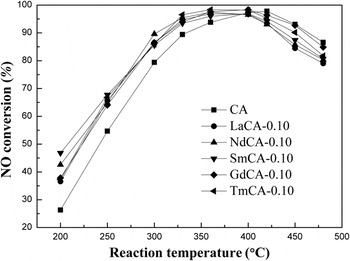
Figure 1 displays the temperature dependence of NO conversion obtained with CA and rare earth element modified CeO2/Al2O3 catalysts (RCA for short). As shown in Fig. 1, the additions of R3+ ions correspond to similar law, but different slightly. The catalytic activities of RCA-0.10 (R:Ce = 0.10:1) are higher than CA when the temperature is lower than 400 °C. In particular, the NdCA-0.10 (Nd:Ce = 0.10:1) and SmCA-0.10 (Sm:Ce = 0.10:1) show higher catalytic activity at 200–300 °C. TmCA-0.10 shows the highest catalytic activity at 360 °C, so that TmCA-0.10 is chosen for other characterizations to compare with CA catalyst in the following sections. Furthermore, the point of maximum catalytic activity shifts to lower temperature with the addition of R3+ ions, which might result from the increase of Lewis acid sites. Reference Jin, Shen and Zhu6 Therefore, the suitable addition of R3+ ions to the CA catalyst will increase the catalytic activity. All the RCA-0.10 catalysts show high catalytic activities at 360 °C, so that the N2 selectivity of RCA-0.10 catalysts at 360 °C are obtained to study the effect of R3+ ions on the N2 selectivity over CA catalyst. The result suggests that the N2 selectivity reduces slightly with the addition of R3+ ions. However, the effect can be neglected and all the N2 selectivity over RCA-0.10 catalysts is still more than 95% at 360 °C.
Effect of different elements on NO conversion over RCA catalysts at a GSHV of 5000 h−1.

2. Effects of GHSV and H2O/SO2
The catalytic activities of CA and TmCA-0.10 with different GHSVs at 360 °C are shown in Fig. S2. The NO conversion dramatically decreases at the 200–250 °C with the increasing GHSV. It may be suggested that the thermal motion of molecules is not severe at the low temperatures and the time of gas molecules on the catalyst surface decreases with the increasing GHSV. Therefore, the gas molecules are easier to escape instead of adsorption and reaction on the catalyst, which will affect the catalytic activity. On the other hand, the effect becomes weaker gradually with the increase of reaction temperature and high NO conversion is maintained until the GHSV reaches 50,000 h−1. Furthermore, the catalytic activities of CA catalyst decrease much more seriously than that of TmCA-0.10 with the increasing GHSV. The maximum catalytic activity of CA catalyst is 78.28% while that of TmCA-0.10 is 91.06% at the GHSV of 50,000 h−1. Therefore, the addition of Tm3+ ions to CA can lead to an obvious enhancement of the catalytic activity. At the last, it can indicate that the TmCA-0.10 catalyst is highly effective for NO removal within the GHSV range of 5000–20,000 h−1, which can meet the requirement of marine diesel engine.
Figure 2 shows the NO conversion over CA and TmCA-0.10 under the reaction conditions 5 vol% H2O and/or 200 ppm SO2 at 360 °C. The total catalytic activities of CA and TmCA-0.10 basically keep unchanged when water vapor is introduced separately in the whole testing, possibly because the weak competitive adsorption among water vapor and NH3 or NO on the surface of catalysts. When 5 vol% H2O and 200 ppm SO2 start to be added, the NO conversions of CA and TmCA-0.10 drop by 15% and 13% respectively in 2 h. In the next 19 h, the NO conversions of the CA and TmCA-0.10 are almost unchanged. In addition, once SO2 and H2O are closed, NO conversions of the CA and TmCA-0.10 quickly recovered to 85% and 93%, respectively. Therefore, the anti-sulfur ability can be enhanced with the addition of R3+ ions, and the TmCA-0.10 showed excellent performance in resisting reactant poisoning caused by vapor and sulfur.
NO conversion of (a) CA; (b) TmCA-0.10 catalysts in the presence of H2O and SO2 at 5000 h−1, 360 °C.

B. Phase analysis
The XRD results of RCA catalysts are shown in Fig. 3. All the reflections of the RCA catalysts provide typical diffraction patterns for the CeO2 (2θ = 28.6°, 33.1°, 47.5°, 56.4°) (PDF-ICDD 65-5923) and Al2O3 (2θ = 37.6°, 45.8°, 66.7°) (PDF-ICDD 02-1420). Diffraction peaks attributed to R3+ ions (R = La, Nd, Sm, Gd, and Tm) ions are not detected in the XRD patterns, implying that R3+ ions are finely dispersed on the surface of the catalysts or exist as amorphous species. As shown in Fig. 3, the intensities of the diffraction peaks pertaining to CeO2 decrease slightly with the incorporation of R3+ ions. In addition, the diffraction peaks of CeO2 shift to small angle, which results from the distorting lattice with the addition of R3+ ions. It can be suggested that some R3+ ions enter the crystal lattice and lead to the lattice expansion of CeO2. Visible Raman spectra are applied to characterize the catalysts, and the results are presented in Fig. S3. All the samples show an obvious band at about 462 cm−1, which pertained to CeO2 (F2g). The Raman spectral intensity decreases slightly and the peaks shift to lower wave numbers with the incorporation of R3+ ions, which might be due to the interaction of R3+ and CeO2. That is to say, some R3+ ions are incorporated into the lattice of ceria so that the oxygen defect concentration can increase with the R3+ ions incorporation.
X-ray diffraction patterns of RCA catalysts.

C. Physical property analysis
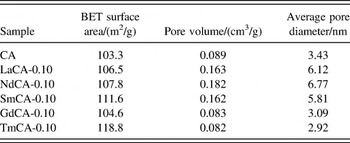
The specific surface area, pore volume, and pore size of RCA catalysts are shown in Table I. The surface area of CA catalyst is 103.3 m2/g, and the average pore diameter is 3.43 nm. The specific surface area and the average pore diameter increase in the similar tendency with the R3+ ions incorporation. As shown in Table I, the specific surface areas of the catalysts increase gradually with the addition of R3+ ions and decrease as TmCA-0.10 > SmCA-0.10 > NdCA-0.10 > LaCA-0.10 > GdCA-0.10 > CA. However, the average pore diameters and the pore volume show a parabolic trend with the R3+ ions incorporation, and decrease in the following order NdCA-0.10 > LaCA-0.10 > SmCA-0.10 > CA > GdCA-0.10 > TmCA-0.10. As well known, the pore volume and the average pore diameter exhibit a positive correlation when the specific surface area is unchanged. The small pore of CA catalyst collapses to form relatively larger pore with the addition of La, Nd, and Sm while there is no big change with the addition of Gd and Tm. This may be the reason for the trend of the average pore diameters and the pore volume. In addition, the specific surface area plays an important role in the catalytic activity at low temperature and seldom references mention that the average pore diameter and the pore volume contributed to catalytic activity for NH3-SCR. Consequently, the catalytic activities of RCA catalysts are higher than that of CA at low temperatures.
Physical properties of different catalysts sample.

D. Acid property analysis
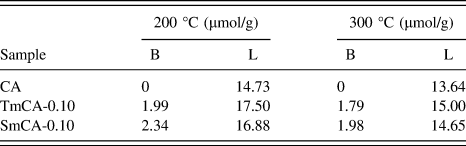
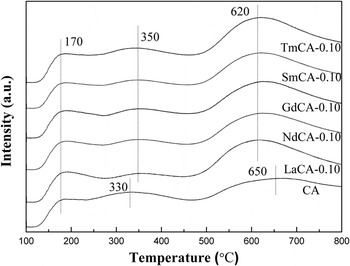
Figure S4 shows the Py-IR spectra of CA, SmCA-0.10, and TmCA-0.10 vacuum treatment at 200 and 300 °C. The bands at 1448 and 1544 cm−1 are commonly attributed to Lewis acid sites and Bronsted acid sites, respectively while the band at 1488 cm−1 is assigned to the Lewis or Bronsted acid sites. Reference Lercher, Gründling and Eder-Mirth29,Reference Jing, Li, Yang and Hao30 As shown in Fig. S4, it can be seen that both of CA, SmCA-0.10, and TmCA-0.10 exhibit vibrational peaks centered at 1448 cm−1, indicating that all of CA, SmCA-0.10, and TmCA-0.10 possess Lewis acid sites. Furthermore, the spectra of SmCA-0.10 and TmCA-0.10 show obvious band of Bronsted acid sites while it is indiscernible at 1544 cm−1 in the CA catalyst. Therefore, the additions of R3+ ions are beneficial to the formation of Bronsted acid sites. As calculated in the Tanabe acidic rule, the interaction of R2O3 and CeO2 is effective to improve the Lewis acid sites. That is to say, the interaction of R2O3 and Al2O3 can also exist in the catalyst, which will form the Bronsted acid sites. Furthermore, the concentration of acid sites on the catalysts is calculated by the method, Reference Ning, Song, Li, Zhang, Liu, Zhang, Tang and Huang31 and the result is shown in Table II. It is clear that Lewis acid sites are the main acid sites in all the samples, and the concentrations of Lewis and Bronsted acid sites increase with the addition of R3+ ions. Figure 4 shows the NH3-TPD profiles of different catalysts. As shown in Fig. 4, there is no great difference between the peak temperature of CA and that of RCA at the low temperature (100–250 °C). The peak temperatures of the medium acid sites (250–450 °C) increase and that of strong acid sites (450–600 °C) decrease with the addition of rare earths ions. The peak above 600 °C may be the result of ammonia decomposition. That is to say, the medium acid strength is enhanced while the strong acid strength is reduced with the addition of R3+ ions. In addition, the areas of the ammonia desorption peaks at low temperatures have no great difference between CA and RCA catalysts, implying that there is no big change for the number of the weak and medium acid sites with the addition of R3+ ions. Meanwhile, the areas of the ammonia desorption peaks at high temperatures, which is related to Lewis acid sites, increase with the addition of R3+ ions. Reference Wang, Wu, Zou, Yu, Gui and Dong32 In general, the number of total acid sites increases with the addition of R3+ ions.
Concentration and distribution of Bronsted and Lewis sites on different catalysts.

NH3-TPD profiles of RCA catalysts.

It is generally known that the acidity of catalyst plays an important role in the adsorption capacity of NH3. Reference Wang, Wu, Zou, Yu, Gui and Dong32 Ammonia molecules are adsorbed on Lewis and Bronsted acid sites, and then generate coordinated NH3 species and NH4+ ions, respectively. Reference Pârvulescu, Boghosian, Jung and Grange33 The increase of adsorbed NH3 concentration is beneficial to the catalytic activity for NH3-SCR. Consequently, the catalytic activity of CA catalyst will be enhanced with the addition of R3+ ions.
E. Redox property analysis
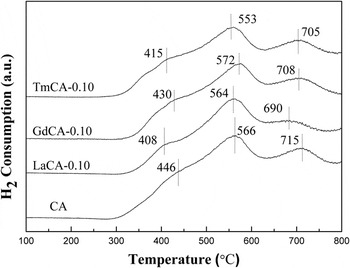
H2-TPR is a commonly used analysis technique to evaluate the reducibility of solid oxide catalyst. Reference Zhang, Zhao, Xu, Zheng, Liu, Jiang, Duan and He34 Figure 5 shows the H2-TPR results of RCA catalysts, and the RCA catalysts present three broad peaks. There is no hydrogen consumption for the H2-TPR profiles of pure Al2O3. Reference Jin, Wei, Zhao, Liu, Yu, Li and Li35 Therefore, for the CA catalyst, the broad peak centered at 446 °C is likely assigned to the reduction of surface oxygen of Ce4+–O–Ce4+. Reference Jiang, Xing, Wang, Huang, Wang and Liu36,Reference Gao, Jiang, Fu, Zhong, Luo and Cen37 In addition, the weak peak centered at 566 °C is attributed to the reduction surface oxygen of Ce3+–O–Ce4+, Reference Zhu, Qin, Shan, Shen and Wang38,Reference Murugan and Ramaswamy39 and the third peak centered at 715 °C corresponds to the reduction of bulk ceria by the elimination of O2− anions from the lattice. Reference Ndifor, Garcia, Solsona and Taylor40,Reference Andreeva, Nedyalkova, Ilieva and Abrashev41 As shown in Fig. 5, there is no great difference for the reduction peaks among the different catalysts when temperature is lower than 600 °C. The only exception is the high temperature reduction peak (>700 °C), which is, however hard to correlate with the catalyst performances since it is related to the reduction of bulk CeO2. Therefore, the promotional effect of rare earth ion additives may mainly due to the increase of acid sites.
H2-TPR profiles of different catalysts.

F. XPS spectra analysis
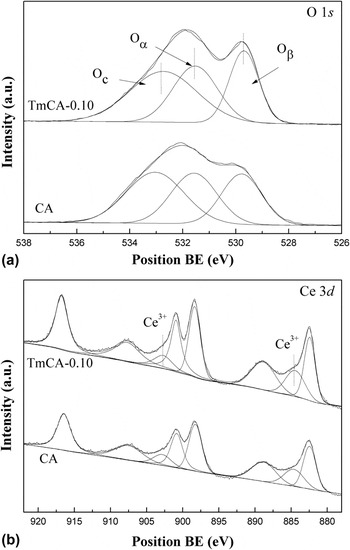
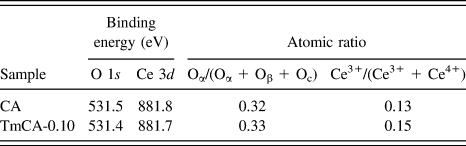
As shown in Fig. 6, the CA and TmCA-0.10 catalysts are tested by XPS high-resolution scans over O 1s and Ce 3d, and Table III shows the position binding energy and atomic ratio. The spectra of O 1s can be fitted into three peaks. The peak centered at 529.8 eV is attributed to the lattice oxygen (hereafter denoted as Oβ) and the peak at around 531.5 eV is referred to the chemisorbed oxygen (hereafter denoted as Oα). The last peak at about 533 eV corresponds to surface oxygen by hydroxyl species (hereafter denoted as Oc). Reference Kang, Park, Kim and Yie42 It is reported that surface chemisorbed oxygen is the most active oxygen and plays an important role in oxidation. Reference Wu, Jin, Liu and Wang43 In addition, there is no great difference between the Oα/(Oα + Oβ + Oc) ratio of CA and that of TmCA-0.10. There are some other reasons for the increase of catalytic activity with the addition of R3+ ions.
XPS high-resolution scans over (a) O 1s and (b) Ce 3d peaks on CA and TmCA-0.10 catalyst.

Position binding energy and atomic ratio of different catalysts.

The spectral peak of CA and TmCA can be observed at binding energy of 903 and 884 eV, which is ascribed to Ce3+ and the other peaks are referred to Ce4+. Reference Larachi, Pierre, Adnot and Bernis44 The value of Ce3+/(Ce3+ + Ce4+) ratio is considered as a significant parameter for NH3-SCR and calculated by the integral specific of spectral peaks. Reference Boningari, Pappas, Ettireddy, Kotrba and Smirniotis45 The value of Ce3+/(Ce3+ + Ce4+) in the surface layer of TmCA is higher than that of CA, which might be one of the reasons for the increase of catalytic activity with the addition of RE3+ ions. In addition, the Ce 3d and O 1s core levels shift to lower binding energy with the addition of R3+ ions, indicating that the interaction between Ce and O decreased slightly.
G. Discussion
In general, the RCA catalyst is a solid acid catalyst, and there is a considerable correlation between catalytic activities and the number of acid sites. As calculated in the Tanabe acidic rule, the interaction of R2O3 and CeO2 is effective to improve the Lewis acid sites. But the additions of R3+ ions are beneficial to the formation of Bronsted acid sites. That is to say, the interaction of R2O3 and Al2O3 can also exist in the catalyst, which will form the Bronsted acid sites. As stated above, the increase of Lewis and Bronsted acid sites corresponds to improvement of catalytic activity at low temperature and the number of strong acid sites is a key factor in improving the catalytic activity. Reference Shen, Su and Ma46 In addition, the R3+ ions can enter the crystal lattice and lead to the lattice expansion of CeO2, which also affects the catalytic performances of CA catalyst.
IV. CONCLUSIONS
In this work, five rare earth elements, as modifier, is added to study the effect of R3+ ions on the CeO2/Al2O3 for NH3-SCR. It is found that the catalytic activity at low temperature and the anti-sulfur ability at 360 °C can be enhanced with the addition of rare earth elements. The number of Lewis and Bronsted acid sites increase and the redox properties are improved with the addition of R3+ ions. In addition, the increase of Ce3+ concentrations is beneficial to the improvement of catalytic activity. With these superior capabilities, TmCA-0.10 exhibits the best catalytic performance for NH3-SCR and more than 98% NO conversion at 360 °C under GHSV of 5000 h−1.
Supplementary Material
To view supplementary material for this article, please visit https://doi.org/10.1557/jmr.2017.125.
ACKNOWLEDGMENTS
This work is supported by the National Key Research and Development Program of China (2016YFC0205500), Jiangsu Provincial Science and Technology Supporting Program (BE2013718), Project Funded by the Priority Academic Program Development of Jiangsu Higher Education Institutions (PAPD).