Introduction
Increasing attention has been paid to nanometer-sized carbon materials, including carbon black, carbon nanotubes, and graphene because of their unique mechanical, thermal, and electrical properties.[Reference Han, Lee, Park and Shim1–Reference Araby, Meng, Zhang, Zaman, Majewski and Ma3] The p- and n-type doping of carbon materials through charge–transfer interaction has been investigated as an important technique of the functionalization, such as for thermoelectric power generation with π-shaped modules.[Reference Nonoguchi, Ohashi, Kanazawa, Ashiba, Hata, Nakagawa, Adachi, Tanase and Kawai4–Reference Fukumaru, Fujigaya and Nakashima6] Since carbon materials are generally p-type and there are essentially only a few reports on n-type doping of carbon materials, the development of n-type doping method is still desirable. Nonoguchi et al.[Reference Nonoguchi, Ohashi, Kanazawa, Ashiba, Hata, Nakagawa, Adachi, Tanase and Kawai4] reported that absorption of molecular dopants altered the type of majority carriers of pristine single-walled carbon nanotubes (SWNTs) from positive to negative, and they displayed a relatively large Seebeck coefficient (S = −72 µV/K at 310 K) of the flexible film fabricated from phosphine-doped SWNTs (i.e., the electrons from phosphine molecules compensated the holes in p-type SWNTs and further electron transfer induced n-type charge carriers and increased the n-type thermoelectric power).[Reference Nonoguchi, Ohashi, Kanazawa, Ashiba, Hata, Nakagawa, Adachi, Tanase and Kawai4] Matsumoto et al.[Reference Matsumoto, Okabe and Akuzawa5] reported that thermoelectric properties of commercially available graphite sheets could be manipulated by intercalating chemical species into the graphite interlayers, and they showed a Seebeck coefficient (S = −58 µV/Κ at room temperature) and a large power factor (σS 2 > 10−2 W/m/K2 at room temperature, σ stands for the electrical conductivity) of the sheet with potassium–graphite intercalation compounds.[Reference Matsumoto, Okabe and Akuzawa5] In spite of their successes, there has been essentially no report about the functionalization of carbon blacks with such doping method even though it should be easy to use them for large-scale production because of the lower price compared with other carbon materials.[Reference Dai7]
In the present study, therefore, we tried to fabricate an n-type material using an easily obtainable carbon material, carbon black [acetylene carbon black (AB) and Ketjenblack (KB)], as a main raw material. The n-type doping of those carbon blacks, generally p-type material, was examined with a molecular dopant, triphenylphosphine (tpp) with/without silver (Ag) nanoparticles deposited on carbon blacks. The versatility of the method was also investigated by changing the metal precursors and carbon materials.
Experimental
Chemical and materials
AB (50% compressed, average particle size 0.042 µm, Strem Chemicals, Newburyport, Massachusetts), KB EC600JD (≥98%, average particle size 34 nm, Lion Specialty Chemicals, Tokyo, Japan), graphite (particle size <20 µm, Aldrich, St. Louis, Missouri), poly(vinyl pyrrolidone) (PVP, M w ≈ 40,000, Wako Pure Chemical Industries, Osaka, Japan), silver(I) nitrate (AgNO3, ≥99.8%, Wako Pure Chemical Industries, Osaka, Japan), sodium tetrahydroborate (NaBH4, ≥92.0%, Kanto Chemical, Tokyo, Japan), tpp (≥97.0%, Wako Pure Chemical Industries, Osaka, Japan), ethanol (≥99.5%, Wako Pure Chemical Industries, Osaka, Japan), and acetone (≥99.0%, Wako Pure Chemical Industries, Osaka, Japan) were all used as received. Deionized water was obtained by a water purifier (RFP343RB, Advantec, Tokyo, Japan) and is referred to as water throughout the paper.
Modification of carbon materials with Ag nanoparticles
In a typical synthesis, 1.8 mL of an ethanol solution of NaBH4 (4.5 × 10⁻³ g/mL) was added to a mixture of 60 mL of an ethanol solution containing both AB and PVP (5.0 and 1.7 g/L, respectively) and 0.30 mL of an aqueous solution of AgNO3 (0.20 g/mL), and the solution was then stirred for 1 h at room temperature. The Ag–nanoparticles-modified AB (Ag/AB hybrid nanoparticles) were roughly separated from independent Ag nanoparticles by centrifugation (11000 rpm, 1 h) and washed by dispersion–centrifugation process in ethanol, and it was then dried at room temperature in a fume hood.
Modification of Ag–nanoparticles-modified carbon materials with tpp
Twenty milliliter of an ethanol solution of tpp (1.1 × 10⁻² g/mL) was added to 20 mL of an ethanol dispersion of as-prepared Ag/AB hybrid nanoparticles (containing 0.6 g of AB), and the dispersion was then stirred overnight at room temperature. The hybrid nanoparticles were washed by dispersion–centrifugation process in ethanol and acetone, and it was then dried at room temperature in a fume hood.
Characterizations
Scanning electron microscopy (SEM) and energy-dispersive spectrometry (EDS) analyses were performed using a JEOL JSM-7500F equipped with JEOL JED-2300. The samples for SEM and EDS analyses were prepared by drying droplets of the particle dispersions on silicon substrates under vacuum. The Seebeck coefficients of the dried particles were measured at room temperature using a thermoelectric measurement system (ZEM-3, ULVAC) in the ambient atmosphere.
Results and discussion
Treatment of AB nanoparticles with tpp (without Ag nanoparticles)
The commercial AB nanoparticles without further purification were used as a standard carbon material in this study. Functional groups, such as the hydroxyl and carboxyl groups, are supposed to be existed on the surface of AB in the same fashion as ordinary carbon blacks.[Reference Han, Lee, Park and Shim1, Reference Villars8] Nonoguchi et al.[Reference Nonoguchi, Ohashi, Kanazawa, Ashiba, Hata, Nakagawa, Adachi, Tanase and Kawai4] found that most phosphine derivatives promoted p-type SWNTs into n-type form, as well as several amine- and imine-containing molecules [e.g., PVP, poly(4-vinylpyridine), and polyethyleneimine]. Especially, their tpp-doped SWNT film exhibited the highest Seebeck coefficient (S = −72 µV/K at 310 K) as an n-type material in those doped SWNT films.[Reference Nonoguchi, Ohashi, Kanazawa, Ashiba, Hata, Nakagawa, Adachi, Tanase and Kawai4] Inspired by their success, first, we tried to alter the p-type AB nanoparticles into n-type materials by doping with tpp. Contrary to our expectation, Seebeck coefficients did not change even after the tpp treatment (S = 12 µV/Κ in both cases). It seems to be that the AB nanoparticles was not successfully covered with tpp perhaps due to a weak affinity of tpp molecules for the surface of AB.
Preparation of Ag/AB hybrid nanoparticles and tpp modification of the Ag nanoparticles
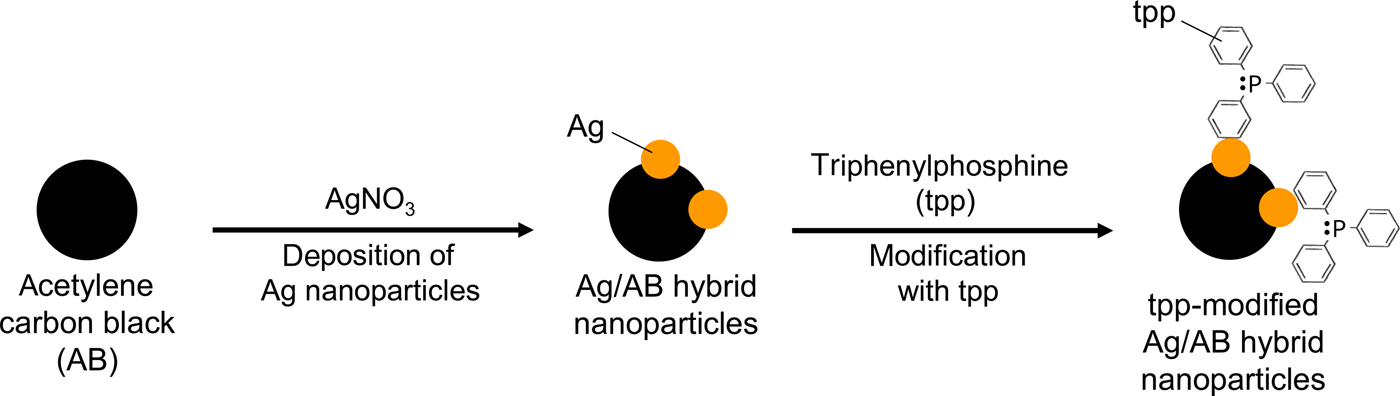
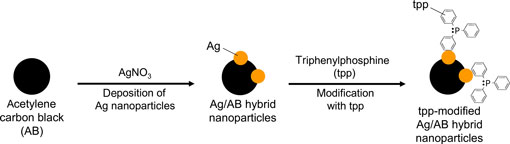
We next tried to modify the AB nanoparticles with Ag nanoparticles via liquid-phase reductive deposition to attach tpp molecules through interaction between the valence electrons of Ag nanoparticles and the π electrons of aromatic rings (Fig. 1).[Reference Kanehara, Takahashi and Teranishi9–Reference Rekha, Umadevi and Rajkumar12]
Schematic illustration of the procedure for preparing Ag–nanoparticles-modified AB (Ag/AB hybrid nanoparticles) and modifying the Ag nanoparticles with tpp.

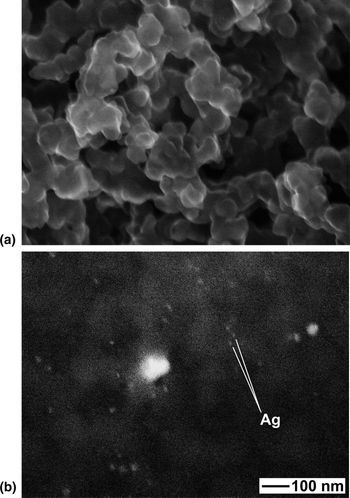
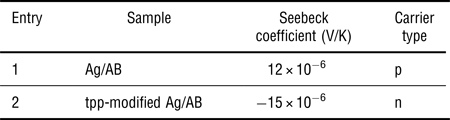
Figures 2(a) and 2(b) show a SEM image of Ag/AB hybrid nanoparticles and back-scattering SEM image taken from the same area, respectively. The dark (gray) and bright (white) regions correspond to AB and Ag, respectively, in Fig. 2(b). The existence of Ag was confirmed by EDS analysis (see Fig. S1). The Ag and AB nanoparticles could come together as a result of the heterogeneous nucleation of Ag nanoparticles on the surface of AB. The Ag nanoparticles were well dispersed on the surface of AB, and the typical diameter of Ag nanoparticles was ~10–20 nm as shown in Fig. S2. Table I shows the Seebeck coefficient and carrier type of Ag/AB hybrid nanoparticles with/without tpp modification at room temperature. The Seebeck coefficient of the p-type AB was successfully shifted to n-type by tpp modification. This result suggests that the surface of Ag nanoparticles was successfully covered with tpp molecules, which could play a role of an electron donor. It is worth noting that the charge transfer from tpp molecules to AB occurred through the Ag nanoparticles deposited on the surface of AB.
(a) SEM image of Ag/AB hybrid nanoparticles and (b) back-scattering SEM image taken from the same area. The dark (gray) and bright (white) regions correspond to AB and Ag, respectively, in (b). The 100 nm scale bar applies to both images.

Seebeck coefficient and carrier type of Ag/AB hybrid nanoparticles with/without tpp treatment at room temperature.

The effect of the electrical charges of metal precursors
We found that the electrical charges of metal precursors played an important role in initiating metal nanoparticle nucleation on the surface of AB. We did a set of experiments to investigate the role of the electrical charges during the liquid-phase reductive deposition of metal nanoparticles. When we used gold(III) chloride trihydrate (HAuCl4, 3H2O) as a metal precursor, the gold (Au) nanoparticles did not nucleate on the surface of AB (i.e., separated from AB nanoparticles as a result of the homogeneous nucleation in the reaction solution). When the metal precursor was chloroplatinic acid hydrate (H2PtCl6), the platinum (Pt) nanoparticles was also separated from AB nanoparticles. Only when we used AgNO3, Ag and AB nanoparticles could come together as shown in Figures 2(a) and 2(b). For the cases of HAuCl4, 3H2O and H2PtCl6, the metal atoms (Au and Pt) exist in the anionic complexes ([AuCl4]− and [PtCl6]2−, respectively) in the system. On the other hand, Ag atom exists as the cation (Ag+) for the AgNO3 case, and the positive charge should be favorable to initiate the heterogeneous nucleation from the AB surface with negative charge derived from the hydroxyl and carboxyl groups. Combined together, we can conclude that one has to choose an appropriate metal precursor with a proper electrical charge in order to lead the heterogeneous nucleation of metal nanoparticles on the carbon substrate.
Expansion of the method to other carbon materials
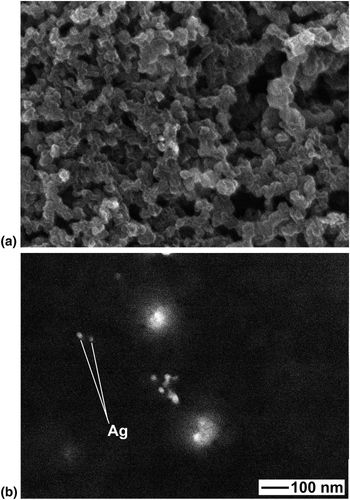
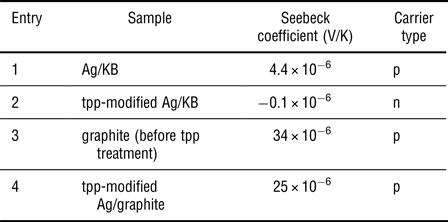
We also examined the versatility of our method by using different carbon materials. First, we applied the method to KB nanoparticles with an average diameter of 34 nm as a different kind of carbon blacks. The size of KB nanoparticles is similar to that of AB nanoparticles, which we used as a standard carbon material. Figures 3(a) and 3(b) show a SEM image of Ag–nanoparticles-modified KB (Ag/KB hybrid nanoparticles) and back-scattering SEM image taken from the same area, respectively. The dark (gray) and bright (white) regions correspond to KB and Ag, respectively, in Figure 3(b). The existence of Ag was confirmed by EDS analysis (see Fig. S3). The Ag nanoparticles with the typical diameters of ~20–40 nm (the size distribution is shown in Fig. S4) were unevenly distributed on the surfaces of KB nanoparticles, i.e., only a part of KB nanoparticles was modified with Ag nanoparticles. We still tried to change the majority carriers to n-type by tpp modification, and evaluated the Seebeck coefficient at room temperature. As shown in Table II entries 1–2, the Seebeck coefficient was shifted to n-type by the doping, but the absolute value was much smaller than that of tpp-modified Ag/AB hybrid nanoparticles. We believe that this difference in the doping effect was probably caused by the difference in the distribution of Ag nanoparticles on carbon blacks (i.e., both doped and undoped KB nanoparticles should be existed as a mixture, and the absolute value of the Seebeck coefficient therefore remained low as an average of the mixture). This result indicates that highly dispersed Ag nanoparticles on carbon materials are also suitable for an effective doping. The dispersity of Ag nanoparticles on KB nanoparticles should be improved by changing the deposition condition, such as reaction temperature.[Reference Vajtai13–Reference Yang, Peng, Zhou, Lee, Bao, Lee, Wu and Xia17]
(a) SEM image of Ag–nanoparticles-modified KB (Ag/KB hybrid nanoparticles) and (b) back-scattering SEM image taken from the same area. The dark (gray) and bright (white) regions correspond to KB and Ag, respectively, in (b). The 100 nm scale bar applies to both images.

Seebeck coefficients and carrier types of Ag/KB hybrid nanoparticles with/without tpp modification, graphite microparticles without tpp modification, and Ag/graphite hybrid microparticles with tpp modification at room temperature (the Seebeck coefficient of KB nanoparticles without Ag nanoparticles could not be evaluated due to the poor formability of untreated KB nanoparticles).

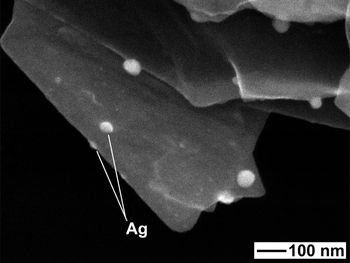
We next used a relatively large carbon material, i.e., graphite microparticles with an average diameter of ~3.6 µm. The graphite microparticles were modified with Ag nanoparticles in the same method as that for the AB nanoparticles. As shown in Fig. 4, Ag nanoparticles, confirmed by EDS analysis, were deposited on the surface of graphite [bright (white) regions correspond to Ag] and the diameters were ~10–100 nm. We then tried to alter the majority carriers from p- to n-type by tpp modification, and evaluated the Seebeck coefficient at room temperature. As shown in Table II entries 3–4, the absolute value of the Seebeck coefficient was decreased from 34 (entry 3) to 25 (entry 4), but the doping effect was limited and the hybrid microparticles remained as a p-type material. It should be reasonable that there was a difference in the doping effect by the sizes of carbon materials because the volume of the graphite microparticle was ~6 × 10⁵ times larger than that of the AB nanoparticle (calculated from average diameters). This result indicates that smaller carbon materials are favorable for an effective doping. In principle, it should be possible to use this tendency to tune the Seebeck coefficients of carbon materials.
SEM image of Ag–nanoparticles-modified graphite (Ag/graphite hybrid microparticles).

Conclusions
We have fabricated an n-type material using an easily obtainable carbon material, carbon black, as a main raw material. The n-type doping of those carbon blacks, generally p-type material, was conducted with a molecular dopant, tpp, through interaction between the π electrons of aromatic rings and the valence electrons of Ag nanoparticles deposited on carbon blacks. We have also found that the electrical charges of the metal precursor played an important role in initiating the nanoparticle nucleation on the surface of carbon blacks. Furthermore, highly dispersed Ag nanoparticles and smaller carbon materials were favorable for the effective doping. We believe that the method described in this study could be readily extended to a variety of carbon materials and also other kinds of metal nanoparticles from an appropriate metal precursor with a proper electrical charge. Our approach is expected to be used for the fabrication of functional devices (such as thermoelectric devices) from p- and n-type materials.
Supplementary Material
The supplementary material for this article can be found at https://doi.org/10.1557/mrc.2017.48.
Acknowledgment
This work was partly supported by Nanotechnology Platform Program (Molecule and Material Synthesis) of the Ministry of Education, Culture, Sports, Science and Technology (MEXT), Japan.