Introduction
Indications for surgical removal of tonsils have been debated for a long time, with differing views expressed.Reference Rosefsky1 Tonsillectomy is a commonly performed ENT operation in children in the Western world.Reference Rutkow2 When performed for appropriate indications, it contributes to improvement in the quality of life and at times can help with airway difficulties.
It is well understood that two of the most common reasons for these procedures are infection (e.g. recurrent tonsillitis, peritonsillar abscess, tonsillolithiasis and pharyngotonsillitis) and sleep-disordered breathing (a continuum from primary snoring to obstructive sleep apnoea syndrome).Reference Discolo, Darrow and Koltai3, Reference Darrow and Siemens4 The improved understanding of the appropriate indications for tonsillectomy that has emerged in the last 30 years is responsible for the decline in the numbers of children undergoing this procedure. Although studies conducted since the early 1970s have better defined the candidate populations for tonsillectomy and adenoidectomy, many clinicians are still unclear about the indications.Reference Darrow and Siemens4
In view of this, we undertook a study to ascertain the factors general practitioners consider important when referring children for tonsillectomy, and to compare these views with those of consultant ENT surgeons.
Methods
A web-based questionnaire was sent to general practitioners in South Yorkshire primary care trusts and all consultant members of ENT UK. The questionnaire (Appendix 1) we used for this study was similar to that used by Donnelly et al. Reference Donnelly, Quraishi and McShane5 in 1994. Respondents were asked to give a score from one to five, in order of increasing importance, to a number of specific factors relevant when considering a child for a tonsillectomy (Appendix 1). Those factors given a score of one to two were deemed to be unimportant, those scored as three to be of intermediate importance, and those scored as four or five to be of greater importance.
Results
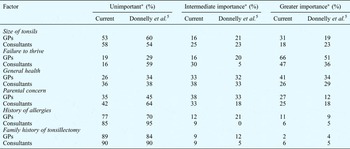
In total, 141 general practitioners and 146 ENT consultants responded to the survey. There was a good level of agreement between general practitioners and consultants for many of the non-specific questions relating to referral for tonsillectomy (Table I). The size of the tonsils was considered an unimportant indication for tonsillectomy by the majority of general practitioners (53 per cent) and consultants (58 per cent). However, 31 per cent of general practitioners and 18 per cent of consultants felt that the size of the tonsils was an important indication. In addition, 27 per cent of general practitioners and 25 per cent of consultants considered parental pressure to be important in their tonsillectomy decision. A history of allergy and a family history of tonsillectomy were considered to be of little importance as indications for tonsillectomy by both groups of doctors.
Questionnaire results: factors with greater GP–consultant agreement

*Results calculated from response scoring; see text for details. GP = general practitioner; current = current study
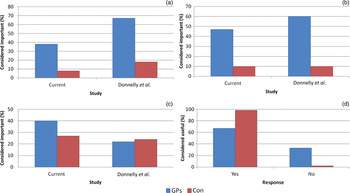
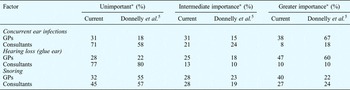
There was a major difference of opinion between general practitioners and consultants in three areas (Table II). Importantly, 38 per cent of general practitioners felt that recurrent ear infections were an important indication for tonsillectomy, whereas only 8 per cent of consultants were of the same opinion (Figure 1a). In a similar vein, ‘glue ear’ was considered to be an important indication by 47 per cent of general practitioners but only 10 per cent of consultants (Figure 1b). Snoring was considered an important indication for tonsillectomy by 40 per cent of general practitioners but by only 27 per cent of consultants (Figure 1c).
General practitioner and consultant responses regarding the importance of (a) ear infections, (b) ‘glue ear’, and (c) snoring, in the decision to perform tonsillectomy, in our study and that of Donnelly et al. 5 (d) General practitioner and consultant responses regarding general usefulness of tonsillectomy, in our study. GP = general practitioner; Con = consultant

Questionnaire results: factors with less GP–consultant agreement

*Results calculated from response scoring; see text for details. GP = general practitioner; current = current study
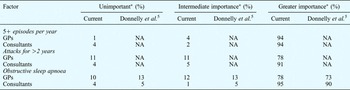
The factors considered to be the most important indications for tonsillectomy are recorded in Table III. Obstructive sleep apnoea (OSA) was considered an important indication by 95 per cent of consultants and 78 per cent of general practitioners. There was good agreement between general practitioners and consultants regarding the importance of the frequency of tonsillitis attacks and the duration (in years) of recurring tonsillitis that would justify referral for a tonsillectomy procedure.
Questionnaire results: factors considered best tonsillectomy indicators

*Results calculated from response scoring; see text for details. GP = general practitioner; current = current study
Overall, 65 per cent of general practitioners and 98 per cent of consultants felt that, in general terms, tonsillectomy was a useful operation (Figure 1d).
Discussion
One of the most common indications for tonsillectomy is recurrent tonsillitis. It is the frequency of tonsillitis episodes and the duration of the complaint that have been the subject of debate. According to the Scottish Intercollegiate Guidelines Network, the following are recommended as reasonable indications for consideration of tonsillectomy in both children and adults, based on the current level of knowledge, clinical observation in the field and clinical audit.6 The patients should meet all the following criteria: sore throats are due to acute tonsillitis; the episodes of debilitating sore throat are disabling and prevent normal functioning; the patient has had seven or more well-documented episodes of clinically significant, adequately treated sore throats in the preceding year, or five or more such episodes in each of the preceding two years, or three or more such episodes in each of the preceding three years.6 In contrast, the American Academy of Otolaryngology – Head and Neck Surgery quantifies three or more infections per year as an adequate indication for surgery.Reference Deutsch7
Reviewing the recent clinical trials,Reference Discolo, Darrow and Koltai3 the absolute indications for tonsillectomy include: OSA, failure to thrive, suspicion of malignant disease, haemorrhagic tonsillitis and abnormal dento-facial growth in children. Otitis media and recurrent or chronic rhinosinusitis or adenoiditis are relative indications for adenoidectomy but not tonsillectomy.
We found the majority of the general practitioners (78 per cent) were aware of the importance of referring children with a history of OSA. However, 22 per cent of general practitioners did not appear to realise the seriousness of the problem. Surprisingly, 5 per cent of consultant ENT surgeons also considered OSA to be of intermediate or no importance when considering placing a child for tonsillectomy. Snoring was considered an important indication for tonsillectomy by the majority of general practitioners (40 per cent) but only 27 per cent of consultants.
In Donnelly and colleagues' study,Reference Donnelly, Quraishi and McShane5 22 per cent of general practitioners felt that snoring was an important indication for tonsillectomy, whereas, in our study, 40 per cent of general practitioners held this view. This indicates that general practitioners increasingly consider snoring as an indication for tonsillectomy.
The main area of disagreement between general practitioners and consultants in our study was the role of tonsillectomy in the management of ‘glue ear’ and recurrent ear infections. Evidence suggests that adenoidectomy has a role in the management of both recurrent acute and chronic otitis media.Reference Paradise, Bluestone, Colborn, Bernard, Smith and Rockette8, Reference Paradise, Bluestone, Rogers, Taylor, Colborn and Bachman9
In Donnelly and colleagues' study,Reference Donnelly, Quraishi and McShane5 approximately half of the general practitioners and consultants felt that recurrent ear infections were an important indication for tonsillectomy. Comparison of these results with our own findings indicates that both general practitioners and consultants have improved their understanding that tonsillectomy is not effective in the management of recurrent ear infections.
In our study, 31 per cent of general practitioners and 18 per cent of consultants considered that tonsillar size was an important factor regarding the need for a tonsillectomy. However, previous studies have shown that tonsillar size is not important when deciding whether tonsillectomy is required for recurrent tonsillitis.Reference Cable, Batch and Stevens10, Reference Barr and Crombie11
Both general practitioners and consultants have started to recognise that failure to thrive is an important indication for tonsillectomy; in our study, 66 per cent of general practitioners and 47 per cent of consultants were of this opinion. In Donnelly and colleagues' study, 59 per cent of consultants considered that failure to thrive was not an important indication for tonsillectomy, whereas in our study only 16 per cent were of this persuasion. This suggests that, in this area, consultants' views have changed.
In our study, an overwhelming majority of both general practitioners and consultants stated that neither a history of allergies nor a family history of tonsillectomy had any importance regarding the need for tonsillectomy.
In Donnelly and colleagues' study,Reference Donnelly, Quraishi and McShane5 12 per cent of general practitioners considered parental concern to be an important factor in their decision regarding tonsillectomy, compared with 35 per cent in our study. This suggests that general practitioners are increasingly influenced by parental pressure. This was similar to the conclusion drawn from the North of England and Scotland Study of Tonsillectomy and Adeno-tonsillectomy in Children (a pragmatic randomised controlled trial with a parallel non-randomised preference study), which showed a strong parental preference for tonsillectomy.Reference Lock, Wilson, Steen, Eccles, Mason and Carrie12
Our study found that tonsillectomy in children was regarded as a useful operation by 65 per cent of general practitioners and 98 per cent of consultant ENT surgeons (Figure 1d). This difference in opinion between the general practitioners and consultants was statistically highly significant (p < 0.001, chi-square test).
• This questionnaire assessed general practitioners' and consultant ENT surgeons' opinions regarding paediatric tonsillectomy indications
• Generally, there was good correlation between the two groups' opinions
• The two groups differed with regard to ‘glue ear’, recurrent ear infections and snoring
In the Donnelly et al. study,Reference Donnelly, Quraishi and McShane5 92 per cent of general practitioners regarded tonsillectomy in children as a useful operation. The difference between the proportion of our general practitioners who viewed tonsillectomy as beneficial, versus the proportion quoted in Donnelly and colleagues' 1994 survey, is statistically highly significant (p < 0.001, chi-square test).
A recently updated Cochrane review reported that there was no clear evidence for the clinical effectiveness or cost-effectiveness of adenotonsillectomy in the treatment of recurrent sore throat among children.Reference Burton and Glasziou13 The North of England and Scotland Study of Tonsillectomy and Adeno-tonsillectomy in Children findings suggest that the continuing careful use of ‘watchful waiting’ and medical management in both primary and secondary care is therefore recommended until clear-cut evidence of effectiveness is available.Reference Lock, Wilson, Steen, Eccles, Mason and Carrie12 However, this latter study does state that there are clinical benefits of tonsillectomy that persist for at least two years.
The ENT UK 2009 conference position paper on tonsillectomy indications also reiterates that tonsillectomy remains a highly effective intervention in appropriate patients, not only in terms of elimination of severe sore throat and upper airway obstruction, but also in terms of patients' and parents' reported quality of life.14
Conclusion
The results of this study indicate that there is a good level of awareness and agreement on the currently accepted indications for paediatric tonsillectomy, comparing general practitioners and consultant ENT surgeons. However, there were important areas of difference between the two groups with regard to ‘glue ear’, recurrent ear infections and snoring.
Our study's results differ from those of Donnelly and colleagues' 1994 study as regards both groups' views regarding failure to thrive and recurrent ear infections. We conclude that, since 1994, the proportion of general practitioners who believe tonsillectomy to be beneficial to patients has fallen by 27 per cent, to 65 per cent. However, the majority of ENT consultants (98 per cent) still feel that it is a useful operation. Thus, we recommend that standardised indications for tonsillectomy should be effectively disseminated to general practitioners.
Appendix 1. Questionnaire
When considering referring a child for a tonsillectomy do you consider the following important?

In general terms, do you consider tonsillectomy to be a useful operation?
Yes
No