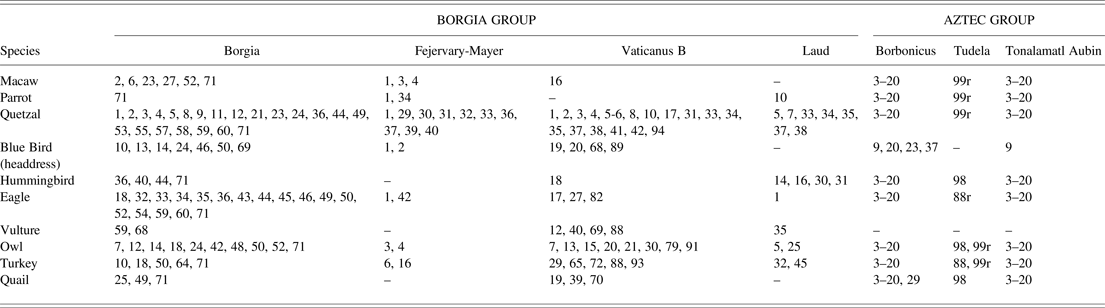
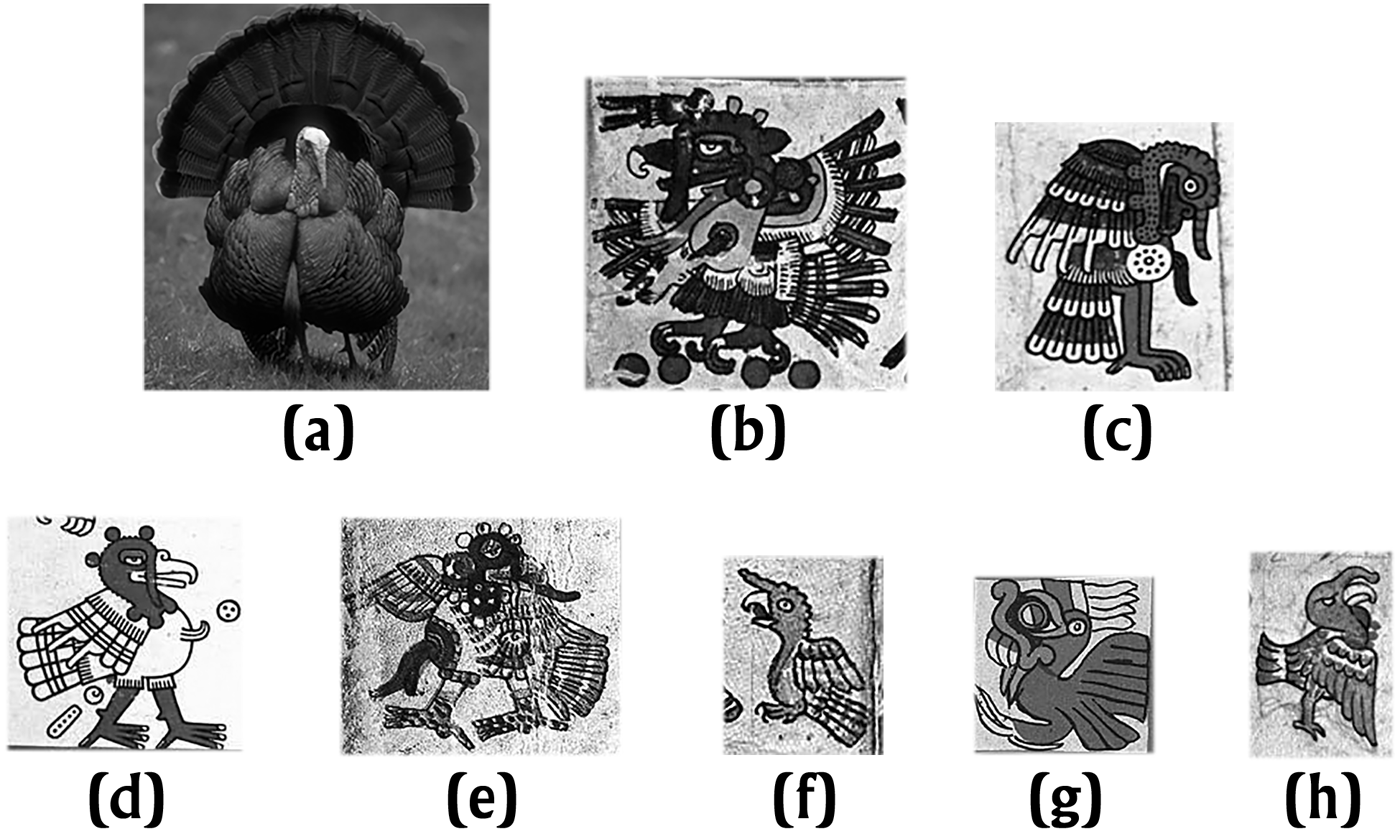
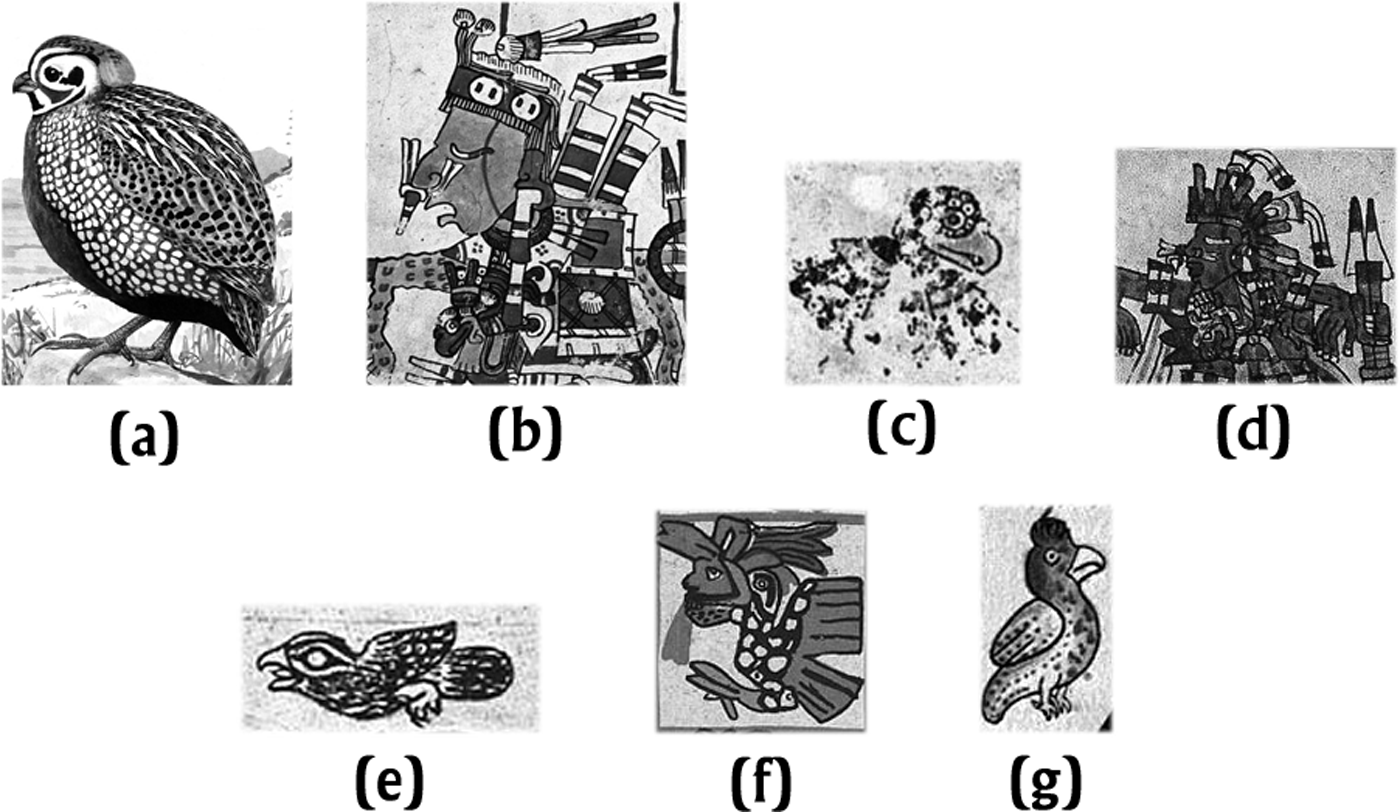
With over a thousand species of birds in Mexico today (Edwards Reference Edwards1998; Peterson and Chalif Reference Peterson and Chalif1973:xvii), it is no wonder they played such an important role in every one of the central Mexican codices. The overwhelming prevalence of birds in the codices can be seen in their use as calendrical Day Signs, natural scenic elements, ritual sacrificial offerings, personal name and location signs, symbols for abstract concepts, and, perhaps most noticeable of all, as decorations in the form of feathers, headdresses, and other ornamental paraphernalia that festoon humans and deities alike. The codex artists appear to have paid careful attention when placing particular birds in certain contexts, suggesting that individual species had their own set of symbolic values. Very few Mesoamericanist scholars have performed a systematic identification of these avians, with the notable exception of German ethnohistorian Eduard Seler in his article, “The Animal Pictures of the Mexican and Mayan Manuscripts,” originally published in German in the Zeitschrift für Ethnologie in 1909, and which was later translated into English under the direction of J. Eric S. Thompson (Seler Reference Seler, Comparato, Thompson and Richardson1996). In the hundred years since Seler's initial identifications, ornithologists have broadened our knowledge of the avian taxonomy of Mexico (for example, Edwards Reference Edwards1998; Howell and Webb Reference Howell and Webb1995; Peterson and Chalif Reference Peterson and Chalif1973). Furthermore, new interpretations of the Mexican codices have enhanced our understanding of pre-Columbian culture and history (Berdan and Anawalt Reference Berdan and Anawalt1997a, Reference Berdan and Anawalt1997b; Boone Reference Boone2000, Reference Boone, Joe and Lozano2007; Boone and Mignolo Reference Boone and Mignolo1994; Nicholson and Quiñones Keber Reference Nicholson and Keber1994).
The following is intended to serve as an update to Seler's enterprising work on the identification of bird species and their symbolic significance in the central Mexican codices. These codices include those produced in the Aztec area, as well as the codices of the Borgia Group, believed to have originated from the Puebla-Tlaxcala region (Boone Reference Boone, Joe and Lozano2007:227–228; Milbrath Reference Milbrath2013). Identifications and interpretations are made here using a number of comparative sources, including the works of early Spanish chroniclers such as Bernardino de Sahagún (Primeros Memoriales and the Florentine Codex), the Mexican tribute records (for example, the Codex Mendoza and the Matrícula de Tributos), and discoveries made over the last century in the field of zooarchaeology, particularly discoveries of avian remains recovered from ritually significant contexts at the Templo Mayor of Tenochtitlan (López Luján Reference López Luján1994; López Luján, et al. Reference López Luján, Balderas, Zúñiga-Arellano, Molina and Maldonado2012; Valentín Maldonado and Gallardo Parrodi Reference Valentín Maldonado and Parrodi2006).
SELER'S IDENTIFICATIONS AND SYMBOLIC INTERPRETATIONS
Seler's original identifications of the birds in the codices, along with analyses of their symbolic significance and an overview of Nahuatl, Zapotec, and Maya names, is undoubtedly the most extensive systematic undertaking to interpret the significance of codex avifauna. Seler's analysis included similar assessments for Mesoamerican insects, fish, amphibians, reptiles, and mammals, the latter of which have been the subject of much discussion by researchers in recent years (Benson Reference Benson1997; Bricker Reference Bricker, Robertson and Fields1991; Colas Reference Colas, Rivera and Le Fort2006; Vail Reference Vail, Bricker and Vail1997; von Nagy Reference von Nagy, Bricker and Vail1997). In his introduction to the article on animal pictures, Seler admits that he attempted to refrain from traversing “into details of modern zoological nomenclature,” citing that it was “sufficient to discuss in general terms the species in question” (Seler Reference Seler, Comparato, Thompson and Richardson1996:167). For some mammals and reptiles, this “general” interpretation of species may have sufficed, since only one representative member of a species exists for certain taxonomic genera. For birds, however, individual species within a single genus or family can be greatly divergent, especially in terms of coloration and size. Age and sexual dimorphism are further sources of variation. It is likely that the ancient Mesoamericans placed special emphasis on particular species, and that artists had the physical qualities of a specific species in mind when painting particular birds.
Few attempts have been made to produce an update for Seler's original ornithographic interpretations. Tozzer and Allen's (Reference Tozzer and Allen1910) report entitled Animal Figures in the Maya Codices was written concurrently with Seler's analysis, and provided an excellent contemporary inquiry into the birds depicted in the Maya codices. Tozzer and Allen's study focused almost exclusively on the artistic representations of the birds, whereas Seler was primarily interested in the symbolic and mythic interpretations, often drawing information from sources outside the realm of codex research, including linguistic terminology and artistic depictions known from ceramic figurines and vessels. A similar qualitative analysis of artistic elements as Tozzer and Allen had done for the Maya codices does not exist for the Mexican books, and is one of the goals of the current study.
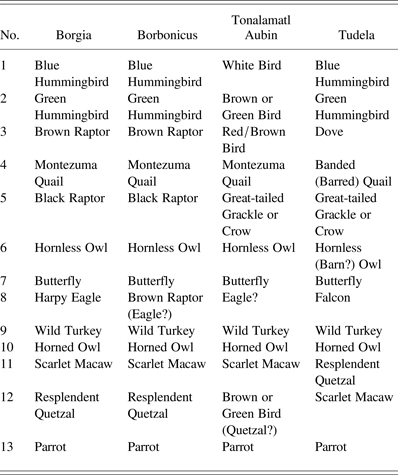
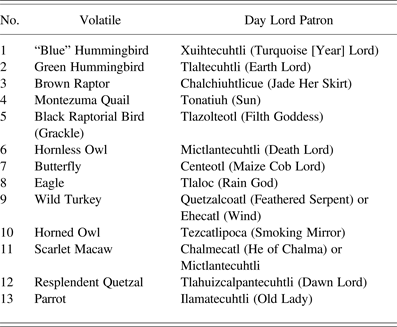
Concerning the central Mexican codices specifically, occasional reinterpretations can be found for some of Seler's identifications, although these are rarely comprehensive in scope. Nicholson (Reference Nicholson, Ekholm and Bernal1971) and Kendall (Reference Kendall1992) reviewed the 13 “volatiles” (Figure 2), 12 birds and one butterfly that are often related to the 13 Day Lords, and modified or expanded upon many of Seler's interpretations. Byland (Reference Byland, Diaz and Rodgers1993), Benson (Reference Benson1997), Boone (Reference Boone, Joe and Lozano2007), and others have included their own interpretations of species, sometimes corroborating or refuting Seler's proposals, but these are most often brief comments rather than comprehensive analyses. Sánchez Vázquez (Reference Sánchez Vázquez, Ahuatzin and Padilla2009) assessed the recurrent theme of birds as they are related to the cardinal directions in the codices Borgia, Fejérváry-Mayer, and Vaticanus B, and although his interpretations generally coincide with those of Seler, he revises Seler's identification of the “hummingbird” on Borgia 51, and includes several identifications of birds in the Codex Fejérváry-Mayer that Seler had not reported.
THE SIGNFICANCE OF BIRDS IN ANCIENT MESOAMERICA
Birds played a number of roles in ancient Mexican life, both as figures in myths, sources of food, feathers, and medicine, and even as symbolic representatives of names and ideas. A reexamination of their roles in the Mexican codices has been needed for some time in light of the numerous discoveries that have been made in both Mesoamerican archaeology and zooarchaeology. Advances in the latter over the last century (Álvarez and Ocaña Reference Álvarez and Ocaña1999; Álvarez et al. Reference Álvarez, Solano, Reyes Gomez and Azúa2005; López Luján Reference López Luján1994) have provided unprecedented information in regards to what species were commonly used in ancient Mexican everyday life, such as the turkey (Álvarez and Ocaña Reference Álvarez and Ocaña1999; Camacho-Escobar et al. Reference Camacho-Escobar, Jiménez-Hidalgo, Arroyo-Ledezma, Sánchez-Bernal and Pérez-Lara2011), as well as which species were involved in ritual performances, notably the eagle and hummingbird (López Luján et al. Reference López Luján, Balderas, Zúñiga-Arellano, Molina and Maldonado2012). Since most of the surviving Mexican codices deal with mythological and ritual matters, zooarchaeological data can offer unique insights into the symbolic roles certain birds held, and often provide detailed information regarding which species were important in rituals and offerings.
Certain bird species were also valued for their feathers and as sources of food or medicine, themes that may influence the symbolic roles these species held in the ancient codices. Some of the early Spanish chroniclers, including the Franciscan friar Bernardino de Sahagún (Reference Sahagún, Dibble and Anderson1963, Reference Sahagún1997, Reference Sahagún and Temprano2001, Reference Sahagún, Anderson and Dibble2002) and the naturalist and court physician to the King of Spain, Francisco Hernández (Reference Hernández1888 [1615]), recorded detailed accounts of the novel bird species they encountered in the New World, often with meticulous descriptions, illustrations, and records of how these birds were perceived or used by the Mexican peoples (Corona Martínez Reference Corona Martínez, Götz and Emery2013). Accounts by Sahagún (Reference Sahagún and Temprano2001) and Bernal Díaz del Castillo (Reference Díaz del Castillo2011) attest to entire aviaries of birds at the Aztec capital maintained by experienced caretakers; these were often separated according to the birds' value as a source of feathers or as hunting companions. Hernández's (Reference Hernández1888 [1615]:260–261, 269) analysis of the medicinal uses of plants and animals throughout Latin America includes details of which species were believed to possess curative properties, such as vulture feathers for curing wounds and hummingbirds for gout.
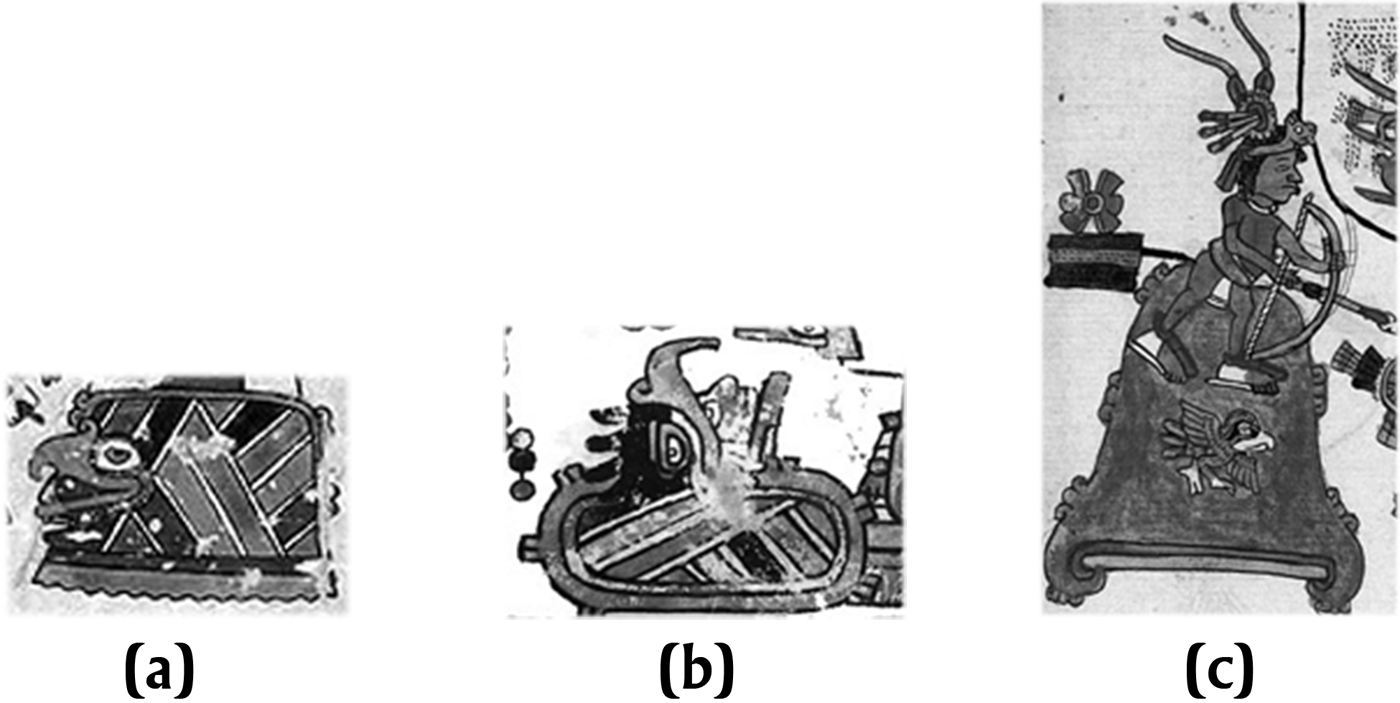
Birds also played important roles as the name signs for people and places (Boone Reference Boone2000; Smith Reference Smith1973), a subject of research that has seen many advances since the time Seler wrote his original manuscript on birds in the codices. The discussion of specific people and places often relies on the identity of a particular bird whose name is used as all or part of the name glyph in question. For example, in the case of the Oaxacan site of Tututepec, the Codex Telleriano-Remensis (Quiñones Keber Reference Quiñones Keber1995:25r, 43r) uses its Nahuatl name “in the hill of the bird” (tototl = “bird” and tepetl = “hill,” with the additional suffix c = “in”), represented by the glyph of a bird in a hill (Boone Reference Boone2000:51; Smith Reference Smith1973:67–68) (Figure 1). Nonetheless, the Codices Bodley (Jansen and Pérez Jiménez Reference Jansen and Pérez Jiménez2005:9–III) and Nuttall (Anders et al. Reference Anders, Jansen and García1992:45d and 50b) use the Mixtec form of the name represented by an eagle with the additional qualifier of a human face or chin near the beak, indicating that it is to be read as “bird” (dzaa) rather than “eagle” (yaha), an important distinction so that the reader understands which town is being identified (Smith Reference Smith1973:67) (Figure 1a and b). Yet the specific identity of the bird has been called into question, with Berlin (Reference Berlin1947:20) noting that the bird in the Codex Telleriano-Remensis resembles a quail, in which case the site would be Sultepec (“in the hill of the quail”) rather than Tututepec (Smith Reference Smith1973:68). Such seemingly minor illustrative distinctions in species could in fact have significant implications when discussing specific places or people, and exemplifies why it is so important to be able to identify particular birds in ancient Mexican art.
Name glyphs for Yucu Dzaa, or “Hill of the Bird,” the Mixtec name for Tututepec. (a) Codex Nuttall 50b, (b) Codex Bodley 9–III, (c) Codex Telleriano-Ramensis 43r. The identity of the bird in the latter glyph has led some to question if the location is, in fact, Tututepec.

METHODOLOGY OF THE PRESENT STUDY
The following is a reexamination of the species identifications for the birds in the central Mexican codices, focusing primarily on the artistic representations of the major bird species. I do not attempt to reinterpret all of the symbolism inherent in each scene depicting birds, for I believe that Seler's pioneering work in this regard is still largely accurate, and a thorough analysis of the many symbols associated with birds is outside the scope of this article. I also do not attempt to modify any of Seler's Nahuatl or Zapotec linguistic identifications, unless, as in the Codex Tudela, the written name of the bird accompanies the depiction. The Codex Tudela was discovered in 1940, and was thus unavailable to Seler at the time he wrote his original treatise on codex animals (Boone Reference Boone, Joe and Lozano2007:253). This analysis includes Mexican codices from both the Aztec and Borgia Groups, and is intended to serve as a guide for those interested in identifying birds and their feathers in images or other codices not specifically covered here.
The codices assessed in this study include the Borbonicus (Anders et al. Reference Anders, Jansen and García1991), Tonalamatl Aubin (Seler Reference Seler and Keane1901), and Tudela (Tudela de la Orden Reference Tudela de la Orden1980) from the Aztec region, as well as the Borgia (Díaz and Rodgers Reference Díaz and Rodgers1993), Fejérváry-Mayer (Anders et al. Reference Anders, Jansen and García1994a), Laud (Anders et al. Reference Anders, Jansen and García1994b), and Vaticanus B (Anders et al. Reference Anders, Jansen and García1993) from the Borgia Group. Documents with distinct Nahuatl and Spanish annotations, such as the Mexican tribute records (that is, the Matrícula de Tributos [Anders et al. Reference Anders, Jansen and García1997] and Codex Mendoza [Berdan and Anawalt Reference Berdan and Anawalt1997a, Reference Berdan and Anawalt1997b]), provide names for certain bird species and their feathers, serving as an excellent means of identifying particular species and depictions of plumage in the codices under study.Footnote 1 Information on specific bird species provided by Sahagún (Reference Sahagún, Dibble and Anderson1963, Reference Sahagún and Temprano2001) in his extensive sixteenth-century compilations of observations of Nahuatl life, the Historia General de las Cosas de la Nueva España, which includes the two Códices Matritenses, the Florentine Codex, and the Primeros Memoriales (Sahagún Reference Sahagún1997), is also used here as a comparative reference. Zooarchaeological data is consulted when relevant, since such evidence provides a unique opportunity to identify the species that played a role in central Mexican daily and ritual life.
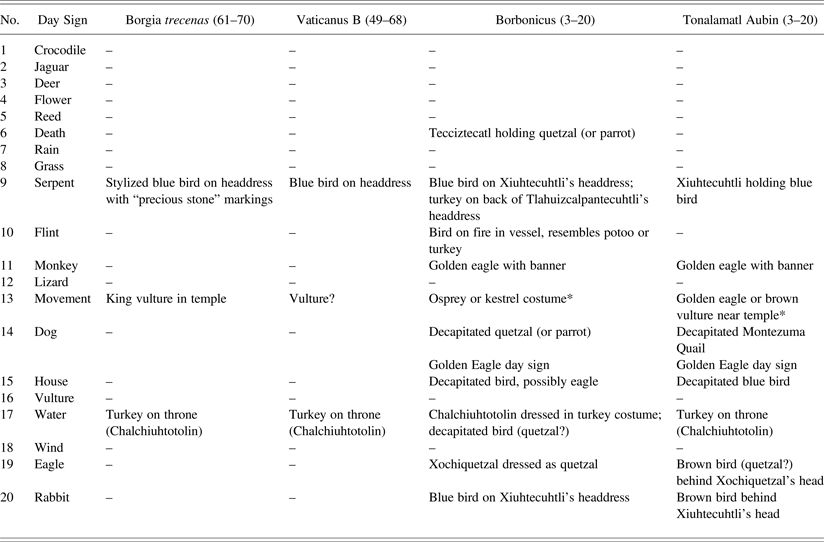
The codices under consideration for this study represent both pre- and post-conquest periods. Thus, not only are artistic variations in the depictions of birds assessed, but I also note variations that may reflect regional familiarity with certain birds. Since several codices depict similar symbolism in related almanacs, such as the volatiles and their associated Day Lords (Figure 2, Tables 1 and 2), day-sign names, the tonalpohualli (the 260-day sacred year), and the thirteen-day periods known as trecenas (Table 3), the same species of birds should be expected to be represented in each instance (Boone Reference Boone, Joe and Lozano2007:95–107). When obvious differences occur that cannot be explained by artistic variation alone, the alteration may indicate regional familiarity with a particular species of bird, or possibly even regional emphasis placed on one species over another.
Two trecena series, each representing a period of 13 days corresponding to 13 volatiles (12 birds and one butterfly). (a) Codex Borbonicus 20, the twentieth and last trecena of the 260-day tonalpohualli calendar; (b) Codex Borgia 71, the only surviving example of a trecena including the 13 volatiles in a Borgia Group codex.
Summary of identifications made in this study of the 13 volatiles in the Codex Borgia 71, Codex Borbonicus 3–20, Codex Tonalamatl Aubin 3–20, and the Codex Tudela 98v–99r
The 13 volatiles and their respective Day Lords. Excludes Codex Tudela (after Boone Reference Boone, Joe and Lozano2007:Table 4)
Summary of tentative identifications of birds in the trecena series in this study. All deity identifications from Boone (Reference Boone, Joe and Lozano2007:47–48)
*Seler (Reference Seler, Comparato, Thompson and Richardson1996:247–248) identifies as vulture.
THE MAJOR BIRD SPECIES
Several groups of birds are especially prevalent in the codices. These include those used for Day Signs, specifically the eagle and vulture, as well as symbolically charged birds used for festivals and adornment, such as the quetzal, turkey, parrot, and macaw. Table 4 summarizes my identifications for these major groups and their prevalence within each of the seven central Mexican and Borgia Group codices. Water birds, including ducks, herons, and seabirds, are not addressed in this analysis since they appear infrequently in the codices under consideration and were not assessed in detail in Seler's (Reference Seler, Comparato, Thompson and Richardson1996) original analysis.
Examples of the major bird taxa in the Borgia and Aztec codices by page number. Excludes Eagle and Vulture Day Signs
The following sections are organized in the same arrangement that Seler used to structure his original identifications, as they appear in the fifth volume of his collected works published in 1996. For each bird type covered I provide a description of the species (sometimes multiple) of the category in question, including relevant habitat and behavioral information, followed by an account of where I, or Seler (Reference Seler, Comparato, Thompson and Richardson1996), have identified the particular bird in each of the codices under examination and what its appearance may suggest in different contexts. This examination helps to provide a preliminary understanding of the significance of the most prevalent bird species in the Mexican codices.
The Macaw
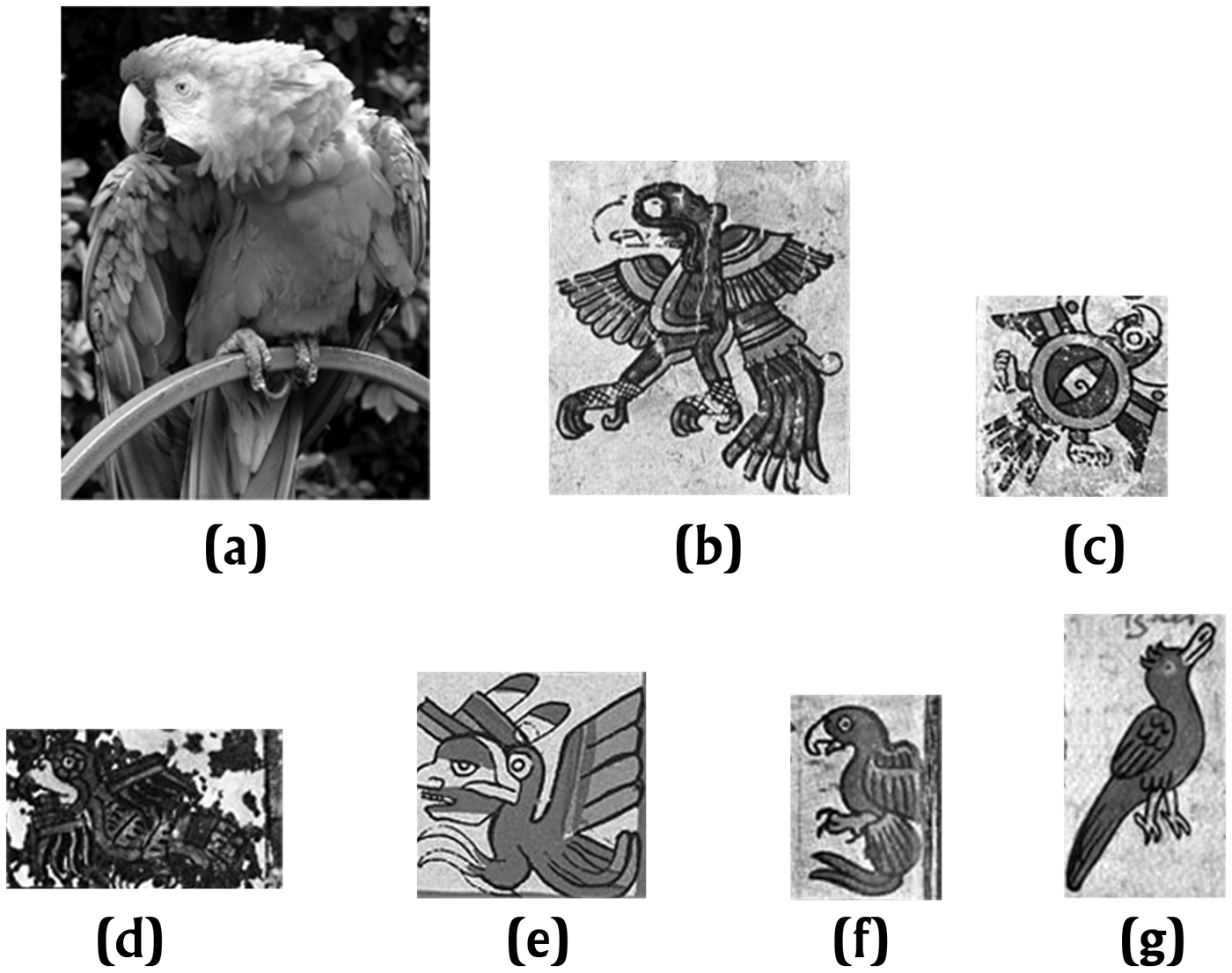
Of the two species of macaws found in Mexico, the scarlet macaw (Ara macao) is the most distinguishable, and likely the most prevalent, in the codices (Edwards Reference Edwards1998:56) (Figure 3). The scarlet macaw is a brilliant red bird with blue feathers on its wings and tail that contrast sharply with yellow coverlet feathers. It has a white patch of exposed skin around the eyes, and a pale gray beak (Howell and Webb Reference Howell and Webb1995:337). Today, the bird is naturally found in the tropical lowlands of southern Mexico and along the Gulf and Pacific coasts, although there is zooarchaeological evidence that they were traded and bred in captivity as far north as New Mexico (Creel and McKusick Reference Creel and McKusick1994; Somerville et al. Reference Somerville, Nelson and Knudson2010), and at least 13 skeletons were recovered from the offering caches within the Temple of Ehecatl at Tenochtitlan (Álvarez and Ocaña Reference Álvarez and Ocaña1999:50). Sahagún (Reference Sahagún and Temprano2001:895) noted they had been “domesticated,” and were among the many valued species found in the totocalli (“House of the Birds”) at Tenochtitlan (Sahagún Reference Sahagún and Temprano2001:745), an aviary maintained for Moctezuma that contained some three hundred different bird types, according to Hernán Cortés (Reference Cortés2011:86, 91).
The scarlet macaw (Ara macao): (a) scarlet macaw. Photo by Adrian Pingstone, released to the Creative Commons public domain; (b) Codex Borgia 71; (c) Codex Fejérváry-Mayer 1; (d) Codex Vaticanus B 16; (e) Codex Tonalamatl Aubin 14; (f) Codex Borbonicus 13; (g) Codex Tudela 99r.
Of the seven codices reviewed in this study, only the Codex Laud lacks any representation of the macaw (Table 4). In the other codices, the characteristic bright red feathers are a consistent feature in every example, and the wings and tail feathers almost always include blue and yellow bands, an accurate portrayal of the bird. The macaw's tail feathers are usually drawn noticeably longer than other birds, with the notable exception of the quetzal. In the Borgia codices, the macaw is often illustrated with a white eye-ring and a white beak (Borgia 2, 6, 27, 52; Vaticanus B 16). Both Aztec and Borgia codices also stress the ruffled nature of the bird's head-feathers, with the Borgia codices often representing these feathers as a tuft on the lower posterior side of the head (Figure 3b). This trait is not found among the birds in the wild, and appears to be an artistic attribute, although it could perhaps reflect preening behavior (Pitter and Christiansen Reference Pitter and Christiansen1997:136). The artist of the Codex Borgia must have noted the bird's darkly scaled legs and claws, and so often illustrated the legs with a unique cross-hatch pattern (Borgia 23, 71) (Figure 3b).
The macaw appears in a variety of scenes throughout the codices. Most frequently it is represented as the eleventh of the 13 volatiles, although the Codex Tudela (99r) mistakenly reverses it with the quetzal as position twelve. According to the Codex Tudela (99r), the bird is identified by the Nahuatl name chiconcuetzali, which Kendall (Reference Kendall1992:125) interprets as “bird of seven colors,” a rare name for the species. The strangely shaped bill of the Codex Tudela bird (Figure 3g) stands in stark contrast to the distinctly curved beak of the parrot beside it, leading me to consider whether the artist may have actually had the roseate spoonbill (Platalea ajaja) in mind (Peterson and Chalif Reference Peterson and Chalif1973:18). Both birds were valued for their red plumage (see 68v, 261v, 266r in Sahagún [Reference Sahagún1997:96, 111, 271]). Intriguingly, of the 18 yearly festivals Sahagún describes in the Primeros Memoriales, the festival and month of Quecholli is named after the roseate spoonbill (Sahagún Reference Sahagún1997:64, 252r). The relationship of the bird to the festival is apparently drawn from the fact that during this month arrows were made using roseate spoonbill feathers (Milbrath Reference Milbrath2013). Since the volatiles each represent a day, perhaps the artist was conflating the month of Quecholli with the volatile day.
According to Seler (Reference Seler1963:Plate 6, Reference Seler, Comparato, Thompson and Richardson1996:222), the scarlet macaw's brilliant plumage contributed to its association with fire and the sun. The scarlet macaw is also associated with the southern cardinal direction in the Codex Borgia (52), although this is not the case in the other parallel directional almanacs of the Borgia Group codices, where it is replaced by a jaguar in the Codex Vaticanus B (18), and a parrot in Codex Fejérváry-Mayer (1). In the case of the latter, the macaw is shifted to the northwest intercardinal direction, and the bird's body has a cartouche with the “yearbearer” symbol, Knife (Figure 3c). The specific reasons behind these variations in directional association remain unclear (Sánchez Vázquez Reference Sánchez Vázquez, Ahuatzin and Padilla2009:178); however, I am of the belief that its association with the south may have to do with the location of its natural habitat in respect to the codices' place of origin, much like the jaguar and parrot, as well as its connection with the underworld (described below), a place that is often associated with the south in Mesoamerican lore (Miller Reference Miller and Robertson1974).
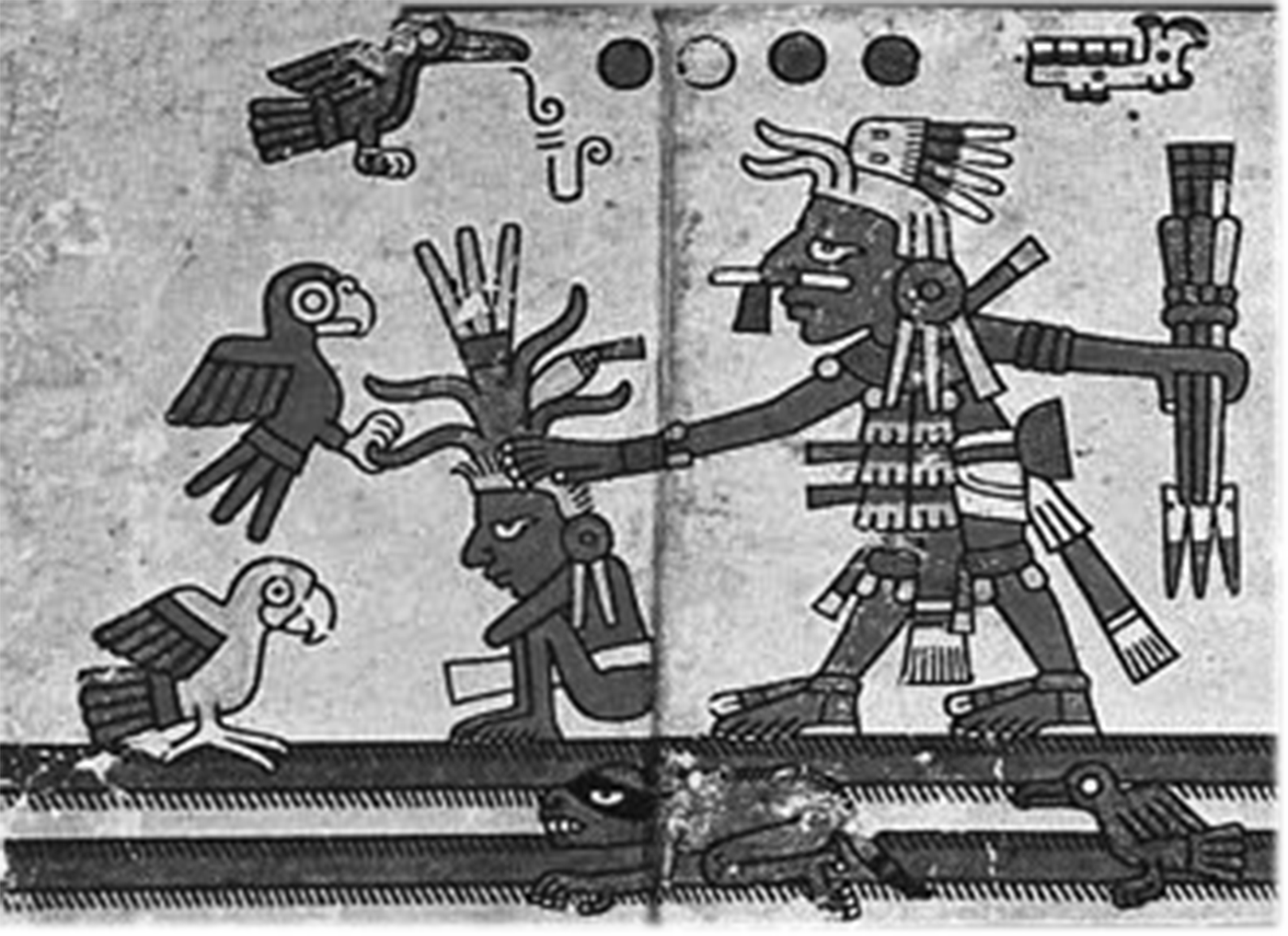
Outside of its role as a volatile and companion to the eleventh Day Lord, Chalmecatl or Mictlantecuhtli (Boone Reference Boone, Joe and Lozano2007:46), the macaw is not common in Aztec codices. On the other hand, the Codex Borgia makes extensive use of the bird, and at least six depictions can be identified (Table 4). Its role as a “fire” bird may come into play on Codex Borgia 27, where the rain god Tlaloc is dressed in the guise of a macaw as he stands in a field of maize that is being rapidly devoured by several rodent-like creatures; this scene has been interpreted as an unusually dry year, perhaps reflected by the macaw symbolism (Woolley and Milbrath Reference Woolley and Milbrath2011:43). The macaw takes on a similar role when consuming maize on Codex Fejérváry-Mayer 34 where, alongside a parrot, two black birds, and a raccoon, it represents a poor year for crops (Boone Reference Boone, Joe and Lozano2007:145–147) (Figure 4). On Codex Vaticanus B 16, a macaw with an unusual gray-blue body and red head resides within a “jeweled” temple (Figure 3d) that faces a second temple decorated with skulls containing a horned owl on the opposite page. It is possible this symbolism denotes a night-and-day juxtaposition, for Seler (Reference Seler, Comparato, Thompson and Richardson1996:222, 225) notes the Maya often associated the macaw with the kin, or “day,” glyph, and owls are nocturnal creatures. An analogous scene appears on the two preceding pages, Codex Vaticanus B 13–14, but here the macaw identification is more uncertain, for although the eyes and red belly are similar, the head and body are blue and the wings are decorated with flints. This latter trait is usually characteristic of eagles and other birds of prey, as will be discussed shortly. In the Aztec codices, the macaw's association with the underworld gods Chalmecatl or Mictlantecuhtli in the Day Lord sequence could possibly relate to its association with fire, dryness, and death.
Scarlet macaw (middle left) and yellow-headed parrot (lower left) attack an anthropomorphisized maize plant during a season of poor crops depicted on Codex Fejérváry-Mayer 34.
The military macaw (Ara militaris) is a green version of its red cousin (Edwards Reference Edwards1998:56). Both male and female military macaws resemble the scarlet macaw, but they have a red patch on the forehead above a dark gray or black beak, and have a single blue band on the wings, rather than blue and yellow wing feathers. Today they inhabit the semi-deciduous forests and foothills near the Pacific coast (Howell and Webb Reference Howell and Webb1995:337). Their long, green tail feathers are distinctive, but this trait is more often associated with quetzals in the codices. It is possible some of the parrots, described in the next section, could actually be military macaws. The amount of naturalistic detail afforded to representations of the scarlet macaw, however, is never replicated in the case of the military macaw.
The Parrot
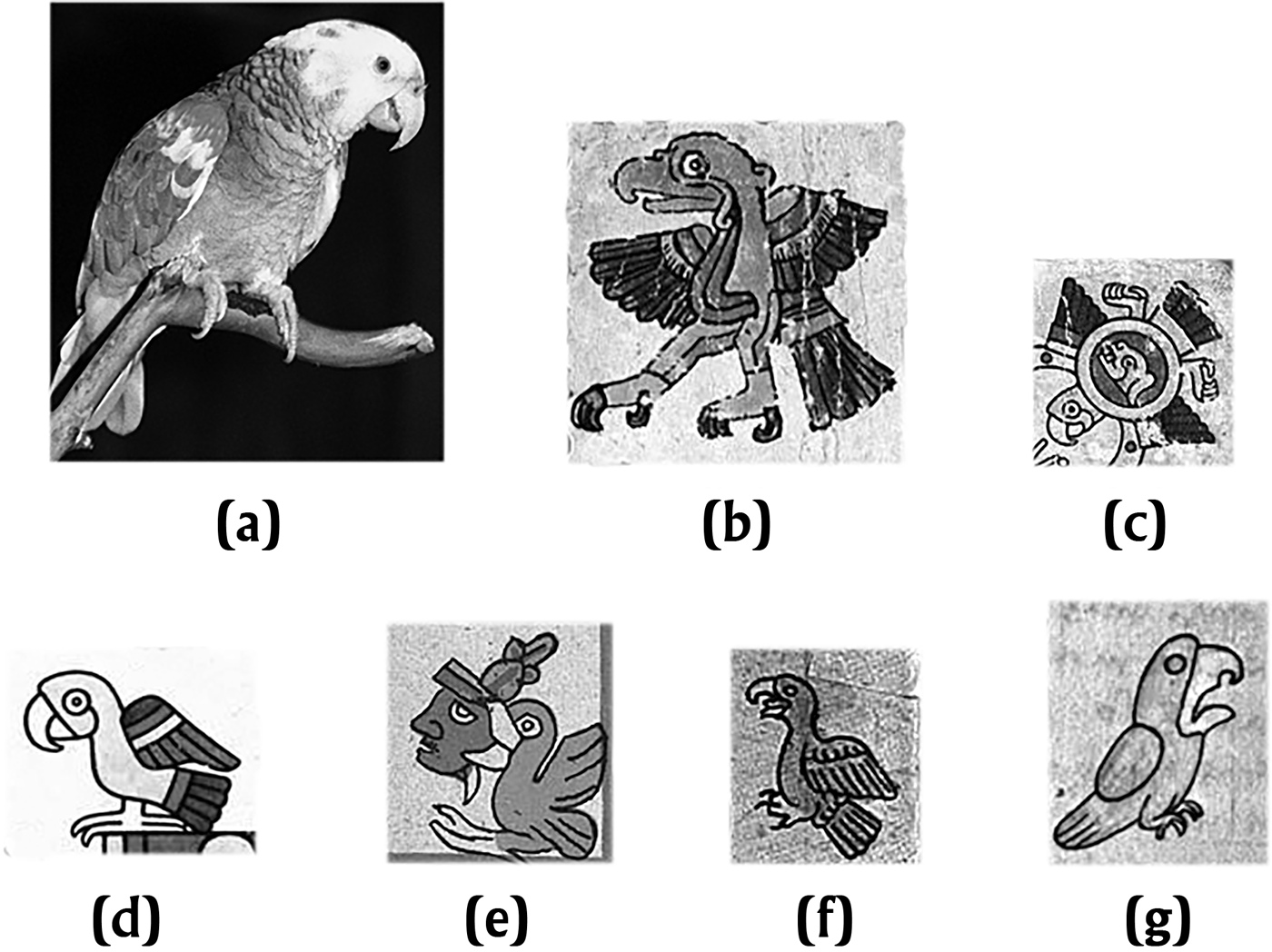
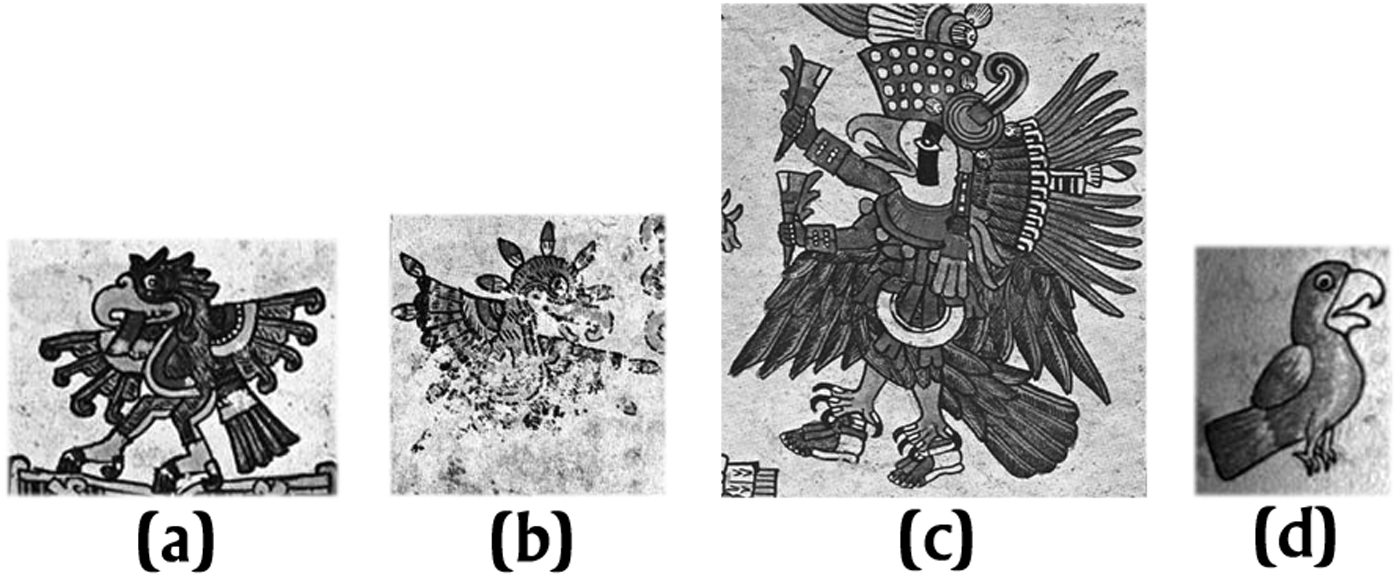
Although there are several parrot species in Mexico today (Edwards Reference Edwards1998:56–59), the codices rarely depict parrots in enough detail to distinguish individual species (Figure 5). Most parrots in Mexico inhabit the semi-deciduous lowland forests of southern Mexico and the Yucatan (Howell and Webb Reference Howell and Webb1995:340–345). They are predominantly green with thick, curved beaks, although many species are characterized by bands of variable hues on the head, wing, and tail feathers. Although they are commonly captured or bred in captivity to satisfy demands of the pet trade today, they appear infrequently in the zooarchaeological record (Álvarez and Ocaña Reference Álvarez and Ocaña1999:50–51). Conquistador and chronicler Bernal Díaz del Castillo (Reference Díaz del Castillo2011:152) recorded a number of parrots in Moctezuma's aviary, marveling that there were so many he could not recall all of their names.
The parrot: (a) the yellow-headed parrot (Amazona oratrix). Photo by David Paul Ohmer, released under the Creative Commons Attribution 2.0 Generic license; (b) Codex Borgia 71; (c) Codex Fejérváry-Mayer 1; (d) Codex Laud 10; (e) Codex Tonalamatl Aubin 3; (f) Codex Borbonicus 7; (g) Codex Tudela 99r.
Parrots seem to be rare in the codices; however, their feathers may be depicted on the garments and plumed accoutrement of individuals, as described below. When parrots do appear, it is usually in their role as the thirteenth volatile in the four codices that contain images of the volatile sequence. The Aztec codices associate the bird with the aged earth goddess, Ilamatecuhtli, the thirteenth Day Lord (Boone Reference Boone, Joe and Lozano2007:46). A unique trait among the parrots in the volatile sequence is that they are consistently depicted in a bright yellow hue, which is a color most prevalent on the yellow-headed parrot (Amazona oratrix). In this sequence, the Codex Tudela (99r) refers to the parrot as a toznene, a bird that Sahagún (Reference Sahagún, Dibble and Anderson1963:22) identifies as a “young” yellow-headed parrot in the Florentine Codex. He describes the juvenile bird as a greener version of the yellow adult, the toztli. This latter observation has also been noted by modern ornithologists (Howell and Webb Reference Howell and Webb1995:344).
In addition to their role in the volatile series, the yellow-headed parrot may be represented in the Codex Fejérváry-Mayer 1 (Figure 5c), where the bird located at the southeast ordinal direction has the yellow head and red and green wing and tail feathers typical of the yellow-headed parrot. There are a number of parrots with yellow markings in Mexico, usually around the base of the wings or above the beak, but none has the extensive yellow markings characteristic of the yellow-headed species, specifically the oratrix subspecies most prevalent in Mexico. Today, the yellow-headed parrot's natural range is restricted to the gallery forests and savannas near the Gulf of Mexico and Pacific coasts (Howell and Webb Reference Howell and Webb1995:344). Two subspecies also exist with variable yellow markings, the belizensis and hondurensis, which are found along the Caribbean coast of Belize and Honduras, respectively.
Whereas the macaw is common in Borgia Group codices, parrots appear less frequently; like the macaw, the parrot does not appear outside of the volatile sequence in the Aztec codices (Table 4). There is evidence the bird may have held similar symbolic associations to those of the macaw, for it often appears in similar contexts. As has been mentioned, Codex Fejérváry-Mayer 1 includes a parrot on the southeast intercardinal direction, but there is also a parrot perched on the southern tree, a position held by the scarlet macaw in Codex Borgia 52 (Sánchez Vázquez Reference Sánchez Vázquez, Ahuatzin and Padilla2009:173). As previously noted, Codex Fejérváry-Mayer 34, depicting a poor maize harvest, includes a parrot alongside a macaw (Figure 4). A parrot-like bird also perches at the foot of Centeotl's agricultural throne in the half-trecena depicted on Codex Laud 10 (Boone Reference Boone, Joe and Lozano2007:133–134) (Figure 5d). Other half-trecenas in the same almanac show birds that may be symbolically related with the enthroned deity they are associated with, such as the roseate spoonbill alongside the Rain God and the hummingbird next to the Sun God. The association of the Maize God with the macaw and the parrot is a negative augur for the maize crop, for they are both associated with Day Lords representing the underworld (Table 2). In the Day Lord sequence, the macaw is linked with Mictlantecuhtli, the death god, while the parrot is associated with Ilamatecuhtli (also identified as Cihuacoatl), a mother goddess with a death aspect in the Aztec codices (Milbrath Reference Milbrath1995:64–67, Fig. 8). Parrots can be frequent pests to corn crops, and undoubtedly it was an unwelcome sight if encountered in the fields.
As mentioned, although the parrot itself is often missing, it is quite possible the bird's feathers are illustrated instead (Figure 6). The Primeros Memoriales, which includes an extensive list of garments and accoutrements worn by specific deities, as well as those that were to be worn by particular soldierly ranks of the Aztec military and nobility, refers to yellow parrot feathers on multiple occasions, as on Folios 57r, 68r, and 261r (Sahagún Reference Sahagún1997). Many of the tunics illustrated in yellow, as well as the fans and shields, are specifically identified as having been made of parrot feathers. Outfits nearly identical to these (for example, the coyote costume seen in Sahagún [Reference Sahagún1997:73r]) can also be found in the Codex Mendoza (21v, 65r), and can be assumed to have been made from the same feathers (Anawalt Reference Anawalt, Berdan and Anawalt1997:122). Assuming that the descriptions and accompanying illustrations Sahagún presents for the feathered uniforms are comparable to those seen in other codices lacking descriptions, yellow-headed parrot regalia may be represented in a number of instances, such as on the hummingbird guise of Huitzilopoctli (Sahagún Reference Sahagún1997:93–94, 261r) (Figure 6b).
Some examples of the impressive variety of plumage found in the codices: (a) cotinga skins and feathers of variable color, part of the tribute listed on Codex Mendoza 47r; (b) Huitzilopoctli's hummingbird disguise consisting in part of yellow-headed parrot and quetzal plumes, Codex Tudela 25r; (c) Cihuacoatl's eagle feather cape and shield, Codex Borbonicus 36; (d) Xochiquetzal's mantle of macaw, parrot, and quetzal feathers, Codex Borbonicus 19; (e) Xipe Totec in the guise of the Red Tezcatlipoca, with quetzal feather headdress and back-device, Codex Borbonicus 14; (f) Black Tezcatlipoca with his signature quetzal feather back-device, Codex Borgia 21; (g-h) quetzal feather headdresses with distinctive frontal curl, Codex Vaticanus B 41 and Codex Fejérváry-Mayer 10.
The Quetzal
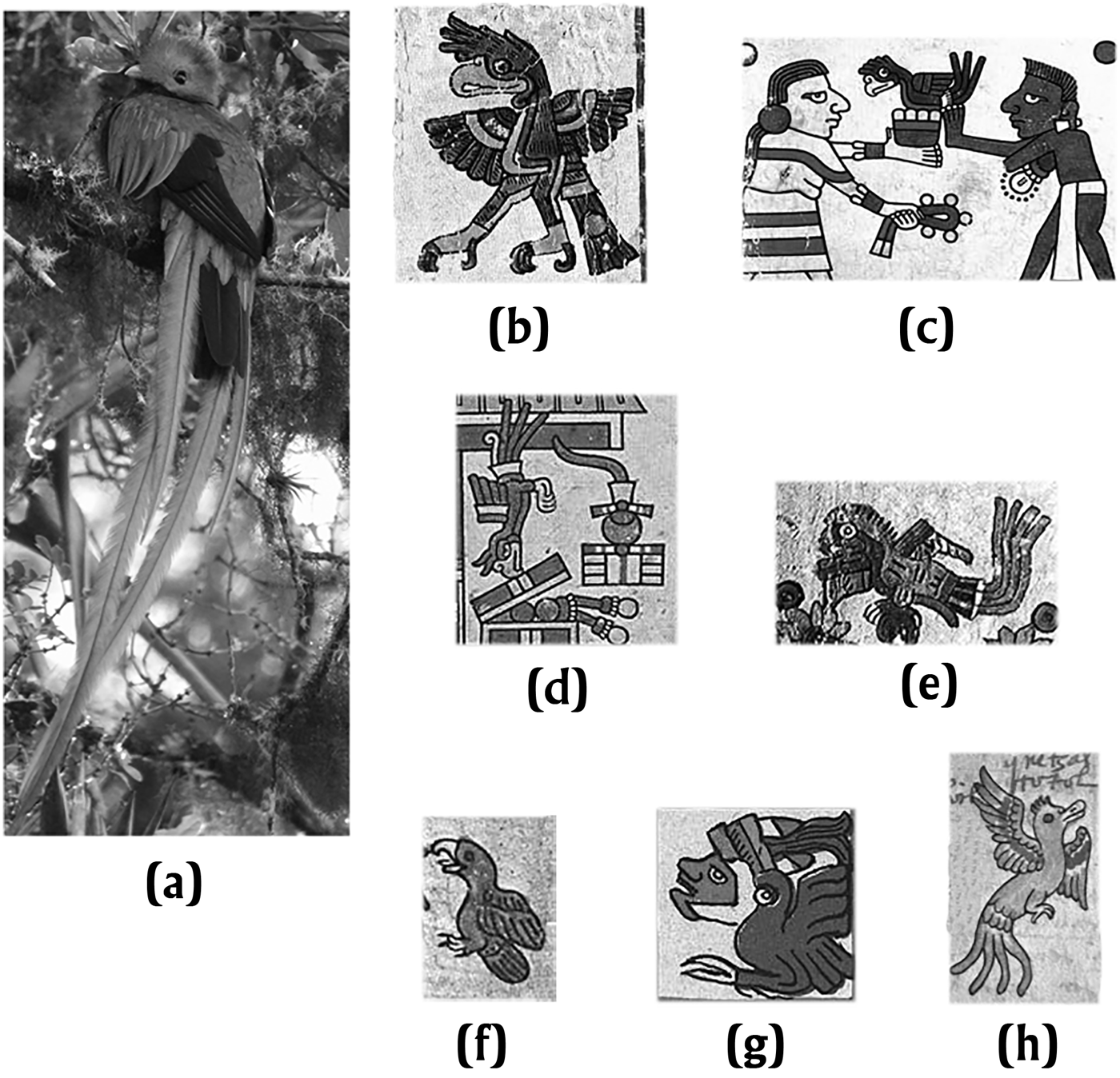
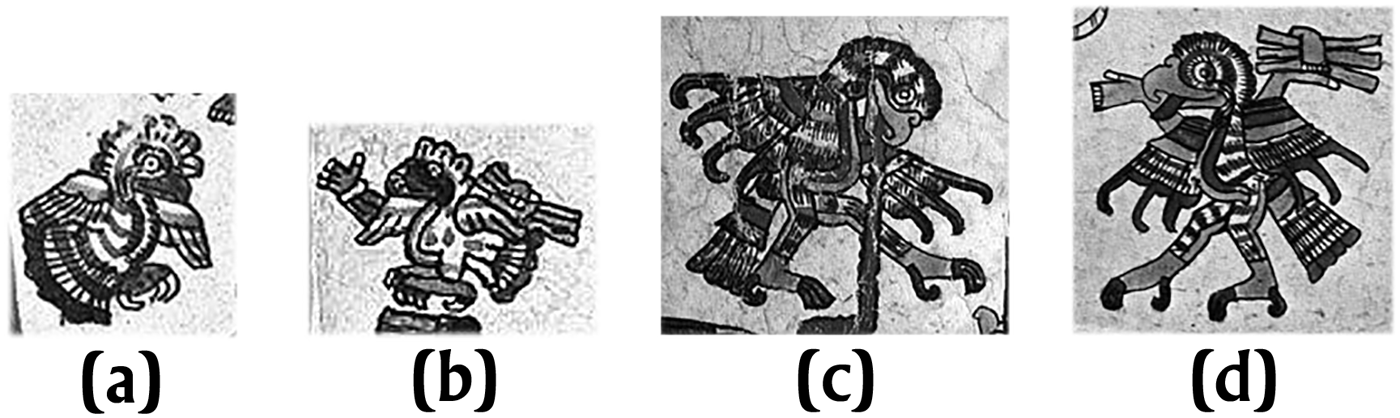
The quetzal is one of the most frequently depicted birds in the codices, second only to the eagle. The quetzal is also one of the most easily recognizable birds, usually identifiable by its diagnostic feather crest or tuft uniformly drawn above the beak and eyes, along with an unusually long tail (Figure 7). This green crest, combined with distinctive red markings around the shoulders, chest, and base of the tail, distinguishes the male resplendent quetzal (Pharomachrus mocinno), a species whose range today is confined to the highland cloud forests of southern Mexico (Howell and Webb Reference Howell and Webb1995:436). Occasionally artistic liberties are taken in its representation, for the Borgia Group codices often illustrate a red ring around the eyes and conspicuous white tufts on the top of the crest (Borgia 57; Fejérváry-Mayer 39; Vaticanus B 34). The colors range from a dark-green or blue in the Borgia Group to a tan or brown in most Aztec codices examined here. The Codex Tudela 99r (Figure 7h) has a unique depiction of this bird, illustrating it with a rainbow range of hues and a red crest. It is not clear whether females of the species were ever depicted, which lack the red markings, green crest, and elongated tail feathers of the males.
The quetzal: (a) the resplendent quetzal (Pharomachrus mocinno). Photo by Frank Vassen, released under the Creative Commons Attribution 2.0 Generic license; (b) Codex Borgia 71; (c) quetzal signifying a woman's worth in a marriage almanac, Codex Laud 38; (d) quetzal among other sacrificial items, Codex Fejérváry-Mayer 30; (e) Codex Vaticanus B 17; (f) Codex Borbonicus 10; (g) Codex Tonalamatl Aubin 3; (h) Codex Tudela 99r.
The Spanish chroniclers tell us that the plumage of this bird, particularly the long tail feathers, was used in the costumes of priests and nobility (Benson Reference Benson1997:75–76; Sahagún Reference Sahagún and Temprano2001:891–892; Seler Reference Seler, Comparato, Thompson and Richardson1996:225, 228). Benson (Reference Benson1997:75) notes that the penalty for killing one of these sacred birds during pre-Columbian times was death. Nevertheless, in an analysis of the Aztec tribute tables from five provinces listed in the Codex Mendoza and the Matrícula de Tributos, Peterson and Peterson (Reference Peterson and Peterson1992) have calculated that the average annual allotment of tail feathers required as tribute would have been on the order of 24,800–124,000, the equivalent of 6,200–31,000 birds. This staggering number may have had a permanent and detrimental effect on quetzal populations if the birds were killed as opposed to having been captured, plucked, and released to grow new feathers.
In the codices, the quetzal appears in a number of recurring scenes: “descending” toward an offering bowl as a sacrifice (Borgia 3; Fejérváry-Mayer 30); carried on the packs of travelers, often deities (Fejérváry-Mayer 31–32; Laud 7); worn as a mask or headdress of deities associated with the bird, particularly Xochiquetzal (Borgia 9; Vaticanus B 42); held in the arms of important individuals, especially women in the marriage almanacs, to signify their worth (Borgia 59; Laud 34, 38; see also Boone Reference Boone, Joe and Lozano2007:140) (see Figure 6c). It is also the most consistently portrayed directional symbol in the almanacs, perched on the eastern tree (Borgia 49; Fejérváry-Mayer 1; Vaticanus B 17), a direction associated with the rejuvenation of life and the rising sun (Sánchez Vázquez Reference Sánchez Vázquez, Ahuatzin and Padilla2009:149). On Codex Borgia 53, the bird also sits atop a thriving maize plant representing the central direction, which unites the underworld with the celestial heavens (Sánchez Vázquez Reference Sánchez Vázquez, Ahuatzin and Padilla2009:170).
The quetzal often holds the position of the twelfth volatile accompanied by the Day Lord Tlahuizcalpantecuhtli, the lord of the dawn and the rising sun, which seems appropriate in light of the quetzal's connections with the east, the sun, and the rebirth of new life. The Codex Tonalamatl Aubin depicts it as a generic brown bird (Figure 7g), lacking any particularly distinguishable features, and raising the question as to whether the artist of the codex had ever seen a quetzal. The Codex Tudela (99r), which mistakenly places it in the eleventh position, identifies the bird as a quetzal tototl (Tudela de la Orden Reference Tudela de la Orden1980:181–184), a term used by Sahagún (Reference Sahagún, Dibble and Anderson1963:19) in reference to the resplendent quetzal: “This bird is crested; of quetzal spines, of quetzal thread feathers is its crest, very resplendent….” The volatiles are, in part, symbolic representations of the Day Lords who usually accompany them in the 260-day tonalpohualli sequence, with each of these deities representing a particular day in the sequence (Boone Reference Boone, Joe and Lozano2007:Table 4). This suggests that the Codex Tudela would also change the order of the Day Lords, but these gods do not appear with the volatiles in this codex, and there is a sequence of the first 13 days of the tonalpohualli in the proper order on the same pages.
Quetzal feathers (quetzalli) (Sahagún Reference Sahagún and Temprano2001:892), like yellow-headed parrot feathers, are probably depicted more often than the actual birds throughout the codices (Figure 6). Green plumage in the Primeros Memoriales and tribute books, particularly the Matrícula de Tributos and Codex Mendoza, list most of the green feathers as belonging to quetzals, and so it can be assumed the majority of green feathers depicted in the codices reviewed in this study belong to quetzals as well. Often, the Codex Mendoza substitutes the term plumas ricas (“rich plumage”) instead of specifically noting quetzal feathers (for example, 30r and 37r), yet another indication of how extremely valuable these feathers were in ancient Mexican society. Quetzal plumes decorate countless deities and important individuals depicted in every codex, and are usually distinguished as a cluster of long, trailing plumes with one or two curling feathers in the front (Figures 6g and 6h).
Blue Birds and Blue “Quetzal” Ornaments
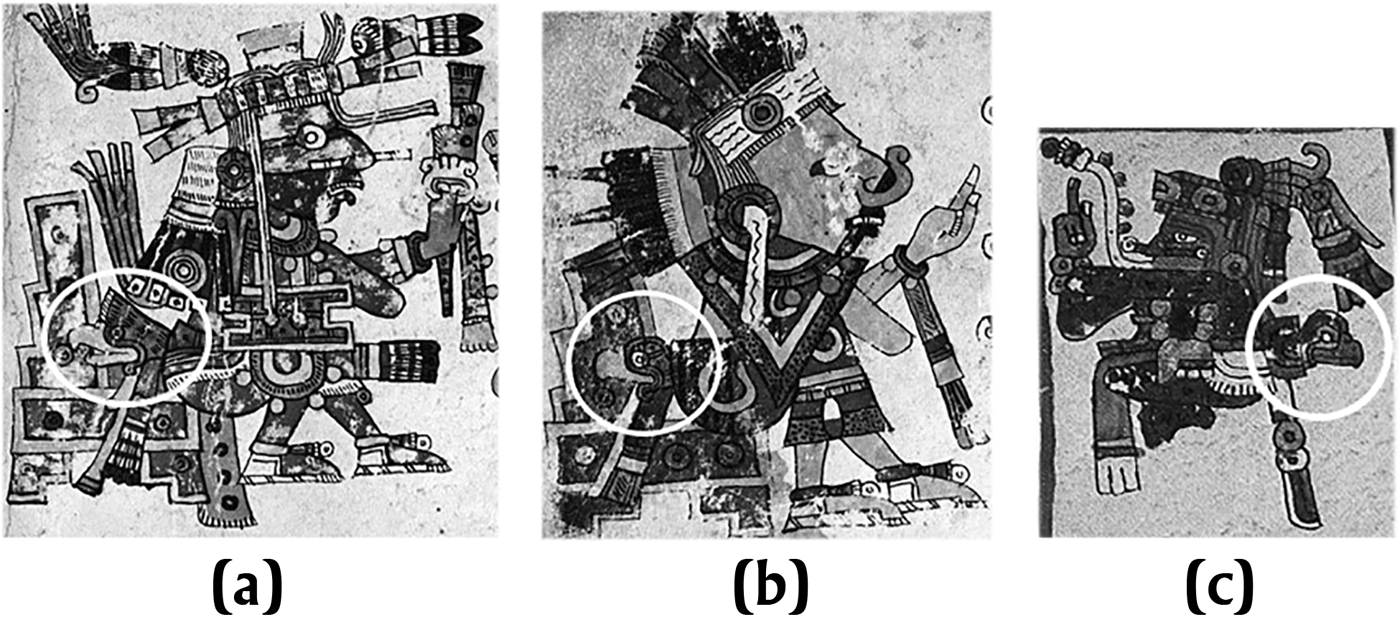
Blue birds, including blue birds with quetzal traits, appear frequently in the codices as adornments on the waistbands and headdresses of particular deities. In many Mesoamerican communities today, the colors “blue” and “green” are often not differentiated (MacLaury Reference MacLaury1997), and it may be that the “blue” we see in the codices could also imply green. The Codex Borgia exhibits many blue avian costuming elements, and blue birds as headdress elements occur frequently in all of the Mexican codices. More rarely, a bird head is worn as part of a helmet, as in the crested blue quetzal helmet worn by Xochiquetzal (Borgia 9). Occasionally the birds worn on the backs of waistbands sport a crest, analogous to that of the quetzal in the volatile series on Codex Borgia 71 (Figures 7b and 8a; Borgia 61, 67, 69); otherwise, the waistband birds are crestless and are often characterized by the “precious stone” circle-and-double-dash markings symbolic of turquoise mosaic (Borgia 66, 68; see Aguilera Reference Aguilera1997:13) (Figure 8b). The birds worn on the anterior side of headdresses are often shown full-bodied, with head down and one protruding wing, and are occasionally decorated with turquoise markings (Borbonicus 9; Borgia 13, 69; Fejérváry-Mayer 1). Variations in the “headdress” and “waistband” birds suggest they may designate at least three different species.
Blue birds as ornamentation on the waistbands of deities: (a) crested, quetzal-like bird, Codex Borgia 61; (b) crestless bird with “precious stone” design, Codex Borgia 68; (c) crestless bird, Codex Vaticanus B 90.
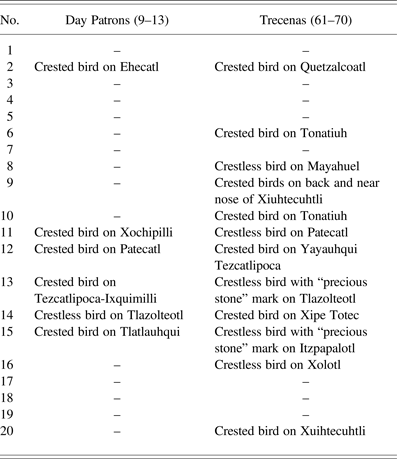
The blue waistband birds appear most frequently in the Borgia Group, particularly the Codex Borgia. Table 5 lists the birds and their respective Day Patrons on Borgia 9–13 and those in the trecena almanacs on pages 61–70. The crested blue birds rarely appear outside of these two forms of almanacs. There is no apparent pattern in terms of the specific gods who wear the non-crested blue birds in the Codex Borgia, for the bird appears on many deities; nonetheless, the distribution in Table 5 suggests that the presence of the crested bird may be confined to male deities in the calendar almanacs. The only exceptions to this pattern are Xolotl (Borgia 65), who is portrayed as a dog, and Patecatl (Borgia 70), who is dressed in the quechquemitl and skirt of a woman (Anawalt Reference Anawalt1981:5–37), making his gender in this context ambiguous, as has been noted among other lunar deities (Milbrath Reference Milbrath1995). If a gender-based difference does exist between those who wear the crested bird and those who do not, it could be an intentional parallel to mimic the sexual dimorphism observed in many crested bird species. If the bird in question is a quetzal, the male deities may be wearing the male birds, while the females are wearing the crestless female bird. The two birds, crested and crestless, could possibly also be different species, and may even be two species of trogon, the bird family that includes the quetzal (Edwards Reference Edwards1998:83). The relatively large size of the bird may seem incompatible with the quetzal identification, but this appears to be a costuming convention rather than a statement about the bird's size.
Crested and crestless blue birds worn on the waistbands of patron deities in the Codex Borgia trecena series
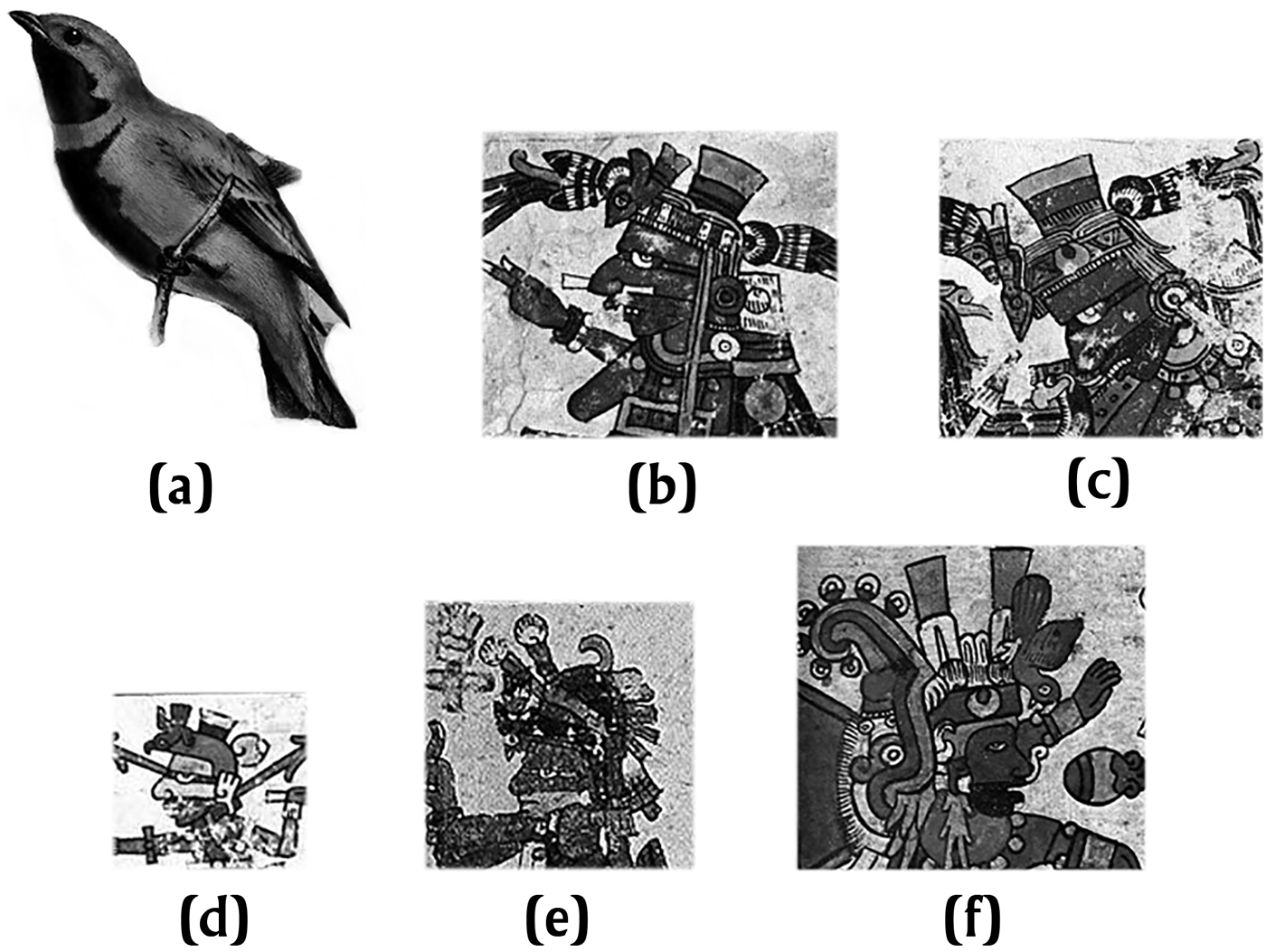
The blue bird used as a headdress ornament is usually depicted considerably smaller than the waistband birds, and appears almost exclusively on the headdress of Xiuhtecuhtli, the fire god (Taube and Bade Reference Taube and Bade1991:16) (Figure 9). Xiuhtecuhtli's name can be translated as either “Turquoise Lord” or “Year Lord,” and he represents a deity of dualities (Fernandez Reference Fernandez1992:106). There are a few species in Mexico that could represent the blue bird associated with Xiuhtechuhtli. The lovely cotinga (Cotinga amabilis), a small species with striking turquoise plumage and a red or purple underbelly, is one possibility (Milbrath Reference Milbrath2013; Taube and Bade Reference Taube and Bade1991:17). The red markings that occasionally appear in the Borgia codices on the bird's underbelly, in addition to its large beak, could also identify it as a member of the bunting and grosbeak family (Edwards Reference Edwards1998:172–174), possibly the rose-bellied bunting (Passerina rositae). Either of these possibilities could relate to Sahagún's description of the xuihtototl, a bird with bright blue plumage and purple markings on its chest (Corona Martínez Reference Corona Martínez2002:Table 2; Sahagún Reference Sahagún and Temprano2001:893). In the Aztec codices, Xiuhtecuhtli is associated with the first volatile, usually identified as a “blue hummingbird” (Boone Reference Boone, Joe and Lozano2007:46; Kendall Reference Kendall1992:102; Seler Reference Seler, Comparato, Thompson and Richardson1996:231). It is possible that the small ornamental bird worn by this deity is a hummingbird; however, as noted in the next section, there is no such thing as a turquoise hummingbird in Mesoamerica.
Xuihtecuhtli's blue bird headdress, possibly depicting the lovely cotinga (Cotinga amabilis): (a) the cotinga (after Wolf Reference Wolf1856:Plate 123); (b) Codex Borgia 13; (c) Codex Borgia 69; (d) Codex Fejérváry-Mayer 1; (e) Codex Vaticanus B 90; (f) Codex Borbonicus 20.
According to Mohar Betancourt's (Reference Mohar Betancourt1987:303) analysis of the Matrícula de Tributos, turquoise feathers requested in the tribute documents come from the xuihtototl, and Sahagún (Reference Sahagún and Temprano2001:893–894) emphasizes that those who hunt this bird take precautions when touching its feathers for fear of damaging their luster. Although the name is unspecified, the illustrations for 160 bird skins recorded as tribute from several towns on the Codex Mendoza 47r (see Figure 6a) depict a blue bird with purple underside that closely resembles a cotinga, suggesting that these birds were a valuable commodity. Sahagún (Reference Sahagún1997:103, 224, 261) notes that the costumes of several deities and military garments that boast blue plumage are made from cotinga feathers, and so it seems likely that most blue-feathered garments worn by individuals in the pre-Columbian codices were made from cotinga feathers.
The Hummingbird
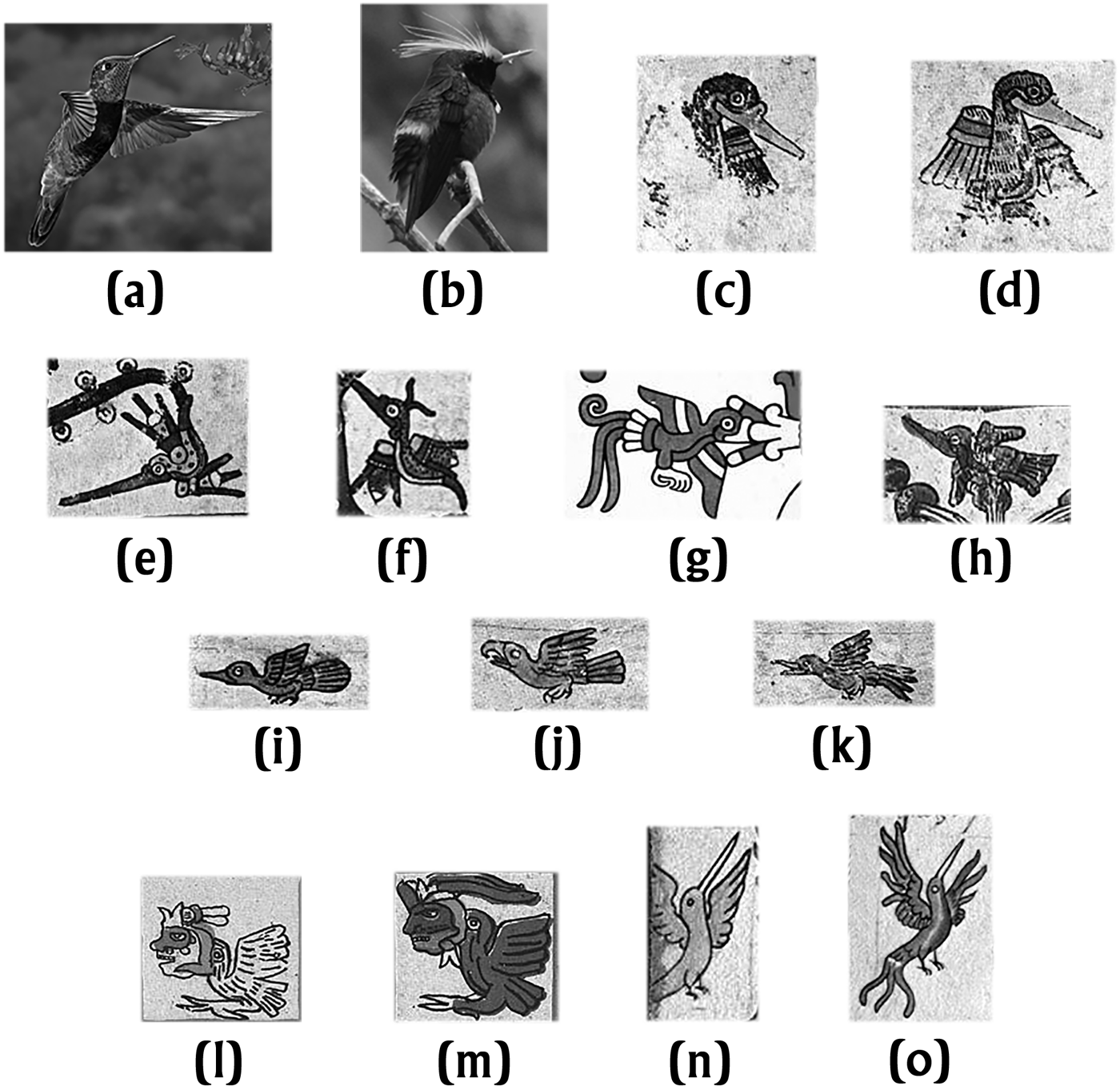
There are over 50 species of hummingbirds known in Mexico today (Peterson and Chalif Reference Peterson and Chalif1973:94), representing a wide range of different colors and traits. Hummingbirds appear in most of the codices, and are often drawn with similar diagnostic clues: long, narrow, closed beaks; small, rounded heads; and, usually, small bodies (Figure 10). In the Codex Borgia, the birds are often depicted without legs when in flight (Figure 10e and 10f).
The hummingbird: (a) the magnificent hummingbird (Eugenes fulgens). Photo courtesy of Nature's Pics Online, http://www.naturespicsonline.com; (b) a crested coquette (Lophornis sp.). Photo by Dominic Sherony, released under the Creative Commons Attribution-Share Alike 2.0 Generic license; (c) blue hummingbird volatile, Codex Borgia 71; (d) green hummingbird volatile, Codex Borgia 71; (e) Codex Borgia 36; (f) crested hummingbird, Codex Borgia 44; (g) Codex Laud 14; (h) Codex Vaticanus B 18; (i) blue hummingbird volatile, Codex Borbonicus 14; (j-k) variations of the green hummingbird volatile, Codex Borbonicus 4 and 5; (l) white hummingbird volatile, Codex Tonalamatl Aubin 3; (m) green hummingbird volatile, Codex Tonalamatl Aubin 3; (n) blue hummingbird volatile, Codex Tudela 98; (o) green hummingbird volatile, Codex Tudela 98.
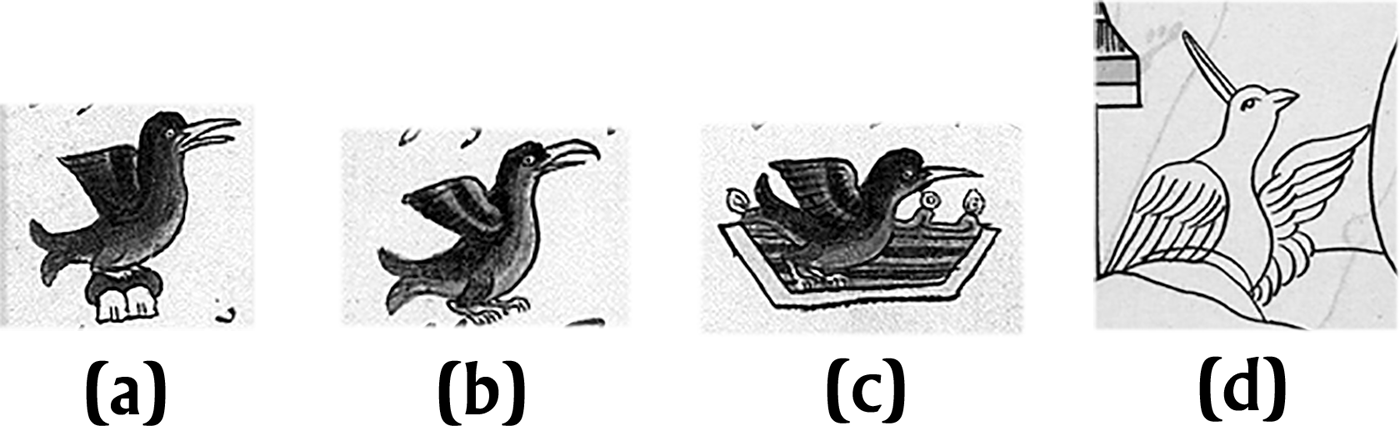
There are several examples of birds in the codices that possess these same traits, but also have crests (Figure 10f). Many scholars have identified these as hummingbirds (Boone Reference Boone, Joe and Lozano2007:116; Byland Reference Byland, Diaz and Rodgers1993:xxvi; Sánchez Vázquez Reference Sánchez Vázquez, Ahuatzin and Padilla2009:172–173; Seler Reference Seler, Comparato, Thompson and Richardson1996:233). Crested hummingbirds are exceedingly rare in Mexico today (Edwards Reference Edwards1998:73), being represented by only two species of coquettes: the black-crested coquette (Lophornis helenae) and the short-crested coquette (Lophornis brachylophus). Neither species closely resembles the crested “hummingbirds” that appear on Borgia 44 (Figure 10f) or the western tree in the Codex Fejérváry-Mayer 1. Nonetheless, the Codex Borgia 36 includes a group of 12 birds that are most likely hummingbirds, with two possessing crests. This curious detail suggests the artist had a hummingbird in mind when drawing the bird, and so was either intentionally illustrating a coquette, or was taking artistic liberties with the representation. The hummingbird appears in place names for numerous towns in ancient Mexico, as seen in the annotated post-conquest documents (Berdan and Anawalt Reference Berdan and Anawalt1997a:188–189); but in these sources the bird's appearance varies from fairly accurate (for example, Mendoza 21v, 24v, 32r) (Figure 11a–c) to virtually unrecognizable as the bird identified in the Nahuatl or Spanish gloss (for example, the Lienzo de Tlaxcala, see Chavero [Reference Chavero1964:Lamina 30]) (Figure 11d).
Hummingbird place name glyphs in post-conquest documents: (a-b) Huitzilan, Codex Mendoza 21v and 24v; (c) Huitzizilapan, Codex Mendoza 32r; (d) Huitzilapan, Lienzo de Tlaxcala (Chavero Reference Chavero1964:Lamina 30).
According to Benson (Reference Benson1997:77–78), the quick, darting movements of a hummingbird were associated with the youthful fervor of young warriors. The hummingbird was associated with the warrior and sun deity, Huitzilopochtli, whose name incorporates the Nahuatl word for “hummingbird,” huitzilin (Boone Reference Boone1989:8–9). The sharp hummingbird beak was seen as a weapon, and the birds' sudden movements were likened to attack strikes. Benson (Reference Benson1997:77) also notes that, among the Aztecs, it was believed hummingbirds were the souls of deceased warriors that would set in the west with the sun. This belief likely originated from the birds' natural behavioral trait of sleeping at night and lying dormant in the winter months, when the sun is not as strong as it moves to the southern hemisphere (Benson Reference Benson and Preuss1989:5). Since the west, much like the south, was perceived as belonging to the realm of the underworld where the sun passed throughout the night (Miller Reference Miller and Robertson1974), there appears to be a strong association between the hummingbird, the sun, and the cycle of life and death.
Hummingbirds do not seem to be consistently associated with the west in the codex directional almanacs (Sánchez Vázquez Reference Sánchez Vázquez, Ahuatzin and Padilla2009:178). The bird on the western tree in Codex Vaticanus B 18 is most likely a hummingbird (Figure 10h); however, the crested bird on the western tree in the Codex Fejérváry-Mayer 1 does not seem to be a hummingbird, and the corresponding bird on the Codex Borgia 51 (Figure 14a) is almost certainly not a hummingbird, although both of these avian creatures have been misidentified as hummingbirds in the past (Boone Reference Boone, Joe and Lozano2007:116; Seler Reference Seler, Comparato, Thompson and Richardson1996:231, 233). As previously noted, the bird on the Codex Fejérváry-Mayer (1) could be a coquette, or more probably a kingfisher, perhaps the small amazon kingfisher (Chloroceryle amazona) which is more similar in color (Edwards Reference Edwards1998:85). The bird on the Codex Borgia 51, as will be discussed later, is most likely a raptorial bird, exhibiting details consistent with how the Borgia artist depicts eagles and hawks.
Three of the four codices that include the volatiles place a blue or dark-colored hummingbird in the first position and a green or light-colored hummingbird in the second position. The only exception to this pattern is the Tonalamatl Aubin, which uses a white bird as the first volatile and a brown bird as the second (Figure 10l and 10m). Since most of the birds on Codex Tonalamatl Aubin's volatile sequence are drawn in a similar generic fashion, it is likely that these were intended to be hummingbirds. Kendall (Reference Kendall1992:102–107) produced an excellent analysis of how these two birds, designated the xuitzil (blue hummingbird) and quetzal huitzil (quetzal or green hummingbird) in the Codex Tudela (98v), relate to Sahagún's (Reference Sahagún and Temprano2001:896) descriptions of hummingbirds. The green hummingbird could refer to at least two dozen species in the area (Edwards Reference Edwards1998:72–74), but Sahagún's description of a green quetzal-colored hummingbird with a colorful throat suggests it could be the well-known ruby-throated hummingbird (Archilochus colubris).
The only caveat with trusting the Codex Tudela's labels is that there is no such thing as a “blue” hummingbird, and a predominantly blue coloring is suggested by Sahagún (Reference Sahagún, Dibble and Anderson1963:24) when describing the xihujtzilli, the closest approximation to the Codex Tudela's “xuitzil”: “[it is] completely light blue, like a cotinga, pale like fine turquoise.” Anderson and Dibble (in Sahagún Reference Sahagún, Dibble and Anderson1963:24), have suggested that the xihujtzilli may be the Costa's hummingbird (Calypte costae). It is also possible that the bird Sahagún describes is a member of the honeycreeper family, such as the red-legged honeycreeper (Cyanerpes cyaneus), which shares similar physical attributes to the hummingbird with the exception of its unique pattern of flight. Finally, it is possible that the xuitzil is the same species of blue bird found on Xiuhtecuhtli's headdress, although, as mentioned previously, the headdress bird is most likely the larger cotinga or bunting.
Some clues that may help us in solving this hummingbird mystery may come from the Templo Mayor excavations as Tenochtitlan, where recent excavations have uncovered over a dozen hummingbirds in ritual caches believed to have an association with the underworld (Gallardo Reference Gallardo and Marín Benito2000; Valentín Maldonado and Gallardo Parrodi Reference Valentín Maldonado and Parrodi2006). Often interred with golden eagles (Aquila chrysaetos) that symbolize the sun (see the following section), these hummingbirds represent a number of distinct species. Identifications made by Valentín and Gallardo (Reference Valentín Maldonado and Parrodi2006) include the amethyst-throated hummingbird (Lampornis c.f. amethystinus), the white-eared hummingbird (Hylocharis c.f. leucotis), the violet-crowned hummingbird (Amazilia violiceps), and several magnificent hummingbirds (Eugenes fulgens) (Figure 10a). The latter boast a metallic turquoise sheen on the throat, and may therefore be a strong candidate for our xuitzil.
Eagles, Hawks, and Falcons
Without exception, the eagle is the most commonly occurring bird in the codices. Part of its ubiquity can be ascribed to its role as one of the 20 Day Signs. Its pervasiveness is also due to the significant role it plays in the myth and symbolism that characterizes pan-Mexican culture. The golden eagle is a symbol of the foundation of the Aztec empire and the city of Tenochtitlan, and the bird is part of a foundation event depicted on the Mexican flag today (Benson Reference Benson1997:79–80; Matos Moctezuma Reference Matos Moctezuma1985:799). There has been a common tendency to describe most eagles in the codices under the all-encompassing general term “eagle,” or more specifically, as the golden eagle (Boone Reference Boone, Joe and Lozano2007; Byland Reference Byland, Diaz and Rodgers1993; Kendall Reference Kendall1992; Nicholson Reference Nicholson, Ekholm and Bernal1971:Table 2). My research, however, suggests that the golden eagle is common only in the Aztec codices, and that the Borgia Group instead uses the harpy eagle (Harpia harpyja).
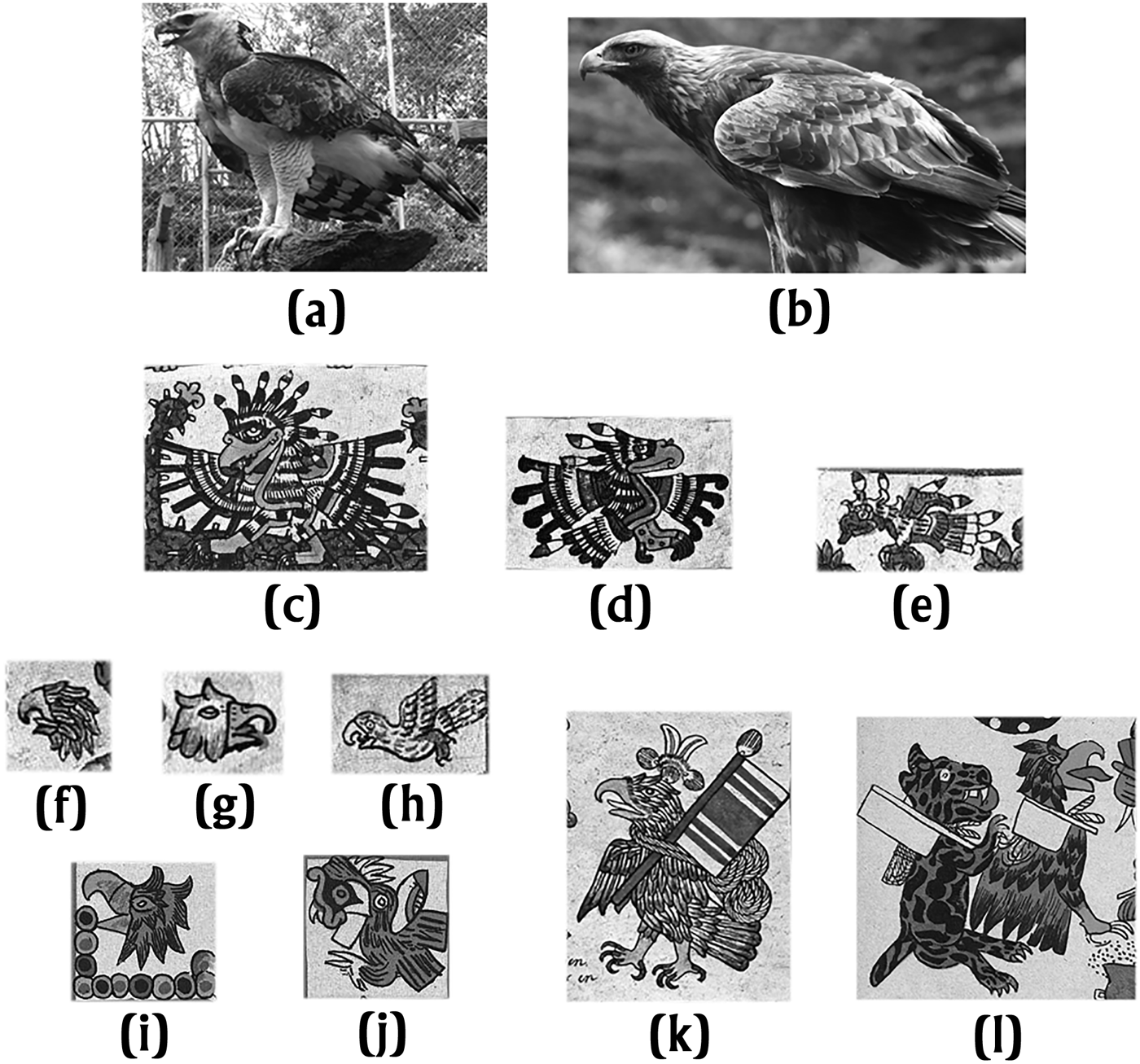
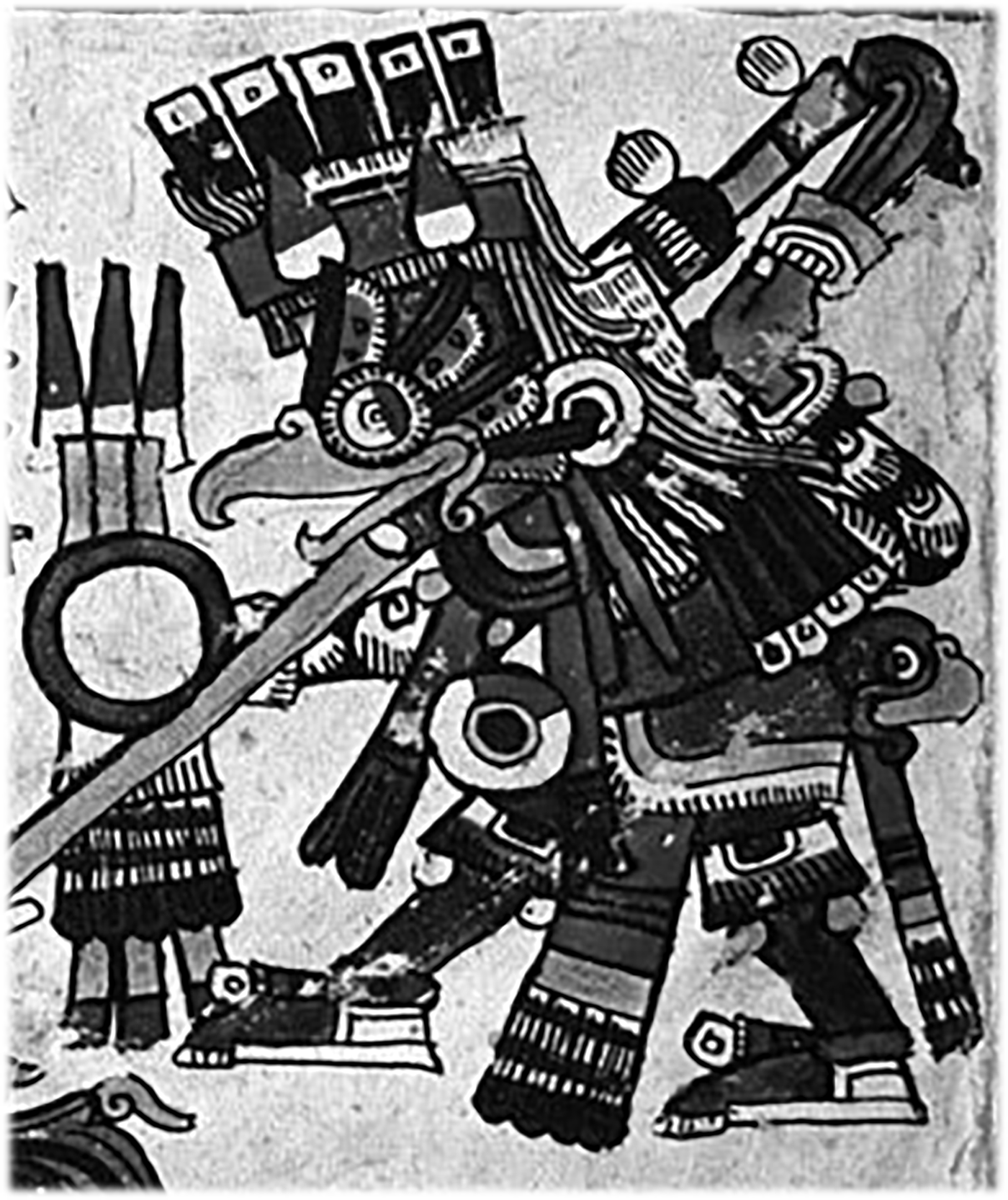
The eagle in the Borgia Group codices, particularly in the Codex Borgia, is depicted fairly consistently throughout (Figure 12c–e). It is a gray-and-white striped bird, with long black wing tips and a fan of feathers on the posterior aspect of the head (Figure 12c). Occasionally this eagle also has jaguar-spotted legs and claws (Borgia 19; Vaticanus B 27) (Figure 12d), which may be a stylistic representation of its scaled legs, or a symbolic link between it and the jaguar, a species similarly known for its ferocity and solar associations (Benson Reference Benson1997:79; Saunders Reference Saunders1994:107). Often the Borgia eagle has flints on its crest, tail, and occasionally wingtips, apparently signifying its warrior-like, raptorial nature (Borgia 52, 71; Vaticanus B 17) (Figure 12c–e). These flints are also depicted on a large version of the Day Sign Eagle on Codex Borgia 11.
The eagle: (a) the harpy (Harpia harpyja). Photo by Mateus Hidalgo, released under the Creative Commons Attribution-Share Alike 2.5 Brazil license; (b) the golden eagle (Aquila chrysaetos). Photo by Raquel Quintana, released under the Creative Commons Attribution 2.0 Generic license; (c) harpy eagle, Codex Borgia 50; (d) harpy eagle with jaguar-spotted legs, Codex Borgia 19; (e) harpy eagle, Codex Vaticanus B 17; (f) golden eagle Day Sign, Codex Borbonicus 3; (g) Day Sign Eagle, Codex Tudela 101r; (h) eagle volatile, Codex Borbonicus 3; (i) golden eagle Day Sign, Codex Tonalamatl Aubin 9; (j) eagle volatile, Codex Tonalamatl Aubin 3; (k) golden eagle standard bearer, Codex Borbonicus 11; (l) golden eagle and jaguar standard bearers, Codex Tonalamatl Aubin 11.
There are several black-and-white eagle species in Mexico, including eagle-hawks, but the most impressive and closely analogous species that fits the role of the Borgia eagle is the harpy eagle (Edwards Reference Edwards1998:19–25). With an average wing-span over six feet in length, it would have been the largest bird in ancient Mexico with the possible exception of the California condor (Gymnogyps californianus), now extinct in the region (Peterson and Chalif Reference Peterson and Chalif1973:26). The ruffled head and neck feathers of the harpy are a diagnostic trait of this eagle species. Today, the harpy eagle's natural range is confined to the humid evergreen forests of the Yucatan and southern Mexico (Howell and Webb Reference Howell and Webb1995:208).
On the other hand, the Aztec codices, for the most part, depict a golden eagle for the Day Sign (cuauhtli; see Boone [2007:Table 5]) and in other scenes (Figure 12f, and 12i–12l). It is a large dark-gold or brown bird, which today inhabits the dry grasslands and foothills of northern and central Mexico (Howell and Webb Reference Howell and Webb1995:205–206). They are known to have been particularly important as ritual offerings, for several were found in special deposits in Tenochtitlan's Templo Mayor (López Luján Reference López Luján1994:469–470; López Luján et al. Reference López Luján, Balderas, Zúñiga-Arellano, Molina and Maldonado2012) and Teotihuacan's Temple of Quetzalcoatl (Álvarez and Ocaña Reference Álvarez and Ocaña1999:42). Some of these eagles exhibit signs of having been raised in captivity (Ramírez et al. Reference Ramírez, Maldonado and Echevarría2010) and were carefully skinned and decorated with copper bells and wood and shell pectorals for the purpose of being interred as a dedication offering to Tlaltecuhtli, the earth deity representing an entry to the underworld. Many eagles were likely raised in captivity. Sahagún (Reference Sahagún and Temprano2001:745) and Francisco López de Gómara (Reference López de Gómara1890 [1826]:220–222) both describe the special care given to eagles at Moctezuma's aviary, and Cortés (Reference Cortés2011:85–86) describes entire streets of Tlatelolco as having been dedicated to the sale of birds, most especially eagles. The Matrícula de Tributos (Mohar Betancourt Reference Mohar Betancourt1987:303; the Lamina de Xillotepec [6r]) and the Codex Mendoza (30v, 31r, 54v, 55r) also list live golden eagles as among the annual tribute items presented each year from surrounding provinces, “according to what they found” (Berdan and Anawalt Reference Berdan and Anawalt1997b:66–67). Clearly, the golden eagle was an exceedingly valuable bird in Aztec society.
The golden eagle is usually rendered in the codices with individual feathers of a variable brown hue and darker wingtips (Figure 12i and 12l). The bird usually lacks the fan of feathers in the back of the neck characteristic of Borgia images of the harpy eagle (Figure 12c and 12d). In the Codex Tonalamatl Aubin, the eagle in the volatile series resembles many of the other volatiles, with the exception of a single flint on its back, apparently a holdover from pre-conquest symbolism (Figure 12j).
In general, eagles are associated with warriors, and this theme can be observed in the codices (Benson Reference Benson1997:79–80; Brumfiel Reference Brumfiel1998:9–10). Eagles are often depicted alongside jaguars, and one reoccurring theme in the Aztec trecenas depicts these two animals holding banners and decorated in the regalia befitting warriors (Borbonicus 11; Tonalamatl Aubin 11) (Figure 12k and 12l). This is very likely a reference to the Eagle and Jaguar Warriors of Aztec society, two classes that fought in staged battles and were highly respected throughout the empire (Benson Reference Benson1997:79; Sahagún Reference Sahagún1997:221; Saunders Reference Saunders1994:107). The eagle and jaguar association can also be found in the way eagles are depicted in the codices, such as the aforementioned spotted legs, as on Figure 12d (Borgia 19). Eagles and jaguars were involved in the creation myths, where it is said the eagle was the first animal to plunge into a supernatural fire, associating it with the Sun God, the first of the gods to emerge from the fires of creation, whereas the jaguar entered second, only to have its fur scorched in the ashes (Seler Reference Seler, Comparato, Thompson and Richardson1996:241).
The eagle represents at least one, and possibly two, volatiles in the series associated with 13 numbers and their corresponding Day Lords. The most consistent of these representations is the eighth volatile. In the Codex Borgia (71), this is a harpy eagle, although identification of its exact species is more vague in the Aztec codices, which place a surprising amount of emphasis on realistically rendering the Day Sign Eagle as a golden eagle (Figure 12f, 12g, and 12i), but does not detail the eagle used in the volatile sequences. Interestingly, the Codex Tudela (99r) depicts the eighth volatile in the same manner as the parrot, but the underlying gloss identifies it as a tlotli, the Nahuatl term for falcon (Corona Martínez Reference Corona Martínez2002:Table 2; Kendall Reference Kendall1992:118). It is therefore possible that the Aztec codices used a falcon (Falco sp.) in place of the Borgia harpy eagle. Like the golden eagle, at least one falcon was recovered in the ritual deposits found in Tenochtitlan's Templo Mayor (López Luján Reference López Luján1994:470), suggesting its importance in Aztec ceremonies.
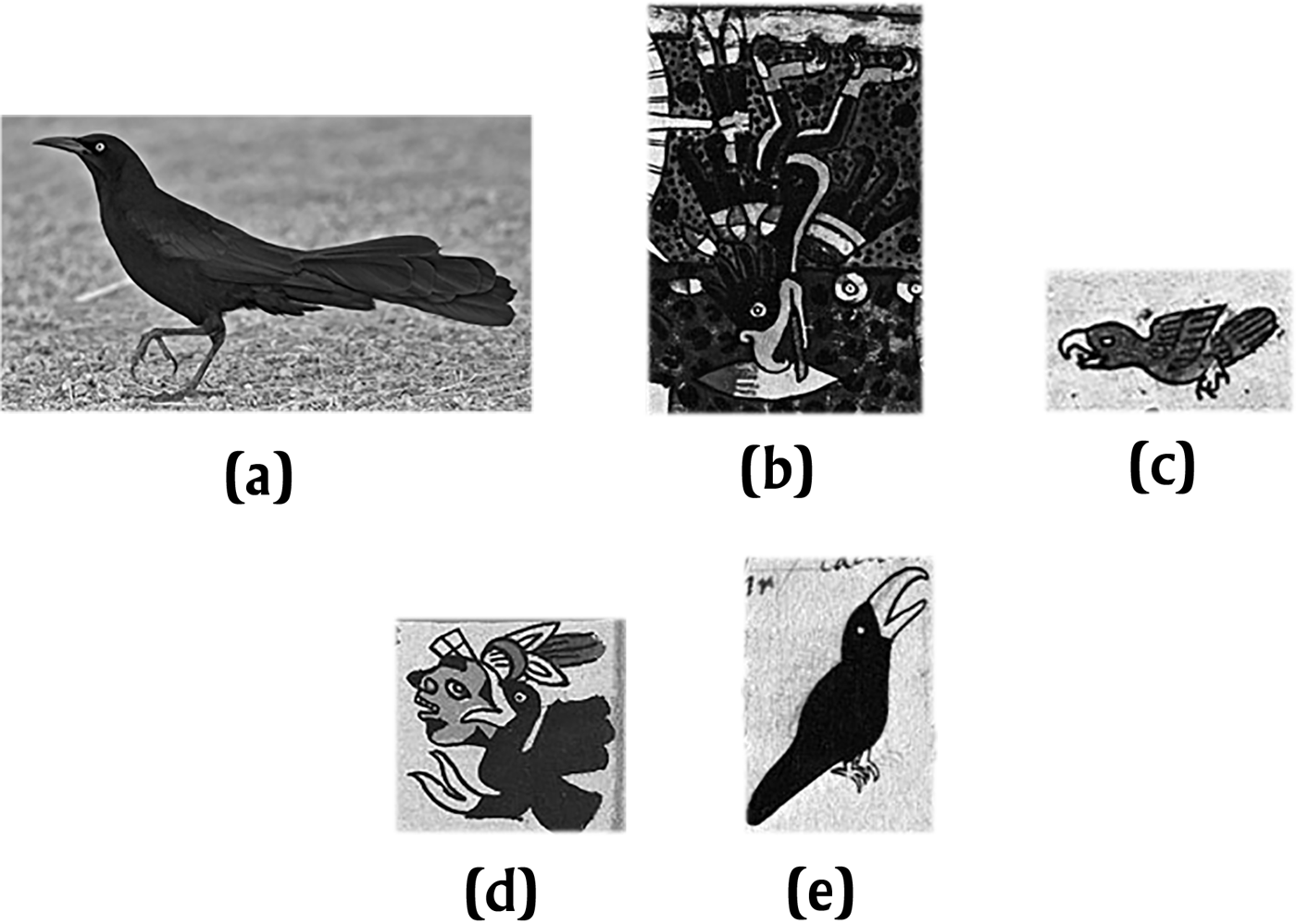
A black eagle appears to be represented as the fifth volatile on Codex Borgia 71, and this same bird can be observed in more detail on Codex Borgia 18 (Figure 13b). The distinctive fan of feathers on the back of its head, combined with the same pattern of radiating flints found on the harpy eagle in the Codex Borgia (Figures 12c, d), suggests that it is one of the larger black eagles, perhaps the solitary eagle (Harpyhaliaetus solitarius) or the black hawk-eagle (Spizaetus tyrannus), rather than the smaller hawk (Edwards Reference Edwards1998:22, 25). On the other hand, the fifth volatile in the Aztec Codices Tonalamatl Aubin and Tudela seems to be a crow or raven (Corvus sp.), and the Tudela gloss identifies the bird as a cacalotl, the Nahuatl word for crow (Corona Martínez Reference Corona Martínez2002:Table 2) (Figure 13d and 13e). This bird may possibly be the great-tailed grackle (Quiscalus mexicanus) (Figure 13a), a bird known by the name K'au in the Maya sources (Milbrath Reference Milbrath and Stone2002:126), which had been introduced from its natural habitat in southern Mexico and Guatemala to the Valley of Mexico by traders during the reign of Aztec emperor Auitzotl (a.d. 1486–1502), and thereafter became an invasive species throughout northern Mexico (Haemig Reference Haemig1978). It is unclear what symbolic link this black raptor has with its associated Day Lord, Tlazolteotl, the goddess of childbirth, filth, and the forgiver of misdeeds (Boone Reference Boone, Joe and Lozano2007:48). Possibly, the connection relates to a Nahua version of the Maya hummingbird myth, in which a hero, often a deity, impersonates a grackle to seduce and impregnate a girl who gives birth to a maize deity (Chinchilla Mazariegos Reference Chinchilla Mazariegos2010). Since Tlazolteotl is the mother of Centeotl, the Aztec maize god (Giasson Reference Giasson2009), the grackle seems to be the father of maize and thus husband to Tlazolteotl.
Black raptorial birds: (a) the great-tailed grackle (Quiscalus mexicanus). Photo courtesy of Nature's Pics Online, http://www.naturespicsonline.com/); (b) black eagle, Codex Borgia 18; (c) volatile, Codex Borbonicus 9; (d) grackle or crow volatile, Codex Tonalamatl Aubin 9; (e) grackle or crow volatile, Codex Tudela 98.
Eagles also occur in a number of other contexts, particularly as sacrificial offerings (Borgia 46, 50), costumes (Borbonicus 15; Borgia 32), directional symbols (Borgia 50), or as actors in a sequence of events, such as the supernatural journey of Quetzalcoatl or Stripe Eye in the Codex Borgia (29–46). The eagle is positioned on the northern tree in the directional almanacs, particularly the ones seen on Codex Borgia 50 and Codex Vaticanus B 17. On the other hand, the bird on the northern tree of the Codex Fejérváry-Mayer 1 lacks any distinguishing characteristics of an eagle, and its white color is not characteristic of an eagle. A more likely representation of an eagle on this page is the bird on the southwest corner, which resembles a harpy eagle. Again, the Codex Fejérváry-Mayer 1 shifts the placement of birds that represent a cardinal direction in other codices to an intercardinal direction, as was noted previously in the case of the scarlet macaw and the resplendent quetzal. If there is a general association between the eagle and the north, however, I would propose it follows a similar standard as the other cardinal direction birds: the eagle, possibly representing the sun, is located in the direction where the sun travels throughout the day, which the Mesoamericans associated with the north (Miller Reference Miller and Robertson1974).
Hawks, kites, and falcons are closely related to eagles (Figure 14) and which were also observed by early Spanish chroniclers as being raised in captivity (Cortés Reference Cortés2011:91; Díaz del Castillo Reference Díaz del Castillo2011:152; López de Gómara Reference López de Gómara1890 [1826]:220–222). The Codex Borgia has several possible images of hawks drawn with the separated wingtips and curved beak of an eagle. The third volatile in the Codex Borgia (71) (Figure 14b) is most likely a hawk, and is adorned with flints like those on the eagles. Seler (Reference Seler, Comparato, Thompson and Richardson1996:247) also identified this as a bird in the raptor family, specifically a falcon. In the Codices Borbonicus and Tonalamatl Aubin, the third volatile is difficult to identify, and may possibly be a hawk or other small raptorial avian. The artist of the Codex Tudela (98v), however, clearly drew a dove (Colombidae) and labeled it using the Nahuatl term for dove, cocotzin (Corona Martínez Reference Corona Martínez2002:Table 2; Kendall Reference Kendall1992:107). Since the volatile eight eagle is associated with the god Tlaloc, the husband of the third volatile's Day Lord, Chalchiuhtlicue, I believe the switch to a dove may be an error. As stated previously, the discrepancy suggests the Codex Tudela artist was possibly not familiar with established patterns in representing the volatiles.
Raptorial birds: (a) possible hawk or falcon, Codex Borgia 51; (b) hawk or falcon volatile, Codex Borgia 71; (c) osprey (Pandion haliaetus) or kestrel (Falco sparverius), Codex Borbonicus 13; (d) falcon (Falco sp.), Codex Tudela 99r.
Other raptorial birds appear occasionally throughout the codices. The bird on the western tree in the Codex Borgia (Figure 14a), incorrectly identified by Seler (Reference Seler, Comparato, Thompson and Richardson1996:233) as a hummingbird, is most likely a raptorial bird due to its curved beak, splayed wingtips, and radiating head feathers, all of which are features found on eagles. Both the Codex Borgia 10–11 and the Codex Vaticanus B 29–30 (Figure 15) depict two birds in comparable Day Patron images that may be raptorial species, although their lack of definitive detail does little in the way of making this a decisive identification. The representation of these two birds is similar to that of birds used to represent name glyphs in the post-conquest documents (Boone Reference Boone2000:49–55), and their identities may be important to understanding a name or place referenced in the scene. On Codex Borbonicus 13, a possible kestrel (Falco sparverius) or osprey (Pandion haliaetus) may be represented in the thirteenth trecena, denoted by its white head and black streak across the eye (Milbrath Reference Woolley and Milbrath2011, personal communication) (Figure 14c). At least one kestrel was found in the Templo Mayor offerings at Tenochtitlan, providing archaeological evidence of this bird's importance in Aztec rituals (Álvarez and Ocaña Reference Álvarez, Ocaña and Polaco1991:135; López Luján Reference López Luján1994:470).
Probable raptor species in comparable Day Patron sequences: (a-b) Codex Vaticanus B 29–30; (c-d) Codex Borgia 10–11.
The Vulture
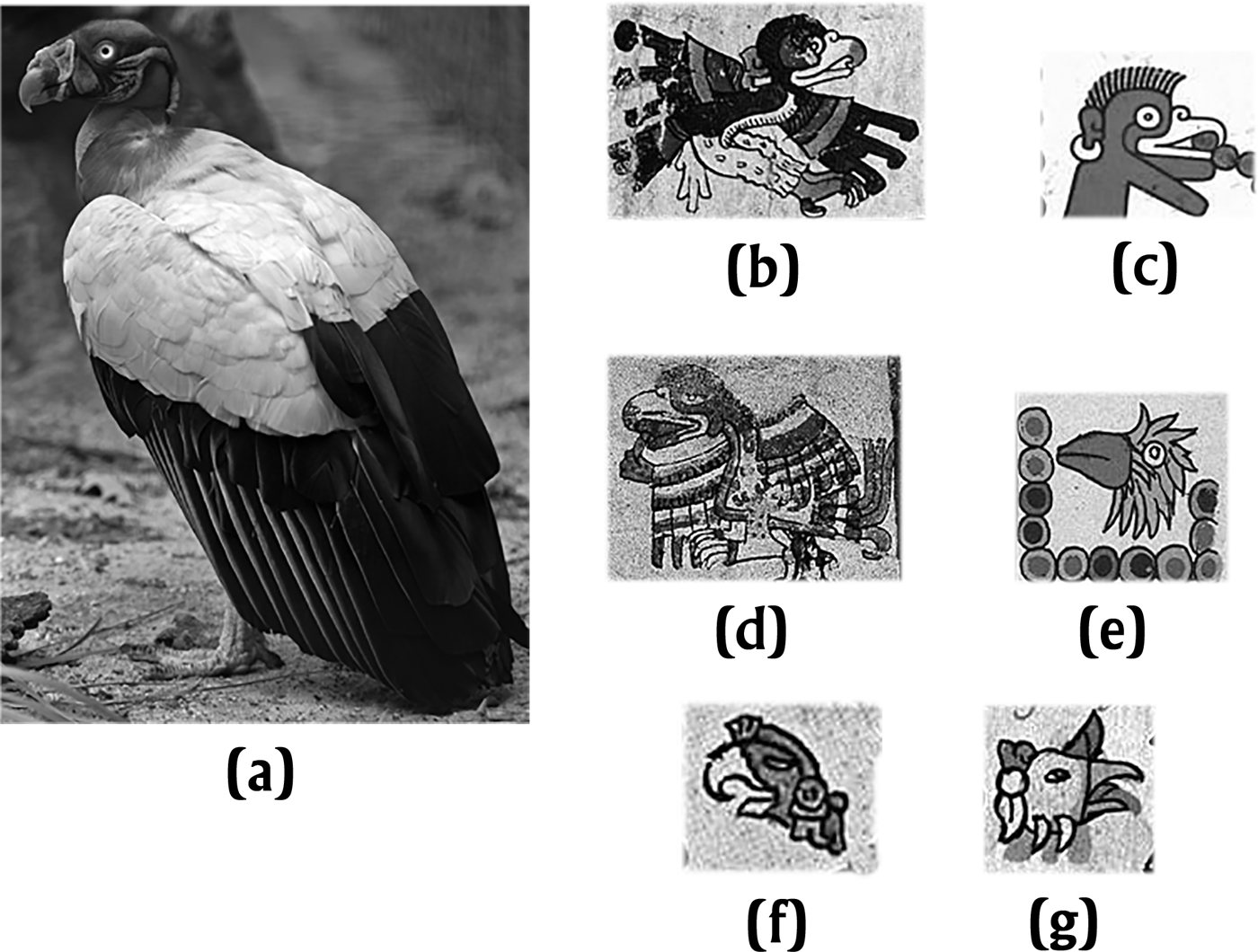
Like the eagle, the vulture is one of the 20 Day Signs, although it is not frequently encountered outside of this context in Mexican painted books (despite appearing fairly often in the Maya codices). There are four species of vulture in Mexico today, and there is evidence that the California condor once also resided in the area (Peterson and Chalif Reference Peterson and Chalif1973:25–26). The species most recognizable as the vulture of the codices, however, is the king vulture (Sarcoramphus papa), although the savanna vulture (Cathartes burrovianus) could be a possible candidate in some instances (Figure 16). The king vulture, found today in the lowland forests of southern Mexico, is a large bird with a red and black featherless head, large white eyes, a predominantly white body, and black and gray wing and tail feathers (Howell and Webb Reference Howell and Webb1995:175–176). The savanna vulture (or yellow lesser-headed vulture) is a slightly smaller species that occupies lowland grasslands as well as forests, and has a predominantly black body, gray wingtips, and a mottled red, gray, and yellow featherless head.
The vulture: (a) the king vulture (Sarcoramphus papa). Photo by Eric Kilby, released under the Creative Commons Attribution-Share Alike 2.0 Generic license; (b) king vulture, Codex Borgia 20; (c) human with vulture features, Codex Laud 35; (d) king vulture, Codex Vaticanus B 88; (e) Day Sign Vulture, Codex Tonalamatl Aubin 9; (f) Day Sign Vulture, Codex Borbonicus 3; (g) Day Sign Vulture, Codex Tudela 101r.
Since the vulture in the codices is often represented as a Day Sign only by its head, it is difficult to definitively identify the bird's species in every codex. In the Codex Borgia, the bird is occasionally drawn as a full-body representation of a Day Sign (Borgia 18–20) (Figure 16b). In these few cases, there are distinctive white markings on the majority of the bird's body, which identify the bird as a king vulture, since all other vulture species in the area are pure black (Peterson and Chalif Reference Peterson and Chalif1973:25). The wings of the bird in the codices are a dark gray with bands of red and yellow near the bases, and the head is feathered the same dark gray. The colored bands, as well as the feathered head, are not present in any vulture species living today, and are probably a stylistic element.
Another of these stylized features appears on the bird's ear, which is consistently depicted like that of a human and usually sports a shell or circular earring. Needless to say, vultures do not have human-shaped ears, and it is possible the design was inspired by the uniquely shaped skin-folds on the back of the vulture's head. On the king vulture, these folds are gray or red and contrast with the otherwise black face of the bird. According to Seler (Reference Seler, Comparato, Thompson and Richardson1996:247, Figures 476–499), various representations of vultures in the codices depict king vultures, identified as cozcaquauhtli or “ringed eagle” in Nahuatl; the term cozcatl means “jewel,” and Seler suggests that the earring may also have been a visual metaphor representing its name. Cozcaquauhtli is also the word used to identify the Day Sign Vulture in the Codex Tudela (99v), supporting Seler's identification.
The Borgia codices depict the vulture with greater consistency than the Aztec codices (Figure 16). On the Codex Fejérváry-Mayer 37, the bird is illustrated with a close-cropped cluster of brown down on the top of its head, which may represent the sparse black down found on male king vultures. The full-bodied vulture in the top center square of Codex Vaticanus B 88 (Figure 16d) has some of the white body feathers of the king vulture, although its head is the color of a savanna or turkey vulture (Cathartes aura). The red area around the bird's eye is usually correctly depicted in the codices, although occasionally the bird sports an anthropomorphic eyebrow as on Codex Borgia 20 (Vaticanus B 12) (Figure 16b). The orange or red wattle on the beak is often missing in the Borgia Group, although it is included in the Codex Tudela (102v) (Figure 16g), where the face is colorless, a trait that is also observed in some of the other bird images (Codex Tudela 98v). The Codex Borbonicus (Figure 16f) also occasionally includes this wattle, but the red-faced bird could represent another member of the vulture species, since the king vulture usually has a dark face. The Day Sign Vulture in the Codex Tonalamatl Aubin least resembles a vulture among the codices examined here, and is only illustrated as a head (Figure 16e). This bird has a fan of red or pink feathers running along the back of its head, and lacks an earring; its similarity to the eagle in this regard may have to do with its Nahuatl name, “ringed eagle,” as mentioned previously.
Overall, there is a great deal of variation among the depictions of the vulture throughout the codices, and it does not appear that the bird had a consistent role in codex symbolism outside of its use as a Day Sign. Seler (Reference Seler, Comparato, Thompson and Richardson1996:247) notes that the vulture is occasionally depicted with brown down and “forehead locks” (Borgia 68; Vaticanus B 27, 92), possibly associating it with warriors who were known to wear their hair in this fashion, as well as the goddess Itzpapalotl, patroness of war (Boone Reference Boone, Joe and Lozano2007:43; Seler Reference Seler, Comparato, Thompson and Richardson1996:247). The Borgia Group codices, and possibly also the Codex Borbonicus and the Codex Tudela, use a king vulture with these warrior traits to represent the Day Sign Vulture. The artist of the Codex Tonalamatl Aubin, however, appeared to have another bird in mind when illustrating this Day Sign, or else the artist was possibly not familiar with the vulture (Figure 16e).
I would propose a possible explanation for the vulture-raptor conflation is that the ancient Mexicans may not have distinguished between the two sets of species. This is suggested in Sahagún's (Reference Sahagún and Temprano2001:910) description of raptors in the Florentine Codex, which includes the cozcaquauhtli and its darker counterpart, the tzopilotl, likely a savanna vulture (Sahagún Reference Sahagún, Anderson and Dibble2002:Plate 125). The birds are described as if they were eagles, and it is likely the authors of the codices did not perceive the distinction between the eagle and vulture as two entirely different families of birds as we do today, but instead as two types of eagles.
The Owl
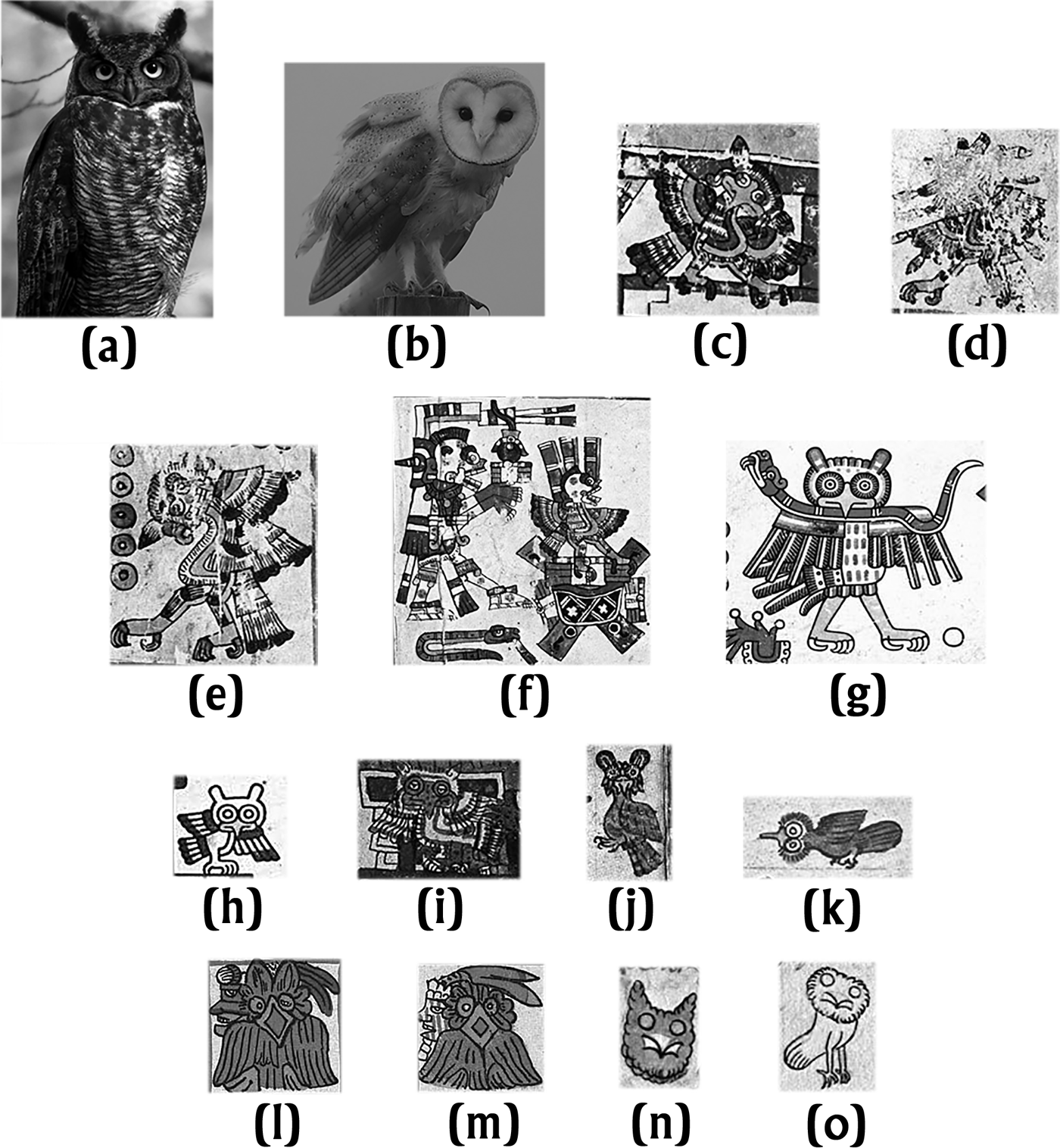
The owl is one of the most consistently portrayed birds in the codices (Figure 17). Owls are usually drawn from a frontal perspective, facing the viewer. Unlike other birds, owls have frontal-facing eyes, and their anatomical inability to move their eyeballs in their sockets forces them to cant their heads in the direction they choose to observe (Peterson and Chalif Reference Peterson and Chalif1973:81). This unique trait was apparently noteworthy to the ancient Mexicans, who emphasized the frontal-facing head in their art, even as far back as Early Classic period Teotihuacan (Miller Reference Miller1973:138–139, Plates 281–283, 285), where several frontal-facing owls festoon the walls of one of the Tetitla compound's murals.
The owl: (a) the great horned owl (Bubo virginianus). Photo by Brendan Lally, released under the Creative Commons Attribution 2.0 Generic license; (b) the barn owl (Tyto alba). Photo by Steve Garvie, released under the Creative Commons Attribution-Share Alike 2.0 Generic license); (c) horned owl, Codex Borgia 12; (d) hornless owl volatile, Codex Borgia 71; (e-f) owl with Mictlantecuhtli “death” head, Codex Borgia 71 and 14; (g) horned owl with coral snake, Codex Laud 5; (h) horned owl, Codex Fejérváry-Mayer 4; (i) horned owl, Codex Vaticanus B 91; (j) horned owl volatile, Codex Borbonicus 3; (k) hornless owl volatile, Codex Borbonicus 17; (l) horned owl volatile, Codex Tonalamatl Aubin 3; (m) hornless owl volatile, Codex Tonalamatl Aubin 3; (n) horned owl volatile, Codex Tudela 99r; (o) possible barn owl volatile, Codex Tudela 98.
There are at least two species of owls that appear in the codices, one with feathered “horns” and one without. With nearly a dozen species of horned owls identified in Mexico today (Edwards Reference Edwards1998:61–66), there is no simple method of distinguishing the horned owls in the codices, especially since the relative size of the owl is not clear in most representations. The striped brown markings on most of the horned owls does not help identify the species because there are so many horned owls with stripes, including the striped owl (Pseudoscops clamator), stygian owl (Asio stygius), flammulated owl (Otus flammeolus), long- and short-eared owls (Asio sp.), screech-owls (several species in the Megascops genus), and the great horned owl (Bubo virginianus). The latter two possibilities have often been used by researchers in the past to identify the owls in the codices (Boone Reference Boone, Joe and Lozano2007:46, 60; Kendall Reference Kendall1992:113–114; Nicholson Reference Nicholson, Ekholm and Bernal1971:Table 2; Seler Reference Seler, Comparato, Thompson and Richardson1996:253–256), but I see no reason to disregard the other possible species. The name of the horned owl in the Codex Tudela is tecolotl (Tudela 99r), which is also the term Sahagún (Reference Sahagún, Dibble and Anderson1963:42) uses. Sahagún's discussion of this owl, however, is not very diagnostic of any particular species, mostly noting their round bodies and large, nocturnal eyes.
Most owls are depicted in the central Mexican codices with two feathered “horns” (Figure 17). Those lacking horns tend to have a more ruffled appearance (Borgia 71; Tonalamatl Aubin 3–20) (Figure 17d and 17m). Nearly all owls are illustrated with round eyes, usually accentuated by white or brown eye-rings. Their body feathers tend to be horizontally striped with alternating brown, white, and occasionally gray patterns. Owls consistently appear in the sixth and tenth positions in the volatile sequence, with the horned species taking the tenth position.
The second type of owl in the codices that lacks “horns” tends to vary more extensively than the horned owl, and does not appear to play a role outside of its place as the sixth volatile. Nicholson (Reference Nicholson, Ekholm and Bernal1971:Table 2) and Kendall (Reference Kendall1992:113) identify this bird as the hornless barn owl (Tyto alba) (Figure 17b), based on the Codex Tudela (98v) gloss where the bird is identified as a chicuatli, which Sahagún (Reference Sahagún, Dibble and Anderson1963:46) describes as a bird with a yellow chest and wing colorations similar to that of a quail. The spotted wings of the barn owl could possibly match this description. Barn owls are a ubiquitous species found in grassland habitats throughout Central America, and are characterized by their white or cream-colored body, small dark eyes, and white or gray-spotted wings (Howell and Webb Reference Howell and Webb1995:353). Barn owls are also one of the few examples of owls recovered from Mexican archaeological sites, almost exclusively as offerings (Álvarez and Ocaña Reference Álvarez and Ocaña1999:52).
The Codex Tudela bird is colorless, which may allude to the white color of the barn owl. Comparing the sixth bird in the volatile sequence of the Codex Borbonicus and the Codex Tonalamatl Aubin, there is no resemblance to the barn owl, but the sixth volatiles in these two codices do resemble one another. Both are brown with ruffled markings around the eyes, which could indicate they are any number of non-horned Mexican owls. The sixth volatile of the Codex Borgia 71 is a unique case, since it resembles the depiction of a harpy eagle and is decorated with the flints characteristic of eagles and hawks (Figure 17d). The eagle is frontal-facing, however, and possesses the ruffled feathers and wings that also appear on the tenth volatile on Codex Borgia 71, which is clearly a representation of the horned owl. There is no owl in the Mexican area that has splayed facial feathers resembling the sixth volatile, so, once again, any specific identifications seem impractical here. Seler (Reference Seler1963:Plate 71) identifies the tenth volatile on Borgia 71 as a barn owl, which seems unlikely since it possesses horns.
Splayed facial feathers also appear on the representation of a bird in the Venus almanacs on Borgia 54, where an owl-like bird has unique jaguar-spotted head feathers (Figure 18). In his analysis of the Codex Borgia, Seler (Reference Seler1963:121–122, Plate 54) identifies this bird as an owl (tototl), acting as a black Venus god of the south. Interestingly, its spotted appearance resembles the muan (or moan) bird from the Maya codices (Seler Reference Seler, Comparato, Thompson and Richardson1996:256, Figs. 548–571). If the direction of south is associated with the underworld, as mentioned previously, perhaps this is another indication the bird is an owl, a representative of the underworld. Owls are associated with the southerly and westerly directions in the pre-conquest Lienzo de Tequixtepec (Boone Reference Boone2000:150); although the exact interpretation of this part of the lienzo remains ambiguous, a glyph identifying the southerly location as “skull” further substantiates its association with the underworld. The southern Venus god of Codex Borgia 54 could be represented by an owl for this reason. The profile view of the bird, however, is not consistent with the usual depiction of an owl, and Milbrath (Reference Milbrath2013) has suggested the bird may instead represent the Day Sign Eagle.
Venus deity with owl traits, Codex Borgia 54.
The owl is also associated with the death god, Mictlantecuhtli, the Day Lord for the hornless owl volatile (Kendall Reference Kendall1992:114; Nicholson Reference Nicholson, Ekholm and Bernal1971:Table 2; Seler Reference Seler, Comparato, Thompson and Richardson1996:253). Owls were often perceived as underworld messengers, and their cries were considered dangerous omens, particularly if encountered on a crossroads or near a house (Sahagún Reference Sahagún1997:174; Reference Sahagún and Temprano2001:381). This is apparent in some of the more symbolic portrayals of the codex owls, such as Codex Borgia 14, in which an owl is illustrated with a human skull similar to that of Mictlantecuhtli (Figure 17f), the Codex Fejérváry-Mayer 3 where a skulled owl sits at the crossroads, and Borgia 42, where two horned owls appear in the underworld.
The Turkey
The wild turkey (Meleagris gallopavo) and the ocellated turkey (Meleagris ocellata), are the two species of turkeys in Mexico today (Peterson and Chalif Reference Peterson and Chalif1973:47), but the Mexican codices only appear to include the former (Figure 19). Whereas the ocellated turkey can be distinguished by its metallic green sheen, the wild turkey, which includes a domesticated variety in Mexico, is variably black, gray, brown, and white, and has a mottled red or blue head. While wild turkeys are found throughout most of Mexico, the range of the ocellated turkey is usually restricted to the semi-deciduous or tropical forests of southern Mexico and the Yucatan (Howell and Webb Reference Howell and Webb1995:226). Both wild and ocellated turkeys have a distinctive wattle (or snood) above the beak, and fleshy protuberances known as “caruncles” atop the head. Male wild turkeys have a tuft of hair-like feathers, known as a “beard,” on the center of the chest, which is notably lacking in the ocellated species. This distinctive tuft of feathers is almost always depicted in the codices, and distinguishes the bird from vultures, which are often drawn with similar traits. The upright, flaring tail, another distinguishing feature of this bird, is rarely depicted in the codices (Figure 19).
The turkey: (a) the wild turkey (Meleagris gallopavo) (photo released under the Creative Commons public domain); (b) Codex Borgia 50; (c) Codex Fejérváry-Mayer 6; (d) Codex Laud 45; (e) Codex Vaticanus B 29; (f) volatile, Codex Borbonicus 3; (g) volatile, Codex Tonalamatl Aubin 12; (h) volatile, Codex Tudela 99r.
The turkey is the ninth position in every volatile sequence in the codices, and is identified as a chalchi totoli in the Codex Tudela (99r), which Kendall (Reference Kendall1992:122) notes is a misspelling of the term Chalchiuhtotolin, or “jade turkey.” The god Chalchiuhtotolin is portrayed in a number of codex images, particularly in the seventeenth trecena in the Codex Borgia (64), Codex Vaticanus B (65), Codex Borbonicus (17), and the Codex Tonalamatl Aubin (17). The turkey is rarely found in other contexts, although it seems to be represented as an underworld sacrifice in Codex Borgia 18, and is present during a blood sacrifice on the Codex Laud 45 (Figure 19d), in both instances represented with a red head and wattle beneath the beak.
Turkeys may have been one of the principal sacrificial species due to their large body size and ability to be domesticated. The significance of turkeys depicted in Aztec ritual sacrifices in the codices can also be compared to the zooarchaeological record from Tenochtitlan's Templo Mayor, where five wild turkeys were recovered in special deposits (López Luján Reference López Luján1994:469-470). In a comprehensive analysis of zooarchaeological remains recorded in pre-Columbian site reports across Mexico, Álvarez and Ocaña (Reference Álvarez and Ocaña1999) found that turkeys were by far the most prevalent bird species recovered, in diverse contexts ranging from middens to cave deposits. A sacrifice of a different kind, the turkey (both alive and dead) was one of the primary offerings to Cortés and his army in the Lienzo de Tlaxcala, presented by both the Tlaxcalans and neighboring groups of whom he gained allegiance (Chavero Reference Chavero1964:Laminas 2, 28, and 29), as well as Moctezuma and his court at Tenochtitlan before relations turned sour (Lamina 11). The role of the turkey in ancient Mexican society clearly went beyond its contemporary role as a centerpiece at the dinner table.
The Quail
In the codices, the quail is one of the most important sacrificial animals, a role that is confirmed by zooarchaeological records from the central Mexican area (Álvarez and Ocaña Reference Álvarez and Ocaña1999:133-134; López Luján Reference López Luján1994:470; Marcus and Flannery Reference Marcus, Flannery and Renfrew1994:407). The most commonly sacrificed quail species appears to be the Montezuma Quail (Cyrtonyx montezumae), distinguished by its spotted black-and-white plumage, facial stripes, and blue beak (Edwards Reference Edwards1998:30). It is this latter feature that distinguishes the bird in the codices (Figure 20). The Montezuma quail is consistently portrayed as the fourth bird in the volatile sequence, with the exception of Folio 98v in the Codex Tudela (Figure 20g), which depicts a banded (barred) quail (Philortyx fasciatus). The Codex Tudela identifies the bird as a zolin, a general Nahuatl term for quail (Kendall Reference Kendall1992:109).
The quail: (a) the Montezuma quail (Cyrtonyx montezumae) (after Fuertes [1928]); (b) Montezuma Quail on the neck of Xipe Totec, Codex Borgia 25; (c) volatile, Codex Borgia 71; (d) Montezuma quail on Xipe Totec, Codex Vaticanus B 70; (e) Montezuma quail volatile, Codex Borbonicus 10; (f) Montezuma quail volatile, Codex Tonalamatl Aubin 3; (g) banded quail (Philortyx fasciatus) volatile, Codex Tudela 98.
Seler (Reference Seler, Comparato, Thompson and Richardson1996:263) suggests that one reason the quail was considered such a significant sacrificial animal was because its black-and-white spotted feathers were associated with the starry night sky, the celestial abode of the gods. A quail sacrifice occurs as the central image of the volatile page of the Codex Borgia 71, in honor of the Sun God, Tonatiuh, its associated Day Lord in the volatile sequence. Another quail sacrifice can be found on Codex Tonalamatl Aubin 14, the fourteenth trecena. Even though parallel bird sacrifices occur in the other codices depicting this same trecena, they appear to illustrate other birds, such as a green bird resembling the quetzal (Borbonicus 14, 17). A quail appears on the arm of a woman impersonating the Maize Goddess who wears a flayed skin on Codex Borbonicus 29. Often, the Montezuma quail appears as an ornament around the neck of Xipe Totec, the god most closely associated with flayed sacrificial victims, as on Codex Borgia 25 (see Figure 20b) and 49, and on Codex Vaticanus B 19, 39, and 70 (Figure 20d). The quail's association with this particular deity is likely due to the overarching theme of sacrifice.
It should be noted that Seler (Reference Seler, Comparato, Thompson and Richardson1996:263–264) identifies Xipe Totec as the god associated with the quail in the volatile series. Yet, Boone (Reference Boone, Joe and Lozano2007:46) describes the associated Day Lord as Tonatiuh. Although the deity associated with the quail in the Codex Tonalamatl Aubin is difficult to identify, the one in the Codex Borbonicus has the sun disk of Tonatiuh, and thus is clearly the sun deity. An interesting example of quails having been sacrificed to the sun may be found in the faunal remains of Offering 125 at the Templo Mayor (López Luján, et al. Reference López Luján, Balderas, Zúñiga-Arellano, Molina and Maldonado2012), where several incomplete Montezuma quail skeletons were recovered inside the skeleton of an eagle decorated as a solar deity, presumably having been fed to the eagle before its death. If, as previously noted, we consider the eagle as a representation of the sun, it appears the quails were a sacrifice made to the solar avian impersonator before the latter became a sacrifice itself.
A summary in the Primeros Memoriales (Sahagún Reference Sahagún1997:83) of the duties expected of the Priest of Molonco suggests black feathers used for decorative purposes may have come from quails, for among this particular priest's occupations was that of caring for the sacrificial quails and black feathers for the festival of the goddess Chiconauhecatl. During this ceremony, a young impersonator of the deity was sacrificed by a priest who held a quail in his teeth (Sahagún Reference Sahagún1997:90–91). Although Sahagún (Reference Sahagún1997:270) described the use of crow feathers in other instances of black-coated regalia, black quail feathers may have been used by individuals during sacrificial performances.
CONCLUDING REMARKS
This study has provided a brief overview of the broad variety of birds present in the central Mexican codices, based on the species originally analyzed by Seler in the early twentieth century. Only a handful of the major bird families were covered in this overview, and it would be hoped that further investigations be carried out to explore the lesser-known or more ambiguous bird identifications, if at all possible. This article demonstrates that, although some species of birds share the same characteristics throughout many of the codices (such as the quetzal, owl, and macaw), other birds are represented quite differently (that is, the eagle and quail), particularly when comparing the pre-conquest Borgia and post-conquest Aztec groups. Such differences hint at regional familiarity with certain species in specific areas, which could provide evidence as to where certain codices were produced. While the modern range of species is helpful in the identification of certain birds, it is clear that some species, such as the quetzal, were often portrayed fairly accurately by artists producing codices outside of the species' natural range; this implies certain exotic species were traded throughout central Mexico, as substantiated by zooarchaeological data (López Luján Reference López Luján1994; Somerville, et al. Reference Somerville, Nelson and Knudson2010) and early Spanish records (Cortés Reference Cortés2011; López de Gómara Reference López de Gómara1890 [1826]; Sahagún Reference Sahagún1997).
The overarching goal of this article was to produce a revised compendium of the work initiated by Seler (Reference Seler, Comparato, Thompson and Richardson1996) over a century ago. Toward this end, I made an effort to keep true to his original format, reviewing the same primary bird species he had considered, and using a number of his original identifications and associated symbolic lore that accompanied each species. I have also made corrections, however, to several of his identifications, either suggested by me or proposed by other scholars over the last century (that is, Benson Reference Benson1997; Boone Reference Boone, Joe and Lozano2007; Nicholson Reference Nicholson, Ekholm and Bernal1971), particularly in regards to the volatile sequence and the cardinal direction figures. Using the Codex Tudela, a document not known to Seler when he wrote his initial treatise, I explored the possibility that different artists had different conceptions of which specific birds fit certain recurring roles found in many codices, such as the volatile or trecena series. I also examined instances where bird plumage was used for a specific purpose, such as the quetzal, cotinga, and yellow-headed parrot feathers valued in the post-conquest tribute documents and worn by particular deities (Anawalt Reference Anawalt, Berdan and Anawalt1997; Sahagún Reference Sahagún1997). Finally, I turned to zooarchaeological data to understand the role of birds in ritual contexts that can clarify or substantiate their symbolic import in the codices, as in the case of the golden eagle (Ramírez et al. Reference Ramírez, Maldonado and Echevarría2010) and Montezuma quail (López Luján et al. Reference López Luján, Balderas, Zúñiga-Arellano, Molina and Maldonado2012); such information was unavailable to Seler a hundred years ago, and provides a prime means of linking physical evidence with historic documentation.
It is hoped that this review has made clear that the ancient Mexicans held certain species in special regard, attributing specific qualities and symbolic import to several birds. Among the new identifications provided here are the harpy eagle as the Borgia Codex Day Sign Eagle, the magnificent hummingbird and the ruby-throated hummingbird as two of the birds in the volatile sequence, and the great-tailed grackle as a bird in the volatile sequences of the Aztec codices. The birds of the volatile series were each associated with a particular Day Lord, and, consequently, day (Boone Reference Boone, Joe and Lozano2007:46); their order was likely as important as the days of our own calendar, if not more so since each bird and its respective Day Lord (Table 2) were accompanied by an entire suite of symbolic themes: the owl with Mictlantecuhtli, death, and the underworld; the quetzal with Tlahuizcalpantecuhtli, sunrise, the rejuvenation of life, and wealth; the grackle with Tlazolteotl and the birth of maize. While this study did not and could not comprehensively cover every bird species known to the ancient Mexicans, it is likely countless other bird species—and even non-bird species that were often associated with birds, such as butterflies and certain beaked fish (Sahagún Reference Sahagún and Temprano2001:938)—were also qualified with particular symbolic traits.
As further advances are made in the study of Mesoamerican art and zooarchaeology, there will be many more opportunities to advance the study of birds in the codices. Although this article is intended to serve as an update to Seler's seminal work over a hundred years ago, it is just one more step in the ongoing investigation into the complex story of birds and myths of ancient Mesoamerica.
RESUMEN
Las identificaciones y el análisis de Eduard Seler en 1909 de varias aves en los códices mexicanos son uno de los estudios más exhaustivos sobre el tema del simbolismo de animales. A pesar de las numerosas revelaciones en las investigaciones de los códices durante el siglo pasado y los avances en los estudios de ornitología y zooarqueología, no ha habido una revisión completa de las identificaciones de las aves en la obra original de Seler. Esta investigación revisa y actualiza las identificaciones de los grupos de aves más importantes en la composición de Seler, incluyendo el guacamayo, el loro, el quetzal, la cotinga, el colibrí, el águila, el halcón, el búho, el buitre, el pavo, y la codorniz. Al estudiar los códices Borgia, Fejérváry-Mayer, Laud, y Vaticanus B del Grupo Borgia, y el Borbonicus, Tonalamatl Aubin, y Tudela del estilo azteca, este análisis hace una comparación de las características naturales y las representaciones simbólicas de los especies. Además, este análisis incorpora las investigaciones recientes sobre los códices, el simbolismo y arte, la mitología, y los relatos etnohistóricos de México central, en conjunción con los descubrimientos realizados durante el siglo pasado en las áreas de zooarqueología y ornitología, para mejorar las identificaciones realizadas por Seler en su obra original y para construir una revisión cabal de los papeles desempeñados por las aves en la mitología del México antiguo. La investigación revela que hay diferencias en la representación de aves específicas en los códices del tiempo anterior y posterior a la conquista, quizás un indicativo de una disminución de familiaridad con ciertas especies a través del tiempo.
ACKNOWLEDGMENTS
I would like to thank Susan Milbrath for providing me with the inspiration to undertake this investigation, as well as for her insightful editorial comments as the research for this article came into shape. I would also like to thank Kitty Emery for her editorial consultation and advice regarding the zooarchaeological aspect of the central Mexican fauna, as well as Jeffrey Vadala for providing many of the scans of the codices used as images in this analysis. Finally, this research would not be possible without generous funding from the University of Florida Department of Anthropology Graduate Alumni Fellowship.