INTRODUCTION
The world's population is aging (Jedrziewski et al., Reference Jedrziewski, Lee and Trojanowski2007). Accordingly, the need for institutionalization in personal care home (PCH) settings is expected to grow, and the number of individuals dying in such settings is likely to increase (Hanson, Reference Hanson2003). Personal care homes are thus being required to take on an increasingly prominent role in end-of-life care. Research examining expert registered nursing care of the dying in a variety of clinical contexts has been conducted (Degner et al., Reference Degner, Gow and Thompson1991; McClement & Degner, Reference McClement and Degner1995; Hawkins, Reference Hawkins1995; Helwer, Reference Helwer1995). As regards the personal care home context, however, it is health care aides (HCAs) who have the most sustained contact with and provide the vast majority of care to dying residents and their families (Pennington et al., Reference Pennington, Scott and Magilvy2003). To date, health care aides' perceptions regarding expert end-of-life care have not been examined. Our understanding of the nature of expert care of the dying, thus, is incomplete. Given their integral role in the PCH setting, accessing the perspectives of these members of the health care team is warranted. Therefore, the purpose of this study was to identify and describe expert behaviors in care of the dying resident from the perspective of these direct care providers.
Literature Review
Research examining the issue of providing end-of-life care in the PCH has been conducted, but has focused largely on the increasing acuity of residents and symptom complexity (Hanson et al., Reference Hanson, Eckert and Williams2008), the hospitalization of dying residents (Kayser-Jones et al., Reference Kayser-Jones, Wiener and Barbaccia1989), variability in disease trajectory (Forbes et al., Reference Forbes, Bern-Klug and Bessert2000), lack of physician availability and support (Shield et al., Reference Shield, Wetle and Teno2005), factors challenging the provision of end-of-life care in nursing homes (Wowchuk et al., Reference Wowchuk, McClement and Bond2006, Reference Wowchuk, McClement and Bond2007), and issues concerning family satisfaction with end-of-life care (Vohra et al., Reference Vohra, Brazil and Hanna2004; Thompson et al., Reference Thompson, Menec, Chochinov and McClement2008). Although caregivers in PCHs can make a difference in the quality of end-of-life care residents receive, there is consensus in the literature that HCAs who provide the majority of such care are not well trained to do so (Hyer & Ragan, Reference Hyer and Ragan2002; Pelletier, Reference Pelletier2004). Research suggests that health care providers who are exposed to care of the dying without adequate education and support experience anxiety and tend to minimize contact with dying patients (Shusterman & Sechrest, Reference Shusterman and Sechrest1973). Such a scenario clearly undermines the provision of optimal end-of-life care. Research that taps the expertise of HCAs who are skilled in caring for dying residents will identify an array of care strategies that may enhance HCA feelings of efficacy in their role, help reduce staff turnover, and result in more approach behaviors in care of the dying.
Conceptual Framework
Benner's (Reference Benner1982) work detailing the nature of expert practice provided the theoretical basis for this study. Drawing on the postulates of the Drefyus Model of Skill Acquisition, Benner (Reference Benner1982) generated a development model of levels of proficiency in nursing and described the nature of expert practice. Experts are characterized as experienced individuals who have an intuitive grasp and understanding of situations that arise in clinical work and the ability to hone in on clinical issues and problems quickly (Benner, Reference Benner1982). Benner's delineation of the nature of expert practice provided direction regarding the ways in which expert HCAs might be identified for this study and thus provided a means by which the knowledge, skill, and ethos embedded in the practice of the HCA expert might be explicated and examined.
METHOD
Design
A descriptive exploratory qualitative design and constant comparative analysis (Burns & Grove, Reference Burns and Gove2005) were used to address the aim of the study. Qualitative research is indicated when little is known about the phenomenon of interest and its relevant concepts have not been well described or are poorly developed (Speziale & Carpenter, Reference Speziale and Carpenter2007).
Sample and Setting
A nonprobability, convenience purposive sampling methodology was used. Five HCAs identified by their peers as being expert in care of the dying elderly resident in the PCH setting were recruited for the study. Additional inclusion criteria required that participants be able to read and speak English. It was recognized that this sample size would not approximate data saturation; the point at which no new ideas from the data is forthcoming with additional interviews (Speziale & Carpenter, Reference Speziale and Carpenter2007). Rather, the pilot data collected from these participants helped to establish the feasibility of using Benner's (Reference Benner1982) model in identifying HCA experts and allowed us to refine and revise our recruitment approach and interview schedule for use in follow-up studies using larger samples.
The sample was drawn from a 116-bed nonproprietary personal care home setting in a western Canadian city that is part of a larger complex comprised of assisted living, supportive housing, and adult day programs and employs approximately 70 HCAs.
Procedure
Upon securing ethical and institutional approval, the research nurse for the study made arrangements to meet with HCAs during shift-scheduled in-services to describe the nature of the study and invite them to anonymously nominate their peers who demonstrated excellence in care of the dying resident. HCAs were given a form that described particular attributes of excellence based on Benner's work to assist them in the nomination process. Nominators were asked to place their anonymous form in a ballot box left in the staff lounge. Extra copies of the nomination form as well as a one-page summary of the study were also left in the lounge for those who were unable to attend any of the information sessions. The research nurse returned to the facility 2 weeks after the information sessions to collect the ballots.
The names of the nominated HCAs were listed and tabulated by the research nurse. A formal letter of invitation to participate in the interview portion of the study wherein expert care of the dying would be explored was sent via the care home's interdepartmental mail system to the five most frequently nominated HCAs. Recipients were asked to mail the research nurse regarding their decision about taking part in the study using a provided self-addressed stamped envelope. The research nurse then contacted interested individuals to schedule a mutually convenient interview time. All of the nominated experts agreed to participate in the interview portion of the study.
Data were collected using semistructured face-to-face interviews that were conducted in participants' homes, as per their choice. A semistructured interview guide was developed to elicit from expert HCAs a description of the behaviors they associated with excellent end-of-life care. Semistructured interviews are frequently used in qualitative studies and are organized around topics of particular interest while still allowing flexibility in scope and depth of discussion. The interviews ranged in length from 1 to 3 hours. All interviews were audiorecorded to preserve their authenticity. Field notes were written after the interview by the research nurse to capture contextual features of the interaction and nonverbal behaviors. Participants also completed a brief demographic form.
Data Analysis and Interpretation
Audiotapes were transcribed verbatim. Interview transcripts were read to identify essential behaviors identified by HCAs. Behaviors identified in individual interviews were listed and compared with each other. All behaviors were listed and then compared and clustered into categories that provided the best explanation of the data. Demographic information was analyzed using descriptive statistics.
RESULTS
Characteristics of the Sample
Participants ranged in age from 25 to 43 years of age, were predominantly female, had an average of 8 years of health care aide experience, and all had completed a 10-month health care aide course. Three of the five participants indicated that they participated in ongoing education in palliative care through attending conferences and workshops.
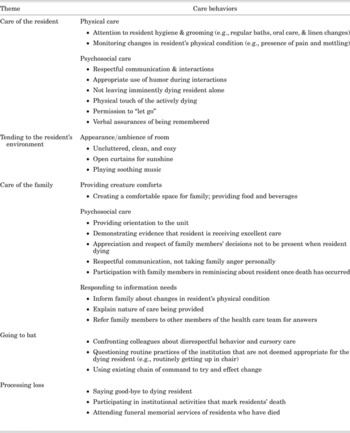
The overarching theme arising from the data was that of “caring as if it were my family.” This fundamental disposition, or ethos, appeared to underpin the behaviors identified by HCAs in this study. Examples of specific care behaviors associated with the subthemes of (1) care of the resident, (2) tending to the environment, (3) care of the family, (4) going to bat, and (5) processing loss are summarized in Table 1.
Specific care behaviors identified by health care aides

Care of the Resident
Care of the resident included two major dimensions: (1) physical care and (2) psychosocial care. As regards physical care, study participants were unequivocal about the need to ensure residents felt and appeared clean, secure, and comfortable. This was achieved through the provision of regular and thorough bed baths, linen changes, oral care, attention to resident grooming, and proper positioning. One of the aides asserted: “If somebody's dying it doesn't mean they should have less care. If anything they should have a bit more.”
Physical care of the resident also required that HCAs be vigilant in observing for changes in the resident's physical state. Pain and the mottling of extremities were the primary symptoms that aides in this study identified they watched for when providing care and reported to the registered nurse in charge of the unit. However, experts in this study had also learned to trust their instincts when they felt that there was some type of subtle deterioration in the resident that they could not specifically identify. Explained this aide:
Sometimes you go into that person's room and there's something different about them, there's something not right here. And you don't know if maybe their blood pressure has dropped. Its just something inside telling you, you know, there's something wrong here. That's when you get the nurse.
In describing the psychosocial care they provided to residents, participants stressed the importance of respectful communication and interactions. This was particularly salient when residents were confused and combative, such as can occur with those with Alzheimer's disease. Experts in this study had learned not to take such behaviors personally and stressed the importance of looking beyond such behavior to appreciate the individual resident for who he or she was. To appreciate the personhood of those in their care, HCAs interviewed indicated that they took the time to get to know about the lives of the residents they cared for. This knowledge helped them to focus on the resident in a more holistic way and appreciate various idiosyncrasies. An aide explained:
I love looking at their pictures on the wall. Before Alzheimer's set it, they are still Mrs. so and so. That part has never changed in them. They are still that person from beginning to end. And you have to sometimes look beyond that old crabby lady there.
HCAs also identified the importance of humor in interacting with the residents in their care. When used in an appropriate and sensitive manner, humor was seen as a way of diffusing a stressful situation and reassuring residents that their care was not burdensome to the aide. This aide recounted such an example:
You can joke with them. That's another thing that comes in handy. Like some of them, they might have a fear of they're going to fall. Like you're trying to transfer them from their wheelchair. And they say, you are going to make me fall. And I always say, I would never do that to you. And they just look at me and I say, it requires too much paper work if you do. You can only do that with some, you can't do it with all.
A specific set of behaviors emerged from the data with respect to the psychosocial care of the resident who was imminently dying. During such times, HCAs stressed the importance of not leaving the patient to die alone. Aides described the importance of providing soothing touch to the resident through stroking the forehead or holding a hand. Additionally they believed it was important to talk to the dying resident. During such conversations, they provided assurance to the residence that it was “okay to let go” and that they would “be remembered.” One aide recounted: “Sit beside them, hold their hand, let them know that you're there. Don't be afraid to touch them.”
Care of the Family
The theme “care of the family” included three major sub-themes: (1) providing creature comforts, (2) providing psychosocial care, and (3) responding to information needs.
As regards providing creature comforts, HCAs identified the importance of making sure that family members who were holding vigil at the bedside of a dying resident had places to sit and places to sleep if they were staying overnight and access to food and beverages.
The psychosocial care of family members involved orienting family members who did not visit often or who were from out of town to their surroundings and making them feel welcome on the unit. Aides identified that one of the most important things that they could to do help support family members was to demonstrate that their dying relative was receiving excellent physical and psychosocial care. The provision of such care was also seen as a way of building trust with family members. HCAs demonstrated to families that such care was happening by explaining the nature of care they were going to provide to the resident, checking in on the resident frequently during their shift, and completing the task checklist used in the facility that documents that such activities as turning and mouth care have been completed.
As regards psychosocial care, aides in this study stressed the importance of being nonjudgmental toward family members who chose not to be at the bedside of an imminently dying resident. Aides were able to appreciate that some family members may find such a vigil too difficult to experience and assured families that one of the aides would be with their dying relative as death drew near. Experts in this study indicated that this reassurance was much appreciated by families.
The psychosocial care provided to families did not end with the resident's death. In addition to conveying their sympathy to family members on the occasion of the resident's death, an important behavior identified by aides in caring for grieving family members was to appreciate the need for family members to reminisce about the departed. Aides often took an active role in the reminiscence, offering memories and stories about the resident they had experienced while caring for them. Said one of the aides:
Her father had just passed away. We were all giving the daughter support, and then we started talking about, do you remember when he did this? Or do you remember that? And then she laughed. She goes, oh yeah, I heard about that. And then it just blossomed from there.
As was identified by aides concerning communication and interaction with residents, not taking family anger or dissatisfaction with care personally emerged as being an important behavior in family care. Rather, aides explained that it was important to try and put themselves in the family members' shoes, and they recognized that family emotion and outbursts were usually reflective of the grief and loss being experienced.
Responding to family members' information needs required that HCAs speak with family members about changes in the resident's physical condition, particularly those indicative of decline, and explain the nature of care that was being provided. Participants in this study readily identified that there were some questions asked of them by family members they did not know the answers to. When this occurred, aides directed families to the registered nurse in charge of the unit to have their questions answered and then routinely followed up with families to ensure their questions had been answered.
Tending to the Environment
Much in the same way they provided meticulous physical care to residents, HCAs identified the importance of tending to the immediate environment of the resident's room, making it appear warm and welcoming as opposed to messy and cluttered. Behaviors identified to achieve this goal included putting away supplies involved in the resident's care, opening the curtains to allow sunshine into the room, and making use of the “comfort basket” that the facility had that contained a compact disc player and selections of soothing music that could be played in the residents' rooms. This aide remarked: “You know, you're not going to throw a party in there but, like they're still alive. If its daytime, have the curtains open!”
Going to Bat
Experts in this study had all identified a role for themselves in working with other members of the health care team to resolve issues they felt undermined the provision of optimal end-of-life care. This commitment to uncompromised practice included challenging other HCAs who provided care in a cursory or disrespectful manner and respectfully questioning decisions of registered nurses and institutional norms regarding dying residents' care. One health care aide stated:
One of my coworkers gave the residents no respect. In turning, it was like, you know, let's get this over and done with kind of thing. You could just tell in the motions she wanted it over and done with quickly. I don't condone that kind of behavior. I chose not to speak in front of the resident, but when I left, I said to her, you know, that lady is passing away. We can't treat her like that.
Study participants stressed the importance using the proper chain of authority to effect change. However, in instances where quick resolution of an issue could not be found, aides trusted their own instincts about what constituted the best care for dying residents in their charge. Sometimes, this meant nonadherence to institutional routines:
I've butt heads with a lot of nurses. Like with residents who are palliative or just regular residents who don't want to get up. And I said, fine, you know what, I'll get you up later. I'm here all day, whenever you're ready. And it was like the world was over. It was like how come they're not up yet? It's not like I can't feed them later. They don't want to get up. This is their home.
The HCAs interviewed in this study explained that they often developed very close attachments to residents for whom they cared, describing their relationship to be “like family.” Accordingly, aides recognized the significance of the losses they experienced when residents died. Said one of the aides:
Dealing with them passing away, its hard to watch them deteriorate. You almost feel as if you're part of the family because you're in this person's life. So you have to go through the whole grieving process yourself as well, which is hard.
Aides also stressed the importance of taking time to acknowledge and process these losses when they occurred. This was accomplished in several ways. Some aides identified the importance of going in to the deceased resident's room to pay their respects and say their final good-byes before the body was removed. Other aides explained that they felt it was important to collect the obituaries of the deceased and participate in the rituals held by the facility that marked the passing of residents who lived there, where staff could reminisce about the departed. When work schedules allowed, aides indicated that attending the funeral or memorial services of residents also helped them to process their loss.
DISCUSSION
Optimal end-of-life care is concerned with addressing physical and psychological issues; ensuring pain and symptom management; providing social, psychological, emotional, and spiritual support; and supporting family members (Emanuel & Librach, Reference Emanuel and Librach2007). Behaviors identified by the participants in this study are consistent with accomplishing these aims.
HCAs stressed the importance of providing scrupulous physical care to dying residents. The need for and importance of such care is borne out in the literature. A study conducted by Hanson et al. (Reference Hanson, Eckert and Williams2008) examining the symptom experiences of dying long-term care residents (N = 363) indicated that 90% of residents will “always” or “almost always” need assistance with mouth, skin, and perineal care. Moreover, such care is an integral part of ensuring comfort and preventing skin irritation, breakdown, and infection (Bliss et al., Reference Bliss, Zehrer and Savik2007).
Monitoring the resident's condition for the presence of pain and mottling of extremities was identified as important care behaviors by HCAs. Although these clinical issues are important, with pain consistently reported as being undertreated in personal care home settings (Trask et al., Reference Trask, Teno and Nash2006), there are a myriad of additional symptoms dying long-term care residents experience such as dyspnea, anorexia, dehydration, delirium, depression, and anxiety (Reynolds et al., Reference Reynolds, Henderson and Schulman2002; Hanson et al., Reference Hanson, Eckert and Williams2008). It is possible that additional symptoms may have emerged if more interviews had been conducted. However, these findings suggest that education of HCAs about other symptoms that occur at the end of life is needed, a sentiment echoed by both the literature (Phillips et al., Reference Phillips, Davidson and Ollerton2007) and HCAs in this study.
The use of humor in the provision of end-of-life care emerged as an important behavior and was deemed particularly valuable in helping aides deal with challenging care situations. The value and function of humor in providing end-of-life care has empirical support. Research examining the phenomena of humor and laughter in the context of palliative care reveals that, when used appropriately, humor provides tension relief and respite from challenging situations for both patient and care provider and helps to preserve patient dignity (Dean & Gregory, Reference Dean and Gregory2004).
HCAs stressed the importance of tending to the dying resident's environment. In addition to rooms being tidy, the behavior of opening curtains to let the sunshine in was one that aides universally endorsed. The influence of environmental aesthetics has been identified in the literature as influencing one's physical and psychological health (Caspari et al., Reference Caspari, Eriksson and Nåden2006), with lighting playing a particularly important role (Beauchemin & Hays, Reference Beauchemin and Hays1996, Reference Beauchemin and Hays1998; Dowling et al., Reference Dowling, Hubbard and Mastick2005). Beyond mere aesthetics, tending to the environment in this way was confirmation of the fact that the resident, though dying, was “still alive,” and the care surroundings should reflect this. Philosophically, this care behavior is consistent with the emphasis on “living while dying” espoused by palliative care.
Ensuring respectful communication between HCAs, residents, and their families goes far beyond mere social courtesy. Research demonstrates that patient perceptions of dignity are related to and affected by the tenor of interactions they have with health care providers. Chochinov et al. (Reference Chochinov, Kristjanson and Hack2006) reported that 87% of a sample of 211 palliative cancer patients endorsed the items “not being treated with respect or understanding” and “feeling a burden to others” as one of the two most important issues having an influence on their sense of dignity. Research demonstrates that consistently feeling that one is a burden to others is a significant factor in suicidal behavior; therefore the importance of the tenor that HCAs assume when caring for and interacting with residents cannot be overemphasized.
The importance of responding to family members' need for information and providing psychosocial care identified by participants in this study are echoed repeatedly in palliative and end-of-life care literature (Goodridge et al., Reference Goodridge, Bond and Cameron2005; Brazil et al., Reference Brazil, Krueger and Bedard2006; Vohra et al., Reference Vohra, Brazil and Szala-Meneok2006; Carlson, Reference Carlson2007; Rhodes et al., Reference Rhodes, Mitchell and Miller2008). In addition to meeting these needs in the clinical moment, research has demonstrated that family member satisfaction with both patient care and having their information needs met has a positive impact on family members' health and functioning in the bereavement period (Kristjanson et al., Reference Kristjanson, Sloan and Dudgeon1996). Thus, the ability of HCAs as well as other members of the health care team to meet information needs has implications for family care planning.
The theme “going to bat” and its attendant behaviors that emerged in this study are analogous with descriptions of advocacy in the nursing literature as they relate to the unique relationship between patient and caregiver, the nurse pleading the cause of the patient and interceding on the patient's behalf. It is unknown if the participants in this study had formal education in the area of advocacy. However, consistent with findings reported by Vaartio et al. (Reference Vaartio, Leino-Kilpi and Salantera2006), lack of formal education does not appear to preclude caregivers from being able to describe and participate in advocacy-related activities in the provision of care. HCAs appeared to adopt both an individual approach to advocacy, when they confronted colleagues about what they perceived to be substandard care, and a more systems-based approach when they appealed to unit managers that changes within the institution occur that were in the best interest of the resident.
It is clear from this study that HCAs need time to process the losses they experience when residents die. All of the aides who participated in this study indicated they had developed long-standing, close relationships with many of the residents they cared for and consistently described these residents as being “just like family.” Such long-term relationships allowed HCAs to learn about the life experiences of the person and family, decipher residents' emotional responses and detect early changes in their physical condition, and understand family dynamics. This knowledge was seen as being critical to HCAs in order to provide holistic care for residents and their families; however, it also meant that aides experienced feelings of acute grief and loss when these same residents died. Filial characterizations of the health care aide relationship have been previously identified in the literature (Chichin et al., Reference Chichin, Burack and Olson2000; Moss et al., Reference Moss, Moss and Rubinstein2003). More than simply capturing the close ties that exist between aides and residents, however, research conducted by Moss et al. (Reference Moss, Moss and Rubinstein2003) suggests that the metaphor of “family” in staff communication about dying and death serves some important functions. Their ethnographic study of bereavement in long-term care revealed that long-term care staff used the metaphor of family to manage their grief and legitimize self-oriented feelings of loss in response to the death of the resident and work-oriented feelings of loss in response to the severing of the caregiving relationship. Given that unresolved loss may contribute to staff burnout, job dissatisfaction, and employee turnover (Anderson, Reference Anderson2008), administrators of personal care homes would be well advised to provide opportunities for staff to process and find meaning in resident deaths when they occur.
Future Directions
Though the sample size in this pilot study is small and male health care aide perspectives are underrepresented, the preliminary findings provide direction for future research. The behaviors identified by experts in this study speak to the importance of developing and evaluating educational initiatives for HCAs about (1) the multiple symptoms that commonly arise as death draws near, (2) ways of communicating and interacting effectively with dying residents and their families, and (3) the importance of reflecting upon and processing the losses they experience in the course of caring for dying residents. Ongoing research is needed that examines the type of educational approaches that HCAs would find most helpful in enhancing their expertise in providing end-of-life care. Psychometrically sound and meaningful outcome indicators are also needed to capture the impact of such educational initiatives from the perspectives of residents, families, nursing home administrators, and staff. The issue of health care aide as advocate also warrants further research. Future work in this area might explore HCAs' beliefs and perceptions regarding the nature of advocacy, and the compatibility or congruence between health care aide advocacy behavior and resident autonomy.