Introduction
Globally, an estimated 15 million babies are born preterm every year.Reference Blencowe, Cousens and Oestergaard 1 With improvements in perinatal care, the majority of preterm infants born in the developed world are now expected to survive and form an increasingly prevalent part of the adult population.Reference Doyle 2 Although the short-term consequences of preterm birth are well described, there has been less attention given to the potentially detrimental effects of preterm birth on adult health, in part owing to the inherent difficulty of prospectively following clinical cohorts for many decades. However, recent data have implicated preterm birth as an additional risk factor for cardiovascular and metabolic disease with evidence in ex-preterm adults of dysfunction across all of the cardinal markers of cardiovascular health; increased blood pressure,Reference Johansson, Iliadou and Bergvall 3 , Reference Bonamy, Bendito and Martin 4 clinical hypertension,Reference Crump, Winkleby, Sundquist and Sundquist 5 altered structure and function of the heartReference Lewandowski, Bradlow and Augustine 6 , Reference Lewandowski, Augustine and Lamata 7 and vasculature,Reference Schubert, Muller, Bonamy, Abdul-Khaliq and Norman 8 altered cardiac electrical signal transmissionReference Bassareo, Fanos and Puddu 9 as well as reduced insulin sensitivity.Reference Tinnion, Gillone, Cheetham and Embleton 10 In humans, the latency between birth and middle- or old-age in human studies make it difficult to establish causality between events in perinatal life and adult health and also limit the speed with which new knowledge can inform patient care. In addition, there are often multiple potentially confounding socio-economic factors in the human ex-preterm population.Reference Glinianaia, Ghosh and Rankin 11 The available data do, however, raise important questions about the life course cardio-metabolic vulnerability of those born preterm, and ultimately, the potential impact of preterm birth on non-communicable disease rates and global healthcare expenditure.
To date, there is limited direct experimental data to help understand the mechanisms linking preterm birth with adult cardio-metabolic health outcomes. Although pigs and sheep are valuable models of preterm birthReference Sangild, Thymann and Schmidt 12 , Reference Berry, Jaquiery, Oliver, Harding and Bloomfield 13 that have been fundamental to improvements in short-term health outcomes, longitudinal studies following large animals into old age are constrained by significant logistical issues. Conversely, standard term-born laboratory rodents are extremely small, immature and foetal-like with many key organ maturational events occurring postnatally rather than antenatally. Guinea pigs, however, have a long gestation length (69–71 days) and deliver precocial young. Like humans, guinea pigs have a haemochorionic placenta and the foetus develops significant adipose stores during late-gestation. In addition, their cardiovascular and metabolic characteristics are well describedReference Kind, Clifton and Grant 14 – Reference Leite, DeOgburn and Ratliff 16 and they mature rapidly, enabling life course and intergenerational studies. Preterm operative delivery and short-term survival is possible and has been used to explore some of the adaptive short-term responses to preterm birth at the margins of viability.Reference Dyson, Palliser, Kelleher, Hirst and Wright 17 However, maternal–infant interaction is recognized to influence later cardio-metabolic function; in adult mice, poor maternal care is associated with increased blood pressure and altered hypothalamic–pituitary–adrenal function,Reference Matthews, Samuelsson and Seed 18 whereas the early mother–infant bonding of guinea pigs appears to influence neurodevelopmental outcomes.Reference Hennessy 19 Development of a model of medically induced preterm birth, with preservation of mother–infant bonding and good long-term postnatal survival would therefore significantly improve our ability to systematically investigate the long-term sequelae of preterm birth.
Methods
All interventions were conducted with the prospective approval of the University of Otago, Wellington, Animal Ethics Committee. Breeding Dunkin Hartley sows were group housed with other mature females. At oestrous they were placed with a proven male for 24 h, then returned to the female group pen. Day of mating was taken as day 0 of a 69-day pregnancy.
Sows randomized to term delivery had no further interventions during pregnancy. Within 12 h of birth, term-born pups were weighed, measured and gestational age was recorded. Pups and their mothers remained in the nursery pen with free access to standard chow and fresh fruit/vegetables until weaning on postnatal day 21. Term-born pups received no interventions to support respiratory function, nutrition or hydration.
Preterm parturition (62 days gestation)
Betamethasone [1 mg/kg subcutaneously (SC); celestone chronodose; Merck, Sharp & Dohme, Auckland, New Zealand] was given 48 and 24 h before planned delivery of the pups to accelerate foetal lung maturation, mimicking standard care for women at risk of preterm birth. 20 This betamethasone dose is equivalent to that used clinically, given the relative glucocorticoid resistance of the guinea pig.Reference Owen and Matthews 21 At 24 h before, and on the morning of delivery, a progesterone receptor antagonist, aglepristone 10 mg/kg (a standard dose used for early termination of pregnancy in small animal veterinary practice; Provet, Palmerston North, New Zealand) was given SC to pharmacologically abolish progesterone-induced continuance of pregnancy. At 1 h after the second aglepristone dose, oxytocin 3 IU/kg i.m. (Provet) was given to stimulate maternal uterine activity. Repeat doses of oxytocin were administered at 30-min intervals until all pups and placentas were expelled. Irrespective of litter size, most sows delivered within 2 h of commencing oxytocin [median, four doses (1.5 h); range, four to six doses (1.5–2.5 h)]. No sows treated with aglepristone and betamethasone started to labour before commencement of oxytocin.
Resuscitation
At delivery, preterm pups were transferred to a heated pad with an overhead heat lamp, briefly dried, covered in plastic wrap to minimize evaporative heat loss and stimulated (gentle rubbing of the chest wall) to encourage spontaneous respiratory effort.
Respiratory support was provided using a Neopuff infant T-piece resuscitator (Fisher & Paykel, Auckland, New Zealand) with blended air and oxygen delivered at 5 l/min. Apnoeic pups receive an initial 3 s inflation breath at an inspiratory pressure of 15 cmH2O, followed by positive pressure ventilation at a rate of 60/min, with an inflation pressure of 12 cmH2O and an expiratory pressure of 5 cmH2O until spontaneous respiratory effort was observed. Pups with adequate respiratory drive but increased respiratory effort received continuous positive airway pressure (CPAP) support at 5 cmH2O. All preterm pups requiring respiratory support received an initial fractional inspired oxygen concentration of 30% that was up-titrated according to changes in the animals colour, heart rate, respiratory status and activity.
Once stable, pups were transferred to a warm humidified human infant incubator (Dräger 8000 IC; Drägerwerk AG & Co., Lübeck, Germany; ambient temperature 30°C, 70% humidity) with 1 l/min 100% O2 delivered to the incubator for the first 12 h. Incubator settings were reduced sequentially to 28°C and 30% humidity in progressive daily decrements of 0.5°C and 10% humidity.
Nutrition and postnatal care
No preterm pups were able to suckle feed for the first 48 h of life. Maternal milk was therefore expressed manually 3 h to ensure lactation become established pending effective suckling.
Regular perineal stimulation using a cotton bud moistened with warmed saline was required to stimulate voiding and passage of stool for at least the first 2 days of life or until suckling, and maternal grooming of the pup was observed.
Within the 1st hour of birth, and then 3 h for the first 24 h, all preterm pups received 0.3–0.5 ml guinea pig replacement colostrum (Impact guinea pig colostrum replacement; Wombaroo Food Products, Adelaide, Australia) via a 1 ml insulin syringe. In addition, preterm pups required saline 0.5 ml SC at 12 h for the first 24–48 h to support hydration.
During postnatal days, two to seven preterm pups were fed 3 h with 0.5–1.5 ml guinea pig replacement milk (Impact guinea pig milk replacement; Wombaroo Food Products) as needed to supplement independent feeding attempts. Term-born pups start eating solid food soon after birth, and preterm pups attempt solids from about postnatal day 5. From day 5 onwards, an increasing amount (0.5–2 ml) of fruit-based proprietary baby weaning food mixed with milk was given via syringe in addition to milk feeds. All supplemental feed was discontinued at postnatal day 7 [i.e. term equivalent age (TEA)].
On the day before TEA, sows and pups were transferred from the infant incubator to a standard single cage at ambient room temperature, then, after 48 h, to the nursery pen with other sows and pups.
Growth assessment
All pups were weighed and measured at birth, and regular intervals until weaning on corrected postnatal day 21. Ponderal index was calculated as a proxy for adiposity using weight/linear length (crown rump length+hind limb length).Reference Johansson, Iliadou and Bergvall 3
Data were analysed using JMP v10 (SAS Institute Inc., Cary, NC, USA). As growth is sexually dimorphic, growth outcomes were assessed in same-sex group using ANOVA. Statistical significance was set at a P-value of <0.05.
Results
Only outcomes for live-born animals are reported. Term-birth occurred at a median of 69 days (range: 67–73 days). There was a spontaneous term stillbirth rate of ~10%, and one preterm pup was stillborn. There was no adverse maternal morbidity or mortality following preterm induction of labour.
The majority of the preterm pups required positive pressure ventilation to support birth transition and establish independent respiratory effort, followed by CPAP for up to 1 h.
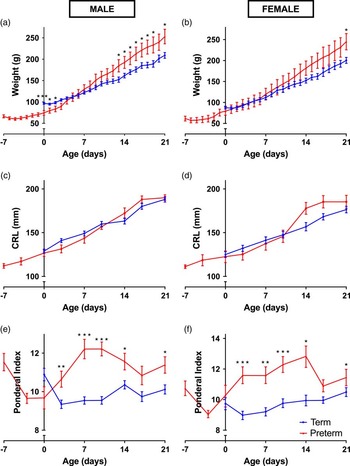
At birth, preterm pups were smaller than term-born pups. However, by TEA, weight, length and ponderal index of preterm females was not different to that of term-born females, whereas preterm males remained significantly lighter than term-born males until day 2 corrected postnatal age (Fig. 1). Weight between birth and weaning, but not linear growth, was greater in preterm-born than term-born pups with a resultant increase in ponderal index (Fig. 1).
Growth in preterm guinea pigs; birth to weaning. Weight (a, b), crown-rump length (c, d) and ponderal index (e, f) in male (left column) and female (right column) guinea pigs. Preterm pups are shown in red, term-born pups in blue. Data are mean±s.e.m. *P<0.05, **P<0.01, ***P<0.001.

Survival to weaning of preterm pups was less than for term-born pups (Table 1).
Survival rates in preterm guinea pigs

Discussion
Translational animal paradigms of human disease allow interrogation of the mechanistic basis of disease and thereby development of new strategies for disease prevention or treatment. We report a novel experimental paradigm in which preterm parturition is imposed on an otherwise healthy pregnancy in a standard laboratory species. Importantly, we have demonstrated that long-term survival of pups born at moderate preterm gestation is achievable with provision of care analogous to the required by human infants born moderately preterm (29–31 weeks gestation). This is an essential step towards new research initiatives in which the long-term and second-generation effects of preterm birth can be comprehensively assessed in a timely manner across the life continuum.
Ascribing precise gestational age ‘equivalents’ between humans and any other animal species is fraught, as no species can precisely ‘model’ the developmental trajectories and maturational pathways of another. However, based on lung maturation characteristicsReference Sosenko and Frank 22 and the need for intervention to support respiration, thermoregulation and nutrition, our preterm pups share many of the anatomical and functional characteristics of a 29–31 week gestation human infant. In addition, our paradigm is not intended to reflect the complexities of the extremely preterm infant. Rather, infants born at moderate- and late-preterm gestations represent 85% preterm populationReference Martin, Hamilton, Osterman, Curtin and Mathews 23 and thus pose the greatest potential public health burden of adult morbidity consequent on preterm birth.Reference Crump, Winkleby, Sundquist and Sundquist 5 , Reference Dalziel, Parag, Rodgers and Harding 24
Compared to other paradigms of preterm birth in small animals,Reference Dyson, Palliser, Kelleher, Hirst and Wright 17 , Reference Sosenko and Frank 22 , Reference Heinzerling, Liedel and Welak 25 we believe that our medical induction of labour confers significant theoretical and survival advantages. First, the combination of progesterone blockade followed by stimulation of uterine activity and vaginal delivery more closely emulates the normal parturition process. Pups are not exposed to the effects of maternal anaesthesia for caesarean section, and the physiological benefits of vaginal v. operative delivery for neonatal birth transition are well described.Reference Hansen, Wisborg, Uldbjerg and Henriksen 26 Second, induced vaginal birth enables pups to be reared by their mother. Although unlikely to alter short-term adaptive responses, in other species adequacy of early maternal care plays a major role in later cardio-metabolic function,Reference Matthews, Samuelsson and Seed 18 whereas in the guinea pig, the sow–pup interaction appears to have implications for neurodevelopment,Reference Hennessy 19 making it desirable to maintain as near normal sow–pup interaction as possible. Finally, as expected, the early mortality rate for animals born preterm was greater than for term-born animals. Although previous studies have reported increased early mortality rates in males pups born preterm,Reference Dyson, Palliser, Kelleher, Hirst and Wright 17 we have insufficient numbers to draw definite conclusions about sex-specific mortality in this paradigm.
The altered growth characteristics of preterm pups compared with those born at term highlight the need for on-going detailed assessment of growth, fat partitioning and metabolic function. In particular, the apparent divergence in ponderal index between preterm and term-born animals is intriguing. Whether this reflects an effect of gestational age per se, or the impact of early nutritional intervention is unclear. However, all pups had free access to their mothers, and all preterm pups had established independent suckle feeding with discontinuation of nutritional supplementation by TEA when there was little difference in growth metrics between cohorts. It remains possible that the imposition in early life of time-dependent, rather than hunger-dependent feeds or provision of supplemental formula milk rather than maternal milk may have altered later appetite regulation and/or energy homoeostasis. However, it should be noted that many of the potential explanations above equally apply to the preterm human infant and therefore do not detract from the utility of the paradigm.
Antenatal corticosteroid exposure was universal in our preterm animals. Steroid-naïve preterm birth in experimental animals is associated with significant mortalityReference De Matteo, Blasch, Stokes, Davis and Harding 27 and, in humans, corticosteroid treatment to women at risk of preterm birth significantly reduces neonatal morbidity and mortality, and is the international gold-standard of care. 20 The vast majority of individuals born preterm, therefore, have also been exposed to antenatal corticosteroids. The corticosteroid dose and timing of administration relative to birth of the pups is comparable with that seen in clinical practice. Consequently, our approach combining clinically relevant corticosteroid exposure with preterm birth is a pertinent experimental paradigm that closely replicates the human scenario.
In conclusion, we have developed a viable guinea pig model of preterm birth that emulates the human clinical condition. This represents a major advance in our ability to investigate the long-term sequelae of preterm birth, and their mechanistic basis. Given the increasing prevalence of adult survivors of preterm birth, new translational biomedical paradigms are urgently needed to inform appropriate health surveillance and anticipatory guidance for those already entering middle age. For infants and young children born preterm, greater understanding of the mechanistic basis of these late effects may result in new strategies to ameliorate or prevent this latent health ‘cost’ of preterm birth.
Acknowledgements
The authors gratefully acknowledge the assistance given by Hannah Palliser and Jonathon Hirst in sharing their expertise with guinea pigs.
Financial Support
This study was supported by funds from the Department of Paediatrics and Child Health, University of Otago, Wellington and project grants awarded to MB from the University of Otago, The Neonatal Trust, Wellington and The Royal Australasian College of Physicians.
Conflicts of Interest
None.
Ethical Standards
All animal work performed is in agreement with the ethical standards and guidelines presented by the Guide for the Care and Use of Laboratory Animals, 8th edition, and the National Animal Ethics Advisory Committee of New Zealand. All work was carried out with prospective approval of the University of Otago, Wellington Animal Ethics Committee.