Introduction
Maize, Zea mays L. (Poaceae), is a staple crop that can alleviate the global food crisis. The grains must be stored to ensure a steady supply of food, earn better income when market prices go up, and provide seeds to grow in the next planting season. Unfortunately, stored maize is vulnerable to attack by insect pests.
Maize weevil, Sitophilus zeamais (Coleoptera: Curculionidae), is the most important insect pest that adversely affects maize in storage (Adedire, Reference Adedire, Ofuya and Lale2001). Post-harvest losses have been recognized as an increasingly important problem in Africa (Markham et al., Reference Markham, Bosque-Pérez, Borgemeister and Meikle1994; Adedire et al., Reference Adedire, Akinkurolere and Ajayi2011). Infestation commences in the field, but most damage is done during storage (Demissie et al., Reference Demissie, Tefera and Tadesse2008; Osipitan et al., Reference Osipitan, Adebowale, Mohammed and Adekanmbi2012). Damaged grains have reduced nutritional and market values, and reduced weight and germination potential (Abebe et al., Reference Abebe, Tefera, Mugo, Beyene and Vidal2009; Adedire et al., Reference Adedire, Akinkurolere and Ajayi2011; Nwosu and Nwosu, Reference Nwosu and Nwosu2012). Losses from S. zeamais infestation range across the world from 20 to 90% in unprotected grains (Giga et al., Reference Giga, Mutemerewa, Moyo and Neeley1991), consequently affecting food security in countries dependent on maize.
Chemical insecticides that are widely used to control insect pests of stored products, particularly, the maize weevil, are often effective but have harmful effects on human health and the environment. Research is, therefore, important in developing alternative pest control measures. Mwololo et al. (Reference Mwololo, Mugo, Okori, Tefera, Otim and Munyiri2012) show that the use of resistant varieties can provide a feasible and economical way of reducing grain losses from infestation and damage by the maize weevil. It is, therefore, important to test new maize varieties routinely for resistance to insect pests of stored products (Adedire et al., Reference Adedire, Akinkurolere and Ajayi2011).
Materials and methods
Test maize varieties
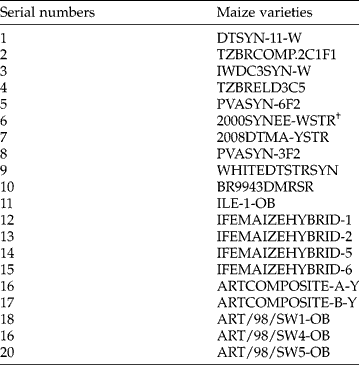
The 20 new and improved varieties used in the study are presented in Table 1. The first 10 were obtained from Maize Breeding Unit, International Institute of Tropical Agriculture, and the remainder from Maize Breeding Unit, Institute of Agricultural Research and Training, both in Ibadan, Nigeria. Variety 2000SYNEE-WSTR was previously found to be resistant against S. zeamais infestation (Nwosu et al., Reference Nwosu, Adedire and Ogunwolu2015).
The 20 new and improved maize varieties used in the study
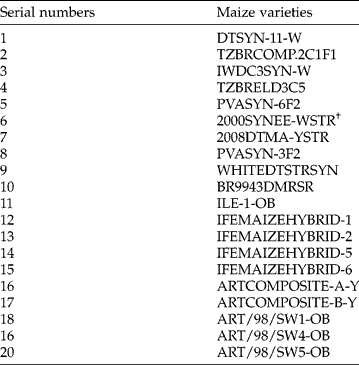
Maize varieties 1 to 10: IITA, Ibadan, Nigeria; Maize varieties 11 to 20: IAR&T, Ibadan, Nigeria.
† Check maize variety.
Grains were cleaned and kept in a deep freezer at − 20 ± 2 °C for 1 week to disinfest them, then air-dried to prevent mould growth, and stored at 4 °C to prevent re-infestation. Before commencement of these experiments, grains were kept for 2 weeks in muslin-covered plastic containers under experimental conditions for acclimatization and stabilization of moisture content at 12–13% (Abebe et al., Reference Abebe, Tefera, Mugo, Beyene and Vidal2009).
Weevil culture
A population of S. zeamais was obtained from the Storage Research Laboratory of the Biology Department, Federal University of Technology Akure, Ondo, Nigeria. Cultures of the pest species were established to supply a population of similar age for the experiments. Twenty-five kilogrammes of the susceptible variety, Bende White, was procured from Umuahia Main Market, Abia State, Nigeria, and cleaned to eliminate grains with visible damage. The cleaned grains were stored in a refrigerator at − 4 °C until needed, then transferred to polythene bags and air-dried before use. Adult maize weevils (100/500 g of grain) were maintained in each of seven containers (25 cm height and 15 cm diameter). The containers were covered with muslin cloth (each lid with a hole of 15 cm diameter) to allow aeration and prevent insect escape. Seven days after oviposition, all parent S. zeamais were removed from each container and placed on another set of grains kept at the same conditions. Removal of parent S. zeamais and transfer to a fresh medium was repeated until sufficient laboratory-reared insects of known age were available for the study.
Determination of adult emergence and susceptibility index
Two pairs of newly emerged adults (1–5 days old) were introduced into each transparent container (diameter 11 cm and height 4.5 cm) containing 20 g of a maize variety. This was replicated four times and kept for 7 days for oviposition. The containers were arranged in a completely randomized design on the laboratory workbenches. Mortality was assessed 7 days after introduction of S. zeamais, then all weevils (dead or alive) were removed after sieving using an aluminium sieve (2.66 mm mesh size). The grains were kept under the same experimental conditions to monitor and assess the emergence of F1 progeny on a daily basis. Emerging adults were also counted per container, from the first day of emergence, on a daily basis. Owing to delayed emergence, and to ensure that all F1 progeny had emerged, observation was extended to 56 days (Abebe et al., Reference Abebe, Tefera, Mugo, Beyene and Vidal2009).
The susceptibility index at F1 was calculated using the method developed by Dobie (Reference Dobie1974) as follows:
 $$\begin{eqnarray} \end{eqnarray}$$
where Ln is the natural logarithm, F1 is the total number of first-generation emerged adults and D is the median development time. (Days from middle of oviposition period to emergence of 50% of the F1 progeny were taken as the median development time.)
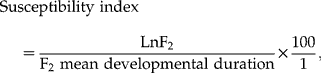
On day 56, all F1 adults were discarded, leaving behind their eggs. Thereafter, daily observation and counting of the F2 generation was performed over the next 33 days (Asawalam et al., Reference Asawalam, Emosairue, Ekeleme and Wokocha2007). A new formula for determining the susceptibility index at F2 was derived from Dobie (Reference Dobie1974) as follows:
 $$\begin{eqnarray} \end{eqnarray}$$
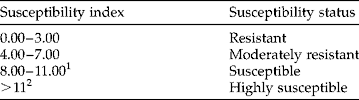
where F2 mean time of development = 0.5 (Terminal time [in days] of F1 assay − Time [in days] of first emergence of F1 adults)+(Time [in days] taken for approximately 50% of F2 adults to emerge). Screened varieties were rated at F1 and F2 generations using Dobie's Index (Dobie, Reference Dobie1974) classification modified in this study (Table 2).
Scale for rating the susceptibility index of the 20 maize varieties tested for resistance to infestation and damage by Sitophilus zeamais
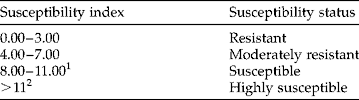
1 The range in Dobie's classification is 8.00–10.00.
2 The range in Dobie's classification is ≥ 11.00.
Assessment of maize grain damage at 56 and 90 days post-infestation by weevils
Damage in terms of holed grains, grain weight loss and weight of grain powder at 56 and 90 days post-infestation was evaluated following the guidelines of Tefera et al. (Reference Tefera, Mugo and Likhayo2011), except that all grains were examined.
Statistical analysis
Data obtained in the study were subjected to analysis of variance using the SPSS Statistics 17.0 Software. Significantly different means were assessed using least significant difference (LSD). A 5% probability level was considered for all statistical inferences.
Results
Maize varietal effect on Sitophilus zeamais adult emergence and susceptibility index
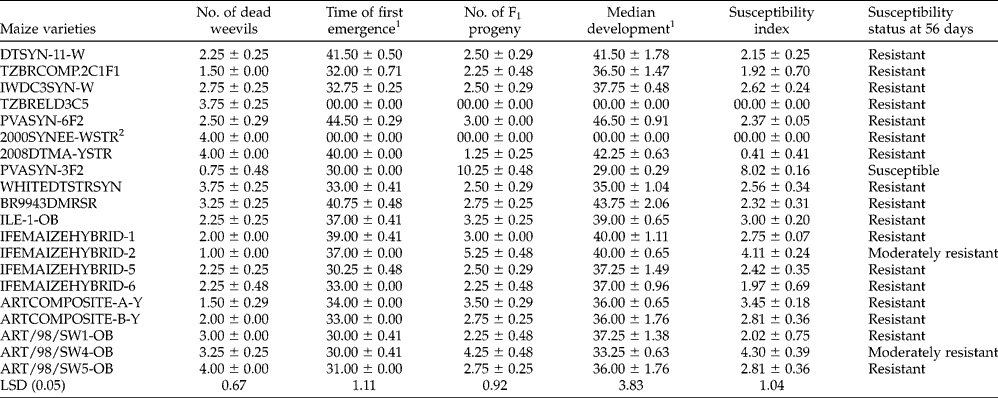
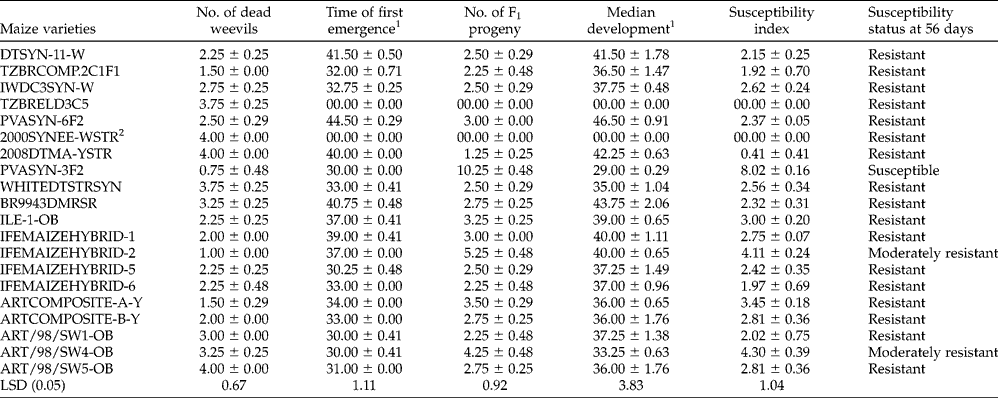
Differences observed in the adult mortality of weevils fed with the test varieties were significant (LSD = 0.67). Sitophilus zeamais fed with PVASYN-3F2 maize comparatively experienced the lowest (0.75) mortality; weevils fed with 2000SYNEE-WSTR, 2008DTMA-YSTR and ART/98/SW5-OB had the highest (4.0) mortality after 7 days of exposure. Numbers of dead weevils ranged from 1 to 3.75 in the other maize varieties (Table 3).
Maize varietal effect on Sitophilus zeamais bionomics (F1) and varietal susceptibility at 56 days post-infestation
All values are expressed as mean ± standard error of four replicates.
1 In days.
2 Check maize variety.
Significant differences among test varieties occurred at the time of first emergence of F1 progeny of S. zeamais (LSD = 1.11). The earliest emergence was from PVASYN-3F2, ART/98/SW1-Y and ART/98/SW4-OB at day 30 post-infestation. Delayed emergence at day 44 post-infestation was observed in PVASYN-6F2. In the other test varieties, the time of first emergence ranged from day 30.25 to day 39 (Table 3). There were significant differences in the number of F1 progeny (LSD = 0.9). Weevils did not emerge from TZBRELD3C5 and 2000SYNEE-WSTR for an assessed period of 56 days. Meanwhile, the highest number was 10.25 of F1 progeny in PVASYN-3F2; in the other varieties it ranged from 1.25 to 5.25 (Table 3).
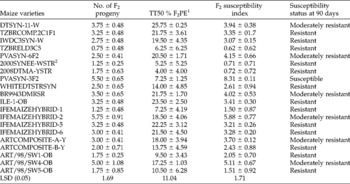
Significant differences also occurred in the number of F2 progeny that emerged from the test varieties (LSD = 1.69). The fewest F2 weevils (0.75) emerged from TZBRELD3C5; the most (5.75) from IFEMAIZEHYBRID-2. In the other varieties, the number of emerged F2 adult S. zeamais ranged from 1.25 to 5.5 (Table 4).
Maize varietal effect on Sitophilus zeamais bionomics (F2) and varietal susceptibility at 90 days post-infestation

All values are expressed as mean ± standard error of four replicates.
1 Time taken for 50% of F2 progenies to emerge.
2 Check maize variety.
The median development time of S. zeamais to F1 on the test varieties differed significantly (LSD = 3.83). There was no development to the adult stage on TZBRELD3C5 and 2000SYNEE-WSTR; the longest median development period (46.50 days) was on PVASYN-6F2. Median development time on other varieties ranged from 29 to 43 days (Table 3).
The F1 susceptibility index of the sampled elite varieties differed significantly (LSD = 1.04). The lowest index (0.0) was on TZBRELD3C5 and 2000SYNEE-WSTR; the highest (8.02) was recorded in PVASYN-3F2. The susceptibility index of the other varieties ranged from 0.41 to 4.30. Comparatively, all the varieties (except TZBRELD3C5 that showed equal inherent ability) were more susceptible than 2000SYNEE-WSTR (the check variety) that had the lowest index. Using 2000SYNEE-WSTR as ‘standard’, 16 varieties were classified as resistant, 2 were moderately resistant, and 1 was susceptible (Table 3).
The correlation of susceptibility index and time of the first emergence of S. zeamais (r= − 0.59) and weevil mortality on day 7 (r= − 0.65) were negative and significant (P= 0.05). The susceptibility index was positively and significantly (P≤ 0.05) related to the number of F1 (r= 0.98) and F2 (0.76) progeny. Correlation of the susceptibility index and median development time of weevils (r= 0.04) were positive and insignificant. Percentage grain damage (r= 0.98), percentage grain weight loss (r= 0.54) and weight of grain powder (r= 0.82) at 56 days post-infestation and r= 0.48, 0.83 and 0.80, respectively, at 90 days post-infestation showed positive and significant correlations with the susceptibility index.
Significant differences were observed in the time taken for 50% of the F2 progeny to emerge (LSD = 11.04) and the susceptibility index at F2 generation (LSD = 1.71) (Table 4). Variety 2008DTMA-YSTR had the shortest time (4 days) for approximately 50% of the F2 progeny to emerge; DTSYN-11-W maize had the longest (25.75 days). In the other test varieties, the time ranged from 5.25 to 23.50 days. Extension of the emergence period of F1 to 56 days did not affect all F2 data. Susceptibility index at F2 was lowest (0.62) in TZBRELD3C5, highest (8.31) in PVASYN-3F2 and ranged from 0.71 to 5.88 in the other test varieties. In terms of susceptibility status at F2, the number of resistant varieties went down from 17 (85.0%) to 13 (65.0%), the moderately resistant varieties increased from 2 (10%) to 6 (30%), and no change occurred in the number of susceptible varieties (Table 4).
The results of the correlation of F2 index of susceptibility and number of F2 emerged progeny (correlation coefficient, r= 0.93), percentage grain tunnelling (r= 0.55), percentage weight loss (r= 0.73) and weight of grain powder at 90 days (r= 0.70) were positive and significant. However, the correlation of susceptibility index at F2 and time taken for approximately 50% of the F2 progeny to emerge were positive and insignificant (r= 0.41).
Varietal differences in maize grain damage at 56 and 90 days post-infestation of Sitophilus zeamais
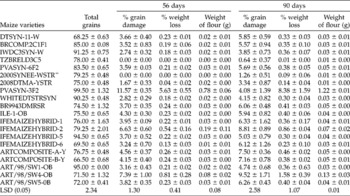
Significant differences occurred in percentage grain damage (LSD = 1.30), percentage grain weight loss (LSD = 0.41), and weight of grain powder (LSD = 0.08) due to weevil attack after 56 days of infestation (Table 5). TZBRELD3C5 and 2000SYNEE-WSTR (the check maize) did not have holed grains. Damaged grains in other test varieties ranged from 1.67 to 7.39%; the highest percentage (11.57%) was obtained in PVASYN-3F2. Weight loss was least (0.0%) in TZBRELD3C5 and 2000SYNEE-WSTR. The largest weight loss (5.63%) was in PVASYN-3F2. Weight loss in the other test varieties ranged from 0.04 to 0.81%. TZBRELD3C5 and 2000SYNEE-WSTR did not produce any grain powder after 56 days of infestation. Powder produced by other test varieties ranged from 0.01 to 0.19 g (Table 5). The most (0.78 g) was produced by PVASYN-3F2.
Maize varietal effect on grain damage at 56 and 90 days post-infestation by Sitophilus zeamais

All values are expressed as mean ± standard error of four replicates.
+ Check maize variety.
There were also significant differences in percentage grain damage (LSD = 2.58), percentage grain weight loss (LSD = 1.07) and weight of grain powder (LSD = 0.01) among sampled varieties after 90 days of infestation. The lowest percentage of damaged grains (0.64%) was observed in TZBRELD3C5 and the highest (16.30%) in PVASYN-3F2. Grain damage ranged from 1.26 to 8.81% in the other test varieties. Weight loss was least (0.01%) in TZBRELD3C5 and most (8.38%) in PVASYN-3F2. Loss in grain weight in the rest of the test varieties ranged from 0.14 to 1.58%. Varieties TZBRELD3C5, 2000SYNEE-WSTR and 2008DTMA-YSTR produced the least (0.01 g) grain powder. The most (1.22 g) was produced by PVASYN-3F2. Grain powder in the other varieties ranged from 0.03 to 0.13 g (Table 5).
Damage and loss due to S. zeamais (in terms of percentage grain damage, percentage weight loss and weight of grain powder) relatively increased over the period of storage.
Discussion
Impact of maize varietal differences on Sitophilus zeamais bionomics and on grain susceptibility to the weevil
The significant differences found in this study, in the mortality response of adult S. zeamais to infestation of maize grains, are not in agreement with the findings of Abraham (Reference Abraham1991). This is probably caused by varietal differences. The findings of the study on weevil emergence, in the first place, have corroborated reports that data are subject to the influence of the environment (Kiritani, Reference Kiritani1965; Mattah, Reference Mattah2001). This may explain why various workers report different terminal dates for investigations on weevil emergence.
The variations found in weevil developmental period, and emergence, strongly indicate that the development of S. zeamais is influenced by the variety of maize on which it feeds. Painter (Reference Painter1951) and Kumar (Reference Kumar1984) had earlier reported that the development of an insect is influenced by the nature of the food on which it is reared, highlighting that development is faster on a more susceptible host. Therefore, PVASYN-3F2, in particular, has been found to be suitable for the feeding and development of the maize weevil. In addition, the relatively longer developmental time observed on the resistant than on the moderately resistant varieties, and the shortest time on the susceptible variety, reduced the pest population and amount of grain damage. Abebe et al. (Reference Abebe, Tefera, Mugo, Beyene and Vidal2009) had earlier reported that prolongation of development periods reduces the number of generations in a season.
The analysis of progeny emergence, index of susceptibility, damage, and the other weevil bionomics (time of first emergence and mortality rate) in this study, are supported by Horber (Reference Horber1988) who recorded that the susceptibility index is based on the assumption that the more numerous the F1 progeny and the shorter the duration of development, the more susceptible the grains.
Abraham (Reference Abraham1991) reported that the extent of damage in stored maize depends on the number of adults emerging during each generation, and the length of each life cycle; thus, grains allowing more rapid and higher levels of adult emergence will be more seriously damaged. In other words, test varieties with a relatively lower susceptibility index can be stored for longer periods of time with less damage.
Seventeen (85%) of the evaluated varieties were resistant to weevil attack at F1 progeny, based on Dobie's susceptibility index. The study found that, using 2000SYNEE-WSTR as the check variety, 16 were comparatively resistant, 2 were moderately resistant, and 1 was susceptible.
The number of resistant varieties (at F2) was reduced from 17 (85%) to 13 (65%), and moderately resistant varieties increased from 2 (10%) to 6 (30%) after 90 days of infestation. This clearly shows that some varieties can lose at least part of their inherent resistance as the length of the storage period advances. This agrees with the findings of Dobie (Reference Dobie1974) that the duration of maize storage has a direct relationship with its susceptibility to S. zeamais infestation. Therefore, at F2 progeny, when compared with the check variety 2000SYNEE-WSTR, it was found that 12 varieties were resistant, 6 were moderately resistant and 1 was susceptible. Variety 2000SYNEE-WSTR (and the other resistant varieties found) should be effectively utilized to reasonably minimize weevil infestation and damage in stored maize.
The possibility of transferring desired characters to other varieties, to increase their resistance to the maize weevil (and other pests of stored products), should be explored. Therefore, the identified two highly resistant varieties can be used as a source of resistance in breeding against weevil infestation in stored maize. However, care must be taken in gene transfer, since the process could alter the grain's susceptibility to other pests, thus affecting the pest–host relationships (Ashamo and Khanna, Reference Ashamo and Khanna2006).
Influence of varietal differences on grain damage at 56 and 90 days post-infestation of Sitophilus zeamais
The significant differences observed in this study, with respect to damaged grains, weight loss and weight of grain powder, are attributable to the inherent ability of a particular variety to resist weevil infestation. Based on the outcome of the study, TZBRELD3C5 and 2000SYNEE-WSTR (the check maize), were best in resisting S. zeamais attack. Damage levels recorded in PVASYN3F2 suggest that the variety has reduced/very low inherent characters to resist weevil attack. As TZBRELD3C5 and 2000SYNEE-WSTR were not damaged within the first 56 days of storage, but recorded a certain degree of damage beyond this 2-month period, it was suggested that some varieties could lose their inherent resistance when the storage period is increased to 90 days. This observation corroborates the findings of Dobie (Reference Dobie1974) and Abebe et al. (Reference Abebe, Tefera, Mugo, Beyene and Vidal2009) who showed that the length of exposure of maize grain to S. zeamais is an important factor affecting its level of damage by the pest. Similarly, all the indices of damage relatively increased over the assessment period. Thus, it is recommended that only resistant varieties should be stored for as long as three months to prevent post-harvest losses due to S. zeamais attack.
Acknowledgements
This paper is part of the first author's PhD research. The first author received active help and encouragement from several Professors of Entomology in Nigeria. They include Prof. C.O. Adedire, Prof. M.O. Ashamo, Prof. E.O. Ogunwolu, Prof. M.C. Eluwa and Prof. S.S. Ogbogu. The International Institute of Tropical Agriculture (IITA), and Institute of Agricultural Research and Training (IAR&T), Moor Plantation, both in Ibadan, Nigeria, provided the improved and new maize varieties used for the study.