Implications
Considering the excessive use of glyphosate-based herbicide Roundup, our study has a relevant environmental impact, as the toxic effects of this herbicide on non-target organisms, including humans, are not well known. In this context, our research encourages molecular studies by reverse transcription-quantitative PCR to evaluate the toxicity of glyphosate-based herbicide in different organs, using zebrafish as model organism. We propose the better reference genes, which will reduce costs and time in the standardization by other researchers. We believe that our results have an important impact in the scientific environment for facilitating the accomplishment of other studies, using this molecular approach.
Introduction
Glyphosate (N-(phosphonomethyl) glycine; GLY) is the active ingredient of the most widely used herbicides in the world, applied as part of a formulated product. Among these formulations, Roundup is the best known and marketed and its use has increased sharply with the development of genetically modified glyphosate-resistant crop varieties (Guyton et al., Reference Guyton, Loomis, Grosse, El Ghissassi, Benbrahim-Tallaa, Guha, Scoccianti, Mattock, Straif, Blair, Fritschi, McLaughlin, Sergi, Calaf, Le Curieux, Baldi, Forastiere, Kromhout, Mannetje, Rodriguez, Egeghy, Jahnke, Jameson, Martin, Ross, Rusyn and Zeise2015). Due to extensive use, GLY has been detected in air, inland freshwater, foods, and in the blood and urine of agricultural workers (Acquavella et al., Reference Acquavella, Alexander, Mandel, Gustin, Baker and Chapman2004; Arregui et al., Reference Arregui, Lenardón, Sanchez, Maitre, Scotta and Enrique2004; Ronco et al., Reference Ronco, Marino, Abelando, Almada and Apartin2016). Therefore, many studies have been conducted in order to investigate the effects of glyphosate-based herbicides (GBH) on non-target organisms. However, there is no consensus about the toxicity of this compound, a concern that remains unresolved (Portier et al., Reference Portier, Armstrong, Baguley, Baur, Belyaev, Bellé, Belpoggi, Biggeri, Bosland, Bruzzi, Budnik, Bugge, Burns, Calaf, Carpenter, Carpenter, López-Carrillo, Clapp, Cocco, Consonni, Comba, Craft, Dalvie, Davis, Demers, AJDe, Dewitt, Forastiere, Freedman, Fritschi, Gaus, Gohlke, Goldberg, Greiser, Hansen, Hardell, Hauptmann, Huang, Huff, James, Jameson, Kortenkamp, Kopp-Schneider, Kromhout, Larramendy, Landrigan, Lash, Leszczynski, Lynch, Magnani, Mandrioli, Martin, Merler, Michelozzi, Miligi, Miller, Mirabelli, Mirer, Naidoo, Perry, Petronio, Pirastu, Portier, Ramos, Robertson, Rodriguez, Röösli, Ross, Roy, Rusyn, Saldiva, Sass, Savolainen, PTJ, Sergi, Silbergeld, Smith, Stewart, Sutton, Tateo, Terracini, Thielmann, Thomas, Vainio, Vena, Vineis, Weiderpass, Weisenburger, Woodruff, Yorifuji, Yu and Zambon2016). For these reasons, countries have regulations governing the permissible limits of GLY in aquatic environments (Environmental Protection Agency/EPA, 2002; Conselho Nacional do Meio Ambiente/CONAMA, 2005). In addition, there is a need for further toxicological studies on glyphosate or GBH to improve the knowledge of their harmful effects, and to help control the use of glyphosate or promote the development of formulations of less toxic herbicides.
Different animal models have been employed for the toxicological evaluation of chemical compounds, allowing the range of effects at systemic, cellular and molecular levels to be assessed. The zebrafish Danio rerio is a vertebrate model extensively used in investigations in many biological areas, such as cell biology, toxicology, biochemistry and neuroscience (Dai et al., Reference Dai, Jia, Chen, Bian, Li, Ma, Chen and Pei2014). This successful performance is due to its sequenced genome, as well as its physiology and laboratory adaptability (Dai et al., Reference Dai, Jia, Chen, Bian, Li, Ma, Chen and Pei2014). In the last decades, protocols and techniques have been developed to evaluate lethal and sub-lethal effects of agrochemicals in zebrafish (OECD, 1992). Moreover, studies of GLY and GBH exposure in fish demonstrate that different organs are affected by the herbicide, including the liver (Uren Webster and Santos, Reference Uren Webster and Santos2015; Jofré et al., Reference Jofré, Alvarez, Perez, Mohamed, Jerez, Juri Ayub, Enriz and Giannini2016), brain (Menéndez-Helman et al., Reference Menéndez-Helman, Ferreyroa, Dos Santos Afonso and Salibián2012), ovaries (Armiliato et al., Reference Armiliato, Ammar, Nezzi, Straliotto, Muller and Nazari2014) and testis (Uren Webster et al., Reference Uren Webster, Laing, Florance and Santos2014). However, the molecular basis of many of the effects of GLY and GBH in these organs remains unclear.
The reverse transcription-quantitative real-time PCR (RT-qPCR) is a tool that can be used to understand the molecular mechanisms of chemical actions through the analysis of target gene expression (Filby and Tyler, Reference Filby and Tyler2007). A prerequisite of this technique is the identification of appropriate reference genes, whose expression is stable in all samples of an experimental condition (Radonić et al., Reference Radonić, Thulke, Mackay, Landt, Siegert and Nitsche2004). Error can be introduced in the expression analysis of target genes by the use of inappropriate reference genes as normalizers. Therefore, the stability of reference gene expression must be established before use in RT-qPCR (Filby and Tyler, Reference Filby and Tyler2007). Studies evaluating the stability of reference genes in zebrafish have been described at different stages of development, adult males and females, and different tissues exposed to pollutants (Filby and Tyler, Reference Filby and Tyler2007; McCurley and Callard, Reference McCurley and Callard2008; Hu et al., Reference Hu, Xie and Yao2016; Xu et al., Reference Xu, Li, Zeng, Agrawal, Zhu and Gong2016).
To our knowledge, there is no information about the stability of reference gene expression in zebrafish and in other fishes exposed to differing concentrations of GBH as Roundup, the herbicide most extensively used. In the context of the controversy about Roundup toxicity, there is an increasing demand for the analysis of gene expression by RT-qPCR in D. rerio exposed to this herbicide. There are few studies evaluating alterations on gene expression after exposure to the glyphosate or GBH in zebrafish (Roy et al., Reference Roy, Carneiro and Ochs2016; Velasques et al., Reference Velasques, Sandrini and da Rosa2016; Lopes et al., Reference Lopes, Caldas, Primel and da Rosa2017). Thus, considering that the conventional reference genes may be unstable in a variety of experimental conditions, and also that inappropriate normalization of target genes expression leads to data misinterpretation, the aim of this study was to evaluate the stability of expression of six reference genes and one expressed repetitive element (β-act, rpl8, gapdh, b2m, hprt1, ef1α, hatn10) in males (brain, gill and testis) and females (ovary) of zebrafish exposed to different concentrations (0.065, 0.65 and 6.5 mg GLY/l) of Roundup WG for 7 days. The relevance of our results is reinforced by the recommendation of organ-specific reference genes for RT-qPCR analysis, which will contribute to evaluate the toxicity to Roundup in these organs, in order to better understand the molecular basis of the effect of this herbicide.
Material and methods
Zebrafish
Wild type adult male and female D. rerio were purchased from a commercial supplier and maintained in tanks of capacity 20 l (1 g of fish/l) with continuous aeration at a stable temperature of 26±1°C, and pH 7.0±0.2. The zebrafish were fed daily with commercial feed Alcon Basic® MEP 200 Complex flakes for fish, and were kept under a 14:10 light–dark cycle. The experimental procedures were approved by the Ethical Committee for Animal Usage (Universidade Federal de Santa Catarina; CEUA-UFSC protocol No. 5466040416/2016).
Experimental design
Males and females (n=6/sex) were exposed to concentrations of 0.065, 0.65 and 6.5 mg/l of GLY contained in the GBH Roundup WG granulated formulation (Monsanto do Brasil Ltda, containing 720 g GLY/kg). To prepare the different concentrations, Roundup was diluted in dechlorinated water. Non-exposed zebrafish were used as controls (n=6/sex). Glyphosate concentrations were chosen based on the range of environmentally relevant concentrations found in streams of agricultural areas in Brazil, Canada and USA (CONAMA, 2005; Scribner et al., Reference Scribner, Battaglin, Gilliom and Meyer2007; Struger et al., Reference Struger, Thompson, Staznik, Martin, McDaniel and Marvin2008; Giroux et al., Reference Giroux, Roy and Lamontagne2010). D. rerio were exposed for seven days to Roundup WG, and 100% of the water was renewed twice, on the 3rd and 6th days, regarding the half-life of this herbicide in water (Giesy et al., Reference Giesy, Dobson and Solomon2000). After exposure, males (0.38±0.10 g in weight and 3.47±0.32 cm in length) were euthanized by decapitation (Conselho Nacional de Controle de Experimentação Animal/CONCEA, 2013), dissected and the brain, gill and testis were collected. From females (0.49±0.11 g in weight and 3.73±0.43 cm in length), only the ovaries were collected. The organs sampled from two fishes were pooled and quickly frozen in liquid nitrogen, then transferred for storage at −80°C until RNA extraction was carried out.
RNA extraction and complementary DNA synthesis
Organs were homogenized in 1 ml of Trizol reagent (Invitrogen, Carlsbad, CA, USA) and total RNA was extracted following the manufacturer’s recommendations. RNA samples were treated with DNase (1U/μl; Thermo Scientific, Carlsbad, CA, USA) at 37°C for 30 min. DNase I treatment efficacy in samples was evaluated by PCR specific for the ef1α gene. Integrity of RNA was evaluated using electrophoresis in agarose gel (1.5%) stained with GelRed (1:500, Biotium, Fremont, CA, USA). RNA quality and concentration was determinate using spectrophotometry (BIO-5000-BI; Kasuaki, China) and RNA with a 260/280 and 260/230 absorbance ratios >1.8 was considered acceptable and used in the synthesis of complementary DNA (cDNA). For cDNA synthesis (20 µl), total RNA (1 µg) from each organ, 0.25 µg of each of oligo (dT)15 and random hexamer primers, 4 µl of GoScript 5X Reaction Buffer, GoScript Reverse Transcriptase (160 U; Promega Corporation, Madison, WI, USA), 0.5 mM of each deoxynucleotide triphosphate, 2.5 mM MgCl2, and ribonuclease inhibitor (20 U) were used. The reactions were conducted at 25°C for 5 min, 42°C for 60 min, and 70°C for 15 min.
Selection of reference genes and primers
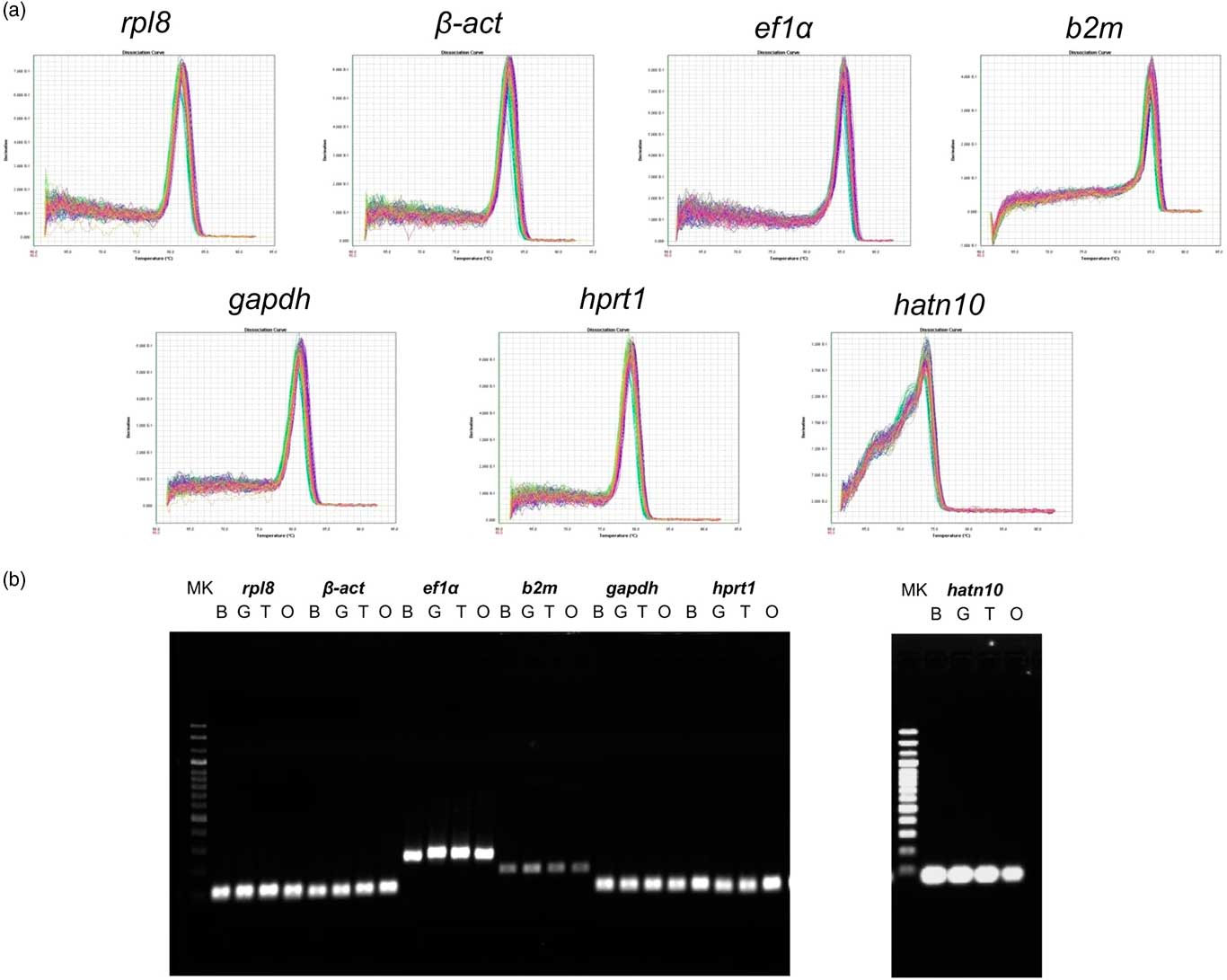
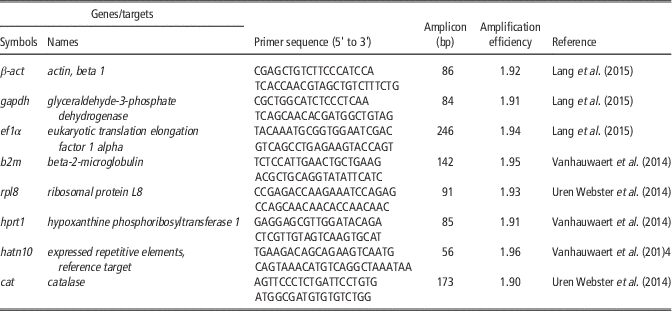
Six genes and one expressed repetitive element were selected for evaluation of their expression stability in zebrafish exposed to Roundup. The relevance and the weight of the reference genes used here are grounded. First they have been used in previous studies with zebrafish (Uren Webster et al., Reference Uren Webster, Laing, Florance and Santos2014; Vanhauwaert et al., Reference Vanhauwaert, Van Peer, Rihani, Janssens, Rondou, Lefever, De Paepe, Coucke, Speleman, Vandesompele and Willaert2014; Lang et al., Reference Lang, Wang and Zhang2015), second, these genes are involved in various cellular functions, being components of the cytoskeleton (β-act), participating in protein synthesis (ef1α), being a component of the ribosome and participating in protein synthesis (rpl8), participating in the immune system (b2m), being involved in glycolysis (gapdh) and having a central role in the purine metabolism (hprt1); and thirdly, these genes are expressed in all the organs analyzed. In addition, an expressed repetitive element (hatn10) was included, which was recently proposed by Vanhauwaert et al., (Reference Vanhauwaert, Van Peer, Rihani, Janssens, Rondou, Lefever, De Paepe, Coucke, Speleman, Vandesompele and Willaert2014) as a reference target, instead of genes encoding proteins, as a novel normalization method in zebrafish gene expression studies using RT-qPCR. All primer sequences used are indicated in Table 1. A melting curve presenting a single peak in RT-qPCR analysis was evaluated and electrophoresis in agarose gels was performed to verify the specificity of the primers (Figure 1). The amplification efficiency (E) in the experimental conditions adopted here (organs and Roundup) was determined using RT-qPCR analysis from a standard curve of five-fold serial dilutions (1/8, 1/16, 1/32, 1/64, 1/128) of undiluted pooled cDNA of all samples and calculated according to the equation E=10(−1/slope) (Table 1). The efficiency ranged from 1.9 to 2.1 and Pearson’s coefficients of determination (R 2) of each reference gene >0.99 were considered acceptable for RT-qPCR.
Primer specificity of six reference genes and one expressed repetitive element and amplicon size in reverse transcription-quantitative PCR (RT-qPCR). (a) Melting curve of the reaction for all genes. (b) Agarose gel electrophoresis of products of RT-qPCR with the expected size for each reference gene. MK=ladder DNA 100 bp; B=brain; G=Gill; T=testis; O=ovary.

Reference genes and primers used in reverse transcription-quantitative PCR assays of zebrafish Danio rerio organs after exposure with glyphosate-based herbicide

Real-time PCR
Real time PCR was performed with GoTaq qPCR Master Mix (Promega) on a 7900HT Fast Real-Time PCR System (Applied Biosystems). Diluted cDNA samples (1/10) were run in duplicate PCR reactions in optically clear 96-well plates. Each qPCR reaction (10 μl) consisted of 5 μl of master mix, 0.3 μM of each primer, 0.1 μl of CXR, 1 μL of cDNA and 3.3 μl DEPC-water. The cycling parameters used were 50°C for 2 min, 95°C for 10 min, 40 amplification cycles of 95°C for 15 s and 62°C for 1 min, and a melting curve analysis at 95°C for 15 s, 60°C for 15 s, and 95°C for 15 s.
Expression stability of the reference genes
The C t values of RT-qPCR data were collected using SDS 2.2 software (Applied Biosystems, Carlsbad, CA, USA) considering the same threshold value for all analyzed genes. The expression stability of the reference genes for RT-qPCR was calculated using the computational programs, BestKeeper, NormFinder, geNorm and the Delta C t method. The BestKeeper program is based on the standard deviation (SD) of the C q , and reference genes with lower SD values are more stable for RT-qPCR (Pfaffl et al., Reference Pfaffl, Tichopad, Prgomet and Neuvians2004). NormFinder, an ANOVA-based model, calculates the expression stability value by determining inter- and intra-group variation of gene expression. The lowest value for a reference gene indicates the highest stability. Also, based on the intra- and inter-group variations of each gene, this program calculates the most stable pair of reference genes (Andersen et al., Reference Andersen, Jensen and Ørntoft2004). GeNorm calculates the expression stability value (M) of each reference gene based on the average pairwise variation among all tested reference genes. A higher gene expression stability is represented by a lower M value. This program ranks the stability of reference genes and gives the most stable combination of two genes (Vandesompele et al., Reference Vandesompele, De Preter, Pattyn, Poppe, Van Roy, De Paepe and Speleman2002). The Delta C t method calculates the stability of the genes by obtaining the SD of C q differences within each sample for each pairwise comparison with the other genes and finally calculates the average SD for each gene. The lowest average SD of each gene compared with the others indicates the highest stability (Silver et al., Reference Silver, Best, Jiang and Thein2006). GeNorm also compares the pairwise variation (V) of evaluated reference genes with others. The V value of V n /V n+1 (threshold value <0.15) between two sequential normalization factors was used to determine the optimal number of reference genes.
In addition, the RefFinder platform was used, which integrates the current major computational programs geNorm, NormFinder, and BestKeeper and the Delta C t method. RefFinder calculates the geometric mean of the weights of ranking of each program to produce one general ranking (Xie et al., Reference Xie, Xiao, Chen, Xu and Zhang2012). The comprehensive stability ranking of reference genes in each organ was calculated by the platform RefFinder. The optimal number of reference genes was calculated using NormFinder and geNorm.
Effect of normalization with reference genes
The catalase gene (cat) was used as a target gene to evaluate the performance of reference gene normalization in RT-qPCR. The cat gene was chosen because it is expressed in all analyzed organs, and because GLY and GBH changes cat mRNA, as well as the enzymatic activity of catalase (Uren Webster et al., Reference Uren Webster, Laing, Florance and Santos2014; Murussi et al., Reference Murussi, Costa, Leitemperger, Guerra, Rodrigues, Menezes, Severo, Flores-Lopes, Salbego and Loro2016). To evaluate the effects of normalization on the expression level of cat gene in each organ, the two most stable reference genes, the two least stable reference genes, and the optimal combination of reference genes were used as normalizers. The amplification efficiency of the cat gene was tested by RT-qPCR. The transcript levels of the cat gene in each group were calculated using the
 $$2^{{{\minus}\Delta \Delta C_{t} }} $$
method (Livak and Schmittgen, Reference Livak and Schmittgen2001). For the
 $$2^{{{\minus}\Delta \Delta C_{t} }} $$
method was used one reference gene or the geometric mean of C
q
values of the optimal combination of reference genes.
Statistical analysis
Normality of data and homoscedasticity were verified using the Shapiro–Wilk and Levene’ test (P<0.05), respectively. The gene expression data was analyzed by one-way ANOVA, using Statistica 10.0 for Windows. Pairwise comparison of means was performed using the Fisher test and a P-value < 0.05 was considered significant.
Results
Expression profiles of candidate reference genes in zebrafish organs
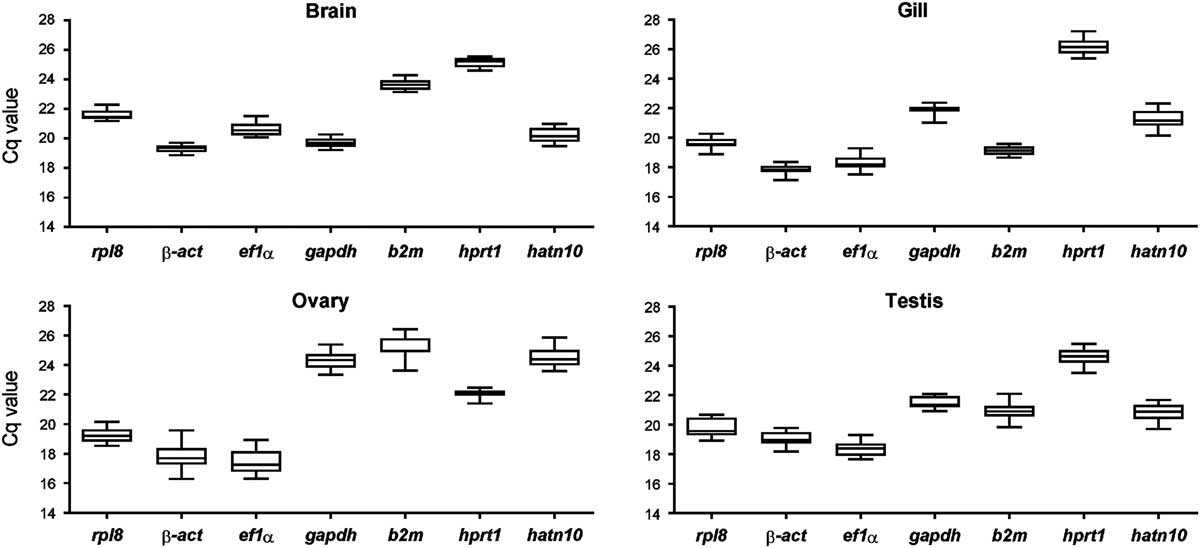
Considering the same threshold value for all genes in the four zebrafish organs (brain, gill and testis for males and ovary for females) exposed to Roundup for 7 days, C q values were used to determine the expression profile of reference genes. In the brain, the C q values of the transcripts were in the range from 19.33 (β-act) to 25.16 (hprt1). In the gill, they were in the range from 17.86 (β-act) to 26.17 (hprt1). In the testis, the range was 18.37 (ef1α) to 24.59 (hprt1), and in the ovary the range was from 17.41 (ef1α) to 25.13 (b2m) (Figure 2). Considering the expression of reference genes at the Roundup concentrations evaluated, the genes with the highest expression, indicated by their low C q values, were β-act and ef1α in gill, testis and ovary. However, β-act and gapdh were the highest expressed in the brain.
Expression profiles of six reference genes and one expressed repetitive element in organs of zebrafish Danio rerio. A line across the box depicts the median. Whiskers represent the maximum and minimum quantification cycle (C q ) values.

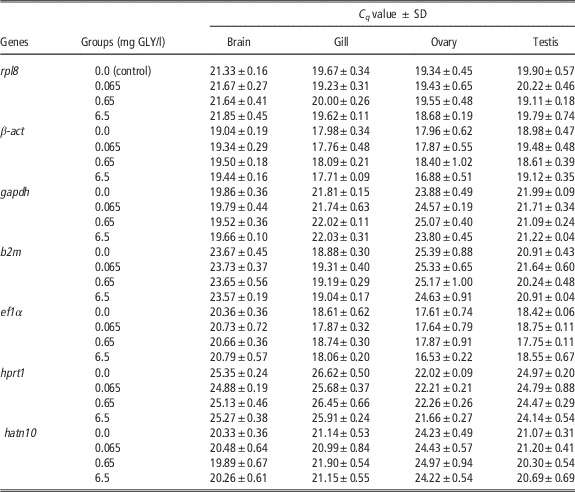
In addition, when we evaluate the direct effect of Roundup on the transcription of the reference genes of each organ, no differences were found among control and Roundup-exposed groups (Table 2).
C q values for the expression of six reference genes and one expressed repetitive element in four organs of zebrafish Danio rerio

GLY, N-(phosphonomethyl) glycine.
No statistically significant difference was found among groups.
Evaluation of the stability of candidate reference genes
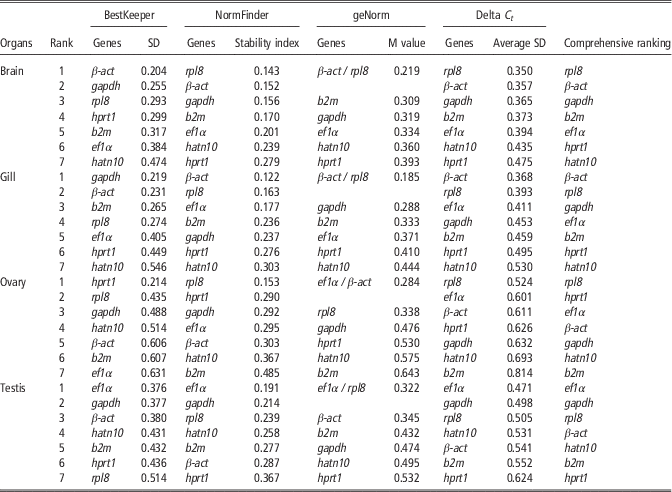
The stability of reference gene expression in zebrafish organs was evaluated using four computer programs and the RefFinder platform. BestKeeper ranked the two most stable genes in the brain (β-act and gapdh), gill (gapdh and β-act), testis (ef1α and gapdh) of male and ovary (hprt1 and rpl8) of female zebrafish. NormFinder ranked the two most stable genes in the brain (rpl8 and β-act), gill (β-act and rpl8), and testis (ef1α and gapdh) of male and ovary (rpl8 and hprt1) of female zebrafish. GeNorm ranked the two most stable genes in the brain (β-act and rpl8), gill (β-act and rpl8), testis (ef1α and rpl8) of male and ovary (ef1α and β-act) of female zebrafish. Delta C t ranked the two most stable genes in the brain (rpl8 and β-act), gill (β-act and rpl8), testis (ef1α and gapdh) of male and ovary (rpl8 and ef1α) of female zebrafish. RefFinder analysis, which combines the geNorm, NormFinder, BestKeeper, and Delta C t outputs, showed that in the brain of males, rpl8 and β-act were the most stably expressed genes, and hprt1 and hatn10 were the least stable. In the gill of male, β-act and rpl8 were the most stable, and the least stable were hprt1 and hatn10. In the testis, ef1α and gapdh were the most stable genes, whereas b2m and hprt1 were the least stable genes. In the ovary, rpl8 and hprt1 were the most stable genes and hatn10 and b2m were the least stable (Table 3).
RefFinder comprehensive ranking of six reference genes and one expressed repetitive element for analysis of reverse transcription-quantitative PCR in organs of zebrafish Danio rerio exposed to glyphosate-based herbicide

Optimal reference gene combination for reverse transcription-quantitative PCR
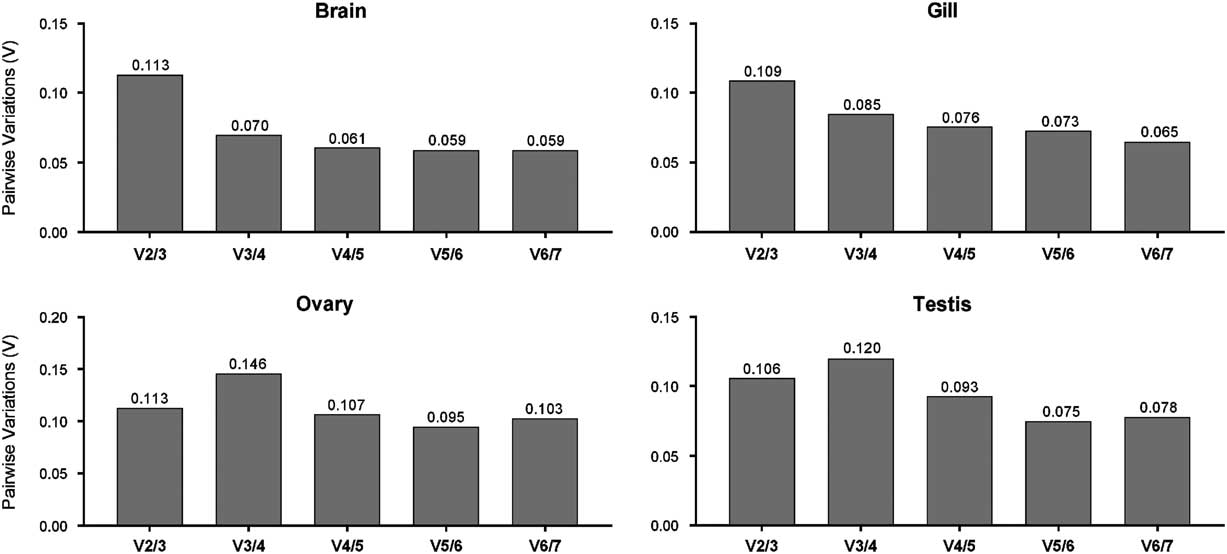
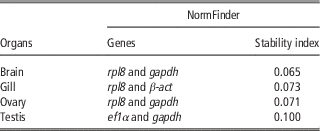
Considering that use of more than one reference gene for normalization in RT-qPCR analysis gives greater robustness of the results, the optimal combination of reference genes for the four organs of zebrafish exposed to Roundup was evaluated. The geNorm program (Figure 3) determined that the combination of two reference genes is the optimal for the brain (rpl8 and β-act), gill (rpl8 and β-act), testis (ef1α and rpl8) of males and ovary (β-act and ef1α) of female zebrafish. Using the NormFinder program also was determined the combination of the best two reference genes in brain (rpl8 and gapdh), gill (rpl8 and β-act), testis (ef1α and gapdh) of males and ovary (rpl8 and gapdh) of female zebrafish (Table 4).
Determination of the optimal combination of reference genes for the four organs of zebrafish Danio rerio exposed to glyphosate-based herbicide. V n /V n+1 indicates the pairwise variation (V) between two sequential normalization factors (NF n and NF n+1), used to determine the optimal combination of reference genes required for accurate normalization. The geNorm V (< 0.15) suggests that two reference genes are the best combination for normalization in each organ.

Best combination of two reference genes for normalization determined by the NormFinder program.

Transcript levels of cat gene using candidate reference genes as normalizers
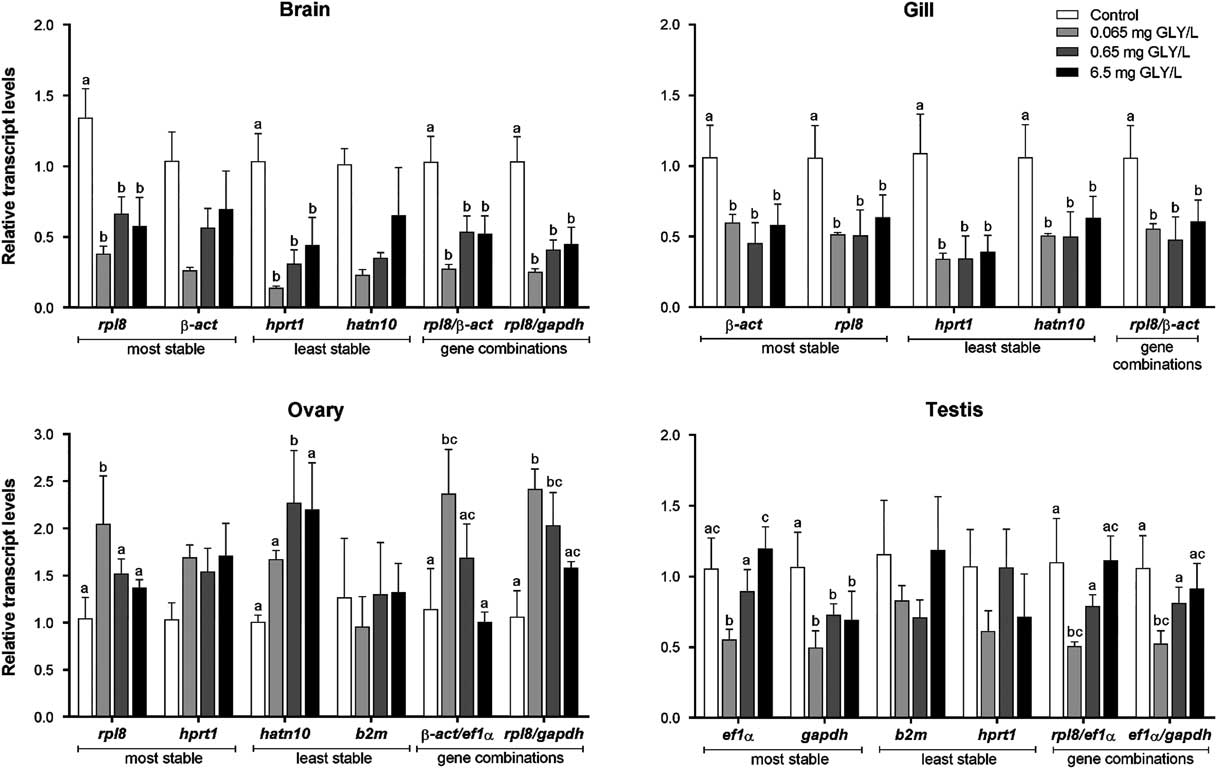
When the most stable gene rpl8, was used for normalization in male brains (Figure 4), the transcript levels of the cat gene decreased in all groups exposed to Roundup in comparison with the control. Moreover, using hprt1 or the combinations rpl8 and β-act or rpl8 and gapdh for normalization, differences were found in the transcript level of the cat gene. However, no differences in cat gene transcripts were found using β-act or hatn10 for normalization. Whether the most stable genes, the least stable, or the combination of rpl8 and β-act were used for normalization in gill, the transcript levels of the cat gene decreased in all groups exposed to Roundup compared with the control. When the most stable gene rpl8 or the combinations β-act and ef1α or rpl8 and gapdh were used as normalizer genes in the ovary, the transcript levels of the cat gene increased at the concentration 0.065 mg GLY/l contained in the Roundup, compared with the control. Moreover, differences in transcripts levels of the cat gene were found when using other reference genes, except for hprt1 and the least stable b2m gene. When the most stable gene ef1α was used as normalizer gene in the testis, the transcript levels of cat decreased at the concentration 0.065 mg GLY/l contained in the Roundup, but cat transcript levels were similar among the control, 0.65 mg GLY/l and 6.5 mg GLY/l samples contained in the Roundup. Differences in transcript levels of cat among the groups were also found when using the second most stable gene (gapdh) and the optimal combination of reference genes (rpl8 and ef1α) or (ef1α and gapdh) for normalization. However, when the least stable genes (b2m or hprt1) were used as normalizers, no differences in the transcript levels of cat were found among the groups.
Transcript levels of the cat gene in organs of zebrafish Danio rerio exposed to glyphosate-based herbicide. Variability of cat gene expression is shown for the two most stable, and the two least stable reference genes used as a normalizer. The last and penultimate set of bars, show the gene combinations used as normalizers, obtained using the geNorm and NormFinder program, respectively. In gill, both programs determined the same pair of genes. Bars indicate mean±standard error. a,b,c Letters represents significant difference at P<0.05 among groups exposed to Roundup.

Discussion
The toxicity of GLY and Roundup remains controversial, possibly due to the low availability of studies that have addressed the molecular basis of the toxicity of these compounds. We consider the toxicological risk assessment of the GBH Roundup more realistic, because GBH is more toxic than pure GLY (Folmar et al., Reference Folmar, Sanders and Julin1979; Mann and Bidwell, Reference Mann and Bidwell1999; Tsui and Chu, Reference Tsui and Chu2003; Peixoto, Reference Peixoto2005; Richard et al., Reference Richard, Moslemi, Sipahutar, Benachour and Seralini2005) and corresponds to the commercial formulation used in the environment. The toxic effects of Roundup and other GBH in fish organs can be better understood by analysis of gene expression by RT-qPCR. However, studies that assess the most appropriate reference gene (an essential requirement for RT-qPCR analysis) for different organs in fish exposed to GBH Roundup are lacking. Considering that the utilization of non-appropriate references for normalization of gene expression influence the results in qPCR, and the use of reference genes is specific to an experimental condition, we evaluated the stability of six reference genes and one expressed repetitive element in organs of males (brain, gill, testis) and females (ovary) of zebrafish exposed to Roundup for 7 days.
The expression profile and stability ranking of evaluated reference genes showed differences in the organs of zebrafish, indicating organ-specific reference genes. The differences of gene stability ranking in organs in studies that evaluate reference genes are probably due to the different functions and heterogeneity of organs (Gong et al., Reference Gong, Sun, Chen, Han, Pang, Wu, Qi and Zhang2016). The discrepancies in the rankings of the most stable genes obtained by each computational program reflect the differences of the algorithms and procedures of each program (Vandesompele et al., Reference Vandesompele, De Preter, Pattyn, Poppe, Van Roy, De Paepe and Speleman2002; Andersen et al., Reference Andersen, Jensen and Ørntoft2004; Pfaffl et al., Reference Pfaffl, Tichopad, Prgomet and Neuvians2004; Silver et al., Reference Silver, Best, Jiang and Thein2006). In other studies evaluating reference genes, different gene stability rankings were described depending on the program used (Bower and Johnston, Reference Bower and Johnston2009; Mo et al., Reference Mo, Zhao, Liu, Cao and Jiang2014). In our study, similar results in the rankings of less stable genes were obtained using BestKeeper, NormFinder, geNorm and the Delta C t method. The most stable gene from one program was the same or was among the three most stable genes in the other programs. However, the gene ranking obtained from the BestKeeper program was more different to the other programs. This was especially the case in the testis, in which rpl8 was classified as the least stable reference gene, but the other programs (NormFinder, geNorm and Delta C t ) ranked rpl8 among the three most stable reference genes. This difference of ranking is probably due to the algorithm and inputs used by the program BestKeeper (cycle raw data) in comparison with geNorm and NormFinder (relative quantities) (Potashnikova et al., Reference Potashnikova, Gladkikh and Vorobjev2015). These differences in gene stability rankings show the need to evaluate the stability of reference genes using several programs for a final decision.
Studies using qPCR analyses have been performed to evaluate the effect of glyphosate or Roundup on the expression of target genes in zebrafish (Uren Webster et al., Reference Uren Webster, Laing, Florance and Santos2014; Velasques et al., Reference Velasques, Sandrini and da Rosa2016; Lopes et al., Reference Lopes, Caldas, Primel and da Rosa2017). In these studies, it was not mentioned by the authors whether the evaluation of reference genes was performed. Some studies also use ANOVA analysis or Student’s t test for the evaluation of a direct effect of an experimental condition on the expression of reference genes (Filby and Tyler, 2007; Gubern et al., Reference Gubern, Hurtado, Rodríguez, Morales, Romera, Moro, Lizasoain, Serena and Mallolas2009). In our study, no differences were found in the expression of reference genes from the Roundup-exposed groups in relation to the control group using ANOVA. Therefore, reference genes classified as less stable in some organs (for example, hprt1 and hatn10 in brain and gill of male zebrafish) could be interpreted as stable genes, although other most stable reference genes exist for qPCR analysis.
The RefFinder platform integrates the four computational programs and performs a quick analysis for reference gene validation starting from a single input of the C q values (Spiegelaere et al., Reference Spiegelaere, Dern-Wieloch, Weigel, Schumacher, Schorle, Nettersheim, Bergmann, Brehm, Kliesch, Vandekerckhove and Fink2015). In addition, we produced a final gene stability ranking for each organ with the results of these four programs, and identical results to those generated by the RefFinder platform were obtained. Using this platform for reference gene evaluation, the best genes were ranked in a combined analysis in each organ. The best gene was different in each organ, with rpl8 being best in the brain of male and ovary of female zebrafish. The rpl8 gene has also been used as a normalizer gene in testis and ovary of zebrafish exposed to GLY and GBH Roundup for 15 days (Uren Webster et al., Reference Uren Webster, Laing, Florance and Santos2014), but it was not previously mentioned whether rpl8 is the most stable reference gene compared with other genes in the organs of zebrafish exposed to Roundup. Our data showed that for testis, ef1α was the most stable reference gene instead of rpl8, according to our evaluation. Previously, β-act and b2m gene expressions were used to normalize the expression of the ache gene in brain of zebrafish males exposed to Roundup for 24 and 96 h (Lopes et al., Reference Lopes, Caldas, Primel and da Rosa2017). On the other hand, in our study, the β-act gene was the most stable in the gills of zebrafish exposed to Roundup. However, other studies describe modulation of β-act expression in Cyprinus carpio and Pimephales promelas (Sarmiento et al., Reference Sarmiento, Leal, Quezada, Kausel, Figueroa, Vera and Krauskopf2001; Filby and Tyler, Reference Filby and Tyler2007), indicating that it may not be suitable as a reference gene in some experimental conditions. Previously, the tbp (TATA box binding protein) and ef1α genes were employed as reference genes in RT-qPCR of zebrafish gills exposed for 24, 48, 72 and 96 h to Roundup (Velasques et al., Reference Velasques, Sandrini and da Rosa2016). Moreover, although the expressed repetitive element hatn10 was suggested as one of the best normalizers for RT-qPCR in different conditions (Vanhauwaert et al., Reference Vanhauwaert, Van Peer, Rihani, Janssens, Rondou, Lefever, De Paepe, Coucke, Speleman, Vandesompele and Willaert2014, Reference Vanhauwaert, Lefever, Coucke, Speleman, De Paepe, Vandesompele and Willaert2016), in this study, hatn10 was ranked among the least stable genes in all organs evaluated. These results could indicate that different reference genes can be more appropriate for RT-qPCR analysis depending on the experimental conditions (e.g. time of exposure and Roundup concentration).
The use of multiple reference genes for normalization in RT-qPCR analysis allows greater accuracy when compared with the use of a single reference gene (Vandesompele et al., Reference Vandesompele, De Preter, Pattyn, Poppe, Van Roy, De Paepe and Speleman2002). In this study, the most stable combination of reference genes obtained by geNorm and NormFinder presented the most stable gene of the overall ranking. An exception was the combination of genes (β-act and ef1α) obtained in the ovary by geNorm. Therefore, our results showed that the gene combination of NormFinder was better at containing the best gene of overall ranking. The NormFinder program has been more used in the determination of combinations of reference genes, because it considers the intra- and inter-group variation (Chen et al., Reference Chen, Pan, Xiao, Farwell and Zhang2011). Curiously, the profile of cat expression was similar in the ovary using both of the most stable gene combinations, which suggests the gene combination of geNorm could be still stable for normalization in the ovary. Differences in the determination of ranking and the optimal number of reference genes between these programs have been previously described by Silberberg et al. (Reference Silberberg, Baruch and Navon2009) and Chen et al. (Reference Chen, Pan, Xiao, Farwell and Zhang2011). In the analysis of gene expression in fish, the use of one reference gene is common, because this is more favorable in terms of cost, limited availability of samples and minimum normalization efforts (Lang et al., Reference Lang, Wang and Zhang2015). However, it is advisable that reference genes should be selected from a previous evaluation, considering that expression of reference genes can change in fish with development, tissue type and experimental condition (Ingerslev et al., Reference Ingerslev, Pettersen, Jakobsen, Petersen and Wergeland2006; Filby and Tyler, Reference Filby and Tyler2007; McCurley and Callard, Reference McCurley and Callard2008; Small et al., Reference Small, Murdock, Bilodeau-Bourgeois, Peterson and Waldbieser2008). On the other hand, the geometric average of multiple reference genes is highly recommended for normalizing gene expression in RT-qPCR (Vandesompele et al., Reference Vandesompele, De Preter, Pattyn, Poppe, Van Roy, De Paepe and Speleman2002), and it has been strongly advocated that at least two or three reference genes should be used (Vandesompele et al., Reference Vandesompele, De Preter, Pattyn, Poppe, Van Roy, De Paepe and Speleman2002; Chapman and Waldenström, Reference Chapman and Waldenström2015). In our results, cat expression indicates that the most stable gene of general ranking, as well as the combinations of genes could be used as normalizers of RT-qPCR for 7-day Roundup-exposed zebrafish experiments.
In conclusion, the expression stability of six reference genes and one expressed repetitive element in four organs of zebrafish exposed to Roundup for 7 days demonstrated organ-specific expression variability. In the brain (male) and ovary (female), rpl8 was the most stable gene, whereas in the testis and gill of males, ef1α and β-act were the most stable genes, respectively. These results indicate the importance of evaluating the reference gene in each organ separately. Therefore, it is important to consider that the reference genes for RT-qPCR may be altered by experimental condition, that is different organs, sex, age of fish, chemical concentration and time of exposure. Analysis of the transcript level of the cat gene in zebrafish organs demonstrated that, depending on the reference gene chosen, it is possible to evidence biological effects or not. To our knowledge, reference genes for zebrafish exposed to GBH Roundup WG have been evaluated for the first time and could serve as the basis for initiating the evaluation of reference genes in fish exposed to Roundup or other GBH formulations. In this context, these findings support the use of better organ-specific reference genes for proper interpretation of results in RT-qPCR in zebrafish exposed to Roundup for 7 days. Moreover, these results provide information that will contribute to analysis of gene expression in these organs, for the purpose of elucidating the molecular mechanisms of GBH Roundup toxicity in the zebrafish model.
Acknowledgments
This work was supported by Coordenação de Aperfeiçoamento de Pessoal de Nível Superior (425/2010) and Conselho Nacional de Desenvolvimento Científico e Tecnológico (475788/2011-7). The authors are thankful to Laboratório de Estudos em Biologia/LAMEB of the Universidade Federal de Santa Catarina.