Introduction
The number of people with dementia is expected to increase worldwide, from the current 46 million to an estimated 131 million by 2050 (Prince et al., Reference Prince2015). In Germany, up to 50% of dementia patients will be cared for in a nursing home (NH) during the course of the disease (Luppa et al., Reference Luppa2010). Caring for people with dementia in NHs is both fulfilling and demanding (Schmidt et al., Reference Schmidt, Dichter, Palm, Müller and Hasselhorn2012). In dementia, behaviors such as agitation, wandering, and apathy can present a challenge to caregivers of people with dementia. Almost 90% of people with dementia develop at least one type of challenging behavior throughout the course of the syndrome (Schäufele et al., Reference Schäufele, Köhler, Lode, Weyerer, Schneekloth and Wahl2009; Selbaek et al., Reference Selbaek, Engedal and Bergh2013). These behaviors are often distressing for caregiver in NHs (Schmidt et al., Reference Schmidt, Dichter, Palm, Müller and Hasselhorn2012). Moreover, dementia is not curable, and psychosocial interventions are thus widely recognized as frontline interventions for reducing challenging behavior in people with dementia (Bartholomeyczik et al., Reference Bartholomeyczik2006; Livingston et al., Reference Livingston2014). These interventions are often implemented by caregivers and thus have enormous potential for future actions and present opportunities to positively influence the care provided.
One promising psychosocial concept in dementia care is person-centered care (PCC), which aims to achieve the best possible quality of life (Qol) and a reduction in challenging behavior among people with dementia (Chenoweth et al., Reference Chenoweth2009). Moreover, PCC is assumed to increase dementia-friendly caregiver attitudes and job satisfaction as well as decrease caregiver burnout (Lintern, Reference Lintern2009; van de Ven et al., Reference Van de Ven2013; Barbosa et al., Reference Barbosa, Sousa, Nolan and Figueiredo2015). Based on the work of Carl Rogers, PCC supports a change in the traditional therapeutic expert–patient relationship and places less emphasis on care tasks and more on the person (Rogers, Reference Rogers1961; McCormack and McCance, Reference Mccormack and Mccance2006). After Rodgers, Tom Kitwood translated PCC to dementia care using his social-psychological theory of personhood (Kitwood, Reference Kitwood1997). This theory assumes that the difficulties that people with dementia experience are not just a consequence of the syndrome itself; rather, they result from dementia-unfriendly environments, which include negative caregiver attitudes, communication, and care practices (Kitwood, Reference Kitwood1997; Barbosa et al., Reference Barbosa, Sousa, Nolan and Figueiredo2015). PCC aims to value people with dementia and their caregivers, provide individualized care that is based on the perspective of people with dementia, and create a positive environment. The VIPS framework (V = valuing people with dementia, I = individualized care, P = understanding the world from the patient's perspective, and S = providing a social environment that supports the needs of the patient) combines these concepts (Brooker, Reference Brooker2004). The relational nature of PCC emphasizes the need to value caregivers as a prerequisite for successful PCC (Kitwood, Reference Kitwood1997). Thus, caregivers’ emotional strain has to be recognized and their experiences and feelings have to be valued; caregivers for people with dementia also require a high level of communication skills (Barbosa et al., Reference Barbosa, Sousa, Nolan and Figueiredo2015). Kitwood's framework guided the development of different psychosocial interventions for dementia care (Barbosa et al., Reference Barbosa, Sousa, Nolan and Figueiredo2015). One highly recognized approach is the Dementia Care Mapping (DCM) method. The DCM method is a structured, multicomponent, and cycling intervention that targets the implementation of PCC in dementia care. DCM was updated to the current eighth version from 2001 to 2005 (Brooker and Surr, Reference Brooker and Surr2006).
Two previous trials investigated the effectiveness of DCM for caregiver outcomes. One Australian cluster randomized controlled trial (cRCT) compared a standardized PCC training session, one DCM cycle, and task-oriented care (Jeon et al., Reference Jeon2012). The caregiver outcomes were burnout, general well-being, attitudes, and reactions toward residents’ challenging behavior and perceived managerial support. Of all outcomes, only one subscale of the Maslach Burnout Inventory (emotional exhaustion) showed a significant change over time, with a reduction in the DCM method group. A previous Dutch pragmatic trial investigated the effects of the DCM method on caregiver outcomes, namely, stress-related symptoms, job experience, and job satisfaction (van de Ven et al., Reference Van de Ven2013). After an intervention period of eight months, fewer stress-related symptoms were reported over time in both groups (DCM method and control group). Furthermore, the secondary outcomes demonstrated no significant intervention effects. The only significant effect favoring the DCM method was that caregivers in the DCM group had more positive emotional reactions (subscale of the questionnaire about experience and assessment of work) than those in the control group (van de Ven et al., Reference Van de Ven2013).
The DCM method is well known in Germany. Unfortunately, no previous investigations have examined the effectiveness of the DCM method in German NHs. Given this lack of evidence, the Leben-QD II study aimed to evaluate the effectiveness of the DCM method for residents with dementia and their caregivers in German NHs over a period of 18 months. Moreover, the study aimed to investigate adherence to the intervention and possible facilitators and barriers of the intervention. In this paper, we report the results regarding the following research question: Does the DCM method positively affect caregiver attitudes toward dementia, improve job satisfaction, and reduce burnout (Halek et al., Reference Halek, Dichter, Quasdorf, Riesner and Bartholomeyczik2013)?
Methods
Research design
The Leben-QD II study was a pragmatic quasi-experimental trial based on a convenience sample of nine NH units (from nine different NHs) that used three measurement points: T 0, baseline; T 1, after six months; and T 2, after 18 months (Halek et al., Reference Halek, Dichter, Quasdorf, Riesner and Bartholomeyczik2013).
All NHs belong to one NH provider, which was responsible for selecting the participating units and assigning them to one of the three different groups. This selection and assignment was based on the interest and prior experience of each unit in the respective intervention.
Group assignment was performed before T 0. Three units with ≥ 1 year of experience in using DCM were assigned to group A. Group B consisted of three units in which the DCM method was newly introduced. In group C, a regular standardized Qol rating was integrated into the standard care provided.
The Ethics Committee of the German Society of Nursing Science approved the study protocol in August 2010. The voluntary completion of the caregiver questionnaire was considered to indicate informed consent (Halek et al., Reference Halek, Dichter, Quasdorf, Riesner and Bartholomeyczik2013).
Sample and inclusion criteria
The NH units were heterogeneous by living arrangement, care concept, and qualification of the caregiver team. Dementia special care units with up to 15 residents or integrative traditional units with up to 36 resident places were included, depending on the NH. For this analysis, the target population was all caregivers at the participating units.
The caregivers were invited to a kick-off informational meeting at each NH unit. During this meeting, caregivers were informed about the opportunity to voluntarily participate in the study through informational documents and posters as well as oral information provided by the project coordinator of each NH (see also the intervention section).
For inclusion, the caregivers had to work on the participating units and be involved in providing daily resident care.
Based on our previous studies and the literature (Jeon et al., Reference Jeon2012), we predicted a relatively high attrition rate for this population (caregivers). To enable an intention-to-treat analysis after the long intervention period (18 months), we included caregivers with an ongoing procedure. Thus, newly employed caregivers or caregivers who failed to complete a questionnaire at the previous measurement point were included at T 1 and T 2 if they met the inclusion criteria.
Intervention
One staff member from each NH served as the project coordinator and was responsible for scheduling the data collection and implementing the intervention. In addition, a DCM in-house trainer coordinated and managed the implementation of the DCM intervention in groups A and B. A manager at one participating NH coordinated the implementation of the control intervention in group C.
Intervention group A
The three units in group A had ≥ 1 year of experience with the DCM. During a previous application of the DCM method, the observations, data analysis, report writing, and feedback of results were performed by an external DCM mapper. In this study, two interested members from each care team were trained as DCM basic users by the in-house DCM trainer (part of component 1). Based on the official DCM manual developed at the University of Bradford (8th version), the caregivers were trained in PCC principles and implementation of DCM observation, practice, and feedback. We estimated that the DCM-experienced units (group A) would have a higher level of PCC than the units in groups B and C.
The implementation of the six DCM components (Brooker, Reference Brooker2007; BSI, 2010) has been described elsewhere (Halek et al., Reference Halek, Dichter, Quasdorf, Riesner and Bartholomeyczik2013; Dichter et al., Reference Dichter2015) and is summarized below in brief:
-
1. Training of two caregivers per unit during a three-day course (DCM basic user); 1.5 days of observation sessions supervised by the in-house DCM trainer to enhance observation skills; and briefing and preparation of the whole caregiver team and the leadership of the participating NH units.
-
2. DCM observations: 5–8 hours of DCM observations performed simultaneously by two trained DCM basic users.
-
3. DCM data analysis and report writing by the DCM basic user.
-
4. Feedback of results to caregivers and leadership during a formal caregiver meeting.
-
5. A written action plan based on the DCM observation data and team reflection during the feedback meeting.
-
6. Implementation of the action plan.
Intervention group B
In contrast to the units in group A, the three units in group B had no experience with PCC based on the DCM method but did have interest in implementing DCM; as in group A, two interested caregivers were trained as DCM basic users. All intervention components were equivalent to the procedures used in group A.
Control group C
Parallel to our trial, German NHs were obliged to implement a mandatory assessment of Qol in people with dementia during the care process. This requirement was based on the quality assurance criteria outlined by the German medical advisory service of the statutory health insurance (MDS, 2009). Therefore, during the intervention phase, the units in group C applied their usual care plus a regular and standardized rating of Qol. The intervention consisted of the following components:
-
1. Briefing and preparation of caregivers and NH management.
-
2. A 1.5-hour training program for the caregivers, including general information about Qol rating for people with dementia and the application of the used instrument QUALIDEM (Ettema et al., Reference Ettema, Dröes, De Lange, Mellenbergh and Ribbe2007) in particular.
-
3. Initial Qol ratings for all residents with dementia within the first three intervention months (October–December 2011). The Qol ratings should be based on a proxy agreement between two caregivers.
-
4. Subsequent Qol ratings if notable changes in residents’ needs or conditions were perceived. A new Qol rating was conducted at least every six months. If necessary, the caregivers initiated case conferences to discuss the relevance of the ratings for the care process.
Instruments
The data collection and DCM cycles were combined. Following the baseline measurement (T 0) and the first DCM cycle, measurement T 1 occurred after an intervention phase of six months. After T 1, second and third DCM cycles were performed, with a subsequent follow-up measurement (T 2) after a total intervention period of 18 months. All of the instruments were assessed at each of the three time points. The instruments were chosen based on their appropriateness for the target setting and population, their psychometric properties, and their feasibility.
All applied instruments were included in one caregiver questionnaire. For each member of the caregiver team, a questionnaire with all measurements was distributed and included an information page about the Leben-QD II study and a prepaid envelope for returning the completed questionnaires to the research team. Participation in the data collection was anonymous and voluntary, and the confidentiality of all data was assured.
As the primary outcome, caregiver attitudes were assessed with the Approaches to Dementia Questionnaire (ADQ) (Lintern et al., Reference Lintern, Woods and Phair2000). This questionnaire includes 19 items divided into two subscales: hope and person-centeredness. Items are summed to generate a total score ranging from 19 to 95. Higher scores indicate more positive attitudes toward people with dementia. The ADQ is a valid and easy to administer self-report instrument of caregiver attitudes toward people with dementia (Lintern, Reference Lintern2001).
The secondary outcomes were job satisfaction and caregiver burnout. Job satisfaction was measured with a four-item scale from the Copenhagen Psychosocial Questionnaire (COPSOQ) (Kristensen et al., Reference Kristensen, Hannerz, Hogh and Borg2005). The scale results in a score from 1 to 4, which is transformed to a total score between 0 and 100. Higher scores reflect higher job satisfaction. Caregiver burnout was assessed using a six-item scale from the Copenhagen Burnout Inventory (CBI), which has five response options for each item; the item scores result in a total score ranging from 1 to 5, and this value is also transformed to a range between 0 and 100. Higher scores correspond to a greater degree of burnout (Borritz and Kristensen, Reference Borritz and Kristensen2001). Both the job satisfaction and burnout scales showed appropriate psychometric properties in earlier studies in terms of internal consistency (Kuemmerling et al., Reference Kuemmerling, Hasselhorn, Tackenberg, Hasselhorn, Tackenberg and Müller2003; Nubling et al., Reference Nubling, Stossel, Hasselhorn, Michaelis and Hofmann2006).
The following variables were assessed to describe the study sample and to act as covariates.
Dementia-specific caregiver burden was assessed with the BelaDem questionnaire (Halek et al., Reference Halek, Dichter, Quasdorf, Riesner and Bartholomeyczik2013). This 16-item instrument rates dementia-specific burden in relation to residents’ challenging behavior. The items are divided into four subscales: aggressive behavior, helplessness, quantitative demands, and acoustic disturbances. Each subscale generates a score between 0 and 100. Higher scores indicate higher dementia-specific burden (Schwab, Reference Schwab2013). Sociodemographic characteristics (age, gender, nursing qualification level, working hours per week, working experience) were assessed with single items.
Covariates at the institutional level were assessed in relation to organizational characteristics, e.g. caregiver/resident ratio and funding per resident, using the self-developed Dementia Institution Questionnaire (DIQ). The DIQ is divided into two sections. The first section consists of four items that evaluate the entire institutional structure and financial revenue. The second section targets the nursing unit and is divided into resident-specific factors (three items), structure (one item), and staffing, which includes employee turnover (five items). The responses for all items are open ended. The questionnaire was completed by the coordinating staff member of the corresponding NH. The instrument enables a descriptive analysis to be performed separately for each item, and combinations of items can be used to determine relationships, e.g. between the number of advanced training days and caregiver fulltime equivalents. The self-developed Dementia Milieu Assessment (DMA) was used to assess the dementia friendliness of the milieu of the nursing unit. The DMA is a standardized observation instrument that consists of 29 items divided into an environmental (21 items) and a psychosocial subscale (eight items). Each item is measured using dichotomous response options (yes/no). The scores range from 0 to 21 (environmental domain) and from 0 to 8 (psychosocial domain). Higher scores indicate a more dementia-friendly environment. DMA observations were conducted by an experienced registered nurse and dementia researcher over a 2-hour period from 3 pm to 5 pm in the public space of each participating nursing unit. The single items from the DIQ and DMA were found to be feasible in a cross-sectional study called Leben-QD I (Dichter et al., Reference Dichter2013).
Data analysis
The characteristics of the caregivers and NHs were stratified by time and intervention group. All caregiver-related measurements were aggregated at the NH level for the following analysis.
Depending on their distribution, baseline characteristics were described by frequency tables or means ± standard deviations. Overall, the three intervention groups were compared using Fisher's exact test or ANOVA. These analyses were not adjusted for cluster correlations.
Linear mixed models (Brown and Prescott, Reference Brown and Prescott2006) were used for cluster data (mean aggregated) to estimate the expected values of the primary and secondary outcomes (caregiver attitudes, job satisfaction, burnout) assuming an approximately normal distribution of the cluster means. The outcomes were used as dependent variables. The fixed effects (independent variables) were time, intervention group, and the interaction between time and intervention group. Time-adjusted repeated measurements for the clusters were adjusted by covariance patterns (Brown and Prescott, Reference Brown and Prescott2006) with a compound symmetry (CS) structure, and degrees of freedom were calculated by Satterthwaite's method. Adjustment for cluster correlations was ensured by analyzing cluster-aggregated data. Furthermore, an adjustment for literature-based covariates (Schrijnemaekers et al., Reference Schrijnemaekers2003; van Weert et al., Reference Van Weert, Van Dulmen, Spreeuwenberg, Bensing and Ribbe2005; Fritsch et al., Reference Fritsch2009; Jeon et al., Reference Jeon2012) was performed by including age, sex, working hours per week, work experience, aggressive behavior (BelaDem subscale), and relation of fulltime equivalents to residents as independent variables in the model. Overall, type-three tests were performed for the primary fixed effects of time, intervention, and the time* intervention interaction. The expected values of the outcomes at time-intervention strata were estimated by model-based least-square means.
All tests were two sided, and the level of significance was 5%. The model-based estimated time courses of the three main outcomes are presented graphically with 95% confidence intervals. Statistical analyses were performed using the statistical software package R version 3.0.1 (R Core Team, 2014).
Results
Participants
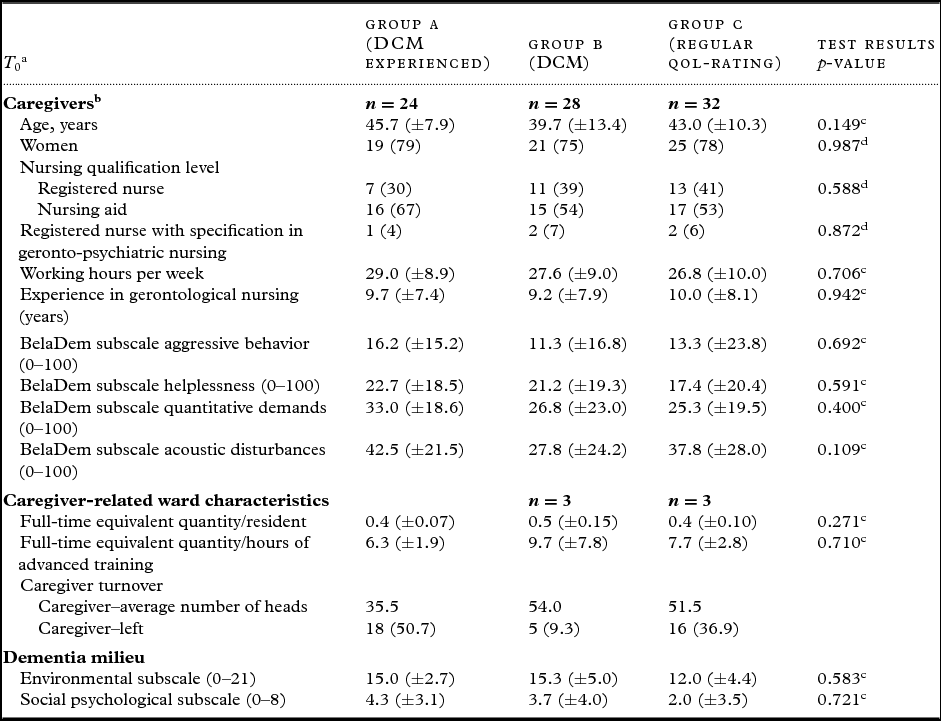
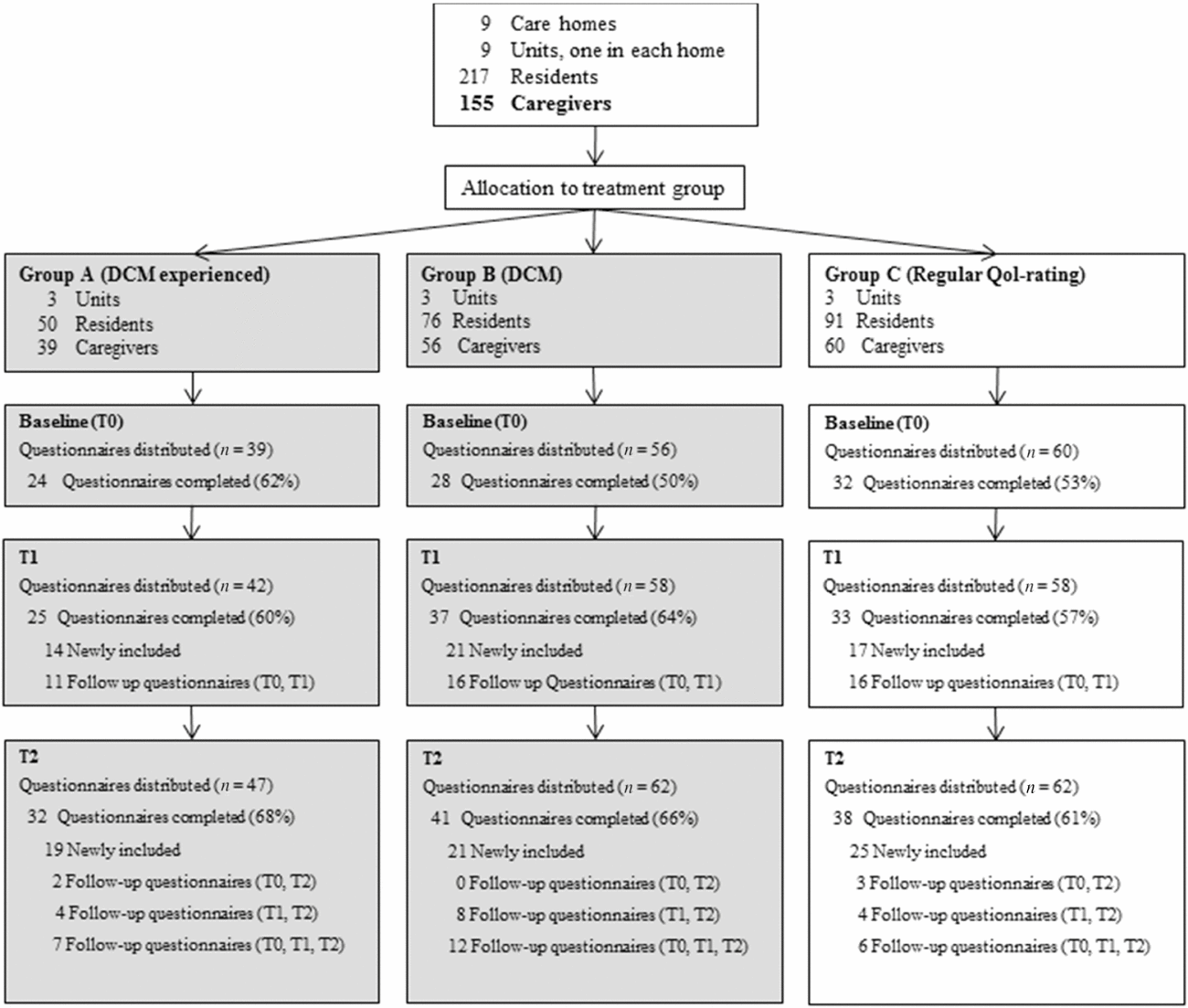
All nine participating NH units completed the study. In total, 155 caregivers at these units were eligible at baseline, and 201 caregivers with 290 completed questionnaires (84 at baseline, Table 1) were included in the analyzed dataset, for a total of 290 completed caregiver questionnaires at all data collection time points (Figure 1). Depending on the time point and intervention group, the response rate ranged between 50% and 68% (Figure 1).
Baseline characteristics of caregivers and caregiver-related ward characteristics based on intention-to-treat analysis

Data are presented as the mean (±SD) or numbers (%).
FAST = Functional Assessment Staging, NPI-NH = Neuropsychiatric Inventory – Nursing Home version.
a Overall n = 290 caregivers (all measurement points), group A: n = 81, group B: n = 106, group C: n = 103.
b Caregivers include registered nurses, social workers, and nursing aids (nursing aids and nursing students). Interns and volunteers are excluded.
c ANOVA.
d Fisher's exact test.
Flowchart with detailed numbers of study participants (caregivers).

The baseline characteristics of the participating caregivers and units are demonstrated in Table 1. These characteristics were generally comparable among groups. Group differences related to caregiver turnover were only descriptively analyzed because of the small number of units.
Intervention effects
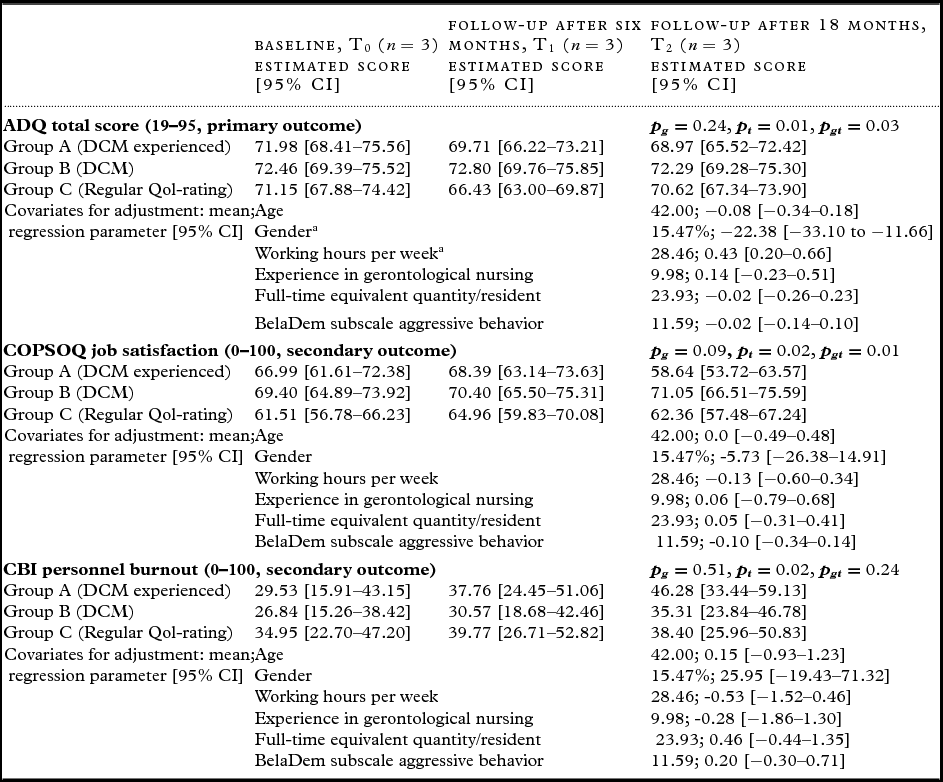
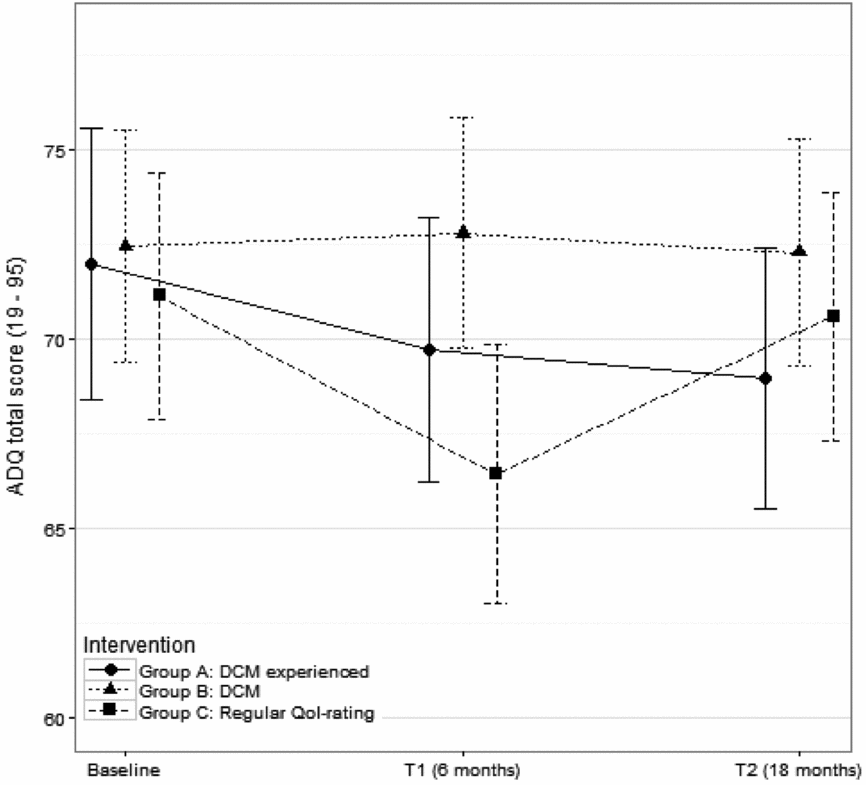
The primary outcome measured with the ADQ (covariate-adjusted model, Table 2) demonstrated a non-linear decrease from baseline to 18-month follow-up in the DCM method intervention groups A and B (Figure 2). The control group C also showed a non-linear decrease in ADQ scores from baseline to T 2.
Intervention effects on caregivers (mean cluster level) based on intention-to-treat analysis (adjusted for covariates: age, gender, working hours per week, experience in gerontological nursing, full-time equivalent quantity/resident, BelaDem subscale aggressive behavior)

a significant; p < 0.05 for covariates.
No missing data in cluster-aggregated covariates.
95% CI = 95% Confidence interval.
Estimated score = estimated least-square means.
pg = main effect of the intervention.
pt = main effect of time (at three time points).
pgt = main effect of the interaction between group and time.
ADQ = Approaches to Dementia Questionnaire.
COPSOQ = Copenhagen Psychosocial Questionnaire.
CBI = Copenhagen Burnout Inventory.
Estimated least-square means [CI = 95%] for Approaches to Dementia Questionnaire (ADQ) scores adjusted for covariates.

The ADQ (Table 2) did not differ significantly between the three groups (two interventions and one control), pg = 0.24, whereas time (T 0, T 1, and T 2), and the intervention*time interaction demonstrated a significant effect, pt = 0.01, pgt = 0.03.
The estimated least-square means of the ADQ decreased between baseline (T 0) and T 2 (after 18 months) from 71.98 (95% confidence interval (CI): 68.41–75.56) to 68.97 (CI: 65.52–72.42) in group A and from 71.15 (CI: 67.88–74.42) to 70.62 (CI: 67.34–73.90) in group C. In contrast, the ADQ in group B showed no changes, from 72.46 (CI: 69.39–75.52) at baseline to 72.29 (CI: 69.28–75.30) at T 2 (Figure 2).
Comparing only the measurement points T 0 and T 2, the estimated difference between group A and group B was −2.85 (CI: −6.57–0.87); between group C and B, −0.36 (CI: −3.90–3.17); and between group C and A, 2.49 (CI: −0.30–5.27). No significant differences from 0 remained.
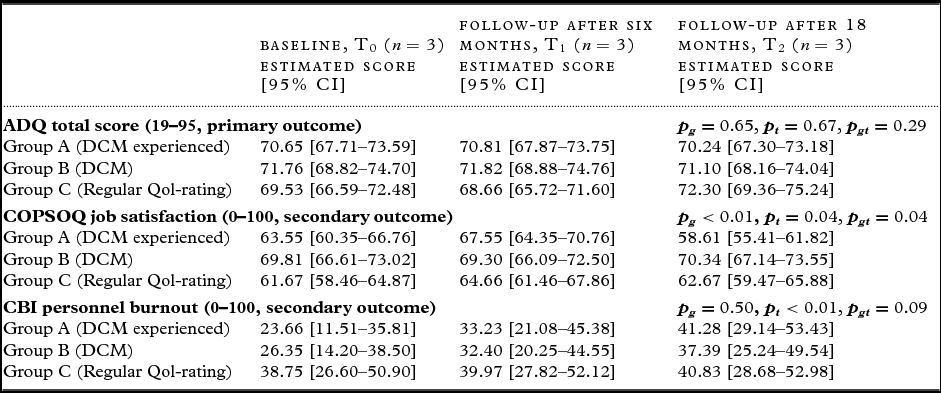
The model without covariate adjustment showed non-significant results for the primary outcome (Table 3: pg = 0.65, pt = 0.67, pgt = 0.29).
Intervention effects on caregivers (mean cluster level) based on intention-to-treat analysis (not adjusted for covariates)

95% CI = 95% Confidence interval.
Estimated score = estimated least-square means.
pg = main effect of the intervention.
pt = main effect of time (at three time points).
pgt = main effect of the interaction between group and time.
ADQ = Approaches to Dementia Questionnaire.
COPSOQ = Copenhagen Psychosocial Questionnaire.
CBI = Copenhagen Burnout Inventory.
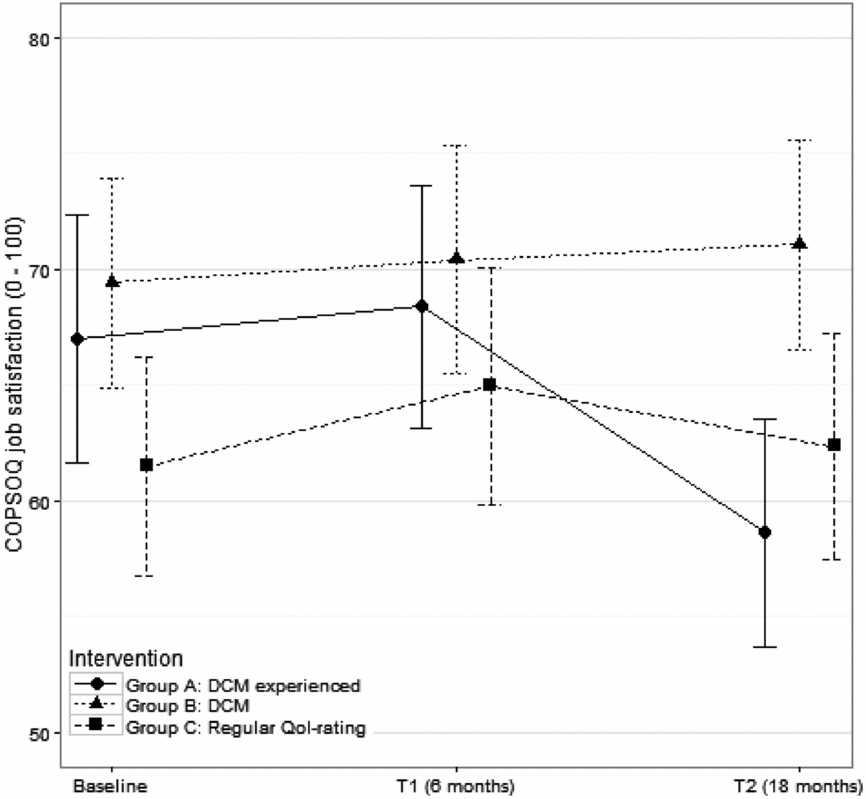
The secondary outcome of job satisfaction was measured with the COPSOQ (covariate-adjusted model, Table 2) and showed a non-linear decrease in intervention group A and a small increase in group B from baseline to T 2 (Figure 3). The job satisfactions scores for group C demonstrated a small non-linear increase from baseline to the 18-month follow-up.
Estimated least-square means [CI = 95%] for job satisfaction (COPSOQ) adjusted for covariates.

Job satisfaction showed significant effects of time and the time*intervention interaction (covariate-adjusted model in Table 2: pg = 0.09, pt = 0.02, pgt = 0.01). These results were similar to those of the model without covariate adjustment (Table 3, significant group effect). Table 2 and Figure 3 show a decrease in estimates over time in group A (66.99 (CI: 61.61–72.38) to 58.64 (CI: 53.72–63.57)). In contrast, the estimates increased (69.40 (CI: 64.89–73.92) to 71.05 (CI: 66.51–75.59)) in groups B and C (61.51 (CI: 56.78–66.23) to 62.36 (CI: 57.48–67.24)).
A comparison between the T 0 and T 2 measurement points showed an estimated difference of −10.00 (CI: −17.55 to −2.44) between group A and group B, −0.79 (CI: −8.38–6.79) between group C and group B, and 9.20 (CI: 3.07–15.34) between group C and group A.
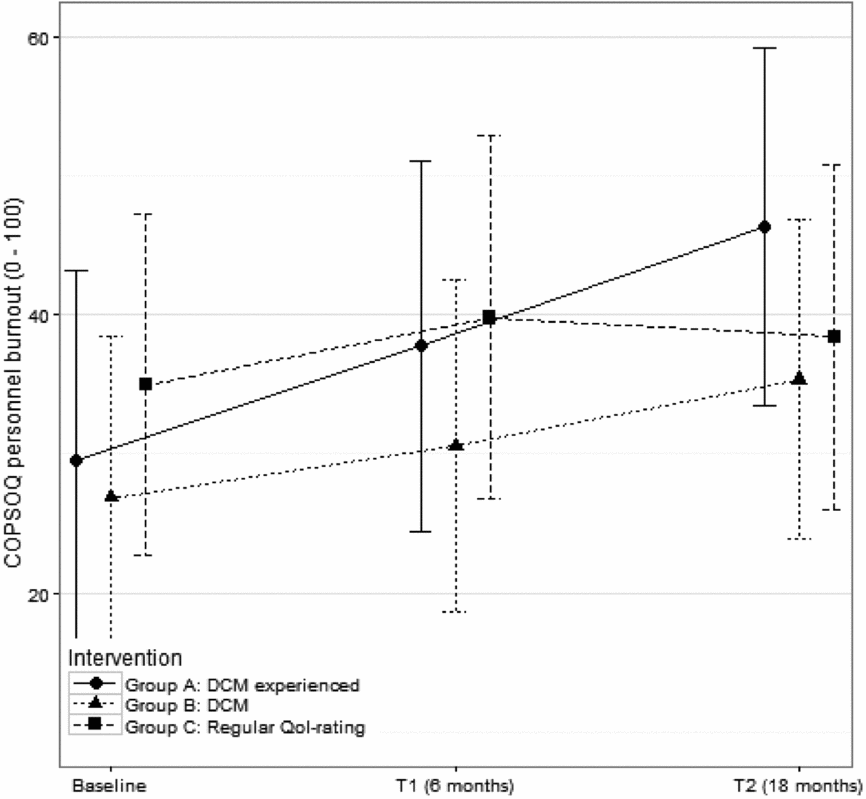
The analysis of burnout measured with the CBI (covariate-adjusted model, Table 2) demonstrated an increase in burnout in both intervention groups (A and B) from baseline to T 2 (Figure 3). Increased burnout scores (but non-linear) were also observed in the control group C over the 18-month follow-up period.
Burnout scores yielded significant differences for time (covariate-adjusted model in Table 2: pt = 0.02) and a non-significant effect for intervention (pg = 0.51) and for time*intervention (pgt = 0.24). The model without covariate adjustment showed a significant result for time (Table 3: pt < 0.01) and a non-significant effect for intervention and time*intervention (pg = 0.50, ptg = 0.09).
Figure 4 demonstrates the estimated increase in all groups between baseline and T 2 (group A: 29.53 (CI: 15.91–43.15) to 46.28 (CI: 33.44–59.13); group B: 26.84 (CI: 15.26–38.42) to 35.31 (CI: 23.84–46.78); and group C: 34.95 (CI: 22.70–47.20) to 38.40 (CI: 25.96–50.83)).
Estimated least-square means [CI = 95%] for personnel burnout (CBI) adjusted for covariates.

The estimated difference (T 0 to T 2) between group A and group B was 8.29 (CI: −7.66–24.23); between group C and group B, −5.02 (CI: −20.39–10.34); and between group C and group A, −13.31 (CI: −25.51−1.12).
Discussion
The results regarding the primary outcome of caregiver attitudes toward dementia showed a significant effect for time and for the time*intervention interaction in the course of 18 months. While the attitudes toward dementia decreased in groups A and C, with low values of C at T 1, the ADQ scores in group B remained almost stable. Our additional analysis regarding the group differences between T 0 and T 2 underlined that the main reason for the statistical significance might be the non-linear development in ADQ score in group C.
For the secondary outcome of job satisfaction, significant effects were observed for time and intervention*time. The results demonstrated a negative development in group A (T 0–T 1–T 2) and a positive change in groups B and C between T 1 and T 2.
Burnout as an additional secondary outcome increased unexpectedly in all groups (significant for time). The heterogeneous results with no clear direction were similar to the results of two previous trials regarding the effectiveness of the DCM method (Jeon et al., Reference Jeon2012; van de Ven et al., Reference Van de Ven2013). Based on study design, our results can be best compared with the results of van de Ven et al. (Reference Van de Ven2013). This trial found no significant effect for intervention or time*intervention in stress-related symptoms. However, the results indicated a significant effect for time regarding stress-related symptoms (primary outcome) in the intervention and control group. The secondary outcomes of job experience and job satisfaction demonstrated no effects. However, the observed tendencies favored the DCM method group. This study and the Leben-QD II study were pragmatic trials in terms of the lack of inclusion criteria for the participating nursing units and that the DCM method was performed by trained caregivers and not by researchers. In addition, both studies were based on intention-to-treat analysis, allowing the ongoing inclusion of caregivers. This ongoing inclusion could be one explanation for the non-linear outcome development. Thus, future studies should include intervention components that ensure the circulation of knowledge regarding the intervention to new staff members. The response rates in DCM studies have varied between 53% and 90% (van de Ven et al., Reference Van de Ven2013) and ranged between 50% and 68% in our trial. While van de Ven (Reference Van de Ven2013) showed positive tendencies but no significant effect of the DCM method after eight months, we observed a significant negative effect for caregiver attitudes and burnout. For job satisfaction, we observed heterogeneous developments by group, with a decrease in group A (DCM method experienced), an increase in group B, and stability in group C. Based on the lack of randomization, we cannot assume structurally equivalent groups. Accordingly, differences at baseline in resident conditions, resident behavior, caregiver characteristics, or ward characteristics could have had a stronger influence on the outcomes than our intervention (Hazelhof et al., Reference Hazelhof, Schoonhoven, Van Gaal, Koopmans and Gerritsen2016). The aforementioned study by Jeon et al. (Reference Jeon2012) used a more explanatory design. The inclusion of NH units and residents with dementia was based on specific criteria. Moreover, the DCM method was performed by two researchers in collaboration with caregivers, and ongoing inclusion of caregivers was not allowed; their study had a response rate at baseline of between 39% and 46% (intervention time was eight months). Thus, the effectiveness of the DCM method was tested under near-ideal conditions (van de Ven et al., Reference Van de Ven2013). Based on a complete case analysis (only caregivers who completed the questionnaire at all three measurement points were included), this trial also showed no significant effect on the primary and secondary outcomes but did show a significant reduction over time in the Maslach Burnout Inventory subscale of emotional exhaustion. Summarizing these results, no study has identified a significant effect of the DCM method regarding the primary caregiver outcome assessed (Jeon et al., Reference Jeon2012; van de Ven et al., Reference Van de Ven2013). While one study found a tendency toward a positive effect (van de Ven et al., Reference Van de Ven2013), the study by Jeon et al. (Reference Jeon2012) found no such tendency, and our trial demonstrated a tendency toward a negative effect of the intervention.
For our trial and the study by van de Ven (Reference Van de Ven2013), process evaluation data are available for further interpretation of the caregiver results. Both process evaluations demonstrated a substantial variation across the participating NH units in adherence to the intervention protocol (Van de Ven et al., Reference Van de Ven and Van de Ven2014; Quasdorf et al., Reference Quasdorf2017). In particular, deviations in the integration of action planning (component 5) into daily care practice were common. These deviations from the intervention protocol could additionally explain the lack of positive effects on the primary outcome (attitudes) and the negative effects for the secondary outcome of burnout. Reasons for the lack of implementation of the action plans in practice include a low perceived importance of the action plan from the caregiver's perspective or an inadequate care environment, which can hinder adequate implementation. An inadequate care environment in particular acts as a barrier to the implementation of PCC (McCormack et al., Reference Mccormack, Karlsson, Dewing and Lerdal2010) and as a facilitator of caregiver burnout.
The reduced adherence to the intervention occurred despite the training of two caregivers for each unit as DCM basic users (three-days course) in our study and of caregivers as basic and advanced users (seven-days course) in the previous Dutch trial (van de Ven et al., Reference Selbaek, Engedal and Bergh2012). Therefore, future trials should develop a systematic implementation strategy considering the setting-specific context of implementation as an additional component of the DCM method. Accounting for the overall and specific conditions of a given sample within the implementation strategy will increase intervention adherence and thereby the potential for a significant positive effect of DCM. Moreover, both process evaluations demonstrated the need to outline predefined selection criteria for DCM mappers (Quasdorf, Reference Quasdorf2017). Selecting caregivers with competencies as change agents, with experience in leadership and with a high level of knowledge of dementia care will improve the consistency of the entry level competences of trainees (Van de Ven et al., Reference Van de Ven and Van de Ven2014) and their potential as champions (Quasdorf et al., Reference Quasdorf2017). In addition to the importance of mapper competencies, Rokstad et al. (Reference Rokstad2013) stated that team leaders of NH units should be active role models with a clear vision. For the DCM method to be successfully implemented, leaders and mappers must involve and empower all caregivers at the NH unit in the development process (Rokstad et al., Reference Rokstad2013).
Study limitations
This study has several limitations. First, we were not able to randomly allocate the clusters to the three intervention groups. Second, the participating caregivers could not be blinded to the intervention, given the need to inform all caregivers as part of the first intervention component and to train the mappers. Third, the sampling was based on a convenience sample of NH units from one NH provider. Therefore, the NH units do not appear to be representative of German NH units in general. Fourth, the low numbers of clusters (three per group) implied low power, and thus the results may be biased by cluster-specific events (e.g. organizational) over the time course. Fifth, the response rate differed between 53% and 68% according to the measurement point and group. These rates are far from 100%, but they were high in relation to those of other studies investigating NH caregivers (Jeon et al., Reference Jeon2012; Schmidt et al., Reference Schmidt, Dichter, Palm, Müller and Hasselhorn2012). Sixth, the ongoing inclusion of caregivers may have led to a selection bias (e.g. based on different lengths of exposure to the intervention). The main strength of our study was the long evaluation period, which extended over 18 months in a real-life setting. Thus, our study contributes to the body of knowledge regarding the effectiveness of the DCM method. Based on the limitations of our trial, we recommend conducting more clinical research on the effectiveness of person-centered interventions on caregiver outcomes. Our effects should be interpreted as associations only.
Conclusion
The results of our study demonstrate that in the real-life setting of the participating German NHs, the DCM method had no positive significant effect on the primary outcome of caregiver attitudes toward dementia. Overall, the primary and secondary outcomes showed a tendency toward a negative effect of the DCM method for caregivers. This finding could be explained by the results of the process evaluation, which demonstrated substantial deviation in adherence to the intervention protocol across the NH units. This deviation occurred in particular in the translation of the action planning phase (component 5) into care practice. Therefore, we recommend developing a systematic implementation strategy tailored to the specific organizational context as an additional component of the DCM method, defining specific criteria for the selection of DCM mappers and ensuring the active involvement of team leaders to enable successful implementation of the DCM method.
Conflict of interest
The study was partially funded by the Public Welfare Foundation North Rhine-Westphalia (Stiftung Wohlfahrtspflege Nordrhein-Westfalen) and the Knights of St. John of Jerusalem Nursing Home Section West (Johanniter Seniorenhäuser GmbH, Regionalzentrum West). The Knights of St. John of Jerusalem Nursing Home Section West is also the provider that operated the institutions included in this study. The Knights of St. John of Jerusalem Nursing Home Section West is a well-established welfare organization with a charitable status. The Public Welfare Foundation North Rhine-Westphalia is a public foundation that supports projects in the field of social welfare with public funding. Neither organization has competing interests. Most of the authors are employees of DZNE and declare that they have no competing interests. BH is self-employed with mediStatistica and received a fee for statistical consulting and analyses. He has no competing interests.
Description of author's roles
Study Design: MND, MH. Data Collection: MND, TQ, CGGS. Data Analysis: MND, DT, BH, MH. First Draft of the Manuscript: MND, MH, DT, BH. Manuscript Preparation: MND, MH, TQ, CGGS, DT, BH.
Acknowledgments
Our thanks to the participating caregivers and managers of the nursing home teams for their contributions as well as to the research assistants in the trial.