Among the various disasters affecting humanity, earthquakes probably have the largest impact on the health system.Reference Schulz and Deynes1, Reference Guha-Sapir and Vos2 The international community has traditionally mobilized widely to provide aid to populations devastated by the disaster,3–6 and the Israel Defense Forces (IDF) have deployed 4 field hospitals in the acute phase after major earthquakes in Armenia (1988), Turkey (1999), India (2001), and Haiti (2010). Although an additional field hospital was dispatched to Turkey following an aftershock, the number of casualties was relatively small and the hospital was established a priori as a substitute for routine medical care. Therefore, it was not included in the study.
The other 4 missions were deployed under similar circumstances—at the acute phase after a major earthquake. In spite of this, the number of patients treated and the types of pathologic conditions encountered in the 4 hospitals varied widely. The objective of the present study was, therefore, to propose strategies and recommendations for future planning and deployment of field hospitals in earthquake-stricken zones by (1) quantifying and comparing the activities carried out in the 4 hospitals; (2) analyzing affecting factors leading to these activities; (3) assessing if the hospital activity and subsequent requirements can be anticipated at the stage of mission preparation; and (4) comparing our experience to that accumulated in the world in similar situations.
Methods
Geographical data regarding the earthquakes were collected from published and Internet sources.3–6 Data regarding hospital activity were collected from IDF records; these included hospital records, patient files, surgical notes, logistic records, and mission reports. Full records were found for the missions in Armenia, Turkey, and Haiti, and partial data were located for the mission in India.
We examined mission timetables; patient epidemiology; therapeutics and surgical procedures performed; evacuations; logistic support; personnel; structure; and equipment usage.
Qualitative data were derived from 16 structured interviews with all mission commanders, acting IDF surgeon generals at the time of the mission, and Israeli government representatives in the country of occurrence.
We examined the following features:
• The decision process before ordering the deployment
• Activity of scout teams dispatched in 2 of the missions
• Characterization of type and size of mission
• Personnel mobilization, equipment preparation and logistic support, and transportation to the disaster zone
• Selection of landing area, hospital site, and transport to the site
• Hospital structure and operation
• Collaboration with local authorities, adjacent medical facilities, and evacuation
• Resupply of personnel and equipment
• Termination of hospital activity
Results
Earthquake and Country Data
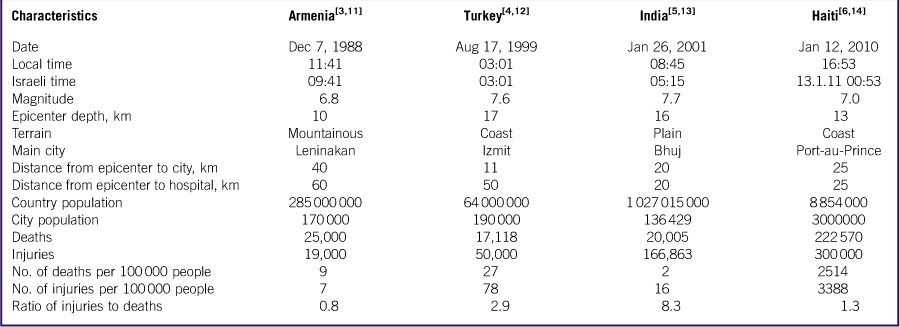
The magnitude of the earthquakes on the Richter scale ranged from 6.8 to 7.7. The depth of the epicenter measured between 10 and 17 km, and its distance from a major city was 11 to 40 km (Table 1).7–Reference Sommaruga10 The Turkish earthquake occurred at night; the other 3 happened during the daytime. Armenia's earthquake took place in a cold, snowy season, while the others were during temperate weather.
Geographic Characteristics and Casualties

Casualties
The total number of persons affected by the earthquake were 250 000 to 3 000 000. The death toll was of similar magnitude (Table 1) in Armenia (25 000), India (20 000), and Turkey (17 118).Reference Armenian, Melkonian, Noji and Hovanesian11–Reference Phalkey, Reinhardt and Marx13 Haiti suffered a significantly higher number of dead—222 570. Injuries numbered 130 000 in Armenia,Reference Noji, Kelen, Armenian, Organessian, Jones and Sivertson15 50 000 in Turkey, 166 000 in India, and 300 000 in Haiti.
Local Medical Services and Casualty Evacuation Before the Delegation Arrived
Except for 1 military hospital that remained functional in Bhuj, India, local medical services were nearly in total collapse. In Armenia, 6000 injured persons and 7000 women and children were evacuated from Kirovakan. In Turkey, evacuation to major hospitals began on day 2.Reference Bar-Dayan, Beard and Mankuta16 In India, evacuation began several hours after the earthquake, and 1000 patients were evacuatedReference Bremer17. In Haiti, hospital function in Port-au-Prince was minimally effective during the first 3 to 4 days. Evacuation to higher level care centers began in limited numbers only 1 week after the earthquake.Reference Kreiss, Merin and Peleg18
Planning, Organization and Transport to Site
In Turkey and Haiti, a scout team headed by a senior medical officer was dispatched 11 hours after the earthquake (Table 2). The mission of these teams was to establish contact with local authorities and Israeli representatives, evaluate the medical needs, locate a suitable location for the hospital, and prepare equipment for unloading and transport of hospital equipment and personnel. Recruitment was initiated between 15 hours (Haiti) and 96 hours (Armenia) after the earthquake. The latter was delayed due to the absence of diplomatic relations between Israel and the USSR. Personnel were recruited from both regular army and reserve units. Departure was between 52 (Haiti) and 209 hours (Armenia).
Field Hospital Deployment and Setup Timetable

Flight time and organization after landing was between 24 (Turkey) and 53 hours (Armenia). The variability was influenced by flight distance, weather, type of aircraft, ground control, local authority control, and presence of an assessment team and/or local liaison. The initiation of hospital activity was on day 4 in Turkey and Haiti, on day 6 in India, and on day 12 in Armenia.
Hospital Operation
Physical Structure
Due to the cold temperatures in Armenia, the hospital was set up in a sports hall. In Turkey, the hospital was initially set up in an existing building but was transferred to tents after an aftershock. The hospitals in India and Haiti were both set up in a fully self-sufficient tent encampment.
Organizational Structure
Initially, the basic model of the field hospitals consisted of 7 clinical units:
• Triage and emergency department
• Internal medicine—adults
• Orthopedics
• Pediatrics
• Obstetrics and gynecology
• Operating theatre
• Recovery and intensive care
The total number of hospital beds was 25 in Armenia, 35 in Turkey, 30 in India, and 72 in Haiti. An auxiliary services unit included radiology, laboratory, and pharmacy and medical supplies. A logistic support unit included logistics (ie, supplies, kitchen, maintenance, communications, security) and the command center.
After the initiation of operations, adjustments in hospital structure were made according to existing needs. These included dividing the adult ward by gender into men and women's wards (India), establishing a pediatric neonatal intensive care unit (India and Haiti), and operating an outpatient clinic to decrease occupancy and enable treatment of more patients. In Haiti, due to the extremely high volume of trauma patients, the triage unit was operated separately from the emergency department; in the first days, all hospital beds except for obstetrics and gynecology and neonatal intensive care were dedicated to trauma.Reference Kreiss, Merin and Peleg18
Medical Personnel
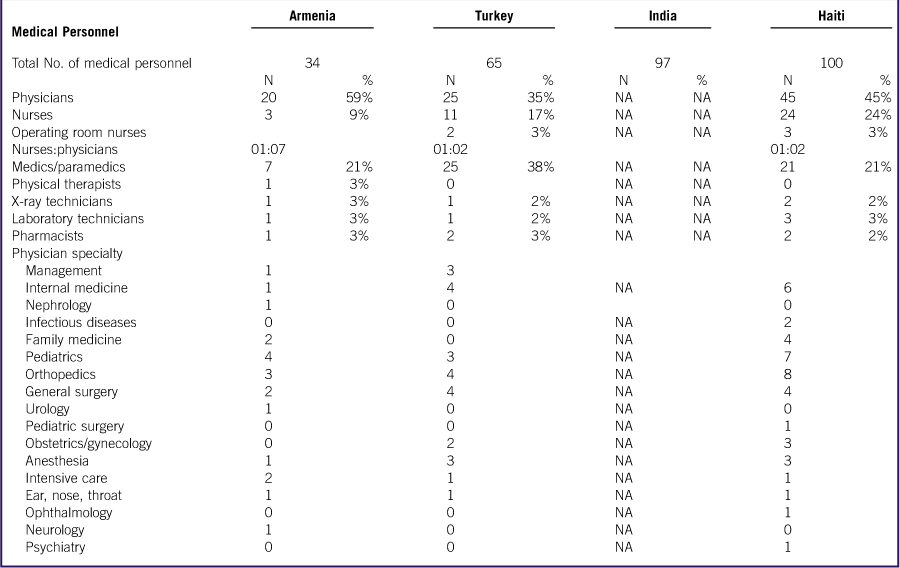
The total number of medical and paramedical personnel ranged from 34 in Armenia to 100 in Haiti (Table 3). Physicians composed 35% to 59% of the total, and nurses constituted 9% to 24%. Local and foreign personnel joined the hospital for varying periods in all 4 cases.
Medical Personnel
Patients
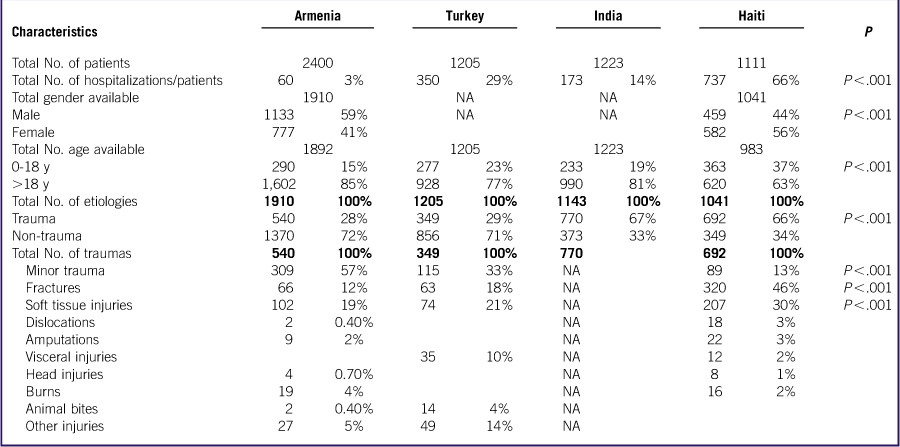
The total number of patients treated in each of the hospitals varied from 1111 in Haiti to 2400 in Armenia (Table 4). The percentage of children treated ranged from 15% in Armenia to 37% in Haiti. Hospitalization rates were between 3% of the patients treated in Armenia and 66% of those treated in Haiti. Mean hospitalization time was 2.8 days in Armenia and 1.4 days in Haiti.
Patient Demographics, Etiologies, and Trauma Breakdown
Earthquake-related traumatic injuries were suffered by 68% and 66% of patients in India and Haiti, respectively, compared to 29% and 28% in Turkey and Armenia, respectively. Of the trauma victims in Haiti, 46% sustained fractures, compared to 18% in Turkey and only 12% in Armenia. Fracture locations, which were available for Armenia and Haiti, showed a predominance of upper limb fractures in Armenia (50%), and lower limb fractures in Haiti (63%). Minor trauma constituted 57% of injuries in Armenia compared to 13% in Haiti. The percentage of trauma-related causes gradually decreased and was below 50% by deployment day 9 in all missions, while an increase was noted in routine medical problems, most commonly gastrointestinal followed by respiratory and cardiovascular problems.
Surgery Performed and Diagnostic Tests
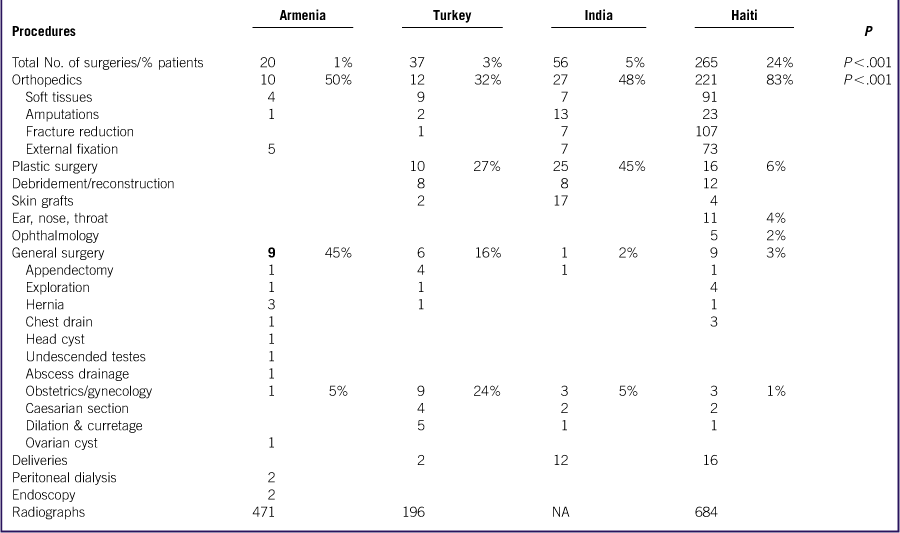
In Armenia, 1% of the treated patients underwent surgery with use of general or regional anesthesia; a total of 20 operations were performed (Table 5). In Turkey, 37 operations were performed in 3% of patients; in India, 56 operations were performed in 5% of patients; and in Haiti, 265 procedures were performed in 24% of patients. The type of surgery was either orthopedic or plastic surgery in 50% of cases in Armenia, 60% of cases in Turkey, and 89% and 85% of cases in India and Haiti, respectively. Vaginal deliveries and cesarean sections were performed in Turkey, India, and Haiti. Peritoneal dialysis was performed in Armenia but not in the other 3 hospitals. In addition, 471 radiographs were taken in Armenia, 196 were obtained in Turkey, and 684 were performed in Haiti.
Surgical and Diagnostic Procedures
The laboratories were capable of processing the following types of tests:
• Hematology: blood type and RH, blood count and differential, blood smear, sedimentation rate, and clotting test
• Biochemistry: liver function (aspartate aminotransferase, alanine aminotransferase), renal function (urea, creatinine), glucose, electrolytes, amylase, alkaline phosphatase, cholesterol, triglycerides, and blood gases
• Microbiology : microscopy, (urine, mycology, malaria), fecal tests, fast test for malaria, and cultures.
The most common laboratory tests performed were blood count, blood gases, and electrolytes. Albumin and calcium were additional tests that were required mainly for a later-phase operation, but these were not available.
Adjacent Medical Facilities, Referrals and Evacuations
Evacuation to permanent hospitals out of the disaster area was possible in the first 3 missions from the first day of operation. In addition, activity was gradually restored in some of the local hospitals. In Haiti, evacuation was unavailable during the first week of operation. In the second week, after the arrival of the hospital ship USNS Comfort and the establishment of the University of Miami hospital, patients were transferred to these facilities. Also, contact was established with other functioning facilities with lesser surgical capabilities than ours, and patients were triaged on site at these facilities and transferred to us, while postsurgical patients were transferred to the other facilities for continued care, thus freeing hospital beds. The collaboration with local and foreign personnel who joined the hospital proved extremely effectiveReference Peleg, Kreiss, Ash and Lipsky19.
Duration of Stay, Replenishments, and Termination of Operation
All 4 hospitals were operational for a similar period of 10 days. In Armenia, 1 replenishment flight occurred halfway through the mission. In Turkey, aircraft traffic was constant between Israel and the mission. In India, 1 aircraft remained in Bhuj and served the hospital both for the evacuation of patients and replenishments within India. In Haiti, resupply was limited by ground transportation from the Dominican Republic, which was coordinated by the Israeli embassy. The decision to terminate the mission became possible after more permanent medical facilities were established that could provide continued care for the patients treated at the hospital.
Discussion
A major earthquake is a disaster that often reaches a catastrophic magnitude, necessitating a massive aid effort by the international community.Reference Drifmeyer and Llewellyn20–Reference Lhowe and Briggs22 The epidemiology of casualties shows a large percentage of musculoskeletal injuries—mainly of the limbs, with fractures—many of them open and crush injuries. This epidemiology is affected by several determinants including the magnitude of the earthquake, the depth of the epicenter, the time of occurrence, proximity to urban population centers, building type and quality, as well as local demographic, social, and cultural factors.Reference Macintyre, Barbera and Smith23–Reference Chu, Stokes, Trelles and Ford30
The magnitude of the earthquakes in the events studied ranged from 6.8 (Armenia) to 7.7 (India), with the epicenter at a depth of 10 km (Armenia) to 17 km (Turkey). The death toll in 3 of the events (Armenia, Turkey, and India) was of a similar magnitude (17 000-25 000), while, according to official estimates, the death toll in Haiti was tenfold that (222 570). Although later reports have disputed this official figure, placing the death toll at 45 000-80 000,14 the Haiti death toll was still significantly larger than the other 3.
When dispatching a field hospital to an earthquake zone, the conditions under which it will operate need to be anticipated and planned accordingly, both from logistic and medical standpoints. Deployment in the acute phase of the disaster is especially challenging. The first days after an earthquake are characterized by material and organizational chaos; information regarding the true situation and needs are unavailable. Also, destruction of infrastructure is severe, and organizational chaos precludes local logistic support.
In our experience, this early stage requires complete logistic self-sufficiency. Similar findings were reported in other earthquakes, where foreign field hospitals that arrived without their own logistic support were burdensome on the already stressed local authorities.Reference Abolghasemi, Radfar, Khatami, Nia, Amid and Briggs31, Reference von Schreeb, Riddez, Samnegard and Rosling32
Another dilemma is whether to deploy a light clinic-like facility capable of delivering basic care to a very large number of patients or a full-service field hospital. Based on our experience, we think that the activities of multiple NGOs that are capable of delivering basic care can be anticipated, whereas a field hospital with advanced, wide-ranging medical and surgical capabilities and logistic backup adds significant value and thus should be deployed. Although foreign field hospitals cannot arrive during the first 48 hours (phase 1) —when saving patients with directly life-threatening injuries is possible—they can be deployed in phase 2 (days 3-14), when many patients are encountered suffering from severe fractures and soft tissue injuries, crush syndrome, and severe infections, which are potentially threatening to life and limb. In addition, the field hospital will need to provide medical care for the routine problems in the local population.Reference von Schreeb, Riddez, Samnegard and Rosling32–Reference Roy, Shah, Patel and Coughlin38 In phase 3 (weeks 2-6), the shift to routine medical needs continues. For example, the situation is worsened by poor sanitation conditions in improvised habitations. Although many of the acute-phase teams terminate their deployment at this stage, more sophisticated treatment centers are re-established.
The low trauma caseload in Armenia in spite of the large number of injuries can be explained by the late deployment, which occurred mostly in phase 3. Also, the large evacuation effort of injured women and the children before the mission's arrival further decreased the number of trauma patients and the number of women and children treated. Conversely, the hospital in Turkey also encountered predominantly non-trauma patients, in spite of early deployment. A possible explanation lies in the short distance from the Turkish disaster area to major medical centers, together with the significant evacuation capabilities of the Turkish armed forces.
The caseloads in India and Haiti were predominantly earthquake related, even though the local military authorities in India began an effective evacuation effort several hours after the earthquake. Their large trauma caseload may be due to the large ratio between injuries and mortality in the Gujarat earthquake: 8.3/1 compared to 5.3/1 in Armenia and 2.9/1 in Turkey. In spite of a similar trauma caseload, the hospital activity in India, when compared with that in Haiti, showed a large difference in surgical activity, with 56 operations being performed in India (5% of patients) compared to 265 operations in Haiti (24% of patients). This difference may be attributed to the fact that the local military hospital in Bhuj, which remained operational, performed a formidable 9526 operations during the first week.Reference Bremer17 This achievement, along with the major evacuation effort, left a large proportion of more minor injuries, which were treated at the field hospital and reduced the surgical caseload. In Haiti, the combination of a very large number of casualties, the collapse of local health care facilities, an absence of effective evacuation to facilities outside the disaster zone, and the early arrival of the field hospital led to a large trauma caseload, a high hospitalization rate, and a high proportion of surgical cases in hospital activity.
Hospital personnel composition varied among the missions. Physicians accounted for between 35% (Turkey) and 59% (Armenia), nurses for 9%(Armenia) and 24% (Haiti), and medics or paramedics for 21% and 38% of the workforce. Also, the nurse:physician ratio was from 1:7 to 1:2. Most hospital commanders interviewed thought that the main personnel deficiency was in nursing staff, resulting in an overstaffing of medics and paramedics who may have limited effectiveness in a field hospital situation. They also thought that the nurse:physician ratio should ideally be 2:1 to 1:1. However, the personnel dispatched commonly depends on availability. In a military unit, medics are relatively easily available for immediate dispatch, while nurses are scarcer and have more family constraints.
Regarding physician specialties, the wide range of specialties enabled flexibility in treating various caseloads. However, the unpredictability of the situation and the changing caseload during the deployment period made role shifting necessary in most hospitals, with nonsurgical physicians caring for injured patients in India and Haiti, and surgical specialists assisting in routine patient care in Armenia and Turkey. Similarly, although the hospitals were initially divided into medical and surgical departments, patients were hospitalized in the various departments according to the current needs. This flexibility in both hospital structure and personnel allocation was considered an essential element for smooth functioning of the hospitals in the high pressure and dynamic situation in which they operated. Consequently, it was rated as a high priority asset by all hospital commanders. This flexibility also required a high level of leadership and decision-making at departmental and hospital command levels.
Conclusions
Our findings led to the following strategies and recommendations for establishing field hospitals in early disaster response after earthquakes:
• Full logistic self-sufficiency is an absolute prerequisite for effective early deployment.
• The specific activity of the field hospital cannot be reliably predicted if deployment is to be at the early stage of phase 2.
• The hospital should not be customized according to possible predicted activity but rather prepared to treat all different types of pathologic conditions—both earthquake related and routine.
• Task shifting can occur between clinical wards and between personnel from various specialties.
• A resupply mission, preferably on day 4 or 5 of the operation, should be inherent in the hospital operation to replenish ordinance and reinforce specific personnel needs, according to the situation encountered.
• Collaboration with local and international medical crews can greatly increase surge capacity, as they often include highly trained personnel with no logistic support or proper framework in which to operate. The comprehensive field hospital provides the framework that enables the use of this trained crew effectively. Also, patients can be transferred from facilities with lesser surgical capabilities and returned for postoperative care, and local liaison is essential to evacuate patients from the disaster zone.
• Coordination of operation by local authorities and international organizations can greatly improve the effectiveness of care delivery.
The collaboration and coordination and predisaster planning along the lines described in this study should be initiated. We believe that these strategies may improve the level of care delivery in future disasters.Reference Peleg and Kellermann39