Introduction
Incidence of falls in people with dementia is approximately twice that of the similar population who are cognitively intact. Those with dementia may have factors such as wandering, agitation and perceptual difficulties that increase this risk, in conjunction with common risk factors in older patients such as postural instability, orthostatic hypotension and visual impairment.Reference Shaw, Bond, Richardson, Dawson, Steen, McKeith and Kenny 1 Older people with dementia also have an approximately three times increased risk of sustaining a fracture after a fall, predominantly fractured femurs leading to prolonged hospital admissions and poor outcomes.Reference Van Dijk, Meutenberg, Van De Sande and Habbema 2 , Reference Oliver, Connelly and Victor 3 The health, social and economic effects of this increased risk and poor outcome is large and highly detrimental to patients and their carers. Falls account for more than half of the hospital admissions in people aged over 65 years in the UK, and are the leading cause of mortality resulting from injury in this age group.Reference Schuffham, Chaplin and Legood 4 They present not only a substantial threat to independence, but also have a significant economic impact on the NHS and social services.Reference Age 5 It is understandable that due to this some older people experience fear in relation to falling.
‘Fear of falling’ (FoF) or ‘ptophobia’ was first recognized by Bhala et al. Reference Bhala, O'Donnell and Thoppil 6 Since then a number of definitions have been proposed but no consensus on defining the condition has been established. FoF tends to be viewed as a symptom rather than an illness, characterized by high anxiety relating to walking.Reference Harding and Gardener 7 It is commonly reported in older populations, with the highest prevalence rates documented in fallers and frail elderly people.Reference Zijlstra, van Haastregt, van Eijk and van Rossum 8 – Reference Scheffer, Schuurmans, Van Dijk, Van der Hooft and De Rooij 10 Historically FoF was considered to be a post-fall condition, initially referred to as ‘post-fall syndrome’.Reference Murphy and Isaacs 11 More recently studies have shown that FoF is also common in older people who have not fallen.Reference Friedman, Munoz, West, Rubin and Fried 9 , Reference Suzuki, Ohyama, Yamada and Kanamori 12 Nevertheless, the concept that FoF is a contributory factor in early falls is one which has had surprisingly little attention. In 2002, Friedman et al. Reference Friedman, Munoz, West, Rubin and Fried 9 reported a longitudinal study, which found that falls are an independent predictor of FoF at 20 months (OR = 1.75; P < 0.0005). Perhaps more significantly they also found that participants who demonstrated FoF at baseline were also more likely to fall at 20 months (OR = 1.79; P < 0.0005). Forty-two per cent of non-fallers reported FoF that restricted activity at baseline, suggesting that there are a significant number of people who experience the condition and are at increased risk of falls but have not had these fears addressed, or perhaps not had an opportunity to articulate them. If FoF is present, reduced physical activity and cautious gait are likely to develop. The desire to avoid a fall by restricting activity is, however, counterproductive as subsequent decreases in strength and balance actually further increase the falls risk.Reference Hotchkiss, Fisher, Robertson, Ruttencutter, Schuffert and Barker 13
Current guidelines
FoF is a problem that is more frequently being highlighted by patients in clinical practice. Nevertheless, there is a lack of standardized assessment or management guidelines for patients (both with and without dementia) that focus solely on treating the condition regardless of their fall status.Reference Rochat, Büla and Martin 14 , Reference Boyd and Stevens 15 The latest guidelines for falls issued by the National Institute for Health and Clinical Excellence (NICE) identify multi-factorial treatment for falls prevention, with exercise and medication assessments as key elements. 16 Although these guidelines recognize FoF as a concept, there are three key issues. Firstly, they are primarily indicated for people who present to hospital with falls or who are classed as ‘at risk’, a model that makes no reference to those who do not present at hospital or to non-fallers who have indicated a fear, but are not considered to be ‘at risk’.Reference Friedman, Munoz, West, Rubin and Fried 9 Secondly, they describe FoF as a potential ‘barrier’ to falls rehabilitation, omitting to recognize that FoF could actually be a contributory factor to the fall that needs treatment. Lastly they provide no evidence-based guidelines for treating FoF in patients with dementia. This lack of national clinical direction to treat the condition may lead to underestimating its significance for both the patient and the treating clinician.
Impact of fear of falling
Many studies have highlighted the association between FoF, functional decline and poor health status.Reference Zijlstra, van Haastregt, van Eijk and van Rossum 8 , Reference Friedman, Munoz, West, Rubin and Fried 9 , Reference Suzuki, Ohyama, Yamada and Kanamori 12 , Reference Beyer, Hauer, Kempen, Piot-Ziegler and Todd 17 – Reference Delbaere, Smith and Lord 19 The most frequently reported impact of FoF is restriction of activity, either by the person experiencing FoF or imposed upon them by a carer/proxy.Reference Ambrose, Paul and Hausdorff 20 – Reference Myers, Powell, Maki, Holliday, Brawley and Sherk 24 Rochat et al. Reference Rochat, Büla and Martin 14 studied gait function in relation to FoF through the use of body sensors and questionnaires and found that those reporting activity restrictions due to FoF had reduced gait performance and increased gait variability. The gait variability was found to be independent of functional status, though all participants were classed as ‘well-functioning’. Supporting studies have also shown that although gait changes are most pronounced in those with restricted activity through FoF, some changes such as increased step-width may show progressive beneficial adaptations towards FoF.Reference Donoghue, Cronin, Savva, O'Regan and Kenny 25 Muscle weakness, fatigue and reduction in stamina through activity restriction also compound the poorer outcomes and contribute to an increased risk of falls.Reference Hotchkiss, Fisher, Robertson, Ruttencutter, Schuffert and Barker 13 , Reference Rochat, Büla and Martin 14 , Reference Ambrose, Paul and Hausdorff 20 , Reference Clemson, Singh and Bundy 26 Dementia is an independent risk factor for reduced activity, muscle weakness and fatigue,Reference Kurrle, Brodaty and Hogarth 27 further impacting on patients with dementia who are also fearful of falling.
The physiological effects that take place due to the experience of FoF are well documented. However, the tools and measures used to assess the level of restriction are varied, making comparisons difficult. Tools such as the physical activity survey used by Tinnetti et al. Reference Tinetti, Mendes de Leon, Doucentte and Baler 28 and the Short Form-36 (SF-36) General Health Perceptions subscaleReference Ware and Gandek 29 used by Howland et al. Reference Howland, Peterson, Levin, Fried, Pordon and Bak 30 are solely dependent on the accuracy of the participant's perception and recognition of their activity restriction. The heavy reliance on self-reported questionnaires often does not give good insight into the level of activity restriction for a person with dementia. People with dementia have demonstrated inaccurate reporting of their actions or abilities when these types of measures are utilized, due to memory loss, loss of perception of abilities and impaired judgement.Reference Kurrle, Brodaty and Hogarth 27 Studies of the impact of cognition and insight on the application of the SF-36 highlighted that reliability and validity of a number of subdomains were poor in patients with a Mini-Mental State Examination (MMSE) score <17 or impaired insight (Cronbach's α < 0.7, with no significant correlation to the Quality of Life in Alzheimer's Disease (QOL-AD) scale).Reference Geschke, Fellgiebel, Laux, Schermuly and Scheurich 31 Dementia-specific quality of life questionnaires have been validated for use within this population,Reference Smith, Lamping and Banerjee 32 , Reference Brod, Stewart, Sands and Walton 33 but there is no evidence of their use in studies focusing on the impacts of FoF.
The psychological impact of FoF is also significant. People who identify FoF often express lower confidence levels in their ability to perform tasks, as well as reporting poorer health status.Reference Brouwer, Musselman and Culham 34 Social isolation in this group of patients is increasingly being recognized as an area of concern for public health as studies suggest it poses significant health detriment.Reference Beyer, Hauer, Kempen, Piot-Ziegler and Todd 17 , Reference Nicholson 35 , Reference Kendrick, Carpenter and Morris 36 Older people with more advanced dementia may alternatively express little psychological fear, i.e. deny a sense of fear regarding falling or walking. However, YardleyReference Yardley 37 highlights that it is possible to demonstrate psychophysiological signs of anxiety without a conscious awareness of fear. Psychophysiological signs may include becoming more cautious in movement or gait, or changes in posture which may result in reduced muscle strength and potentially increase the falls risk.Reference Rein Tideiksaar 38
Measuring fear of falling
A number of tools are currently used to assess FoF and measure two main outcomes: self-efficacy and fear. Early studiesReference Tinetti and Powell 18 , Reference Tinetti, Richan and Powell 23 focused on measuring the levels of fear a person experienced and tended towards dichotomous questions such as “Are you afraid of falling – Yes or No?”. Although simple to administer, this method has been criticised for its inability to accommodate varying levels of fear or indeed distinguish FoF from general fear.Reference Fuzhong, John-Fisher, Harmer, McAuley and Wilson 39 , Reference Lawrence, Tennstedt, Kasten, Shih, Howland and Jette 40 Likert scales were developed in order to incorporate the potential for variation in fear across differing tasks or activities,Reference Beyer, Hauer, Kempen, Piot-Ziegler and Todd 17 although arguably the use of simple questions is preferable, particularly as a screening tool or within certain populations such as those with a diagnosis of dementia.
Alternative measures focus on efficacy or confidence of a person to perform a task without falling, a concept founded in social cognitive theory. Self-efficacy is determined by the extent of a person's belief in their ability to perform a task.Reference Bandura 41 The Activities Balance Confidence scale (ABC)Reference Myers and Powell 42 asks the question “How confident are you that you will not lose your balance or become unsteady while.. . .?” The user rates their confidence, with zero indicating no confidence and 100 indicating complete confidence that they will not fall. Initially developed to assess older people with high functionality (i.e. those who are socially active and independently mobile), the ABC scale may be less appropriate for people with dementia with less functionality or who may not be able to distinguish their levels of confidence using an analogue scale.
The Survey of Activities and Fear of Falling in the Elderly (SAFE)Reference Lachman, Howland, Tennstedt, Jette, Assmann and Peterson 43 offers the opportunity for the identification of activity restriction due to fear and the reasons associated with this. The underlying assumption is that fear in itself may not be damaging unless it interferes with the person's daily life, pre-occupies thoughts, restricts important activities, or leads to a sedentary lifestyle. The recognition of activity restriction in relation to FoF, as well as offering a chance to assess the extent of the impact, is a clear benefit of this tool. It also allows for the exploration of the origin of the activity restriction (i.e. FoF or something else).
Perhaps the most widely used tool is the Falls Efficacy Scale-International (FES-I), derived from the original Falls Efficacy Scale (FES) which also assessed the perceived self-efficacy towards completing a task without a fall.Reference Tinetti, Richan and Powell 23 The FES-I expanded to address fears relating to more demanding activities of daily living (ADLs) and social interactions providing better internal and test–retest reliability than the former.Reference Beyer, Hauer, Kempen, Piot-Ziegler and Todd 17 , Reference Greenberg 44 Many variations on the FES have been developed and although the FES-I provides a quick comparison of FoF across a large range of cultures it offers little contextualization, particularly for patients with dementia who may struggle with the concept of fear. Delbaere et al. Reference Delbaere, Smith and Lord 19 support this by arguing that FoF should be considered as context-specific, highlighting that some people may only be fearful of falling whilst performing ‘risky’ activities such as walking on a slippery surface. To address this, they developed the Iconographical Falls Efficacy scale (Icon-FES), which uses pictures to contextualize the questions. On validation, the Icon-FES showed close agreement with the FES-I, but due to the inclusion of more demanding balance-related activities at the same time as using icons the added value of iconography could not be established.
Fear of falling and dementia
Many narrative accounts from older people living with dementia acknowledge generalized fear as an everyday experience. 45 Nevertheless, very little is known about FoF in this group despite reported significantly higher falls rates and fall-related injuries compared with the general older population.Reference Puisieux, Pardessus and Bombois 46 The lack of validated assessment tools for people with dementia is likely to have impacted on research in this area.
A systematic literature search during November and December 2014 highlights the paucity of published studies in this area. CINAHL, MEDLINE, EMBASE and BNI databases were searched as well as a manual review of reference lists for other relevant papers; MeSH subject headings were used with some truncated keywords to ensure that multiple endings, plurals and spellings were included. Terms included: accidental fall*, dementia, cognitive impairment, fear* and fear of falling. Limitations were applied to the searches with regard to language, age of paper and full text access. Duplicate searches were removed; the abstracts of 67 papers were considered pertinent to the search topic and were screened for relevance to FoF associated with cognitive impairment. The most relevant abstracts (n = 12) were assessed in full to determine specificity to assessing FoF in this patient group. Many of the studies considered FoF in terms of its contribution as a risk factor in falls, or used FoF as an outcome measure.Reference Ambrose, Paul and Hausdorff 20 , Reference Denkinger, Wilmar and Lukas 47 – Reference Wesson, Clemson and Brodaty 49 Four studies were found to focus on assessing FoF in people with dementia.Reference Hauer, Yardley and Beyer 50 – Reference Delbaere, Close, Taylor, Wesson and Lord 53
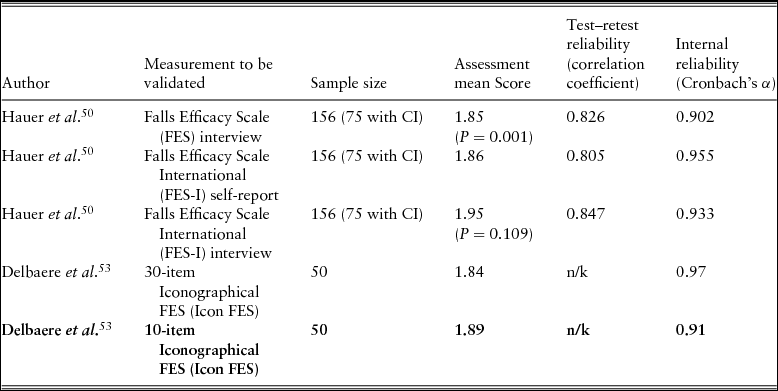
Hauer et al. Reference Hauer, Yardley and Beyer 50 highlighted the lack of validated assessment tools for patients with dementia and set out to validate the self-report and interview versions of the FES and the FES-I. There were 156 patients on a geriatric rehabilitation ward who participated in the study, with (n = 75) and without (n = 81) cognitive impairment (CI). Participants were asked to complete the self-reported FES-I questionnaire followed by a structured interview version; 62 patients were retested 5–7 days later to assess test–retest reliability. They found that in the CI group of participants, the mean FES-I and FES scores summed over all items significantly differed between the two administration methods (mean FES-I (n = 57) self-report score 28.58 vs interview score 31.96 (P = 0.001), and mean FES (n = 62), self-report score 15.51 vs interview score 18.61 (P = 0.001)). A significant problem with the self-reporting method was that only 53.3% (n = 40) of the CI participants provided complete data, in comparison with 76.5% (n = 62) of those with intact cognition. The significant difference in means in the CI groups across the two administration methods suggests that those with CI express less FoF when self-assessing, maybe due to factors such as unrealistic perceptions of risk or memory deficits in relation to functionality.Reference Kurrle, Brodaty and Hogarth 27 The low completion rate of the questionnaire also suggests that this method of assessment is taxing in people with CI and dementia, as found in other studies that identify the negative influence of CI on validity and response rate of questionnaires.Reference Rankin, Baldwin, Pace-Savitsky, Kramer and Miller 54 Although overall the CI group showed lower test-retest reliability than the cognitively intact group, the interview method also showed greater test–retest reliability than self-reports, suggesting that this is a more reliable method for FoF assessment.
The administration method of assessments in FoF with patients with dementia may significantly impact on the outcome and is an area that needs to be considered when looking to validate tools for this group of patients. Faesa et al. Reference Faesa, Reelicka and Joosten-Weyn Banninghab 52 further explored the use of interview in assessing the impact of falls in people with CI. Ten community-dwelling older people with differing levels of cognitive impairment were interviewed along with their caregivers. Both participants and their carers expressed a ‘constant fear’ of the patient falling, related both to the potential unknown consequences of a fall (i.e. hospitalization) and also with regard to falling when alone. Both patients and their carers identified feelings of frustration and anger towards the falls, with social withdrawal being highlighted as a consequence. Notably, carers suggested that they imposed restrictions on their care receivers in order to minimize risk. This type of carer restriction has been seen in other studies and should be a consideration when assessing patients' abilities and falls risks.Reference Griffiths, Mason and Boardman 55 In comparison with the quantifiable tools such as the FES-I, this type of interview method allows for the expression of emotion surrounding falls, as well as rationale and explanation as to the experiences of the person who is fearful, which may be insightful in terms of therapeutic interventions.
There is agreementReference Hauer, Yardley and Beyer 50 , Reference Delbaere, Close, Taylor, Wesson and Lord 53 that self-reported questionnaires may be difficult for people with dementia to complete due to comprehension difficulties. In addition, a lack of awareness of falls risk may result in the reporting of inappropriately low levels of fear.Reference Kurrle, Brodaty and Hogarth 27 Studies suggest that contextualization of questions for people with dementia is crucial in order to illicit accurate data. As previously highlighted, the development of the Icon-FES to provide environmental contexts to questions demonstrated a strong ability to assess FoF in high-functioning older people who are cognitively intact.Reference Delbaere, Smith and Lord 19 The use of iconography to assess patients with dementia has been developed within other areas such as pain assessment. Similar to the concept of fear, pain is essentially a subjective experience which can make it difficult to quantify.Reference Frampton 56 Historically, and mirrored within the assessment of FoF, the difficulties associated with assessing pain in patients with dementia has led to their pain being poorly managed and often undertreated.Reference Morrison and Siu 57 Some studies have shown that patients with dementia were on average prescribed a third of the amount of analgesia given to the same population who were cognitively intact.Reference Morrison and Siu 57 – Reference Scherder and Bouma 59 The likely reason for such large discrepancies in treatment for patients with dementia is not that they experience less pain, but because of problems with recall, recognition and expression of pain.Reference Horgas and Miller 60 The same issues apply when assessing FoF. The use of iconography to contextualize a question may be strategic in prompting recall of fear and assisting in expression. Table 1 summarizes the current validated assessment tools for use with people with dementia.
Summary of validated fear of falling assessments for people with dementia

n/k, not known.
Interventions to treat fear of falling
Over the last two decades some interventions to treat FoF have been proposed based primarily on risk awareness, education and physical strengthening. Cochrane reviews in 2009Reference Gillespie, Robertson, Gillespie, Lamb, Gates, Cumming and Rowe 61 and 2012Reference Gillespie, Robertson, Gillespie, Sherrington, Gates, Clemson and Lamb 62 concluded that exercise and home safety intervention programmes reduced both the rate and risk of falls. In a systematic review considering effectiveness of falls intervention studies on people with dementia,Reference Jensen and Padilla 63 exercise intervention was found to be beneficial; however, the overall long-term effectiveness remained unclear. Nevertheless, reducing the risk of falls may not alleviate the experience of FoF for the older person. If FoF is considered as a loss of confidence, increasing confidence would seem as valid a primary outcome as increasing physical strength. This concept is supported by Delbaere et al.,Reference Delbaere, Close, Brodaty, Sachdev and Lord 64 who considered the disparities between perceived and physiological falls risk in a community sample (n = 500). Categorized into subsections according to their perceived and actual falls risk, it was found that people with a high perceived falls risk and low physical falls risk (termed an ‘anxious group’) experienced more falls (39%) than those whose physical risk was high but perceived it to be low (34%) (termed a ‘stoic group’). In fact, the percentage of fallers in the anxious group was close to the highest falls rate in those with both high perceived and actual falls risk (40%). These results suggest that perceived risk or psychological influences on falls are as important as the actual physical risk and therefore it would follow that behavioural, cognitive and psychological interventions should be able to reduce the ill effects of high perceived falls risk. However, cognitive, psychological or behavioural adaptations for a person with dementia can be extremely complex. Although the suggestion of the use of cognitive behavioural therapy (CBT) to reduce falls risk has been identified within previous studies,Reference Brouwer, Walker, Rydahl and Culham 65 , Reference Zijlstra, Van Haastregt and Ambergen 66 there is minimal evidence for CBT to reduce falls in patients with dementia.
Implications for further research and practice
Further research needs to be completed in both addressing the specific assessment barriers that people with dementia may face with regard to the use of current FoF tools, with further exploration surrounding the individuals experience of FoF, and with how this may be impacting upon their quality of life and functionality. The majority of research in this area has been cross-sectional in nature with numerous factors being highlighted and associated with FoF. These include falls, co-morbidities, anxiety, polypharmacy and functional decline. However, it remains unclear if they are causal or resultant of the fear and little is known about how relationships develop or change over time. Cumming et al. Reference Cumming, Salkeld, Thomas and Szonyi 67 go some way to clarifying these relationships over a 12-month period, assessing falls-related self-efficacy using the FES, ADLs and health-related quality of life. Results suggest that those with low FES scores (<75) had a twofold increased risk of falling (adjusted relative risk 2.09, 95% CI 1.31–3.33) as well as significantly greater decline in ability to complete ADLs. Self-assessed quality of life scores were also lower amongst those with low FES. Non-fallers who were fearful of falling showed an increased risk of institutionalization. The vast majority of patients were recruited for this study during an acute phase in hospital that may limit the generalizability of the findings.
More longitudinal studies such as that of Cumming et al. Reference Cumming, Salkeld, Thomas and Szonyi 67 are required in order for us to develop and utilize early, targeted interventions and better understand causality, with the aim of reducing both rate of falls and reduction in activity that is associated with fear. In particular, further research should be directed towards the feasibility of adequate FoF assessment tools specifically for people with dementia. The tools required need to be able to differentiate between generalized fear and FoF in this population, as well as giving some practical, objective measure for use in targeted therapies. As a starting point, factors surrounding current identification and recognition of FoF by healthcare professionals in people with dementia should be sought. This is essential if we are to work on rectifying the current lack of assessments for this group. The recognition that fear is often present prior to a fall needs to be highlighted to health professionals who may come into contact with older people, with further exploration of pre-fall fear then needed. The methodology used to elicit adequate information from patients with dementia regarding their fears needs to be considered in the context of its acceptability and practicality. Memory, communication skills and judgement abilities may be affected from early stages of dementia and may result in patients feeling overburdened by long qualitative interviews regarding their falls risk.
Conclusions
Since its conception, FoF has emerged as a distinct condition with significant prevalence in older people, both those who have fallen and those who have not. However, its prevalence amongst older people with dementia is not well established, despite the likelihood that it may be causing a reduction in functional and psychological well-being for this population. With an ageing population the risks of cognitive decline are increasing and measurement tools to assist in the assessment of FoF for this population are required. The factors that contribute to FoF are numerous and compounded by age-related conditions. It remains unclear which risk factors may play the greatest contributory role for older people with dementia and how their dementia may directly impact upon their fear. The use of iconographical scales and unstructured interviews show some promise in this area, but more research is required to develop validated tools for clinical practice. The realities of clinical settings call for practicality and although the interview studies identified appear valid, they are often not appropriate for either the patient or clinician in a busy clinical setting. Until a well-validated method has been developed, clinicians need to utilize available tools as guidelines, seek the assistance of proxies at all stages of the care journey, and use clinical judgement to assess FoF in patients with dementia.
Financial support
This review was supported by a Health Education Wessex (HEW) Clinical Academic Careers (CAC) Internship Award.
Conflicts of interest
None.