


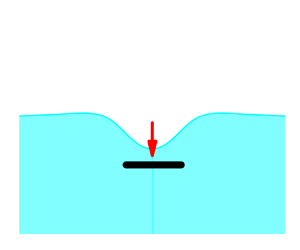

1. Introduction
The concept of impulse pressure goes back to the work of Lagrange (Reference Lagrange1783), in which he interpreted the product of the density times the velocity potential as the pressure impulse needed to suddenly impel a fluid from rest to its present velocity. It is worth mentioning the first work of Joukowskii (Reference Joukowskii1884) on the impact between two spheres, one of which is half submerged in a liquid, which first dealt with the added mass. The impulse pressure concept received further development in the works of von Kármán (Reference von Kármán1929) and Wagner (Reference Wagner1932) studying the initial stage of violent water impact flows with application to seaplane landing and ship slamming. Havelock studied the impulsively starting motion of a cylinder, with a constant velocity (Havelock Reference Havelock1949a) and a constant acceleration (Havelock Reference Havelock1949b), respectively. He applied a linearized free surface boundary condition and investigated the full time evolution of the free surface. Tyvand & Miloh (Reference Tyvand and Miloh1995) studied an unsteady nonlinear free surface flow using the method of small-time-series expansion taking into consideration orders high enough to account for the leading gravitational effects on the surface elevation and to predict the hydrodynamic force acting on the cylinder. The related problem of water entry (water exit) of a circular cylinder was studied theoretically and experimentally by Greenhow (Reference Greenhow1983) and Greenhow & Yanbao (Reference Greenhow and Yanbao1987).
The impulsive concept has been used to predict wave impacts on marine and coastal structures (Cooker & Peregrine Reference Cooker and Peregrine1995), ship slamming (Faltinsen Reference Faltinsen2005), the impulsive vertical motion of a body initially floating on a flat free surface (Iafrati & Korobkin Reference Iafrati and Korobkin2005), dam-break flows (Korobkin & Yilmaz Reference Korobkin and Yilmaz2009), impulsive sloshing in containers and tanks (Tyvand & Miloh Reference Tyvand and Miloh2012), and drops that hit a solid or liquid surface in impulsive impact (Hjelmervik & Tyvand Reference Hjelmervik and Tyvand2017). A solution based on the impulsive concept may lead to an infinite velocity where a free surface meets a solid body. In such cases, the impulse solution is used as an outer solution, which has to be matched with an inner solution in the vicinity of the contact line using the method of matched asymptotic expansion (King & Needham Reference King and Needham1994; Iafrati & Korobkin Reference Iafrati and Korobkin2005; Korobkin & Scolan Reference Korobkin and Scolan2006; Needham, Billingham & King Reference Needham, Billingham and King2007).
Mathematical models of impulse flows are based on the theory for an incompressible and irrotational flow, so that a velocity potential can be introduced. The free surface is assumed to be flat before the impact, and the potential on the free surface remains zero during the impact. The boundary value problem for the velocity potential can be written as follows:
 \begin{equation} \Delta \varPhi^\prime=0 \end{equation}
in the fluid domain;
 \begin{equation} \varPhi^\prime=0 \end{equation}
on the free surface;
 \begin{equation} \frac{\partial \varPhi^\prime}{\partial n}={-}Un_y \end{equation}
on the body surface, where  $U$ is the velocity immediately after the impact,
 $\boldsymbol {n}$ is the outward normal to the body surface and
 $n_y$ is its component in the
 $y$-direction; and
 \begin{equation} |\nabla\varPhi^\prime |\rightarrow 0, \quad x^2+y^2 \rightarrow \infty, \end{equation}
which is the far-field condition.
In contrast to the previous studies, we consider the impulsive motion of a body fully submerged in a liquid. The motivation for this research comes from the naval hydrodynamics of high-speed hydrofoil craft, whose foil system may experience sudden vertical impacts caused by waves hitting the main body of the craft (Faltinsen Reference Faltinsen2005).
The impulsive pressure on the body, the velocity on the free surface and the associated added mass are determined in a wide range of depths of submergence and for various shapes, including a flat plate, a circular cylinder and a rectangle.
The study of the added mass is of interest in connection with the drift volume concept introduced in fluid mechanics by Darwin (Reference Darwin1953). For a circular cylinder, he showed using the potential flow theory that the drift volume enclosed between the initial and the final positions of the body (at upstream and downstream infinity, respectively) is equal to the added-mass volume of the cylinder. Later, this was confirmed by Eames, Belcher & Hunt (Reference Eames, Belcher and Hunt1994) for a sphere. Peters et al. (Reference NewmanReference Peters, Madonia, Lohse and van der Meer2016) presented an experimental study for a disc impulsively set into motion on a plane oil–water interface. They showed that there exists a time window of universal behaviour of the entrained oil for various Froude numbers.
2. Boundary-value problem
A sketch of the physical domain is shown in figure 1(a). The body submerged below a calm free surface is symmetric about the  $Y$-axis, and thus only half of the flow region is considered. Before the impact,
 $t=0$, the body and the liquid are at rest. At time
 $t=0^+$ the body is suddenly set into motion with acceleration
 $a$ directed downwards such that, during infinitesimal time interval
 $\Delta t \rightarrow 0$, the speed of the body reaches the value
 $U$. The problem of a rigid body moving in a fluid body is kinematically equivalent to the problem of a fluid body moving around a fixed rigid body with acceleration
 $a$ at infinity. We define a non-inertial Cartesian system of coordinates
 $XY$ attached to the body at point
 $A$, and an inertial system of coordinates
 $X^\prime Y^\prime$ in which the velocity of the liquid at infinity equals zero. The body is assumed to have an arbitrary shape, which can be defined by the slope of the body as a function of the arclength coordinate
 $S$,
 $\beta _b=\beta _b(S)$. The liquid is assumed to be ideal and incompressible. The flow starting from rest remains irrotational at subsequent times. Both gravity and surface tension are ignored.
(a) Sketch of the physical plane, and (b) the parameter or  $\zeta$-plane.

We can introduce complex potentials  $W(Z)=\varPhi (X,Y)+\textrm {i}\varPsi (X,Y)$ and
 $W^\prime (Z)=\varPhi ^\prime (X,Y)+\textrm {i}\varPsi ^\prime (X,Y)$ with
 $Z=X+\textrm {i}Y$. In these systems, the velocity fields are related as follows:
 \begin{equation} \frac{\textrm{d}W}{\textrm{d}Z}=\frac{\textrm{d}W^\prime}{\textrm{d}Z} - \textrm{i}at, \end{equation}
where  $a$ is the acceleration,
 $0 < t < \Delta t$ and
 $\Delta t \rightarrow 0$. Integrating (2.1), we can find
 \begin{equation} W=W^\prime - \textrm{i}atZ, \quad \frac{\partial W}{\partial t}=\frac{\partial W^\prime}{\partial t} - \textrm{i}aZ, \quad \frac{\partial \varPhi^\prime}{\partial t}=\frac{\partial \varPhi}{\partial t} - aY. \end{equation}
By substituting the last equation into Bernoulli's equation
 \begin{equation} \frac{\partial \varPhi^\prime}{\partial t}+\frac{p}{\rho}+ \frac{|V^\prime|^2}{2}=\frac{p_a}{\rho}, \end{equation}
and integrating it over infinitesimal time interval  $\Delta t\rightarrow 0$, one can obtain
 \begin{equation} P=\int_0^{\Delta t}p\,\textrm{d}t={-}\rho\varPhi+\rho UY, \end{equation}
where  $p$ and
 $P$ are the pressure and impulsive pressure, respectively, and
 $U=a\Delta t$. Here,
 $|V^\prime |<\infty$ and
 $p_a$ are the velocity magnitude and the pressure on the free surface, respectively, whose integrals over time interval
 $\Delta t\rightarrow 0$ tend to zero.
We introduce dimensionless quantities normalized by  $U$,
 $L$ and
 $\rho$:
 $v=|V|/U$,
 $x=X/L$,
 $y=Y/L$,
 $h=H/L$ and
 $\phi (s)=\varPhi (S)/(LU)$. The vertical impulse force
 $F_y$ is obtained by integrating the impulse pressure over the body surface,
 \begin{equation} F_y={-}2\rho L^2 U\int_{s_A}^{s_C}\phi(s)\cos(n,y) \,\textrm{d}s-2\rho UA=\rho mL^2 U, \end{equation}
where  $s$ is the arclength coordinate along the body surface,
 $s_A$ and
 $s_C$ are the arclengths of points
 $A$ and
 $C$,
 $m$ is the added-mass coefficient and
 $A$ is the cross-sectional area. The factor ‘
 $2$’ accounts for the force acting on the part of the body symmetric about the
 $y$-axis. Owing to the symmetry of the body about the
 $y$-axis, the horizontal impulse force equals zero.
It is desired to determine the velocity potential  $\phi (s)$ immediately after the impact.
3. Conformal mapping
To find the complex potential  $w(z)$ directly is a challenge; therefore, we introduce an auxiliary parameter plane, or
 $\zeta$-plane, as suggested by Michell (Reference Michell1890) and Joukovskii (Reference Joukovskii1890). We formulate boundary-value problems for the complex velocity function,
 $\textrm {d}w/\textrm {d}z$, and for the derivative of the complex potential,
 $\textrm {d}w/\textrm {d}\zeta$, both defined in the
 $\zeta$-plane. Then the derivative of the mapping function is obtained as
 $\textrm {d}z/\textrm {d}\zeta = (\textrm {d}w/\textrm {d}\zeta )/(\textrm {d}w/\textrm {d}z)$, and its integration provides the mapping function
 $z = z(\zeta )$ relating the coordinates in the parameter and physical planes.
We choose the first quadrant of the  $\zeta$-plane in figure 1(b) as the region corresponding to the fluid region in the physical plane (figure 1a). The conformal mapping theorem allows us to arbitrarily choose the locations of three points, which are points
 $O$ at the origin (
 $\zeta =0$),
 $D$ (
 $D^\prime$) at infinity and
 $B$ at
 $\zeta = 1$ (see figure 1b). The position of points
 $A$ (
 $\zeta =a$) and
 $C$ (
 $\zeta =c$) has to be determined from the solution of the problem and physical considerations.
3.1. Expressions for the complex velocity and the derivative of the complex potential
The body is considered to be fixed; therefore, the velocity direction and the slope of the body coincide. Besides, at this stage, we assume that the velocity magnitude on the free surface is a known function of the parameter variable,  $v(\eta )$. Then the boundary-value problem for the complex velocity in the first quadrant of the parameter plane can be written as follows:
 $$\begin{gather} \chi (\xi ) = \arg \left(\frac{\textrm{d}w}{\textrm{d}z} \right) = \left\{{ \begin{array}{@{}ll} -\beta_b(a) + \beta_0, & 0 \leq \xi \leq a, \\ - \beta_b(\xi), & a \leq \xi \leq c, \\ - \beta_b(c) - \beta_0, & c \leq \xi < \infty. \end{array}} \right. \end{gather}$$
 $$\begin{gather}v(\eta ) = \left| {\frac{\textrm{d}w}{\textrm{d}z}} \right|_{\zeta=\textrm{i}\eta}, \quad 0\leq\eta<\infty, \end{gather}$$
where  $\beta _0={\rm \pi} /2$,
 $\beta _b(a)={\rm \pi}$ and
 $\beta _b(c)=0$. Equation (3.1) satisfies the conditions:
 $\chi (\xi )=-{\rm \pi} /2$ along the intervals
 $OA$ and
 $CD$ on the symmetry line, and
 $\chi (\xi )=-\beta _b(\xi )$ along the body. The argument of the complex velocity exhibits jumps
 $\varDelta =-{\rm \pi} /2$ at points
 $A$ and
 $C$ when we move along the boundary in the physical plane from point
 $O$ to point
 $D$.
This boundary-value problem can be solved by applying the following integral formula (Semenov & Yoon Reference Semenov and Yoon2009):
 \begin{align} \frac{\textrm{d}w}{\textrm{d}z} = v_{\infty}\exp \left[ {\frac{1}{{\rm \pi} }\int_0^\infty {\frac{\textrm{d}\chi }{\textrm{d}{\xi }}\ln \left( {\frac{\zeta + {\xi }}{\zeta - {\xi }}} \right)\textrm{d}{\xi } - \frac{\textrm{i}}{{\rm \pi} }\int_0^\infty {\frac{\textrm{d}\ln v}{\textrm{d}{\eta }}\ln \left( {\frac{\zeta - \textrm{i}{\eta }}{\zeta + \textrm{i}{\eta }}} \right)\textrm{d}{\eta } + \textrm{i}\chi_{\infty}}}} \right], \end{align}
where  $v_\infty =v(\eta )_{\eta \rightarrow \infty }$ and
 $\chi _\infty =\chi (\xi )_{\xi \rightarrow \infty }$. Substituting (3.1) and (3.2) into (3.3) and evaluating the first integral over the step change at points
 $\zeta =a$ and
 $\zeta =c$, we obtain
 \begin{align} \frac{\textrm{d}w}{\textrm{d}z} &= v_\infty\left(\frac{\zeta - a}{\zeta + a}\right)^{{1}/{2}} \left(\frac{\zeta - c}{\zeta + c}\right)^{{1}/{2}} \nonumber\\ &\quad \times \exp\left[\frac{1}{\rm \pi}\int_a^c{\frac{\textrm{d}\beta_b}{\textrm{d}{ \xi}}\ln \left(\frac{\zeta - \xi}{\zeta + \xi}\right) \textrm{d}{\xi}} - \frac{\textrm{i}}{\rm \pi}\int_0^\infty {\frac{\textrm{d}\ln v}{\textrm{d}{\eta }}\ln \left( {\frac{\zeta - \textrm{i}{\eta }}{\zeta + \textrm{i}{\eta }}} \right)\textrm{d}{\eta}} - \textrm{i}\beta_0 \right]. \end{align}
It can be easily verified that for  $\zeta =\xi$ the argument of the right-hand side of (3.4) is the function
 $-\beta _b(\xi )$, while for
 $\zeta =\textrm {i}\eta$ the modulus of (3.4) is the function
 $v(\eta )$, i.e. the boundary conditions (3.1) and (3.2) are satisfied. It can also be seen that the complex velocity function has zeros of order
 $1/2$, which correspond to the flow around a corner of angle
 ${\rm \pi} /2$ at points
 $A$ and
 $C$.
In order to derive the derivative of the complex potential, we have to analyse its behaviour. Before the impact, the free surface is flat, and it coincides with the  $x$-axis (see figure 1a). The pressure along the free surface is constant. Then, as follows from the Euler equation, the velocity generated by the impact is perpendicular to the free surface where the pressure is constant, or the velocity is directed in the
 $y$-direction. Therefore, the
 $x$-component of the velocity is zero, and
 $\textrm {d}w=(\textrm {d}w/\textrm {d}z) \,\textrm {d}z=(v_x-\textrm {i}v_y )\,\textrm {d}x=-\textrm {i}v\,\textrm {d}x$. Thus, the free surface corresponds to the interval
 $(-\infty ,0)$ on the imaginary axis
 $\psi$ in the
 $w$-plane. We have
 $\textrm {Im}(w)=0$ along the line
 $OABCD$ due to the impermeability condition on the body
 $ABC$ and the intervals
 $OA$ and
 $CD$ of the symmetry line. At the same time,
 $\textrm {Re}(w)$ changes from zero at point
 $O$ to
 $-\infty$ at infinity
 $D$. Thus, the flow region in the physical plane corresponds to the third quadrant in the
 $w$-plane. They are related as
 $w=-K\zeta$, where
 $K$ is a positive real number. Then one can obtain
 \begin{equation} \frac{\textrm{d}w}{\textrm{d}\zeta}={-}K. \end{equation}
The simple form of the complex potential,  $w(\zeta )=-K\zeta +w_O$, allows one to exclude the parameter
 $\zeta$ and obtain the solution in Kirchhoff's form, for which the complex velocity is a function of the complex potential. Here,
 $w_O$ is the complex potential at point
 $O$.
The derivative of the mapping function is obtained by dividing (3.5) by (3.4), i.e.
 \begin{align} \frac{\textrm{d}z}{\textrm{d}\zeta} &={-}K\left(\frac{\zeta + a}{\zeta - a}\right)^{{1}/{2}}\left(\frac{\zeta + c}{\zeta - c}\right)^{{1}/{2}}\nonumber\\ &\quad \times \exp\left[\frac{1}{\rm \pi}\int_a^c{\frac{-\textrm{d}\beta_b}{\textrm{d}{\xi}}\ln \left(\frac{\zeta - \xi}{\zeta + \xi}\right) \textrm{d}{\xi}} + \frac{\textrm{i}}{\rm \pi}\int_0^\infty {\frac{\textrm{d}\ln v}{\textrm{d}{\eta }}\ln \left( {\frac{\zeta - \textrm{i}{\eta }}{\zeta + \textrm{i}{\eta }}} \right)\textrm{d}{\eta}} + \textrm{i}\beta_0 \right]. \end{align}
The integration of this equation yields the mapping function  $z = z(\zeta )$ relating the parameter and the physical planes. Equations (3.4) and (3.5) include the parameters
 $a$,
 $c$ and
 $K$ and the functions
 $v(\eta )$ and
 $\beta _b(\xi )$, all to be determined from physical considerations and the kinematic boundary condition on the free surface and on the solid boundary
 $OABCD$.
3.2. Body boundary conditions
The arclengths between points  $A$ and
 $B$,
 $s_{AB}$, and between points
 $B$ and
 $C$,
 $s_{BC}$, and the depth of submergence are determined as follows:
 \begin{equation} \int_a^1\left|\frac{\textrm{d}z}{\textrm{d}\zeta} \right|_{\zeta=\xi}=s_{AB}, \quad \int_1^c\left|\frac{\textrm{d}z}{\textrm{d}\zeta} \right|_{\zeta=\xi}=s_{BC}, \quad \int_0^a\left|\frac{\textrm{d}z}{\textrm{d}\zeta} \right|_{\zeta=\xi}=h. \end{equation}
The unknown function  $\beta _b (\xi )$ is determined from the following integro-differential equation:
 \begin{equation} \frac{\textrm{d}\beta_b}{\textrm{d}\xi} = \frac{\textrm{d}\beta_b}{\textrm{d}s} \left|\frac{\textrm{d}z}{\textrm{d}\zeta} \right|_{\zeta=\xi}, \end{equation}
where  $\beta _b(s)$ is the given function. Equation (3.8) is solved by iteration using
 $\textrm {d}\beta _b/\textrm {d}\xi$ in (3.6) known at the previous iteration.
3.3. Free surface boundary conditions
An impulsive impact is characterized by infinitesimally small time interval  $\Delta t\rightarrow 0$ such that the position of the free surface does not change during the impact. From the Euler equations, it follows that the velocity generated by the impact is perpendicular to the free surface (
 $p=p_a$):
 \begin{equation} \arg \left(\left. \frac{\textrm{d}w}{\textrm{d}z}\right|_{\zeta=\textrm{i}\eta} \right)={-}\beta_0, \quad 0 \le \eta \le \infty. \end{equation}
Taking the argument of the complex velocity from (3.4), we obtain the following integral equation in the function  $\textrm {d}\ln v/\textrm {d}\eta$:
 \begin{align} &\int_0^\infty \frac{\textrm{d}\ln v}{\textrm{d}\eta }\ln \left| \frac{\eta^\prime-\eta}{\eta^\prime+\eta} \right|\textrm{d}\eta^\prime+\tan^{{-}1}\left(\frac{\eta}{a}\right) + \tan^{{-}1}\left(\frac{\eta}{c}\right)\nonumber\\ &\quad + \frac{2}{\rm \pi}\int_a^c \frac{\textrm{d}\beta_b}{\textrm{d}\xi} \tan^{{-}1}\left(\frac{\eta}{\xi}\right)\textrm{d}\xi =0. \end{align}
Equation (3.10) is a Fredholm integral equation of the first kind with a logarithmic kernel. Its solution takes the form (see Appendix A)
 \begin{equation} v(\eta)=\sqrt{\eta^2+a^2}\sqrt{\eta^2+c^2}\exp\left(\frac{1}{\rm \pi}\int_a^c\frac{\textrm{d}\beta_b}{\textrm{d}\xi}\ln (\eta^2+\xi^2)\,\textrm{d}\xi\right). \end{equation}
Equations (3.7a–c), (3.8) and (3.10) form a closed system of equations in the parameters  $a$,
 $c$ and
 $K$ and the functions
 $\beta _b(\xi )$ and
 $\ln v(\eta )$.
4. Results
The results presented below are shown in the system of coordinates related to the liquid at infinity. The velocity distribution on the free surface generated by the impulsive impact of a flat plate is shown in figure 2 for various depths of submergence. The position of the plate (right axis) is shown as a thick horizontal line. The colours of the plate and the associated velocity distribution are the same. After the impact, the plate gets a velocity equal to  $-$1. At a relatively small depth of submergence,
 $h<0.25$, the velocity of the liquid in front of the plate,
 $|x|<1$, is close to
 $-1$, i.e. the plate entrains the liquid, and they move almost together. Outside of the plate,
 $|x|>1$, the plate displaces the liquid, and it moves upwards, providing the balance of the liquid coming into and out of the flow region. The larger the depth of submergence of the plate, the smaller is the response of the free surface.
Velocity magnitude on the free surface (left axis) for various depths of submergence (right axis):  $h=0.25$ (red, solid line), 0.5 (blue, dotted line) and 1.0 (magenta, dot-dashed line).

The velocity distribution along the free surface and the impulsive pressure versus the arclength coordinate  $s$ are shown for a circular cylinder in figures 3(a) and 3(b), respectively. The coordinates
 $s=0$ and
 $s={\rm \pi}$ correspond to the top (point
 $A$) and the bottom (point
 $C$) of the cylinder. The bottom pressure is positive, and it depends only weakly on the depth of submergence. At the top of the cylinder, the pressure is negative, but it increases as the cylinder approaches the free surface.
(a) Velocity along the free surface (left axis) and (b) impulsive pressure along the cylinder for various depths of submergence (right axis):  $h=0.02$ (red, solid line),
 $0.1$ (blue, dashed line),
 $1.0$ (magenta, dotted line),
 $3.0$ (green, dot-dashed line) and
 $10.0$ (purple, dot-dot-dashed line).

The response of the free surface caused by the impulsive impact of a submerged rectangle is shown in figure 4 for depth  $h=0.25$ and various values of the side length
 $b$ of the rectangle. For a small length,
 $b=0.1$, the velocity distribution is close to that shown in figure 2 for a plate at depth
 $h=0.25$. For larger lengths
 $b$, the velocity decreases, while the length of the free surface in the
 $x$-direction affected by the impact increases. Such behaviour provides a balance between the liquid moving into and out of the flow region.
Velocity (left axis) along the free surface generated by the impact of a rectangle submerged at depth  $h=0.25$ and the position of the rectangle (right axis): side length
 $b=0.1$ (red, solid line),
 $m=2.272$;
 $b=1.0$ (blue, dashed line),
 $m= 2.786$; and
 $b=3$ (magenta, dotted line),
 $m= 3.241$. The top surface of the rectangles,
 $y=-h$, is the same, while the bottom surface,
 $y=-h-b$, is shown by the appropriate coloured line.

The added-mass coefficients are shown in table 1 for various shapes of the body. For a flat plate,  $m\rightarrow {\rm \pi}/2$ as
 $h\rightarrow 0$, which agrees with the added mass for a flat plate floating on a free surface (von Kármán impact solution). For a large depth of submergence,
 $h=50$, the effect of the free surface becomes negligible, and the coefficient of the added mass approaches the value corresponding to the added mass in an unbounded fluid domain. Greenhow & Yanbao (Reference Greenhow and Yanbao1987) presented Walton's analytical formula for the added mass of a submerged cylinder. An equivalent formula was proposed by Venkatesan (Reference Venkatesan1985). The formulae contain elliptical integrals, and they are quite complicated for computations. Because of this, Greenhow & Yanbao (Reference Greenhow and Yanbao1987) proposed a polynomial approximation, which provides an accuracy within 2 %. The difference between the obtained results and those based on the approximation formula is also less than 2 %.
Added-mass coefficient for various cross-sectional shapes of the cylinder and depths of submergence:  $^\ast$unbounded fluid domain;
 $^{\ast \ast }$approximate formula (Greenhow & Yanbao Reference Greenhow and Yanbao1987).

5. Upward impulsive impact
Here, we analyse how the direction of an impact on a submerged body affects the velocity field. In the system of coordinates attached to the body, a change of the impact direction results in a reversal of the velocity direction of the liquid at infinity and on the whole solid boundary, including the body and the symmetry line. Equation (3.1) will keep its form if we set values  $\beta _0=-{\rm \pi} /2$,
 $\beta _b (a)=0$ and
 $\beta _b(c)=-{\rm \pi}$, or subtract
 ${\rm \pi}$ from
 $\chi (\xi )$ in (3.1). In this case, the expression for the complex velocity (3.4) keeps its form. The derivative of the complex potential is obtained from (3.5) if we change the sign of the expression. Thus, all the equations of the problem keep their form. Therefore, the velocity magnitude on the free surface (3.11) remains the same for both upward and downward impact directions.
In the system of coordinates related to the liquid, a change of the impact direction results in a reversal of the velocity direction on the free surface, while the magnitude of the velocity and the added-mass coefficients are identical to the case of downward impact. Figure 5 illustrates the velocity distribution on the free surface corresponding to an upward impact of the plate for the same depths of submergence as shown in figure 2 for a downward impact. The velocity distribution on the free surface near the plate edges predetermines flow separation from the plate edges in later times.
The same as in figure 2 but opposite (upward) direction of impact.

6. Conclusions
An analytical solution of the impulsive impact of a cylindrical body below an undisturbed free surface is found using the integral hodograph method. The cross-sectional shape of the body may be a polygon or an arbitrary smooth shape. The results are shown for a flat plate, a circular cylinder and a rectangle. The equation for the complex velocity includes the velocity magnitude on the free surface, whose analytic form has been determined.
The associated added masses are found as a function of the depth of submergence. As the depth of submergence tends to infinity, the added mass tends to the value corresponding to the added mass in an unbounded fluid domain.
It is shown that upward and downward impacts generate an identical magnitude of the velocity on the free surface and identical added-mass coefficients. However, the velocity direction is opposite. The obtained solution can be considered as a first-order solution in solving the problem using the method of small time series.
The presence of a free surface does not change the structure of the flow near the body, which determines the added mass. Therefore, we may expect that the obtained results will reflect real situations similar to those occurring in the case of an unbounded fluid domain.
Declaration of interests
The authors report no conflict of interests.
Appendix A
Let us consider a polygon inscribed in a given smooth boundary of the body. Let  $N_p$ be the number of sides of length
 $l_i$, the slope of which is
 $\beta _{pi}$. Let
 $\xi _i$,
 $i=1,2, \ldots ,N_p$, be the points in the parameter region corresponding to the vertices of the polygon. Then the function
 $\beta _b(\xi )$ can be written explicitly as
 \begin{equation} \beta_b(\xi)=\beta_{bi}, \quad \xi_{i-1} < \xi \le \xi_i, \quad i=1, \ldots N_p, \end{equation}
where  $\xi _0=a$,
 $\xi _{N_p}=c$,
 $\beta _{p1}={\rm \pi}$ and
 $\beta _{Np}=0$.
By substituting (A1a,b) into (3.4) and evaluating the integral over the step change in the function  $\beta _b(\xi )$ at points
 $\xi =\xi _i$, we obtain the complex velocity for the polygon-shaped body
 \begin{align} \frac{\textrm{d}w}{\textrm{d}z} &= \left(\frac{\zeta - a}{\zeta + a}\right)^{{1}/{2}}\left(\frac{\zeta - c}{\zeta + c}\right)^{{1}/{2}} \prod_{i=1}^{N_p}\left(\frac{\zeta - \xi_i}{\zeta + \xi_i}\right)^{{\Delta\beta_{pi}}/{\rm \pi}}\nonumber\\ &\quad \times \exp\left[- \frac{\textrm{i}}{\rm \pi}\int_0^\infty {\frac{\textrm{d}\ln v}{\textrm{d}{\eta }}\ln \left( {\frac{\zeta - \textrm{i}{\eta }}{\zeta + \textrm{i}{\eta }}} \right)\textrm{d}{\eta}} - \textrm{i}\beta_0 \right]. \end{align}
The free surface boundary condition (3.9) with the complex velocity (A2) leads to the integral equation
 \begin{equation} \int_0^\infty \frac{\textrm{d}\ln v}{\textrm{d}\eta }\ln \left| \frac{\eta^\prime+\eta}{\eta^\prime-\eta} \right|\textrm{d}\eta^\prime=f(\eta), \end{equation}
where
 \begin{equation} f(\eta)=\tan^{{-}1}\left(\frac{\eta}{a}\right) + \tan^{{-}1}\left(\frac{\eta}{c}\right) + \frac{2}{\rm \pi}\sum_{i=1}^{N_b}\Delta \beta_{bi} \tan^{{-}1}\left(\frac{\eta}{\xi_i}\right). \end{equation}
By applying the following transformations (Polyanin & Manzhirov Reference Polyanin and Manzhirov1998):
 \begin{equation} \frac{\textrm{d}\ln v}{\textrm{d}\eta}={-}\frac{2}{{\rm \pi}^2}\frac{\textrm{d}}{\textrm{d}\eta}\int_\eta^\infty\frac{F(u)\,\textrm{d}u}{\sqrt{u^2-\eta^2}}, \quad F(u)=\frac{\textrm{d}}{\textrm{d}u}\int_0^u\frac{pf(p)}{\sqrt{u^2-p^2}}\,\textrm{d}p, \end{equation}
the solution of the integral equation (A3) is obtained as
 \begin{equation} v(\eta)=\sqrt{\eta^2+a^2}\sqrt{\eta^2+c^2}\prod_{i=1}^{N_p}(\eta^2 + {\xi_i}^2)^{{\Delta\beta_{bi}}/{\rm \pi}}. \end{equation}
By taking the limit of (A6) for  $N_b \rightarrow \infty$ and using
 $\Delta \beta _{bi}=({\textrm {d}\beta _b}/{\textrm {d}\xi })_i{\Delta \xi }_i$, we obtain equation (3.11).



