INTRODUCTION
‘Life in cities’ is a common conceptualisation of urbanism in urban studies, whereby scholars endeavour to shed light on certain features of urban life that are closely associated with the particular cities they study. In Africans’ urban life, such features embody the coexistence of uncertainty and precarity with agency and creativity, especially in the fields of informal economies, contentious politics and youth cultures (Simone Reference Simone2004; Murray Reference Murray2011; Newell Reference Newell2012). These works have contributed considerably to our understanding of the specifics of urban experiences in African cities. What they generally leave out, however, is how the meanings of such experience are shaped by longer life trajectories, often spanning not only the current city of a person's residence, but the many other urban areas that remain important to them, for a variety of reasons. This paper argues that adopting a relational approach that takes account of this phenomenon will further deepen our understanding of the urban experience in Africa.
To support this claim, this paper proposes, as an alternative conceptualisation to ‘life in cities’, ‘cities in life’: an approach that prioritises individuals’ lived experiences and life trajectories over the cities that these individuals inhabit. In this regard, the phrasing ‘Lagos in life’ refers to a project aimed at understanding how the city of Lagos, Nigeria, is subjectively experienced not solely on its own terms, but also in its relationships with lives in other places, including residents’ hometowns, as well as other cities that have featured prominently in the narratives of their own migration histories. Reconciling this spatial relationality of places with the temporal trajectory of individual lived experiences helps to tease out the conceptual perspective of a place in the individual's life, especially for the focused city of Lagos.
‘Cities in life’ is expected to be particularly useful in tackling three sets of research problems. First, the rural-urban dichotomy has been widely interrogated through the examination of the dynamics of rural-urban migration and mobilities (de Bruijn et al. Reference De Bruijn, van Dijk and Foeken2001; Potts Reference Potts2010). Drawing on this scholarship, the present paper calls for a deeper articulation of the specificity of places in the accounts of migration dynamics. Thus, instead of interpreting lived experiences through a rural-urban lens, it advocates taking the politics of place in individual lived experiences seriously (Cresswell Reference Cresswell2015: 41–6), irrespective of the relevant places’ rural or urban status.
Second, in line with geographic work on relational places (Massey Reference Massey1994; Pierce et al. Reference Pierce, Martin and Murphy2011), this paper brings relationality to bear on how a particular city, Lagos, is placed in relation to other places by its inhabitants. Accordingly, in addition to the studied relationships between rural hometowns and urban societies, this paper provides more nuanced interpretations of relationality among differently positioned places, including Lagos, and how these relationships are narrated and practiced in individual experiences.
Third, existing research has shed certain light on changing social and political dynamics in African megacities and secondary cities (e.g. Simone Reference Simone2004; Murray & Myers Reference Murray and Myers2007; Nuttall & Mbembe Reference Nuttall and Mbembe2008), which can be further articulated through an examination of individual subjectivities by letting individual subjects elaborate on their lived experiences in and beyond the focused cities. This article's approach allows researchers to inductively analyse how cities are narrated and understood in research subjects’ life stories, thereby shedding light on their cognitive practices of placing.
BEYOND THE RURAL-URBAN CONCEPTION: POLITICS OF PLACE AND THE PERSPECTIVE OF PLACING
In this section, I will first review prior studies of rural-urban migration in Africa, focusing on recent critiques that complicate the primary neoclassical economic explanation of migration. Being a human geographer, I will also include geographic thinking about place among the reviewed critiques of the rural-urban dichotomy, notably the idea that the ‘place-ness’ of migrants’ hometowns should be taken seriously in the analysis of the ‘hometown factor’ in urban dwellers’ lived experiences. In this regard, the politics of place clearly manifests the politics of indigeneity in Nigeria. Lastly, this section explains how employing a perspective of placing allows researchers to prioritise lived experiences and relationality over off-the-shelf categories such as ‘rural village’, ‘secondary city’ and ‘megacity’.
In the field of African Studies, looking at cities through the lens of the rural-urban nexus was fundamental. A traditional narrative in this vein is that migrants leave rural villages for metropolitan cities to earn their livelihoods (Kuper Reference Kuper1965). The neoclassical economic explanation for this phenomenon is that it is driven by income and employment inequalities between the rural and the urban and the migrants’ concomitant desire to maximise their material benefits (Todaro Reference Todaro1971). Drawing on this model of economic rationality, scholars have also assumed that migrants will leave cities, generally for rural areas, if their urban livelihoods are not economically sustainable, e.g. due to unemployment, underemployment or retirement (Gould & Prothero Reference Gould, Prothero, Kosinski and Prothero1975).
More balanced accounts of rural-urban circular migration and urbanisation processes have emerged as these traditional theories have been interrogated and modified. Potts (Reference Potts2010) argued that sustainable urban livelihoods are crucial to migrants’ decision-making, and rural livelihoods will often be preferred over unsustainable urban ones. In part for this reason, migration between the rural and the urban is highly dynamic. Potts (Reference Potts2009, Reference Potts2010) also maintained that urbanisation in Africa has slowed down, as circular migration between urban and rural areas has increased. Based on the case of Lagos, which is said to be the largest metropolis in Africa, Potts (Reference Potts2012: 1387) argued that Nigerian urbanisation has been overestimated, and that the population of Lagos according to the 2006 national census, 8.048 million, was still a reasonable figure six years later. Potts's work is primarily based on census data, surveys and structured interviews (also see Beauchemin Reference Beauchemin2011). Although it helpfully elucidates some under-examined dynamics of rural-urban migration, it still conceptualises people's lived experiences in terms of a rural-urban dichotomy.
Studies of rural migrants’ experiences in African cities, meanwhile, have tended to examine what motivates these individuals to move to cities and how they adapt to urban life or cope with urban hardships (Aina & Baker Reference Aina and Baker1995; De Bruijn et al. Reference De Bruijn, van Dijk and Foeken2001). This body of work has shown that migrant experiences in cities are profoundly affected by group or individual social capital, established social networks, and infrastructural links among rural and urban areas, as well as by the economic forces and material benefits mentioned above (de Haan et al. Reference De Haan, Brock and Coulibaly2002). In many African cities, ‘hometown’ associations play critical roles in providing necessary support for newly arrived migrants and improving their welfare thereafter (e.g. Page Reference Page2007; Mercer et al. Reference Mercer, Page and Evans2008). Scholars taking this approach have also highlighted the existence of urban continua, not only on the periphery of metropolises (Lerner & Eakin Reference Lerner and Eakin2011) but around and among their small satellite cities (Corker Reference Corker2017).
In short, the existing body of research on the rural-urban nexus in Africa offers a range of important insights regarding the changing, often circular patterns of human movement between the rural and the urban, as well as the complexity of migrants’ livelihoods in cities and their adjacent areas. Arguably, however, scholarly work of this kind could profitably take the concept of place even more seriously. More specifically, the existing critiques of the rural-urban dichotomy have done little to articulate the specificities of cities in migration's processes and linkages, and instead tend to depict a very general storyline of how Africans move from one place to another and decide to settle down in cities or return to their rural hometowns. Thus, it remains unclear how particular cities are chosen, either in relation to the hometowns in question or individual migrants’ life trajectories. Finally, this lack of nuanced interpretation of the position of places in Africans’ lived experiences can overshadow their subjectivities.
Place matters deeply, for it is ‘a way of seeing, knowing, and understanding the world’ (Cresswell Reference Cresswell2015: 18), and human geographers have gone a long way toward explicating the complicated connections among place, meaning and power (Massey Reference Massey1994; Massey et al. Reference Massey, Allen and Sarre1999). The contemporary politics of place tends to render places progressive, unbound and relational (Amin Reference Amin2004; Pierce et al. Reference Pierce, Martin and Murphy2011). Thus, I argue that interrogations of the epistemology of the rural-urban dichotomy should pay heed to these geographic insights and emphasise ontological accounts of places in human experiences. In other words, not simply the places in research subjects’ experiences, but also the relationships between and among those places, should be identified and critically discussed in terms of their meanings, senses and power dynamics, rather than simply slotted into an urban or rural category.
Adopting such a theoretical orientation opens up a new perspective on the ‘hometown factor’. Existing research on hometown associations in Africa has primarily focused on the functionality of social ties between a relative generic rural place called ‘hometown’ and a more or less equally generic target of rural immigration, usually an urban centre (e.g. Mercer et al. Reference Mercer, Page and Evans2008). As with other migrant organisations around the world (Caglar Reference Caglar2006), the interpersonal ties embodied by African hometown associations are relatively strong and are utilised by migrants for a variety of ends. However, sociological analysis of these ties tends to lack awareness of the geographic context of such associations’ focal hometowns.
Accordingly, this article will discuss how individuals conceptualise their hometowns as places within their imaginative maps of cities where they have lived. In adopting such an approach, it is expected to shed light on a particular politics of place associated with hometowns: the politics of indigeneity as it affects admission to higher education in Nigeria. The politics of indigeneity have led to discrimination against and marginalisation of non-indigenes as well as extensive conflicts and contestation over autochthony (Fourchard Reference Fourchard2015; Mang & Ehrhardt Reference Mang and Ehrhardt2018). This paper will focus on how such politics play out in young Lagosians’ life trajectories, and on the roles of discourses of indigeneity around hometowns in their choices of educational institutions, migration routes and employment. In other words, it is through the analysis of positionality of places in people's lived experiences that these nuanced politics unfold.
Taking place seriously also manifests as another perspective that prioritises lived experiences over categories of places: i.e. ‘cities in life’ over ‘life in cities’. Many Africanist ethnographers have demonstrated that the opportunities cities can provide are not only economic, but also for the fulfilment of urban aspirations and global fantasies (e.g. Newell Reference Newell2012; Spronk Reference Spronk2012). For instance, in one secondary city with a neoliberal economic regime – Arusha, Tanzania – barbershops run by youth emerged as key sites not only in the struggle to earn a living, but also as nodes in an explosion of popular culture that appropriated images from the global circulation of music, fashion and modelling (Weiss Reference Weiss2009). This case indicated that specific urban experiences are marked by nuanced, but often ignored, subjective interpretations of the relationship between one's migration to a city and one's livelihood there. This is arguably a further reason to complicate conceptions of an urban-rural nexus.
During my ethnographic fieldwork, research subjects are encouraged to narrate all kinds of life stories, from childhood up to the date of our encounters. In the analysis, I pay particular attention to how my interlocutors ‘place’ the cities and other places in which they have lived within their life-story narratives. Thus, instead of taking cities as categories of analysis, I treat them as categories of practice: defined by Brubaker & Cooper (Reference Brubaker and Cooper2000: 4) as ‘categories of everyday social experience, developed and deployed by ordinary social actors, as distinguished from the experience-distant categories used by social analysts’. From this angle, it is reasonable to expect that placing is practised by many of my research subjects, those who have the agency to conceptualise hometowns, various migrant cities, and the relationships among them.
As a verb, ‘place’ invites us to prioritise human subjectivities in living with places, understanding them, and retrospectively making sense of lived experiences in them. It is hoped that this perspective will help to reframe Africans’ lived experiences in a more subjective direction, and facilitate re-evaluation of the meanings of particular places, irrespective of their scale – i.e. whether they are megacities, secondary cities, rural towns or villages. It is also hoped that this will help to supplement prior Africanist research in favour of megacities and rapid urban growth (e.g. Barredo & Demicheli Reference Barredo and Demicheli2003). Though Africa is urbanising twice as fast as Europe did, and most of its urbanisation processes are taking place in just a few metropolitan areas, notably Lagos, Cairo, Johannesburg and Kinshasa (Pieterse & Parnell Reference Pieterse and Parnell2014), it is an open question how meaningful the rapidity of urbanisation is to African megacities’ residents. The answers they give can be expected to vary considerably, but the question is nonetheless a worthwhile one to actually put to them.
LAGOS IN THE MAP OF NIGERIA
Before proceeding to an analysis of how Lagos and other cities are placed in individuals’ narratives and experiences, it is necessary to examine how Lagos is represented in prior studies of Nigerian cities. Nigeria, with a population of about 200 million (UN DESA 2019), boasts a wide range of economic activities, many of which began long before European exploration, conquest and colonial rule. These activities had the effect of generating their own system of cities, which European penetration – especially in the 19th and 20th centuries – reworked but never fully replaced (Mabogunje Reference Mabogunje1968).
One of the major impacts of colonial governance on urbanisation in Nigeria was that it solidified the development of ethno-regional urban centres. In the south-western region of the country, different sub-groups of Yoruba people built large cities, including Ibadan, Abeokuta, Ile-Ife, Akure, and of course Lagos, which before colonial occupation was primarily inhabited by the Awori subgroup (Peil Reference Peil1991). Likewise, in the south-east, Onitsha, Enugu and Aba emerged as major cities whose primarily Igbo inhabitants were bound to one another by strong clan ties. But since the 1950s, new types of Igbo associations, superseding hometown-based group networks, have helped to consolidate a novel pan-Igbo identity among Igbo migrants in all Nigerian urban centres (Meagher Reference Meagher2010: 39–40). In the north of the country, meanwhile, rapid industrialisation and urbanisation in places such as Kano and Kaduna have tended to promote not only pan-Hausa identity formation, but also Muslim class consciousness (Lubeck Reference Lubeck1986).
Nigerian cities have also been arenas for cultural representation and political crisis throughout their postcolonial history. In the 1970s, amid Nigeria's soaring national confidence as a rapidly developing oil-state, African cultures were incorporated into its new ‘empire of cultural signs’ that sought to erase its colonial legacies from collective memory. Such efforts notably included the Second World Black and African Festival of Arts and Culture (FESTAC) in Lagos, then still the national capital, in 1977 (Apter Reference Apter2005). However, after the oil economy collapsed in the 1980s, and the following decade witnessed the failure of the country's Structural Adjustment Programme policies, Nigerian national identity became less stable, and this led to societal disorder and even political violence in major cities (Jega Reference Jega2000).
Faced with ethno-regional divisions in urbanisation against a backdrop of economic recession, the Nigerian state decided to establish a new capital city. The positionality of this designed city was associated with longstanding ethno-regional tensions and national challenges to identity and unity (Adebanwi Reference Adebanwi, Bekker and Therborn2012). Therefore, in 1976, ‘virgin land’ was acquired in the geographic centre of Nigeria, and 15 years later, a new city there – Abuja – officially superseded Lagos as the nation's capital. By 2014, Abuja had become the eighth largest city in Nigeria as well as the headquarters of all its federal authorities (Abubakar Reference Abubakar2014). However, it should be emphasised that Abuja was not founded due to the decline of Lagos, but rather the reverse.
Originally a peripheral coastal village in Yorubaland, Lagos grew explosively to become Nigeria's largest commercial centre, and a magnet for immigration from all over the country (Peil Reference Peil1991). Due to large-scale urbanisation in recent decades, Lagos, on the one hand, has been frequently described in broadly negative and alarmist terms: e.g. as an ‘urban jungle’ by past president Obasanjo; as ‘junkspace’ by architect Koolhaas (Reference Koolhaas and Enwezor2002); and even as a ‘burning’ city by New Yorker writer Packer (Reference Packer2006). On the other hand, Lagos is labelled as a world-class megacity in Africa (Adama Reference Adama2018), as the former Lagos state governor Babatunde Fashola claimed, “a new and beautiful Lagos which would be a reference point for best practices that you can find anywhere in the world” (Basinski Reference Basinski2009: 6). In many ways, representations of Lagos life demonstrate a combination of both desires and fears: disorder and decay side by side with creative energies (Dunton Reference Dunton2008).
This central, paradoxical feature of Lagos life is built on its distinct place in national governance, especially since the 1980s. The situation is further complicated by the fact that the government of Lagos State has been contesting federal authority within its borders since the advent of the nation's Second Republic in 1979 (Joseph Reference Joseph1987). Fourchard (Reference Fourchard2011) notes that, among other consequences of this state versus federal tug of war, multiple urban planning projects in Lagos failed. Importantly, from the country's return to democracy in 1999 until 2015, the ruling party in Lagos State was never the same as that of the Nigerian federal government. This political opposition undermined urban governance of infrastructure to some extent (Gandy Reference Gandy2006), while also leading to state-level elite-driven urban renewal and modernisation initiatives (Cheeseman & de Gramont Reference Cheeseman and de Gramont2017). In this vein, since 1999, Lagos State's government has required all candidates for the position of state governor to have been born in Lagos: a clear signifier of the importance of the politics of birthplace in 21st-century Nigeria.
In Lagos, discourses of city and ethnicity are entangled in contentious urban politics. During the 2015 national presidential elections, the traditional Yoruba leader of Lagos, Oba Akiolu, made controversial comments that involved throwing people of certain ethnicities into Lagos Lagoon (Sheba Reference Sheba2015), sparking animated public debates on ‘Lagosian’ identities, ethnicities and political power. The city's various ethnic groups have struggled with one another at many points in its history (Aworawo Reference Aworawo, Falola and Salim2004: 271–92), and the non-Yoruba among them have contested Yoruba nationalism for decades (Adebanwi Reference Adebanwi2004). Therefore, in everyday conversations, Lagos is popularly characterised by two phrases: its Yoruba framing, Eko Ile,Footnote 1 used by Yoruba peoples as a form of homage to Lagos; and its Nigerian pidgin descriptor, No Man's Land, used by Igbos and many migrants other than Yoruba peoples, implying that, though lived in by a variety of people, it is a place owned by nobody. These expressions seemingly signpost a binary juxtaposition of an ethnic discourse and a cosmopolitan discourse, but they implicitly overshadow the complexity of conceptualising Lagos through variegated urban experiences, on which this article will shed light.
In sum, Nigerian cities are usually studied in terms of an ethno-regional nexus, and even the capital city of Abuja was constructed and continues to be represented in this context, albeit as a direct rejection of it. The intertwined nature of city and ethnicity also continues to be manifested in Lagos, despite its profuse variety of migrants and its distinctive type of autonomy in the Nigerian political arena.
STUDY SITE
Given the well-attested ethno-regional nexus in Nigerian urbanisation, I decided early in this research to seek out the widest possible variety of urban residents in a study site, in terms of their geographic origins, ethnicities, and types and intensities of involvement with that nexus. As a major migrant destination and the largest metropolitan area in Nigeria, Lagos was therefore selected as the main focus of this research, though it is inherent in my relational approach that it will also touch on many other population centres, large and small.
In an extraordinarily complex city, however, it would not be sensible to use random sampling to gain access to a “representative” array of residents’ lived experiences. Thus, a particular neighbourhood was chosen as a study site, as a means of narrowing down the potential pool of interviewees while ensuring that the data collected remained rich. According to a World Bank report (Corral et al. Reference Corral, Molini and Oseni2015), Nigeria's middle class only accounts for 19% of its total population, and many of its members live abroad. Thus, the loosely defined lower-middle class comprises a majority of the population in Nigeria, Lagos being no exception. For this reason, I chose a lower-middle class neighbourhood with diverse population profiles, as well as a particular history of being implicated in grand discourses of Lagosian and Nigerian identities.
This neighbourhood, called Gowon Estate, can be described as ‘lower-middle’ in terms of its housing prices, among other factors. For instance, the rent of a two-bedroom flat in a four-storey building at the time of my fieldwork was 250,000 naira a year, i.e. about US$58 per month. Due to its location at the intersection of the Egbeda and Ipaja districts, this price is higher than for the same type of housing in other parts of these districts, but not nearly as high as those in more prosperous places such as Ikeja, Ikoyi and Victoria Island. Its residents’ backgrounds are diverse. During field research on 5 June 2017, an elder who had lived there since the early 1980s told me a metaphor: ‘Gowon Estate is the United Nations of Nigeria’.
Gowon Estate was constructed by the federal government during an oil boom in the 1970s and named for then-head of state General Yakubu Gowon. In the first instance, it was intended to serve as a temporary accommodation space for people who came to Lagos for FESTAC. After FESTAC ended, its homes and land were allocated to military and police-force personnel, civil servants, and employees of state-owned enterprises, who at that time were recruited from all over the country. Since the 1980s, when the oil economy collapsed and the Federal Housing Authority was no longer able to maintain Gowon Estate's infrastructure, its housing was gradually privatised; and new waves of residents from other neighbourhoods of Lagos after 2000 diversified it further. This special history provides an ideal environment for researching a diversity of lived experiences.
METHODS
I conducted ethnographic fieldwork for 15 months in 2017–19, in which two main methods, participant observation and life-story interviews, were employed. An important methodological consideration is the ways in which my own lived experience in a rented flat in this neighbourhood intertwined with the life stories shared with me by my interviewees, who were selected from among my circle of acquaintances of that time. On multiple occasions, I discussed each of these individuals’ experiences with them, covering life in and out of the neighbourhood and in and out of the wider Lagos area. These discussions were made formally with recordings and also informally while conducting participant observation in their social lives by attending their family gatherings, accompanying them to event venues (e.g. churches or mosques), and mingling in their social groups.
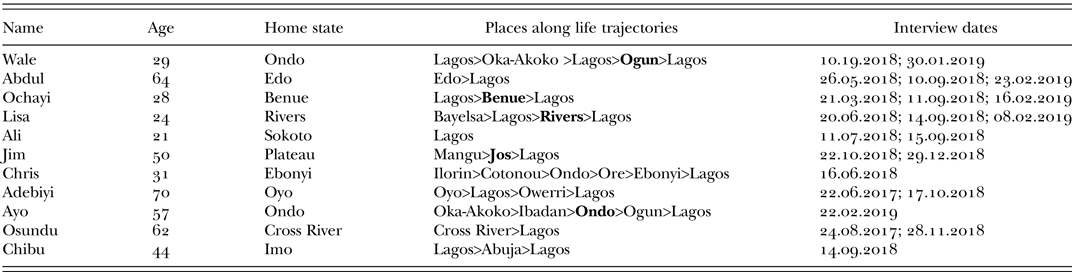
In all, I made 185 audio recordings of interviews with 102 residents of Gowon Estate, 76 males and 26 females, who claimed to come from 26 of Nigeria's 36 states. Their self-described ethnicities included Yoruba (n = 35), Igbo (n = 12), and various minority peoples. Muslims, 11 of them Hausa, accounted for 20 of my research participants, the other 82 being Pentecostalist or Catholic. The ages, home states, hometowns and life trajectories of all participants are given in Table I.
Interviewees mentioned in the article. The names are pseudo in order to anonymise the interviewees. The ages are calculated at the time of 2018. In bold are places where interviewees studied at higher education institutions.

In the open-ended interviews, I usually started with the following invitation: ‘Tell me what happened in your life, from your birth till now.’ The various stories that emerged from these initial sessions were then discussed on multiple occasions over the fieldwork period. The usual language of these conversations was Pidgin English, sometimes mixed with Yoruba. In this way, I engaged in ‘a repetitive recycling of interpretive moves’ (Mishler Reference Mishler, De Fina, Schiffrin and Bamberg2006: 30) regarding the details of their experiences.
To understand how Lagos was situated in their life trajectories, I particularly enquired about their experiences in all the other neighbourhoods of Lagos, and other cities, that they had inhabited in their lifetimes. If they had been born and raised in Lagos, I also asked if they had any experience of living elsewhere. In those conversations, there were no objective temporal criteria for judging whether someone had ‘lived in’ a place as opposed to merely visited it. Rather, the threshold for inclusion of a place in my analysis was simply the subject's decision to tell me about it.
I also chose to trace 12 research participants’ trajectories back to their hometowns and other cities they had previously lived in. Based on prior scholars’ accounts of ethno-regional factors in Nigeria's urban development, I delved particularly deeply into these individuals’ trajectories from Lagos to their respective hometowns when such hometowns were located in the hinterlands of four regional cities: Akure, Calabar, Jos and Kaduna. In addition to following informants’ networks to visit these large cities, I also investigated five informants’ different connections to the same hometown – Oka Akoko in Ondo State – a smaller town in south-western Nigeria.
In sum, by focusing on experiential dimensions of Lagosian migrants’ and residents’ narrations of their life trajectories, this paper provides a nuanced interpretation of how they make sense of their migration and mobility among Lagos, their hometowns and other places.
LAGOS IN LIFE
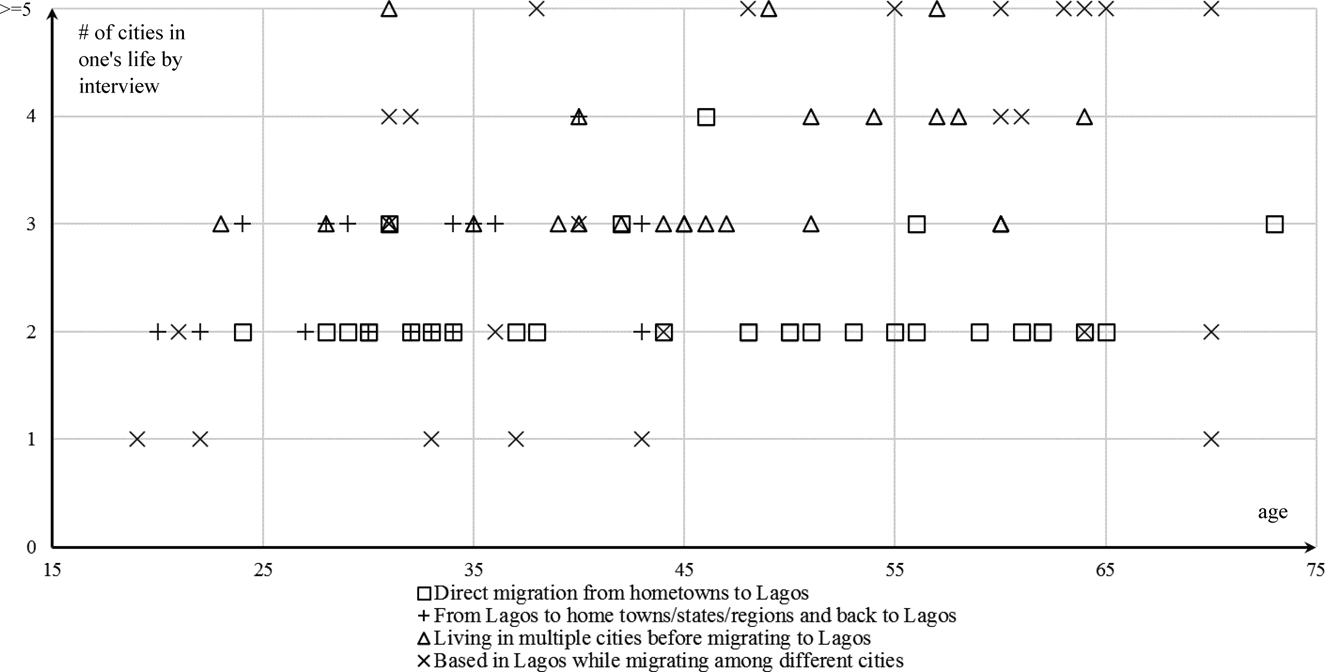
By teasing out how cities and towns are placed in 102 individuals’ life trajectories, which are illustrated in Figure 1, a new framing of ‘cities in life’ unfolds in four dimensions. The first comprises the place-ness of the hometowns from which people who settle in Lagos have migrated. In this case, the ‘hometown factor’ is not simply a source of social capital but involves the idea of the hometown-as-place. The second dimension is a mobility pattern whereby Lagosians move to other cities and then return to Lagos, especially for educational reasons. The choices of these cities hinge on the politics of indigeneity in Nigeria. The third dimension involves people's movements to and among other cities before they take up residence in Lagos: a further aspect of relationality. Lastly, the fourth dimension consists of the mobility patterns of people who are based in Lagos but whose lived experiences extend to other cities.
Synthesis of interviewees’ lives over time and space.

Hometown is about the town, not just home
Existing research on African hometowns has focused on identities associated with hometown communities (Trager Reference Trager2001) and the social functionality of hometown associations (Mercer et al. Reference Mercer, Page and Evans2008). In cities like Lagos, groups of people who claim the same place of origin often gather to socially and economically support one another. This prototype of hometown associations, however, was far from universally applicable to the immigrant residents of Gowon Estate. Some of my interviewees who had come from Sagamu and Ijebu claimed that their hometown people did not establish associations in Lagos because of those places’ proximity to the city, meaning that they could travel to their hometowns within an hour or two if they needed to mobilise hometown resources or deal with any kind of emergency. Other interviewees attributed a lack of hometown associations to their hometowns’ small sizes.
Just as importantly, some individuals did not appear to have formed hometown identities at all. This was especially the case among the younger generations of migrant families, for whom their elders’ hometowns could seem quite foreign. Wale, a 30-year-old man who had been born and raised in Lagos, used to follow his father back to the latter's hometown, Oka (Oka-Akoko in full): a small town in Ondo State where his grandmother and various other relatives lived. But, following the death of his grandmother a few years before, and a turn for the worse in his father's health, Wale had stopped visiting his relatives there. He complained that people from Oka were jealous of his life and earnings in the city. Characterising his relationship with his grandmother as his only concern there, he said, ‘I have no relationship to that place’. Wale's comment on hometown people's attitudes reflects an ideological divide between the rural and the urban, which he conceptualised subjectively. Through my multiple visits to Oka, I discovered that Oka people in Lagos are organised on the basis of which quarter of the town they are associated with, and that there is no broader association in Lagos that covers Oka as a single unit. In any case, however, neither Wale nor his father had ever attended associational activities.
While hardly refuting the importance of hometown associations or hometown identity among Lagos residents, the above data certainly indicate that ‘hometown’ is far from being a homogeneous concept for each individual who comes from a particular place. In other words, hometown is not just about home, but should be granted its due specificity through a ‘place’ analysis.
Through examining the complete set of my informants’ life trajectories, several places from which the interviewees directly migrated to Lagos drew my attention. These were Edo and Delta states in the central part of southern Nigeria, and Benue and Cross River states on its eastern border. It should be noted that these hometown places are not demographically representative, but rather, meaningful because of the optimism of their narration. That is, my informants who had come directly to Lagos from these places were, on the one hand, peculiarly motivated by high hopes for their prosperous lives in Lagos, and on the other hand, strikingly unregretful about their decisions to have left their original homes. Lagos, in their accounts of rapid urbanisation and infrastructural development in recent decades, especially during Foshola's regime, is a better and more hopeful place than their hometowns, though the realities of their Lagos life did not often appear as they imagine and plan.
Direct migrations from hometowns to Lagos had usually taken place quite early in my informants’ lives: in their teen years, as part of migration by their families, or slightly later, as young migrants seeking work opportunities. The hometowns in the four states mentioned above also stand out as places of ethnic minorities, insofar as the urban centres in those states – Benin City, Warri, Makurdi and Calabar – were not regarded as their places. For this reason, they preferred to migrate to the ‘No man's land’ than to these cities nearer to home, though in Lagos, they were faced with higher uncertainties than the cities they were more familiar with. In their narratives, the discourse of ‘No man's land’ is used to justify their decisions to move to Lagos. For instance, in the words of Abdul, a 64-year-old man from a town in northern Edo State, ‘Lagos belongs to nobody; Lagos also belongs to everybody’.
Leaving Lagos for home places, temporarily
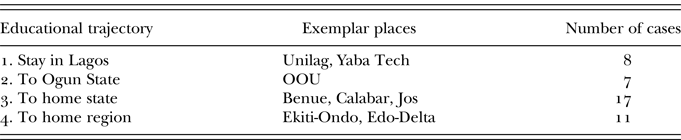
Among the various life stories, a salient phenomenon associated with hometowns was that of young Lagosians leaving Lagos to study in their home towns or home regions. This reflects the strong emphasis on the places of hometowns in processes of admission to higher-education institutions in Nigeria. For one thing, universities’ admissions quotas are usually higher for students originally from the same state in which they are located than for students from other states. Whether someone is ‘originally from’ a place is determined via checking his/her certificate of indigeneity, which indicates the father and paternal ancestors’ place of origin (Fourchard Reference Fourchard2015). One important effect of this is to make it more difficult for a resident in Lagos who is originally from another state to gain admission to any Lagos-based university, but especially to the best one, the University of Lagos. If they want to study in an institution that is less expensive and has more relaxed admission criteria, Ogun State, which is adjacent to Lagos State, is an option. Among my 43 interviewees who had pursued or were pursuing higher education, seven chose to study at Olabisi Onabanjo University (OOU) in Ogun State (Table II).
Lagosians’ mobility when pursuing higher education

In short, young Nigerians deciding on a target university have to consider not only their JAMBFootnote 2 scores, but also the ‘hometown factor’. Thus, a common path for younger generations of migrant families, though they might have been born and raised in Lagos, is to attend universities in their home states. For instance, my informant Lisa (age 24) went to Rivers State University in Port Harcourt, and Ochayi (age 28) to Benue State University in Makurdi. Although Port Harcourt and Makurdi were not their hometowns, choosing to study in the capital cities of their respective home states was easier than struggling for a coveted ‘stranger's place’ at a university to which they had no historical geographic relationship. In most cases, my young informants (or their parents) made the decision to apply to home-state universities before the JAMB exams. In addition to home states, just over one-fourth of my student and ex-student informants had studied in regions that had been historically united to those states, such as Ekiti in the case of Ondo, and Edo in the case of Delta. In these informants’ narratives, studying in these broadly defined ‘home regions’ was still easier than doing so in Lagos.
However, the ‘hometown factor’ was sometimes applied strictly, i.e. against the grain of people's conceptualisations of ‘home regions’. For instance, Ali, an 18-year-old male originally from Sokoto State, planned to apply to Bayero University Kano, one of the best universities in northern Nigeria. He and his father believed that the admission should not be a problem, because his family was from the north and his mother was from Kano State itself. Nevertheless, the university did not admit him, even though his JAMB score was higher than its admission threshold. He elected to spend another year preparing, and took the JAMB exams a second time, but his father asked him to apply to Usmanu Danfodiyo University, in his paternal ancestors’ home state of Sokoto, instead. This application was a success.
From this it can be seen that the ‘hometown factor’ in Nigeria is far from identical with the ‘ethnic factor’ whereby, as several of my informants put it, ‘Yoruba hires Yoruba; Igbo favours Igbo; Hausa works with Hausa’. Rather, it is a ‘hidden transcript’ (Scott Reference Scott1990) that transcends ethnic politics: as manifested in the refusal by a university dominated by Hausa people to admit a Hausa man with satisfactory examination scores, Ali, presumably because only his mother's ancestors came from the state where it was located. In other words, the politics of place – closely bound up with the matter of indigeneity – matters; and its importance is commonly recognised and reluctantly internalised by informants from various backgrounds. Not only in the case of university admission, the politics of place could aggravate uncertainty in life as there is always ambiguity in how the politics is played out (see Cooper & Pratten Reference Cooper and Pratten2015).
On the other side of the coin, hometowns can be related to economic benefits. Ochayi, a 28-year-old man who had gone to Benue State University, regularly came back to visit his family in Lagos during his studies. During those visits, he bought clothes at wholesale markets to sell them to his college friends who were fascinated by the styles of clothes from Lagos – a place called by Ochayi ‘a land of opportunities’. When he first moved back to Lagos after finishing university, however, he struggled with unemployment and became desperate to find a job. He then thought, ‘Why not restart the clothing business?’ In October 2017, he rented a small shop in Gowon Estate and began to advertise in the neighbourhood. He believed this was a stepping stone toward a better future: ‘I hope I could move to a bigger market when my finance permits’.
Ochayi's experience in his ‘home’ state of Benue was not only subject to the politics of indigeneity in the education system. It also, in the form of the business he initiated for trading between Lagos and Makurdi, manifested the place of the hometown as a market and thus as a partial solution to urban hardships and uncertainty in Lagos, namely for underemployed youth. At the time of my research, he did not visit Benue State any more, but that place, by having brought about his status as a business owner, could be seen as a key ‘starting point’ in his life, even though he had been born and raised in Lagos.
Between hometowns and Lagos: placing cities
Some secondary cities also played important roles in individuals’ life trajectories between their hometowns and Lagos. My informants from Yorubaland tended to live in one or more other cities in south-western Nigeria, including Akure, Ibadan, Oshogbo, Ile-Ife and Abeokuta, before migrating to Lagos. Those from Igboland, meanwhile, tended to have had some involvement with the cities of Enugu, Onitsha and/or Aba. Individuals whose hometowns were small and unable to provide adequate livelihoods were most likely, in the first instance, to seek opportunities in the large cities of their home states: citing established connections with relatives or friends in those cities, and their similar cultural or linguistic environments. Despite such apparent advantages, however, these regional urban centres became springboards for their eventual migration to Lagos.
In northern Nigeria, the major urban centres include Jos, Kaduna and Sokoto. For many Gowon Estate residents from Plateau State, Jos had been the ‘springboard’ city. For instance, Jim (age 50), who was born in a small town in that state, was admitted to the University of Jos and gradually established himself in that city, obtaining a teaching position in a Polytech after graduating.Footnote 3 Having planned to pursue this career indefinitely, he believed that Jos would be his new hometown. A few years later, however, a university classmate rang him from Lagos, having seen an advertisement for an analyst job at Lagos Murtala Muhammed International Airport. Jim initially did not take this opportunity seriously, because he did not have any idea about Lagos or any connections to it, but his friend persuaded him to give it a try, on the grounds that it required candidates with degrees in mathematics. After several rounds of interviews, he secured an offer, and owing to the economic burden of a growing family, he decided to accept it. He said it had taken him two years to settle down in Lagos, where he rented a decent two-bedroom flat in Gowon Estate, accustomed himself to his new type of work, and built new interpersonal networks. It was only after this settling-in period that he brought his family to Gowon Estate, where they have lived ever since.
In Jim's experience, Jos provided him with livelihood in his early years whereas Lagos secured his livelihood later. In his narrative of his emotional attachment, he said, ‘Jos is a pleasant city to live my life because it's close to my hometown’. He also told me that the initial stage of his gradual adaptation to the Lagos lifestyle was not pleasant – in his words, ‘Lagos is tough’, and that he planned to return to Jos after he retired. That is, far from being merely a ‘springboard’ to Lagos, Jos was placed by Jim as equally meaningful to Lagos, as well as a fixed point in his imagined future reverse-migration trajectory.
However, ‘springboard’ cities can also be relatively meaningless in people's subjective life trajectories, whether in terms of livelihood or emotionally. Chris was born in 1987 in Ilorin, one of six children of an Igbo family from Ebonyi. Shortly after he had started his first year of junior school, an uncle came to take him to Cotonou in Benin, where – instead of continuing his education – he worked in his uncle's mobile-phone shop. After becoming familiar with this business, Chris started his own in the town of Ore in Ondo State, where his aunt lived. In this new place, his business grew very fast, and attracted the envy of local youths. He shared a long story of how he was cheated by a young Yoruba man, and his products were all stolen. Through his cross-border connections in Cotonou, he was able to require replacement stock, and his business revived. However, while he was travelling to Ebonyi, his shop was burned down. Although this was reported to the police, no one came forward to identify any suspects. Chris left Ore with a deep sense of disappointment and enduring mistrust of its Yoruba inhabitants. Staying with a friend in Lagos, he began to look for jobs there in 2017. Without enough capital to re-found his business a second time, he was compelled to work as a waiter or salesman on short-term contracts. When we met in June 2018, he said he was tired of underemployment, and found life in Lagos hopeless.
Chris's case was echoed in the narratives of my other Igbo informants, who tended to regard cities as places of business. In this sense, all settlements other than their hometowns are instrumental to them. Not least due to the history of Nigeria's civil war of 1967–70, Igbo people have strong emotional attachments to Igboland (Smith Reference Smith2005), and place-based social organisations and identities have become increasingly prevalent in the decades since the war ended (Harneit-Sievers Reference Harneit-Sievers2006). For Chris, the metropolis of Lagos and the town of Ore were equally meaningless, or perhaps meaningful at a time in a practical sense. Both provided limited economic opportunities with which he was not satisfied and made him still live with uncertainty and precarity, and thus neither aroused a sense of belonging or strong sense of place. As such, Lagos, Ore and even a foreign city, Cotonou, were accorded similar, low weights in his subjective narration of life stories.
For Jos, Ore and many other ‘springboard’ cities and towns, placing emerged from my informants’ narratives as an experiential practice that reflects individuals’ meaning-making and senses of place. Lagos was not seen as the end of the journey in either Jim's or Chris's imaginative maps of their lives, even while they were living there. Therefore, from the perspective of placing, a city is not static or insular but interpreted and conceptualised in open-ended narratives along with temporal unfolding of lived experiences, in which the individual subject is constantly undergoing a status of uncertainty (Cooper & Pratten Reference Cooper and Pratten2015: 13).
Lagos within dynamic mobilities
Through a relational and dynamic lens to examine individual mobilities (Sheller & Urry Reference Sheller and Urry2006), many of my subjects’ life stories reflected complex life trajectories that involved movement back and forth between different cities. One clearly recognisable pattern, familiar from the prior literature (e.g. Potts Reference Potts2010), was circular migration between hometowns and a large migrant city. Another, less well-documented pattern that emerged from my research, however, was of Lagos serving as a base for an individual's core family while he or she lives a transient life among various other cities. This was especially notable among those Gowon Estate residents who worked for the customs service, army, navy or other state authorities, who were usually appointed to work in a given place outside Lagos for no more than a couple of years before being transferred onward to another.
Lagos is seen as a base by these people who become mobile among selected places due to occupational appointments. Adebiyi, a 70-year-old man, exemplifies this latter pattern. After finishing secondary school in 1965 in a town in Oyo State, he moved to Lagos with his family. In 1967, when the Nigerian civil war broke out, those in his neighbourhood who enlisted in the army acquired a privileged status, and this prompted him to join the army the following year. After the war ended in 1970, he remained in the army and was transferred to many places across the country, including Owerri, Benin City and Maiduguri. Through most of that time, however, his family lived in the Ojo Barracks in Lagos. In 2000, some eight years before he retired, he was allocated an apartment in Gowon Estate, and has lived there since. Because he arrived while still a child, he said he was ‘so used to life in Lagos’ that he could not ‘cope with village anymore’. More practically, Lagos became his ‘base’ to stabilise his livelihood in case of any uncertainty. Although able to tell me where his hometown was located, he said little else about it, and clearly treated Lagos as the key place in his life. Tellingly, Adebiyi was one of my Yoruba informants who called Lagos Eko Ile.
Although some of my informants had, like Adebiyi, thoroughly adapted themselves to the Lagos lifestyle, many regarded mobility between their hometowns and Lagos as indispensable to their lives in Lagos. Various events, including weddings and funerals as well as education, mandated that they leave Lagos for their hometowns for a period of weeks and months or even longer. I would argue that this type of irregular mobility differs fundamentally from Potts's (Reference Potts2010) conception of circular migration between the rural and the urban and is instead constitutive of Lagos's urban rhythms.
For my informants who were based in Lagos and employed, the time available to travel back to their hometowns depended in large measure on their work schedules. Ayo, a 57-year-old male first-generation migrant from Oka-Akoko in Ondo state, worked for the Ministry of Education in Ogun State while residing in Lagos's Abesan Estate. He chose to live in Lagos rather than Abeokuta, the capital city of Ogun State, because his wife worked in a Lagos hospital. Since it only took an hour or two to travel between his home in Lagos and his workplace in Abeokuta, he became a commuter, and on top of this, went back to Oka-Akoko on weekends, usually twice per month. These five-hour trips were motivated primarily by his status as an investor in a palm-tree plantation in his hometown.
For people who have retired in Lagos, the time available for travel back to their hometowns is of course much less restricted. Osondu, a 62-year-old man from Obutu, a peripheral area in Cross River State, was working as a secondary-school teacher in Calabar, the state capital, in 1980. Upon seeing an advertisement for a job at a state-owned publisher in Lagos, he applied and was accepted, remaining in Lagos until his retirement in 2010. Then, thinking that his home village would be ideal for agribusiness, he decided to commence farming in Obutu from March to June every year, while remaining with his wife and three children in Lagos for the rest of the year. The elder two of his three children were self-supporting by this point, but his youngest one's school fees were still his responsibility. Therefore, to supplement his pension, Osondu's wife operated a restaurant in Gowon Estate, with which he periodically assisted.
The above cases demonstrate that rural-urban mobilities – as opposed to migration, which describes more consequential movements from one place to another – can be largely dependent on individuals’ life-needs in the urban setting of Lagos. Similar kinds of rural-urban mobilities have also been identified in other African countries, including Zimbabwe, where Buhera people utilise their hometown networks to mitigate adverse economic circumstances in Harare (Andersson Reference Andersson, de Bruijn, van Dijk and Foeken2001). With regard to the position of places in people's lived experiences, we can say that, long after Ayo and Osondu migrated to Lagos, their hometowns continued to feature periodically in their movement trajectories, due to both emotional and material attachments. Lagos, whether they identify themselves with or against it, becomes a ‘base’ of lived experiences such migrants share with their families. The idea of ‘base’ signposts a desire of stability and certainty in life. Unless they made resolutions to migrate back to their hometowns – which was very rare among my young and middle-aged interviewees – Lagos was in effect the ‘independent variable’ that affected hometowns as ‘dependent variables’.
For young people who have lived in Lagos for a long time, and who do not have strong or frequent connections with their hometowns, Lagos becomes a foundational place in their lives; and yet, they are not necessarily ‘anchored’ by the city (Whitehouse Reference Whitehouse2012: 10). As the largest metropolis and main commercial centre in Nigeria, Lagos is from many Nigerians’ perspectives a symbol of opportunities, especially for employment. However, its high incidence of underemployment drives many job-hunting youth to despair in uncertainty and precarity. They thus become mobile in their search for economic opportunities, within and sometimes outside the country.
Among the wide array of urban centres in Nigeria, the rapidly developing federal capital, Abuja, is becoming an important mobility option for unemployed youth in Lagos. Aided by their personal networks, some of my interviewees went to work in the service industries there, including in restaurants, bars and barber shops. However, the increasing cost of living and social stratification in Abuja (Adebanwi Reference Adebanwi, Bekker and Therborn2012) meant that few of them stayed for long. For instance, Mike (age 33) and Chibu (age 44) each spent three years in Abuja before returning to Lagos. Chibu complained that her rent in Abuja was much higher than in Lagos, and that she was not able to save as much as she wanted to from her restaurant wages.
These accounts of dynamic mobilities based on individuals’ lived experiences help to map out a complex terrain in ways that existing rural-urban migration frameworks cannot. As implied by my usage of ‘mobilities’ rather than ‘migration’, individuals – though physically connected to a particular city – demonstrate considerable agency with regard to becoming mobile to earn their livelihood. Lagos in this sense is strategically placed as a base for their ever-changing mobility patterns.
CONCLUSION
This paper's re-conceptualisation of cities based on individuals’ lived experiences, and especially on how cities are ‘placed’ along people's subjectively narrated life trajectories, has yielded new, relational understandings of Lagos. As a pioneering case study of ‘Lagos in life’, it has highlighted the sheer variety of the meanings this metropolis has in the lives of residents in an urban neighbourhood. This required detailed examination of how individuals conceptually and practically ‘placed’ Lagos among other places, including not only their hometowns but also other regional urban centres. Because ‘placing’ is a perspective that takes the researched subjects’ agency seriously, this paper advocates a methodology that does not treat cities as a central analytical unit, but rather, inductively interprets the meanings of living in cities after assembling particular residents’ full storylines, allowing the specific meanings of the city to emerge from this holistic interpretation.
It is hoped that this methodological reorientation will help us to critically rethink not only Africa's cities, but its rural-urban dynamics. Certainly, by prioritising individual experiences, we have discovered that the rural hometown is not always perceived simply as the ‘opposite side of the coin’ of the sprawling metropolis. The ‘hometown factor’ plays out in various urban experiences, not only as a particular set of social bonds, but also as politics of indigeneity and identity. University admission is one of many examples in which the politics of indigeneity is internalised. Whether or not an individual chooses to physically connect with his or her hometown, this factor is persistent in Lagos life over the long term. Thus, from an experiential perspective, the politics of place built around hometowns is more relevant than any analytical framework based on a generalised rural-urban dichotomy, not least because Lagosians’ hometown places are not homogeneously rural. Hometowns endowed the lives of urban dwellers in Lagos not only with meanings, but with strategies and material resources. Some, however, also negotiated and contested the meanings of place, and the politics of attaching those meanings to themselves.
In examining how urban dwellers in Lagos ‘place’ difference places – including Lagos itself as well as their hometowns and ‘springboard’ regional centres – along their life trajectories, I discovered that Lagos does not always play a major role. Moreover, for those elders who had settled down in Lagos, so-called rural-urban mobilities became a subjective practice, hinging on their lifestyles and livelihoods in Lagos; and for those youngsters struggling with underemployment, being mobile beyond Lagos was likewise an optional strategy, though Lagos is ideally their base. In other words, Lagos is just placed in the life.