Introduction
Mastoiditis is a potentially serious complication of acute otitis media. Inflammatory processes in the middle ear will often involve the mastoid to some degree, and if infection is aggressive it can rapidly invade the air cells of the mastoid system, destroy its architecture, and involve adjacent structures including the brain and/or the meninges.
Around the start of the twentieth century, between 20 and 50 per cent of acute otitis media cases progressed to mastoiditis, with mortality rates as high as 50–100 per cent.Reference Osborne, Blaser and Papsin1–Reference Austin and Work3 With the advent of antibiotic therapy, together with general improvements in healthcare and the environment, mastoiditis now complicates fewer than 1 per cent of acute otitis media infections, and the annual incidence of mastoiditis has fallen to approximately 1.2–3.8 cases per 100 000 children in the developed world,Reference Schwartz4–Reference O'Connor, Perry and Lannigan6 with intracranial complication rates in the region of 5–15 per cent.Reference Austin and Work3, Reference Van Den Aardweg, Rovers, Alexander de Ru, Albers and Schilder5 However, several studies have suggested that the incidence of mastoiditis may be increasing again,Reference Van Den Aardweg, Rovers, Alexander de Ru, Albers and Schilder5, Reference Bahadori, Schwartz and Ziai7–Reference Antonelli, Dhanani, Giannoni and Kubilis11 although this view is not universally shared.Reference Kværner, Bentdal and Karevold2–Reference Nussinovitch, Yoeli, Elishkevitz and Varsano10
The commonest causative organism for acute mastoiditis in children is Streptococcus pneumoniae.Reference Roddy, Glazier and Agrawal12, Reference Quesnel, Nguyen, Pierrot, Contencin, Manach and Couloigner13 This pathogen has also been implicated in a wide variety of other infections, including pneumonia, meningitis and septicaemia. The recent introduction of the septavalent pneumococcal conjugate vaccine (PCV7) has successfully reduced the burden of pneumococcal disease,Reference Zangeneh, Baracco and Al-Tawfiq14, Reference Gladstone, Jefferies, Faust and Clarke15 including the incidence of pneumococcal acute otitis media.Reference Stamboulidis, Chatzaki, Poulakou, Loannidou, Lebessi and Katsarolis16–Reference Eskola, Kilpi, Palmu, Jokinen, Eerola and Haapakoski18 However, there are concerns that those serotypes targeted by the vaccine may become replaced by new serotypes or other bacteria.Reference Zangeneh, Baracco and Al-Tawfiq14, Reference Stamboulidis, Chatzaki, Poulakou, Loannidou, Lebessi and Katsarolis16–Reference Jacobs, Good, Bajaksouzian and Windau22
In New South Wales, Australia, the septavalent vaccine was recommended for all children at the ages of two, four and six months, with additional doses recommended for children with underlying medical problems. A new, 13-valent vaccine replaced the septavalent one in 2011.
It was hoped that the introduction of pneumococcal vaccination in New South Wales would reduce the number of children with pneumococcal mastoiditis and acute mastoiditis in general, rather than prompt a rise in mastoiditis incidence as reported by several investigators.Reference Van Den Aardweg, Rovers, Alexander de Ru, Albers and Schilder5, Reference Bahadori, Schwartz and Ziai7–Reference Antonelli, Dhanani, Giannoni and Kubilis11 Therefore, the aim of this project was to determine whether the incidence, severity and microbiology of acute mastoiditis had changed over the previous 11 years, and to assess any correlation with the introduction of pneumococcal vaccination.
Materials and methods
With institutional ethical approval, we conducted a retrospective chart review of all children with acute mastoiditis treated at our institution between 2000 and 2010 (inclusive). Mastoiditis was diagnosed on the basis of clinical features supplemented by radiological and/or operative findings, as clinically indicated. In addition to basic demographic data, we collected information on clinical severity (i.e. highest fever and leukocyte count, and intracranial complications) and clinical management (i.e. duration of intravenous (IV) and oral antibiotic therapy, and any surgical intervention). Samples for microbiology were routinely collected at the time of any surgery, ear swabs were performed in the case of a discharging ear, and blood cultures prepared as indicated by clinical features or signs of systemic sepsis. Pneumococcal isolation (on culture of any fluid or tissue) was attempted, although serotyping was not available. The annual number of mastoiditis cases presenting to our institution was determined.
We used the Statistical Package for the Social Sciences version 19 software program (IBM, Armonk, New Jersey, USA) for statistical analysis.
For purposes of analysis, we split our patient cohort according to the time period in which they were treated. Period one (2000–2004) occurred prior to the introduction of vaccination. Period two (2005–2007) included the year in which the septavalent vaccination was introduced (2005) and the two following years. During period three (2008–2010), the vaccine had already been in widespread use for several years.
Results
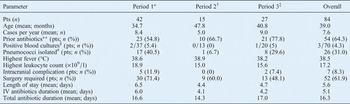
A total of 84 children were studied. The children treated in the three time periods did not differ significantly with respect to mean age (39 months overall) or gender (38.1 per cent girls and 61.9 per cent boys overall). Table I shows the number of patients and their clinical characteristics and treatment during the three time periods.
Mastoiditis patient characteristics over time

*2000–2004; †2005–2007; ‡2008–2010. **Children receiving antibiotics prior to hospital admission. §Value of blood culture fraction denominators does not sum to that of the overall blood culture fraction because blood cultures were not performed in all cases. #Presence of pneumococci on any microbiological analysis. Pts = patients; IV = intravenous
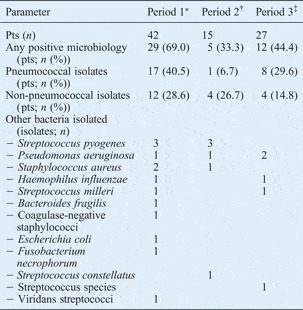
The overall number of patients was relatively small, and differences were not statistically significant. However, the number of patients with mastoiditis fell with vaccine introduction but then rose again, as did the number of children with pneumococcal isolates (p = 0.051, chi-square test). A variety of other bacteria were also identified (Table II). The majority of children treated during periods two and three had received pneumococcal vaccination; however, there was one child (6.7 per cent) in period two who had not been immunised, and two children (7.4 per cent) in period three.
Bacterial isolates from mastoiditis patients

*2000–2004; †2005–2007; ‡2008–2010. Pts = patients
The fall, and subsequent rise, in the number of children with mastoiditis and/or pneumococcal isolates, which was seen following vaccine introduction, was also observed when examining the number of children with intracranial complications (p = 0.351; chi-square test). Period one contained five children (11.9 per cent) with intracranial complications (three venous thromboses, one dural inflammation and one extradural abscess), while period two contained none and period three two (one venous thrombosis and one extradural abscess). Of the seven children with intracranial complications, S pneumoniae was isolated in two cases, Streptococcus pyogenes in one and Streptococcus milleri in one; no organism was isolated in the remaining three cases.
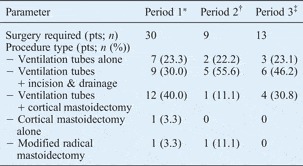
With respect to treatment, a trend towards shorter in-patient stays and shorter courses of IV antibiotics (the latter being 6.0, 4.1 and 4.2 days, respective to periods one to three) was noted in later years. Similarly, a reduction in the number of children undergoing surgery was also observed (being 71.4, 60.0 and 48.1 per cent, respectively); Table III lists the surgical procedures required.
Surgical procedures in mastoiditis patients

*2000–2004; †2005–2007; ‡2008–2010. Pts = patients
Discussion
This study examined acute mastoiditis in children, and the likely effect of introduction of the pneumococcal vaccination. When the vaccine was introduced, a fall in the number of children with pneumococcal isolates was noted, as was a corresponding fall in the overall number of acute mastoiditis cases and the proportion with intracranial complications. However, this reduction proved to be only a temporary phenomenon. A few years after vaccination was first introduced, the incidence of mastoiditis, and the proportion of cases with intracranial complications and pneumococcal aetiology, began to rise again.
Changing incidence of mastoiditis?
The advent of modern healthcare, the appropriate use of antibiotics, and the general improvement in health and living conditions have all led to a large fall in mastoiditis incidence and in the proportion of cases suffering intracranial complications.Reference Osborne, Blaser and Papsin1–Reference O'Connor, Perry and Lannigan6 However, several investigators have recently reported that the mastoiditis incidence is again on the increase;Reference Van Den Aardweg, Rovers, Alexander de Ru, Albers and Schilder5, Reference Bahadori, Schwartz and Ziai7–Reference Antonelli, Dhanani, Giannoni and Kubilis11 possible aetiological factors include increasing levels of antibiotic resistance and decreasing use of antibiotics for the treatment of acute otitis media.
The data presented here provide no evidence that mastoiditis admissions increased in number at our institution between 2000 and 2010; other authors have made similar observations.Reference Kværner, Bentdal and Karevold2, Reference Nussinovitch, Yoeli, Elishkevitz and Varsano10 On the contrary, we observed a drop in numbers with the introduction of the pneumococcal vaccination, although this was only a temporary phenomenon. It is interesting to note that the use of antibiotics prior to admission to our unit appeared to increase over the whole study period, with prior antibiotics being received by 54.8 per cent of children in period one, 66.7 per cent in period two and 77.8 per cent in period three. It is difficult to ascertain how the incidence of mastoiditis would vary were it not for vaccine introduction and increased antibiotic usage, but it is possible that its incidence would be higher than seen at the end of the study. Because the incidence of mastoiditis is multifactorial, the discrepancies noted in the published literature may be due to patient population factors or the time periods studied.
The introduction of pneumococcal vaccination has been shown to have a beneficial effect on the incidence of invasive pneumococcal disease,Reference Zangeneh, Baracco and Al-Tawfiq14, Reference Weinberger, Malley and Lipsitch19–Reference Lynch and Zhanel23 and a concomitant fall in the incidence of pneumococcal mastoiditis, and therefore of mastoiditis overall, could have been expected. This was indeed observed in the current study; however, the number of children with acute mastoiditis treated per year returned to pre-vaccination levels a few years following the introduction of routine vaccination (i.e. in period three). Whilst period three also saw a similar, rebound increase in the number of children with pneumococcal isolates, these numbers did not quite return to pre-vaccine levels. Since the number of children with any positive microbiology results was also lowest in period three, it may be that the incomplete rise in pneumococcal isolates in period three is a measure of a general trend towards fewer positive microbiology results, perhaps associated with greater antibiotic use. Although we did note increasing use of antibiotics prior to hospitalisation, due to the long study duration and the involvement of many clinicians it was not possible to establish whether any systematic change in prescribing took place either in the community or within the hospital.
We observed a fall followed by a rise in the incidence of mastoiditis and of pneumococcal isolates as its causative agent. In contrast, a decrease was not seen by Roddy et al. Reference Roddy, Glazier and Agrawal12 in their study of the microbiology of mastoiditis prior to vaccine introduction and for five years thereafter. This discrepancy may be the result of their inclusion of chronic as well as acute mastoiditis, and their grouping into one category all patients treated in the five years following vaccine introduction; the latter might have precluded detection of a temporary fall in incidence immediately after vaccine introduction. Another study of acute paediatric mastoiditis following pneumococcal vaccine introductionReference Choi and Lander24 noted a 53 per cent rise in the rate of admissions for acute mastoiditis, with more advanced disease and requirement for more extensive surgery, although shorter in-patient stays were observed. Again, this study combined all post-vaccine era patients into a single group, representing 6.5 years, and any temporary fall in incidence may have been missed. Although our study findings do indicate a short-lived fall when vaccination was first introduced, they agree with published data suggesting that (at least after two to three years) the incidence of mastoiditis is not reduced by pneumococcal vaccination.
Pneumococcus in acute mastoiditis
Streptococcus pneumoniae is the commonest pathogen implicated in the aetiology of acute mastoiditis; others include Staphylococcus aureus, S pyogenes, Haemophilus influenzae, Pseudomonas aeruginosa, B-haemolytic streptococci and Moraxella catarrhalis.Reference Van Den Aardweg, Rovers, Alexander de Ru, Albers and Schilder5 Similar organisms were found in the present study, with S pneumoniae again being the predominant organism, followed by S pyogenes, P aeruginosa and S aureus. Allowing for the small numbers of individual bacteria isolated, there was no evidence of emergence of unusual organisms as the causative agent of acute mastoiditis.
With the introduction of pneumococcal vaccination, the proportion of patients in whom S pneumoniae was isolated was noted to fall (from 40.5 to 6.7 per cent); however, it then rose again (to 29.6 per cent) a few years later, in period three. A similar fall and then partial rise was seen in the number of patients with any positive microbiological result. Interestingly, the proportion of children who tested positive for non-pneumococcal organisms did not change from periods one to two, but then fell in period three. This may have been the result of greater antibiotic use in period three, but the relatively small number of patients precludes meaningful statistical analysis.
It is disappointing to note that the number of patients with mastoiditis returned to pre-vaccine levels in period three, and that the number with pneumococcal isolates also resurged; however, this is in keeping with observations on pneumococcal disease reported from other disciplines. Numerous studies on pneumococcal serotypes have reported that the initial fall in vaccine serotypes and invasive pneumococcal disease is followed, a few years later, by an increase in non-vaccine serotypes; this is typically accompanied by a rise in pneumococcal disease, although the overall incidence mostly remains below pre-vaccine levels.Reference Zangeneh, Baracco and Al-Tawfiq14, Reference Weinberger, Malley and Lipsitch19–Reference Jacobs, Good, Bajaksouzian and Windau22, Reference Singleton, Hennessey, Bulkow, Hammitt, Zulz and Hurlburt25 An increase in non-pneumococcal pathogens may also be seen. The issue of serotype replacement is currently being addressed by the development of new pneumococcal vaccines that are protective against additional serotypes; however, whether serotype replacement will be a problem even with newer vaccines remains to be seen.
In the present study, it is interesting to note that the children treated during period one were on average at least 6 months younger than those treated in period three, and 13 months younger than those in period two. This suggests that younger children may be most at risk of pneumococcal mastoiditis, and therefore may gain the most from vaccine introduction.
Clinical severity and treatment
The present study used highest fever, highest leukocyte count, positive blood culture and intracranial complications as markers of disease severity. The positive blood culture rate and leukocyte counts were broadly similar to previously published findings,Reference Bahadori, Schwartz and Ziai7 as was the intracranial complication rate.Reference Austin and Work3, Reference Van Den Aardweg, Rovers, Alexander de Ru, Albers and Schilder5 Importantly, none of the patients in period two suffered intracranial complications, but in period three the rate rose to 7.4 per cent, although this was not as high as the pre-vaccine level (11.9 per cent). This study found no evidence of an increase in mastoiditis severity, in contrast to Choi and Lander,Reference Choi and Lander24 who reported more advanced disease and a requirement for more extensive surgery following vaccine introduction, although they also noted shorter hospital stays.
• Streptococcus pneumoniae is the commonest cause of paediatric acute mastoiditis
• Pneumococcal conjugate vaccine has reduced the pneumococcal disease burden
• In this study, pneumococcal acute mastoiditis admissions fell following vaccination introduction
• The overall mastoiditis incidence, and that of intracranial complications, also fell
• However, mastoiditis admission rates subsequently returned to pre-vaccination levels
The length of stay and duration of IV antibiotics were highest in period one, and the requirement for surgery also fell across the three time periods. A change in the type of surgery performed was also noted, with evidence not only of fewer procedures overall, but also of a trend towards less aggressive surgery (e.g. simple drainage of sub-periosteal abscess plus ventilation tube insertion, rather than formal cortical mastoidectomy). However, this may be a reflection of general trends in clinical practiceReference Spratley, Silveira, Alvarez and Pais-Clemente8, Reference Pang, Barakate and Havas26 rather than a vaccine-specific effect.
Limitations
The current study did not analyse pneumococcal isolates to determine which serotypes were involved. Thus, whilst an initial fall in pneumococcal isolates was noted, it is not clear whether the subsequent resurgence represents the vaccine serotypes or serotype substitution, although the latter is likely.Reference Lynch and Zhanel23
Although our study was performed in an academic hospital and was of substantial duration (i.e. 11 years), in common with many other studies, the number of children in each subcategory remained small; consequently, meaningful statistical analysis was difficult. Nevertheless, important information on the group as a whole can be gained. The three time periods chosen for the study were designed to assess the effect of pneumococcal vaccination, but it is difficult to divorce vaccine effects from other determinants of disease presentation and severity, or from factors that influence trends in clinical practice. The study was conducted in a large academic centre that acted as the secondary referral point for a wide local area as well as a tertiary referral centre; however, we are not aware of any changes in demographic or referral patterns in the local population which could have affected admission rates.
Conclusion
In this study, the number of children admitted with pneumococcal mastoiditis appeared to fall when vaccination was first introduced, with a concomitant fall in overall incidence of mastoiditis and its intracranial complications. However, this appeared to be a temporary phenomenon, as mastoiditis admission rates subsequently returned to pre-vaccination levels.