Introduction
Pierced stone plates are termed bracers, or ‘wrist-guards’, because they were used in archery to protect the forearm against the sting of the bowstring (Vasconcellos, Reference Vasconcellos1915; Sangmeister, Reference Sangmeister, van Uslar and Narr1964). They are, however, currently interpreted in various ways, with multiple functional and symbolic aspects considered. They have been found on archaeological sites across Europe, usually in funerary contexts and often associated with the Bell Beaker phenomenon (2600–2000 cal bc). Some authors suggest that they formed part of an archer's equipment, since they are often found on the forearms of human remains, but a symbolic connotation with hunting or warfare carried to the grave has also been put forward (Van der Vaart, Reference Van der Vaart2009a: 46; Turek, Reference Turek, Prieto Martinez and Salanova2015; Ryan et al., Reference Ryan, Desideri and Besse2018). This symbolic value is also acknowledged by other authors who argue that the shape of the bracers, their size, cases of bracers found away from the forearm, and examples with metal ornamentation make them unsuitable as functional objects (Smith, Reference Smith2006; Woodward et al., Reference Woodward, Hunter, Ixer, Roe, Potts and Webb2006; Fokkens et al., Reference Fokkens, Achterkamp and Kuijpers2008: 118; Woodward & Hunter, Reference Woodward and Hunter2011; Drenth et al., Reference Drenth, Van Os and Van der Velde2017; Nicolas, Reference Nicolas2020a, Reference Nicolas2020b). Indeed, some scholars propose that they were a specially produced funerary version of objects that would ordinarily be made of organic materials (Clarke et al., Reference Clarke, Cowie and Foxon1985: 173). By contrast, traces of metal on the bracers together with finds of bracers alongside metal artefacts suggest an alternative use as sharpeners (Harrison, Reference Harrison1980: 53; Waldren, Reference Waldren1982; Delgado & Risch, Reference Delgado, Risch, Longo and Skakun2008; Muñoz, Reference Muñoz, Garrido, Flores and Herrero-Corral2019), which may also have been worn on the forearm (Delgado, Reference Delgado2008: 404; Muñoz, Reference Muñoz, Garrido, Flores and Herrero-Corral2019). This interpretation is not generally applicable because it is incompatible with some of the raw materials used to make the bracers (Turek, Reference Turek, Prieto Martinez and Salanova2015: 37).
Experimental studies with replicas of stone bracers have shown that they can be used effectively both to polish metal implements and to protect an archer's forearm (Delgado, Reference Delgado2008; Van der Vaart, Reference Van der Vaart2009a, Reference Van der Vaart2009b; Muñoz, Reference Muñoz2017, Reference Muñoz, Garrido, Flores and Herrero-Corral2019). Bracers may therefore have had multiple primary and secondary uses and been both ornamental and functional. The way they were made, their state of fragmentation, traces of use, and archaeological context can be used to outline the history of specific exemplars.
Here, we present the biography of two bracers found in the graves of two children in the Bell Beaker burial ground of Las Mayores (Toledo, Spain). We describe the archaeological context of the bracers, our analysis of their raw material, the technology employed to make them, and the functional traces on them; the results are used to reconstruct their histories. The type of bracer found in these children's graves is contextualized within the corpus known for the Iberian Peninsula and for the rest of Europe and is compared with types associated with adult individuals.
The Site of Las Mayores
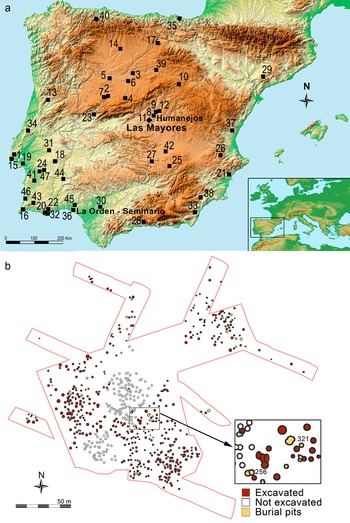
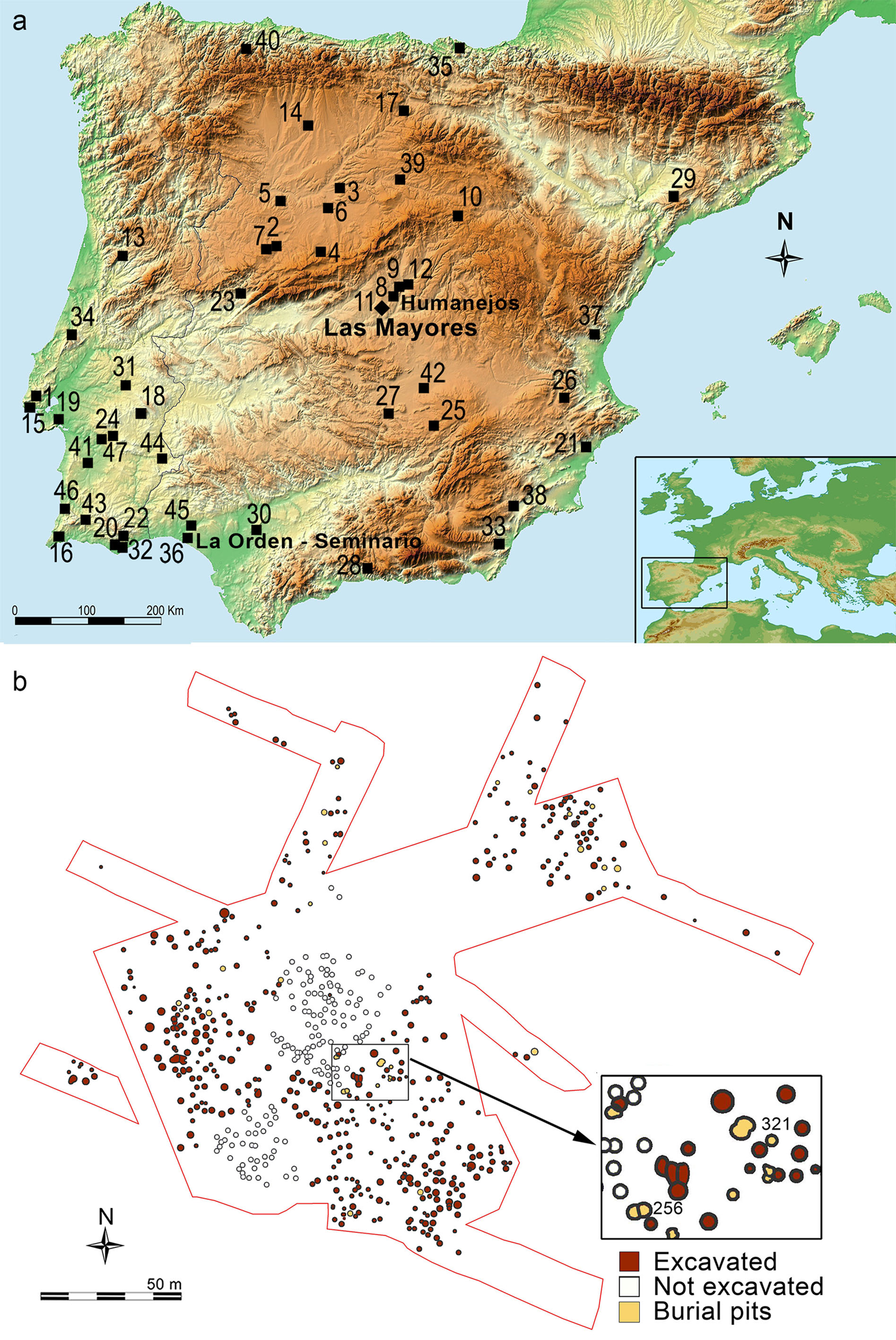
Las Mayores (Numancia de la Sagra, Toledo) is situated in the centre of the Iberian Peninsula (40⁰ 05′ 04.28″ N / 3⁰ 51′ 21.86″ W) (Figure 1). The site covers 2.4 ha and is typical of prehistoric settlements in central Iberia, consisting of a series of negative features with domestic and funerary remains dated to the third and second millennia cal bc (Diaz del Río, Reference Díaz del Rio, Díaz del Rio and García Sanjuán2006). Bayesian modelling suggests that it was occupied in two discrete phases between 2490 and 1400 cal bc. The first corresponds to a small Bell Beaker cemetery estimated to have been established between 2490 and 2300 cal bc and ending between 2340 and 2170 cal bc (at 95.4% confidence) (Barroso et al., Reference Barroso, Cerrillo Cuenca, Bueno-Ramírez and González2021). It consists of seven individual and collective graves containing a minimum of twenty-one individuals. Only one grave is unfurnished; the others contained grave goods including undecorated ceramics or vessels with Ciempozuelos-type decoration, characteristic of the region (Garrido-Pena, Reference Garrido-Pena1997). These are associated with artefacts such as copper awls, ivory buttons, and archers’ bracers, which, together with the bodies, were covered with cinnabar powder (Barroso et al., Reference Barroso, Bueno-Ramírez, González, Balbín-Behrmann and Rojas2018; Emslie et al., Reference Emslie, Silva, Valera, Vijande Vila, Melo and Curate2021). Two of the graves are presented here, one a collective burial and one an individual burial. Each contained an undecorated bowl and a bracer (Figure 2).
a) Location of Las Mayores and sites with bracers analysed in this article. 1. Carrascal; 2. Peñacaída; 3. El Carrascal; 4. El Castillo de Cardeñosa; 5. El Pago de la Peña; 6. Fuente Olmedo; 7. Galisancho; 8. Humanejos; 9. La Aldehuela; 10. La Sima III; 11. Las Mayores; 12. Mejorada II; Oxca de Seixas; 14. Pago de Valdenabí; 15. S. Pedro do Estoril 1; 16. Almadeninha; 17. Alto del Reinoso; 18. Antas dos Godinhos; 19. Barro; 20. Bemparece; 21.Campello; 22. Campina; 23. Casas del Monte 2; 24. Castelo do Giraldo; 25.Castillejo del Bonete; 26. Cerro Cuchillo; 27. Cerro de la Encantada; 28. Cerro de la Negreta; 29. Coveta de l'Heura; 30. El Gandul; 31. Revelad; 32. Ferradeira; 33. Fuente Alamo; 34. Juncal; 35. Kobeaga; 36. La Orden Seminario; 37. Lloma d Betxi; 38. Los Cipreses; 39. Los Cotorros; 40. Los Fitos; 41. Lousal 1; 42. Motilla de Retamar; 43. Palmeira; 44. Ratinhos; 45. Soto 2; 46. Vale da Telha; 47. Zambujeiro. b) Plan of Las Mayores with Bell Beaker burials (inset).
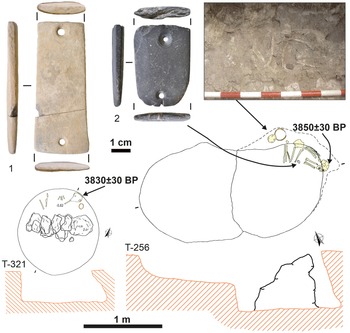
Plans and cross-sections of graves 321 and 256 at Las Mayores with location of the bracer B256: 1) B321; 2) B256. Photo with detail of the burial 256.
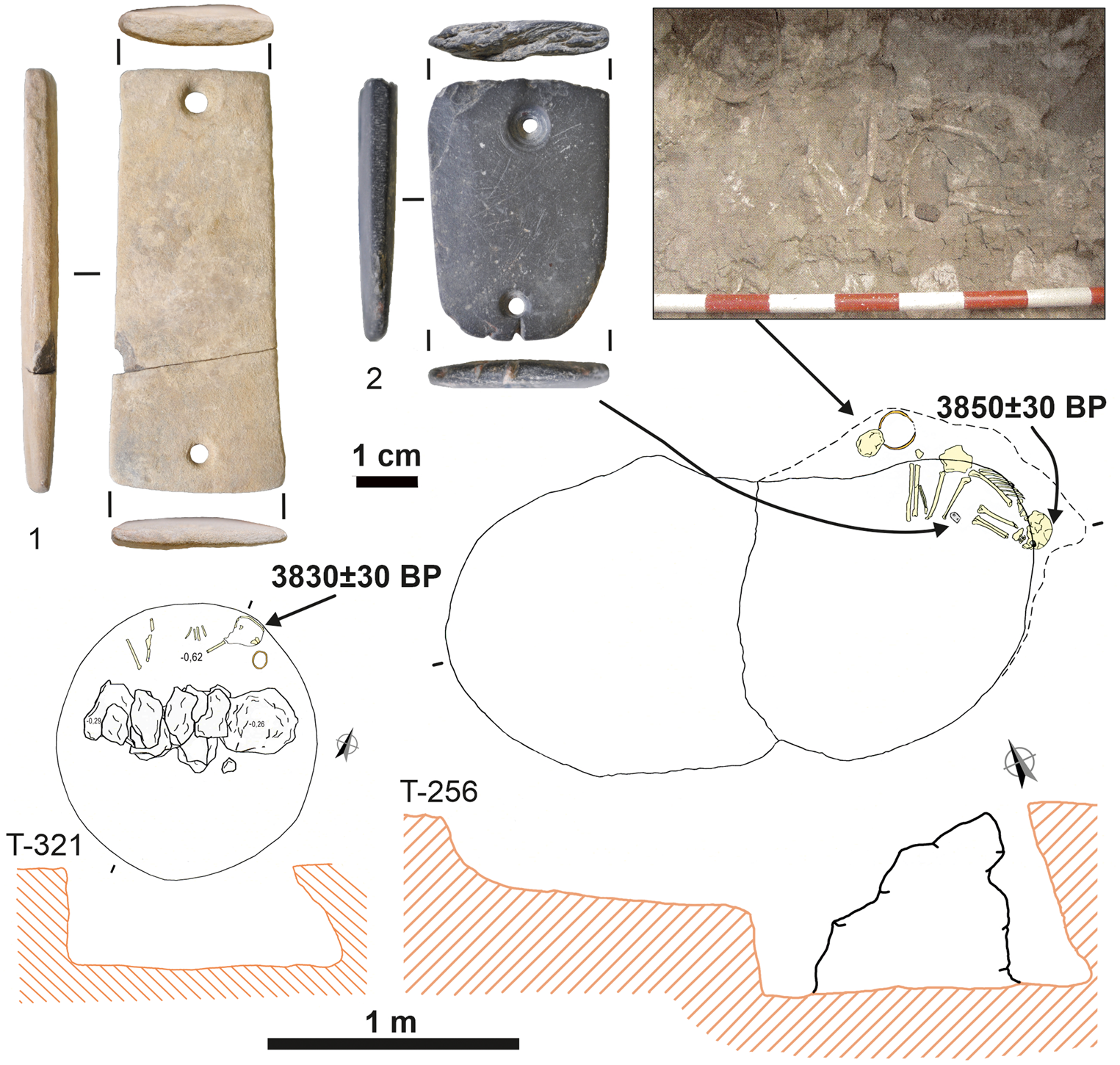
Grave T-321 is a pit measuring 1.15 m in diameter and 0.48 m in depth. It contained the body of a single child approximately four or five years old (4±12 months: Ubelaker, Reference Ubelaker1978; 4.5 years: AlQahtani et al., Reference AlQahtani, Hector and Liversidge2010). The body was placed in the base of the pit and covered with small stones. Oriented NE–SW, it was deposited in a flexed position on its left side, with the head towards the north-east. An undecorated bowl, 10 cm in diameter, and a bracer were deposited next to the body. Their exact position could not be determined due to the poor state of preservation of the bones. A date of 2451–2148 cal bc (at 95.4% confidence; Beta-473695) (Table 1) was obtained from a fragment of cranial bone.
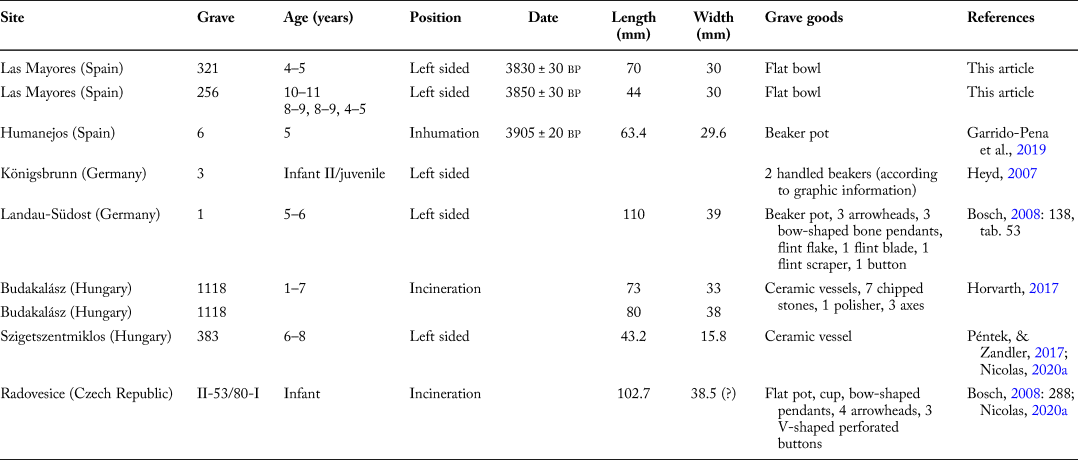
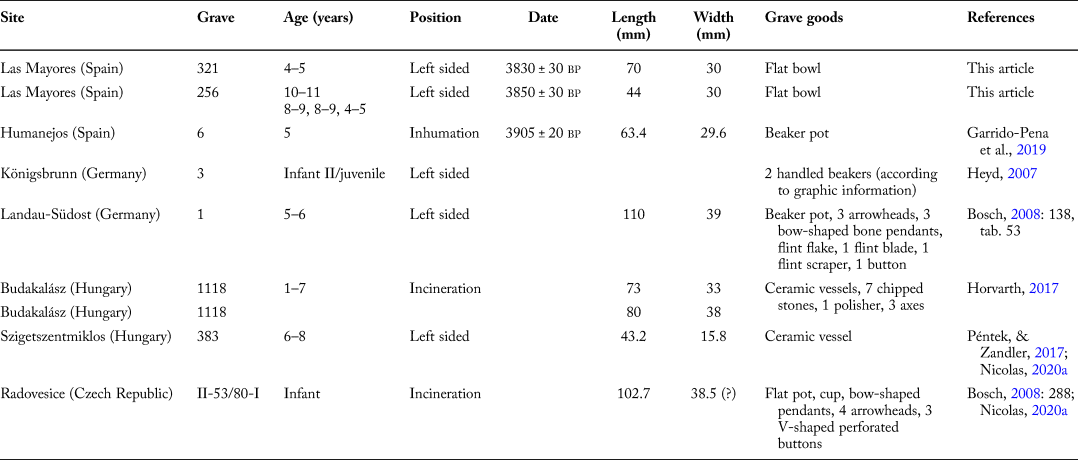
European Bell Beaker children's graves with archer's bracers.
Grave T-256 is a double pit, 2.64 m long and 0.68 m deep, used for the collective burial of four subadults (Table 1). The last body laid to rest before closing the grave with stones was an approximately eleven-year-old child (11 ± 30 months; Ubelaker, Reference Ubelaker1978; 10.5 years: AlQahtani et al., Reference AlQahtani, Hector and Liversidge2010), interred in a flexed position on its left side. The body was oriented SE-NW with the head towards the south-east. The left arm was bent with the hand towards the face and the right arm was flexed. The archer's bracer was found near the inside forearm. The date of the burial, obtained from a fragment of the cranium, was determined to be 2454-2204 cal bc (at 95.4% confidence; Beta-471832) (Table 1). At the feet of the child was an undecorated bowl, 12.8 cm in diameter, set next to the cranial remains of another individual in a secondary position. Only dental remains have been found for the other two burials detected in the structure.
Despite anthropological analysis, it was not possible to determine the sex of the two children in the graves, but it should be noted that in the Bell Beaker cemetery of Las Mayores all the primary burials associated with grave goods, including those of women, were placed on their left side (Barroso et al., Reference Barroso, Bueno-Ramírez, González, Balbín-Behrmann and Rojas2018), while the only contemporary unfurnished grave contained an individual placed on its right side. The vessels in both children's graves were simple semi-spherical bowls; their poor state of conservation prevented reconstruction. The poor quality and small size of the pottery is common to all the graves at the site.
Material and Methods
The two stone bracers are thin, narrow rectangles with a flat cross-section that is slightly convex on the side thought to be the upper face. They are each pierced by two biconical perforations made from either side and with concentric striations. Bracer B321 (no. 1 in Figure 2) was fractured and repaired in the museum. It is 70 mm long, has a maximum width of 30 mm, a maximum thickness of 7 mm, and weighs 21.4 g. One end is trapezoidal with rounded and thinned corners, while the other end is thicker and straight-edged. Bracer B256 (no. 2 in Figure 2) is 44 mm long and 30 mm wide, has a maximum thickness of 5 mm, and weighs 14.3 g. One end is rounded and thinned and has two V-shaped notches. The other end is 5 mm wider, slightly convex and unshaped. One of the perforations is placed slightly to the side of the central axis. The natural foliated structure of the rock is visible on the unpolished fractured edge.
Photographs were taken with a Nikon D5000 camera with a NIKKOR AF-S DX lens of 18–55 mm VR. The technological and use-wear analysis and the microscopic pictures were obtained with a binocular microscope with magnification between 8× and 50×. The perforations were compared by calculating the cross-section profiles of the images using a Zeta 20 Optical Profilometer (Zeta Instruments Inc. USA). The bracers’ material was determined by X-ray diffraction, using a Bruker D8 Diffractometer (Bruker Corp. USA), and their microstructure was examined with a Hitachi TM-1000 Scanning Electron Microscope (Hitachi Corp. Japan). Radiocarbon determinations from the two graves were calibrated to 95.4% probability with the IntCal20 international atmospheric curve (Reimer et al., Reference Reimer, Austin, Bard, Bayliss, Blackwell and Bronk Ramsey2020) and Bchron software (Haslett & Parnell, Reference Haslett and Parnell2008). These results form part of a series of thirty-two dates available for the site (Barroso et al., Reference Barroso, Cerrillo Cuenca, Bueno-Ramírez and González2021).
Results and Interpretation: Biography of the Wrist-Guards
It is difficult to establish what techniques were used to make the two bracers because they are finished objects with a long use life. Moreover, in the case of object B321, made of fine-grained quartz arenite (Supplementary Material Figures S1 and S2), erosion has removed the traces of its manufacture and use (Figure 3). It seems that the object was reshaped to a smaller size, based on the following features: 1) the upper part is straight and has a non-bevelled finish; 2) the diameters and inclinations of the two perforations differ; and 3) shape and size of each end differ significantly, beyond the slight dissymmetry that can be expected from an adaptation to fit the wrist (Turek, Reference Turek, Prieto Martinez and Salanova2015: 34). The length of the original bracer, estimated from the shape of the object, would have been 90 mm rather than the current 70 mm.
Bracer B321 with details of the holes and hypothetical reconstruction of the original form of the object.
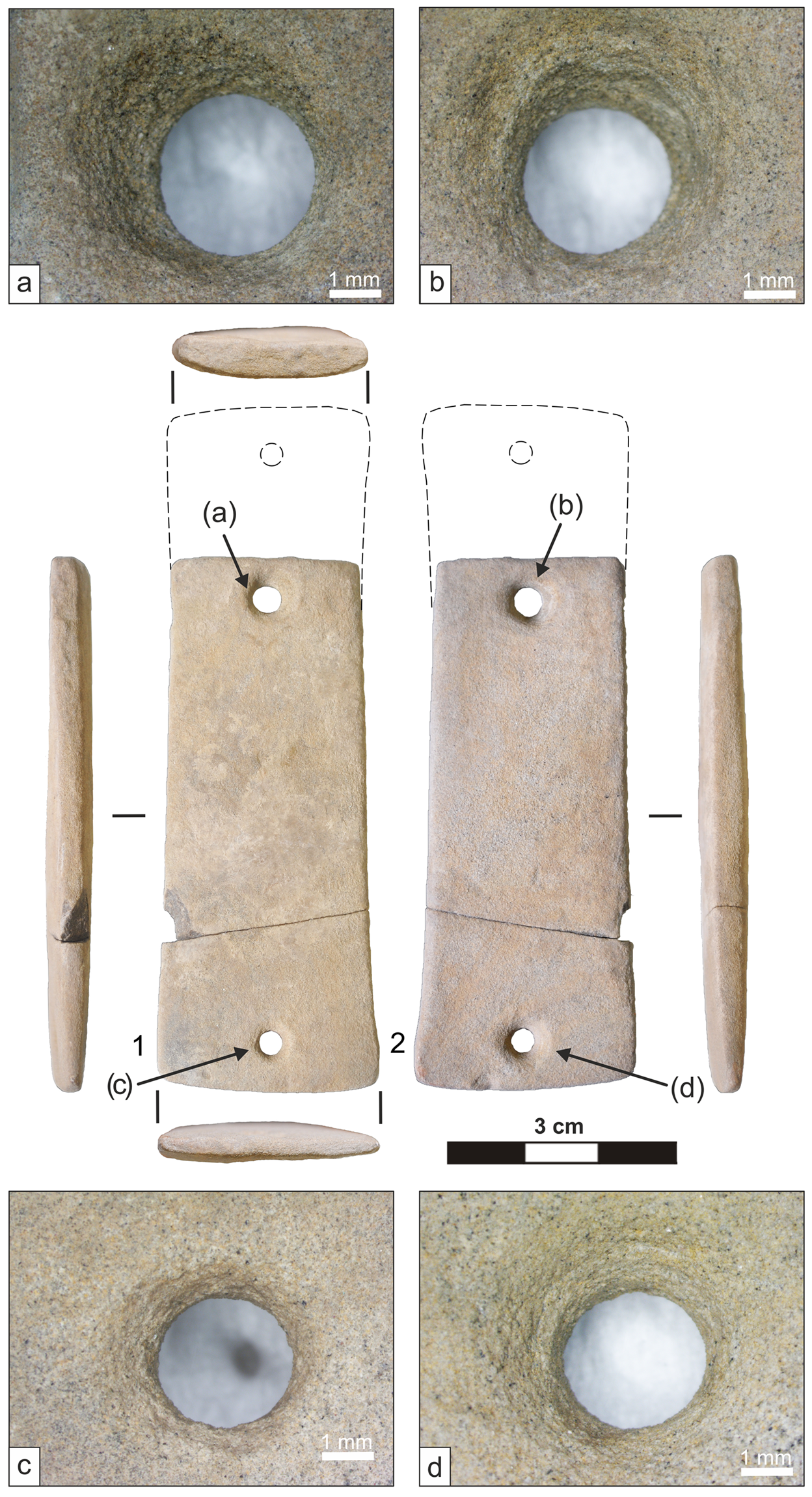
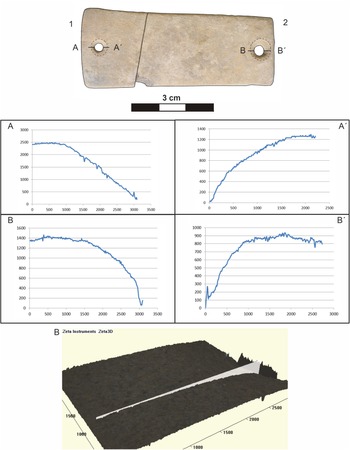
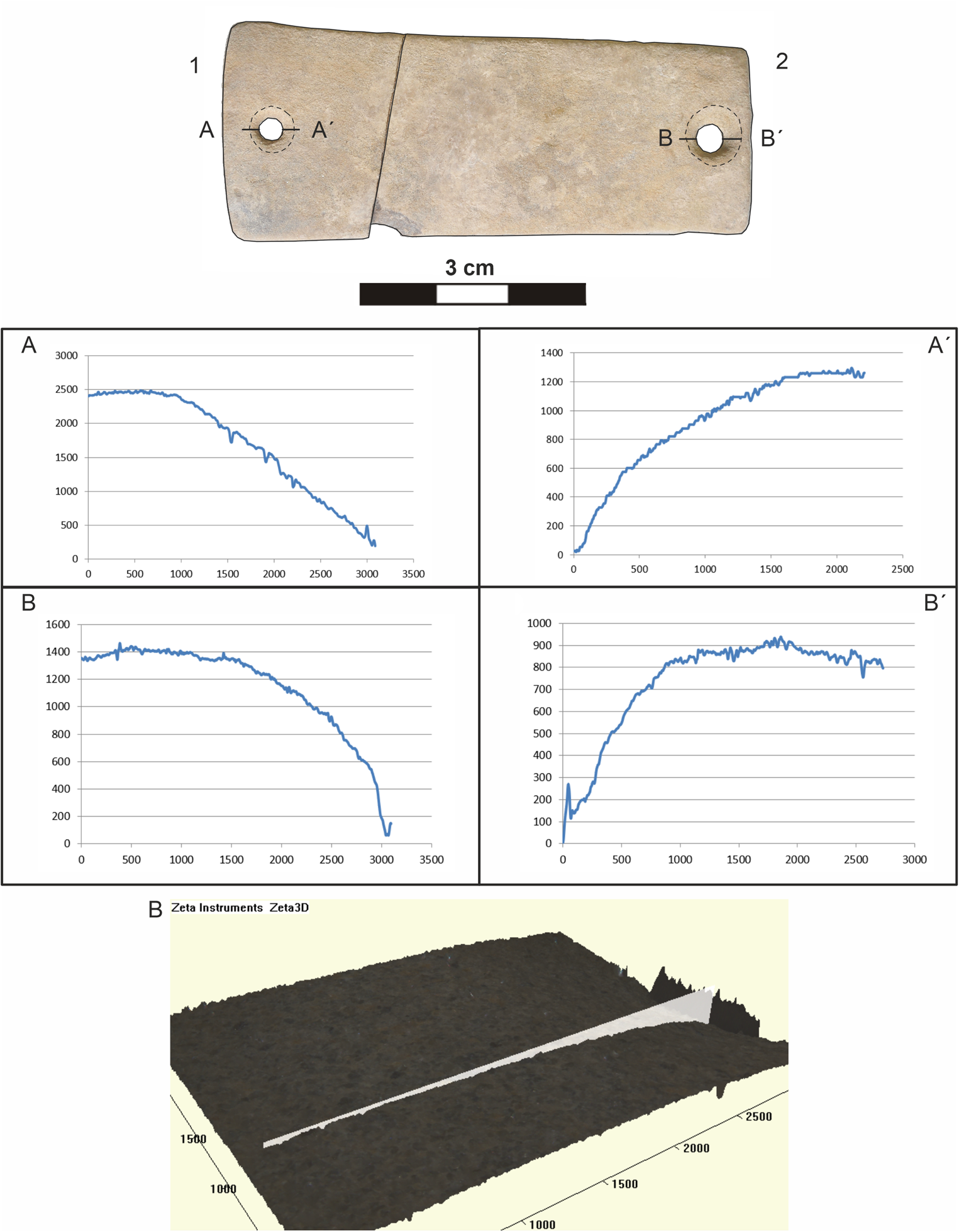
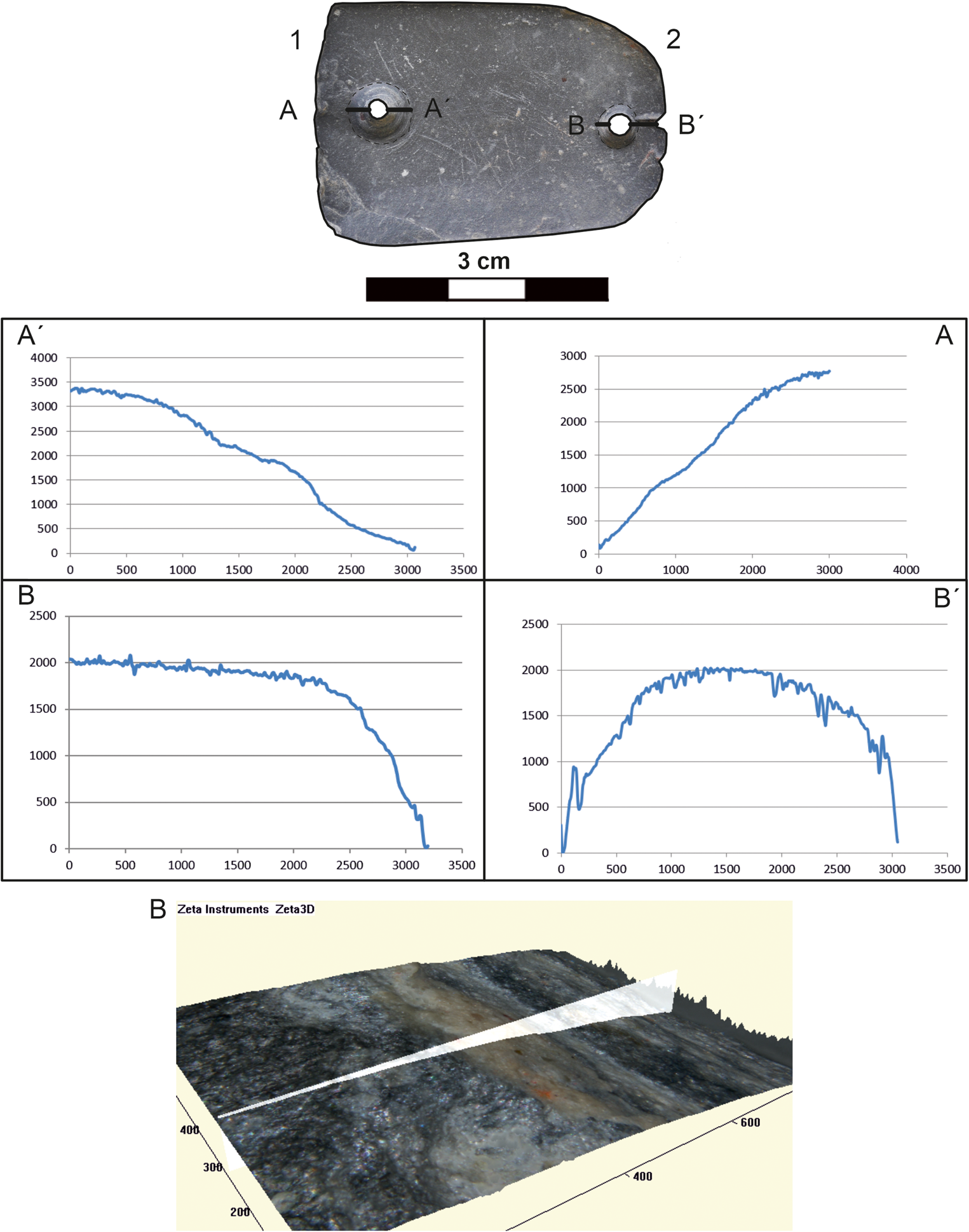
The most telling evidence for the re-use of this bracer is the difference between the two perforations. In order to document and quantify the morphological variations of the perforations, their surfaces and cross-sections were examined by Optical Profilometer. The cross-sections of the holes show that they were made with different drills. In the case of Perforation 1, the two cross-sections on Face 2 are the same (Figure 4: 1, A and A’). This regularity is also clear on the other face of the object (Figure 3c and d). In Perforation 2, on the other hand, dissymmetry and irregularities are noticeable in the cross-sections (Figure 4: 2, B and B’). This dissymmetry is visible on both faces of the object (Figure 3a and b). Because of alterations to the surface, the type of drill that was used cannot be securely identified. Nonetheless, the morphology of Perforation 1 would correspond to a bi-directional rotary drill, whereas Perforation 2 is most likely to have been made manually and is thus wider and more irregular. The bracer was probably reshaped after accidental breakage, as indicated by the irregularities in the section of the broken part. The absence of use-wear traces due to surface erosion prevents us from establishing whether the object was used before or after repair.
Bracer B321. 1) Perforation and cross-sections A and A’; 2) perforations and cross-sections B and B’ (3D image of the surface and cross-sections obtained by Optical Profilometer).
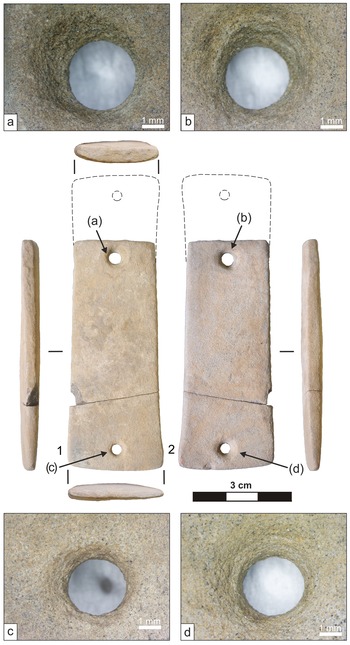
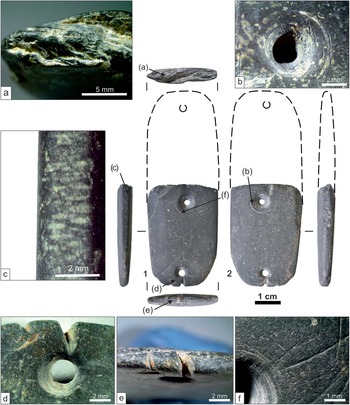
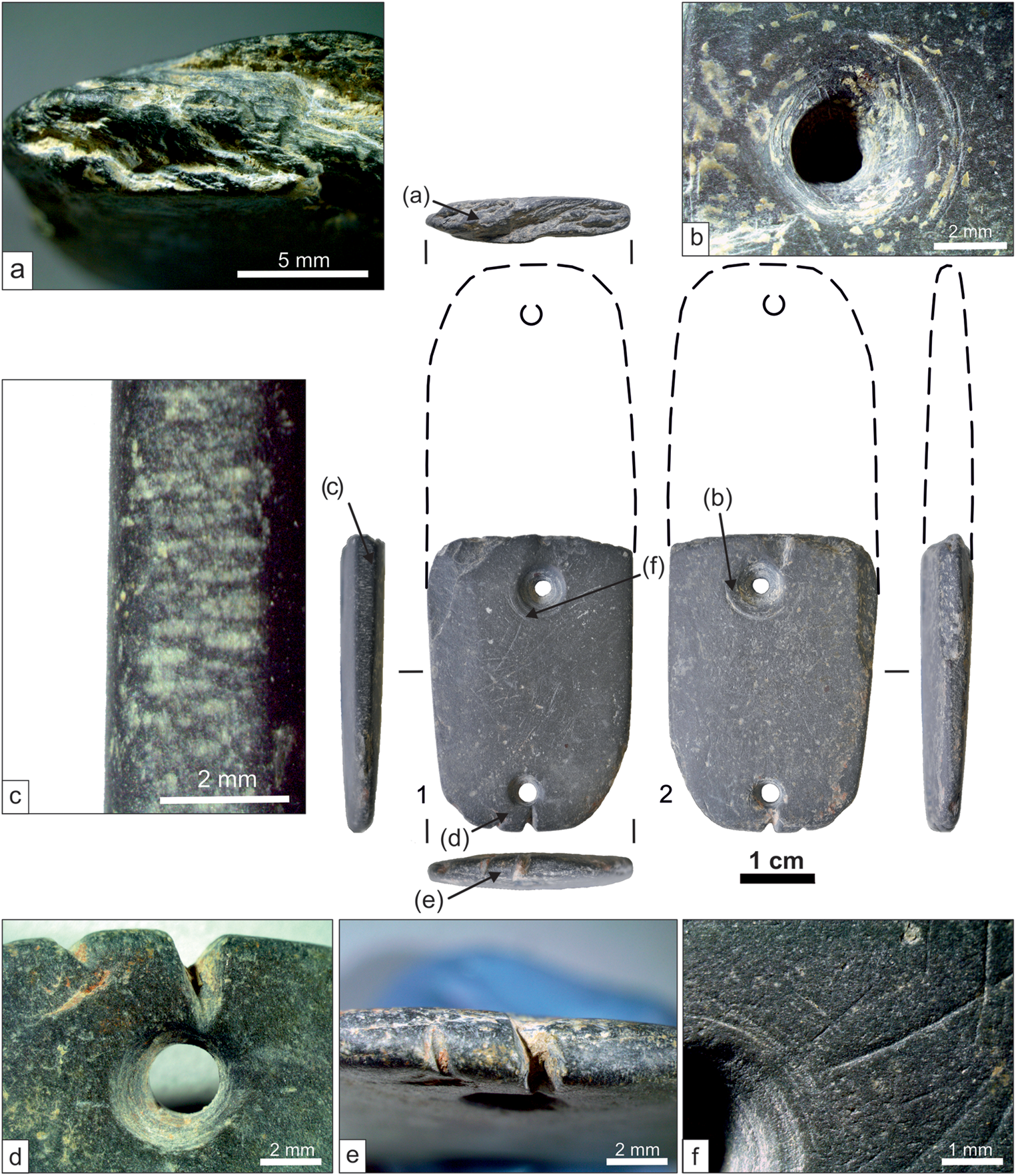
Bracer B256 was made of slate (Supplementary Material Figures S3 and S4) and its repair is clearer than in the previous case. The excellent preservation of both technological and use-wear traces allows for a better reconstruction of its biography (Figure 5). The bracer broke in its middle section and its original length would have been 88 mm rather than its current 44 mm. The degree of transformation of bracer B256 does not allow an assessment of the object from which it was made; it is likely to have been a chipped stone or a preform obtained from a secondary geological deposit. Marks on one side (Figure 5c) show that it was shaped by parallel abrasion on an abrasive rock. It may be inferred that the rest of the object was similarly shaped and then the surfaces of both faces were polished (Figure 5: 1 and 2). A perforation was then drilled at the new end of the object (Figure 5b), while the other old perforation was kept (Figure 5d). The fracture suggests that the bracer was broken by flexion. The break revealed the inner foliated structure of the slate (Figure 5a) and lifted flakes from both faces of the object (Figure 5: 1 and 2). The notches made by abrasion in the previous perforation can be associated with this repair episode, since they cut the old perforation (Figure 5e).
Bracer B256, with hypothetical reconstruction of the original form of the object and the technological marks. a) Polishing and patina caused by use in the section of the fracture; b) hole with concentric striations caused by the drill and area polished by the cord; c) abrasion traces; d) hole and fissures with polish produced by the cord; e) polish and patina caused by use at the end; f) hole with concentric striations from the drill cut through by impact marks.
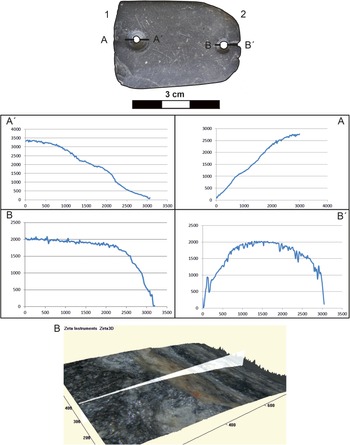
The perforations were categorized from their surfaces and cross-sections (Figure 6). Perforation 2 (the original) has a narrow cross-section and cone, while the cone of Perforation 1 (the later addition) is more open. This dissymmetry indicates that they were made with different drills: the former with a bi-directional rotary drill and the latter manually, possibly with a pointed flake or blade, creating the open cone and the circular marks around the hole (Figure 5b). We are therefore confident that the bracer was repaired after being broken. The original break may have been intentional or accidental.
Bracer B256. 1) Perforation and cross-sections A and A’; 2) perforations and cross-sections B and B’ (3D image of the surface and cross-sections obtained by Optical Profilometer).
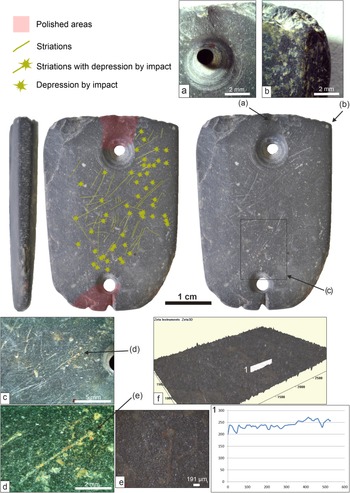
The use-wear marks on bracer B256 show that it was used for a significant period (Figure 7). The perforations display areas that became polished by the organic cords that held the object (Figure 7a). This type of polish in the holes has been documented on other bracers in Europe (Nicolas, Reference Nicolas2020a, Reference Nicolas2020b) including in the Iberian Peninsula (Muñoz, Reference Muñoz2017; Muñoz Martínez et al., Reference Muñoz Martínez, Curto, Muñoz Moro, Gutiérrez, Alonso, Baena and Canales2017). Similar rounded and polished traces of wear are frequently observed on suspended or articulated objects made of various materials, and have been documented both ethnographically (Guzzo Falci et al., Reference Guzzo Falci, Cuisin, Delpuech, Van Gijn and Hofman2018) and archaeologically (Martínez-Sevilla, Reference Martínez-Sevilla2019). Polished areas in the cross-section of the fracture would also indicate use of the bracer over an extended period (Figure 7b).
Bracer B256, showing use-wear. a) Hole made during repair with wear produced by the cord; b) polish and patina in the fracture caused by use; c) impact mark and striations; d and e) details of the comet-shaped impact marks; f) 3D surface of a comet-shaped impact mark and its cross-section.

Patinas and polishing on bracers have been shown to result from prolonged contact with the skin and with body fluids and acids (Vanhaeren et al., Reference Vanhaeren, d'Errico, Van Niekerk, Henshilwood and Erasmus2013). No such finishes, however, appear on the flat part of bracer B256 (Figure 5: 2), which would have been in direct contact with the skin. It is therefore possible that an organic layer was present between the bracer and the skin, and that contact with the skin only occurred along the longitudinal edges (Figure 5a and e). Areas polished by the fastening system, grooves caused by the cords as well as by repair, have been documented on a bracer in the United Kingdom (Woodward & Hunter, Reference Woodward and Hunter2011: 79, fig. ID 104). The bracers could be fastened to the arm in several ways. As a suggestion, B256 may have been attached to a piece of leather and the grooves would have helped fasten the bracer to the arm and adjust its position.
The convex face of bracer B256 displays impact marks that can be related to its function of protecting the forearm during archery. These comet-shaped marks are each characterized by an impact pit with a longitudinal striation extending from it (Figure 7d and e). Examination of the surface and the cross-section of the striations with confocal microscopy indicated that these are light scratches on the surface (Figure 7f) and not the result of abrasion. Experimental research with slate bracers used as wrist-guards has identified such kind of use-wear as stripping the surface of the stone (Muñoz, Reference Muñoz2017; Muñoz Martínez et al., Reference Muñoz Martínez, Curto, Muñoz Moro, Gutiérrez, Alonso, Baena and Canales2017). Similar use-wear traces have been described and documented on other examples of wrist-guards in the Iberian Peninsula (Muñoz, Reference Muñoz, Garrido, Flores and Herrero-Corral2019). In the present case, the marks are distributed over the whole of the convex surface. The orientation of the impacts and the striations show that the bracer was used in two directions. The striations begin above the first hole and finish at the hole made during the repair (Figure 5f); additional impact striations cut through the marks of the new second hole (Figure 7a). The analysis of superimpositions of the striations indicates that the object was used as a wrist-guard both during its original configuration and after its repair. After a long use life, the bracer was deposited in the grave next to the infant. Traces of cinnabar from the burial were preserved on the lower part of the flat face (Figure 5: 2).
In sum, both bracers were used for a long period before being deposited with the inhumed infants. Both had been repaired, which reduced their size; it is possible that they were deliberately broken and reshaped on a smaller scale. In the case of bracer B256, the use-wear marks indicate that it was used both before and after the repair.
Discussion
A wide range of sizes and shapes of bracer have been documented in Europe. Several typological studies concur in differentiating two main groups. Wide bracers with four holes are characteristic of central Europe (though not exclusively so), whereas narrow bracers with two holes are more common in western Europe (Sangmeister, Reference Sangmeister, van Uslar and Narr1964, Reference Sangmeister1974: 113; Harrison, Reference Harrison1980: 54–55; Fokkens et al., Reference Fokkens, Achterkamp and Kuijpers2008: 112; Turek, Reference Turek, Prieto Martinez and Salanova2015: 30).
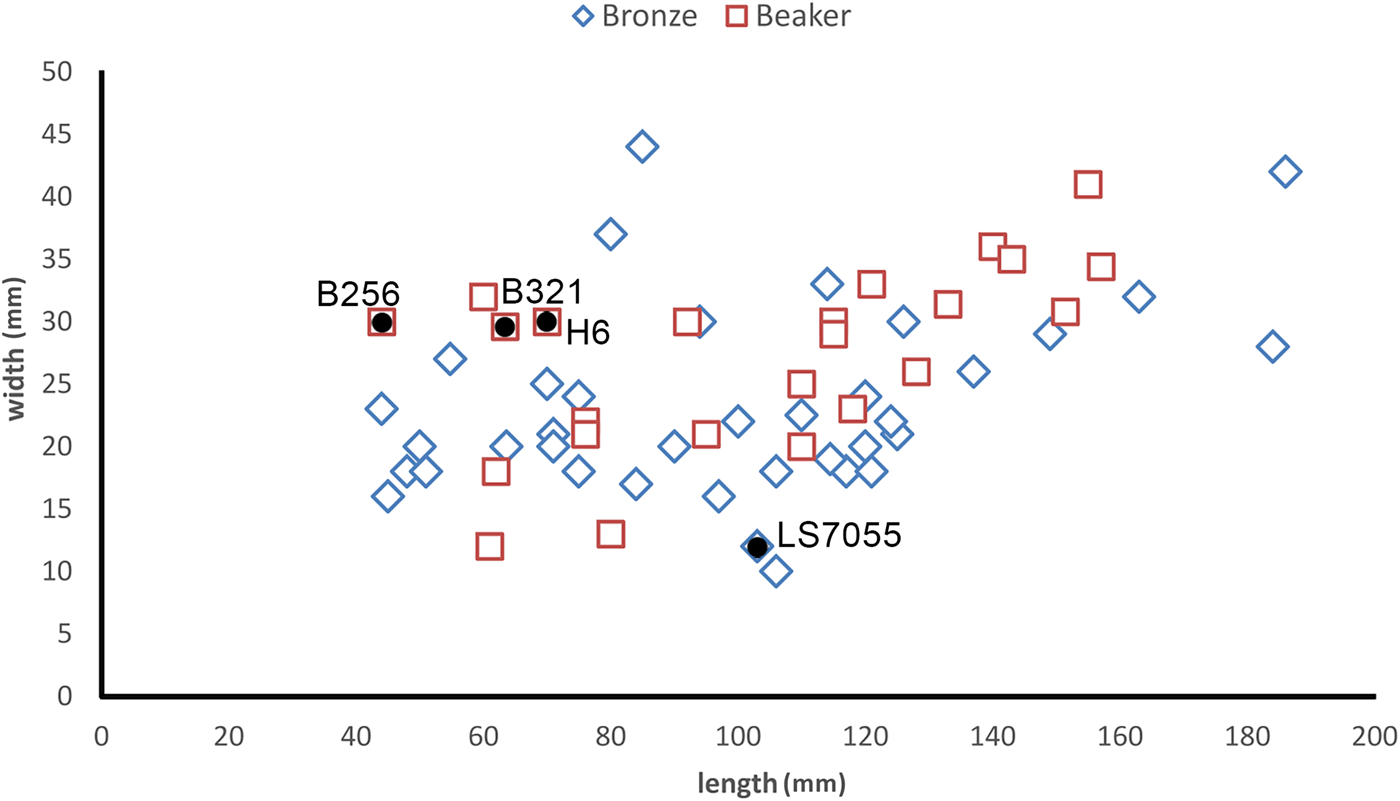
In the Iberian Peninsula, bracers have been found on sites dating to the third and second millennia bc and extending well into the Bronze Age. These are usually of the narrow type with two holes, albeit of diverse sizes (Muñoz, Reference Muñoz2017). It is currently impossible to establish a chrono-typological sequence because only regional studies are available. It has been proposed that, in the south-west of the peninsula, the oldest bracers were shorter and narrower, and that these were replaced by larger types at the end of the third millennium bc (Gomes, Reference Gomes2015: 95). In inland Iberia, both large and small types are associated with Bell Beaker assemblages, the smaller type later becoming more widespread in the Bronze Age (Muñoz, Reference Muñoz2017). Our analysis of the relationship between length and width for a sample of sixty-two complete Iberian bracers shows the variability present (Figure 8 and Supplementary Material Table S1).
Correlations between length and width of the archer's bracers at the Iberian sites listed in Figure 1. The examples from the children's graves (Las Mayores B321 and B256, Humanejos H6, and Orden Seminario LS7055) are highlighted.
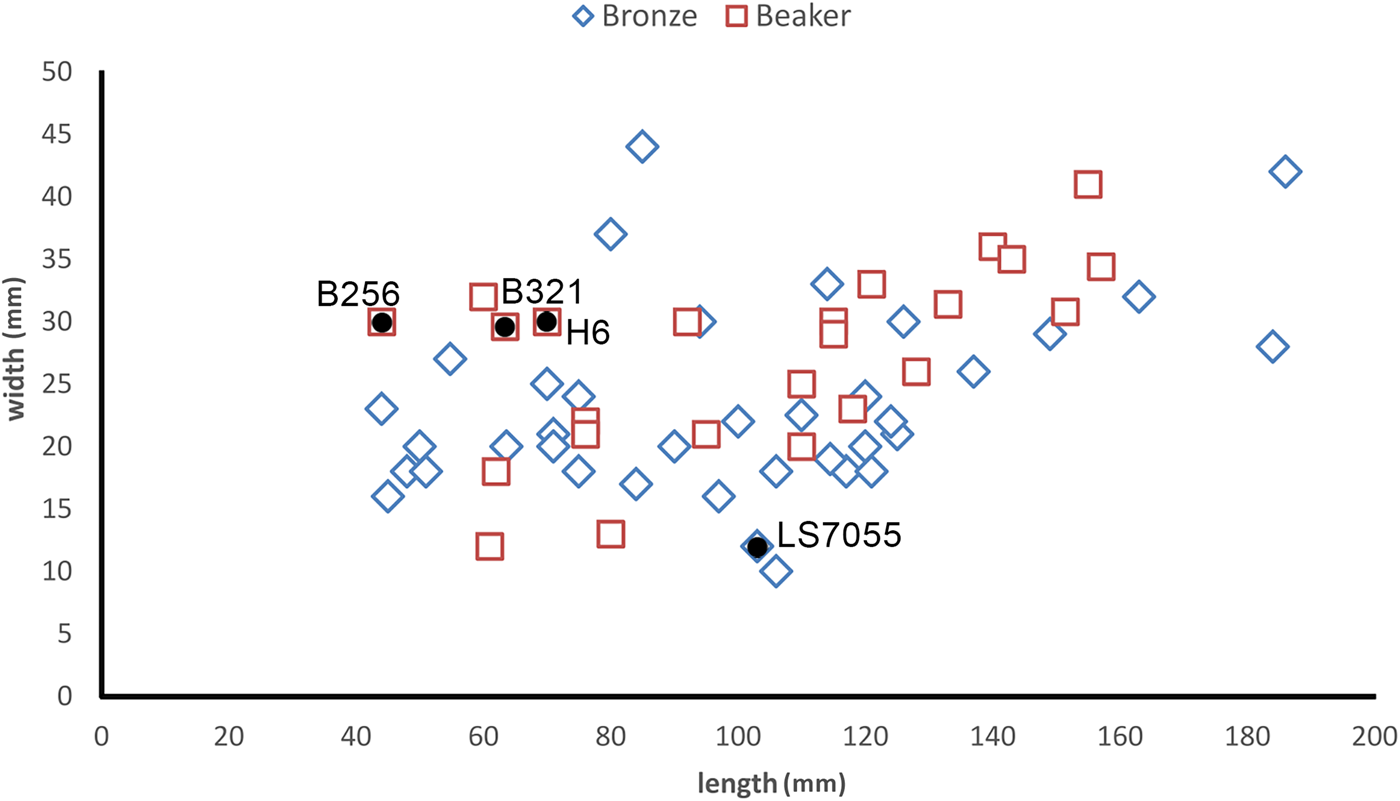
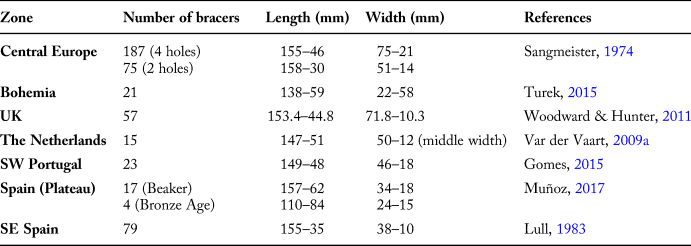
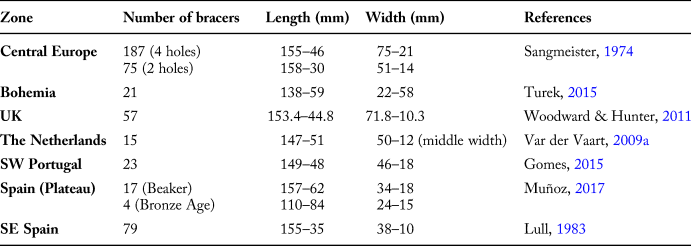
The bracers from Las Mayores, each with two holes, correspond to Type G in Sangmeister's (Reference Sangmeister1974: 118) typology. Both were originally medium-sized and were refashioned as smaller objects. B256 is one of the shortest bracers documented in the Iberian Peninsula although it is of average width. In Europe, small bracers (Table 2) are sometimes called ‘miniatures’ (Gomes, Reference Gomes2015; Turek, Reference Turek, Prieto Martinez and Salanova2015: 34). Their size, like that of the very large examples, has been used to argue against their suitability as wrist-guards for archery (Delgado, Reference Delgado2008: 405; Fokkens et al., Reference Fokkens, Achterkamp and Kuijpers2008: 117; Nicolas, Reference Nicolas2020a: 42). Nonetheless, some authors maintain that the use of smaller bracers in archery should not be ruled out, as factors such as the tension in the bowstring or the archer's skill also influence their functionality (Van der Vaart, Reference Van der Vaart2009a: 21 and 45; León & Casseyas, Reference León and Casseyas2014: 122).
Maximum and minimum lengths and widths of European bracers.
It is difficult to determine why our bracers were reshaped. Bracers must have frequently been broken, and many fractured examples are known in Europe. Repaired bracers are less common (Heyd, Reference Heyd2007; Turek, Reference Turek, Prieto Martinez and Salanova2015: 30); they were made into smaller bracers or they were turned into different objects (Harbison, Reference Harbison1976; Woodward et al., Reference Woodward, Hunter, Ixer, Roe, Potts and Webb2006: 536). Some bracers with broken corners were pierced with new holes further from the edge (Nicolas, Reference Nicolas2020a: fig. 16; Wentink, Reference Wentink2020: fig. 6.10). These cases all demonstrate an interest in prolonging the life of the object because of its personal or functional value, or to make maximum use of the raw material.
This value of the raw material appears not to have been an important factor in the case of the Las Mayores bracers. The raw material has the predominantly neutral colours of other Iberian examples (Muñoz, Reference Muñoz2017: 12) and is unlike the red stone predominant at central European sites, likely due to preferential selection (Turek, Reference Turek, Prieto Martinez and Salanova2015). The traces of red colouring on B321 are owed to its funerary context, where cinnabar was sprinkled over the remains. The presence of this mineral, brought from at least 150 km away (Bueno Ramírez et al., Reference Bueno-Ramírez, Barroso and Balbín-Behrmann2019), shows that Las Mayores had access to resources from outside the region. This was not, however, necessary for the bracers, which were made from stone available in the immediate surroundings. Moreover, their narrow form and use of only two holes means that they were easy to make, in a working time calculated to be between two and three hours (Delgado, Reference Delgado2008: 179; Van der Vaart, Reference Van der Vaart2009a: 29).
Bracers are generally associated with adult males, and with right-handed individuals (Heyd, Reference Heyd2007: 357; Matĕjíčková & Dvo̬řák, Reference Matĕjíčková, Dvo̬řák, Matĕjíčková and Dvo̬řák2012: fig. 11; Salanova, Reference Salanova, Koch and Cunliffe2016). In central Europe, only two to three per cent of children's graves contain archery equipment (Nicolas, Reference Nicolas2020a: 37). In these cases, the funerary ritual and the grave goods are similar to those of the adults (Turek & Černý, Reference Turek, Černý and Nicolis2001; Heyd, Reference Heyd2007: 352). In western Europe, the collective graves make it difficult to obtain precise data. Some collective Bell Beaker burials include children, and arrowheads (Bueno Ramírez et al., Reference Bueno-Ramírez, Barroso and Balbín-Behrmann2005) and even bracers figure among the grave goods (Delibes et al., Reference Delibes, Guerra, Velasco, Olalde, Fitzpatrick, Salazar-García, Delibes and Guerra2019); but their association with the children cannot be ascertained. The two graves at Las Mayores, together with Grave 6 at the nearby site of Humanejos (Garrido-Pena et al., Reference Garrido-Pena, Flores and Herrero-Corral2019), each contain bracers found together with children, and so fill a gap in the data (Woodward & Hunter, Reference Woodward and Hunter2011: 99; Salanova, Reference Salanova, Koch and Cunliffe2016: 17). Another noteworthy find is that of Grave 7055 at Orden Seminario (Huelva, Spain), dated to 2276–1946 cal bc (CNA30: 3700 ± 50 bp). It contained the burial of a six- or seven-year-old child with two undecorated pottery vessels, a bracer, and a copper dagger (Linares-Catela, Reference Linares-Catela2020: 26; this find has not yet been published in detail). No Bell Beaker pottery has been recovered from the cemetery, but similar traditions were evidently used to distinguish certain individuals, even the very young.
Some European cemeteries with significant assemblages of bracers show no correlation between the sizes of the objects and the age of the individuals with whom they are associated (Horvarth, Reference Horvarth2017; Péntek & Zandler, Reference Péntek, Zandler, Kulcsár and SzabóState2017: 303). Some small bracers, even reused ones, are found with adults (Nicolas Reference Nicolas2020a: fig. 19) but, in some cases, children's grave goods imitate on a small scale the items found in adult burials. This was identified in relation to the small ceramic vessels in Bell Beaker children's graves (Case, Reference Case, Kinnes and Varndell1995: 63; Turek, Reference Turek and Pavlů2000; Cooper et al., Reference Cooper, Garrow, Gibson, Giles and Wilkin2022) and has also been posited for bracers, based on the example at Humanejos (Herrero-Corral et al., Reference Herrero-Corral, Garrido-Pena and Flores2019). Some miniature pots have been attributed to young apprentices, owing to their poor finish (Garrido-Pena & Herrero-Corral, Reference Garrido-Pena, Herrero-Corral, Romero, Alarcón and Aranda2015).
The same cannot be said in the case of the bracers, although some of the examples accompanying the burials of children are incompletely finished, as occurs with other archery equipment, such as the not fully polished short bows that are attributed to children (Junkmanns et al., Reference Junkmanns, Klügl, Schoch, Pietro and Hafner2019: 298). The reused bracer from Humanejos is short and narrow with its side edge left unfinished, although it displays marks from its use in archery (Garrido-Pena et al., Reference Garrido-Pena, Flores and Herrero-Corral2019: 209). At Las Mayores, the cross-sections of the fractures of both bracers were not fully smoothed when the bracers were refashioned. Together with the differences seen in the holes, this suggests that they were not reshaped by the person who made the original versions, or that the same care or tools were not employed in both processes. They may have been made by inexpert hands or their purpose may not have justified a finished appearance. In any case, it is reasonable to suppose that practical know-how was transferred from experts to novices in activities such as the use of the bow, and that objects were transmitted from generation to generation together with that knowledge; in other words, bracers were inherited (Smith, Reference Smith2006; Bosch, Reference Bosch2008: 139).
While children would not have been specialized archers (Ryan et al., Reference Ryan, Desideri and Besse2018: 110), different age categories within childhood can be distinguished in terms of their physical and mental development (Fahlander, Reference Fahlander, Lally and Moore2011). At two or three years of age, children can begin to practice with small bows (Kamp & Whittaker, Reference Kamp, Whittaker, Rebay-Salisbury and Pany-Kucera2020: 16). At the age of six, they acquire the coordination skills necessary to use a bow (Días-Meirinho, Reference Dias-Meirinho2011: 210). A glance at European children's graves with bracers (Table 1) shows that the bracers are associated with young children for whom a bow would be a toy, others who would be starting to use one, and yet others with sufficient mobility and coordination to practise archery; although there is no correlation between the age of the individual and the size of the bracers. Indeed, at Las Mayores, the inverse is the case since the smaller bracer was associated with the older child. It appears that children of the same age were buried with both miniature and large bracers, but also that the largest objects formed part of the most abundant assemblages of grave goods. In central Europe, there are children's graves containing large numbers of items, including arrowheads and bow-shaped pendants that indicate a connection with archery. In contrast, the Bell Beaker sites in the Iberian Peninsula contain only pottery and a bracer, as at Las Mayores, where the bracers were associated with two simple, undecorated bowls.
There is no information about the sex of the children. In the burials that have been studied, most were laid on their left side. In central Europe during the Bell Beaker period, the position of the body in the grave is related to the sex of the deceased: males on their left side and females on their right (Turek & Černý, Reference Turek, Černý and Nicolis2001; Nicolas, Reference Nicolas2020a: 17). Based on this rule, the children at Las Mayores would be males; but at Las Mayores the majority of the deceased are buried on their left side, regardless of sex, as is the norm for the whole of central Iberia (Soriano et al., Reference Soriano, Herrero-Corral and Garrido-Pena2021).
The location of the bracers relative to the body has been studied in detail. Their correct position as arm protectors would be on the inside of the left forearm, but in numerous European burials they are found on the outside (Fokkens et al., Reference Fokkens, Achterkamp and Kuijpers2008) or in other positions (Nicolas, Reference Nicolas2020a: 44). They are consequently interpreted as symbolic, although it should be noted that some small, reused bracers have been found in a protective position (Nicolas, Reference Nicolas2020a: 37, fig. 19). In Grave 256 at Las Mayores, the location of the bracer on the right arm of the individual would identify them as left-handed (Smith, Reference Smith2006: 13). However, this position would also make the bracer more visible to the mourners, given that the body was laid on its left side.
Conclusions
Pottery, personal adornments, and weapons are the main components of the Bell Beaker funerary set and are restricted to a few individuals. Bracers form part of these grave goods, being mostly associated with adults (Salanova, Reference Salanova1998: 324) and less frequently with children. Three Bell Beaker burials of children in the Iberian Peninsula (the two graves at Las Mayores and a grave at the site of Humanejos) can be added to the limited record of these objects found together with children in Europe. All three bracers are reused objects. Despite their association with young children, their manufacture, reshaping, and final deposition in the grave are indicative of a long biography that may combine both functional and symbolic aspects.
The unexceptional raw materials and unfinished appearance of the two bracers from Las Mayores bring into question their role as merely social exhibits in the grave and suggest an identity value linked to the buried individuals, either because the objects were their property in life or had been transferred to them after death.
Both objects had been reshaped without any evidence of specialization. They were made in an easily obtainable raw material and possessed an original hole that could be imitated at the newly fashioned end. They were made smaller, which suggests that they were being adapted to the age of the deceased but do not seem to be simply miniature versions of adult bracers made specifically for the grave. A fracture that was probably accidental was the reason for reshaping B321, although its state of preservation hinders the observation of use-wear marks. The young age of the individual with whom it was deposited suggests that the child could only have been beginning to practise archery. B256 was found in the position expected of a wrist-guard, next to the forearm of a ten-or eleven-year-old individual. The use-wear traces show that it was used in archery before and after its repair and therefore could have been used by the child rather than being a ritual remodelling of the bracer to be deposited in the grave. Bracers with an unfinished side might suggest experimental or practice use by inexperienced archers like children.
The fact that these small objects functioned as arm protectors is new: they have not previously been considered to have been used. We cannot claim that they would be fully practical, but their small size does not exclude their functionality. Experimental studies are necessary to determine their use more precisely. The small bracer found at Humanejos also exhibits traces of use as a wrist-guard, but in this case, it cannot be established whether the marks were produced before or after it was reshaped (Garrido-Pena et al., Reference Garrido-Pena, Flores and Herrero-Corral2019: 207).
The detailed analysis of the manufacturing techniques used and the traces of use-wear has allowed us to reconstruct part of the history of these bracers, but it has also revealed the difficulty of answering other important questions. When they broke, were the bracers repaired and reused by the children themselves? Were they a gift to the children from an adult after they broke? Were they a hand-me-down from an earlier generation? Such questions cannot currently be answered, but further in-depth studies of the social life of prehistoric objects will undoubtedly be conducive to a more precise understanding of Chalcolithic societies in the third millennium bc.
Acknowledgements
This study was carried out within the research projects PGC2018-099405-B-I00, funded by the Ministerio de Ciencia, Innovación y Universidades in the Spanish Government and SBPLY/19/180801/000031, funded by the Junta de Comunidades de Castilla-La Mancha. The authors are most grateful to the Museo de Santa Cruz (Toledo) for permission to analyse the bracers. They would also like to thank J.A. Linares-Catela for the information about the bracer from La Orden Seminario site (Huelva).
Supplementary Material
To view supplementary material for this article, please visit https://doi.org/10.1017/eaa.2022.39.