INTRODUCTION
Angiostrongylus vasorum is found in Europe, Africa and North and South America, where its distribution in endemic countries is typically patchy with foci of high and low prevalence (Koch and Willesen, Reference Koch and Willesen2009; Morgan et al. Reference Morgan, Jefferies, Krajewski, Ward and Shaw2009; Conboy, Reference Conboy2011). Interest in A. vasorum has increased in recent years due to first reports of its occurrence in many countries, such as Slovakia (Hurnikova et al. Reference Hurnikova, Miterpakova and Mandelik2013), Poland (Demiaszkiewicz et al. Reference Demiaszkiewicz, Pyziel, Kuligowska and Lachowicz2014), Serbia (Simin et al. Reference Simin, Kosic, Kuruca, Pavlovic, Savovic and Lalosevic2014), the USA (Kistler et al. Reference Kistler, Brown, Allison, Nemeth and Yabsley2014) and Belgium (Jolly et al. Reference Jolly, Poncelot, Lempereur, Caron, Bayrou, Cassart, Grimm and Losson2015), and apparently expanding distribution in countries in which it is already known to be present. Putative range expansion in A. vasorum has been attributed variously to climate change through increased abundance of its gastropod mollusc intermediate hosts, increased pet movements facilitating spread to new areas, and increased abundance and urbanization of foxes, the main wildlife host in Europe (Helm et al. Reference Helm, Morgan, Jackson, Wotton and Bell2010; Morgan and Shaw, Reference Morgan and Shaw2010).
Knowledge of current and potential future parasite distribution is of particular importance to veterinary clinicians, since dogs are susceptible to infection and subsequent disease can be severe and even fatal (Koch and Willesen, Reference Koch and Willesen2009; Elsheikha et al. Reference Elsheikha, Holmes, Wright, Morgan and Lacher2014). Infected dogs are difficult to identify as the clinical signs are inconsistent and can include coughing, dyspnoea and coagulopathies, while until recently diagnostic tests were cumbersome and of low sensitivity (Koch and Willesen, Reference Koch and Willesen2009; Traversa, Reference Traversa2013). In common with most other canine diseases, clinical cases and laboratory diagnoses are not centrally collated or subject to standardized criteria, so robust data on which to base objective assessment of prevalence and distribution are lacking. As a result, claims that the parasite is spreading have proven controversial, and are putatively driven at least in part by increased awareness (Morgan, Reference Morgan2014).
In the United Kingdom (UK), A. vasorum was first identified in foxes and dogs in the southwestern county of Cornwall in 1979 (Jones et al. Reference Jones, Neal and Turner1980; Simpson and Neal, Reference Simpson and Neal1982). Since then its distribution appears to have increased, with foci emerging in both Southwest and Southeast England (Cobb and Fisher, Reference Cobb and Fisher1990; Chapman et al. Reference Chapman, Boag, Guitan and Boswood2004; Simpson, Reference Simpson2014), and reports in dogs in Northern England (Yamakawa et al. Reference Yamakawa, McGarry, Denk, Dukes-McEwan, McDonald, Mas, McConnell, Tatton, Valentine, Wayne, Williams and Hetzel2009) and in dogs and foxes in Scotland (Helm et al. Reference Helm, Gilleard, Jackson, Redman and Bell2009; Philbey and Delgado, Reference Philbey and Delgado2013). A survey of 546 foxes collected in 2005–2006 found overall prevalence to be 7·3%, with large regional variation and an absence from Northern England and Scotland (Morgan et al. Reference Morgan, Tomlinson, Hunter, Nichols, Roberts, Fox and Taylor2008). These data provide a baseline against which to compare more recent epidemiological data, without confounding variables such as changes in veterinary clinical awareness, and diagnostic and prevention protocols.
The aim of this study was therefore to determine whether and to what extent A. vasorum infection has increased in the fox population in Great Britain over the past 8 years, in terms of both geographic distribution and prevalence, by repeating the methods used in the earlier survey. These data are important to guide evidence-based recommendations for case management, treatment and prevention in dogs. Furthermore, critical local examination of the hypothesis that A. vasorum is spreading could inform the same debate in other countries, and contribute to general understanding of the epidemiology of this important parasitic infection of canids.
MATERIALS AND METHODS
Sample collection and nematode collection
Hearts, lungs and tracheae were obtained from 424 foxes culled between October 2013 and March 2014 as part of a surveillance programme for trichinellosis run by the UK Animal and Plant Health Agency. Sampling of the fox population was opportunistic, with the majority shot for pest control, as well as a smaller number of road-kill carcases. An additional 18 foxes were obtained after being found dead or euthanized following injury, and submitted to Liverpool University and the Gower Bird Hospital, Swansea. Foxes were classified by sex and age, using tooth eruption (aged adult, young adult and juvenile).
The method of parasite recovery followed exactly that described by Morgan et al. (Reference Morgan, Tomlinson, Hunter, Nichols, Roberts, Fox and Taylor2008), which was itself adapted from Jeffery et al. (Reference Jeffery, Lankester, McGrath and Whitney2004). Briefly, the right chambers of the heart and major pulmonary arteries were first opened, followed by the trachea, and any worms seen removed. A small area of trachea (c. 1 cm2) was scraped using a clean scalpel blade and recovered material smeared onto a microscope slide for examination for parasite eggs and larvae. Thereafter, the bronchi and major pulmonary veins were clamped and water directed under pressure into the parenchyma using a 50 mL syringe and blunt cannula. This retrograde flushing was designed to force A. vasorum adults from the arterial vessels and out of the heart. Lung lobes were flushed repeatedly in turn, until tissues appeared pale and devoid of blood, and flushed fluid ran clear. The fluid was examined in a shallow white tray for adult worms, and then passed through a sieve, and the retained material again inspected. After flushing, the pulmonary arterial circulation was dissected and any worms remaining in situ were removed, and finally lungs were coarsely shredded and inspected for worms. This combination of flushing and dissection was found to maximize recovery of A. vasorum in the previous survey (Morgan et al. Reference Morgan, Tomlinson, Hunter, Nichols, Roberts, Fox and Taylor2008), and was replicated in order to obtain comparable results. Worms were identified morphologically, and the identity of suspected specimens of A. vasorum confirmed using the descriptions provided by Kamensky, 1905 (as cited by Ubelaker, Reference Ubelaker1986). Freshly taken tracheal scrapes were examined for larvae (of A. vasorum and Crenosoma vulpis) and eggs (of Eucoleus aerophilus) (McGarry and Morgan, Reference McGarry and Morgan2009; Traversa et al. Reference Traversa, Di Cesare and Conboy2010). Six specimens did not have tracheal scrapes taken due to damage to the trachea, which meant a total of 436 specimens were examined thoroughly for all three species of helminth.
Statistical analysis
Samples were categorized regionally as North (including Scotland), Midlands, South, East and Southeast based on Ordnance Survey National Grid references and using the same criteria as Morgan et al. (Reference Morgan, Tomlinson, Hunter, Nichols, Roberts, Fox and Taylor2008). Overall and regional A. vasorum and E. aerophilus prevalence was compared with data from Morgan et al. (Reference Morgan, Tomlinson, Hunter, Nichols, Roberts, Fox and Taylor2008) using Chi-squared (χ 2) tests. The absence of robust prior data precluded analysis of any putative change in C. vulpis prevalence (see Morgan et al. Reference Morgan, Tomlinson, Hunter, Nichols, Roberts, Fox and Taylor2008). Confidence intervals (CI) for prevalence were estimated using the exact binomial method. Intensity of infection was determined only for A. vasorum as the other helminths were identified on a presence–absence basis, e.g. presence of fragments of adult E. aerophilus in sieved material, or eggs/larvae of E. aerophilus and C. vulpis in tracheal scrapes. Associations between fox sex and age and the presence of each helminth species were determined by binary logistic regression. Associations between burden of A. vasorum and the factors identified as significant in binary logistic regression were examined by Mann–Whitney tests. All analyses were conducted using IBM Statistics SPSS v. 21 and Microsoft Excel 2010. ArcGIS 10 (ESRI, California) was used for mapping the distribution of A. vasorum in foxes, based on carcase collection point. The location of the first reported infections in foxes in Scotland (Philbey and Delgado, Reference Philbey and Delgado2013) was added to the distribution map, but these foxes were not included in prevalence estimates in order to avoid bias. In order to assess the potential confounding influence of weather on between-year comparisons of A. vasorum prevalence, growing degree days for parasite development in the intermediate host were calculated for 2013 and 2005 averaged across the known endemic regions, based on the observed development times in experimentally infected snails (Roberts, unpublished MSc thesis, University of Bristol). Average annual UK rainfall in the same years was obtained from the UK Met Office (www.metoffice.gov.uk, accessed 4 March 2015).
RESULTS
Nematodes were found in 46·4% of foxes (95% CI 41·6–51·2). The overall prevalence of infection with A. vasorum was 18·3% (CI 14·9–22·3), and infection intensity ranged from 1 to 53 adult worms (mean intensity 6·3, s.d. 7·3; median intensity 3·5, 1st–3rd quartiles 1–8; n = 76 infected). Of 420 adult A. vasorum for which the stage of extraction was recorded, 69% were found in the heart, 26·5% in the lung flush, 4% in the dissected pulmonary blood vessels and 0·5% in the trachea (presumably having been moved mechanically during organ extraction and processing).
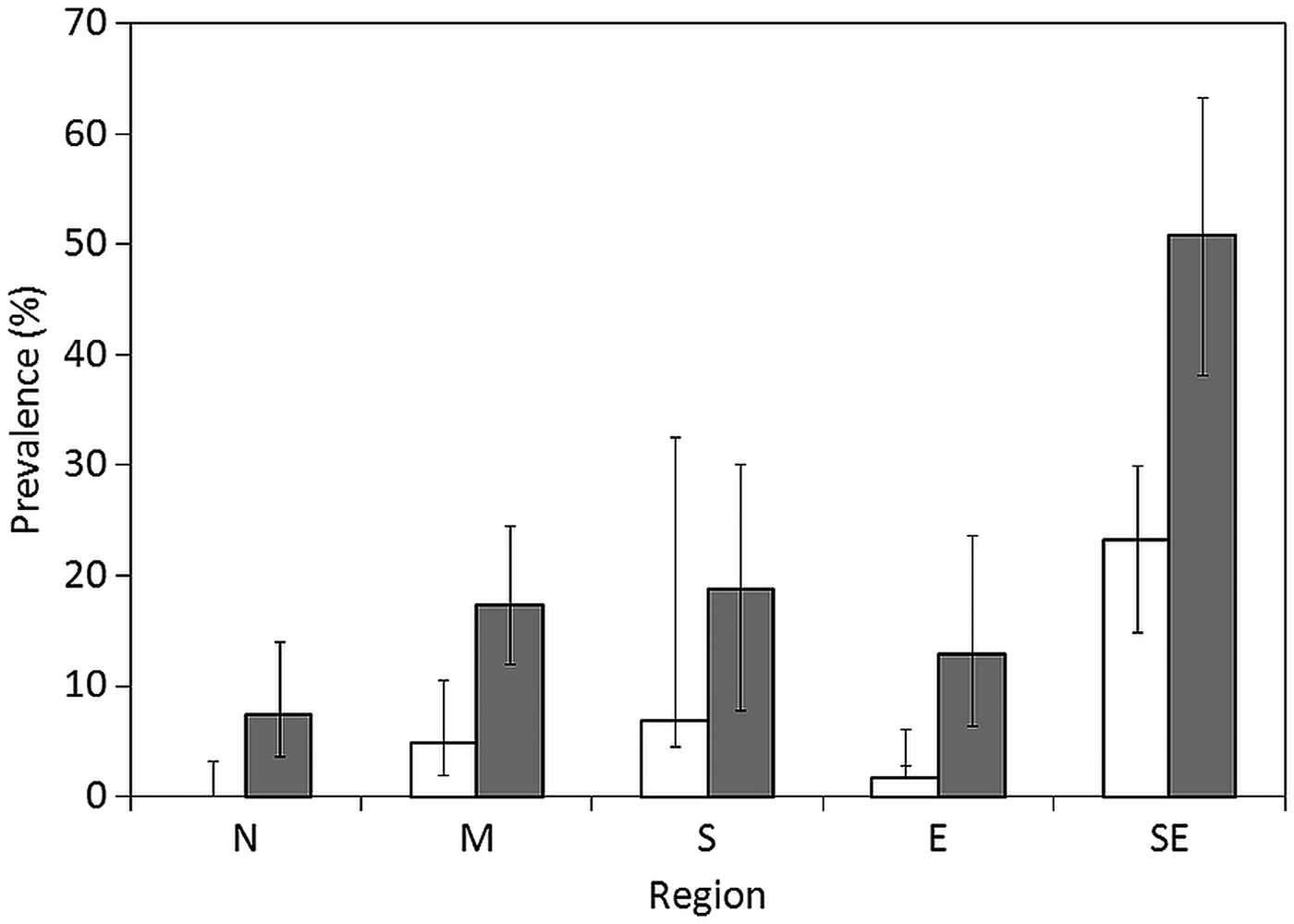
Foxes infected with A. vasorum were unevenly distributed across Great Britain (Fig. 1) and prevalence varied strongly by region, being highest in the Southeast (50·8%) and lowest in the North (7·4%) and East (12·9%) (Fig. 2). The overall prevalence of A. vasorum was significantly higher than that recorded in the previous survey (χ 2 = 29·51, 1 d.f., P < 0·001). Similarly, prevalence in all regions except for the South (χ 2 = 1·62, 1 d.f., P = 0·20) was significantly higher than in the 2005–2006 study (χ 2 ⩾ 9·49, 1 d.f., P ⩽ 0·002).
Distribution of foxes infected (filled circles) and uninfected (open squares) with Angiostrongylus vasorum. Locations represent collection points of carcases; some points overlap.

The regional prevalence of Angiostrongylus vasorum in the current study (shaded), compared with the previous comparable survey in 2005–2006 (Morgan et al. Reference Morgan, Tomlinson, Hunter, Nichols, Roberts, Fox and Taylor2008). Error bars represent exact binomial 95% confidence intervals. N, North (including Scotland; UK Ordnance Survey, OS, grid squares H, NC-NZ, SD-SJ); M, Midlands (SK-SP); S, South (SS-SY); E, East (TA-TM); SE, Southeast (TQ-TV).

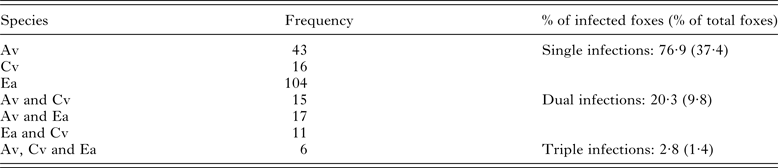
Crenosoma vulpis (overall prevalence 10·8%, n = 436, CI 8·1–14·2) and E. aerophilus (31·6%, n = 436, CI 27·3–36·2) were the only other parasites identified. Overall sample size was slightly lower for these species (436 cf. 442) because the trachea was sometimes truncated during organ recovery, and therefore not always examined. The overall recorded prevalence of E. aerophilus was lower than in 2005–2006 (31·6% compared with 39% previously; χ 2 = 5·48, 1 d.f., P = 0·019). Foxes infected with E. aerophilus were widely distributed around the UK, including Scotland. The distribution of C. vulpis was broadly similar to A. vasorum, with prevalence highest in the Southeast and lowest in the North (Table 1). Of foxes found to be infected, 98% (C. vulpis) and 91% (E. aerophilus) would have been identified by the discovery of immature stages in the tracheal scraping alone. Mixed infections were recorded in 11·2% of foxes sampled (23·1% of those infected by at least one species) (Table 2). Despite particular vigilance for Dirofilaria immitis, which is exotic to the UK, no infected foxes were found (upper exact binomial CI = 1·1%).
Regional prevalence of Crenosoma vulpis and Eucoleus aerophilus in foxes (CI = 95% exact binomial confidence intervals). Sample sizes per region are given between brackets, first for the current study, followed by those reported in Morgan et al. (Reference Morgan, Tomlinson, Hunter, Nichols, Roberts, Fox and Taylor2008)

Frequency of single, dual and triple infections with Angiostrongylus vasorum (Av), Crenosoma vulpis (Cv) and Eucoleus aerophilus (Ea) in the sampled foxes (n = 436)

Binary logistic regression confirmed that region was a significant predictor of A. vasorum prevalence (Wald statistic = 40·35, 4 d.f., P < 0·001). The occurrence of A. vasorum was also positively associated with that of C. vulpis (binary logistic regression, Wald statistic 6·665, P = 0·01, odds ratio, OR = 2·64, 95% CI 1·26–5·52). Infection with C. vulpis was, in turn, positively associated with the presence of A. vasorum (Wald statistic = 14·31, P < 0·001, OR = 4·00, CI 1·95–8·22). Infection with E. aerophilus was not significantly associated with the presence of either of the other two species. No significant associations were found between infection with any of the three nematode species and fox age or sex.
Estimated growing degree days for A. vasorum development in the intermediate host were slightly fewer in 2013 (1796) than in 2005 (1992). Rainfall was very similar between years (UK annual average 1086·2 mm in 2013, and 1091·0 mm in 2005; 99% of 1961–1990 average in both cases).
DISCUSSION
The importance of wildlife as potential reservoirs of pathogens which may infect domestic animals and humans is attracting growing interest because of apparent increases in wildlife-related disease (Daszak et al. Reference Daszak, Cunningham and Hyatt2000; Taylor et al. Reference Taylor, Latham and Woolhouse2001). This may be associated with factors such as expansion of housing and agriculture into rural areas, increased popularity of wildlife as pets, and increased exposure of companion animals to novel pathogens and vectors due to a rise in pet movements (Chomel et al. Reference Chomel, Belotto and Meslin2007). Unlicensed rehabilitation and movement of wildlife species has also been identified as a potential risk factor for disease dissemination in the UK (Anon., 2007). The red fox, Vulpes vulpes, has been implicated as a reservoir of numerous pathogens internationally, including the rabies virus, Echinococcus multilocularis, Sarcoptes scabiei, Trichinella spiralis and A. vasorum (Deplazes et al. Reference Deplazes, Hegglin, Gloor and Romig2004; Balastrieri et al. Reference Balastrieri, Remonti, Ferrari, Ferrari, Lo Valvo and Robetto2006; Letková et al. Reference Letková, Lazar, Goldová and Košuthová2006).
Whatever the impact of the fox as a reservoir of A. vasorum, infection in foxes is likely to indicate changes in parasite distribution more reliably than reports of clinical cases or surveys of dogs, dog owners and veterinarians, since these are likely to be strongly influenced by veterinary practitioner awareness, recruitment bias and advances in diagnostic technologies (Morgan et al. Reference Morgan, Jefferies, Van Otterdijk, McEniry, Allen, Bakewell and Shaw2010; Schnyder et al. Reference Schnyder, Schaper, Bilbrough, Morgan and Deplazes2013; Kirk et al. Reference Kirk, Limon, Guitan, Hermosilla and Fox2014). In comparison with a previous survey of foxes in Great Britain (Morgan et al. Reference Morgan, Tomlinson, Hunter, Nichols, Roberts, Fox and Taylor2008), whose methods were replicated as exactly as possible, the present results clearly indicate a northward expansion of this parasite, as well as an increase in prevalence in most areas in which the parasite was previously observed.
There is a risk with once-repeated cross-sectional surveys that point differences between years lead to the erroneous supposition of an increasing trend in infection levels. Thus, higher prevalence in 2013/14 than in 2005/06 could in principle be due to better short-term weather conditions for transmission of A. vasorum, rather than spreading parasite distribution. However, neither average precipitation nor estimated growing degree days were higher overall in 2013 than in 2005. Another potential limitation of the present study design is that foxes were not randomly sampled, but taken opportunistically. By chance, there were therefore fine scale differences in the extent to which different localities were represented. For example, fewer foxes were sampled from near the Scotland–England border than in the earlier survey, while more were sampled from Cumbria. In some cases, such as the increased number of foxes obtained from Wales, this could explain apparent local increases in prevalence. Nevertheless, sampling intensity at regional level was similar in both surveys, and fine scale local variation is likely to contribute to random error but not systematic bias. If anything, smaller numbers of foxes sampled during the current survey in the Southeast (see Table 2) should cause downward bias in overall prevalence. Unintended sampling bias cannot therefore easily explain the consistent pattern of increased (generally more than doubled) prevalence in different regions.
The most likely explanation for the observed results is genuine expansion in the distribution of A. vasorum. This was previously suspected from observed cases in dogs (e.g. Helm et al. Reference Helm, Gilleard, Jackson, Redman and Bell2009; Yamakawa et al. Reference Yamakawa, McGarry, Denk, Dukes-McEwan, McDonald, Mas, McConnell, Tatton, Valentine, Wayne, Williams and Hetzel2009) and foxes (Philbey and Delgado, Reference Philbey and Delgado2013) outside established endemic areas, and widespread reports by veterinary practices (Kirk et al. Reference Kirk, Limon, Guitan, Hermosilla and Fox2014). Serological surveys in dogs have documented broad distribution of A. vasorum infection in the southern part of Great Britain (Schnyder et al. Reference Schnyder, Schaper, Bilbrough, Morgan and Deplazes2013), but did not extend north to areas previously assumed to be uninfected. The present results provide the most robust evidence to date for northward spread and generally increasing abundance of A. vasorum in the UK. Factors underlying this trend could be, inter alia, effects of long-term climate change on intermediate host availability and/or parasite development rate, increasing dog movement, or increasing transmission through the fox population. There appears to be no fundamental climatic barrier to the establishment of A. vasorum throughout the UK (Morgan et al. Reference Morgan, Jefferies, Krajewski, Ward and Shaw2009) and further range expansion is to be expected.
The other, bronchopulmonary nematode species, C. vulpis and E. aerophilus, were also commonly found, though comparison with the earlier survey is less reliable due to unavoidable differences in the proportion of trachea available for inspection, and the dominant performance of tracheal scrapes as a method of detection in the present study. Microscopic examination of tracheal scrapes for immature stages seemed to be an efficient way of detecting infection with these parasites, and could be incorporated into future surveys. Infection with C. vulpis and A. vasorum were positively associated, perhaps because they both use gastropod intermediate hosts, though such an association was not detected in foxes in Newfoundland (Jeffery et al. Reference Jeffery, Lankester, McGrath and Whitney2004).
The apparently increasing distribution and abundance of A. vasorum in the UK has implications for the diagnosis and prevention of infection in dogs, since case management and recommended chemoprophylactic regimes should take account of local risk. Within this widening range, there is significant regional variation, with relatively lower prevalence in foxes in the North and East. These regions have lower fox population densities (Webbon et al. Reference Webbon, Baker and Harris2004), while rainfall is also lower than average in the East of Great Britain, possibly reducing the abundance or activity of slug intermediate hosts (South, Reference South1992). Previous studies also reported a wide range of prevalence in foxes in endemic areas of other countries, of between 4·2 and 92% (Jeffery et al. Reference Jeffery, Lankester, McGrath and Whitney2004; Tønsberg et al. Reference Tønsberg, Saeed and Koch2004; Saeed et al. Reference Saeed, Maddox-Hyttel, Monrad and Kapel2006; Magi et al. Reference Magi, Guardone, Dell'Omodarme, Prati, Mignone, Torracca, Monni and Macchioni2009; Franssen et al. Reference Franssen, Nijsse, Mulder, Cremers, Dam, Takumi and van der Giessen2014). As well as being a cause of disease in dogs, A. vasorum has also been shown to cause pathology and disease in foxes (Poli et al. Reference Poli, Arispici, Mancianti and Abramo1991; Jeffery et al. Reference Jeffery, Lankester, McGrath and Whitney2004; Morgan et al. Reference Morgan, Tomlinson, Hunter, Nichols, Roberts, Fox and Taylor2008; Philbey and Delgado, Reference Philbey and Delgado2013; Eleni et al. Reference Eleni, Grifoni, Di Egidio, Meoli and De Liberato2014), and could affect fox health and population dynamics. While much remains to be elucidated concerning the epidemiology of angiostrongylosis in dogs and foxes, time series of infection levels and distribution such as that presented here will be important to define trends and advance understanding.
ACKNOWLEDGEMENTS
Thanks to Barnaby Dobson, Andrew Cooke and the team at APHA for assistance with the collection and transport of material, and to Adrian Philbey for sharing information on fox locations in Scotland.
FINANCIAL SUPPORT
Fox collections were funded by the UK Food Standards Agency under grant FS231058. C.S.T. was kindly funded by a grant from the Wellcome Trust (WT082161MA) and N.A.A. by a PhD scholarship from the Ministry of Higher Education, Government of Malaysia. J.W.M. would like to thank Roland Schaper and Bayer Animal Health for financial support.