Introduction
Over the past three decades, substantial quantities of evidence have been adduced to support the hypothesis that mammalian sex ratios at birth are causally related to the hormone concentrations of both parents around the time of conception. The hypothesis was first formulated in regard to gonadotrophin in 1980 (James, Reference James1980) and in regard to testosterone in 1986 (James, Reference James1986). The evidence has been summarized (James, Reference James1996, Reference James2004, Reference James2008a, Reference Jamesb). Most of it relates to human births. However, except in a very few cases, these human data are observational and correlational. This is so because, for ethical reasons, intentional human experimentation on offspring sex is normally precluded. However, not all the evidence suffers from the weaknesses inherent in observational/correlational material. To illustrate this point, four other categories of data will now be described, viz. from:
1. Nazi Germany and the Soviet Union
2. Fulfilled predictions
3. Genetics and
4. A network of logically related propositions.
Previously neglected sources
Nazi Germany
Some scientists deliberately refrain from using data from this source. I respect that moral stance. However, I do not share it, and offer the following information for others to use as they wish.
An account was given of my hypothesis in the Journal of Endocrinology (James, Reference James2008a), soliciting comment from endocrinologists themselves. This was because almost all the evidence for the hypothesis had been published in journals of other disciplines. An unexpected result was an email (dated 18th May 2009) from a retired reproductive endocrinologist, Wolfgang Jochle (now resident in the US). He informed me that his PhD supervisor had been Professor Walter Koch. During the 1930s, this man had conducted experiments on dogs, reporting that offspring sex ratios could be manipulated by hormonal means (e.g. Koch, Reference Koch1934, Reference Koch1937). (Around that time, Koch published a number of other papers on this topic in the journal Klinische Wochenschrift; and Rubsamen (Reference Koch1937) made a similar claim in regard to human births.) Later, according to Dr Jochle's email, Himmler's SS started the Lebensborn (Fountain of Life), an organization dedicated to propagating the Nordic race by enticing suitable unwed young women to ‘produce a baby as a gift to Adolf Hitler’. Volunteering women were paired with German SS or Air Force officers. Professor Koch was by now (1942/43) an army veterinary officer, and acted as a consultant on the treatment of these women to increase the proportion of male births among their newborns. This was done by administering small doses of pre-conceptional oestrogen. Dr Jochle reported that he learnt about this in a series of lectures given by Koch in 1948–9 at the Veterinary School of the University of Munich. It may be assumed that Koch and his family later realized that, when he gave these lectures, he had badly misjudged the climate of opinion. The concluding words of Dr Jochle's email are: ‘Prof Koch died in 1972. The students at these lectures were mostly WWII veterans and most have died since. I, at 81 years of age, may be one of the few who can recall these lectures. Prof. Koch's family destroyed a lot of his writings after his death in order to avoid scandals. So there are no witnesses any more.’ Anyone wishing to follow this lead should know that many of the Lebensborn children were not conceived as described above, but were abducted from parents (or hospitals) in the countries occupied by the Nazis. After the War, many of these children were given up for adoption, some to families in the US. However, even if it seems unlikely that we will ever know the sex ratio of the Lebensborn children resulting from Koch's treatment, there seems no immediate decisive reason to question the veracity of his accounts of his original experimental work in the 1930s. For instance, Koch (Reference Koch1937) reported a significant (p<0.05) excess of male pups born to bitches given small doses of oestrogen before mating, as contrasted with untreated controls. This work should be replicated.
Soviet Russia
During the 1960s, Russian experimentalists in animal husbandry reported success in controlling offspring sex ratios (e.g. Vladimirskaja Reference Vladimirskaja1966a, Reference Vladimirskajab; Babiceva, Reference Babiceva1967; Petrenko & Tkachuk, Reference Petrenko and Tkachuk1970; Volosevic et al., Reference Volosevic, Gaifutdinov and Nediljko1970). These authors inferred (following artificial insemination after adding methyltestosterone and other hormones to semen of several mammalian species) that offspring sex ratios are partially under hormonal control. This work was apparently ignored in the West (perhaps because of scepticism about Russian reports that seemingly supported Lysenko at a time not long removed from his fall). As far as I know, this work has been subsequently ignored in Russia too. However, supporting (or consistent) data have since been independently described by Grant and her co-workers (Grant & Irwin, Reference Grant and Irwin2005; Grant et al., Reference Grant, Irwin, Standley, Shalling and Chamley2008; Grant & Chamley, Reference Grant and Chamley2010).
Fulfilled predictions
The power to generate successful predictions is the best test of a scientific hypothesis. It is a consequence of Bayes's Theorem that the more daring a prediction – the lower its a priori likelihood – the more informative it is. Unfortunately, the predictions made from my hypothesis are the opposite of daring: they specify only ‘high’ or ‘low’ offspring sex ratios. Moreover, judging from the scepticism concerning the hypothesis, it seems reasonable to ascribe a low value to its prior likelihood. That being so, each fulfilled prediction – if it is accepted – must logically submit that low value to only a modest multiplier to yield the ‘posterior’. So the revised estimate of that likelihood will still be rather low. Thus, it seems that my hypothesis will not become accepted unless and until a series of predictions have been successfully made on the basis of it. In such a series, after successfully surviving the first test, the post-test odds that the hypothesis is correct become the pre-test odds for the next test. Sterne & Davey Smith (Reference Sterne and Davey Smith2001) offered interesting illustrative material on the point. They suggested that (consistent with the epidemiological literature), at first publication, the percentage of null hypotheses that are false is of the order of ten. They also suggest that, consistent with published surveys of the (generally small) size of trials, the average power (=1−Type II error rate) of studies is of the order of 0.5. They show that under these conditions, if a significance level of 0.05 is used, then 47.4% of the significant results are expected to be false-positive. However, if the hypothesis is submitted to (and passes) a further (different) test with the same conditions as before (power of 0.5, p<0.05), then only about 9% of significant results are false-positive. Thus progress is slow – but it occurs. Accordingly some such fulfilled predictions are here summarized. They are given in the order that they were made.
The sexes of rodent dams' litter-mates in utero
The intrauterine position of rodents has been shown to be associated with their subsequent adult hormone levels; females adjacent in utero to two males (2M females) are more androgenized than females adjacent to two females (0M females). (This was later shown to be due to the transfer of testosterone from male fetuses to adjacent female ones (Ryan & Vandenbergh, Reference Ryan and Vandenbergh2002).) So it was predicted that the sex ratio of the offspring of 0M females would differ from that of 2M females (James, Reference James1989). The point has since been confirmed in female gerbils (Clark et al., Reference Clark, Karpiuk and Galef1993; Clark & Galef, Reference Clark and Galef1994) and mice (Vandenbergh & Huggett, Reference Vandenbergh and Huggett1994). I know of no other explanation for this phenomenon.
Professional drivers
Noting the evidence that professional drivers have poor sperm quality, and the evidence that lead lowers male testosterone levels, it was predicted that – if my hypothesis were correct – professional drivers should sire an excess of daughters (James, Reference James1992). Dickinson & Parker (Reference Dickinson and Parker1994) confirmed this prediction on two large samples, namely those of McDowall (Reference McDowall1985) on births in England & Wales 1980–82, and their own data on Cumbrian births 1950–89. Taken jointly, the data confirm my prediction at the 0.02 level.
Dioxin (TCDD)
Noting that men exposed to dioxin reportedly have a low testosterone/gonadotrophin ratio (Egeland et al., Reference Egeland, Sweeney, Fingerhut, Wille, Schnorr and Halperin1994), it was predicted that they would sire an excess of daughters (James, Reference James1995a). This prediction was confirmed in reports of births following the Seveso explosion of 1976 (Mocarelli et al., Reference Mocarelli, Brambilla, Gerthoux, Patterson and Needham1996, Reference Mocarelli, Gerthoux, Ferrari, Patterson, Kieszak and Brambilla2000; Figa-Talamanca et al., Reference Figa-Talamanca, Tarquini and Lauria2003). It may be acknowledged that there have been a number of failures to confirm in regard to paternal exposures to ‘dioxin-like’ substances (for references see James, Reference James2006a), but on balance, it seems that these may have been due to congeners and contaminants: whereas the dioxin in the Seveso incident was described as ‘pure’. Moreover Ishihara et al. (Reference Ishihara, Ohsako, Tasaka, Harayama, Miyake and Warita2010) noted that pre-mating exposure of male mice to TCDD lowers offspring sex ratio without decreasing litter size.
Non-ionizing radiation
Men exposed to non-ionizing radiation reportedly subsequently sire statistical excesses of daughters, so it was predicted that such men may have ‘a hormone profile of non-specific pathology’ (James, Reference James1997a). Grajewski et al. (Reference Grajewski, Cox, Schrader, Murray, Edwards and Turner2000) confirmed this prediction, reporting a significantly low testosterone level in male radiofrequency heater operators. The low offspring sex ratio in men exposed to radiofrequency electromagnetic fields has been confirmed by Baste et al. (Reference Baste, Riise and Moen2008).
Side of ovulation
It has been reported in regard to several mammalian species that there are significant differences between the sex ratios of pups gestated in the right and left horns. This has most recently been reported in respect of the cow (Hylan et al., Reference Hylan, Giraldo, Carter, Gentry, Bondioli and Godke2009; Giraldo et al., Reference Giraldo, Hylan, Bondioli and Godke2010). Previously, Clark & Galef (Reference Clark and Galef1990) reported that in the Mongolian gerbil, more male offspring than females are gestated in the right uterine horn; and more females than males in the left horn. Moreover, Clark et al. (Reference Clark and Galef1994) found (by surgically removing portions of right and left ovaries and replacing them in right and left ovarian capsules) that ‘the data are consistent with the hypothesis that lateral asymmetries in gerbil ovaries rather than in gerbil uterine horns cause segregation of gerbil fetuses by sex’. These authors did not identify the nature of these lateral asymmetries. However Fukuda et al. (Reference Fukuda, Fukuda, Andersen and Byskov2000) reported that in women, serum oestradiol and testosterone are higher in right-sided ovulation than left-sided ovulation. So it was suggested that the asymmetries were hormonal in nature, and predicted that in natural human pregnancies, boys would be associated with right-sided ovulation (James, Reference James2001a). The point was confirmed by Fukuda et al. (Reference Fukuda, Fukuda, Andersen and Byskov2001). (Though the word ‘predicted’ is used in the sentence above, the point was not original: it had previously been suggested on other grounds by Hippocrates (Clark & Galef, Reference Clark and Galef1990), and by Schoner (Reference Schoner1927).)
HLA genes, hormones and human offspring sex ratios
Some HLA genes act as markers for disease by indexing hormone levels that are pathogenic (James, Reference James1991). Ollier et al. (Reference Ollier, Spector and Silman1989) had assayed the testosterone levels in 71 men with definite rheumatoid arthritis and 138 healthy controls. These men were categorized by the presence or absence of eight HLA-A genes and twelve HLA-B genes. In both patients and controls, the men carrying HLA-B15 had the lowest mean testosterone levels. Accordingly, Astolfi et al. (Reference Astolfi, Cuccia and Martinetti2001) tested a prediction based on my hypothesis, namely that men carrying HLA-B15 should sire a high proportion of daughters. The prediction was confirmed, and these authors wrote: ‘These results suggest an effect of HLA-B15 on the secondary sex ratio mediated by a low testosterone level.’
Finger length ratios and offspring sex ratios
Substantial quantities of data have been adduced to support the hypothesis that the ratio R of the lengths of the second (2D) and fourth (4D) fingers (where R=2D/4D) is negatively correlated with men's testosterone concentrations (Manning et al., Reference Manning, Scutt, Wilson and Lewis-Jones1998; Manning, Reference Manning2002; Voracek, Reference Voracek2009). So it was predicted that men's R values should correlate negatively with their offspring sex ratios (James, Reference James2001b). This prediction was confirmed by Manning et al. (Reference Manning, Martin and Trivers2002). Moreover, and as would also be predicted on the basis of the two hypotheses, it has been reported that a subject's R value correlates negatively with the sex ratio of his/her older sibs (Saino et al., Reference Saino, Leoni and Romano2006).
The sex ratio of the sibs of probands with autism and other male-biased neurodevelopmental disorders
There are a number of behavioural diagnoses that occur more frequently in boys, and which share a measure of genetic overlap and also share other epidemiological features (reading disability, autism spectrum disorder, attention deficit hyperactivity disorder). It has also been hypothesized that high maternal intrauterine levels of testosterone are causally associated with some of these conditions (Manning et al., Reference Manning, Baron-Cohen, Wheelwright and Sanders2001; Baron-Cohen, Reference Baron-Cohen2002; Baron-Cohen et al., Reference Baron-Cohen, Knickmeyer and Belmonte2005; de Bruin et al. Reference de Bruin, Verheij, Wiegman and Ferdinand2006). If Baron-Cohen's hypothesis and mine were both correct, then probands with these conditions should have a statistical excess of brothers. I made this prediction, and reported evidence to confirm it (James, Reference James2008c). Further confirmation of this prediction has since been reported (Mouridsen et al., Reference Mouridsen, Rich and Isager2010; Mouridsen & Hauschild, Reference Mouridsen and Hauschild2010).
Genetics
My hypothesis suggests that high maternal oestrogen levels are associated with subsequent births of sons: in contrast, high paternal oestrogen levels are suspected to be associated with subsequent daughters. (This suspicion is based on reports that the administration of oestrogen to males of a number of mammalian species, including man, depresses testosterone concentrations; see Kalla (Reference Kalla1987); Sharpe et al. (Reference Sharpe, Martin, Morris, Greig, McKinnell, McNeilly and Walker2002).) High testosterone levels in either parent are ex hypothesi associated with sons.
The extent to which a subject is oestrogenized is partially dependent on his/her alleles at the oestrogen receptor gene loci. Accordingly one might suspect that the Hardy–Weinberg equilibrium at these loci would be dislocated vis-à-vis sex. In other words, the distribution of these alleles in men would be expected to differ from that in women. I am grateful to Dr J. MacMurray (of California) for drawing my attention to highly significant evidence for such dislocation in Prichard et al. (Reference Prichard, Jorm, Prior, Sanson, Smart, Zhang, Huttley and Easteal2002). It would be interesting to know whether there is an analogous phenomenon in regard to androgen receptor gene loci.
It is not established how endocrine mechanisms affect offspring sex ratios (though a hypothesis has been offered; James, Reference James1997b). So it is not possible to offer a quantitative estimate of the Hardy–Weinberg dislocation expected on the basis of the hypothesis. However there is good evidence that endocrine mechanisms at least partially operate at the time of conception: sex-selective spontaneous abortion or resorption are apparently not the sole explanation of the variation of mammalian sex ratios at birth (James, Reference James2006b; Alexenko et al., Reference Alexenko, Mao, Ellersieck, Davis, Whyte, Rosenfeld and Roberts2007; Grant & Chamley, Reference Grant and Chamley2010).
A network of logically related propositions
For more than a century, studies have addressed a ‘target’ proposition, viz. that the sex of a zygote is related to the time within the fruitful cycle that it was formed. Until recently, it had been supposed that, if true, this proposition is merely a curiosity. However it has recently been emphasized that this proposition logically (mathematically) entails a number of others, for some of which there is overwhelming evidence (James, Reference James2008d). The truth of these subsidiary propositions must add weight (but not decisive weight) to the target proposition. The strength and nature of the entailments relating the target proposition to the others is given in that paper. Moreover the independent evidence for these other propositions is adduced there. These propositions relate to the variation of offspring sex ratio with: (a) coital frequency, (b) duration of gestation, (c) time taken to achieve conception, and (d) war. I have written elsewhere on the empirical data for this wartime variation, and on the argument that it is due to a form of selection for high coital frequency in couples of whom the men were members of the armed forces on short leave (James, Reference James2009a). Lastly, I have noted that the target proposition, if it were also true in polytocous mammals, would potentially explain the well-established sub-binomial variances of the distributions of the combinations of the sexes within their litters (James, Reference James2009b).
A meta-analysis on ten independent sets of human data relating to the target proposition yielded a Mantel–Haenszel test statistic that was significant at the 0.005 level, suggesting that the regression of p, the probability that a birth will be male, is U-shaped on the time of formation within the cycle (James, Reference James2000). In other words, conceptions in the middle of the fertile interval (that time during the cycle when the probability of conception is non-zero) are more likely to be of girls; and those at either end, of boys. Statistical modelling suggests a similarly shaped regression in the pig (Brooks et al., Reference Brooks, James and Gray1991). In the human being, at any rate, such a phenomenon is explicable on my hypothesis by the rapidly changing luteal hormone concentrations (the ‘LH surge’) across the fertile interval.
Thus this direct evidence for the target proposition, and the strong evidence for some of the entailed subsidiary propositions, jointly constitute strong evidence for my hypothesis.
Prospects for further research
One may suspect that in the near future, research in sex ratios will prosper in two fields, viz. (1) serious human pathology, and (2) diet. These two fields will now be described.
Serious human pathology
There are two forms of human infective agent that are associated with unusual offspring sex ratios, viz. the hepatitis B virus (HBV) and the protozoan parasite Toxoplasma gondii. These are both the subjects of continuing research because of our imperfect knowledge of how to combat infection. Hepatitis B virus carriers reportedly produce significant excesses of sons (Chahnazarian et al., Reference Chahnazarian, Blumberg and London1988). In conformity with my hypothesis, healthy HBV carriers reportedly have highly significantly higher testosterone levels than healthy controls (Yu et al., Reference Yu and Chen1993; Yuan et al., Reference Yuan, Ross, Stanczyk, Govindarajan, Gao, Henderson and Yu1995). Women with toxoplasmosis reportedly produce an excess of sons (Kankova et al., Reference Kankova, Sulc, Nouzova, Fajfrlik, Frynta and Flegr2007). Their testosterone levels are reportedly low (Flegr et al., Reference Flegr, Lindova and Kodym2008). However, in an effort to reconcile these data with my hypothesis, I have adduced evidence that these infected women have high oestrogen levels (James, Reference James2010). It remains to be seen whether this speculation is correct.
Diet
Much work on mammalian sex ratio variation over the past three decades has been inspired by evolutionary adaptive theory, especially that of Trivers & Willard (Reference Trivers and Willard1973). However, as far as primate sex ratios are concerned, this has proved to be frustrating. Recently it was noted that in only about half of 89 studies on human and non-human primates did the results confirm the predictions of these authors (James, Reference James2006a). Accordingly I suggested in that paper that this was a consequence of ‘constraints’ on offspring sex ratio imposed by parental hormone levels around the time of conception, especially by stress-related high maternal adrenal T levels. If my hypothesis is correct, these cause the mothers to produce sons, contrary to the proposal of Trivers & Willard. It seems unlikely that this point will be resolved except by identifying the proximate determinants of mammalian sex ratio variation. This will presumably be done by using experimental animals to test whether established sex ratio variation at birth is preceded at the time of conception by the hypothesized variation in concentrations of parental hormones, or interference with hormone receptors. So it might be useful if experimentalists were to call a temporary moratorium on evolution-based research into sex ratios, and concentrate instead on their proximate determinants. A specific area in which this testing may occur is diet. Over the past decade there have been successful attempts to manipulate mammalian sex ratio variation by dietary means. Two types of diet will be discussed to see what light they throw on my hypothesis.
Dietary fat
It has been reported that the sex ratio of pups born to female mice depends on the fat content of the maternal diet. The sex ratio (proportion male) of litters born to dams on high-fat diets was reportedly 0.67, and that of those on low-fat diets 0.39, the difference between the two being highly significant (Rosenfeld et al., Reference Rosenfeld, Grimm, Livingston, Brokman, Lamberson and Roberts2003). In a second experiment this result was confirmed (Alexenko et al., Reference Alexenko, Mao, Ellersieck, Davis, Whyte, Rosenfeld and Roberts2007). These latter workers established that at 0.5 days post-coitus, the sex ratio bias is already established, and that oestradiol was significantly and substantially higher in high-fat than low-fat dams (Whyte et al., Reference Whyte, Alexenko, Davis, Ellersieck, Fountain and Rosenfeld2007). I suggest that the high offspring sex ratio was directly due to the high levels of maternal oestradiol. Later it was shown that offspring sex ratios varied with the sort of polyunsaturated fatty acids (PUFA) fed to dams before mating. Those on an omega-6 diet had 213 daughters and 133 sons: those on an omega-3 diet had an offspring sex ratio that was not significantly different from 0.5 (Fountain et al., Reference Fountain, Mao, Whyte, Mueller, Ellersieck and Will2008). It has been reported that omega-6 PUFA represses oestrogen receptor expression (Menendez et al., Reference Menendez, Colomer and Lupu2004): if that is correct, then the result of Fountain et al. (Reference Fountain, Mao, Whyte, Mueller, Ellersieck and Will2008) may be construed as consistent with my hypothesis that high maternal levels of oestrogen (or oestrogenic activity) are associated with male births (James, Reference James1996, Reference James2004, Reference James2008a, Reference Jamesb). However Green et al. (Reference Green, Spate, Parks, Kimura, Murphy and Williams2008) reported that ewes on an omega-6 diet had a high offspring sex ratio, so (until this difference between mice and sheep is explained) attempts at reconciling the findings with my hypothesis seem premature.
Dietary glucose
Cameron (Reference Cameron2004) suggested that glucose favours the development of male blastocysts. Later, in conformity with this notion, she and her colleagues reported that female mice on a low-glucose diet produced a high proportion of daughters (Cameron et al., Reference Cameron, Lemons, Bateman and Bennett2008). This finding is consistent with those of Larson et al. (Reference James2001) and Kimura et al. (Reference Kimura, Spate, Green and Roberts2005), who reported that glucose differentially alters the survival of male and female (bovine) fetuses, increasing the sex ratio ‘most likely as a result of increased pentose phosphate pathway activity in female embryos,’ (Kimura et al., Reference Kimura, Spate, Green and Roberts2005). However, preceding this suspected differential mortality by sex, I would suppose that there is differential formation of zygotes by sex. There is evidence that glucose enhances LH secretion (Murahashi et al., Reference Murahashi, Bucholtz, Nagatani, Tsukahara, Tsukamura, Foster and Maeda1996; Nagatani et al., Reference Nagatani, Bucholtz, Murahashi, Estacio, Tsukamura, Foster and Maeda1996). So (if my hypothesis were correct), glucose should be associated with an excess production of female zygotes. So it is not clear whether the data of Cameron et al. (Reference Cameron, Lemons, Bateman and Bennett2008) contradict my hypothesis or not. To test the point, it will be necessary to elucidate the factors mediating the observed association between diminished maternal glucose levels and low offspring sex ratio. Where glucose levels are high, is a suspected female bias at conception masked by a higher female mortality post-conception? Meanwhile, workers on this problem may be interested in the offspring sex ratios of people with diabetes. I reproduced a number of such data-sets in James (Reference James2006d). The data suggest a highly significant excess of sons born to women with type 2 diabetes. There is also, perplexingly, a highly significant heterogeneity across the offspring sex ratios reported of women with type 1 diabetes. Solutions to these problems will enable us to judge whether the data support, or impugn, my hypothesis. These solutions will come by establishing the hormone profiles (and/or modifications to the hormone receptor pathways) associated with each sort of diet. Further work should also be done on supplementing semen with sex hormones in experimental artificial insemination.
Acknowledgments
The author is grateful to Dr W. Jochle for his email (cited in the text) relating to Nazi experimentation on human offspring sex ratios. He is also grateful to Alison Abbott, Nature correspondent in Germany, for searching (so far in vain) for documentation relating to that experimentation. He is grateful to Dr J. MacMurray (California) for the cited information on disruption of Hardy–Weinberg equilibrium at the oestrogen receptor gene locus.
Appendix
A summary of the human observational/correlational evidence
Most of this evidence is of the form:
1. Subjects with a given type of pre-mating exposure have a significantly biased offspring sex ratio,
2. Subjects with that type of exposure have a significantly biased hormone profile as contrasted with controls, and
3. That sort of hormone profile is ex hypothesi responsible for sex ratio bias in the given direction.
Frequently the subjects of the one sort of observation are not the same as those in the other (though an exception is Garry et al. (Reference James2002a, Reference Jamesb, Reference James2003) who reported that paternal fungicide exposure was associated in the same men with: (a) significantly lowered testosterone levels and (b) significantly lowered offspring sex ratios). It should be added that my hypothesis is also supported by the data from two categories of people directly given hormonal fertility treatment, viz.:
1. Women in whom ovulation was induced with clomiphene or gonadotrophins produced a highly significant excess of daughters (James, Reference James1985a, Reference Jamesb).
2. Subfertile men treated with methyltestosterone or gonadotrophin produced highly significant excesses of sons (Sas & Szollosi, Reference James1980).
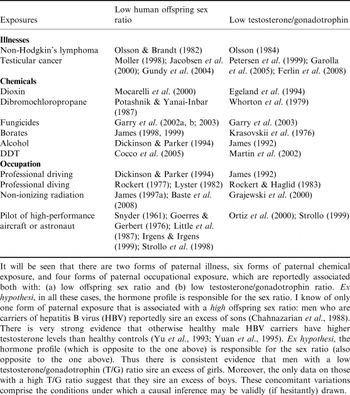
To give some idea of the breadth and consistency of the human correlational/observational evidence, it is summarized in Table A1.
Offspring sex ratios and paternal exposures: references substantiating that some human male illnesses and other adverse paternal exposures are reportedly associated with both low offspring sex ratios and low testosterone/gonadotrophin ratios

It will be seen that there are two forms of paternal illness, six forms of paternal chemical exposure, and four forms of paternal occupational exposure, which are reportedly associated both with: (a) low offspring sex ratio and (b) low testosterone/gonadotrophin ratio. Ex hypothesi, in all these cases, the hormone profile is responsible for the sex ratio.
I know of only one form of paternal exposure that is associated with a high offspring sex ratio: men who are carriers of hepatitis B virus (HBV) reportedly sire an excess of sons (Chahnazarian et al., Reference Chahnazarian, Blumberg and London1988). There is very strong evidence that otherwise healthy male HBV carriers have higher testosterone levels than healthy controls (Yu et al., Reference James1993; Yuan et al., Reference Yuan, Ross, Stanczyk, Govindarajan, Gao, Henderson and Yu1995). Ex hypothesi, the hormone profile (which is opposite to the one above) is responsible for the sex ratio (also opposite to the one above). Thus there is consistent evidence that men with a low testosterone/gonadotrophin (T/G) ratio sire an excess of girls. Moreover, the only data on those with a high T/G ratio suggest that they sire an excess of boys. These concomitant variations comprise the conditions under which a causal inference may be validly (if hesitantly) drawn.
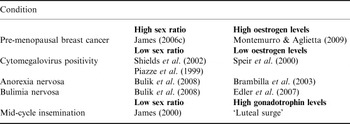
Offspring sex ratios and maternal exposures: references substantiating biased maternal offspring sex ratios and corresponding established unusual hormone concentrations