INTRODUCTION
Breast cancer is the most common cancer diagnosis in women from developed countries (Jemal et al., Reference Jemal, Siegel and Ward2008) and is therefore a major health problem. Earlier research has revealed that some patients with breast cancer adjust relatively well to the disease and its treatment, whereas others do not (Lee, Reference Lee2001). For patients who do not adjust well, an important role for healthcare professionals is to promote better psychosocial adjustment to the disease and to treatments. Psychosocial adjustment to breast cancer fluctuates with the course of the disease and with treatments (Hoskins et al., Reference Hoskins, Baker and Sherman1996).
The level of hope in cancer patients has been measured in several studies (Herth, Reference Herth2000; Ebright & Lyon, Reference Ebright and Lyon2002; Chen, Reference Chen2003; Hsu et al., Reference Hsu, Lu and Tsou2003; Lai et al., Reference Lai, Chang and Keefe2003; Lin et al., Reference Lin, Lai and Ward2003a, Reference Lin, Tsai and Chiou2003b; Sanatani et al., Reference Sanatani, Schreier and Stitt2008; Utne et al., Reference Utne, Miaskowski and Bjordal2008), and hope has been identified as an essential element in cancer patients' life (Nowotny, Reference Nowotny1989; Rustoen & Hanestad, Reference Rustoen and Hanestad1998; Rustoen et al., Reference Rustoen, Wiklund and Hanestad1998; Felder, Reference Felder2004). Hope is considered an effective coping strategy for cancer patients because it provides adaptive power to help patients get through difficult situations, achieve meaning, and achieve desired goals (Herth, Reference Herth2000; Benzein et al., Reference Benzein, Norberg and Saveman2001; Ebright & Lyon, Reference Ebright and Lyon2002; Reb, Reference Reb2007). Several studies have focused on the significance of hope from the patients' perspective, for example, as a way of coping with terminal illness by acknowledging, accepting, and managing to fight the disease and the side effects of treatment (Ersek, Reference Ersek1992; Fryback, Reference Fryback1993). Hope has also been interpreted as an inner strength and an available resource for living in the present (Koopmeiners et al., Reference Koopmeiners, Post-White and Gutknecht1997).
Fatigue is the most frequently reported side effect of cancer treatment, with a prevalence ranging from 25% to 99% at different times in treatment regimens and across different diagnostic groups (Donnelly et al., Reference Donnelly, Walsh and Rybicki1995; Servaes et al., Reference Servaes, Verhagen and Bleijenberg2002; Wratten et al., Reference Wratten, Kilmurray and Nash2004; Von Ah et al., Reference Von Ah, Kang and Carpenter2008). Fatigue has been identified as the most problematic side effect in women with breast cancer receiving adjuvant chemotherapy or radiation therapy (Irvine et al., Reference Irvine, Vincent and Graydon1994; Longman et al., Reference Longman, Braden and Mishel1999; Jacobsen et al., Reference Jacobsen, Hann and Azzarello1999; Hickok et al., Reference Hickok, Roscoe and Morrow2005). Fatigue can persist for years after completion of treatment, disrupting daily functioning and negatively affecting quality of life (Andrykowski et al., Reference Andrykowski, Curran and Lightner1998; Broeckel et al., Reference Broeckel, Jacobsen and Horton1998; Smets et al., Reference Smets, Visser and Willems Groot1998; Miaskowski & Lee, Reference Miaskowski and Lee1999).
Several studies have shown that fatigue is associated with symptoms such as pain and dyspnea (Stone et al., Reference Stone, Hardy and Broadley1999; Utne et al., Reference Utne, Miaskowski and Bjordal2008), depressed mood (Mock et al., Reference Mock, Dow and Meares1997; Walker et al., Reference Walker, McGown and Jantos1997), and anxiety and depression (Stone et al., Reference Stone, Richards and A'Hern2000). Patients with advanced cancer have described their experience of fatigue as affecting the physical, psychological, social, and spiritual aspects of their lives (Potter, Reference Potter2004).
Despite the great number of studies on hope and on fatigue, little research has been reported on the relationship between fatigue and hope. In a recent review by Chi et al. (Reference Chi2007) it was noted that cancer patients' level of hope appears to be related to fatigue. Herth (Reference Herth1992) looked at the relationship between hope and fatigue in a small sample of ill adults, and fatigue significantly affected hope such that subjects who reported experiencing high levels of fatigue had significantly less hope than those experiencing moderate, little, or no fatigue. Benzein and Berg (Reference Benzein and Berg2005) did not find any correlation between hope and fatigue in cancer patients receiving palliative care. A study of Korean women with breast cancer receiving chemotherapy or radiation therapy found that after controlling for hope, fatigue uniquely accounted for 38% of the variance in psychosocial adjustment (Lee, Reference Lee2001). After controlling for fatigue, hope uniquely accounted for 7% of the variance in psychosocial adjustment. However, there was no significant interaction between fatigue and hope in accounting for the variance in psychosocial adjustment (Lee, Reference Lee2001).
Based on the significance of hope and fatigue in breast cancer patients, and given that previous research about hope and fatigue is limited and inconsistent, the aims of the present study in a sample of outpatients diagnosed with breast cancer (stage I or II) were
1. to describe the levels of hope and to compare their hope scores with level of hope in the general Norwegian population;
2. to describe the relationship between hope and fatigue in these patients; and
3. to evaluate the effect of demographic and clinical characteristics and fatigue on hope.
We hypothesize that feeling fatigued and with little energy will be a threat to hope, and give a patient less strength to meet challenges in the future.
METHOD
Sample and Methods of Data Collection
This study is part of a larger longitudinal study in which an intervention was given to a group of patients to reduce their fatigue. The data presented in this paper are baseline data before randomization. The patients were recruited from outpatient clinics at a university-based cancer center in Norway. After they had consented to participate they were given self-report questionnaires, which they filled in at home and mailed to the investigator (T.K.S.).
Women diagnosed with breast cancer (stage I or II) were eligible to participate in the study if they were >18 years of age; able to read, write, and understand Norwegian; and gave written consent. As this study evaluated an intervention for fatigue, the participants had to have a fatigue score ≥2.5 on a numeric rating scale (NRS) (0–10, 0 = no fatigue, 10 = severe fatigue). Women with breast cancer stage I or II were recruited because the cancer prognosis for these stages is relatively good and treatment will mostly be defined as curative. All patients were receiving active treatment for cancer when they were recruited. After undergoing lumpectomy or total mastectomy they were receiving chemotherapy and/or radiotherapy, and some were to receive hormone therapy for 5 years.
Instruments and Scoring Procedures
All patients completed self-administrated questionnaires about demographic and clinical characteristics, comorbidities, fatigue, and hope.
Demographic and Clinical Characteristics
The demographic questionnaire obtained information on age, marital status (married/partnered, unmarried/not partnered, divorced, widowed, separated), living status (alone, with husband/partner, children, parents, at an institution), educational level (primary school, secondary school, university/college) and employment status (paid work employment, self-employed, full time housework, education/military service, unemployed, disabled pensioner, old age pensioner, rehabilitation). For analytical purposes, marital status was dichotomized into married/partnered or not married/partnered, living status into living alone or not, and employment status into employed or unemployed. The clinical questionnaire obtained information on treatment (surgery, chemotherapy, radiotherapy, hormone therapy), and a Self administered Comorbidity Questionnaire (SCQ) obtained information about the presence of other diseases (Sangha et al., Reference Sangha, Stucki and Liang2003).
Herth Hope Index (HHI)
Hope was measured using the Norwegian version of the Herth Hope Index (HHI-N) (Wahl et al., Reference Wahl, Rustoen and Lerdal2004). The HHI is based on the definition of hope developed by Dufault and Martocchio (Reference Dufault and Martocchio1985). It was selected for this study because it is short and easy to use (Herth, Reference Herth1992). The HHI (12 items) measures various dimensions of hope using a 4-point Likert scale that ranges from strongly disagree (1) to strongly agree (4) with items 3 and 6 reverse coded. The scale gives a total HHI score that ranges from 12 to 48, as well as single item scores that range from 1 to 4 (Herth, Reference Herth1992). A higher score denotes higher levels of hope. The scale has been used widely (Herth, Reference Herth2000; Ebright & Lyon, Reference Ebright and Lyon2002; Chen, Reference Chen2003; Hsu et al., Reference Hsu, Lu and Tsou2003; Lai et al., Reference Lai, Chang and Keefe2003; Lin et al., Reference Lin, Lai and Ward2003a, Reference Lin, Tsai and Chiou2003b). Construct validity (Herth, Reference Herth1992), divergent validity (Gibson, Reference Gibson1999; Beckie et al., Reference Beckie, Beckstead and Webb2001), internal consistency (Lin et al., Reference Lin, Lai and Ward2003a), and test–retest correlations (Herth, Reference Herth1992) were reported to be satisfactory in different samples. The HHI-N showed satisfactory reliability (Cronbach's α 0.81) (Wahl et al., Reference Wahl, Rustoen and Lerdal2004) and discriminated between different subgroups of participants (Rustoen et al., Reference Rustoen, Wahl and Hanestad2003). In the present study the Cronbach's α for the global score was 0.86.
Fatigue
A numeric rating scale (NRS) (0 to 10, where 0 = no fatigue and 10 = severe fatigue) was used as a screening instrument to measure fatigue related to inclusion into the study.
Fatigue questionnaire (FQ)
The FQ is an 11-item questionnaire designed to measure fatigue severity and to detect chronic fatigue (Chalder et al., Reference Chalder, Berelowitz and Pawlikowska1993), and was originally developed to measure fatigue in patients with chronic fatigue syndrome or myalgic encephalomyelitis (Wessely & Powell, Reference Wessely and Powell1989; Butler et al., Reference Butler, Chalder and Ron1991). It consists of two domains: physical fatigue (PF, 7 items), covering physical problems such as tiredness, need for rest, feeling sleepy or drowsy, problems in getting started, lack of energy, lack of muscle strength or feeling weak; and mental fatigue (MF, 4 items) covering cognitive difficulties such as difficulty in concentration, slips of the tongue when speaking, difficulties in finding the correct words, and memory problems. The sum of these 11 items is designated total fatigue (TF). Each item has four response choices: “less than usual,” “same as usual,” “more than usual” and “much more than usual.” In this study the responses were scored on a Likert Scale (0-1-2-3) for PF, MF, and TF, with higher scores implying more fatigue. In addition to the FQ (11 items), two additional items ask about the duration and the extent of fatigue for identification of chronic fatigue. For the duration, 0 =< 1 week, 1 =< 3 months, 2 = between 3 and 6 months, and 3 =≥ 6 months. For the extent, 0 = 25% of the time, 1 = 50% of the time, 2 = 75% of the time, and 3 = all the time. A dichotomized scale (0–0, 1–1) was used in the definition of chronic fatigue. Based on earlier results from validation studies, chronic fatigue (CF) was defined by a dichotomized score of ≥4 and a duration of ≥6 months (Chalder et al., Reference Chalder, Berelowitz and Pawlikowska1993; Wessely, Reference Wessely1995).
The FQ is well validated internationally, has shown good psychometric properties, and has also been used in Norwegian samples (Loge et al., Reference Loge, Ekeberg and Kaasa1998; Morriss et al., Reference Morriss, Wearden and Mullis1998). The reliability of FQ was assessed by estimates of internal consistencies of the questionnaire. In the present study the Cronbach's α was 0.84 for PF, 0.81 for MF, and 0.87 for TF, confirming the findings of a previous study (Chalder et al., Reference Chalder, Berelowitz and Pawlikowska1993).
Ethics
The study was approved by the Regional Committee for Medical Research Ethics, Norway (Registration number: 200500327-10/IAY/400), Norwegian Data Inspectorate and the Norwegian Radium Hospital. All patients gave written consent to participate in the study. The study is registered in ClinicalTrials.gov. ID: NCT00927433.
Statistical Analysis
Data were analysed using SPSS Version 15.0 for Windows software (SPSS Inc., Chicago, IL). Descriptive statistics and frequency distributions were used to evaluate demographic, clinical, and fatigue characteristics, as well as levels of hope. Cronbach's α was employed to determine the reliability of the instruments. Pearson's product moment correlations were calculated to explore relationships between fatigue (FQ) and level of hope (HHI). One-way ANOVA was employed to compare levels of hope across subgroups marital-, living-, and employment dichotomized status. One-sample t tests were employed to determine if individual-item and global scores on the total HHI score differed between the cancer outpatients with fatigue and the Norwegian general population. The variables that were significantly correlated with total HHI score in outpatients with fatigue were entered in a regression model, using total HHI score as the dependent variable. A p value < .05 was considered statistically significant.
RESULTS
Recruitment Procedures
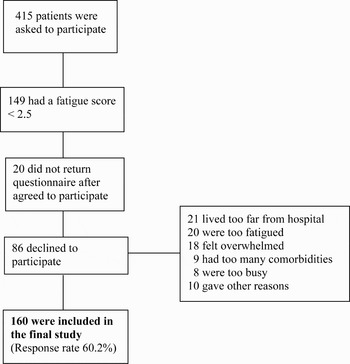
The recruitment procedures are shown in Figure 1. A total of 415 patients were asked to participate in the study. Of these, 255 were not included in the study for varying reasons, mainly because they had a fatigue score < 2.5 (n = 149). The final number of patients included in the study was 160, which gave a response rate of 60.2%.
Information on sample selection and exclusions.

After obtaining informed consent, the patients were asked to complete the Patient Information Questionnaire, the FQ, and the HHI and to return the questionnaires within a couple of days. One reminder was mailed.
Demographic Characteristics
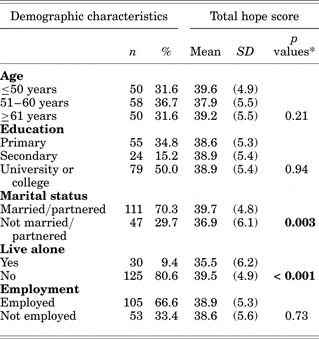
The mean age of the patients was 55.3 years (SD = 9.4), with a range from 25 to 77 years. As shown in Table 1, 37% of the sample was between 51 and 60 years. Half of the sample had university or college education, 70% were married/partnered, 81% lived with someone, and 67% were employed.
Demographic characteristics compared with the total HHI score (n= 160)

*The boldface values are significant at the .05 level.
Clinical and Treatment Characteristics
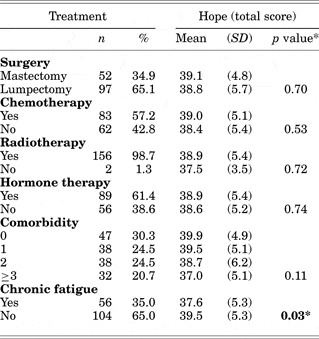
Of the 160 patients included in this study, 155 responded to the SCQ. Approximately one third of patients (30.3%) had no comorbidities. The mean number of comorbidities was 1.5 (SD = 1.5) with a range of 0–8. Half of the patients had one or two comorbidities (24.5% each), and 32 patients had three or more (20.7%). The most common comorbidities were back pain (n = 66), osteoarthritis (n = 33), headache (n = 29), high blood pressure (n = 29), and depression (n = 26). Anemia or other blood diseases were reported by four patients.
The treatment characteristics of patients are summarized in Table 2. All had had surgery, mainly lumpectomy (65.1%), nearly all received radiotherapy (98.7%), and ~ 50% of the patients had received chemotherapy (57.2%), whereas 61.4% had received hormone therapy. At the time of filling in the questionnaires (baseline) patients had undergone surgery, completed chemotherapy, were about to receive the last of 25 daily radiation therapy treatments, and were in the first year of 5 years of hormone therapy.
Treatment characteristics, comorbidity and chronic fatigue compared with Total Hope Score (HHI) (n=160)

*The boldface values are significant at the 0.05 level.
Level of Hope
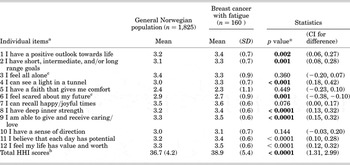
As outlined in Table 3, the mean total hope score measured by HHI was 38.9 (SD = 5.4). Mean scores for individual items on the HHI ranged from 2.3 (SD = 1.1) on the item “I have a faith that gives me comfort” to 3.6 (SD = 0.6) on the item “I can recall happy/joyful times.”
Individual item and total scores for the Herth Hope Index (HHI) in cancer outpatients with fatigue compared to the general Norwegian population

aScores can range from 1 (strongly disagree) to 4 (strongly agree) with higher scores indicating higher levels of hope.
bScores are reversed coded.
cScores can range from 12 to 48 with higher scores indicating higher levels of hope.
*The boldface values are significant at the 0.05 level.
The differences between the HHI scores for outpatients with fatigue and the general Norwegian population are also listed in Table 3. Cancer outpatients with fatigue had significantly higher scores than the general Norwegian population in 6 of the 12 individual HHI items. However, cancer outpatients reported significantly lower scores on the item “I feel scared about my future” than did the general population.
Fatigue Scores
The mean fatigue score measured by the NRS as a screening into the study was 6.1 (SD = 1.7), range 3–10. Nearly half (47%) had a score of ≥7. Mean fatigue scores measured by FQ were for PF 13.7 (SD = 3.2), range 4-21; MF 6.1 (SD = 2.1), range 2–12; and TF 19.8 (SD = 4.6), range 6–33. As shown in Table 2, 35% of the sample reported CF.
Relationships between Hope and Fatigue
Total HHI score was significantly negatively correlated with TF (r = −0.18, p < 0.05); the more fatigued the patients were, the lower their hope score. Total HHI score was also negatively correlated with MF (r = −0.22, p < 0.005) and CF (r = −0.18, p < 0.05). However, no significant correlations were found between total HHI score and PF score (r =−0.12, p = 0.15).
The Effect of Demographic and Clinical Characteristics and Fatigue on Hope
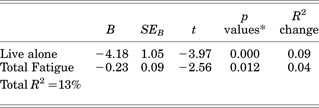
The only demographic variables that were significantly correlated with total HHI score were marital status and living status (Table 1). No significant correlations were found between total HHI score and any of the treatment or comorbidity characteristics (Table 2). The variables that were significantly correlated with total HHI score in fatigued breast cancer patients are shown in Table 4. When entering both marital status and living alone into the model, marital status was removed and living alone explained 9% of the variance of hope. TF and living alone explained 13% of the variance of hope.
Regression analysis with Hope Global Score as the dependent variable with stepwise entry of independent variables (n = 152)
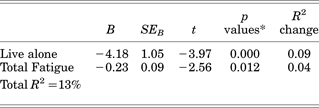
*Values are significant at the 0.05 level.
DISCUSSION
The mean total HHI score was 38.9 (SD = 5.4) in the present study, which is relatively high compared with other studies worldwide. The level of hope using HHI has been reported to vary from 30.8 (Hsu et al., Reference Hsu, Lu and Tsou2003) to 40.3 (Ebright & Lyon, Reference Ebright and Lyon2002). However, our score is similar to those in other studies from Scandinavia. Results from palliative care patients in Sweden showed a mean total HHI score of 39.6 (SD = 5.7) (Benzein & Berg, Reference Benzein and Berg2005), and a study from Norway investigating hope in cancer patients with pain showed a mean total HHI score of 38.0 (SD = 4.3) (Utne et al., Reference Utne, Miaskowski and Bjordal2008). Another Norwegian study examined hope in patients with heart failure and obtained a mean total HHI score of 37.7 (SD = 5.3) (Rustoen et al., Reference Rustoen, Howie and Eidsmo2005).
Some of the literature suggests that the concept of hope is culture specific (Hsu et al., Reference Hsu, Lu and Tsou2003; Lin et al., Reference Lin, Lai and Ward2003a; Rustoen et al., Reference Rustoen, Wahl and Hanestad2003; Utne et al., Reference Utne, Miaskowski and Bjordal2008). When comparing results from the present study and a Korean study with women with breast cancer, the mean total HHI score measured in the Korean study was 35.7 (SD = 4.45) (Lee, Reference Lee2001) compared with 38.9 in the present study. The effect size was 0.31. Field (Reference Field2005) explained an effect size of 0.3 as a medium difference. Whether this effect size is large enough to explain a cultural difference is questionable. The HHI was developed in the United States, and used in other parts of the world after being translated into different languages. More research is needed to explore possible culturally-specific issues related to hope and its measurement.
The breast cancer patients in the present study reported a significantly higher total HHI score than the general Norwegian population, and they also reported significantly higher hope scores than the general Norwegian population in 6 of the 12 individual items (Table 3). The mean total HHI score was higher by 2.2 in the breast cancer group (38.9 vs. 36.7). These findings are consistent with previous studies of patients with heart failure and cancer. Patients with heart failure reported significantly higher total HHI score (37.7) than the general Norwegian population (Rustoen et al., Reference Rustoen, Howie and Eidsmo2005). A recent study (Utne et al., Reference Utne, Miaskowski and Bjordal2008) comparing hope in cancer patients in pain with the general Norwegian population also showed a significantly higher mean total HHI score for the cancer patients (38.0 vs. 36.7). In fact, the total HHI score for the fatigued breast cancer patients was slightly higher (38.9) than for either heart failure patients or cancer patients in pain. This may reflect patients' adaptation to a life-threatening chronic disease. Although having a serious or chronic illness can undermine hope, the changes that can occur in patients' lives, with a redefining of priorities, may result in higher levels of hope and an increased awareness of hope despite negative circumstances. The higher level of hope may also reflect a response shift in patients' evaluation of hope, which means a change in the meaning of one's self-evaluation as a result of changes in values or internal standards (Schwartz & Sprangers, Reference Schwartz and Sprangers1999). Response shift is used to explain higher levels of quality of life reported by patients even with the occurrence of disease progression. The concept of a response shift in hope was described initially by Rustoen et al. (Reference Rustoen, Howie and Eidsmo2005) in patients with heart failure.
When comparing the breast cancer patients' ratings of the individual items on the HHI to those of the general Norwegian population, the largest difference was on the item “I can see a light in the tunnel” (Table 3). The fatigued breast cancer patients had higher scores than the general Norwegian population on this item, although they felt more “scared about the future.” This was also reported by cancer patients in pain (Utne et al., Reference Utne, Miaskowski and Bjordal2008) and might be an expression of the cancer patients' experiences of being cancer survivors. The fear of the disease reappearing is described as one of the biggest fears when going back to hospital for medical follow-up visits (Brooks et al., Reference Brooks, Gordon and Keller2002; Osse et al., Reference Osse, Vernooij Dassen and Schade2005).
On the other six HHI items where differences were found, the fatigued breast cancer patients scored higher than the general Norwegian population. “Having a deep inner strength” was the only one of these six items that was reported as also being significantly higher in cancer patients in pain (Utne et al., Reference Utne, Miaskowski and Bjordal2008). “I have a faith that gives me comfort” was significantly higher both in cancer patients in pain and in the general Norwegian population, compared with fatigued breast cancer patients. The breast cancer group was a homogeneous group (stage I or II), whereas the cancer patient group in pain was a group with different cancer diagnoses and prognoses. Therefore, the higher total HHI score in the fatigued breast cancer group can be related to the fact that, for this patient group, having a relatively good prognosis counted for more than having a faith. However, the finding that the hope score was higher in breast cancer patients than in the general Norwegian population can also be explained by the fact that the cancer group was a homogenous group (breast cancer stage I or II) with relatively good prognoses, and that they just had finished radiation therapy.
The study reveals that fatigue is a great problem for those women who experience it, as they have a mean fatigue score of 6.1, with 35% reporting CF. This is well known from the literature, as fatigue has been identified as the most problematic side effect in women with breast cancer receiving adjuvant chemotherapy or radiation therapy (Irvine et al., Reference Irvine, Vincent and Graydon1994; Jacobsen et al., Reference Jacobsen, Hann and Azzarello1999; Longman et al., Reference Longman, Braden and Mishel1999; Hickok et al., Reference Hickok, Roscoe and Morrow2005).
Number of comorbidities was not related to hope in the present study. This might be caused by the fact that patients reported chronic conditions such as back pain, osteoarthritis, and headache most frequently. They might have lived with these conditions for a long time. The patients who reported being depressed had lower hope scores than those who were not depressed (p < 0.001). Hopelessness is widely seen as the opposite of hope (Benzein & Berg, Reference Benzein and Berg2005), and in psychiatric contexts hopelessness is associated with depression and the desire for hastened death (Breitbart et al., Reference Breitbart, Rosenfeld and Pessin2000).
Studies examining the relationship between hope and fatigue in cancer patients are limited. Previous research has shown a correlation between hope and fatigue among patients (Herth, Reference Herth1992), but another study did not find a significant correlation in patients but rather in their caregivers (Benzein & Berg, Reference Benzein and Berg2005). The present study found significant negative correlations between hope and TF, MF, and CF, but not between hope and PF. As TF on FQ is the sum of MF and PF, it is likely that MF is the factor that adversely affects hope. Patients experiencing difficulties in concentrating, experiencing slips of the tongue, having problems in finding the right words, and having problems with their memory are likely to experience lower levels of hope. Those who reported CF also had lower total HHI scores than other patients. This can be explained by the fact that, by definition, CF has a duration of ≥6 months, and long-lasting fatigue is more tiring than fatigue that lasts a relatively short period of time. It is interesting that having PF was not related to hope in women with breast cancer. An explanation could be that healthcare providers are more likely to explain to patients the physical symptoms of fatigue, such as tiredness, sleepiness, drowsiness, and lack of energy, than the mental symptoms. Patients may be expecting the physical symptoms, and because they might be more familiar they could be less frightening than the more unknown cognitive symptoms. Another speculation is that the cognitive symptoms are more likely to affect cancer patients' concerns about the future. A study investigating problems that cancer patients experienced and their unmet needs (Osse et al., Reference Osse, Vernooij Dassen and Schade2005) concluded that one of the most prevalent problems was coping with the unpredictability of the future.
A Korean study (Lee, Reference Lee2001) used the HHI for measuring hope and the Piper Fatigue Scale for measuring fatigue looked at fatigue and hope in relationship to psychosocial adjustment in women with breast cancer. They did not find any significant interaction between fatigue and hope in accounting for the variance in psychosocial adjustment. In the present study, the correlations between hope and TF were weak even when they were significantly related. Furthermore, fatigue explained only a little of the variance in hope (Table 4). More research is needed to explore further the relationship between hope and fatigue.
In looking at the relationships between hope and demographic, and clinical characteristics in fatigued breast cancer patients, significant correlations were found only between total HHI score and the demographic characteristics of marital status and living alone. Patients not living alone showed more hope than patients living alone. Relationships with family and friends are often emphasized in relation to hope (Rustoen et al., Reference Rustoen, Wiklund and Hanestad1998). In a descriptive study, Raleigh (Reference Raleigh1992) showed that relationships with family and friends are two of the most important sources of hope in people with cancer. People close to the patient can provide valuable support, and it is often stressed that hope is strengthened by the knowledge that others will help if necessary (Rustoen et al., Reference Rustoen, Wiklund and Hanestad1998). The fact that hope was significantly related neither to treatment nor to comorbidity characteristics is also shown in other studies (Sanatani et al., Reference Sanatani, Schreier and Stitt2008; Utne et al., Reference Utne, Miaskowski and Bjordal2008).
The limitations of this study must be noted. First, the response rate was only 60.2% and the sample was only outpatient women with breast cancer stage I or II. Therefore, the findings may not be generalizable to all cancer patients with fatigue. Second, the patients in this study were fairly healthy, although they had a fatigue score of 6.1, which can influence their total HHI score. Scores might be different for patients with breast cancer in more advanced stages. Further studies, therefore, need to include patients with breast cancer at all stages, as well as additional fatigue characteristics and other psychosocial variables that may mediate or moderate the relationships between hope and fatigue.
CONCLUSIONS
The Norwegian fatigued breast cancer patients reported significantly higher total HHI scores than did the general Norwegian population. The HHI scores for the fatigued breast cancer patients were fairly similar to those from other Scandinavian studies; however, the hope score for this patient group was somewhat higher than the results of a Korean study. The current study is one of the first studies examining the relationship between hope and fatigue in breast cancer patients. Total HHI score was moderately negatively correlated with TF and MF, but not with PF. Except for living status, there was no significant correlation between demographical and clinical characteristics and hope. Patients living with someone had significantly higher total HHI scores. As hope is shown to be of importance for cancer patients, more research should be done to further examine the relationship between hope and fatigue in women with breast cancer. Given the high level of fatigue in women with breast cancer, further research is needed, with a focus on psychosocial matters and coping, possibly to strengthen these women's abilities to meet challenges in the future.
ACKNOWLEDGMENT
The research was funded by Oslo University College, Norway, and also supported by the Norwegian Cancer Society. The authors express their deep appreciation to the patients and staff at the Norwegian Radium Hospital, and give special thanks go to the nurses at the outpatient breast cancer clinic and the radiation therapy clinic.