The use of economic sanctions by the United States to compel countries to alter their behavior has increased in recent years. At the same time, U.S. foreign direct investment (FDI) has expanded, with U.S. multinational corporations (MNCs) representing the largest share of global FDI. Despite the growth of U.S. FDI and the U.S. government's imposition of sanctions, no empirical work has considered the relationship between sanctions and U.S. investor decisions. How do U.S. MNCs react to the use of U.S. sanctions and does U.S. FDI make sanctions more or less effective? In this article we analyze the impact of U.S. sanctions on investment decisions made by U.S. MNCs.
Building on investors' risk calculations that are critical to the FDI literature,Footnote 1 we propose several reasons why risk linked to economic sanctions influences FDI flows. We hypothesize that U.S firms significantly draw down their investment in targeted countries prior to the imposition of sanctions as risk levels are most heightened. However, after sanctions have been in place long enough for investors to understand their specific restrictions, uncertainty surrounding the amount of risk decreases and U.S. FDI is expected to return to levels near the pre-sanction period. We also hypothesize that the importance of sanctions is most pronounced when the sanctions carry high costs on the target country or when international organizations (IOs) back the imposition of U.S. sanctions against the targeted country, suggesting that the potency of the sanctions matters for investors. Lastly, we hypothesize that sanctions against nondemocratic countries and sanctions in pursuit of major policy goals are likely to bring about greater levels of pre-sanctions disinvestment.
Using panel data for 171 countries from 1965 to 2000, we generally find strong evidence to support our hypotheses. Consistent with FDI research on risk, we note that as the potential for imposing sanctions grows, U.S. investors are expected to disinvest because the risks associated with sanctions outweigh the benefits. Additionally, the U.S. government can remove incentives for investing in specific countries and impose trade restrictions that are critical for outsourcing, which diminish U.S. MNC interest. The impending sanctions also create an unpredictable environment and U.S. investors thus act preemptively to reduce their potential losses. However, once the sanctions are in place, investors are inclined to return as lowered costs stemming from “fire sales” linked to economic crisis and host country incentives to investors may increase profit opportunities. Investors also have greater certainty of the economic situation after the sanctions are in effect. We also find strong support for our hypotheses that high-cost sanctions or IO support reduce U.S. investor interest. We find backing, to a lesser extent, on the hypotheses that regime type and sanctions in pursuit of major policy goals bring about pre-sanctions disinvestment.
In the first section, we discuss FDI determinants and develop hypotheses on the effect of sanctions on FDI. The research design is shown in the second section. We present the results and their explanation in the third and fourth sections respectively. The final section concludes.
The Effect of Sanctions on U.S. FDI Inflows
FDI, defined as private capital flows that provide a parent firm with at least 10 percent control over an enterprise outside the home country, has greatly increased since the 1980s.Footnote 2 The growth in FDI has led to studies on FDI determinants that are divided into three broad categories: (1) macroeconomic conditions and economic reforms; (2) political factors; and (3) security considerations. Some research indicates that macroeconomic conditions such as rising per capita gross domestic product (GDP) and high domestic growth rates suggest fairly better off domestic consumers, which is attractive for firms catering to local markets. Economic reforms including capital and trade reform also may raise investor interest. Lowered capital controls are presumed to increase investor interest as firms prefer the flexibility to move assets between countries to reduce costs. Similarly, trade reform is critical for firms interested in outsourcing goods in host countries for export or to unbundle goods into multiple stages of production.Footnote 3
Other political economy research suggests that political factors related to investor risk calculations are critical to understanding FDI determinants.Footnote 4 Within the risk discussion, there is a sizeable debate about the importance of regime type for catalyzing FDI. Some authors posit that authoritarian regimes reduce investor risk as they are less subject to electoral concerns and have the ability to repress protest.Footnote 5 Others contend the opposite, claiming that long-standing democracies hold credibility advantages that lower political risks.Footnote 6 Still others argue that regime type is less important than whether host countries provide a stable political environment that safeguards property rights.Footnote 7
Lastly, some studies suggest that security concerns influence investor interest. Tied in to the political risk discussion, the expectation is that investors prefer areas with low levels of conflict that creates a stable political climate. Countries engaged in civil wars or interstate conflicts are likely to threaten commercial conditions in the host country, making it challenging for the MNC to succeed.Footnote 8
Beyond issues of conflict and war, security issues such as sanctions also may affect FDI inflows. Although much research has investigated the effects of sanctions on trade,Footnote 9 surprisingly no empirical studies test the effects of sanctions on capital flows. Based on previous work studying the effects of sanctions on trade and of military conflict on FDI, it might be expected that when the United States imposes sanctions against a country, U.S. FDI should decline in the targeted country because of increased investor risk. As others have found relating to trade, investors will take into consideration the political relationship between the home and host country's governments.Footnote 10 We ask under what circumstances U.S. FDI in the target country is expected to decline and develop five hypotheses tied to the discussion.Footnote 11
Before proceeding with the hypotheses, we assume that investors have more mobility than previously suggested in the literature. Earlier research suggested that FDI suffered from an “obsolescing bargain,” where once investors had sunk capital into projects, their lack of mobility shifted the bargaining advantages to the host country.Footnote 12 Although the obsolescing bargain is likely true for extracting industries and some manufacturing that requires heavy equipment, most firms are mobile. The tremendous growth of outsourcing where the same MNC may have operations in several countries suggests greater firm flexibility. In addition, work in the race-to-the-bottom literature, whereby owners of capital are predicted to move if their demands are not met by the host country,Footnote 13 indicates the relative mobility of most MNCs.Footnote 14
We propose that impending sanctions spark risk that leads U.S. MNCs to disinvest from targeted countries. In particular, we expect that the risk to investors is most intense just prior to imposing sanctions because of uncertainty costs. Foreign investors often rely on risk perceptions that are drawn from their own experiences in a specific host country when deciding whether or not to enhance their capital stakes.Footnote 15 The presumption is that if MNCs are profiting in a host country, firms will use that experience (and information) to determine future investments. However, the dearth of information about the security of the investment created by impending sanctions is likely to throw a wrench into investors' political calculations. Because these are U.S.-based MNCs, they are likely to be well informed regarding the full spectrum of potential restrictions that could be attached to future sanctions imposed by the U.S. government. However, not being certain of the breadth of restrictions that will be imposed, investors will be disadvantaged in their efforts to estimate the true level of risk associated with investment in the foreign country. This increased uncertainty and risk commonly will send investors packing or, at a minimum, reduce their interest in expanding operations in targeted countries.
Additionally, and related to uncertainty issues, impending sanctions pose high risks in terms of the potential denial of access of goods from the sanctioned country to consumer markets in the sanctioning country and its allies, elimination of low-cost capital from the targeted nation if an economic crisis builds, as well as the reduction of outsourcing opportunities and re-export to the home country as trade barriers are imposed. Sanctions also may bring future economic decline in the targeted economy making it less attractive for investment purposes.Footnote 16 Impending sanctions also could heighten investment risk because of the added probability that military actions against the target may follow, again producing increased investor uncertainty.Footnote 17
Impending sanctions also likely lead to the elimination of incentives from the U.S. government to U.S. MNCs. There are several incentives that the U.S. government uses to support U.S. MNCs but two of the most important are the Export-Import Bank and the Overseas Private Investment Corporation (OPIC), a U.S. government agency. Impending sanctions are likely to motivate the United States to cancel new loans from the Export-Import Bank, an institution which offers loans for borrowers to purchase U.S. MNC goods operating in the borrower's country. Sanctions also will likely encourage OPIC to shut off risk insurance to U.S. MNCs, increasing the costs if firms are expropriated. Until recently, only OPIC offered such insurance. Impending sanctions are thus expected to reduce investor confidence.
Uncertainty about the risky business environment, incentive losses from the United States, and economic decline posed by impending sanctions may cause investors to reduce their investment stakes. However, once sanctions are in place, lowered costs as a result of greater information about investment prospects and higher benefits that potentially accrue to investors may lead to reinvestment. First, the uncertainty surrounding the impending sanctions environment is replaced by a clearer business milieu once sanctions are in effect. Indeed, over time, sanctions provide investors with a more predictable investment climate that signal possible business opportunities. Risky investments are not bad investments so long as the risk is properly understood and costs are appropriately discounted.
Second, targeted nations under sanctions are likely to provide economic goodies to attract FDI.Footnote 18 Complementing previous work that showed that authoritarian governments are more likely to offer inducements such as tax easements or access to domestic capital with low interest rates to attract FDI because they are seen as less stable, sanctioned countries also may offer incentives.Footnote 19 Third, and complementing host country incentives, economic sanctions may result in “fire sales,” where the host country lowers the cost of doing business. Similar to work that suggests that local currency depreciation or international price pressure lead to a fire sale of transferable assets to foreign firms,Footnote 20 sanctions also force “rogue” nations to discount assets to lure in prospective investors.
Based on the previous discussion, we propose the following hypothesis.
H1: U.S. FDI is likely to decrease prior to the imposition of sanctions and increase following the implementation of sanctions.
Building on the sanctions hypothesis, there are differences in the attributes of sanctions. For example, some sanctions carry higher costs such as completely eliminating economic transactions between the sanctioning and target country. Alternatively, others carry lower costs that affect only a few products of the targeted country. Closely linked to costs is whether international organizations (IOs) back punishment against the targeted country. IOs can help to reinforce the legitimacy of sanctions, as well as increase the size and coordination of the sender coalition,Footnote 21 raising the economic costs to the target country. IOs also reveal information that helps investors assess the probability that sanctions will be imposed and gauge the potential costs to the target economy.Footnote 22 Sanctions that carry higher costs along with support from IOs are expected to enhance investment risk in the targeted country, which affects investor decisions.
H2: Decreases in U.S. FDI will be greater prior to U.S. high-cost sanctions than prior to U.S. low-cost sanctions.
H3: Decreases in U.S. FDI will be greater prior to U.S. sanctions when an IO is in the sender group.
Concerns about investment risk also are tied to regime type debates in both the FDI and sanctions literatures. As noted, some FDI scholars argue that democratic institutions place checks on the executive that lower investment risk,Footnote 23 while others find that authoritarian regimes are more attractive to investors,Footnote 24 and still others contend that regime type makes little difference.Footnote 25 The sanctions literature also documents the importance of regime type. It is argued that after a sanctions episode, trust in democratic countries for the institutions in other democratic countries will lead them to return to trade sooner than when the target is an autocracy.Footnote 26 Additionally, following democratic peace arguments,Footnote 27 if military conflict ensued after the imposition of sanctions, the United States is expected to have less severe disputes with other democracies resulting in less risk for U.S. firms. We thus propose the following hypothesis:
H4: When sanctions are imposed against democratic targets, U.S. FDI will decrease less than when they are imposed against nondemocracies.
Lastly, U.S. investor risk may be tied to the U.S. government's commitment to penalize U.S. MNCs for violating sanctions.Footnote 28 In U.S. trade policy, “When the hosts' policies seemed to run counter to American national security, U.S. policy and politics moved toward restrictions.”Footnote 29 Given that the U.S. government has more at stake to succeed in coercion attempts when they involve a major rather than a minor policy goal, we expect that U.S. FDI falls when the sanctions are imposed to achieve a major policy goal.Footnote 30
H5: When sanctions are imposed in order to achieve a major policy goal, U.S. FDI will decrease more than when sanctions are imposed in the pursuit of a minor policy goal.
Research Design and Results
We gather data for 171 countries on an annual basis from 1965 to 2000 to determine the effects of sanctions on U.S. investment. To measure U.S. FDI, we use data from the Bureau of Economic Analysis (BEA).Footnote 31 The BEA measures the FDI stocks of U.S. residents in long-term investments in millions of U.S. dollars. We divide U.S. FDI by GDP of the recipient to control for the size of the domestic market, which produces the dependent variable usfdi/gdp.
Independent Variables
The main independent variable in our study involves the imposition of economic sanctions (H1). A dichotomous variable, sanctions, is coded 1 in the first year of U.S.-imposed sanctions and 0 otherwise. The data include 99 start years of sanctions initiated in part or whole by the United States.Footnote 32 Several of our hypotheses also relate to specific characteristics of sanctions. First, one indicator of sanction severity and potential investor risk is the economic cost imposed on the target state (H2). We measure economic cost by creating the dummy variables, high-cost sanc and low-cost sanc. high-cost sanc is coded 1 when sanctions exceed the average cost of sanctions and 0 when they are below it. low-cost sanc reverses this coding. Similarly, information regarding impending sanctions is clearer and the costs higher when IOs back sanctions (H3). We include a dummy variable for whether an IO is involved in the sender coalition.Footnote 33io in sender coalition takes the value of 1 when an IO is present and 0 otherwise. no io in sender coalition reverses this coding.
H4 predicts that sanctions initiated against a nondemocratic state may involve greater risk for U.S. investors. We code regime type using the polity2 variable contained within the Polity IV data that ranges from 10 to −10 (10 is the most democratic).Footnote 34 We create dummy variables for target democracy and target nondemocracy, which follow convention by coding states with a polity2 score at 6 or higher as democracies and less than 6 as nondemocracies.
We are also interested in whether sanctions connect to issues of major or minor U.S. goal. The variable major policy goal is a five-category policy goal variable,Footnote 35 which is dichotomized so that major policy goal is coded 1 when the issue involves regime change, disruption of a military adventure or military impairment, or other major policy changes, and 0 otherwise. minor policy goal reverses this coding.Footnote 36
Control Variables
For security issues, we control for conflict produced by militarized interstate disputes (MIDs) or civil wars that are predicted to create an unstable environment that reduces FDI.Footnote 37 The use of force mids counts the number of MIDs in a country that involved the use of force. We generated the data using EUGene version 3.2.Footnote 38civil wars count the number of ongoing civil wars in a country. Intrastate conflict data come from Expanded War Data, version 1.52.Footnote 39
For macroeconomic controls, we use the log of per capita GDP, lngdppc (a measure of development), economic growth, and previous experience with FDI (lag usfdi/gdp), which are variables commonly used in the FDI literature.Footnote 40 All of the statistical models presented here control for level of development and additional models available in an appendix estimate the main model on only developing countries.Footnote 41 Economic reforms such as trade openness and capital controls are also expected to affect FDI. We use (OPEN C − (exports + imports)/GDP) to measure trade opennessFootnote 42 and employ a 4-point capital openness measure, where higher scores indicate fewer controls.Footnote 43
Factors such as democratization and political institutions may affect U.S. FDI based on risk concerns. We use the polity2 variable to assess regime type affects. This democracy indicator enters all models as a control variable. However, when we test the effect of sanctions against a democracy and the effect of sanctions against a nondemocracy, we drop this control. We use agehinst, a six-fold classification for age in years of the current regime, to assess political stability.Footnote 44
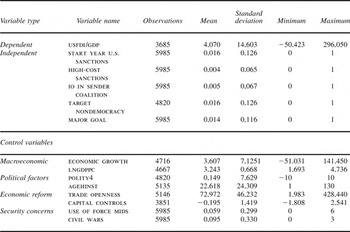
Summary statistics for the variables are presented in Table 1.
Summary statistics

Results
We employ a general estimating equation (GEE) to analyze the effect of the onset of sanctions on U.S. FDI.Footnote 45 A GEE model permits us to specify a variety of within-group correlation structures. Scholars note that population-averaged models, such as GEE, are “valuable for making comparisons across groups or subpopulations.”Footnote 46 Since the focus of this research is on the response of firms to sanctions (or no sanctions), a population averaged approach is an appropriate statistical method.Footnote 47
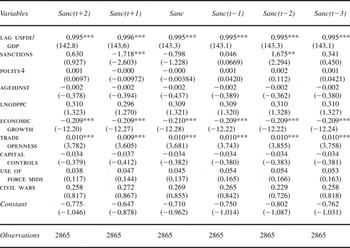
Table 2 shows the results of a GEE model with an AR(1) process and a lagged endogenous variable on the right-hand side of the equation. The results indicate that one year prior to U.S. imposition of sanctions, U.S. FDI significantly lowered in targeted states compared to nontargeted states. The year of the occurrence of sanctions, U.S. FDI continued to be lower in sanctioned states, although not at significant levels. During the first year after sanctions are imposed, there is no significant difference between sanctioned and nonsanctioned states. In the second year, there is a large rebound effect and sanctioned countries experience significantly greater levels of U.S. FDI than nonsanctioned states. Note that we are careful to include only cases where the sanctions lasted at least two years so that this increase cannot be partially attributed to investment returning after sanctions ended. By the third year, no effect is seen. Although not shown to conserve space, further years of sanctions beyond the third year are also insignificant. To show that our results are not dependent on a specific U.S. FDI measure, we follow scholarly recommendations for addressing autocorrelation concerns,Footnote 48 and first-differenced the dependent variable, subtracting the last year's level of U.S. FDI from the previous years as a percent of GDP. The main results do not differ from those presented in Table 2, but to conserve space we do not display them here.Footnote 49
The effect of sanctions involving the United States on U.S. FDI flows

Notes: Values of z-statistics are given in parentheses.
*** p < .01;
** p < .05;
* p < .1.
In Table 2, economic growth and trade openness are the strongest control variables in the model. As expected, trade openness has a strong positive effect on U.S. FDI; economic growth has a strong negative effect on U.S. FDI. The rest of the control variables are insignificant. These variables are not the focus of this study and are all included contemporaneous with current FDI. Therefore they should not be taken as confirming or disconfirming previous studies that focused on the relationship of these variables to FDI.
The results presented in Table 2 are robust to different estimation techniques and model specification. However, the models do not account for potential selection issues and concerns with reciprocal causation between the occurrence of sanctions and levels of FDI. Previous empirical work on economic sanctions has featured the use of a two-stage selection model to account for the possibility that countries are not randomly selected into sanctions.Footnote 50 The use of a Heckman model is appropriate in these previous applications because the outcome variable of interest, typically sanctions success, is only observed conditional on the nonrandom selection into sanctions. Unlike in these previous studies, the full range of our dependent variable is observed and not truncated, censored, or selectively observed based on the value of a third variable. Therefore, a selection equation is not the most appropriate modeling technique.Footnote 51
A more relevant concern for this study is potential simultaneity bias. For example, the United States may be reluctant to impose sanctions on a country where U.S. FDI is high because U.S. investors would incur costs.Footnote 52 If U.S. FDI affects the decision to impose sanctions, then single equation estimates of the effect of sanctions on U.S. FDI that ignore simultaneity will produce inconsistent estimates.Footnote 53 Issues of this nature occur frequently in political science and can be addressed using an instrumental variables approach. However, an instrumental variables approach when simultaneity is not present yields estimates that are inefficient. So while we should be cautious to test for simultaneity, we should not estimate simultaneous equations when appropriate diagnostics indicate that it is not a cause for concern.Footnote 54
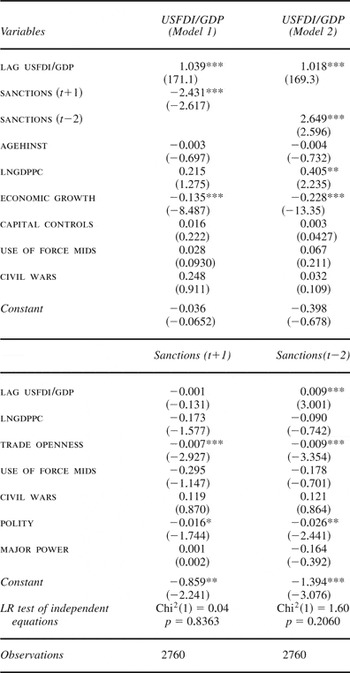
We explore potential simultaneity concerns in Table 3, which shows the results of a two-stage instrumental variable regression.Footnote 55 The first stage of the model instruments the (theoretically) endogenous sanctions variable while the second stage uses the instrumented sanctions variable as a predictor of U.S. FDI in the previous period and two years after the imposition of sanctions.Footnote 56 To produce a theoretically sound set of instruments for sanctions we build off previous work that estimated a model of the onset of sanctions and make several modifications.Footnote 57 First, earlier research tested the effect of a democratic initiator and also included a U.S. dummy.Footnote 58 The analysis here looks only at U.S.-initiated sanctions, so we drop the democratic initiator and U.S. dummy variables. Second, we add the existence of militarized conflict to the model since others have demonstrated that the use of sanctions is highly correlated with the existence of militarized disputes.Footnote 59 Next, we add lagged U.S. FDI and estimate a logit model with robust standard errors and the inclusion of a peace years variable along with three cubic splines to account for autocorrelation.Footnote 60
Instrumental variables regression using a treatment regression model

Notes: Values of z-statistics are given in parentheses. Peace years and three cubic splines were estimated for the sanctions equations, but they are not included in the table to save space.
LR = likelihood ratio.
*** p < .01;
** p < .05;
* p < .1.
The top half of Table 3 shows the effects of the instrumented sanctions variable on U.S. FDI/GDP one year prior to the sanctions (Model 1) and two years after the sanctions (Model 2), and the bottom half shows the corresponding sanctions initiation equations. The results from the likelihood ratio (LR) tests of the independence in Table 3 show p-values of .8363 for Model 1 and .2060 for Model 2. Thus, there is strong evidence that we cannot reject the null hypothesis that the two equations are independent, meaning that simultaneity is not a major concern. Additionally, while we do not directly theorize about the initiation of sanctions, we note that as others have found,Footnote 61 the results from the sanctions initiation equations of Table 3 suggest that the United States is less likely to impose sanctions against fellow democracies or against countries with higher levels of trade openness. The reciprocal effect of U.S. FDI on sanctions is significant in one equation, which leads us to temper our belief in the exogeneity of the equations, although the estimates of the instrumented sanctions variable in the FDI equations are still highly consistent with those found in the single equation models of Table 2, with neither estimate changing in sign or significance. This similarity in estimates between the two models provides additional supporting evidence that endogeneity is not a problem for the estimates of Table 2.Footnote 62 Thus, we have strong evidence that sanctions can be treated as an exogenous regressor and that the estimated effect of U.S. sanctions on U.S. FDI is consistent.
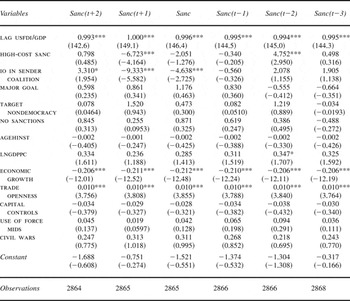
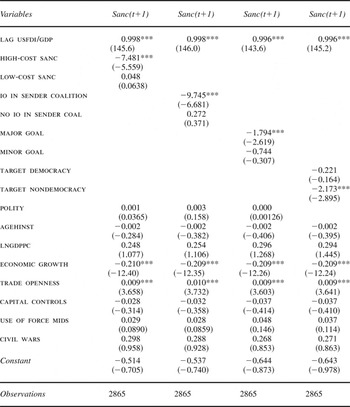
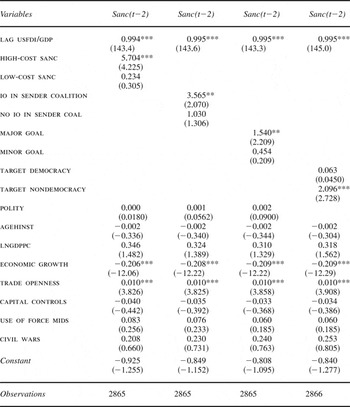
The results presented in Tables 2 and 3 provide compelling empirical evidence that U.S. investors disinvest prior to the imposition of sanctions and this investment returns after the sanctions have been in place for over a year. To gain a greater understanding about why foreign investors have this reaction to sanctions and to test our remaining hypotheses, Table 4 estimates a model with several potentially risk-enhancing characteristics of sanctions. These factors include: the cost of sanctions, whether an IO joined the United States as part of the sanctioning coalition, whether the goal pursued by the United States is major or minor, and whether the sanctions are imposed against a nondemocratic country. Each variable is included as a dummy variable, and the models also include a dummy for no sanctions. Therefore, each dummy variable tests the presence of that factor compared to a sanction that did not include that factor.
Specific characteristics of sanctions involving the United States and how they affect U.S. FDI flows

Notes: Values of z-statistics are given in parentheses.
*** p < .01;
** p < .05;
* p < .1.
Two variables associated with sanctions stand out in Table 4. First, in support of H2, high-cost sanctions magnify the effect of sanctions on FDI. For high-cost sanctions, disinvestment prior to the sanction is significantly greater than for low-cost sanctions. As anticipated in H3, when an IO is present, disinvestment is significantly greater in the year prior to sanctions and continues to be greater into the first year of sanctions. After sanctions are in place, however, only high-cost sanctions experience significant reinvestment when the characteristic is in place. The other two substantively interesting variables in Table 4, sanctions in pursuit of a major goal, and sanctions against a nondemocracy, are insignificant prior to and after the imposition of sanctions.Footnote 63
One potential concern with the results of Table 4 is that by including many related characteristics of sanctions in one model, the results could possibly suffer from problems with collinearity and inflation of the variances of estimates. As a rule of thumb, variance inflation factors (VIF) greater than 10 are cause for concern. The mean VIFs of the models presented in Table 3 are less than 10, providing some confidence that variances are not inflated overall, but several variables, including no sanctions, major goal, and development, tended to produce individual VIFs greater than 10. To combat this potential problem and to also perform a less stringent test of H2 to H5, Tables 5 and 6 present the results of models entering each of the sanction characteristic variables one at a time.Footnote 64 This eliminates possible collinearity problems (no variables in any of these models have VIFs greater than 10) and shows the effect of each of these types of sanctions compared to no sanctions. Tables 2 and 4 identified the year prior to sanctions and the second year of sanctions as critical points for investment. Focusing exclusively on these years, Table 5 shows the results for the year prior to sanctions, and Table 6 shows the results for the second year of sanctions.
Specific characteristics of sanctions involving the United States and how they affect U.S. FDI flows in the year prior to sanctions

Notes: Values of z-statistics are given in parentheses.
*** p < .01;
** p < .05;
* p < .1.
Specific characteristics of sanctions involving the United States and how they affect U.S. FDI flows in the second year after sanctions began

Notes: Values of z-statistics are given in parentheses.
*** p < .01;
** p < .05;
* p < .1.
Table 5 reveals that when compared to years with no sanctions, disinvestment occurs in the year prior to sanctions for high-cost sanctions, sanctions with an IO in the sender coalition, sanctions pursuing a major policy goal, and sanctions against a nondemocratic regime. These findings provide support for H2 to H5. Table 4 also showed that high-cost sanctions and sanctions with an IO in the sender coalition lead to greater disinvestment than low-cost sanctions and sanctions not involving an IO in the sender coalition, respectively. Thus, H2 and H3 receive support from both the more stringent test in Table 4 and the less stringent test in Table 5. H4 and H5, regarding sanctions against nondemocratic countries and in pursuit of major goals, receive mixed support. Compared to no sanctions (Table 5), sanctions against nondemocracies and in pursuit of major goals lead to disinvestment prior to the sanctions. However, we cannot significantly distinguish between sanctions against democracies and nondemocracies or sanctions in pursuit of major and minor policy goals (Table 4). Finally, Table 6 reveals that in each instance (high costs, IO in sender coalition, nondemocratic target, and pursuit of a major policy goal) significant reinvestment occurs in the second year after sanctions are in place.Footnote 65
Based on the results we find strong support for our main hypothesis (H1) on the effect of sanctions on U.S. FDI inflows. As predicted, U.S. investment falls just prior to the imposition of sanctions and returns two years after sanctions are in effect. We also find strong statistical backing for our hypothesis that U.S. FDI is likely to decrease when higher cost sanctions are imposed by the sanctioning country (H2), and for our hypothesis that U.S. FDI is likely to decrease when IOs support the imposition of sanctions against the targeted country although U.S. FDI does not significantly increase two years after occurrence of sanctions (H3). The results provide partial support for the impact of democracy on U.S. FDI (H4) and the importance of sanctions when it involves a major policy goal (H5).
Conclusion
For more than twenty years, U.S. FDI has increased while the U.S. government has frequently used sanctions to support U.S. interests. Despite the growth in U.S. FDI and the U.S. application of sanctions, no empirical work has considered the relationship between sanctions and U.S. FDI. Building on risk analysis from the FDI literature, we find that U.S MNCs disinvest prior to the imposition of sanctions as a response to enhanced risk and uncertainty. The importance of risk is reinforced by the finding that when sanctions carry high costs on the target country or when IOs support the imposition of U.S. sanctions, U.S. FDI is more prone to leave as investment risk intensifies. To a lesser extent, these same effects are seen in conjunction with sanctions pursuing a major foreign policy goal or sanctions imposed against nondemocracies. Once sanctions are in place and uncertainty over the type and extent of sanctions is quieted, in line with a “buy low, sell high” philosophy, investment returns.
More work is needed to investigate the role of sanctions on FDI. In particular, it would be interesting to see if global investors respond similarly to U.S. FDI when the United States imposes sanctions. Indeed, whether global FDI acts like a black knight, rushing in to replace lost U.S. FDI, or follows the same risk cues as U.S. investors is an interesting question with implications for both FDI studies and the ultimate success of sanctions. While there are many interesting questions left for future research, this initial research helps to uncover the importance of U.S. sanctions on U.S. FDI., and provides added insights on investor risk.