Introduction
The organization of phonetic systems in bilingual speakers has been extensively examined by Flege and his colleagues (see Bohn & Munro, Reference Bohn and Munro2007; Flege, Reference Flege and Strange1995, for more information) as well as other researchers (Best, Reference Best and Strange1995; Strange, Reference Strange1995) over the last thirty years. These studies have investigated mainly adult speakers who learn a second language (L2) after they have fully acquired their first language (L1), and focus on how the influence of one language on the other depends on the learner's age of exposure to the L2. Relatively few studies, however, have examined how phonetic categories form and develop in children who learn two languages at a young age, as we undertake in this paper. Before turning particularly to phonetic category formation in bilingual children, we outline the currently dominant model of speech production and review relevant supporting studies on bilingual adults as well as L2 learners.
The Speech Learning Model proposed by Flege (Reference Flege and Strange1995) has subsequently received extensive attention in the study of L2 speech. A basic assumption in Flege's model is that phonetic elements of the L1 and L2 are related to each other at the level of allophones, and the language-specific aspects of speech sounds are formed in long-term representation called “phonetic categories” (Yeni-Komshian, Flege & Liu, Reference Yeni-Komshian, Flege and Liu2000). Two distinct mechanismsFootnote 1 for forming phonetic categories were proposed: assimilation and dissimilation (Flege, Schirru & MacKay, Reference Flege, Schirru and MacKay2003; Yeni-Komshian et al., Reference Yeni-Komshian, Flege and Liu2000). Phonetic category assimilation may occur when a novel sound in the L2 fails to be learned because category formation for the sound is blocked by a similar but non-identical sound in the L1 phonology. Thus, when this happens, a single and merged phonetic category is used to process perceptually linked L1 and L2 sounds. Phonetic category dissimilation, on the other hand, may occur when a new category in the L2 is formed in order to make maximum distinction between the nearest L1 phonetic category and the new category in the L2. The greater the perceived phonetic dissimilarity between an L2 sound and the closest L1 sound, the more likely phonetic differences between the sounds will be discerned.
A number of empirical studies have reported assimilation in this sense in the speech production of L2 learners (e.g., Caramazza, Yeni-Komshian, Zurif & Carbone, Reference Caramazza, Yeni-Komshian, Zurif and Carbone1973; Flege, Reference Flege1987; Flege & Eefting, Reference Flege and Eefting1987; Flege & Port, Reference Flege and Port1981), as well as dissimilation (e.g., Flege et al., Reference Flege, Schirru and MacKay2003; Munro, Reference Munro1993). For example, adult native French speakers tend to produce English voiceless stops with shorter VOT lag than those of native English speakers, who in turn produce French voiceless stops with longer VOT than those of French monolinguals (Flege, Reference Flege1987). Although the French L2 speakers produce VOT values for English voiceless stops greater than for French stops, their English and French VOT values are not sufficiently differentiated, indicating that the English and French stop categories are moving toward merger. Conversely, early Italian–English bilinguals (who seldom use Italian) produce English /e/ with more formant movement than do native English speakers, whereas late bilinguals (who often use Italian) produce the /e/ vowel of English with less formant movement than monolinguals. Flege et al. (Reference Flege, Schirru and MacKay2003) argued that the exaggerated movement on the part of early bilinguals was due to the dissimilation of a phonetic category (English diphthongal /e/ versus Italian monophthongal /e/), whereas the undershot movement on the part of late bilinguals is evidence for a merged phonetic category of /e/ resulting from assimilation.
There is also increasing evidence that early adult bilinguals who learned their two languages at a young age (typically before six to seven years) establish separate phonetic systems for the two languages, unlike late adult bilinguals who learned the L2 after seven to eight years of age when they are approaching the ultimate (adult) stage of learning (Flege, Reference Flege1991; Flege, Munro & MacKay, Reference Flege, Munro and MacKay1995; Kang & Guion, Reference Kang and Guion2006; Mack, Reference Mack1989). In fact, Flege (Reference Flege and Winitz1988; Reference Flege1991) claimed that total separation of the sounds between the L1 and the L2 is possible. Specifically, if children learn the L2 by five or six years of age, they will establish separate phonetic categories for the L1 and the L2. Flege (Reference Flege1991) found, for example, that early Spanish learners of English did not significantly differ in their VOT values from monolingual English speakers, whereas late Spanish learners of English produced the stop /t/ with an intermediate VOT value between the long lag of English and the short lag of Spanish.
In addition, Kang and Guion (Reference Kang and Guion2006) examined VOT and f 0 in early and late Korean–English bilingual adults in comparison to their monolingual counterparts and found results consistent with those of Flege (Reference Flege1991). They also compared both English and Korean stops within bilingual speakers. Kang and Guion found that, while early adult bilinguals produced VOT and vowel-onset f 0 similarly to native speakers for both English and Korean, late adult bilinguals were different from native speakers of both languages. For example, late adult bilinguals produced greater values of VOT for Korean fortis stops as well as longer VOT and higher f 0 for English voiced and voiceless stops as compared to monolingual speakers. Moreover, while early adult bilinguals distinguished all the stop categories, late adult bilinguals manifested only three distinctive categories. They formed English voiceless and Korean aspirated stops as one group, English voiced stops and Korean fortis as another group and the Korean lenis stops as a group by themselves. Kang and Guion concluded that the early bilinguals have two independent stop systems, whereas the late bilinguals have a merged phonetic system.
The questions that naturally arise, then, are these: If early adult bilinguals possess two independent systems, when are these systems established? And what kinds of mechanisms are at play during the developmental process? Although there is a growing number of bilingual children in the US (US Bureau of the Census, 2005), little knowledge about the phonetic development of their linguistic systems is available. Bilingual children are commonly categorized into simultaneous and sequential (Goldstein, Reference Goldstein2004), but the ages at which each group is categorized vary depending on researchers. For example, Padilla and Lindholm (Reference Padilla, Lindholm, Martinez and Mendoza1984) regarded simultaneous bilingual children as those who learn two languages from birth, while McLaughlin (Reference McLaughlin1978) and Hamers and Blanc (Reference Hamers and Blanc2000) considered simultaneous bilingual children as having acquired the L2 before the L1 is established. Based on the Padilla and Lindholm definition, most Korean–English bilingual children from Korean families in the US would be sequential because these children started to be consistently exposed to English only when they were enrolled into English-speaking daycare centers, preschools or kindergartens (unless one of the parents is English-speaking) (Shin, Reference Shin2005). Goldstein (Reference Goldstein2004) raised a concern about defining simultaneous bilinguals by the criterion of acquiring two languages from birth because this leads to considerable heterogeneity, and most bilingual children would be categorized as sequential. That is, if it is necessary to identify when the first language is established in order to determine bilingual status as simultaneous versus sequential, the identification should be based on a solid developmental milestone rather than an arbitrary age.Footnote 2
In this study, we considered as simultaneous bilinguals children who first learned Korean, and then English, before five to six years of age because stops – typically among the earliest developed consonants – are not fully established by four years of age in monolingual Korean children (Kim & Stoel-Gammon, Reference Kim and Stoel-Gammon2009). Specifically, as reported by Lee and Iverson (Reference Lee and Iverson2008), the three Korean stop categories (lenis, fortis, aspirated; see detailed description below) first come to be regularly distinguished by monolingual children at age five. As one of the main goals of this study was to examine the point at which bilingual children establish two independent systems, parallel to those found among early adult bilinguals (who had learned the L2 before six years of age; see Flege, Reference Flege1991; Kang & Guion, Reference Kang and Guion2006; Piske, Flege, MacKay & Meador, Reference Piske, Flege, MacKay and Meador2002), we categorized Korean–English bilingual children who learned both languages before age five to six years as simultaneous in order to contrast them with clearly sequential bilinguals. It is hoped that this classification will aid future studies which examine how sequential bilingual children who learned the L2 after six to seven years of age demonstrate one system, similar to late adult bilinguals.
Several studies have investigated phonetic and phonological development in bilingual infants (Deuchar & Clark, Reference Deuchar and Clark1996; Kehoe, Lleo & Rakow, Reference Kehoe, Lleo and Rakow2004), reporting that infants as young as two years begin to distinguish the voicing systems between their two languages. Still, the systems appear not to be entirely independent, but show interaction effects throughout this period. They also found considerable individual variance, and evidence that some infants appeared to develop two systems while others did not.
Only a few studies of pre-puberty bilingual children have been conducted, however, with a limited number of participating children. Johnson and Wilson (Reference Johnson and Wilson2002) examined the VOT values of two English–Japanese bilingual children (one 4;8, the other 2;10). The younger child did not show a difference between the two languages, but the older child produced longer VOT for English voiceless stops, which are generally heavily aspirated, than for those of Japanese, which are much less aspirated, thus again pointing to the use of two separate systems. Watson (Reference Watson1982) examined stop consonant productions of five-, six-, eight- and ten-year-old French–English bilingual children (five in each age group). By the age of six years, children had developed two sets of distinctions, but the five-year-old children had established only the English VOT values, not the French type of contrast. The author concluded that early bilinguals possess two separate systems, at least after six years of age. In another study, Mack (Reference Mack and Nelde1990) examined a ten-year-old French–English bilingual child. The child produced voiced stops with short-lag VOT values in both French and English. With respect to voiceless stops, the average value for French was 66 ms whereas that of English was 108 ms. The child showed a phonetic contrast between stop categories, but the values for voiceless stops were too long for the norms of either language.
Khattab (Reference Khattab2000) tested three English–Arabic bilingual children (aged five, seven and ten) and found that they had acquired distinct VOT patterns for each of their languages, but that the patterns did not always mirror those of their monolingual counterparts. Specifically, the voicing-lead in Arabic voiced stops was often replaced by the short-lag of the English voiced stop phonemes. With respect to vowels, Baker and Trofimovich (Reference Baker and Trofimovich2005) examined the systems of forty Korean–English bilingual adolescents (ten and seventeen years of age) as well as adults. Using both between- and within-group comparisons, they found that early bilinguals showed bidirectional L1–L2 influence, but retained distinct acoustic realizations of L1 and L2 vowels.
In short, to date, limited studies of phonetic category distinctions in bilingual children are available. Most of these are not conclusive due to methodological limitations, with small numbers of subjects and insufficient statistical analysis to evaluate the strength of assertions about the phonetic systems of bilingual children. Some recent studies of bilingual adults have made both between-group and within-group comparisons in order to obtain a more comprehensive understanding of bilingual phonetic categories (e.g., Baker & Trofimovich, Reference Baker and Trofimovich2005; Guion, Reference Guion2003; Sundara, Polka & Baum, Reference Sundara, Polka and Baum2006), but most investigations of bilingual children make either between- or within-group comparisons, not both. Thus, large-scale studies supported by quantitative evaluation with both between- and within-group comparisons are needed in order to delimit the properties of the phonetic stop systems of bilingual children.
Korean–English bilinguals are of interest in this study because, unlike English, Korean stops show a three-way laryngeal contrast and are distinguished by multiple cues in addition to VOT (see Cho, Jun & Ladefoged, Reference Cho, Jun and Ladefoged2002), thus presenting complexities which may cause difficulty for bilingual children in acquiring them appropriately. In particular, vowel-onset f 0 serves as a supplementary cue to distinguish the three-way contrast in Korean (Cho et al., Reference Cho, Jun and Ladefoged2002). The three Korean stop series are often called “lenis”, “aspirated” and “fortis”; we will refer to the English contrast as “voiced” (even though in phrase-initial position this series is typically voiceless) versus “voiceless” (this series is typically aspirated); cf. Iverson & Salmons (Reference Iverson and Salmons1995), Kager, van der Feest, Fikkert, Kerkhoff & Zamuner (Reference Kager, van der Feest, Fikkert, Kerkhoff, Zamuner, van de Weijer and van der Torre2007). Previous studies reported that the VOT values of Korean lenis and aspirated stops are longer than fortis stops and that vowel-onset f 0 after aspirated and fortis stops is significantly higher than after lenis stops, but is similar between aspirated and fortis stops (e.g., Cho et al., Reference Cho, Jun and Ladefoged2002; Han & Weitzman, Reference Han and Weitzman1970; Hardcastle, Reference Hardcastle1973; Kagaya, Reference Kagaya1974; Silva, Reference Silva2006).
A few studies have been conducted to investigate stop productions of Korean–English bilinguals, both adults and children. In addition to the analysis of Korean–English bilingual adults by Kang and Guion (Reference Kang and Guion2006), Han (Reference Han1998) examined Korean VOT and vowel-onset f 0 in six ten-year-old Korean–English bilingual children compared with monolingual Korean adults and children. While most monolingual Korean children produced similar VOT values for aspirated and lenis Korean stops, three out of the six bilingual children showed longer VOT for aspirated stops. In addition, monolingual Korean children distinguished the three-way stop categories in terms of vowel-onset f 0, whereas bilingual children showed similar f 0 values among the three categories. Han examined only a small number of bilingual children, however, and evaluated only Korean stops, not also English stops. Thus, further investigations should include more bilingual children and compare their stop productions with those of their monolingual English as well as Korean counterparts in order to confirm her findings.
The purpose of the present study, then, is to investigate VOT and vowel-onset f 0 of stop consonants in Korean–English bilingual children at five and ten years of age and to compare these with their monolingual English and Korean counterparts. The study focuses on two questions. First, when do Korean–English bilingual children establish fully independent phonetic systems for each language? Second, what kind of mechanisms (i.e., assimilation vs. dissimilation) do bilingual children employ in their developmental process?
Methods
Participants
A total of ninety children (thirty Korean–English bilingual, thirty monolingual English-speaking, and thirty monolingual Korean-speaking childrenFootnote 3) participated in the study. Within each group, fifteen (seven boys and eight girls) were ten years of age and the other fifteen (seven boys and eight girls) were five years of age. None of the participating children had a history of speech or hearing impairment, based on reports from both teachers and parents. The monolingual English-speaking children were from families in which Midwestern English was spoken with little or no knowledge of languages other than English. The monolingual Korean children lived in Korea and used standard Korean (Seoul dialect) at home and school. They did not know or had little knowledge of languages other than Korean. For example, some monolingual Korean children had learned the names of the letters of the English alphabet (e.g., [bi] for b). Any children who had previously lived in other countries were eliminated from the study.
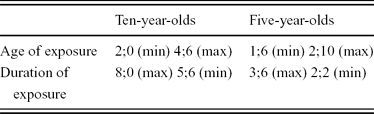
The bilingual children were either born in the United States or had mover to the US at an earlier age: ten-year-olds had arrived at five years of age or earlier, five-year-olds at three years of age or earlier. Based on our definition, all of the bilingual children were “simultaneous bilinguals” in that they had first learned Korean, and then started to learn English before five to six years of age, when they were enrolled in preschool or daycare centers in the United States. Specific information on the age of exposure and the duration of exposure is shown in Table 1. The age of exposure for the ten-year-old children ranged from two years (2;0) to four years and six months (4;6) and for the five-year-old children from 1;6 to 2;10. The children had exposure to both English and Korean for at least five years in the case of the ten-year-olds (ranging from 5;6 to 8;0), and two years in the case of the five-year-olds (ranging from 2;2 to 3;6). All children used mainly Korean at home with their parents and/or grandparents, but used English with their siblings and English-speaking peers. All of the Korean–English bilingual children attended Korean language school (which took place once a week for 3–5 hours) in large Midwestern cities.
Age and duration of exposure of bilingual children.

Stimuli
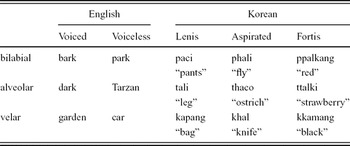
To elicit the stop consonants, nine picture cards for Korean and six picture cards for English, all without written letters, were shown in a random order (see Table 2). These particular words were selected because their initial stops are in the same vocalic environment, viz., followed by /a/, as Smith (Reference Smith1978) reported that stop VOT varies according to following vowel. Based on our pilot data, most bilingual and monolingual children as young as five years of age would likely know these words.
Target words to elicit English and Korean stops.

Recordings
The monolingual data were collected at schools or kindergartens in a quiet room. The bilingual data were collected at Korean language schools, churches or participants’ homes. The same procedures were employed for all children. A digital flash recorder (Marantz Model PMD670) was connected to a stand-mounted omni-directional dynamic microphone (Electro-Voice 635A/B) positioned on a table. Speech was recorded at a sampling rate of 22 kHz. The children sat at the table and spoke the test items. The distance between the subject and microphone was around 20 cm.
Data collection and selection procedure
The primary investigator, a fluent Korean–English bilingual speaker, collected all Korean data from monolingual Korean children. The bilingual investigator also elicited both Korean and English words from the bilingual children. When English words were being elicited, all conversation with the experimenter was in English only, and when Korean words were elicited, all conversation was in Korean. The order of language presentation was balanced across subjects. Children were asked to say each word three times in a row in isolation. Most bilingual children knew all target words. However, when a child did not know a target word, the experimenter used a delayed imitation technique, in that the target word was embedded in a carrier sentence and then the child was asked to name the object portrayed in the picture. The best two (usually the first and second) out of the three productions of each word for each subject were chosen for analysis because children did not always produce words with the same pitch. For example, some children in the younger group tended to produce the third repetition with either rising or falling pitch. Choosing two tokens which had relatively consistent pitch can provide more reliable data instead of averaging all three word productions.
Two additional words eliciting the vowel /i/ were collected from words like English eat and Korean i “tooth” in order to find out whether f 0, independent of stop articulations, was similar among three groups. Instead of measuring f 0 in the middle of /a/ in target words, a separate f 0 value was obtained in order to avoid any influence from preceding stops on the following vowels in Korean (Ahn, Reference Ahn1999). Thus, f 0 was also measured in the English word eat in order to make values comparable, because previous studies have reported that f 0 values vary depending on vowel height (Smith, Reference Smith1978). In order to elicit the vowel /i/, an additional picture card without written letters for either Korean or English was used while words starting with stop consonants were being collected. The pictures were presented in random order. The /i/ vowel tokens were elicited from both English and Korean words for bilingual children and the values of /i/ in both languages were averaged per child.
Acoustic analysis
Computerized Speech Lab (CSL, model 4300, Kay Elemetrics) software was used to analyze the recordings. VOT and vowel-onset f 0 were obtained for each target word. VOT values were measured from the beginning of stop release to the onset of voicing in the vowel /a/, using both waveforms and wide-band spectrograms. Vowel-onset f 0 was measured at voicing onset with a 25 ms window from the first harmonic values in the FFT in the vowel /a/ following the initial stop consonant. In addition, f 0 was measured at the middle of the vowel /i/ from the first harmonic values in the FFT with a 25 ms window.
Statistical analysis
VOT and vowel-onset f 0 were two dependant variables. Age (two levels: ten-year-olds vs. five-year-olds) and group (two levels: monolingual vs. bilingual) were between-subject variables. Consonant category (three levels: lenis, aspirated, fortis for Korean; two levels: voiced and voiceless for English) was a within-subject variable. Place of articulation is not of relevance in the current study because previous studies have consistently reported that VOT in velars is longer than in bilabials and alveolars, and vowel-onset f 0 in Korean stop consonants did not differ according to place of articulation (Cho et al., Reference Cho, Jun and Ladefoged2002; Lee & Iverson, Reference Lee and Iverson2008). Accordingly, VOT and vowel-onset f 0 were averaged across the three places of articulation.
Three types of statistical analyses (i.e., mixed ANOVAs, t-tests and one-way ANOVA) were adopted. First, four mixed ANOVAs (Analysis of Variance) were conducted for: (1) Korean VOT between monolingual and bilingual children; (2) English VOT between monolingual and bilingual children; (3) vowel-onset f 0 for Korean stops between monolingual and bilingual children; (4) vowel-onset f 0 for English stops between monolingual and bilingual children. Second, two sets of t-tests (independent and paired t-tests) were conducted for all possible six pairings between English and Korean (viz., English voiced–Korean lenis, English voiced–Korean aspirated, English voiced–Korean fortis, English voiceless–Korean lenis, English voiceless–Korean aspirated and English voiceless–Korean fortis). Independent t-tests were made between monolingual English and Korean and paired t-tests for the bilingual groups. Finally, a one-way ANOVA was also made for f 0 at the middle of the vowel /i/ among the three groups (monolingual Korean, monolingual English and Korean–English bilingual) at each age (five and ten years) in order to provide a basis for comparison with vowel-onset f 0.
Results
Comparisons between monolingual and bilingual children in English and Korean
In order to investigate whether the stop systems of bilingual children are similar to those of corresponding monolinguals, a mixed ANOVA was conducted for VOT and vowel-onset f 0 between monolingual and bilingual children in Korean and English.
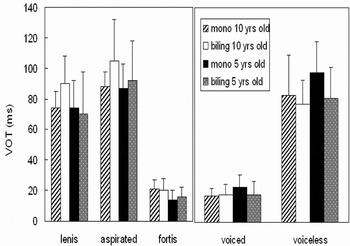
Korean VOT. Figure 1 shows VOT values for Korean stops produced by monolinguals and by Korean–English bilinguals. Both monolingual and bilingual children made clear distinctions among the three Korean stop contrasts. The ANOVA revealed no significant main effect in group (F(1,56) = 3.07, p = .08). However, there were significant differences in age (F(1,56) = 4.66, p = .035) and stop category (F(2,112) = 556.40, p < .001) as well as a three-way interaction among stop category * group * age (F(2,112) = 3.62, p = .03). Pairwise post-hoc comparison indicated that, at five years of age, monolingual and bilingual children produced similar VOT, but ten-year-old bilinguals showed longer VOT for lenis and aspirated stops than monolinguals (p < .017 for both). No other interactions were significant, age * group (F(1,56) = 1.78, p = .19), stop category * group (F(2,112) = 1.78, p = .17), stop category * age (F(2,112) = .80, p = .45).
VOT of monolingual and bilingual children in Korean (left panel) and English (right panel).

English VOT. Figure 1 also shows VOT values for English voiced and voiceless stops in monolingual English and Korean−English bilingual children. There were significant differences between bilingual and monolingual groups (F(1,56) = 5.29, p = .025) as well as between voiced and voiceless categories (F(1,56) = 627.20, p < .001). As expected, VOT in voiceless stops was significantly longer than in voiced stops. While five-year-old bilingual children produced shorter VOTs than monolingual children for both voiced and voiceless stops, ten-year-old bilinguals produced shorter VOTs for voiceless stops than did age-matched monolinguals, but had similar values for voiced stops. There was no main effect of age (F(1,56) = 3.84, p = .55), and there were no interaction effects for age * group (F(1,56) = 2.06, p = .16), stop category * group (F(1,56) = 3.61, p = .06), stop category * age (F(1,56) = 1.34, p = .25), and stop category * group * age (F(1,56) = 0.24, p = .62).
Korean vowel-onset f 0. A comparison of vowel-onset f 0, one of the important acoustic cues in distinguishing Korean stops, was made between the monolingual Korean children and the bilingual children. For recalibration, a one-way ANOVA was made for f 0 at the middle of the vowel /i/ among the three groups (monolingual Korean, monolingual English and Korean–English bilingual) at each age (five and ten years) in order to provide a basis for comparison with vowel-onset f 0. The ANOVA revealed that f 0 values for the three groups in each age category were not significantly different (F(2,42) = 0.30, p = .74 for ten-year-old children; F(2,42) = 0.52, p = .59 for five-year-old children).
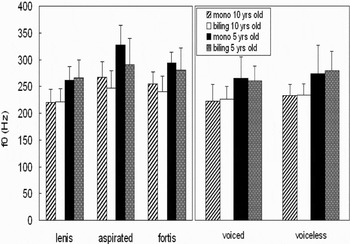
Figure 2 shows vowel-onset f 0 values for Korean stops in monolingual Korean and Korean−English bilingual children. We found that the main effect of group was not significant (F(1,56) = 2.91, p = .94), nor was there an age * group interaction (F(1,56) = 0.114, p = .73). However, the main effect of age was significant, as expected, due to the generally higher f 0 of younger children (F(1,56) = 36.04, p < .001). There was also a significant main effect of stop category (F(2,112) = 108.83, p < .001) and an interaction effect of group * stop category (F(2,112) = 15.43, p < .001). Pairwise post-hoc comparisons indicated a significant difference in aspirated stops between the two groups, suggesting that bilingual children did not raise their pitch for aspirated stop consonants as much as did monolingual children (p < .005). However, both groups of children showed similar vowel-onset f 0 for lenis and fortis stops. Also, monolingual children clearly distinguished vowel-onset f 0 among the three stop categories (p < .001), whereas vowel-onset f 0 differences between aspirated and fortis stops in bilingual children were marginal (p = .04). Other interaction effects such as stop category * age (F(2,112) = 2.86, p = .06) and stop category * group * age (F(2,112) = 2.03, p = .14) were not significant.
Vowel-onset f 0 of monolingual and bilingual children in Korean (left panel) and English (right panel).

English vowel-onset f 0. Although the perception of voicing in word-initial stop consonants correlates primarily with voice onset time values in English, various research studies (Kingston & Diehl, Reference Kingston and Diehl1994; Whalen, Abramson, Lisker & Mody, Reference Whalen, Abramson, Lisker and Mody1993) have shown that vowel f 0 after stop release also plays a role. Thus, a comparison of vowel-onset f 0 in English stops was made between the monolingual English children and the bilingual children (see Figure 2). We found that the main effect of age was significant, as expected, due to the generally higher f 0 of younger children (F(1,56) = 25.42, p < .001) as well as stop category (F(1,56) = 19.59, p < .001). Vowel-onset f 0 was significantly higher after voiceless than in voiced stops in English. However, there was no main effect of group (F(1,56) = 0.02, p = .88), nor were there other interaction effects such as group * age (F(1,56) = 0.02, p = .89), stop category * group (F(1,56) = 1.07, p = .31), stop category * age (F(1,56) = 0.57, p = .45), and stop category * group * age (F(1,56) = 1.18, p = .28).
So far, we have compared VOT and vowel-onset f 0 between monolingual and bilingual children. Although we found both similarities and differences, the question of whether bilingual children possess one or two separate phonetic systems requires further comparison of both English and Korean stop productions within bilingual children. Below we first compare all possible pairings between English and Korean in monolingual children, then we present the comparison results for bilingual children at each age group. Since f 0 differs between the ten-year-old and five-year-old groups, comparisons were made in each age group separately in terms of both VOT and vowel-onset f 0.
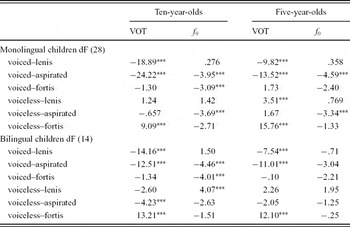
Thus, six t-tests for all comparisons between English and Korean were conducted among the four groups. The four groups include monolingual English and Korean ten-year-olds; bilingual ten-year-olds; monolingual English and Korean five-year-olds; bilingual five-year-olds. The six comparisons between English and Korean were: English voiced–Korean lenis (voiced–lenis), English voiced–Korean aspirated (voiced–aspirated), English voiced–Korean fortis (voiced–fortis); English voiceless–Korean lenis (voiceless–lenis), English voiceless–Korean aspirated (voiceless–aspirated), English voiceless–Korean fortis (voiceless–fortis). The alpha-level was adjusted to .008 (.05/6) because six comparisons were made. The significant pairs were indicated in Table 3.
t-test comparisons of six English and Korean stop pairs.

notes: Adjusted alpha level = .008.
*** p < .001.
Comparison between English and Korean stops of ten-year-old children
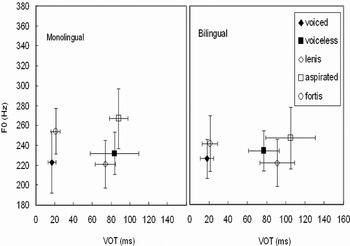
Monolingual English and Korean children. Figure 3 (left panel) shows VOT and vowel-onset f 0 values for monolingual English and monolingual Korean ten-year-olds. As expected, the voiced–lenis, voiced–aspirated, and voiceless–fortis pairs showed large degrees of VOT difference, whereas the voiceless–lenis and voiceless–aspirated pairs were similar in VOT. The t-tests (see Table 3) confirmed that the voiced–lenis and voiceless–fortis pairs were significantly different only in VOT. Lenis and voiceless stops showed longer VOT than fortis and voiced stops. Voiced–fortis and voiceless–aspirated were similar in terms of VOT, but differed with respect to vowel-onset f 0. Fortis and aspirated stops showed higher vowel-onset f 0 than voiced and voiceless stops. Both parameters differed in the voiced–aspirated pair. As expected, aspirated showed longer VOT and higher vowel-onset f 0 than voiced stops. In short, Korean and English stop categories were distinguished from each other in terms of either VOT or vowel-onset f 0, or both. One exception was that the voiceless–lenis pair was similar in both VOT and vowel-onset f 0 for the two groups of monolingual children. The question then arises as to whether bilingual children maintain these distinctions, too, and, if so, how they deal with the similarity between English voiceless and Korean lenis stops at word-initial position.
Stop pairs in monolingual (left panel) and bilingual (right panel) ten-year-old children.

Bilingual children. We turn now to the six stop comparisons in bilingual children. Figure 3 (right panel) also charts the English and Korean stop productions of ten-year-old bilinguals. The voiced–lenis, voiceless–fortis and voiceless–aspirated pairings differed only in terms of VOT, whereas voiced–fortis and voiceless–lenis differed only with respect to vowel-onset f 0, and voiced–aspirated in terms of both VOT and vowel-onset f 0. Similarly to the ten-year-old monolinguals, bilingual children at that age distinguished stop consonants in the two systems in terms of either VOT or vowel-onset f 0. But two pairings in the comparison stood out: (i) English voiceless and Korean aspirated stops in monolingual children were different based on vowel-onset f 0 (higher f 0 in the aspirated than in voiceless) whereas bilingual children distinguished the pairs using VOT (longer VOT in the aspirated than in voiceless); (ii) bilinguals distinguished the voiceless–lenis pair in terms of vowel-onset f 0, whereas English voiceless and Korean lenis stops were not significantly different for monolinguals along either parameter. The vowel-onset f 0 of the voiceless stops is significantly higher than that of lenis stops in bilingual children.
Comparison between English and Korean stops of five-year-old children
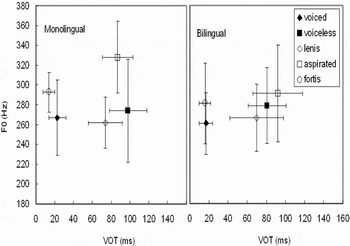
Monolingual English and Korean children. Figure 4 (left panel) graphs VOT and vowel-onset f 0 values for monolingual five-year-olds; the statistical results are listed in Table 3. The t-test revealed that voiced–lenis, voiceless−lenis and voiceless–fortis pairings were different in terms of VOT while voiceless–aspirated differed with respect to vowel-onset f 0. The voiced–aspirated pair differed along both parameters. The comparison within each pair for the five-year-olds was similar to that for the ten-year-olds in that the voiced–lenis, voiced−aspirated, voiceless–aspirated and voiceless–fortis pairings differed in terms of VOT and/or vowel-onset f 0. In contrast to the ten-year-old children, however, five-year-olds did not show a difference in vowel-onset f 0 in the voiced–fortis pair. On the other hand, the five-year-olds differed with respect to VOT for the voiceless–lenis pair. Although the voiceless−lenis pair was similar in terms of both parameters for the ten-year-old children, the VOT of English voiceless was significantly longer than that of Korean lenis stops for the five-year-old children.
Stop pairs in monolingual (left panel) and bilingual (right panel) five-year-old children.

Bilingual children. Figure 4 (right panel) also graphs English and Korean stop productions for the five-year-old bilinguals. The t-test confirmed that the members of the voiced–lenis, voiced–aspirated and voiceless–fortis pairs were significantly different in terms of VOT, but not vowel-onset f 0. On the other hand, the voiced–fortis, voiceless−lenis and voiceless–aspirated pairs were similar with respect to both VOT and vowel-onset f 0. While ten-year-old bilinguals produced different VOT in the voiceless–aspirated stop pairing, five-year-old bilinguals showed no difference. The most striking feature found in five-year-old bilinguals was that they did not use vowel-onset f 0 as a distinguishing acoustic cue in any of the six pairs.
Discussion
Previous studies (e.g., Flege, Reference Flege1991; Kang & Guion, Reference Kang and Guion2006) have argued that early bilingual adults demonstrated use of independent phonetic systems for their two languages; however, it was not clear when and how the two systems become established in bilingual children. The present study compared VOT and vowel-onset f 0 in stops produced by English–Korean bilinguals with those of monolinguals (as well as English and Korean stops within bilingual groups) in order to obtain a more comprehensive understanding of the development of phonetic categories among (simultaneous) bilingual children who started to learn the L2 before five years of age.
We found that bilingual children at two age points distinguished the stop categories for each language in terms of VOT and/or vowel-onset f 0. Thus, voiced vs. voiceless stops in English and lenis vs. fortis vs. aspirated stops in Korean were distinguished within each language along both parameters. The results of this study confirm previous work (Johnson & Wilson, Reference Johnson and Wilson2002; Khattab, Reference Khattab2000) to the effect that bilingual children acquire distinct VOT patterns for each of their languages. However, unlike Watson (Reference Watson1982), who reported that five-year-old bilinguals did not do so, we found five-year-old children were able to distinguish stop consonant categories within each language, both English and Korean. The discrepancy may be attributed to the smaller number of children in Watson's study (five children) versus the larger number in the current study (fifteen children). It may also be related to the fact that the stop systems of English and French (both with two-way contrasts) would appear to be more similar than those of English and Korean (two-way vs. three-way), but the VOT differences are considerable between both pairs of these languages. It should be noted, too, that other work (e.g. Arabic–English bilingual children; Khattab, Reference Khattab2000) has reported that bilingual children acquire distinct VOT categories even though both of their languages have the same “voiced” vs. “voiceless” two-way system phonologically, albeit with regular phonetic differences along the VOT continuum (cf. Iverson & Fourakis, Reference Iverson and Fourakis1985, for review of English vs. Arabic in this respect). Thus, further studies should examine bilingual children from various linguistic backgrounds.
The two sets of within-group comparison at the two different ages provide further insights into the development of phonetic category formation across languages in bilingual children. Kang and Guion (Reference Kang and Guion2006) reported that early Korean–English bilingual adults who started to learn English before six years of age establish fully separate phonetic categories across languages. Even though all Korean–English bilingual children in the present study were exposed to both languages before five years of age, five-year-old bilingual children performed differently compared to ten-year-old bilinguals. This study found that ten-year-old children distinguished all five stop categories, similar to the early Korean–English bilingual adults, while five-year-old bilingual children discerned only two categories (specifically, short-lag and long-lag VOT categories) without incorporating vowel-onset f 0. The two groups of bilingual children differed in terms of exposure duration to both languages. As Table 1 indicates, the ten-year-old children had longer exposure duration to both English and Korean (longer than five years) than the five-year-old children (longer than two years). The findings of this study suggest that small differences of exposure duration (e.g., five years vs. two years) during acquisition periods may play a role in their phonetic categorization and certain exposure duration is needed before Korean–English bilingual children fully establish phonetic categories across languages in their production of both L1 and L2. For example, in monolingual Korean children, stops are not fully acquired until five years of age (Lee & Iverson, Reference Lee and Iverson2009). Similarly, bilingual children also need a certain period of exposure to both languages in order to distinguish the detailed phonetic categories between them. Flege (Reference Flege and Strange1995) hypothesized in his perceptual model (i.e., Speech Learning Model) that the ability to discern phonetic differences decreases as the onset of acquisition increases – in other words, the earlier the onset of acquisition, the longer the exposure. Unsurprisingly, we found the same pattern in bilingual children's production in that the longer bilinguals are exposed to both languages, the better they distinguish phonetic differences across languages.
A core assumption of Flege's Speech Learning Model (Flege, Reference Flege and Strange1995, p. 233) is that “the phonetic systems used in production and perception of vowels and consonants remain adaptive over the life span and that phonetic systems reorganize in response to sounds encountered in an L2 through the addition of new phonetic categories”. Consistent with this point, phonetic category formation in bilingual children does not occur at once, but rather continues to develop over a period of time. The current study, however, does not provide evidence as to the effect on phonetic category formation of the age of onset of acquisition. For example, we did not examine whether ten-year-old children exposed to English at three years of age establish phonetic categories better than the same age bilingual children who were first exposed to English at five years of age. The effect of onset of exposure on phonetic category formation should be carefully investigated in future research.
How bilingual children form phonetic categories across languages was another question of interest in this study. We found that Korean–English bilingual children employed both assimilation and dissimilation depending on age groups. When speaking Korean, the ten-year-old bilinguals in the present study produced longer VOT for lenis and aspirated stops than did monolinguals. This result parallels Han's (Reference Han1998) findings in that five out of six Korean–English bilingual children produced aspirated stops with VOT-lag longer than 80 ms, while only one monolingual Korean child produced aspirated stops with VOT longer than 80 ms. In English, bilingual children produced shorter VOT for voiced and voiceless stops than monolingual English-speaking children. These results are also consistent with the finding of Khattab (Reference Khattab2000) that VOT patterns of bilingual children do not necessarily mirror those of their monolingual counterparts. As early Korean–English bilingual adults are reported to have VOT and f 0 values similar to those of monolingual English or Korean adults (Kang & Guion, Reference Kang and Guion2006), it appears that bilingual children experience a period of development before fully establishing their two phonetic systems with respect to laryngeal articulations.
The differing VOT values between monolingual and bilingual groups indicate that bilingual children use the dissimilation mechanism as they develop stop consonants for both languages. Flege (Reference Flege and Strange1995, p. 239) maintained that “the phonetic category established for L2 sounds by a bilingual may differ from a monolingual's if the bilingual's category is deflected away from an L1 category to maintain phonetic contrast between categories in a common L1–L2 phonological space”. Thus, bilingual children may try to develop distinct systems for each language by maximizing the difference in acoustic values between the two languages. By lowering VOT for English and raising it for Korean, the VOT difference between the two languages would be at maximum. This is consistent with previous studies (Flege et al., Reference Flege, Schirru and MacKay2003; Mack, Reference Mack and Nelde1990). Mack also reported that a ten-year-old French–English bilingual child produced much longer VOT for English voiceless stops than did monolingual children, although the child also produced longer VOT for French voiceless stops. Flege (Reference Flege and Strange1995, p. 242) noted then that “this child [in the Mack study] maintains phonetic contrast . . . in his L1 and L2”.
The maximizing of phonetic contrast has been proposed by Lindblom (Reference Lindblom, Hardcastle and Marchal1990) as a key factor in modeling language structure as well as in explaining language acquisition (Lee & Iverson, Reference Lee and Iverson2009). More specifically, according to Lindblom's notion of “adaptive dispersion”, speakers seek to maintain phonemic contrast by monitoring the trade-off between articulatory economy and perceptual distinctiveness. For example, Korean speakers tended to position the tongue farther back for /u/ as compared to speakers of English in order to maintain sufficient perceptual salience because the Korean vowel inventory includes more high (tense) vowels than does that of English (Korean /i ɨ u/ vs. English /i u/).
The dissimilation mechanism is further supported by the results of within-group analysis in the current study. Among monolingual Korean and English children, all stops were generally distinguished in either VOT or vowel-onset f 0 except for the voiceless–lenis pair. Ten-year-old bilingual children, however, distinguished the voiceless–lenis pair by lowering vowel-onset f 0 for Korean lenis stops. This suggests that if two consonants across languages are similar to each other, as between Korean lenis and English voiceless, bilingual children may impose a distinction by raising or lowering acoustic values beyond the norms of monolinguals (cf. also Sundara et al., Reference Sundara, Polka and Baum2006, who note that by increasing VOT-lead for voiced stops, the VOT differences between voiced and voiceless stops for bilingual speakers become greater than those for monolingual speakers).
We also found the assimilation mechanism to be at play in bilingual child speech development. Although we did not find completely merged categories among ten-year-old bilinguals, an interference effect was observed in that the ten-year-olds demonstrated lower vowel-onset f 0 for aspirated stops relative to monolingual Korean-speaking children, indicating that the pitch properties of English may influence Korean stops in Korean–English bilingual children. Han (Reference Han1998) observed this as well, reporting that vowel-onset f 0 values for aspirated stops in monolingual children were 300 Hz or higher, while those of bilingual children were around 250 Hz; only one bilingual child produced aspirated stops with vowel-onset f 0 higher than 300 Hz. Other studies of adult bilingual or L2 learners (Flege, Reference Flege1991; Kang & Guion, Reference Kang and Guion2006; MacKay, Flege, Piske & Schirru, Reference MacKay, Flege, Piske and Schirru2001) have reported that the L2 of late bilinguals is influenced by their L1 speech, while several have also noted that the L2 can affect L1 speech production (MacKay et al., Reference MacKay, Flege, Piske and Schirru2001). The results of the present study may suggest that bilingual children may not produce as high f 0 as monolingual Korean children do since vowel-onset f 0 is not the primary acoustic cue in English stops. That is, the English system may affect their Korean system. More clear evidence of assimilation can be found in the vowel-onset f 0 of five-year-old bilinguals, whose duration of exposure to the two languages is least, in that these children showed merged categories for voiced–fortis, voiceless–lenis and voiceless−aspirated. They did not distinguish these pairs at all in terms of vowel-onset f 0 (see Table 3).
In short, the present study provides evidence that bilingual children at two different ages employ different mechanisms in the development of phonetic categories. The five-year-old bilingual children who have shorter exposure duration use assimilation, whereas ten-year-old bilingual children who have longer exposure duration employ both dissimilation and assimilation. These findings parallel those of Flege et al. (Reference Flege, Schirru and MacKay2003) in that early adult Italian–English bilinguals who had longer durations of exposure tended to produce the English vowel /e/ with significantly more formant movement than late adult bilinguals who had shorter exposure duration, suggesting that dissimilation mechanism is observed among adult bilinguals with longer exposure.
Kang and Guion (Reference Kang and Guion2006) reported that acoustic values of early Korean–English bilingual adults do not differ from those of monolingual adults in both English and Korean. The present study, by contrast, found that acoustic values of ten-year-old Korean–English bilingual children were not the same as those of their monolingual counterparts. Further studies should examine at what age the stop consonants of Korean–English bilingual children become the same as those of monolinguals in both English and Korean. It is important to point out, however, that not every study investigating early bilingual adults shows phonetic implementation to be the same as for monolingual adults. Sundara et al. (Reference Sundara, Polka and Baum2006) reported that the VOT values of early French–English bilingual adults were significantly different from those of monolinguals, suggesting that interaction effects continue to be evident not only in late adult bilinguals or L2 learners but also for early adult bilinguals.
Finally, the results of this study bear on the methodological issue of how to evaluate phonetic systems in bilingualism. Previous studies of bilingual children compared chiefly stop consonants between bilingual and monolingual children for each language (e.g., voiceless stops between monolinguals and bilinguals) and/or the voicing contrast within each language (e.g., voiced vs. voiceless stops among bilinguals) in order to assess whether bilingual children operate with one or two phonetic systems. However, it is necessary to compare stop consonant productions for both languages within bilingual children (e.g., English voiceless vs. Korean aspirated stops among bilinguals) in addition to comparisons between monolingual and bilingual groups. Further studies should conduct both between- and within-group comparisons in order to understand more fully the emergence of separate phonetic systems in bilingualism.