A great woman sculptor?
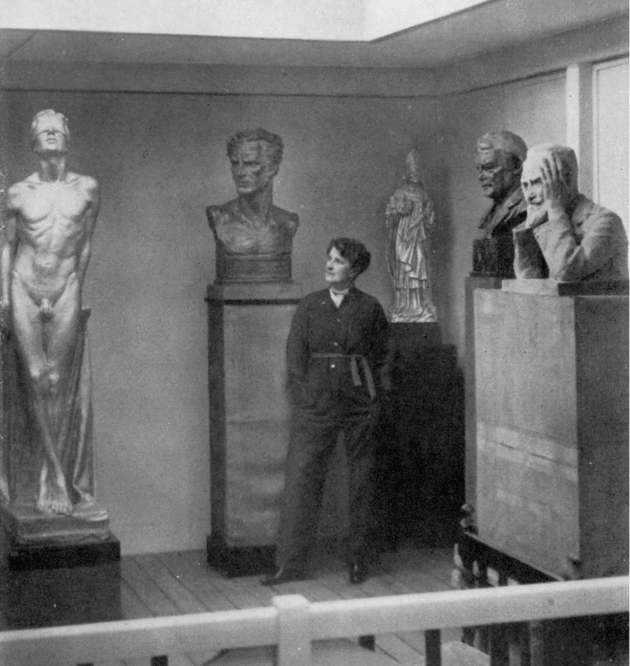
Kathleen Scott (1878–1947) has been historically typecast as her first husband's courageous widow, and is only secondarily known as a sculptor (Fig. 1). Her close friend, George Bernard Shaw attempted a characteristically intrepid historical reappraisal when, shortly after her death, he told Kathleen's second husband Lord Kennet (formerly Edward Hilton Young):
Now Scott was not wonderful (. . .) he was so unsuited to the job he insisted on undertaking that he ended as the most incompetent failure in the history of exploration. He had a craze for Antarctic Polar exploration without a talent for it. Kathleen on the other hand was a wonderful woman, first rate at her job (. . .) And always successful. Scott's best right to celebrity is that he induced her to marry him. This is what you have to face as her biographer (Shaw Reference Shaw1948).
Kathleen Scott in her studio-gallery, 1933 (Photo: Stuart Hamilton; Kennet Reference Kennet1949: opposite 296).

Shaw's opinions on Scott would be controversially elaborated, some thirty years later, by Roland Huntford (Huntford Reference Huntford1979). But Kathleen Scott's commensurate significance as a sculptor remains underexplored. This is despite her posthumously published memoirs and diary, Self-portrait of an artist (1949), which Kennet was editing at the time of Shaw's letter, and more recently Louisa Young's biography A great task of happiness: the life of Kathleen Scott (1995). Yet she was hailed in 1934 by the Hull Daily Mail as ‘one of the greatest woman sculptors of her time’ (The Daily Mail (Hull) 14 May 1934: 5), and was later stated to be ‘the most significant British woman sculptor of [the twentieth] century before Barbara Hepworth’ (Stocker Reference Stocker1999: 54). Kathleen was highly prolific, producing some 220 recorded works which fall into two major, quite distinctive categories. Her portrait sculptures, comprising statues, busts and ‘heads of men whose features suggest high power or intellect’ (The Weekly Dispatch (London) 3 April 1927: 8), for example Shaw himself, account for the large majority of her output. These include monumental portrait statues of Scott, Captain John Smith of Titanic fame in Lichfield (1914) (Savours Reference Savours2010: 178–179) and Edward Wilson in Cheltenham (1914). Less familiar are her dozen major ideal or imaginative sculptures which for her represented ‘the only thing I've cared about (. . .) young male objects’ (Lees-Milne Reference Lees-Milne1996: 10).
Kathleen Scott at the SPRI
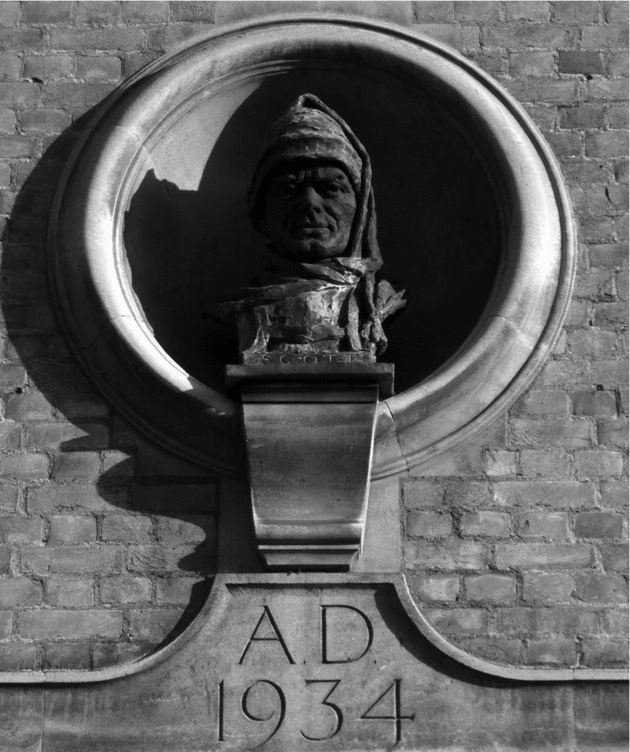
The exterior of Herbert Baker's Scott Polar Research Institute (SPRI) building in Cambridge (1931–1934), prominently features an example of each genre. Kathleen's over-life-sized bronze bust of Scott in polar gear (1933), which created no controversy, occupies a three-foot roundel at the centre of the façade (Fig. 2). Such a feature had been planned at the outset of the SPRI's history in 1926, when Albert Seward, Master of Downing College and at the time Vice-Chancellor of the University of Cambridge, told Kathleen: ‘We should very much like to have some permanent memorial of Captain Scott which could be placed in the building which will be provided as soon as necessary funds are available (. . . .) Perhaps you would be willing to make a half relief portrait of Captain Scott and present it to the Institute’ (Seward Reference Seward1926). Seven years later, in the form of a bust rather than a relief, it was installed. With the adjacent Latin architrave inscription ‘QUAESIVIT ARCANA POLI VIDET DEI’ [He sought the secret of the pole/ but found the hidden face of God], Scott assumes the aura of a Roman emperor, emphasised by the ruggedly modelled realism characteristic of Kathleen's portraiture.
Kathleen Scott, Robert Falcon Scott, 1933–1934, bronze. Scott Polar Research Institute, Cambridge. (Source: Bryan Lintott)
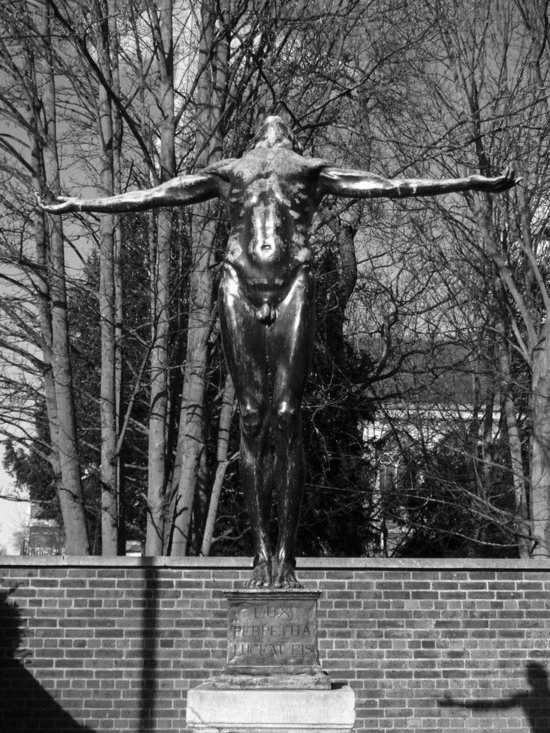
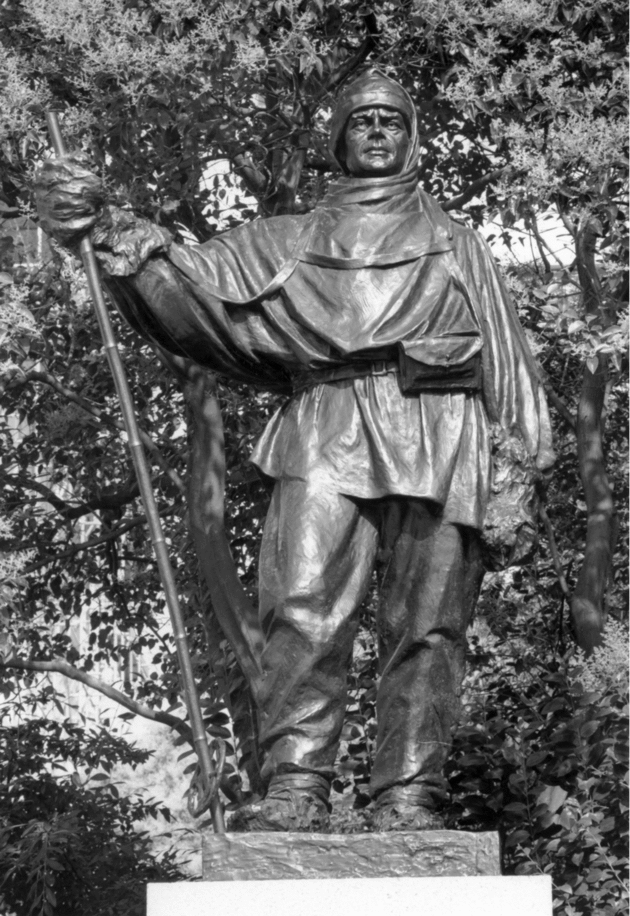
Sited to the east, in the forecourt of the building, is her 191cm. bronze nude figure, which serves as a memorial to Scott and his polar party (Figs. 3–4). Its original subject had no obvious iconographic relationship with this function, which proved a major contributing factor to its later, divisive critical reception in Cambridge, examined below. In the decade following its completion in 1923, the sculpture was alternately named Offering; 1914–1918: These had most to give; aspiration; and the more generic Youth. Other than Kathleen's memorials to Scott of 1913–1917 in Waterloo Place, London and Christchurch, New Zealand (Fig. 5) (Stocker Reference Stocker1998), These had most to give (her preferred name for it) proved to be probably her most acclaimed work.
Kathleen Scott, ‘These had most to give’, 1922–1923, bronze. Scott Polar Research Institute, Cambridge. (Source: Bryan Lintott)
Kathleen Scott, ‘These had most to give’, 1922–1923, bronze. Scott Polar Research Institute, Cambridge. (Source: Bryan Lintott)
Kathleen Scott, Robert Falcon Scott, 1913–1915, bronze. Waterloo Place, London (Source: Conway Library, Courtauld Institute of Art).
Icons of decency
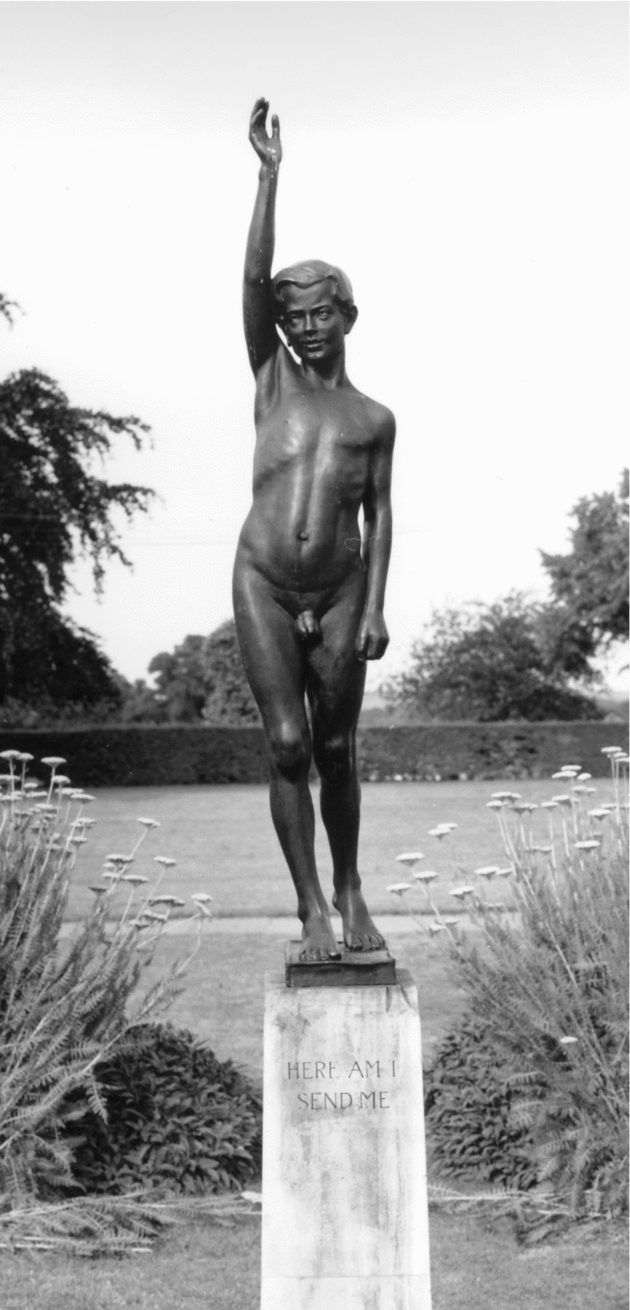
Portraying Scott had lent an emotional depth to Kathleen's sculpture as a whole (Stocker 1997: 56). Country Life admired ‘this power of expressing the inner meaning . . . that made Lady Scott so successful in her memorial to her late husband’ (Country Life 1929: xxxiv). The experience also gave her greater confidence in tackling work on a large scale. World War I and its responsibilities had temporarily thwarted the ‘ecstasy of creating’ (Kennet Reference Kennet1949: 160); a 1920 diary entry reveals her ambition to make another work of ‘magnitude . . . I must stop doing portraits and do exclusively nudes’ (Kennet Reference Kennet1949: 179). The immediate predecessor to These had most to give was a nude figure of a still younger boy, Here am I! Send me (1921–1922; Slimbridge, Gloucestershire; Oundle School, Northamptonshire) (Fig. 6). In this sculpture, Kathleen's initial priority was the formal expression of naturalism and beauty, something she had learnt from her famous mentor, Auguste Rodin (Stocker Reference Stocker1999: 48). Yet as it progressed, the potential of such a work to function as a war memorial, the newly dominant and most lucrative sculptural form, became increasingly apparent. The title comes from Isaiah (6:8), where the prophet undertakes to serve the Lord. Young claims that ‘Personally, Kathleen had no need of God’ (Young Reference Young1995: 173); like Scott, she tended towards agnosticism and would later say, when hospitalised, that she would sooner have her friend Shaw to visit her than any clergyman (Weintraub Reference Weintraub2004: 167). However, a strong sense of morality and idealism pervaded both her character and her art. This helps explain why, unlike some of her famous friends of student days, Eileen Gray and Edward Steichen, she was ultimately unwilling to cross the Rubicon into Modernism. The late Victorian belief that the sculptural male nude represented ‘an icon of decency’ (Hatt Reference Hatt and Prettejohn1999: 241) would not have been lost on her. The ideals conveyed in Here am I! Send me were noted by H.G. Wells in his biography of Oundle headmaster F. W. Sanderson, who had acquired the cast for the school: ‘the bronze boy is in eager pose; there is duty to be done and danger to be faced and a great creative effort to be made’ (Wells Reference Wells1924: 124). At the same time his vulnerability is also manifest, a quality still more explicit in its sequel.
Kathleen Scott, ‘Here am I! Send me’, 1922–1923, bronze. Oundle School, Northamptonshire (Source: Conway Library, Courtauld Institute of Art).
An emblem of sacrifice
These had most to give was an altogether more ambitious work; larger in that it represented a fully (if recently) grown youth; less overtly sentimental and more psychologically subtle in its mood and body language. Its naturalism and fluid modelling reflect Kathleen's continued indebtedness to Rodin's The age of bronze (1876) and St John the Baptist preaching (1878). Bertram Mackennal's Eton College war memorial (1921–1923), shown at the same Royal Academy summer exhibition (1923), affords a still more striking comparison in its open-ended subject matter, body language and handling (Hutchison Reference Hutchison and Edwards2007: 103–109). This was not acknowledged, however, by Kathleen, whose diaries repeatedly reveal her intense competitiveness with contemporaries in the field, and sometimes jealousy towards them.
The sculpture's personal significance to the artist was evident when she declared: ‘If somebody immaterial says how like my bust of so & so is, I am quite pleased, but if anyone but the very real admire These Had Most to Give I want to put a blanket over it, I'd even drop it in the river, how dare the fools admire it’ (Scott Reference Scott1925). The war poet and close friend of Kathleen, Geoffrey Dearmer, was clearly one of the ‘very real’ elect (Young Reference Young1995: 180). He noted its ‘upturned and elevated face’ which ‘admirably restrains the passionate quality of the figure (. . .) We cannot see the averted face, and the figure is unknown. It is this impersonal quality that makes the work a full, perfect and sufficient emblem of sacrifice’ (Dearmer Reference Dearmer1927: 166).
First exhibited at the Royal Academy as Offering, later in 1923 it moved under its war memorial title to the Grosvenor Galleries. One of three works representing Kathleen Scott at the British Empire Exhibitions at Wembley in 1924 and 1925, it reappeared at the 1925 Salon de la Société des Artistes Français in Paris. Here it was awarded a bronze medal and was lauded in Le Temps: ‘The attitude is true and simple, the modelling is faultless’ (Le Temps (Paris) 10 May 1925: 3; Norfolk News 1 August 1925: 5). These had most to give was at one point (1926) on the verge of acquisition by the Tate Gallery. Kathleen noted how its benefactor, Sir Joseph Duveen, ‘professed to simply adore my work, he used the most extravagant adjectives (. . .) oh dear, I mustn't count my chickens’ (Young Reference Young1995: 227). She was proved right; a more minor but representative piece was eventually purchased instead, her head of Herbert Asquith (c. 1913) (Stocker Reference Stocker1999: 51). The unsold bronze remained installed beside the lily-pond in the garden of her London residence in Bayswater Road until Kathleen's solo exhibition at the Fine Art Society in October 1934, which was followed by its immediate, and what proved to be permanent, removal to Cambridge.
Although there are later photographs pasted in Kathleen's diary of her elder son, Peter Scott, charmingly imitating the sculpture's pose, the model was several years his senior, Arnold Lawrence, a younger brother of T.E. (Lawrence of Arabia), who had himself sat for and confided emotionally in Kathleen in 1921, a year previously (Young Reference Young1995: 200–203). Aged 22 at the time, a recent Oxford graduate and slightly too young to have experienced active service, Arnold Lawrence was ‘very much obsessed’ with his sexual anxieties about women. He was ‘rather frightened of himself – told me he has told more about himself than he ever had to any other one. Poor boys, I love them at that age, they are so certain they are the only individuals who have ever lived (. . .) He wants to be so exceptional, bless him, very endearing’ (Scott Reference Scott1922). Lawrence later became Professor of Classical Archaeology at the University of Cambridge, where he would have frequently encountered ‘his’ statue (Cook Reference Cook2009). A wake was held beside it, following his death in 1991 (R.K. Headland, personal communication, 2 August 2012).
A photograph taken shortly after casting immensely impressed Shaw, who told Kathleen: ‘The statue looks a fearfully accomplished piece of work (. . .) The execution amounts to swank in its brilliancy’ (Shaw Reference Shaw1923). He and Wells would both later admire it at the Grosvenor Galleries. In his Observer review, Kathleen's acolyte, the Irish Nationalist politician and writer Stephen Gwynn, eloquently wrote:
The slender body in its quivering inevitably calls up the thought of some tall, soft-stemmed flower, ready for the scythe's sweeping . . . What strikes me about this bronze, and indeed, about all her best bronzes, is that they do not look like castings. I know that this artist chisels her own marble . . . the tool's trace is a caress. Well, in this big nude there is the same delicacy; can simple casting get it? I fancy it is chased and wrought after casting with tool and file and rubbing (The Observer (London) 21 October 1923: 18).
These qualities, and Gwynn was correct about Kathleen's proudly ‘hands-on’ approach, have been emphasised following its recent cleaning.
Kathleen rarely said much publicly about her work, preferring to leave this up to such critics, but echoed Dearmer and Gwynn when she explained that the ‘outstretched hands and the upturned head are expressive of sacrifice, of absolute surrender to ideas, and I intended it to typify the holocaust of youth during the war’ (The Eastern Daily Press (Norwich) 28 March 1927: 5). She later mused: ‘I should like to see it placed on the top of some hill so that it could stand outlined against the sky’ (Patmore Reference Patmore1932: 12), a miniature precursor, perhaps, of Antony Gormley's Angel of the north (1998). Why then did her sculpture fail to find a home as a war memorial at a time of high demand? Kathleen complained that ‘it had always been passed over in favour of figures in full uniform’ (The Courier (Dundee) 1 April 1927: 4). The Daily Telegraph critic Sir Claude Phillips found it difficult to pinpoint what it lacked: ‘There is . . . notwithstanding the audacious movement of the figure, a certain uncertainty, a certain emptiness’ (The Daily Telegraph (London) 23 October 1923: 14). Similar misgivings were later echoed by The Times, which believed it showed ‘only illustrative and dramatic expression . . . though very well executed’ (The Times (London) 29 March 1927: 12). Perhaps its almost irritatingly perfect and tactile nudity, the rasp of Gwynn's ‘caressing tool’, had succeeded rather too well.
Fitting statuary for the SPRI
As its extensive archival documentation testifies, between February 1933 and November 1934 the saga of These had most to give occupied many hours of the SPRI management committee, the Cambridge University Buildings Syndicate, and the architect of the building, Herbert Baker. Conspicuous by its absence, however, is Kathleen's own involvement in the correspondence. Both Baker and the University authorities, notably Seward and the director of the fledgling SPRI Frank Debenham, saw the wisdom in sheltering her from the controversy, although they were equally mindful of their own self-preservation. In March 1931, as soon as the SPRI building had become a viable concern, Kathleen (then known as Lady Hilton Young) had alienated Seward in his role as chairman of the management committee by unilaterally contacting Baker, her preferred architect. The latter had ‘consented to act, so that everything really seems most favourably ready now to make a start’ (Young Reference Young1931). Seward complained to Debenham that ‘Lady Hilton Young (. . .) as usual, seems to think she can run the whole business’ (Seward Reference Seward1931). Her choice of architect was, however, confirmed in February 1932, and Baker would prove her staunch ally in the sculptural standoff that ensued.
The first recorded mention of a ‘statue’, as distinct from Scott's bust, dates from November 1932 in a letter from Baker to Edward Hilton Young (Baker Reference Baker1932a). Baker's description appears consistent with the eventual solution, with a planted yew hedge rather than a wall providing the backcloth, as viewed from the new building. Soon afterwards, Baker told Kathleen: ‘I think your gift and the placing of it is splendid. It will ensure a dignified and beautiful plot in front of the building, especially if the entrance is from the side road.’ The statue was a little smaller than he expected, ‘and there is a risk on the outside of the building of it looking small in scale. But it is a small building and a small place in which it will be seen so I think it will be alright.’ He recommended considerably heightening the pedestal from its present eleven inches, claiming that ‘If it is too near the eye level it becomes too intimate and less like art. It ought to be a little nearer the gods’ (Baker Reference Baker1932b). This is consistent with Baker's, and indeed Kathleen's, late classicism which ran somewhat counter to Rodin's radical ideal of ‘de-pedestalising’ his Burghers of Calais group to create a sense of intimacy with the viewer (Miller and Marotta Reference Miller and Marotta1986: 71). Kathleen endorsed Baker's recommendation: ‘Have it four or five feet up . . . up to the gods with it by all means’ (Young Reference Young1932).
By January 1933, Debenham informed Kathleen that he had received Baker's ‘most interesting design for the treatment of the space in front, embodying the use of an allegorical figure by you.’ He warmly endorsed the proposal on behalf of the committee of management: ‘We appreciate, of course, how very fitting it would be to have some of your work beautifying the building, but of course we must leave it for you to decide what it should be and how it should be used’ (Debenham Reference Debenham1933a). This was a decision that he would soon rue. Kathleen's response was in turn magnanimous; initially she planned to make a copy of These had most to give and to charge the Cambridge University Buildings Syndicate an estimated £100–150 for the foundry costs. Happily, she found that she had more to give. Writing on his wife's behalf, Hilton Young told Debenham that ‘I understand (. . .) that she would now like to offer the original itself as a gift . . . the cost would be nothing. Next in order of choice, I think I should put the bust for the door’ (Young Reference Young1933a). The latter denoted the over-life-sized bust of Scott on the façade of the new building.
In his reply Debenham confirmed that ‘a particular statue of allegorical type (. . .) would be just the right thing for the forecourt. That would be splendid’, although priority would go to Kathleen's commission for Scott's bust. He concluded: ‘Nothing could be more fitting than both pieces of statuary should be hers, but it is asking a great deal of her good nature’ (Debenham Reference Debenham1933b). Kathleen replied that she was ‘scarce [illegible] about to part with my figure from the garden, but it will be a lovely home for it and someday I think I'll cast another’ (Young Reference Young1933b).
‘The tragic side of Polar work’
Any mutual ‘love’ had started to fade, however, by April 1933, when Seward told Debenham that he had seen a pamphlet with a photograph on the front page which ‘no doubt represents the statue which it is suggested we have. Personally I think it unsuitable.’ He showed the image to James Wordie, another committee member, who agreed ‘and wonders if we could refuse it in some diplomatic way. It would be very much better if we could have a statue of Scott’ (Seward Reference Seward1933a).
There is no further record of the latter suggestion, which was probably not pursued due to the shortage of funds at the disposal of the SPRI, as well as the priority that research space took over statuary. It was a measure, nonetheless, of the committee's hostility, which was provoked not so much by the sculpture as a work of art, but rather by its intended context and location. Indeed, apart from a single reference which indicates that a number of the committee members ‘did not like the statue in itself’ (Seward Reference Seward1934b), there is a notable dearth of aesthetic response towards it. Debenham stated the crux of the matter: ‘since the forecourt is very narrow, and the statue pretty prominent within it, passers-by will tend to associate the building overmuch with the idea of death and martyrdom and in general the tragic side of Polar work’. Had the forecourt been ‘very large’ and the statue a ‘detail rather than a centrepiece’, Debenham conceded that his ‘objections would fall’ (Debenham Reference Debenham1933c). Ironically, it was Kathleen's very ability to convey sacrifice altogether ‘too successfully for it to be employed to represent any other idea’ that condemned her sculpture (Seward Reference Seward1933b). Seward told Baker that it ran counter to ‘the spirit in which the young explorer looks upon Polar adventure.’ Baker understood and even sympathised with this point of view but still maintained that ‘the statue might be regarded as expressing devotion to the Spirit of the Quest’ (Baker Reference Baker1933a). This corresponds to the title applied to its 45cm. bronze statuette version, Aspiration (Anglesey Abbey, Cambridgeshire). For a full-scale work, however, such a case appeared unconvincing and it swayed none of the committee members.
Sacrifice and martyrdom had certainly been central to the burst of emotion when the world learned of the deaths of Scott and his polar companions in 1913. Max Jones and Stephanie Barczewski have both explained that such sensibilities had, if anything, intensified during World War I, ‘as a means of explaining death on the battlefield to the bereaved, and thereby of providing comprehension and comfort’ (Barczewski Reference Barczewski2007: 140; see also Jones Reference Jones2003: 254–261). By 1933, however, these pre-modern romantic and chivalric ideals had receded into historical memory, and Herbert Ponting's film, Ninety degrees south, which was released in the same year, had been a box-office failure (Jones Reference Jones2003: 262–263; Barczewski Reference Barczewski2007: 217). Instead, the more disinterested pursuit of scientific research and discovery, which had been central to the British Antarctic Expedition, was now paramount. This applied nowhere more than to the SPRI itself, and was enshrined in its very name. Hence Seward informed Baker: ‘There is a very general feeling that the Statue would suggest ideas inappropriate to the spirit which the Institute should foster’ (Seward Reference Seward1933b). It was further described as having ‘an inapt correlation with polar work in general’ (Debenham Reference Debenham1934a). Several committee members also objected to the ‘incongruity (. . .) of having a statue not only representing sacrifice, but also reminiscent of a crucifix, placed in a position where it would always be seen with the Roman Catholic Church as a background’ (Debenham Reference Debenham1934c). Here Debenham meant the nearby church of Our Lady and the English Martyrs, but this was to underestimate the ability of landscaping to manipulate the lines of sight and thereby obviate such an excess of religiosity.
Although the committee came close to refusing Kathleen's gift outright, in the event nobody was prepared to ‘bell the cat’ as Debenham put it (Debenham Reference Debenham1933c), and break the news to Kathleen and Hilton Young. The sculpture's doughtiest opponent, kept carefully secret from them both, was Debenham himself, Scott's erstwhile British Antarctic Expedition colleague, whom Kathleen affectionately addressed as ‘My dear Deb’ (Young Reference Young1927). Seward suggested a possible compromise under which the work could be accepted ‘as a memorial to Scott and his companions, and inscribed “In memory of the Southern party” or some such words, with the addition of “Presented by Lady Scott”’ (Seward Reference Seward1933b). At a working lunch with Seward and the Vice-Chancellor, William Spens, in July 1933, Baker suggested a variant, which unwittingly raised the problem of the sculptor's surname: ‘THIS GIFT OF KATHLEEN ? WHO MADE IT IS DEDICATED TO THOSE WHO GAINED THE SOUTH POLE AND PERISHED THERE. SCOTT. WILSON. BOWERS. OATES. EVANS’ (Baker Reference Baker1933b). In the event, Spens tactfully assigned Hilton Young with the responsibility of composing a suitable inscription for the base (Baker Reference Baker1933c).
Several months later, in March 1934, Debenham hoped that the statue would be ‘put to the side’ and that ‘some method of hiding from the road can be found. This possibly may be done with brickwork in a semi-circle, curving towards the building’ (Debenham Reference Debenham1934a). Baker protested that such a proposal represented ‘a complete breakaway from the [agreed] position, at the end of the front façade’ and reminded Seward that ‘you can . . . push it back behind the hedge’, as had been originally planned (Baker Reference Baker1934a). A further proposal, made by the University Buildings Syndicate in April, was to place the sculpture in Lensfield Garden, ‘facing the building at a distance of about 50 feet’ (Debenham Reference Debenham1934c). Baker welcomed the idea in principle, but raised the previously mooted question of future road construction by the University, which would risk leaving the statue stranded. This, he asserted, would ‘not be keeping faith with the donor, nor is it the right treatment for what is really a foundation gift in memory of Captain Scott, after whom the building is named’ (Baker Reference Baker1934b).
Rejection of the statue still appeared to be a possibility in correspondence right up to April 1934. Baker took an impassioned stance, warning of ‘the very intense feelings’ that would arise:
After all, though the statue does express ‘Abandonment of Self’ rather than ‘Courage and Endurance’, yet is it not one of the high qualities displayed in Antarctic adventure? It is, moreover a beautiful statue, and it will arrest attention and so give the high sense which art alone can give to a building, raising it above the sense of the material and giving it a spiritual expression. This surely is not alien to ‘The Quest of Polar Adventure’ (Baker Reference Baker1934c).
Seward told an angry and ailing Baker ‘I wish (. . .) that you could forget the statue for the time being’ and warned him ‘We shall not come to any final decision in a hurry’ (Seward Reference Seward1934a). However, following a meeting at which Baker was represented by his less abrasive partner Alexander Scott, four days later Seward could reassure him ‘at the meeting today we decided to have the statue in the position which you proposed’ (Seward Reference Seward1934c).
A sculptural reprieve
Baker was temporarily soothed, only for another, if smaller controversy to erupt over the height of pedestal. His proposal, which he had previously agreed with the sculptor, had been to raise it ‘to four or five feet’ (Young Reference Young1932). He now told Seward, that ‘the danger is, if you put a statue so near the level of the people, it gets an intimate character which kills its art’ (Baker Reference Baker1934d) and suggested consultation with Kathleen. Seward initially wavered, but the committee dissuaded him from pursuing such a course of action. Spens's successor as Vice-Chancellor, J.F. Cameron, bluntly endorsed this: ‘it would be dangerous at this stage to consult with the sculptor’, warning that ‘The female of the species is more deadly than the male’ (Cameron Reference Cameron1934).
In the erection of monumental sculpture, the patron (or in this case the recipient) almost invariably determines the pedestal construction; thus Baker's protests could effectively be disregarded. A low pedestal would minimise the unloved sculpture's conspicuousness, as would an established hedge. For Debenham, a ‘very dominating’ edifice that threatened to stand ‘nearly eleven feet from the ground’ appeared a dreadful prospect in its proximity to the building (Debenham Reference Debenham1934b). He gave vent to his ‘unrepentant’ feelings about the whole matter in a letter to Seward, which also provides insight into his attitudes to Kathleen:
I shall not make trouble at another meeting (. . .) but I am afraid that I stick to my opinion that the statue is not entirely suitable and that I can't really applaud the kind of spirit in which the sculptor gave it (it having been executed for an entirely different motive) and that its position in the front of the building is liable to arouse comment of just the kind I should like to avoid, some of it surprise at the sacrifice idea, and some of it mere ribaldry (Debenham Reference Debenham1934d).
Anecdotal evidence of subsequent undergraduate high jinks, such as the addition of traffic cones and male athletic supports to the sculpture, provides perhaps some foundation for Debenham's concerns. So too does the claim that children (especially girls) at the nearby St Alban's Catholic Primary School were made to walk close to the hedge in order to avoid exposure to the figure's nudity (R.K. Headland, personal communication, 2 August 2012).
In June 1934 Seward effectively shut down further debate on the pedestal: ‘The Master of Downing does not think the question can be considered at all’ (Marshall Reference Marshall1934). Baker was left to protest once more of how this would compromise ‘the abstract qualities of art’ (Baker Reference Baker1934e). Kathleen's reaction when he told her was good-humoured: ‘When inclined to be angry one recollects these fools pass but statues remain. “Who are they anyway?” says I! Of course seven feet is low, but that is all it is in my garden. So do not let us worry unduly.’ Although she suggested ‘perhaps you can surreptitiously pop in another foot or two’ (Young Reference Young1934), Baker was in no position to oblige. The eventual pedestal was 75 cm. tall, slightly over half the height that he had proposed. No hint of displeasure is however contained in Kathleen's diary entry of 20 November 1934, when the new building was opened: ‘Herbert Baker has built it well. My bust of Con [Scott], and my figure in the forecourt, look well. [Stanley] Baldwin [a prominent politician] did his part admirably. It was like listening to a great symphony for the first time. It was nice seeing all he old Antarctics’ (Kennet Reference Kennet1949: 300).
Debenham shared her view, and perhaps surprisingly, was willing to consider a minor heightening of the pedestal ‘because that would give us an opportunity for engraving on the stone some simple words to show that it is a memorial’, but this never materialised. Ten days after the opening, he claimed that people were ‘completely mystified as to its purpose’. Hilton Young's choice of inscription ‘Lux perpetua luceat eis’ (‘May everlasting light shine on them’) only baffled them further: ‘even those who can translate the Latin are no wiser as to why it should be there.’ Debenham conceded, however, that ‘the statue itself looks very much better’ than in the ‘rather chalky reproductions’ that had so influenced the SPRI management committee (Debenham Reference Debenham1934e). Following Kathleen's death in 1947, Debenham's successor, Launcelot Fleming, informed Hilton Young that the Institute had recorded in its minutes that it had been ‘fortunate to possess two fine examples of her own sculptures’ (Fleming Reference Fleming1948). A kind of closure had settled over These who had most to give.
Relevance and resonance
Eighty years after the sculpture's controversial presentation to the SPRI, several of the questions that it raised continue to be relevant. The objections of Debenham and Seward to the inappropriateness of the sculpture to its context remain pertinent. Many visitors to the Institute are still as ‘completely mystified’ about its meaning as they were in 1934. At no stage in its archival documentation (apart from Debenham's concern about ‘ribaldry’) was the question of nudity raised. Yet today, the figure's incongruity with the Antarctic cold seems blatant, perhaps even a little ludicrous. A young man would probably survive for no longer than three minutes in such an environment in that state of nature. The age of the figure, which Kathleen romantically lowered from Lawrence's 22 to an imaginary 18 (Patmore 1931: 12), is also considerably at odds with those of the polar party, which spanned 28 and 43. Yet such contemporary responses reflect an ever-increasing cultural unfamiliarity with the classical tradition in art and in literature, one in which Kathleen's near contemporary, the sculptor Francis Derwent Wood, felt it perfectly appropriate to commemorate the ‘fallen’ of the Machine Gun Corps in the form of an idealised nude figure of David (1925; Hyde Park Corner, London). These had most to give strikes a note eminently consistent with Wood's memorial, as does the literary orthodoxy of the Georgian poets, when they were confronted by the horrors of modern warfare (Ward-Jackson Reference Ward-Jackson2011: 96). There is, furthermore, an increasingly convincing art historical case to be made for an overdue reclamation of Kathleen Scott's masterpiece and its rescue from the condescension of posterity (Stocker Reference Stocker1999). James Lees-Milne's scathing criticism of her sculptures’ ‘exclamatory gestures and strivings towards the sublime’, which he found ‘fairly commonplace’, is no longer self-evident (Lees-Milne Reference Lees-Milne1996: 15–16). With the recent centenary of Scott and his companions’ deaths and the impending centenary of the outbreak of World War I, ‘the embodied personality of self-sacrifice’, Geoffrey Dearmer's apt characterisation of These had most to give (Dearmer Reference Dearmer1927: 166), assumes a new resonance and poignancy.
Acknowledgements
I am very grateful to the following for their assistance with my research: R.K. (Bob) Headland, Heather Lane and Bryan Lintott, all of the Scott Polar Research Institute, University of Cambridge; Liz Kennet; Dr Matthew Potter, University of Northumbria; and Louisa Young. Special thanks to Patrick Quilty and Ann Savours who generously refereed this article.