Children following heart transplantation are at increased risk of infections given their immunological suppression. Occasionally, transplantation can be complicated by anaemia because of repeat phlebotomy, viral infections, and medical treatments. We describe a case of one such child who developed a significant unexplained anaemia following heart transplantation.
Case report
An 11-year-old boy presented 1 month after orthotopic heart transplant with an unexplained anaemia. He was born with coarctation of the aorta for which he underwent surgical repair in his first year of life. He subsequently developed severe subaortic stenosis, which required surgical resection of the subaortic ridge and myomectomy at 8 years of age. He later developed a very acute-onset left ventricular dysfunction with idiopathic dilated cardiomyopathy for which he required treatment with extra-corporeal membrane oxygenation before receiving an orthotopic heart transplant at 11 years of age. He was maintained on immunosuppression with tacrolimus and mycophenolate mofetil.
At presentation, 1 month after transplantation, he was was noted to have a normocytic, normochromic anaemia with a low reticulocyte count (Table 1). The white cell count and platelet count were normal. Apart from marked pallor, he remained otherwise clinically well. The dose of mycophenolate mofetil was decreased and co-trimoxazole discontinued. He remained on prednisolone and tacrolimus, with a target serum tacrolimus level decreased to 9–10 ng/ml. He was treated with oral and intravenous iron supplements, intramuscular vitamin B12, intravenous folic acid, and erythropoietin. However, his haemoglobin did not improve, remaining between 60 and 70 g/L (Table 1) and he subsequently required several blood transfusions.
Selected full blood count parameters over 10 months after transplantation.

Hb=haemoglobin; OHT=orthotopic heart transplant
Investigations were performed to out rule several possible aetiologies. The erythropoietin level was elevated, iron studies were normal, and vitamin B12 and folate levels were normal. Faecal occult blood was negative, there was no haematuria on urinalysis, and trans-oesophogeal echocardiography showed no evidence of subacute bacterial endocarditis. Cytomegalovirus and Epstein–Barr virus polymerase chain reaction were negative.
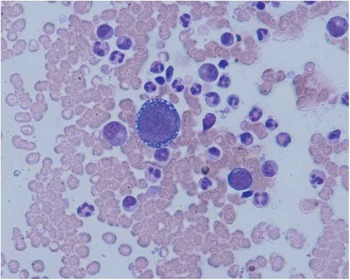
A bone marrow biopsy was performed 1 month post admission, which showed a mildly hypocellular bone marrow (40%) with few red blood cell precursors with giant pro-erythroblasts (Fig 1). There were normal numbers of myeloid lineage cells and abundant megakaryoblasts present. These findings were consistent with a pure red cell aplasia. The patient’s tacrolimus was discontinued and he was commenced on cyclosporin A with a target serum level of 150 µg/L. However, his haemoglobin levels did not improve over the following month; his reticulocyte count remained depressed, and he required further blood transfusions.
Erythroid hypoplasia with a giant proerythroblast showing cytoplasmic vacuolation characteristic of parvovirus B19 infection (×60 Wright-Giemsa stain).

After 2 months of admission, parvovirus B19 polymerase chain reaction returned positive and this was then determined to be the cause of his anaemia. He was treated with intravenous immunoglobulin 1 gm/kg infusion over 24 hours every 2 weeks for a period of 4 months. His haemoglobin returned to normal levels over several months (Table 1). He was recommenced on tacrolimus. He was discharged home 10 weeks following the development of anaemia once his haemoglobin level had stabilised. He is currently well 5 years post transplant.
Discussion
This case highlights the importance of thoroughly investigating anaemia in post-heart transplant patients. Acquired pure red cell aplasia has been associated with viral infection or the use of certain drugs. Tacrolimus, in particular, is a well-recognised cause of pure red cell aplasia in transplant patients.Reference Gregoor and Weimar 1 – Reference Wong, Chan, Leung, Szeto, Tam and Li 3 Parvovirus B19 is a well-recognised cause of pure red cell aplasia but can be relatively asymptomatic, the only feature being an insidious fall in haemoglobin levels and reticulocytopaenia.Reference Fong and Kaplan 4 The patient may require a blood transfusion.Reference Fong and Kaplan 4 – Reference Frickhofen, Chen, Young, Cohen, Heimpel and Abkowitz 6 Parvovirus B19 infection can usually be diagnosed with viral serology, polymerase chain reaction, or bone marrow examination (Fig 1), but serology in immunosuppressed patients can be unhelpful and DNA analysis for ongoing infection should always be carried out.Reference Amiot, Langanay and Drenou 7
Intravenous immunoglobulin is an effective treatment for parvovirus B19 infection and may avoid the need to discontinue immunosuppression with tacrolimus.Reference Crabol, Terrier and Rozenberg 8 Although there is a previous report of parvovirus B19-induced red cell aplasia in an adult after heart transplant, to our knowledge there is no other report in a child post heart transplant.Reference Fong and Kaplan 4
In conclusion, the presence of a pure red cell aplasia in the setting of an immunosuppressed patient should alert one to the possibility of parvovirus B19 infection. This may prevent unnecessary changes in immunosuppresion regime, which may be mistakenly held responsible for the red cell aplasia.
Acknowledgements
The authors are greatful to Dr Michael Burch, Department of Cardiac Transplantation, Great Ornoma Street, London, England; and Mr Andrew Pendred for assistance with figure.
Financial Support
This research received no specific grant from any funding agency, commercial or not-for-profit sectors.
Conflicts of Interest
None.