INTRODUCTION
The World Health Organization defines quality of life (QoL) as individuals' perceptions of their position in life within the context of the culture and value system in which they live, and in relation to their goals, standards, and concerns (Ahmedzai, Reference Ahmedzai, Costa and Blengini2004; Soni & Cella, Reference Soni and Cella2002). QoL is a broad and multifaceted concept. It encompasses the cognitive, physical, and spiritual aspects of an individual's life, in addition to the emotional and social domains. QoL is influenced by a person's individual experiences, beliefs, expectations, and perceptions (Jocham et al., Reference Jocham, Dassen and Widdershoven2006; Rummans et al., Reference Rummans, Clark and Sloan2006). Palliative care focuses on relieving symptoms and providing the best possible quality of life for patients with a life-limiting illness (Zimmermann et al., Reference Zimmermann, Riechelmann and Krzyzanowska2008).
Quality of life has been considered the most important outcome measure in palliative care, and patients have been the preferred source of evaluation (Arraras et al., Reference Arraras, de la Vega and Asin2014). However, quality of life is difficult to define and measure. It is a multidimensional, dynamic, and subjective concept (Jocham et al., Reference Jocham, Dassen and Widdershoven2006). Suitable QoL assessment in patients with advanced disease can orient interventions targeted by the health staff (Arraras et al., Reference Arraras, de la Vega and Asin2014). However, evaluation of the quality of life in patients undergoing palliative care is implemented through instruments not specific to those patients (Nunes, Reference Nunes2014). The weak physical status of palliative care patients means that shorter QoL questionnaires may help reduce the burden and enhance accrual of data (Arraras et al., Reference Arraras, de la Vega and Asin2014). For advanced cancer patients, who can suffer greatly from a variety of symptoms, shorter questionnaires may be particularly beneficial, as they reduce the patient burden and, in the long run, may lead to gathering of richer data and compliance with palliative research studies (Lien et al., Reference Lien, Zeng and Nguyen2011).
The European Organization for Research and Treatment of Cancer Quality of Life–Core 30 (EORTC QLQ–C30) (2005) is the most commonly used instrument for evaluation of the quality of life of patients in palliative care; however, it is extensive and contains items irrelevant to palliative treatment (Groenvold et al., Reference Groenvold, Petersen and Aaronson2006a ; Reference Groenvold, Petersen and Aaronson2006b ; Granda-Comeron, Reference Granda-Comeron, Viyola and Linch2007). The QLQ–C30 has been translated into many languages and validated for use in international, multi-institutional studies within a transcultural setting (Suárez-del-Real et al., Reference Suárez-del-Real, Allende-Pérez and Alférez-Mancera2011; Kaasa & Loge, Reference Kaasa and Loge2003; Guzelant et al., Reference Guzelant, Goksel and Ozkok2004; Aaronson et al., Reference Aaronson, Ahmedzai and Bergman1993). Researchers have concerns that the length of the instrument can be too demanding for respondents and that the items are not well suited for palliative care (Groenvold et al., Reference Groenvold, Petersen and Aaronson2006a ; Granda-Comeron, Reference Granda-Comeron, Viyola and Linch2007; Zhang et al., Reference Zhang, Wang and Zhang2015). It is difficult for a debilitated patient with terminal cancer to navigate such an extensive survey. Therefore, a shorter version, the European Organization for Research and Treatment of Cancer Quality of Life–Core 15–PAL (EORTC QLQ–C15–PAL) was developed, which has been used in only a few studies (Suárez-del-Real et al., Reference Suárez-del-Real, Allende-Pérez and Alférez-Mancera2011; Alawneh et al., Reference Alawneh, Yasin and Khirfan2015). This shortened QoL questionnaire aimed at decreasing the burden on patients with advanced cancer (Shin et al., Reference Shin, Choi and Miyashita2011).
The EORTC QLQ–C15–PAL Scale has been translated into many languages, including Turkish, Japanese, Italian, Russian, Chinese, Greek, German, Arabic, and Spanish (EORTC, 2005), and has been validated for use in Spanish (Arraras et al., Reference Arraras, de la Vega and Asin2014), Brazilian (Nunes, Reference Nunes2014), Mexican-Spanish (Suárez-del-Real et al., Reference Suárez-del-Real, Allende-Pérez and Alférez-Mancera2011), Korean (Shin et al., Reference Shin, Choi and Miyashita2011), Japanese (Miyazaki et al., Reference Miyazaki, Suzukamo and Shimozuma2012; Miyashita et al., Reference Miyashita, Wada and Morita2015), Chinese (Zhang et al., Reference Zhang, Wang and Zhang2015), and Arabic (Alawneh et al., Reference Alawneh, Yasin and Khirfan2015). It a short scale and is easy to understand. However, there are no validated instruments to evaluate the quality of life of Turkish palliative care patients. It is thus very important to make available an instrument that Turkish healthcare providers could use on a daily basis to assess the quality of life of patients in palliative care. The purpose of our study was to present the Turkish version of the EORTC QLQ–C15–PAL and evaluate its psychometric properties among Turkish palliative care patients.
METHODS
Participants
The study was conducted in İzmir with patients who had undergone treatment in the palliative care unit of a university hospital between November of 2011 and December of 2013. Sociodemographic and disease characteristics forms, the Karnofsky Performance Status (KPS) Scale (Karnofsky & Burchenal, Reference Karnofsky, Burchenal and McLeod1948), and the EORTC QLQ–C15–PAL Scale (EORTC, 2005) were employed in order to gather data.
Patients were considered eligible for participation if they: (1) were cancer patients with a limited life expectancy; (2) were not currently undergoing an anticancer treatment; (3) were admitted to the palliative care unit at least 72 hours before completing the survey; (4) were 18 years or older; and (5) had a KPS score of 50 or below. Regarding sample-size calculation, we considered a total of 150 for the study (15 items × 10 patients), based on the work of Tabachnik and Fidell (Reference Tabachnik and Fidell1993).
Linguistic Adaptation
The EORTC QLQ–C15–PAL was translated through a standard translation and back-translation procedure. The English-language items were initially translated into Turkish by two native Turkish speakers (one of whom was a nursing professor and the other an English lecturer) who spoke fluent English. A committee of bilingually fluent Turkish oncology experts (including a professor nurse, an oncology nurse, and a medical oncologist) evaluated and approved these item translations. The items were then translated back into English by a bilingual translator who had not seen the original English version. The English back-translation and the original versions were compared. A Turkish version of the EORTC QLQ–C15–PAL was finally produced.
The resulting questionnaire was pilot tested among patients with cancer in palliative care (30 palliative care patients with advanced cancer). On the basis of the results from the pilot test, we made further translation refinements and then finalized the instrument.
Data Collection Procedures
Sociodemographic and clinical data were taken from clinical records. Performance status (level of physical function) was assessed by the physician (using the KPS Scale).
Instruments
The Karnofsky Performance Scale is a single-item, unidimensional functional status scale utilized to obtain a global measure of level of activity, especially for patients undergoing cancer treatment. Level of functionality is rated by a healthcare provider as a percentage ranging from 100% (normal, no complaints, no evidence of disease) to 0% (dead) (Karnofsky & Burchenal, Reference Karnofsky, Burchenal and McLeod1948).
To reduce the respondent burden in multi-instrument studies, researchers and clinicians should consider using the shorter versions of the EORTC QLQ–C30 and the EORTC Quality of Life Questionnaire for Palliative Care (EORTC QLQ–C15–PAL), which has 15 items specifically designed for palliative care (Groenvold et al., Reference Groenvold, Petersen and Aaronson2006a ; Reference Shin, Choi and Miyashita2006b ). The EORTC QLQ–C15–PAL comprises 15 questions, including two functional scales (physical and emotional function), two multi-item symptom scales (fatigue and pain), and five single-item symptom scales (nausea and vomiting, dyspnea, insomnia, appetite loss, and constipation). Response options to these 14 items were rated on a 4-point Likert-type scale: 1 (not at all), 2 (a little), 3 (quite a bit), and 4 (very much). An additional item, the global health/quality-of-life scale, used a 7-point numerical scale from 1 (very poor) to 7 (excellent). Higher scores for the functional scale and global health/quality-of-life scale indicate a better quality of life, while higher symptom scale scores indicate a lower quality of life.
Statistical Analyses
The internal consistency reliability of the EORTC QLQ–C15–PAL was evaluated using Cronbach's alpha coefficient (α), which was computed for the interference and severity scales of the EORTC QLQ–C15–PAL. A value of 0.70 or greater was considered adequate for group comparisons (Cronbach, Reference Cronbach1951). Spearman correlation coefficients (r) were calculated to assess convergent validity between the EORTC QLQ–C15–PAL, the EORTC QLQ–C30, and the KPS Scale. Correlation assessment between single items was obtained using the Spearman correlation coefficient, and multi-item correlation was evaluated via Cronbach's α. A correlation equal to or greater than 0.4 was considered highly significant. In addition, clinical validity was evaluated by the extent to which questionnaire scores were able to discriminate among the subgroups of patients, differing in terms of their clinical status (including KPS scores). Known-groups validity was evaluated by comparing the subgroups of patients known to differ in clinical variables using the Kruskal–Wallis test and depending on their adherence to a normal distribution. For all tests, a p value less than 0.05 was considered statistically significant.
Ethical Considerations
Before the study was begun, permission to use the EORTC QLQ–C15–PAL–Turkish version was obtained from the author, who developed the tool for use in Turkey. For application of the research, authorization was received by the ethics committee of Ege University and signed consent was obtained from participants.
RESULTS
Study Participants
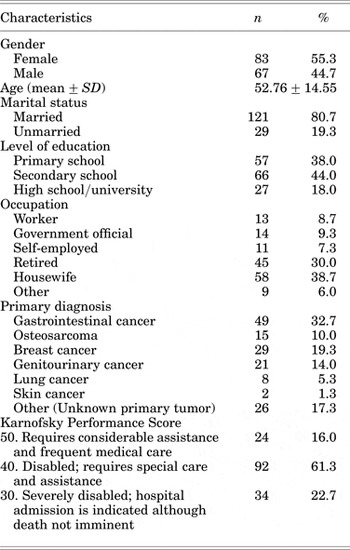
Of a total of 150 patients included in the study, 55.3% were female, 80.7% were married, and the average age was 52.76 ± 14.55. In terms of disease characteristics, 32.7% had GI cancer, 54.7% were diagnosed 1–3 years ago, all were grade IV, and all had metastases. The sociodemographic data of the patients and data about their disease are detailed in Table 1.
Characteristics of patients and diseases (N = 150)

Reliability and Validity
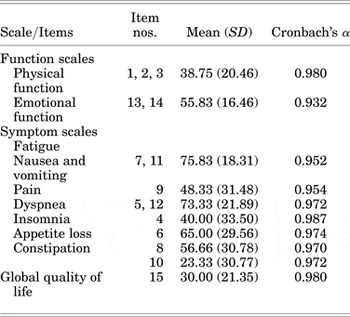
We examined the internal consistency level of the EORTC QLQ–C15–PAL's scale items in order to determine its level of reliability (i.e., absence of measurement errors). For this purpose, we calculated Cronbach's α internal consistency coefficients for the whole scale and for the subscales. In calculations implemented using the first partial data obtained, Cronbach's α met the 0.7 criterion. On the other hand, in calculations implemented using the total dataset of the study, the values of Cronbach's α were found to range between 0.93 and 0.98, and equal to 0.90 for the whole scale. These results indicate that the EORTC QLQ–C15–PAL Scale is a reliable instrument. The values of α for the scale are shown in Table 2.
Description and Cronbach's α values of the EORTC QLQ–C15–PAL Scale

EORTC QLQ–C15–PAL = European Organization for Research and Treatment of Cancer Quality-of-Life Questionnaire–Core 15–Palliative Care; SD: = standard deviation.
Relationship with KPS Performance Score
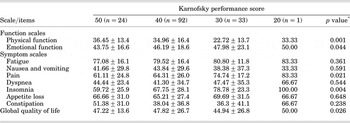
Patients were divided into groups based on KPS scores: ≤30 (n = 34), ≤40 (n = 92), and ≤50 (n = 24). Because the sample did not follow a normal distribution, we evaluated data using the Kruskal–Wallis test. In different KPS groups, we found significant differences in scores across each dimension of the EORTC QLQ–C15–PAL, which indicates that the scale is effective in evaluating the capability of patients. As KPS scores decreased, scores for physical function, emotional function, and global QoL also decreased, while scores for symptom intensity all increased. Therefore, as KPS scores decreased, patients' physical function, emotional function, and global QoL declined, and patients' symptoms became more marked. The correlations between the KPS and EORTC QLQ–C15–PAL scales are shown in Table 3.
Comparison of EORTC QLQ–C15–PAL dimension scores across KPS

ERTOC QLQ–C15–PAL = European Organization for Research and Treatment of Cancer Quality of Life Questionnaire–Core at–Palliative Care; KPS = Karnofsky Performance Status.
* Kruskal–Wallis test.
Relationships among Different EORTC QLQ–C15–PAL Dimensions
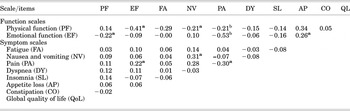
Pearson correlation coefficients were calculated between different symptoms and functional dimensions (Table 4). Most questionnaire areas had low to moderate correlations with the others. The moderate correlations were between fatigue and physical function (–0.41) and between insomnia and emotional function (–0.53). Weak correlations were found between nausea/vomiting and appetite loss (0.31) and between insomnia and pain (0.22). Furthermore, global QoL was weakly correlated with other dimensions (r < 0.40).
EORTC QLQ–C15–PAL coefficients across dimensions

a p < 0.01. b p < 0.05. The Pearson correlation coefficient was adopted.
EORTC QLQ–C15–PAL = European Organization for Research and Treatment of Cancer Quality-of-Life Questionnaire–Core 15–Palliative Care.
DISCUSSION
Ours was a the study of the EORTC QLQ–C15–PAL Scale's reliability and validity in Turkish. For this purpose, the study utilized patients' self-reports with QoL scales and observer-rated KPS to prospectively examine the course of patients with advanced cancer in a palliative care setting. Based on our findings, our validation study has demonstrated that the Turkish version of EORTC QLQ–C15–PAL Scale has adequate psychometric properties of internal consistency, test–retest reliability, and concurrent validity when applied to Turkish patients in palliative care. The QLQ–C15–PAL was originally validated in patients with advanced cancer receiving palliative care services, showing its feasibility for use in a population with a poor prognosis (Groenvold et al., Reference Groenvold, Petersen and Aaronson2006a ; Reference Shin, Choi and Miyashita2006b ).
Our quality-of-life scores are similar to those of other studies in patients with advanced disease. The values of Cronbach's alpha were sufficiently high and similar to those in a Japanese EORTC QLQ–C15–PAL validation study (Miyazaki et al., Reference Miyazaki, Suzukamo and Shimozuma2012; Miyashita et al., Reference Miyashita, Wada and Morita2015) and a Brazilian study conducted with patients in palliative care (Nunes, Reference Nunes2014). In the Japanese population, Cronbach's α ranged between 0.76 and 0.86 (Miyazaki et al., Reference Miyazaki, Suzukamo and Shimozuma2012; Miyashita et al., Reference Miyashita, Wada and Morita2015). The value of α for the Arabic version of the EORTC QLQ–C15–PAL was found to be 0.89 (Alawneh et al., Reference Alawneh, Yasin and Khirfan2015), >0.70 for the Chinese version, and >0.70 for the Mexican-Spanish version (Suárez-del-Real et al., Reference Suárez-del-Real, Allende-Pérez and Alférez-Mancera2011).
In our study, most questionnaire areas had low to moderate correlations with the others. The moderate correlations were between fatigue and physical function (–0.41) and between insomnia and emotional function (–0.53). Internal consistency reliability was generally satisfactory and similar to that of other studies (Arraras et al., Reference Arraras, de la Vega and Asin2014; Nunes, Reference Nunes2014; Zhang et al., Reference Zhang, Wang and Zhang2015; Alawneh et al., Reference Alawneh, Yasin and Khirfan2015; Shin et al., Reference Shin, Choi and Miyashita2011; Miyazaki et al., Reference Miyazaki, Suzukamo and Shimozuma2012; Miyashita et al., Reference Miyashita, Wada and Morita2015). This was not an unexpected result for us, as it was indicated in the outcomes of the Mexican-Spanish patient group in the study implemented by Suárez-del-Real and colleagues (Reference Suárez-del-Real, Allende-Pérez and Alférez-Mancera2011). In some other populations (i.e., Japanese, Korean, Brazilian), correlations were found at various levels between physical function, fatigue, and pain (Nunes, Reference Nunes2014; Shin et al., Reference Shin, Choi and Miyashita2011; Miyazaki et al., Reference Miyazaki, Suzukamo and Shimozuma2012; Miyashita et al., Reference Miyashita, Wada and Morita2015).
Conversely, weak correlations were found between nausea/vomiting and appetite loss (0.31) and between insomnia and pain (0.22). Furthermore, global QoL was weakly correlated with other dimensions (r < 0.40). These results show that the correlational results found were more similar to those found in Chinese and Korean patient populations (Zhang et al., Reference Zhang, Wang and Zhang2015; Shin et al., Reference Shin, Choi and Miyashita2011).
Group validity analyses were examined by comparing total quality-of-life score, stratified by low KPS (<30, <40, and <50). As KPS scores decreased, scores for physical function and global QoL decreased, while scores for symptom dimensions (pain and insomnia) increased. Karnofsky-based differences were in line with those of other studies (Arraras et al., Reference Arraras, de la Vega and Asin2014; Nunes, Reference Nunes2014; Suárez-del-Real et al., Reference Suárez-del-Real, Allende-Pérez and Alférez-Mancera2011). In some studies (Zhang et al., Reference Zhang, Wang and Zhang2015; Shin et al., Reference Shin, Choi and Miyashita2011; Miyashita et al., Reference Miyashita, Wada and Morita2015; Caissie et al., Reference Caissie, Culleton and Nguyen2012), a comparison of quality of life and ECOG performance score was also used, and a significant relationship was found between higher ECOG scores and symptom density, as well as lower quality of life.
With this study, we have provided a clinically simple, useful, and suitable measurement instrument for Turkish patients who have advanced cancer. In addition, this scale, which was found to be valid and reliable for a Turkish population, could also be used for measuring the clinical effects of palliative care provided specifically for Turkish patients with advanced cancer. However, the effects of such factors as the Turkish family structure, the community's cultural features, and the quality of integration of palliative care services within the health system remain unexamined in such studies. It is assumed that these effects will be examined more closely in studies to be implemented with this scale in Turkish palliative care settings in the future.
Consequently, the EORTC QLQ-C15–PAL Scale is a valid and reliable tool for determining the quality of life of advanced cancer patients who are undergoing palliative treatment in Turkey.
DISCLOSURES AND ACKNOWLEDGMENTS
This study was not supported by other organizations and companies. The authors have no conflicts of interest to disclose. The authors are grateful to the research team members for their administrative assistance.