Introduction
Leaf-cutting ants of the genus Atta and Acromyrmex are among some of the most damaging herbivorous insects in the Neotropics (Leal et al., Reference Leal, Wirth and Tabarelli2014). These ants can cause significant economic losses when defoliating agricultural plants in order to feed their symbiotic fungus (Mundim et al., Reference Mundim, Bruna, Vieira-Neto and Vasconcelos2012; De Fine Licht et al., Reference De Fine Licht, Boomsma and Tunlid2014; Oliveira et al., Reference Oliveira, Della Lucia, Della Lucia, Anjos, Araújo and Leite2014). Among the various species of leaf-cutting ants, Atta sexdens Forel (Hymenoptera: Formicidae) stands out as one of the most economically devastating pests in Brazil, because it attacks both perennial and annual cultivated plants (Della Lucia et al., Reference Della Lucia, Gandra and Guedes2014). Although sometimes A. sexdens is found cutting leaves during the day, its foraging activity takes place mostly during the night, which makes it difficult for growers to scout for them (Tonhasca & Bragança, Reference Tonhasca and Bragança2000). In addition, the foraging activities of A. sexdens are known to be influenced by environmental variables such as humidity and temperature (Caldato et al., Reference Caldato, Forti, Bouchebti, Lopes and Fourcassié2016). For example, Fowler & Robinson (Reference Fowler and Robinson1979) found out that A. sexdens do not forage in temperatures above 30°C and below 10°C, thereby suggesting a higher potential for damage in tropical agriculture.
Leaf-cutting ants are typically managed using various insecticides (e.g., baits and dust impregnated with an active ingredient) (Della Lucia et al., Reference Della Lucia, Gandra and Guedes2014). However, the few options of efficient insecticides coupled with some defensive ant behaviors (e.g., grooming between nest mates) have resulted in insecticide inefficiency (Montoya-Lerma et al., Reference Montoya-Lerma, Girald-Echeverri, Armbrecht, Farji-Brener and Calle2012; Della Lucia et al., Reference Della Lucia, Gandra and Guedes2014). Thus, the search for alternative methods for managing leaf-cutting ants is of paramount importance. Countries in the Neotropics such as Brazil are well known for their high biodiversity (Rull, Reference Rull2011), which in turn increases the chances of finding potential biological control agents to manage insect pests such as leaf-cutting ants (Guillade & Folgarait, Reference Guillade and Folgarait2015). Parasitoid flies (Diptera: Phoridae) are one such potential biological control agent because they are known to parasitize ants by laying eggs inside their head, and after hatching the parasitoid larvae feed on the interior of the ant's head (Tonhasca, Reference Tonhasca1996; Bragança et al., Reference Bragança, Tonhasca and Moreira2002; Silva et al., Reference Silva, Bailez, Viana-Bailez, Tonhasca and Della Lucia2008).
It has been documented that phorid parasitoids that parasitize Atta spp. belong mainly to the genera Apocephalus Coquilett, Eibesfeldtphora Disney and Myrmosicarius Borgmeier (Tonhasca et al., Reference Tonhasca, Bragança and Erthal2001; Brown et al., Reference Brown, Disney, Elizalde and Folgarait2010; Uribe et al., Reference Uribe, Brown, Bragança, Queiroz and Nogueira2014); and they could be either host-species specific or parasitize more than one species within the genus Atta (Bragança et al., Reference Bragança, Della Lucia and Tonhasca2003; Brown et al., Reference Brown, Bragança, Gomes, Queiroz and Teixeira2012). Multiple parasitoid species may be present in any location, and it has been postulated that some of these parasitoid species can coexist by having differing preferences of ant head sizes (Bragança et al., Reference Bragança, Tonhasca and Moreira2002). For example, the parasitoid Eibesfeldtphora erthali Brown prefers to parasitize workers of Atta laevigata Smith that have a greater head capsule size, whereas Apocephalus vicosae Disney is known to predominantly attack ants with smaller heads (Bragança & Medeiros, Reference Bragança and Medeiros2006). An outcome of this is that the presence of multiple parasitoid species may provide more efficient biological control.
At any given time, the ratio of receptive females to sexually active males is known as operational sex ratio and it predicts that the more numerous sex will face increased competition for mates than the limiting sex (Kuijper et al., Reference Kuijper, Pen and Weissing2012). An interesting observation is that the sex ratios of phorids emerging from parasitized ants are not always 1:1 (Morrison & Gilbert, Reference Morrison and Gilbert1998; Folgarait, Reference Folgarait2013) and it may vary according to environmental conditions and host size (Morrison et al., Reference Morrison, Porter and Gilbert1999). The ability of an organism to pass its genes on to future generations is significantly affected by the sex ratio of its offspring (Hamilton, Reference Hamilton1967; Sundström et al., Reference Sundström, Chapuisat and Keller1996). In this way, the sex ratio of phorids has great implications on the reproductive ecology of these parasitoids.
Parasitoids also appear to be able to greatly influence ant community dynamics (Feener, Reference Feener1995). For example, the phorid flies Apocephalus sp. are known to interfere with the alarm-recruitment of the ant workers Pheidole dentata Mayr, which then affects the competitive interactions between P. dentata and the fire ant Solenopsis texana Emery (Feener, Reference Feener1981). P. dentata always outcompetes S. texana when the phorid flies are absent, but not when the flies are present. Thus, the presence of phorid parasitoids may be enough to alter ant behaviors that could ultimately interfere with the normal colony activities, or influence ant community competition dynamics (Feener, Reference Feener1995; Elizalde & Folgarait, Reference Elizalde and Folgarait2012).
Here we examine some of the ecological characteristics that underlie the interactions between A. sexdens and its most common phorid parasitoids in the neotropics. Specifically we investigated: (i) which species of phorid parasitoids attack the leaf-cutting ants at our study site, (ii) the parasitism rate, and (iii) whether or not ant head size affects the number and sex ratio of emerging adult parasitoids.
Material and methods
Study site
The study was conducted at the Universidade Federal de Viçosa campus Florestal (19.8712 S, 44.4239 E), located in the city of Florestal, Minas Gerais State, Brazil. This region is considered a transitional area between the Atlantic Forest and the Cerrado biome (also known as Brazilian savanna) (IBGE, 2015).
Collection of ants and assessment of phorid parasitoids
Approximately 200 workers of Atta sexdens were collected randomly from each of four nests during 17 different dates between November 2012 and November 2013. The ants were collected between 19:00 and 22:00 h.Nest codes and collection locations were: N1 (19.87678 S, 44.41364 E), N2 (19.88475 S, 44.41639 E), N3 (19.88375 S, 44.42406 E) e N4 (19.88483 S, 44.42661 E). . The ants were identified by nest location and collection date. Following collection, the ants were individually placed inside plastic vials (28.4 × 18.8 × 6.1 cm3) with inert talc on the inner walls to prevent escape, and closed by perforated caps to allow ventilation. These enclosed ants were kept in a growth chamber with temperature of 25 ± 1°C, relative humidity of 80 ± 5%, and photoperiod of 12 h. While in the growth chamber the ants were fed daily by providing them with a small cotton ball soaked with a 10% honey water solution. Ants that were still alive 15 days after collection were discarded because they had not been parasitized. Ants that died were removed daily from the vials and transferred to an individual glass tube (20 × 200 mm2) that was covered with a piece of cotton. These glass tubes were maintained in the same growth chamber for another 3 days. After that, dead ants that had been parasitized could be visually determined by the presence of parasitoid pupae between the jaws or pupae that had dropped out of the ant. Tubes were kept in the growth chamber until the emergence of adult parasitoids.
The emerged adult parasitoids were stored in eppendorf microtubes containing 70% alcohol solution. The species and sex of these adult parasitoids were identified with the aid of taxonomic identification keys (Brown Reference Brown1997, Reference Brown2001). The parasitoid pupal period was estimated as the average number of days since a given ant's death up to the emergence of an adult parasitoid from that ant's head. In addition, the head capsule width of parasitized ants, with and without emergence of adult parasitoids, was measured using a stereomicroscope equipped with a millimeter ocular lens (Wilson, Reference Wilson1980).
Data analysis
An analysis of variance (ANOVA) followed by Tukey's test (α = 0.05) was carried out to assess differences in head capsule width of parasitized and unparasitized ants, as well as differences in head capsule width of ants that engendered male or female offspring of Apocephalus attophilus Borgmeier and Eibesfeldtphora tonhascai Brown. Additionally, we carried out a t test to compare means of the pupal period for both phorid species.
A Pearson correlation analysis was conducted using the number of A. attophilus individuals emerged per host and the head capsule width of parasitized ants. It was not possible to test such correlation for E. tonhascai because this species forms only one pupa per ant's head. The Kaplan–Meier estimator was used to obtain survival curves and mean survival time of ants parasitized by both parasitoid species, and the log rank test was used to verify if there was a statistical difference between the curves. Lastly, the sex ratios of the parasitoids were statistically compared using a non-parametric chi-square test. All analyses were conducted using GraphPad Prism version 7.0 for Windows (GraphPad Software, La Jolla, California, USA) and SAS (Statistical Analysis Software).
Results
A total of 11,321 worker ants were collected, from which 332 (2.94%) were parasitized by phorids. The parasitoids A. attophilus and Eibesfeldtphora tonhascai Brown parasitized 167 (1.48%) and 165 (1.46%) ants, respectively. The pupal period of A. attophilus (14.7 ± 1.1 days; Mean ± SD) was significantly shorter (t = 10.07; df = 15; P < 0.01) than E. tonhascai (22.1 ± 2.8 days).
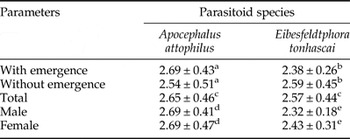
There was no significant difference (F 1, 331 = 2.12; P = 0.14) between the head capsule width of ants parasitized by either A. attophilus or E. tonhascai (table 1). Likewise, there was no significant difference between the head capsule width of parasitized ants with and without the emergence of adult parasitoids, for either A. attophilus (F1, 166 = 3.29; P = 0.07) or E. tonhascai (F1, 164 = 3.31; P = 0.07) (table 1).
Head capsule width (mm) of Atta sexdens workers (Mean ± SD) parasitized by Apocephalus attophilus and Eibesfeldtphora tonhascai. Letters indicate statistical significance by Tukey's test (α = 0.05).

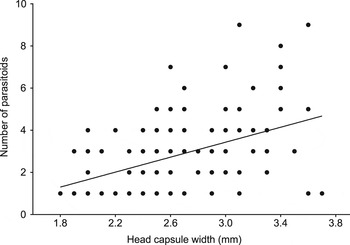
A significant positive correlation was found (r = 0.37; P < 0.01) between the head capsule width of the parasitized ants and the number of adult parasitoids A. attophilus emerged (fig. 1).
Number of Apocephalus attophilus individuals emerged and the head capsule width (mm) of Atta sexdens workers parasitized.

Only one pupa of E. tonhascai was everpresent between the jaws of each parasitized ant, whereas the number of pupae of A. attophilus per parasitized ant ranged from 1 to 15, and were found externally on the ants body.
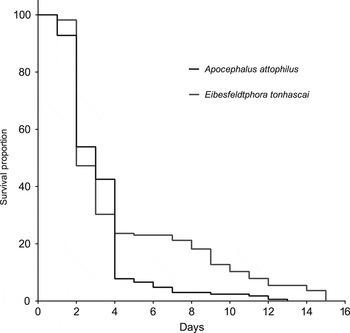
Ants parasitized by E. tonhascai survived significantly longer (χ2 = 4.19; df = 1; P = 0.04) than those parasitized by A. attophilus (4.3 ± 0.29 days; Mean ± SE) and 3.2 ± 0.14, respectively) (fig. 2).
Survival proportion (in days) of Atta sexdens workers parasitized by Apocephalus attophilus and Eibesfeldtphora tonhascai.

There was no significant difference between the head capsule width of ants parasitized with male or female offspring of A. attophilus (F 1, 118 = 2.39; P = 0.98) and E. tonhascai (F 1, 15 = 0.59; P = 0.45) (table 1). In addition, there was no significant difference in the sex ratio (male: female) of the offspring of both A. attophilus (1: 1.20; χ2 = 2.80; df = 1; P = 0.09) and E. tonhascai (1: 1.29; χ2 = 0.06; df = 1; P = 0.80).
Discussion
The parasitism rate observed in this study is consistent with other studies in Brazil that focused on the hosts A. sexdens (2.2%) (Tonhasca, Reference Tonhasca1996) and Atta laevigata Smith (2.8%) (Erthal & Tonhasca, Reference Erthal and Tonhasca2000). For Atta vollenweideri Forel, a parasitism rate of 0.8–20.2% was observed in Argentina, and this high variation appears to be influenced by the climatic conditions in the region (Elizalde & Folgarait, Reference Elizalde and Folgarait2011).
The difference found between the pupal period of A. attophilus and E. tonhascai is likely related to the innate developmental rate of each species as well as to the different selection pressures posed upon each of them (Elizalde & Folgarait, Reference Elizalde and Folgarait2011; Guillade & Folgarait, Reference Guillade and Folgarait2011). The shorter pupal period of A. attophilus could be advantageous by reducing its exposure time to external adversities (e.g., hyperparasitoids, predators, pathogens), because its pupae (vulnerable stage) remain outside the ant's body until adult emergence. In addition, the shorter pupal period of A. attophilus contributes to a faster life cycle, which in turn may allow for more generations per unit of time than its competitors (e.g., E. tonhascai). Differences in pupal period were also observed for the phorids Apocephalus setitarsus Brown and Eibesfeldtphora trilobata Disney parasitizing the ant A. vollenweideri in Argentina (Guillade & Folgarait, Reference Guillade and Folgarait2011). Another species of phorid fly associated with A. sexdens is Myrmosicarius grandicornis, which unlike A. attophilus it completes the entire pupal period inside the ant's head capsule. Ants parasitized by this phorid species lose some mouthparts, and the head detaches from the body, which probably provides the parasite larvae with less exposure to outside adversities, thereby making it less risky to have a longer pupal period (Tonhasca et al., Reference Tonhasca, Bragança and Erthal2001). Overall, it is believed that these differences of parasitoid pupal period and in/on-host location where they pupate have important ecological implications for parasitoid fitness.
The similarity of the head capsule width among ants parasitized by A. attophilus or E. tonhascai may be due to some overlap in the time of their parasitism activities. For example, A. attophilus is known to parasitize during day and night, whereas E. tonhascai parasitizes only during the day (Bragança et al., Reference Bragança, Souza, Nogueira and Della Lucia2008), thus allowing a diurnal overlap in the parasitism of ants with similar head capsule width. Nonetheless, this partial overlap in their parasitism activities may still allow for a niche partition. For example, the parasitoids Pseudacteon litoralis Borgmeier are more active in the early morning and evening while Pseudacteon tricuspis Borgmeier are more active in the afternoon, which allows the exploitation of the same host by both parasitoids (Pesquero et al., Reference Pesquero, Campiolo, Fowler and Porter1996). In addition, the parasitoids also differ in the selection of hosts, A. attophilus selects the workers in the foraging area, landing on leaf fragments carried by ants to lay their eggs (Erthal & Tonhasca, Reference Erthal and Tonhasca2000) while E. tonhascai selects the workers with or without load along the trails (Bragança et al., Reference Bragança, Tonhasca and Della Lucia1998). Because superparasitism generates fitness disadvantages (Gandon et al., Reference Gandon, Rivero and Veraldi2006), these tactics used by parasitoids are likely to be important strategies to reduce competition among species.
The positive correlation observed between the size of ant's head capsule and the number of A. attophilus adults emerging is likely due to the fact that larger ants have more resource available for the development of the parasitoid larvae. This pattern and underlying mechanism has also been identified in the ant species A. laevigata (Erthal & Tonhasca, Reference Erthal and Tonhasca2000). This behavior also resembles that of the parasitoid Apocephalus paraponerae Borgmeier that can parasitize ants in the genera Ectatomma Smith, Odontomachus Latreille and Pachycondyla Smith, but prefer Paraponera clavata Fabricius because of the larger size of these ants (Morehead & Feener, Reference Morehead and Feener2000). The same pattern also was observed in the hymenopteran parasitoid Trichopria drosophilae Perkins in which more offspring developed from larger hosts (Wang et al., Reference Wang, Kaçar, Biondi and Daane2016). In fact, larger hosts are expected to provide better nutritional condition for the development of multiple parasitoid larvae (Liu et al., Reference Liu, Xu, Li and Sun2011). Then, focusing on future biological control program of leaf-cutting ants, bigger workers are more suitable to be selected because more flies can be produced per host.
The occurrence of only one pupa of E. tonhascai between the jaws of the host is a common characteristic observed in this genus. Similar observations have also been reported for E. erthali parasitizing A. laevigata (Bragança et al., Reference Bragança, Tonhasca and Moreira2002), and Eibesfeldtphora bragancai Brown parasitizing Atta bisphaerica Forel (Bragança et al., Reference Bragança, Della Lucia and Tonhasca2003). The number of A. attophilus pupae found per parasitized ant in our study (1–15 pupae per host) was higher than that recorded for A. laevigata, (4–7 pupae) (Bragança & Medeiros, Reference Bragança and Medeiros2006). Polyembryony may be the mechanism responsible for the formation of multiple larvae in the same host as reported for Atta colombica Guerin (Feener & Moss, Reference Feener and Moss1990). In this case, the occurrence of a single parasitoid egg of A. attophilus was found to yield more than one larva per host. One of the hypotheses for the evolution of this development mechanism is the larval ability (phenotypic plasticity) to adjust its size according to the host's capacity (Craig et al., Reference Craig, Slobodkin, Wray and Biermann1997).
The shorter longevity of ants parasitized by A. attophilus (fig. 2) suggests that the larval stage development of this parasitoid species, like the pupal period discussed previously, is faster than E. tonhascai, which could be the cause of a more rapid death of the ants. In regards to workers of A. laevigata, the maximum longevity of parasitized ants by A. attophilus was lower compared with A. vicosae and E. erthali (Bragança & Medeiros, Reference Bragança and Medeiros2006). It is interesting to note that parasitized ants may continue to transport leaf fragments at the early stages of the parasitism (Braganca & Medeiros, Reference Bragança and Medeiros2006). As A. attophilus causes earlier death of the parasitized ants, this phorid may have a greater negative impact on the colony and this feature can be of special importance to biological control of leaf-cutting ants.
It is unclear what the equal sex ratio we found means ecologically, but it may translate into a more stable population growth where the subsequent generations would be of similar size (assuming that all other variables would be kept constant). Regardless, our findings also corroborate the results obtained for the parasitoids A. setitarsus, E. trilobata, Myrmosicarius brandaoi Disney and Myrmosicarius gonzalezae Disney parasitizing Atta vollenweideri Forel (Guillade & Folgarait, Reference Guillade and Folgarait2011), which show also a similar sex ratio for the emerging adult parasitoids. It is also known that variables such as temperature and genetics can influence the sex determination of the parasitoid Megaselia scalaris Loew (Disney, Reference Disney2008) and the same may occur in phorid parasitoids of the leaf-cutting ants Atta spp.
In summary, this field study provides important ecological information about the interaction between leaf-cutting ants and the phorid parasitoids A. attophilus and E. tonhascai. Studying the survival of the parasitized ants, parasitoid offspring sex ratio and host size preference allows for a better understanding of ant natural biological control in the field. Our results suggest that E. tonhascai may be an efficient biological control agent in the field because it engenders only one larvae per host, thus indicating a necessity to parasitize a higher number of hosts to reach realized fecundity. Although the parasitoids species did not show preference for ant head size, their difference in foraging time allows for some niche partitioning, which suggests a potential complementarity for ant biological control. Additionally, these data could be also important for biological control practitioners interested in rearing phorid parasitoids in laboratory. For example, A. attophilus could allow for the production of a higher number of parasitoids per unit of time because they produce multiple larvae per host in a shorter period of time. Lastly, this study also provides new insights into the body of knowledge regarding parasitism of Neotropical leaf-cutting ants.
Acknowledgements
We thank Thalles Pereira for helping with phorid identifications. We also thank the Coordenação de Aperfeiçoamento de Pessoal de Nível Superior (CAPES), Conselho Nacional de Desenvolvimento Científico e Tecnológico (CNPq) and Fundação de Amparo à Pesquisa de Minas Gerais (FAPEMIG) for the financial support. M. A. L. Bragança was supported by a grant from CNPq/BIONORTE and by an agreement between the Universidade Federal de Tocantins and the Secretaria Estadual do Desenvolvimento Econômico, Ciência, Tecnologia e Inovação de Tocantins (SEDECTI/TO).