Introduction
The rosy apple aphid, Dysaphis plantaginea (Passerini) (Homoptera: Aphididae), is a key pest of apple, both in Europe and North America. It causes damage to the fruits at low densities, and prolonged attack impairs shoot growth and reduces the formation of flower buds (Alford, Reference Alford1984). Like many temperate aphid species, D. plantaginea has a holocyclic, host-alternating life cycle, with apple (Malus spp.) as its primary or winter host plant and plantain (Plantago spp.) as secondary host plant. In autumn, winged gynoparae migrate to the primary host to give rise to a wingless generation of oviparous females. By the time these sexual morphs become adult, winged males arrive from the secondary host and mating takes place, after which the winter eggs are laid (Bonnemaison, Reference Bonnemaison1959; Blackman & Eastop, Reference Blackman and Eastop1984; Powell & Hardie, Reference Powell and Hardie2001).
How do male migrant aphids find the oviparae? Various studies have been carried out to elucidate the principles of mate location and reproductive isolation in aphid biology (Steffan, Reference Steffan1987; Guldemond, Reference Guldemond1990a; Guldemond et al., Reference Guldemond, Dixon, Pickett, Wadhams and Woodcock1993; Powell & Hardie, Reference Powell and Hardie2001). Pettersson (Reference Pettersson1970a) was the first to demonstrate that oviparous females release sex pheromones which attract males. More recent studies show the presence of sex pheromones in a number of aphid species (Hardie et al., Reference Hardie, Pickett, Pow, Smiley, Hardie and Minks1999). These sex pheromones mostly contain one or both of the monoterpenoids, nepetalactone and nepetalactol. The ratio between these components gives these blends a certain level of species specificity although the evidence for this is conflicting (Marsh, Reference Marsh1975; Eisenbach & Mittler, Reference Eisenbach and Mittler1987; Steffan, Reference Steffan1990; Hardie et al., Reference Hardie, Holyoak, Nicholas, Nottingham, Pickett, Wadhams and Woodcock1990, Reference Hardie, Nottingham, Dawson, Harrington, Pickett and Wadhams1992). It seems unlikely that different blends of the two pheromone components and their enantiomers alone can provide a species-specific attraction of the males, also taking into account that the ratio of the pheromone blend may vary with the age of the calling oviparae (Hardie et al., Reference Hardie, Holyoak, Nicholas, Nottingham, Pickett, Wadhams and Woodcock1990; Goldansaz et al., Reference Goldansaz, Dewhirst, Birkett, Hooper, Smiley, Pickett, Wadhams and McNeil2004). Steffan (Reference Steffan1987) and Guldemond (Reference Guldemond1990a) argued that the primary host plant must play an important role in reproductive isolation because of the limited range of aphid sex pheromone components found. It has also been suggested that species-specificity is related to spatial and temporal isolation of the different aphid species (Hardie et al., Reference Hardie, Holyoak, Nicholas, Nottingham, Pickett, Wadhams and Woodcock1990). Many species, however, reproduce in the same time period, and their host-plants are found in the same area which excludes this possibility for many aphid species. In some cases, differences in daily rhythm of release of the sex pheromone are suggested to play a role (Guldemond & Dixon, Reference Guldemond and Dixon1994; Thieme & Dixon, Reference Thieme and Dixon1996). Powell & Hardie (Reference Powell and Hardie2001) suggested that synergistic interaction between aphid sex pheromones and host-plant volatiles is important for species-specificity in mate finding. Attraction to host-plant extracts or single plant compounds has been reported (Pettersson, Reference Pettersson1970b; Nottingham et al., Reference Nottingham, Hardie, Dawson, Hick, Pickett, Wadhams and Woodcock1991; Park et al., Reference Park, Elias, Donato and Hardie2000) but in the field no increased attraction was found (Hardie et al., Reference Hardie, Storer, Nottingham, Peace, Harrington, Merritt, Wadhams and Wood1994). Hardie et al. (Reference Hardie, Storer, Nottingham, Peace, Harrington, Merritt, Wadhams and Wood1994), however, showed that the combination of a pheromone blend with the plant volatiles selectively increased male aphid attraction of Rhopalosiphum padi, indicating interaction between pheromone and host-plant odours. To our knowledge for only two aphid species, R. padi and Phorodon humuli, host-plant volatiles have been found to increase responses to the sex pheromone (Campbell et al., Reference Campbell, Dawson, Griffiths, Pettersson, Pickett, Wadhams and Woodcock1990; Hardie et al., Reference Hardie, Storer, Nottingham, Peace, Harrington, Merritt, Wadhams and Wood1994; Lösel et al., Reference Lösel, Lindemann, Scherkenbeck, Maier, Engelhard, Campbell, Hardie, Pickett, Wadhams, Elbert and Thielking1996a,Reference Lösel, Lindemann, Scherkenbeck, Campbell, Hardie, Pickett and Wadhamsb; Pope et al., Reference Pope, Campbell, Hardie, Pickett and Wadhams2007). There are, however, no reports of host-plant manipulation by aphids to increase selectivity of attraction to the sex pheromone. We hypothesize that this mechanism plays a role in species-specific mate finding of host alternating aphid species like the rosy apple aphid, D. plantaginea.
In this study, we addressed the following question: do host plant volatiles whose production is induced by the presence of female aphids affect the attractiveness and selectivity of the pheromone blend to male conspecifics? The presented work was carried out with the sexual generation of the rosy apple aphid, D. plantaginea.
Material and methods
Volatiles were collected from potted apple trees, with and without oviparae of D. plantaginea, and the antennal response to these odours of male aphids were measured by gas chromatography coupled with electroantennogram detection (GC-EAD). Compounds giving an electrophysiological response were tentatively identified by gas chromatography coupled with mass-spectrometry (GC-MS). When the tentatively identified compound showed similar Kováts indices on our chromatographic system as the purchased synthetic reference compound, it was considered to be a positive identification. Differences between the trapped volatiles from trees, with and without female aphids, were quantified. A selection of plant volatiles that both gave an electrophysiological reaction on the male antenna and that were unique or found at higher levels in entrainments from plants with oviparae was tested under field conditions in combination with the aphids' pheromone components.
Insects
Rosy apple aphids were mass-reared in a climate chamber on plantain (Plantago lanceolata L.) under long day conditions (photoperiod L:D=18:6 h) after Blommers et al. (Reference Blommers, Helsen and Vaal2004). For the production of gynoparae and males, plantain plants with aphids were kept in cages under short day conditions (L:D=12:12 h) at 20°C. To produce age cohorts of oviparae, adult gynoparae were transferred from the cages to glass tubes with a detached apple leaf. After 24 h, the gynoparae were removed and the leaves with young oviparae were attached to leaves of potted apple trees (M9 rootstock). Within a few days, the oviparae left the desiccating leaves and settled on the leaves of the potted plant.
Headspace collection
Four 50-cm high potted apple trees (M9 rootstock) without fruits, grown and kept outdoors, were used for headspace collection. On two days (26/9 and 8/10), an apple tree, with and without oviparae of D. plantaginea, was placed under a glass bell jar (19 l) in a growth chamber at 20°C and under short day (L:D=12:12 h) light conditions. Trees with aphids had several hundreds of oviparae (approximately ten per leaf) of minimum 12 and maximum 17 days old. Oviparae on each plant were checked for being adult prior to sampling the trees. Air was purified by passage through a charcoal filter and drawn at 0.2 l min−1 through the jar. Volatiles were entrained for a total of six hours per plant per day (10:00–16:00 h). For the collecting of volatiles, Gerstel thermodesorption tubes, filled with 80 mg Tenax TA 20/35 mesh (Grace-Alltech), were used. Before use, these tubes were cleaned by rinsing them with 10 ml hexane and, subsequently, flushing them for one hour at 280°C with 20 ml min−1 purified nitrogen. The two-day Tenax washings of two trees, with and two without oviparae, were pooled to one concentrated extract for each treatment prior to GC-EAD testing. Each extract contained, therefore, an entrainment of a total of 12-h volatile collection from two different trees. For GC-MS analysis, an extra 6-h headspace collection (27/9; 10:00–16:00 h) of the trees, with and without oviparae, was performed one day after the 26/9 volatile collection. The volatiles in these Tenax tubes were directly analysed via thermal desorption chromatography and used for identification of the EAD-active components.
Thermodesorption GC-MS
Thermal desorption chromatography was performed using a Thermodesorption System (TDS-G) (Gerstel, Mülheim am Ruhr, Germany) coupled to a GC-MSD (HP 6890 plus 5973 MSD) equipped with a split/splitless PTV-injector (CIS 4, Gerstel). The TDS-G was operated in splitless mode and GC was operated in split mode. Samples were desorbed with 50 ml min−1 helium at the following temperature conditions: 25°C (0.1 min hold) to 300°C (4 min hold) at 60°C min−1). Volatiles were collected in the PTV injector at −50°C and desorbed at following temperature conditions: −50°C to 300°C (3 min hold) at 12°C sec−1.
The GC was equipped with a Grace-Alltech EC-5 column (30 m×0.25 mm×0.25 μm) run in constant pressure mode (60 kPa He) and the following oven temperature program: 50°C (4 min hold) to 300°C (21 min hold) at 10°C min−1, transferline temperature, 300°C.
Coupled gas chromatography electroantennographic detection (GC-EAD)
GC-EAD measurements were carried out using an Interscience Trace GC-2000 (Interscience, Breda, The Netherlands) equipped with a cold on-column injector. The gas chromatograph was equipped with a Grace-Alltech 30 m EC-5 fused silica column, 0.25-mm ID and 0.25-μm film thickness. Conditions were: carrier gas, helium (constant flow 1.7 ml min−1); temperature programming, 80°C (0.8 min hold) to 260°C (10 min hold) at 25°C min−1; detector temperature, 250°C; the transfer line between the GC and the EAD (Syntech Laboratories, Hilversum, The Netherlands) followed the oven temperature. Over the antenna, a flow of purified, humidified air was maintained at a flow rate of 80 cm sec−1. The sample was equally split between a flame ionisation detector (FID) and the EAG detector. Antennae were separated from the aphid bodies and mounted between two glass electrodes filled with a ringer solution (6.4 mm KCl, 12 mm MgCl2.6H2O, 9.6 mm KOH, 12 mm NaCl, 20 mm KH2PO4, 1 mm CaCl2 and 354 mm glucose in deionised water). Antennal preparation and EAG recording were performed according to the procedure described by Visser & Piron (Reference Visser and Piron1995) and Van Tol et al. (Reference Van Tol and Visser2002). The EAG recorder plus peripheral equipment were manufactured by Syntech Laboratories. Approximately ten antennal preparations with limited background noise for each treatment showing responses to several compounds in the extract were used for comparison. Only EAG responses that were present in all preparations at the same retention time (Rt) were identified as an EAG positive response to a compound in the extract.
Compounds and treatments
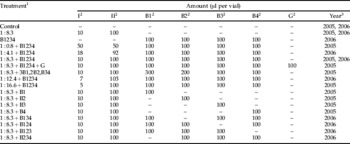
Different compositions and ratios of the tentatively identified plant compounds from the headspace of apple trees infested with oviparae of D. plantaginea were combined with the sex pheromone enantiomers from the rosy apple aphid. Selections of combinations of plant compounds and pheromone for the field trials were based on the combined results of positive EAD response by male D. plantaginea and increased levels or unique presence in the headspace of apple trees with oviparae compared to non-infested apple trees (table 1). We excluded, however, the increased levelled and EAD-positive green leaf volatiles, (E/Z)-3-hexenol and (E/Z)-3-hexenyl acetate from our selection because we assume these compounds not to be plant-species specific enough for the aphids to select their host plant. We cannot, however, exclude that these compounds play a role in synergizing attraction to the other plant compounds and/or pheromone but were unfortunately limited in capacity for field trials. A mixture of the pheromone components (4aS,7S,7aR)-nepetalactone (I) and (1R,4aS,7S,7aR)-nepetalactol (II) was used in the field experiment for the attraction of Dysaphis plantaginea (Hardie et al., Reference Hardie, Pickett, Pow, Smiley, Hardie and Minks1999). Fitzgerald et al. (Reference Fitzgerald, Pope, Solomon, Poppy, Jones and Wadhams2005) found an optimal attraction of male D. plantaginea in the field to the ratio I:II in the range of 1:5 to 1:10, and our preliminary field trial in 2004 with a 1:8.3 mixture of these compounds appeared to be more attractive to male D. plantaginea than lower ratios. The ratio 1:8.3 was obtained by mixing the compounds in a volume to volume ratio of 1:10. Taking into account the purities of the compounds, this resulted in a 1:8.3 ratio. The same field trial in 2004 indicated that a mixture of the esters, hexyl butyrate, (E)-2-hexenyl butyrate, (Z)-3-hexenyl 3-methylbutyrate and hexyl 2-methylbutyrate released by apple trees was most promising in improving selective attraction of D. plantaginea males. Based on these results, the standard ratio of I:II in our field trials was set to 1:8.3; and this ratio was tested next to several other ratios, in combination with the esters, for the selective trapping of D. plantaginea. All treatments are summarised in table 2. The aphid pheromone compounds (4aS,7S,7aR)-nepetalactone (purity 76%) and (1R,4aS,7S,7aR)-nepetalactol (purity 63%) were obtained from Botanix Ltd, Kent, UK; hexyl butyrate (purity 98%), (E)-2-hexenyl butyrate (purity 96%), (Z)-3-hexenyl 3-methylbutyrate (purity 97%), hexyl 2-methylbutyrate (purity 97%) and geranyl acetone (purity 65%, remainder neryl acetone) were obtained from Sigma-Aldrich. All chemicals were used without prior purification. The hexyl 2-methyl butyrate product for field testing consisted of a mixture of the two existing enantiomers, as we have not determined the chirality of this compound released by the apple leaves.
Volatile emission of non-infested and female Dysaphis plantaginea infested apple leaves and antennal response of male D. plantaginea aphids to the emitted compounds (pooled extract).

1 Retention time in minutes on GC-MS.
2 Percentage relative to area peak of (E,E)-α-farnesene in apple leaves without oviparae (=100).
3 Increase factor release compounds in leaves+oviparae to leaves−oviparae.
4 Antennal responses on GC-EAD.
5 Approximate values due to poor resolution of E/Z compounds in GC-MS.
Treatments applied in an apple orchard in 2005 (N=5) and 2006 (N=4) for aphid trapping and amounts (μl per vial) of each compound initially applied per vial mounted centrally above a clear Petri dish water trap.

1 Ratio's (1:0.8 up to 1:16.6) present ratio of compound I relative to II and are based on the purity of the two compounds in the commercial product (I: 76%; II: 63%); All treatments with B and G contain equal amounts of each compound except for treatment 1:8.3+3B1, 2B2, B34 where B1 to B4 is applied in the ratio 3:2:1:1.
2 I, (4aS,7S,7aR)-nepetalactone; II, (1R,4aS,7S,7aR)-nepetalactol; B1, hexyl butyrate; B2, (E)-2-hexenyl butyrate; B3, (Z)-3-hexenyl 3-methylbutyrate; B4, hexyl 2-methyl butyrate; G, geranyl acetone.
3 Year when tested in the field.
Dispensers
Pheromone and plant volatile dispensers were made of 1.5 ml LDPE Pasteur pipettes (Labo Scientific, Ede, The Netherlands). The mixtures to be tested were introduced into the pipette, the tip of which was then sealed by heat. Prior to use, the tip of the pipette was cut off at 1 cm above the reservoir part. The open tip of the dispenser had an internal diameter of 3.5 mm. This type of ‘high release’ pheromone/kairomone dispenser are developed and used by Pherobank (www.pherobank.com) for several years for the attraction of Phyllopertha horticola weevils. Closed dispensers do not release high enough amounts of the plant volatiles through the polyethylene to attract these weevils compared to partially opened vials. The dispenser is a simple and cheap existing design which enables a high release profile especially for larger quantities of plant volatiles. Pheromones and plant volatiles were present as pure commercial compounds mixed in one dispenser according to the compound composition as described in table 2.
Trap design
Water traps consisted of clear plastic Petri dishes (14 cm ø×2 cm deep). Dishes were filled with a dilute detergent solution (Agral LN, Syngenta Crop Protection) and the pheromone dispensers were suspended 3 cm above the centre of the water (after Hardie et al., Reference Hardie, Nottingham, Powell and Wadhams1991) in a vertical position (open tip on top). The dishes were mounted on wooden poles at 1 m above the ground. Traps were positioned near the tree canopies. Weekly traps were emptied; lures refreshed and treatment positions re-randomised. Control traps contained an empty dispenser.
Field experiments
Experiments were performed in two consecutive years (2005 and 2006) in a high density (2700 trees ha−1) apple orchard at the Applied Plant Research Station in Randwijk, The Netherlands. Five replicates in 2005 and four replicates in 2006 for each treatment were divided over the plantation. The distance between the traps was nine metres. Aphids were collected three times a week from the water traps, and treatment positions were re-randomised and lures were refreshed once a week. Traps were placed in the test field between 3 October and 4 November in 2005 and between 2 and 23 October in 2006. Collected aphids were stored in 70% ethanol, and the number of male D. plantaginea and the total number of aphids in the samples were counted afterwards. In 2005, aphids were trapped during a 32-day period. In 2006 aphids were trapped in the same apple orchard used in 2005 during a 21-day period. For each trap, the total number of aphids and male D. plantaginea were counted. In the 2006 field trial, three treatments of 2005 were repeated as standard comparison (unbaited control, pheromones alone (1:8.3 ratio) and pheromone (1:8.3)/ester (1:1:1:1) blend), and seven new combinations of pheromone/ester blends were tested. Identification of male Dysaphis spp. at genus level is based on the work of Stroyan (Reference Stroyan1957, Reference Stroyan1963) and Heie (Reference Heie1982). Based on this work, it is possible to discriminate between males of D. plantaginea and other Dysaphis spp., except for D. aucupariae. All males were thus identified as one of these two species. Although we cannot exclude completely that we also caught males of D. aucupariae, we assume that most or all were D. plantaginea because the single winter host of D. aucupariae is Sorbus torminalis, which is a non-native tree species in The Netherlands, only rarely found in gardens as an ornamental tree, and our trials were performed in a apple orchard with no S. torminalis present in or nearby the orchard.
Statistics
The field tests were set-up as randomised block designs. The mean number of male D. plantaginea (and the mean number of other aphids) per trap were analysed with a GLM (generalised linear model) with logarithmic link, Poisson distribution and not fixed dispersion. The fixed part of the model consists of the additive effects of replicate and pheromone. After the analysis, pairwise comparisons are made on the transformed scale with approximate t-tests. Thereafter, estimates of the means of male D. plantaginea and other aphids are back transformed to the original scale with approximate standard errors.
Results
GC-MS and GC-EAD of headspace collected volatiles
The EAD of male D. plantaginea to tenax-trapped compounds from the headspace of apple leaves, infested and non-infested with oviparae, revealed positive response to a range of compounds (table 1). These compounds were tentatively identified by GC-MS, through comparison of their chromatographic properties with authentic synthetic samples. Comparison of both headspace fractions (table 1) revealed that apple leaves infested with oviparae compared to non-infested apple leaves emitted increased amounts of (E/Z)-3-hexenol, (E/Z)-3-hexenyl acetate, hexyl butyrate, (Z)-3-hexenyl butyrate, (E)-2-hexenyl butyrate, (Z)-3-hexenyl 3-methylbutyrate, hexyl 2-methylbutyrate, β-caryophyllene, δ-3-carene and geranyl acetone. Further, we detected the sex pheromones, (1R,4aS,7S,7aR)-nepetalactol and (4aS,7S,7aR)-nepetalactone, uniquely in the headspace of apple leaves infested with oviparae. Compounds not increased, but showing positive EAD response, were α-terpinene, (E)-4,8-dimethyl-1,3,7-nonatriene, methyl salicylate and germacrene D.
For the field experiment in 2005, we chose compounds that were increased or unique for apple leaves infested with oviparae and showing EAD-positive response on the male antenna of D. plantaginea except δ-3-carene (not available at the time of the start of the field trial). The choice of treatments for 2006 was based on the results of the 2005 field trial.
Field trial in 2005
Results are presented in fig. 1. The number of male D. plantaginea caught in unbaited control traps was significantly lower than in the ‘pheromone only’ treatment (P=0.02) and significantly more ‘other’ aphid species were caught in the pheromone treatment than in the control (P<0.001).
Mean (+SE) number of male Dysaphis plantaginea and other aphids caught in clear (uncoloured) water traps with different lures (weekly refreshed; for treatment codes see table 2) in an apple orchard in 2005 over a 32-day period of sampling (N=5). Letters (small for Dysaphis plantaginea and capital for other aphids) in the top of each bar indicate the significant differences after GLM analysis followed by pairwise comparison of the treatments with t-tests at P=0.05 (□, other aphids; ▪, male D. plantaginea).

Addition to the pheromone blend of the esters hexyl butyrate (B1), (E)-2-hexenyl butyrate (B2), (Z)-3-hexenyl 3-methyl butyrate (B3) and hexyl 2-methylbutyrate (B4) in a 1:1:1:1 ratio did not increase the number of male D. plantaginea compared to the pheromone treatment (P=0.11) but decreased the number of other aphids in these traps compared to the pheromone traps (P<0.001), thus strongly increasing the proportion of male D. plantaginea in the pheromone/ester traps.
By changing the ratio of the pheromone components in this blend to 1:0.8, the attractiveness for male D. plantaginea decreased to the level of the control traps (P=0.93), and the attractiveness for other aphid species strongly increased compared to the control (P<0.001). A ratio of the pheromone components I and II of 1:16.6 in this blend resulted in male D. plantaginea numbers that were not significantly lower than in the 1:8.3 blend (P=0.19) but were significantly higher than in the unbaited control traps (P=0.01). The number of other aphids was higher than in the control (P=0.003) but comparable to the 1:8.3 pheromone/ester blend (P=0.58).
Combinations of the 1:8.3 pheromone blend with each single ester were less attractive for male D. plantaginea than the combination with the four esters together (B1, P=0.002; B2, P=0.01; B3, P=0.003; B4, P=0.002) and did not attract more Dysaphis males than the control trap (P=0.57 (B1); P=0.14 (B2); P=0.42 (B3); P=0.57 (B4)). Changing the ratio of the esters in the blend from 1:1:1:1 to 3:2:1:1 did not increase the attractiveness for D. plantaginea males (P=0.38).
Addition to the pheromone (1:8.3)/ester (1:1:1:1) blend of geranyl acetone did not result in significantly higher numbers of D. plantaginea males per trap compared to the pheromone/ester blend (P=0.73) but did result in significantly higher numbers than in the unbaited control trap (P=0.001). The combination of the pheromone components with geranyl acetone alone was not attractive for the males of D. plantaginea compared to the control traps (P=0.49).
Field trial in 2006
Results of the 2006 field trial are presented in fig. 2. The number of male D. plantaginea caught in unbaited control traps was not significantly different from the pheromone treatment (P=0.84) but significantly less other aphid species were caught in the control than in the pheromone treatment (P=0.001).
Mean (+SE) number of male Dysaphis plantaginea and other aphids caught in clear (uncoloured) water traps with different lures (weekly refreshed; for treatment codes see table 2) in an apple orchard in 2006 over a 21-day period of sampling (N=4). Letters (small for Dysaphis plantaginea and capital for other aphids) in the top of each bar indicate the significant differences after GLM analysis followed by pairwise comparison of the treatments with t-tests at P=0.05 (□, other aphids; ▪, male D. plantaginea).

Additions to the pheromone blend of the esters hexyl butyrate (B1), (E)-2-hexenyl butyrate (B2), (Z)-3-hexenyl 3-methylbutyrate (B3) and hexyl 2-methylbutyrate (B4) in a 1:1:1:1 ratio did not increase the number of male D. plantaginea (P=0.10) but decreased the number of other aphids (P=0.001) significantly compared to the pheromone treatment.
By changing the ratio of the pheromone components I and II in this blend to 1:12.4, the attractiveness for male D. plantaginea increased strongly compared to unbaited control traps (P=0.001), as well as to the 1:8.3 pheromone/ester blend (P=0.002). The attractiveness for other aphid species was not different from the control (P=0.88) and the 1:8.3 pheromone/ester blend (P=0.74). A ratio of the pheromone components I and II of 1:4.1 in this pheromone/ester blend resulted in male D. plantaginea numbers that were not significantly different from the 1:8.3 pheromone/ester blend (P=0.16) or the unbaited control traps (P=0.85) but were significantly lower than in the 1:12.4 pheromone/ester blend (P=0.001). The number of other aphids was higher than in the control (P=0.01), the 1:8.3 pheromone/ester blend (P=0.02) and the 1:12.4 pheromone/ester blend (P=0.01).
Different combinations of the pheromone components I and II in a 1:8.3 ratio with three of the four esters showed that only the combination of the pheromones with the ester mixture (ratio 1:1:1) B1, B2 and B4 or B2, B3 and B4 increased attractiveness for male D. plantaginea relative to the control (B124, P=0.01; B234, P=0.006) and the ‘pheromone only’ treatment (B124, P=0.01; B234, P=0.006), while the other two possible combinations (B1, B2, B3 and B1, B3, B4) were not effective (B123, P=0.07; B134, P=0.10). All four three-ester combinations had no effect on attractiveness for other aphids, catching numbers comparable to the control (B123, P=0.37; B134, P=0.42; B124, P=0.83; B234, P=0.40).
A water trap with the complete ester blend only as a lure revealed no differences in numbers of male D. plantaginea (P=0.31) and other aphids caught (P=0.15) compared to the control.
Discussion
This study provides the first evidence that aphids use conspecific-induced plant volatiles as a species-specific synergist of the sex pheromone for mate finding. The females of the host-alternating rosy apple aphid (D. plantaginea) enhance specific attraction of males to females by female-induced tree odours in combination with the aphid sex pheromone components (4aS,7S,7aR)-nepetalactone and (1R,4aS,7S,7aR)-nepetalactol. Female aphid infestation induces the increased release of four esters (hexyl butyrate, (E)-2-hexenyl butyrate, (Z)-3-hexenyl 3-methylbutyrate and hexyl 2-methylbutyrate) among other volatiles from apple trees. These esters increase the number of male D. plantaginea and decrease the number of other aphid species caught in water traps in the presence of the pheromone components. Since these esters without the sex pheromone are not attractive for male D. plantaginea, the esters can be considered as a sexual kairomone (Ruther et al., Reference Ruther, Reinecke and Hilker2002) for the rosy apple aphid.
Induced plant volatiles
Aphids, like many other insect species, use host-plant specific characteristics for orientation at some stage in their search for suitable food and/or mate finding. Colour, odour and contact cues play a role in the sequential search and acceptance of a potential host-plant. For several aphid species, attraction to plant extracts and specific plant compounds has been shown in laboratory tests (Pettersson, Reference Pettersson1970b; Nottingham et al., Reference Nottingham, Hardie, Dawson, Hick, Pickett, Wadhams and Woodcock1991; Park et al., Reference Park, Elias, Donato and Hardie2000); but, only for a few aphid species, plant odours have been shown to play a role in the field in combination with the aphid sex pheromone only (Campbell et al., Reference Campbell, Dawson, Griffiths, Pettersson, Pickett, Wadhams and Woodcock1990; Hardie et al., Reference Hardie, Storer, Nottingham, Peace, Harrington, Merritt, Wadhams and Wood1994; Lösel et al., Reference Lösel, Lindemann, Scherkenbeck, Maier, Engelhard, Campbell, Hardie, Pickett, Wadhams, Elbert and Thielking1996a,b; Pope et al., Reference Pope, Campbell, Hardie, Pickett and Wadhams2007). In contrast to attractiveness of healthy host-plants, host-plants damaged by conspecifics are avoided by the aphids, most likely because the SOS-signalling of these plants attracts natural enemies (Bernasconi et al., Reference Bernasconi, Turlings, Ambrosetti, Bassetti and Dorn1998). Indeed, several studies have identified induced plant volatiles after aphid infestation and observed the consecutive attraction of the aphids' natural enemies to the plants (Guerrieri et al., Reference Guerrieri, Pennacchio and Tremblay1993; Micha & Wyss, Reference Micha and Wyss1995; Du et al., Reference Du, Poppy, Powell, Pickett, Wadhams and Woodcock1998). Since our study shows that males of the rosy apple aphid are attracted to a synthetic mixture of induced apple tree odours in combination with the aphids' sex pheromone, we hypothesize that male aphids use these plant volatiles as a species-specific attractant in combination with the sex pheromone. Since all studies so far show that aphids use the same two components, nepetalactol and nepetalactone, as a sex pheromone, herbivore-induced plant volatiles via aphid female feeding could create a high degree of specificity for male aphids to locate the females. Induced plant volatiles create an even more specific target for the males to find the females than general host-plant odours of apple trees, as it likely excludes attraction to host-plants not infested with females. Future studies have to reveal whether the specific esters induced and released in increased amounts by infested apple trees are unique for trees infested by this aphid species alone or whether other aphids and/or other herbivores induce the production and release of a similar odour blend. It may be that the induced odours are commonly produced by apple trees infested with other herbivores but that specificity for the rosy apple aphid is found in the combination of the sex pheromone and the esters released from the same tree. To our knowledge, there are, however, no studies showing that apple trees release (increased) amounts of these bio-active esters when damaged by other herbivores. Actually, it is only in our study that we detect all these compounds also in non-infested apple trees, which may be caused by our choice of an apple rootstock (M9) as a test plant instead of an apple cultivar as all other studies have used. Analysis of undamaged apple tree leaves in studies using apple cultivars reveal several compounds we find in larger quantities as well (e.g. (Z)-3-hexenol, (Z)-3-hexenyl acetate, (E)-4,8-dimethyl-1,3,7-nonatriene, β-caryophyllene, germacrene D and (E,E)-α-farnesene) but none of the four induced esters we identified from aphid-infested apple tree leaves of the rootstock apple, M9. In contrast to the leaves, full-grown apples release many more esters, including the two esters, hexyl butyrate and hexyl 2-methylbutyrate induced by aphid-infested leaves in our trials (Bengtsson et al., Reference Bengtsson, Bäckman, Liblikas, Ramirez, Borg-Karlson, Ansebo, Anderson, Löfqvist and Witzgall2001). The other two esters, (E)-2-hexenyl butyrate and (Z)-3-hexenyl 3-methylbutyrate, induced by D. plantaginea oviparae on apple leaves, to our knowledge, have not been reported to be produced and released by apple fruits or leaves of tested cultivars.
The separate ester compounds in combination with the pheromone failed to enhance specific attraction of male D. plantaginea, but tests with combinations of three of the four esters with the pheromone indicated that two combinations of three compounds were enhancing attraction. The combination of (E)-2-hexenyl butyrate, (Z)-3-hexenyl 3-methylbutyrate and hexyl 2-methylbutyrate was enhancing specific attraction stronger, but not significantly better, than the combination of hexyl butyrate, (E)-2-hexenyl butyrate and hexyl 2-methylbutyrate. These results indicate that possibly not all four esters are involved in enhancing attraction and/or the current ratio of the compounds has to be changed in order to attract more male D. plantaginea. Presence of the compounds (E)-2-hexenyl butyrate and hexyl 2-methylbutyrate seems critical for enhanced attraction. The role of the other two compounds remains unclear, and follow-up tests with different combinations of two esters with the pheromone as well as varying the ratios of the compounds are needed to clarify the importance of the different esters in attraction. A ratio of the four esters based on approximate quantitative data from the headspace collection of apple trees infested with oviparae was not effective; but, as with the pheromone components volatility, dispenser type and other factors influence the actual release rate and the tested ratio may not be relevant. Determining the actual release rate of these components may be interesting; but, as shown with pheromone field work, the relation is usually weak and randomly testing different ratios of these compounds in the field is essential to optimise the ester composition in dispensers.
Pheromone ratio
Numerous studies have examined how aphid species, sharing the same two sex pheromone components, are able to distinguish mates of their own species from other species. In some cases, different enantiomers determine specificity; and, in others, a clear distinctive ratio between the two components plays a role in species-specific attraction. Our results show that varying ratios of the two sex pheromone components of rosy apple aphid in combination with the esters also has a clear effect on the absolute catch and proportion of this aphid species in the total catch. A striking difference between the results of 2005 and 2006 was the effect of 1:8.3 vs. control. In 2005, there was a significant increase of D. plantaginea males caught, as well as other aphids. In 2006, this effect was only observed for other aphids and not for D. plantaginea. We have no good explanation for this difference other than that there are unknown year-to-year factors that vary and influence the pheromone (in the applied ratio) efficacy. The population size of rosy apple aphid and other aphids are different between the two test years and may also influence the result, as well as the composition of the synergising esters. In 2006, a ratio of 1:12.4 with the four esters was more attractive than 1:8.3 with the esters; whereas, in 2005, the ratio 1:16.6 with esters was equally well attractive as the 1:8.3 with esters, suggesting that the optimum ratio in combination with the esters lies somewhere between 1:8.3 and 1:16.6. The four esters do not show a consistent synergising effect but other combinations of only three of the four esters do synergise the effect of the pheromone (only 1:8.3 ratio tested). Fitzgerald et al. (Reference Fitzgerald, Pope, Solomon, Poppy, Jones and Wadhams2005) determined the optimum pheromone ratio for catching rosy apple aphid males, by testing different ratios of the two pheromone components, and found an optimum catch at around 1:10. Follow-up studies are needed to determine the optimum ratio of pheromone components with the relevant synergising esters. Several studies also show that the release ratio of the pheromone components varies within one aphid species in relation to the age of the females (Hardie et al., Reference Hardie, Holyoak, Nicholas, Nottingham, Pickett, Wadhams and Woodcock1990; Goldansaz et al., Reference Goldansaz, Dewhirst, Birkett, Hooper, Smiley, Pickett, Wadhams and McNeil2004). It is, therefore, even more doubtful that species-specific attraction with this age-varying release ratio can be maintained without any other species-specific synergising compound(s) of aphid or host-plant origin. Others have suggested that specificity occurs only after contact between the sexes and/or that incompatibility between male sperm and females of other species, copulation incompatibility or reduced fitness of hybrids plays a role (Müller, Reference Müller1982, Reference Müller1985; Thieme, Reference Thieme1988; Guldemond, Reference Guldemond1990b; Hardie et al., Reference Hardie, Holyoak, Nicholas, Nottingham, Pickett, Wadhams and Woodcock1990; Guldemond et al., Reference Guldemond, Dixon and Tigges1994). This random search mechanism seems unlikely where so many aphid species are present and finding conspecific females in a relative short time is essential to reproduce successfully. Spatial and temporal isolation of different aphid species can certainly explain species-specificity for some, but not all, aphid species. More likely, the combined use of pheromone and host-plant odours creates species-specific attraction. An interesting question is, in what sequence do aphids use plant odours and pheromones to trace conspecifics? It is still not clear which role plant odours and pheromone play in orientation of the aphid males at long distance (flight) and short distance (alighting), as well as during walking after landing on the host plant. Goldansaz et al. (Reference Goldansaz, Dewhirst, Birkett, Hooper, Smiley, Pickett, Wadhams and McNeil2004, Reference Goldansaz and McNeil2006) showed that males of M. euphorbiae preferred walking to the pheromone blend over flying to the source, indicating that behavioural responses to the pheromone differ at least between flying and walking stages in mate location.
It is still unknown what the influence of the weather, age of the D. plantaginea males and females (related to responsiveness of males and changing release ratio by the aging females) and the actual release rate of the two pheromone components in time from the vials are on the enhanced attraction of D. plantaginea in and between the different years. Since the vials were refreshed weekly, the initial ratio was restored every week in our trials. Hardie et al. (Reference Hardie, Nottingham, Dawson, Harrington, Pickett and Wadhams1992) showed, however, that the actual release of the two components from a vial in the field differs substantially from the ratio present in the vials at the start. This study was performed to find a more specific attractant for this aphid species, but detailed follow-up studies are needed to define the exact relation between volatility, dispenser influence and actual ratio of the two sex pheromone components released in time to influence and maintain an optimal attractive ratio in time.
Next to understanding how rosy apple aphid uses plant odours and pheromone during different stages of mate finding, further optimising of the ratio of the two sex pheromone components, the pheromone-ester ratio and elucidating the possible role of the separate esters and other plant odours increased but not tested in our field tests are needed to optimise selective attraction for monitoring. Visual cues and behaviour in relation to the odours after landing in species-specific mate finding of this and other aphids is likely playing an important role as well. Initial tests with differently shaped and coloured traps, where aphids have to walk to the pheromone-ester lure after landing before getting trapped, led to a substantial reduction (>90% reduction compared to the standard trap used in this research) in catch of other aphids (Van Tol, unpublished data). Our results are a further step in understanding how different aphid species create species-specific mate finding despite sharing the same pheromone and may lead to better tools for monitoring and control of pest aphid species.
Acknowledgements
This research was part of the national research program LNV 397-II, funded by the Dutch Ministry of Agriculture. We are grateful for the technical and field support of Jan Simonse (Applied Plant Research), Antje de Bruin, Peter van Deventer, Henk Swarts and Olga Smit-Bakker (Plant Research International) as well as the statistical support by Jac Thissen (Plant Research International).