Introduction
The development of next-generation lithium-ion batteries (LIBs) with high energy and power densities, extended cycle life, and cost-effective manufacturing is essential to meet the rigorous demands of applications such as electric vehicles and smart grids (Xu et al., Reference Xu, Gang, Garakani, Abouali, Huang and Kim2016; Cheng et al., Reference Cheng, Jiang, Zhang, Cheng, Wu and Zhang2023). Silicon has been recognised as one of the most promising alternatives to commercial graphite anodes due to its high theoretical capacity of 3579 mAh g–1 (Li15Si4) (Su et al., Reference Su, Wu, Li, Xiao, Lott, Lu, Sheldon and Wu2013; Fu et al., Reference Fu, Liu, Liao, Fan, Wang, Wu, Zhang, Hai, Lv and Mei2018). However, silicon anodes undergo large volume expansion during lithiation (∼300%), which leads to particle cracking, degradation of electronic conductivity, and continuous regeneration of the solid electrolyte interphase (SEI) layer on fractured surfaces (Wu and Cui, Reference Wu and Cui2012; Zuo et al., Reference Zuo, Zhu, Müller-Buschbaum and Cheng2017). These issues ultimately cause rapid capacity degradation and impede their practical implementation. Designing nanostructured materials has proven effective in preventing mechanical fracture and enhancing the cycling stability of silicon electrodes (Gu et al., Reference Gu, He, Zheng and Wang2015; Cui, Reference Cui2021; Wang et al., Reference Wang, Wang, Yuan, You, Wu, Liu, Ye, Wu and Fu2022). In the meantime, various synthesis methods for nano-silicon have been developed, including chemical vapour deposition, plasma evaporation and ball milling (Xu et al., Reference Xu, Liu, Luo, Zhou and Kim2017; Li et al., Reference Li, Kim, Myung and Sun2021; Li et al., Reference Li, Li, Lai, Yang, Yang, Liu, Zheng, Liu, Sun and Zhong2022). The former two are valuable methods for preparing nano-silicon with particle sizes in the range of 10–200 nm but encounter many challenges such as expensive and precise equipment, complicated operating procedures, and high production costs (Yuda et al., Reference Yuda, Koraag, Iskandar, Wasisto and Sumboja2021). In contrast, ball milling is characterised by its simplicity, high yield, and low cost, making it an effective and economical approach for synthesising nano-silicon (Gauthier et al., Reference Gauthier, Mazouzi, Reyter, Lestriez, Moreau, Guyomard and Roué2013). However, the nano-silicon obtained through ball milling typically exhibits particle sizes larger than 100 nm, low purity and inadequate electrochemical performance, which fails to meet the requirements of high-performance lithium batteries (Li et al., Reference Li, Li, Lai, Yang, Yang, Liu, Zheng, Liu, Sun and Zhong2022). Therefore, developing a cost-effective and scalable production method for high-performance silicon anodes is essential to meet the sustainable demand in the field of LIBs.
Magnesiothermic reduction is an effective method for producing porous nano-silicon from silica (Entwistle et al., Reference Entwistle, Rennie and Patwardhan2018; Zhu et al., Reference Zhu, Luo, Wang, Jiang and Yang2019; Tan et al., Reference Tan, Jiang and Chen2021). This method employs magnesium as a reducing agent to convert silica into silicon at a relatively low reaction temperature (500–900°C) (Bao et al., Reference Bao, Weatherspoon, Shian, Cai, Graham, Allan, Ahmad, Dickerson, Church and Kang2007). For instance, Dasog et al. (Reference Dasog, Yang and Veinot2012) successfully produced silicon nanoparticles smaller than 10 nm through magnesiothermic reduction. Furthermore, diverse morphologies of nano-silicon, including nanoparticles (Wang et al., Reference Wang, Favors, Ionescu, Ye, Bay, Ozkan and Ozkan2015; Yang et al., Reference Yang, Du, Hou, Ouyang, Ding and Yuan2020), nanorods (Wen et al., Reference Wen, Lu, Mao, Kim, Cui, Yu, Huang, Hurley, Mao and Chen2013), and nanosheets (Chen et al., Reference Chen, Zhu, Fu, Ma, Zhu, He and Deng2018b), have been successfully prepared via magnesiothermic reduction of various forms of nano-silica. The morphology of silicon is significantly influenced by the structure of silica precursors. In addition, the nano-silicon prepared through magnesiothermic reduction possesses a porous structure (Jia et al., Reference Jia, Gao, Yang, Wang, Nuli and Yang2011), which not only facilitates the structural stability of the electrode by providing sufficient space to accommodate the expansion of silicon but also enhances capacity under high current density by shortening the diffusion path for lithium ions (Ge et al., Reference Ge, Rong, Fang and Zhou2012; Li et al., Reference Li, Gu, Hu, Kennard, Yan, Chen, Wang, Sailor, Zhang and Liu2014).
Minerals are essential raw materials for the development of many advanced materials, such as jarosite (Wang et al., Reference Wang, Wang, Zhao, Zhang, Zhou, Xie and Ren2024), hematite (Ren et al., Reference Ren, Ding, Li and Lu2016), and quartz (Roshani et al., Reference Roshani, Rostaminikoo, Joonaki, Dastjerdi, Najafi, Taghikhani and Hassanpouryouzband2022). Clay minerals, with a high content (∼60%) of SiO2, natural nanostructures, and abundant reserves, have been considered ideal precursors for synthesising nano-silicon materials (Ryu et al., Reference Ryu, Hong, Shin and Park2016b; Lan et al., Reference Lan, Liu, Li, Chen, He and Parkin2021; Zeng et al., Reference Zeng, Dong, Yuan, Zhao, Wang, Liu, Yang, Ge, Sun and Ji2022). Various nanostructured silicon materials were successfully prepared through molten salt-assisted magnesiothermic reduction of clay minerals, and showed remarkable electrochemical performance (Chen et al., Reference Chen, Liu, Zhu, Wu, Fu, Zhu and He2018a; Chen et al., Reference Chen, Zhu, Liu, Wu, Fu, Zhu and He2018c; Chen et al., Reference Chen, Wei, Zhu, Du, Xie, Huang, Zhu and Guo2023). However, this method still suffers from some limitations in practical application. On the one hand, the vapour-transport process involved in the magnesiothermic reduction is hindered by the limited structure of the clay minerals (Ryu et al., Reference Ryu, Hong, Choi and Park2016a). In consequence, the reaction kinetics are slow and uneven, leading to the production of Si-containing byproducts such as magnesium silicide, magnesium silicate, and unreacted silica (Tang et al., Reference Tang, Guo, Liu, Chen, Wang, Zhang, Wang, Qiu and Ma2018). On the other hand, apart from Si, clay minerals also contain other elements, such as Al, Fe and Ni, which can be transformed into byproducts (e.g. spinel, mullite and metal silicide) during the magnesiothermic reduction (Chen et al., Reference Chen, Zhu, Fu, Ma, Zhu, He and Deng2018b). These byproducts are difficult to remove through acid treatment, resulting in low purity nano-silicon. Therefore, developing a more efficient strategy for extracting nano-silicon from clay minerals is crucial for the mass production of silicon and the successful implementation of silicon-based anodes in large-scale batteries.
In this work, montmorillonite-derived nano-silica was selected as the precursor for fabricating nano-silicon via molten salt-assisted magnesiothermic reduction. By utilising ball milling and acid activation of montmorillonite, the obtained nano-silica exhibited particle sizes below 50 nm and featured hierarchical pore structures. The specific surface area of nano-silica reached 647 m2 g–1, which was significantly higher compared to that of raw montmorillonite (∼ 60 m2 g–1). Additionally, the total pore volume of nano-silica (0.71 cm3 g–1) surpassed that of raw Mnt (0.11 cm3 g–1). These features facilitated magnesium reduction kinetics by maximising diffusion channels and shortening diffusion paths for magnesium atoms, and promoted reaction uniformity by reducing precursor particle size. Therefore, the conversion rate from silica to silicon was significantly enhanced. In addition, the low content of Al and Fe in nano-silica effectively prevented undesirable byproduct formation, thus enhancing the purity of nano-silicon produced. This method has three advantages: (i) the resulting nano-silicon has smaller particle sizes (ranging from 50 to 100 nm) and higher purity; (ii) a higher conversion rate from silica in clay minerals to silicon is achieved; and (iii) a lower cost is incurred compared to traditional methods for commercial nano-silicon production. When used as anodes in LIBs, the nano-silicon derived from nano-silica displayed superior lithium storage performance compared to that obtained from montmorillonite. Furthermore, the nano-silicon derived from nano-silica was etched with hydrofluoric acid to enhance specific capacity and subsequently assembled into full cells for evaluating its practical application in LIBs. This study presents a straightforward and efficient method for synthesising nano-silicon from clay minerals, advancing the commercial application of silicon anodes in LIBs.
Experimental section
Materials
The montmorillonite sample (‘Mnt’) used in this study was sourced from Inner Mongolia, China, with a purity exceeding 95% and no further purification was conducted (see Supplementary Table S1 for chemical composition). The quartz powder (‘Qz’) with a median particle size of 2 μm was obtained by grinding quartz sands (0.25–0.6 mm, provided by Shanghai Runjie Chemical Reagent Co., Ltd.) for 5 h. Magnesium powder (‘Mg’, 35 μm) and sodium chloride (‘NaCl’) were obtained from Shanghai Maoguo Technology Co., LTD and Shanghai Aladdin Chemical Reagent Co., LTD, respectively. Hydrochloric acid (HCl, 37 wt.%) and hydrofluoric acid (HF, 40 wt.%) were sourced from Guangzhou Chemical Reagent Factory. Commercial nano-silicon (30–50 nm) was purchased from Guangzhou Hongwu Material Technology Co., LTD.
Preparation of nano-silicon
Three nano-silicon sample types were prepared: (1) using nano-silica derived from Mnt, (2) using Mnt, and (3) using Qz. The details are described below.
Nano-silica preparation: the montmorillonite derived nano-silica (‘n-SiO2’) for the nano-silicon sample ‘ ${\text{S}}{{\text{i}}_{{\text{Si}}{{\text{O}}_2}}}$’ was prepared by initially placing the Mnt sample into an agate ball mill pot with a ball-material ratio of 5:1 and grinding in a planetary ball mill at 350 rpm for 6 h. The resulting sample (‘BM-Mnt’) was then added to 4 M HCl solution with a solid-to-liquid ratio of 1:20 and stirred at 80°C for 6 h. Afterwards, centrifugation and ultra-pure water washing were performed until pH neutrality, followed by freeze-drying for 24 h to obtain the nano-silica (‘n-SiO2’). The purpose of ball milling Mnt before acid activation was to increase the specific surface area and pore volume, as well as reduce the leaching time and minimise the amount of acid, which has been reported in recent research conducted by our group (He et al., Reference He, Zhu, Chen, Tang, Ji, Wei, Du, Yang and Zhu2024).
Nano-silicon preparation: the nano-silicon ‘ ${\text{S}}{{\text{i}}_{{\text{Si}}{{\text{O}}_2}}}$’ was prepared from the n-SiO2 by first heating at 600°C for 3 h to remove adsorbent water and structural hydroxyl groups. Subsequently, n-SiO2, Mg and NaCl were thoroughly mixed in a ratio of 1:0.85:3 and then transferred into a stainless-steel reactor inside a tube furnace under an Ar atmosphere. The mixture was heated initially at a rate of 5°C min–1 to 650°C, held for 4 h, further heated at the same rate to 780°C, and held for an additional hour. After cooling naturally to room temperature, the by-product was removed by acid washing with a dilute HCl solution. Subsequently, it was washed with ultra-pure water until pH neutrality was reached and then vacuum-dried at 80°C to obtain nano-silicon, ‘
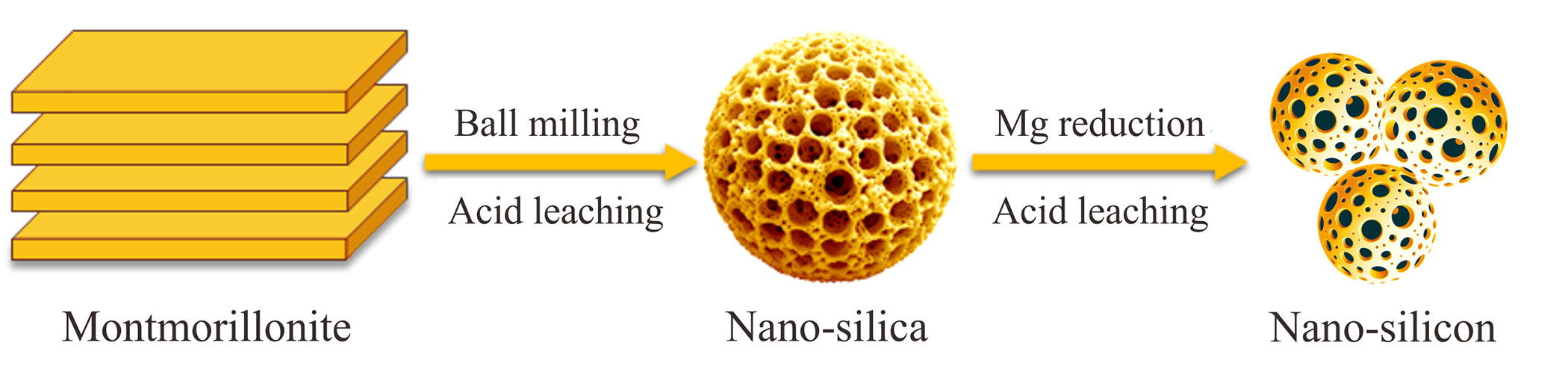
 ${\text{S}}{{\text{i}}_{{\text{Si}}{{\text{O}}_2}}}$’. The process is depicted in Fig. 1 and images of the Mnt, nano-silica, and nano-silicon are shown in Supplementary Fig. S1.
Schematic illustration showing the synthesis of nano-silicon.

In addition nano-silicon derived from montmorillonite (SiMnt) and quartz powder (SiQz) were synthesised as contrast samples. The preparation of the nano-silicon for SiMnt and SiQz was identical to that above for  ${\text{S}}{{\text{i}}_{{\text{Si}}{{\text{O}}_2}}}$, with the only distinction being that Mnt, Mg, and NaCl were mixed in a ratio of 1:0.7:3 due to the lower content of SiO2 in Mnt.
The intermediate products obtained from the magnesiothermic reduction of n-SiO2, Mnt and Qz, were designated as Med- ${\text{S}}{{\text{i}}_{{\text{Si}}{{\text{O}}_2}}}$, Med-SiMnt and Med-SiQz. These intermediate products were also washed to remove NaCl to enhance XRD analysis and the washed products named Med-SiO2, Med-Mnt and Med-Qz, respectively.
To further enhance the lithium storage performance,  ${\text{S}}{{\text{i}}_{{\text{Si}}{{\text{O}}_2}}}$ was etched with 1 wt.% HF for 3 min, followed by rinsing in ultra-pure water until pH neutrality and subsequent vacuum-drying at 80°C. The resulting product was designated as
 ${\text{S}}{{\text{i}}_{{\text{Si}}{{\text{O}}_2}}}$-HF.
Sample characterisation
X-ray diffraction (XRD) patterns were determined using a Rigaku MiniFlex-600 (Rigaku) diffractometer. X-ray fluorescence (XRF) spectra were collected from a Panalytical Epsilon 3 benchtop energy dispersive X-ray fluorescence spectrometer. X-ray photoelectron spectroscopy (XPS) was performed on a Thermo Fisher K-Alpha X-ray photoelectron spectrometer. The resulting spectra were calibrated with C 1s peak at 284.8 eV as the standard reference. Raman spectra were acquired using the HORIBA LabRAM Odyssey instrument. Fourier transform infrared spectroscopy (FTIR) tests were conducted on a Bruker Vertical-70 type Fourier infrared spectrometer. The Scanning Energy spectrum data (SEM-EDS) was acquired using the Hitachi SU5000 thermal field emission scanning electron microscope equipped with the OXFORD Xplore 30 (OXFORD) detector. The energy spectrum signals were collected over ∼1 mm ×1 mm. Transmission electron microscopy (TEM) images, selective electron diffraction pattern (SAED), and energy dispersive analysis (EDS) were all obtained from the FEI Talos F200S Transmission electron microscope. Nitrogen adsorption/desorption isotherms were determined using the Micromeritics ASAP 2020 Specific Surface Area and Aperture Analyzer. The concentrations of Si, Al, Fe and Mg elements in the acid-washing solution were determined using an ICAP 7000 inductively coupled plasma emission spectrometer (ICP-OES). Thermogravimetric (TG) analyses were conducted using a Netzsch STA 490 PC thermal analyser, with a heating rate of 10°C min–1, over a temperature range of 30 to 1000°C.
Electrochemical measurements
The electrochemical properties of silicon materials were evaluated using coin-type half cells (CR2032), depicted in Supplementary Fig. S2 with the corresponding schematic diagram of its structural composition. The working electrode was prepared by blending the active materials with carbon black and sodium alginate with a mass ratio of 7:1.5:1.5 to form a homogeneous slurry. Subsequently, the slurry was coated on a copper foil with a thickness of 9 μm and vacuum-dried at 80°C for 10 h. Finally, the dried electrode was cut into a disc with a diameter of 12 mm. The mass loading of the active material ranged from 0.7 to 1 mg cm–2. The half cells were assembled with the nano-silicon as the working electrode and lithium metal foils as the counter and reference electrode. The electrolyte consisted of 1.0 M LiPF6 in a 1:1 v/v mixture of ethylene carbonate/diethyl carbonate (EC/DEC) supplemented with 10 wt.% fluorinated ethylene carbonate (FEC) additives. Celgard 2500 was used as the separator. The entire assembly process was conducted within an argon glove box with a water and oxygen content of <0.01 ppm. Galvanostatic charge-discharge measurements were carried out in the CT2001A multi-channel battery test system (Wuhan Landian Electronics Co., LTD.) at room temperature, which had a voltage range of 0.05–1.5 V. Cyclic voltammetry (CV) tests were performed on the electrochemical workstation (CHI660E), employing a scan rate of 0.1 mV s–1 and a voltage range of 0.05–1.5 V.
The Si//LiCoO2 Full Cell was fabricated using a prelithiated  ${\text{S}}{{\text{i}}_{{\text{Si}}{{\text{O}}_2}}}$-HF anode and a commercial LiCoO2 (LCO) cathode. The LCO had a reversible capacity of 185 mAh g−1 at 0.1 A g−1, which was obtained from Shenzhen Qingxin Material Technology Co., Ltd). The
 ${\text{S}}{{\text{i}}_{{\text{Si}}{{\text{O}}_2}}}$-HF anode was placed in direct contact with a lithium metal foil in the electrolyte for 20 min to achieve prelithiation, after which it was removed and used for assembling full cells. The LiCoO2 cathode was prepared by blending 80 wt.% LiCoO2 active material, 10 wt.% acetylene black, and 10 wt.% polyvinylidene fluoride (PVDF) binder in N-methyl-2-pyrrolidone (NMP) solvent to create a homogeneous slurry. This slurry was then coated on the Al foil (16 μm thickness) and dried at 110°C for 10 h. The Si//LiCoO2 full cell had an N/P ratio of ∼1.1. The separator and electrolyte used in the full cell were the same as the half-cell. Electrochemical tests were conducted within a potential range of 2.75–4.35 V.
Results and discussion
Composition and structure characteristics of samples
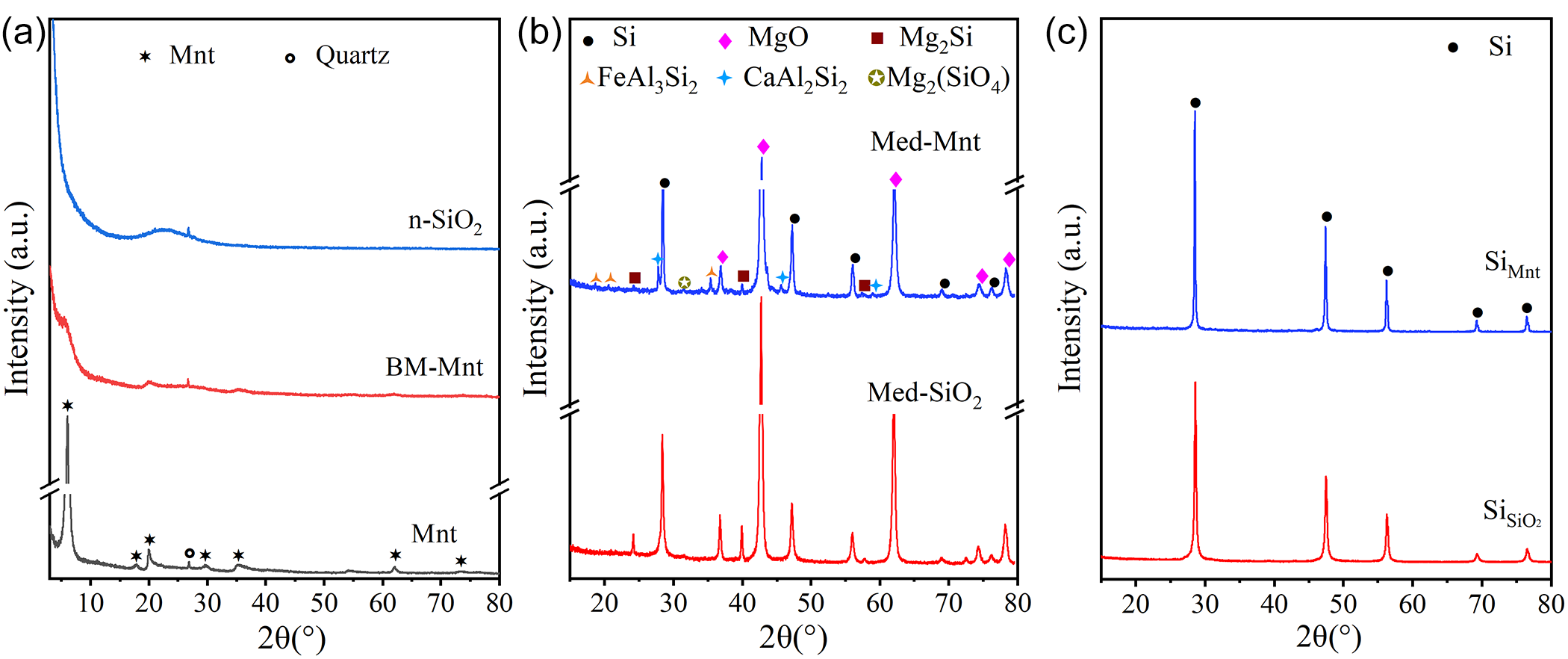
The nano-silicon was prepared via molten salt-assisted magnesiothermic reduction of nano-silica, which was derived from montmorillonite through ball milling and acid activation, as illustrated in Fig. 1. The XRD patterns of samples at various stages of nano-silicon synthesis are given in Fig. 2. The characteristic reflections in the XRD patterns of Mnt primarily corresponded to montmorillonite, indicating the high purity of the sample (Fig. 2a). Subsequent ball milling (BM-Mnt) reduced the intensity of all reflections for montmorillonite, especially the (001) reflection which exhibited the most significant decrease, suggesting a reduction in layer stacking (Bray et al., Reference Bray, Redfern and Clark1998) (Fig. 2a). After acid leaching, the (001) reflection of montmorillonite disappeared in the XRD pattern of n-SiO2, indicating a significant alteration of the montmorillonite structure. Simultaneously, a broad reflection at ∼22.4°(2θ) appeared in the XRD pattern of n-SiO2, which was attributed to amorphous silica (Fig. 2a). The XRF results revealed that the predominant component of n-SiO2 was silica, constituting ∼99% (Supplementary Table S1), implying that the elements such as Al and Fe in montmorillonite were dissolved by HCl. The N2 adsorption/desorption isotherms of n-SiO2 exhibited a high nitrogen adsorption capacity across the entire pressure range, indicating a hierarchical pore structure (Supplementary Fig. S3a). Additionally, the pore size distribution derived from the Non-Local Density Functional Theory (NLDFT) model further indicated numerous micropores and mesopores within n-SiO2 (Fig. S3b). The specific surface area and total pore volume of n-SiO2 were measured to be 647 m2 g–1 and 0.71 cm3 g–1, which was significantly higher than that of raw Mnt (64 m2 g–1 and 0.11 cm3 g–1) (Fig. S3c,d).
XRD patterns of (a) the samples at different stages during the synthesis of n-SiO2: Mnt – starting sample, BM-Mnt – after ball milling for 6 h; n-SiO2 – nano-silica obtained after procedure described in text. (b) Intermediate products after the magnesiothermic reduction of Mnt and n-SiO2 (after the NaCl was removed by washing). (c) The final nano-silicon products obtained:  ${\text{S}}{{\text{i}}_{{\text{Si}}{{\text{O}}_2}}}$ – from the nano-silica; and SiMnt from the montmorillonite, after HCl leaching.

After the magnesiothermic reduction of n-SiO2, the characteristic reflections of MgO and Si were observed in the XRD pattern of Med-SiO2, suggesting that n-SiO2 has been reduced to silicon by magnesium (Fig. 2b). Meanwhile, other byproducts (e.g. magnesium silicide (Mg2Si) and forsterite (Mg2SiO4)) formed, probably through the following reactions: Si + 2Mg → Mg2Si and SiO2 + 2MgO → Mg2SiO4 (Entwistle et al., Reference Entwistle, Rennie and Patwardhan2018). Compared with Med-SiO2, the characteristic reflections of alloy phases with different compositions (FeAl3Si2) and CaAl2Si2) were also observed in the XRD pattern of Med-Mnt (Fig. 2b), indicating that cations such as Al3+, Fe3+, Ca2+ in montmorillonite were reduced to metal counterparts by magnesium, which then combined with silicon at high temperatures to form alloys. It is noteworthy that both FeAl3Si2 and CaAl2Si2 alloys can be dissolved in HCl (Margarido et al., Reference Margarido, Figueiredo, Queiroz and Martins1997), leading to a decrease in silicon yield. Upon removal of MgO and other byproducts using HCl, only the sharp reflections corresponding to crystalline silicon were observed in the XRD patterns of both  ${\text{S}}{{\text{i}}_{{\text{Si}}{{\text{O}}_2}}}$ and SiMnt (Fig. 2c). Moreover, the half-peak width of silicon in
 ${\text{S}}{{\text{i}}_{{\text{Si}}{{\text{O}}_2}}}$ was greater than that in SiMnt (0.0059° vs. 0.0033°). According to the Scherrer equation (Patterson, Reference Patterson1939), the average grain size of the silicon is estimated to be 24 nm for
 ${\text{S}}{{\text{i}}_{{\text{Si}}{{\text{O}}_2}}}$ and 42 nm for SiMnt. Compared to previously reported nano-silicon derived from clay minerals (Chen et al., Reference Chen, Liu, Zhu, Wu, Fu, Zhu and He2018a), this average grain size of silicon derived from n-SiO2 is relatively smaller. This reduced particle size of nano-silicon is beneficial for improving the stability of silicon anodes (Wu et al., Reference Wu, Dong, Su, Wei, Chen, Yan, Ma, Ma, Wang and Chen2023).
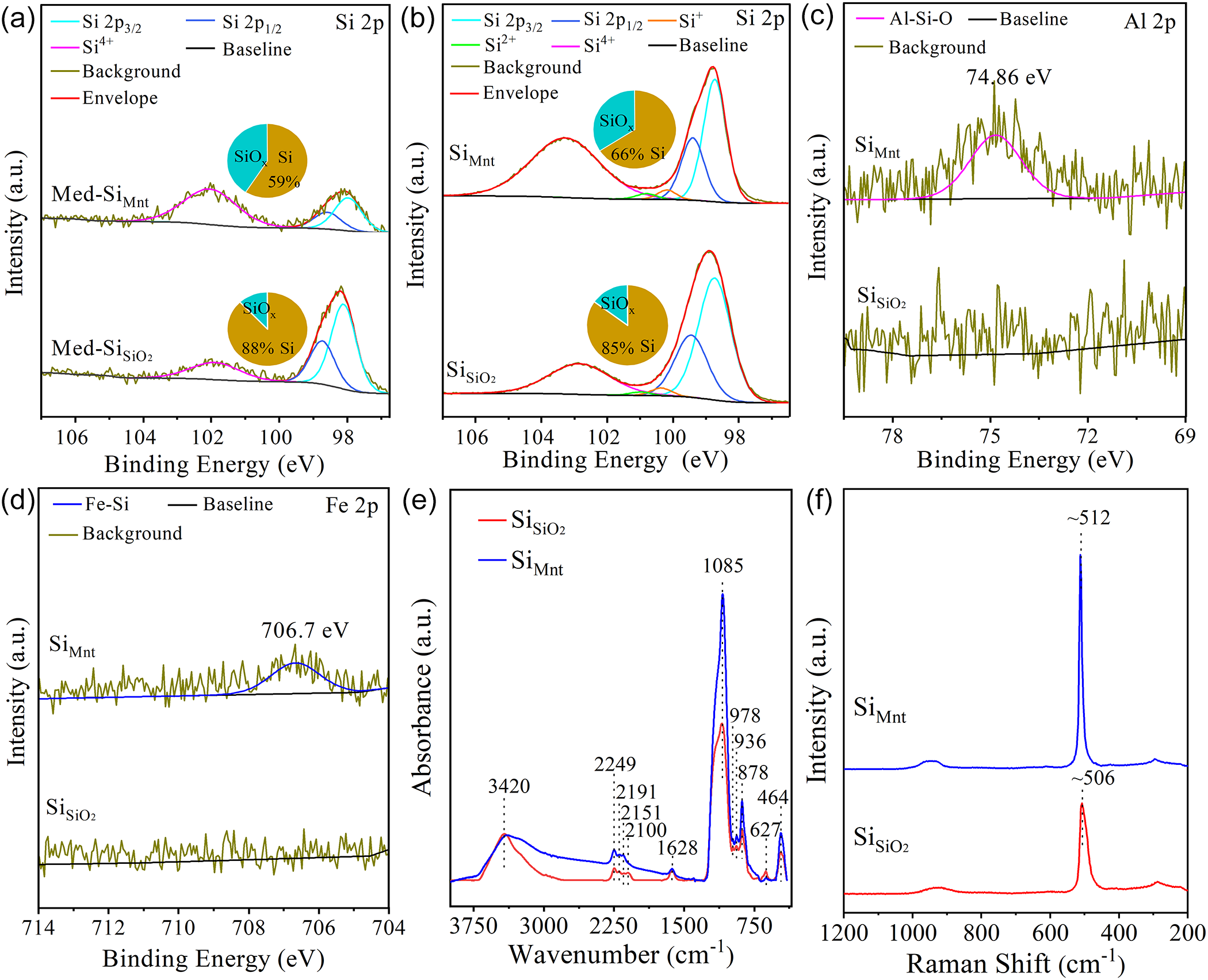
The high-resolution Si 2p XPS spectra of the intermediate products were examined to determine the extent of silica reduction induced by magnesium. The Si 2p spectrum of Med- ${\text{S}}{{\text{i}}_{{\text{Si}}{{\text{O}}_2}}}$ and Med-SiMnt can be deconvoluted into two primary bands at ∼98.6 and 98.0 eV, assigned to the Si 2p1/2 and Si 2p3/2 of silicon, respectively. Additionally, a broad band centred around 102 eV corresponds to the oxides of Si4+ (SiO2) (Himpsel et al., Reference Himpsel, McFeely, Taleb-Ibrahimi, Yarmoff and Hollinger1988) (Fig. 3a). Based on the band area, the atomic proportion of silicon was estimated to be ∼88% for Med-
 ${\text{S}}{{\text{i}}_{{\text{Si}}{{\text{O}}_2}}}$ and 59% for Med-SiMnt. The detailed band ratios are presented in Supplementary Table S2. This phenomenon indicated a higher efficiency in reducing silica to silicon when utilising n-SiO2 as a precursor compared to using raw Mnt as a precursor. This could be attributed to the smaller particle size and abundant pore structure within n-SiO2, which enhanced magnesiothermic reaction kinetics by facilitating diffusion channels and shortening diffusion paths for magnesium atoms. Additionally, the unique features of n-SiO2 also promoted a homogeneous reaction between silica and magnesium. Following HCl leaching, two new bands corresponding to Si+ and Si2+ oxide species emerged in the Si 2p spectrum of both
 ${\text{S}}{{\text{i}}_{{\text{Si}}{{\text{O}}_2}}}$ and SiMnt (Fig. 3b) (Himpsel et al., Reference Himpsel, McFeely, Taleb-Ibrahimi, Yarmoff and Hollinger1988; Alfonsetti et al., Reference Alfonsetti, Lozzi, Passacantando, Picozzi and Santucci1993), which could be attributed to the oxidation of silicon nanoparticles during the leaching process. The atomic proportion of silicon was estimated to be 85% for
 ${\text{S}}{{\text{i}}_{{\text{Si}}{{\text{O}}_2}}}$ and 66% for SiMnt. In comparison with Med-SiMnt, the content of silicon oxide in SiMnt decreased, indicating the dissolution of silicon oxide during leaching. This phenomenon could be attributed to the conversion of weakly crystallised aluminosilicates and magnesium silicates (byproducts of incomplete reduction) (Wang and Shi, Reference Wang and Shi2001; Yoo et al., Reference Yoo, Kim, Choi, Park, Hong, Baek, Kang and Jung2014; Furquan et al., Reference Furquan, Khatribail, Vijayalakshmi and Mitra2018) into soluble silicic acid by HCl. The chemical reactions involved are: Al2O3·SiO2 + 4HCl → 2AlCl3 + H2SiO3 + 2H2O and MgO·SiO2 + 2HCl → MgCl2 + H2SiO3. Additionally, elemental silicon was determined in the acid leaching solution, further verifying the dissolution of silicon oxide (Table 1). Moreover, distinct Al 2p and Fe 2p signals are visible in the XPS spectra of SiMn, whereas no signals are observed for
 ${\text{S}}{{\text{i}}_{{\text{Si}}{{\text{O}}_2}}}$ (Fig. 3c, 3d). The band centred around 74.8 eV in the Al 2p spectrum was attributed to mullite (3Al2O3·2SiO2) (Georgiev et al., Reference Georgiev, Kolev, Laude, Mednikarov and Starbov1998). Similarly, the band centred around 706.7 eV in the Fe 2p spectrum was attributed to iron silicide (FeSi2) (Ohtsu et al., Reference Ohtsu, Oku, Satoh and Wagatsuma2013). These phenomena indicated that
 ${\text{S}}{{\text{i}}_{{\text{Si}}{{\text{O}}_2}}}$ demonstrated a higher purity compared to SiMnt.
The high-resolution Si 2p XPS spectra of (a) the intermediate products and (b) the final products after the magnesiothermic reduction of Mnt and n-SiO2. (c) The high-resolution Al 2p XPS spectra and (d) the high-resolution Fe 2p XPS spectra for SiMnt and SiSiO2. (e) The FTIR and (f) Raman spectra of SiMnt and SiSiO2.

The chemical composition of the hydrochloric acid leaching solution (based on ICP-OES) and the final products (based on SEM-EDS) after magnesiothermic reduction of Mnt and n-SiO2

The bulk composition of  ${\text{S}}{{\text{i}}_{{\text{Si}}{{\text{O}}_2}}}$ and SiMnt obtained from SEM-EDX is presented in Table 1.
 ${\text{S}}{{\text{i}}_{{\text{Si}}{{\text{O}}_2}}}$ consisted mainly of Si and O elements, with an O content of 5 wt.%. In comparison with
 ${\text{S}}{{\text{i}}_{{\text{Si}}{{\text{O}}_2}}}$, SiMnt contained additional elements such as Al and Fe, along with a higher O content of 10 wt.%, which was consistent with the results obtained from XPS analysis. The conversion rate of silica to silicon was estimated based on the mass ratio of Si and O elements in products, assuming that O existed in the form of silica. The conversion rates of silica to silicon for Mnt and n-SiO2 were calculated to be 79% and 91%, respectively. The detailed calculation is presented in Table S3. According to the ratio of actual product weight to theoretical product weight, the yield of nano-silicon derived from n-SiO2 was estimated to be 92% (Table S4). However, the yield of nano-silicon derived from Mnt exceeded 100% due to the presence of impurity elements such as Al and Fe, as well as substantial amounts of O in its product. These aforementioned findings suggested that the utilisation of n-SiO2 as a precursor achieved a higher efficiency in reducing silica compared to using Mnt as a precursor due to its smaller particle size and abundant pore structure. This unique structure not only enhanced magnesiothermic reaction kinetics by facilitating diffusion channels and shortening diffusion paths for magnesium atoms, but also promoted a homogeneous reaction between silica and magnesium. Additionally, the high purity of silica in n-SiO2 could effectively prevent the formation of byproducts containing Al and Fe.
To further confirm the advantages of utilising n-SiO2 with its nanoscale and porous architecture properties as a precursor for the synthesis of nano-silicon, dense quartz powder with minimal porosity was reduced under identical conditions for comparative analysis. The intermediate product of quartz powder (Med-Qz) displayed characteristic reflections corresponding to quartz, Si, Mg2Si, and MgO (Supplementary Fig. S4a). The strong intensity of the reflections for Mg2Si and quartz indicated the incomplete reduction of the quartz powder. After acid leaching, apart from silicon, the distinct reflections of quartz were also still observable in SiQz (Fig. S4b). Based on the mass ratio of Si and O in the SiQz, the conversion rate of silica to silicon for quartz powder was estimated to be 62% (Table S4), which was significantly lower compared to that for n-SiO2 and Mnt. This result demonstrates the importance of a porous structure in enhancing the reduction efficiency of silica to silicon in a magnesiothermic reduction.
The FTIR spectra of  ${\text{S}}{{\text{i}}_{{\text{Si}}{{\text{O}}_2}}}$ and SiMnt revealed the presence of hydroxyl group stretching modes in the range of 3000 to 3800 cm–1, as well as various Si–H stretching modes corresponding to OySiHx between 2100 to 2300 cm–1 (Fig. 3e) (Delpuech et al., Reference Delpuech, Mazouzi, Dupre, Moreau, Cerbelaud, Bridel, Badot, De Vito, Guyomard and Lestriez2014). This observation suggested that the resulting nano-silicon underwent surface oxidation or hydroxylation. Moreover, the intensity of
 ${\text{S}}{{\text{i}}_{{\text{Si}}{{\text{O}}_2}}}$ in the wavenumber range between 1200 and 1000 cm–1, assigned to the Si–O–Si stretching mode (Ogata et al., Reference Ogata, Jeon, Ko, Jung, Kim, Ito, Kubo, Takei, Saito and Cho2018), was comparatively lower than that of SiMnt, indicating a reduced silicon oxide content in
 ${\text{S}}{{\text{i}}_{{\text{Si}}{{\text{O}}_2}}}$, which aligns with the aforementioned results. Raman spectra revealed that the first-order optical phonon of silicon for
 ${\text{S}}{{\text{i}}_{{\text{Si}}{{\text{O}}_2}}}$ exhibited a redshift compared to that for SiMnt (506 vs. 512 cm–1) (Fig. 3f), indicating the presence of smaller-sized silicon grains (Meier et al., Reference Meier, Lüttjohann, Kravets, Nienhaus, Lorke and Wiggers2006).
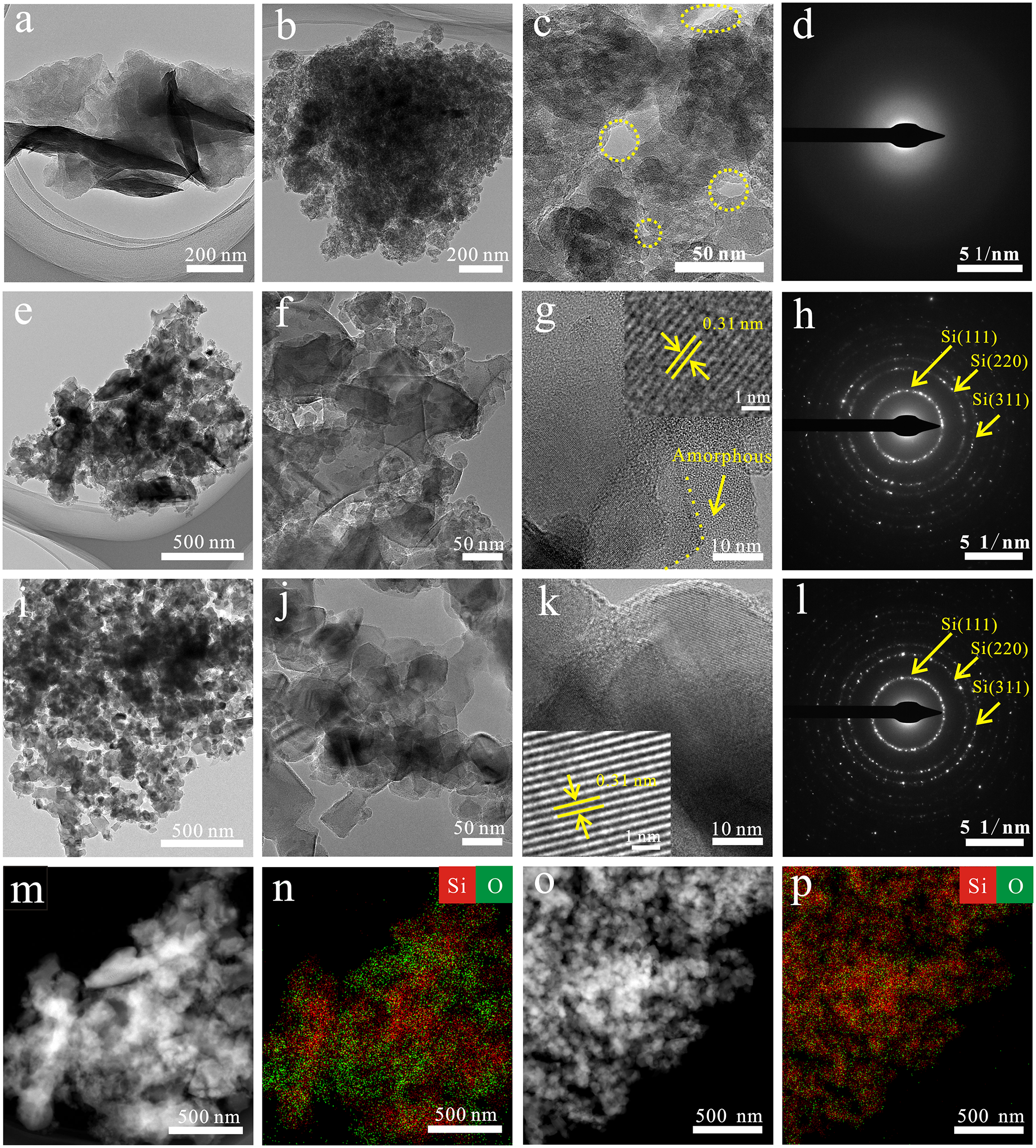
The morphology and structure of raw Mnt, n-SiO2, and the corresponding nano-silicon were characterised by TEM. Raw Mnt exhibited a distinct lamellar structure with a lamellar size of ∼1 μm (Fig. 4a). After acid activation, Mnt transformed into irregular and porous silica aggregations with particle sizes <50 nm (Fig. 4b, 4c). Micropores in n-SiO2 were observed, as indicated by the yellow circles in Fig. 4c. The SAED pattern of n-SiO2 exhibited a diffuse ring, indicating its amorphous structure, which was consistent with the XRD results (Fig. 4d). After undergoing magnesiothermic reduction, SiMnt displayed a flake-like morphology accompanied with particle sizes reaching 500 nm (Fig. 4e, 4f). The morphology of SiMnt inherited the layered structure of the raw Mnt. In contrast,  ${\text{S}}{{\text{i}}_{{\text{Si}}{{\text{O}}_2}}}$ displays an irregular particle morphology with particle sizes between 50 and 100 nm (Fig. 4i, j). This architectural disparity between SiMnt and
 ${\text{S}}{{\text{i}}_{{\text{Si}}{{\text{O}}_2}}}$ can be attributed to the template effect of the silica precursor. Therefore, in comparison with Mnt, the n-SiO2 with a reduced particle size facilitated the formation of smaller silicon nanoparticles, consistent with the aforementioned XRD and Raman results. The HRTEM image of SiMnt confirms the presence of crystalline silicon and amorphous silica, consistent with XPS results (Fig. 4g). The SAED pattern of SiMnt follows that of crystalline silicon, which further confirms the formation of silicon nanocrystals (Fig. 4h). Similarly, the HRTEM image of
 ${\text{S}}{{\text{i}}_{{\text{Si}}{{\text{O}}_2}}}$ shows lattice fringes corresponding to silicon (Fig. 4k), whereas the SAED pattern exhibits diffraction rings indexed to crystalline silicon (Fig. 4l), implying the formation of silicon nanocrystals. The high-angle annular dark-field image and EDS mapping revealed that the distribution of Si and O elements in
 ${\text{S}}{{\text{i}}_{{\text{Si}}{{\text{O}}_2}}}$ was more homogeneous than in SiMnt (Fig. 4m-4p). Moreover, the oxygen content of
 ${\text{S}}{{\text{i}}_{{\text{Si}}{{\text{O}}_2}}}$ was lower than that of SiMnt (5 wt.% vs. 13 wt.%), suggesting a higher silicon content in
 ${\text{S}}{{\text{i}}_{{\text{Si}}{{\text{O}}_2}}}$.
TEM image of raw Mnt (a); TEM images at different magnifications and SAED patterns of n-SiO2 (b–d), SiMnt (e–h), and SiSiO2 (i–l); Dark-field TEM images and corresponding EDS mapping of SiMnt (m, n) and SiSiO2 (o, p).

Electrochemical performance
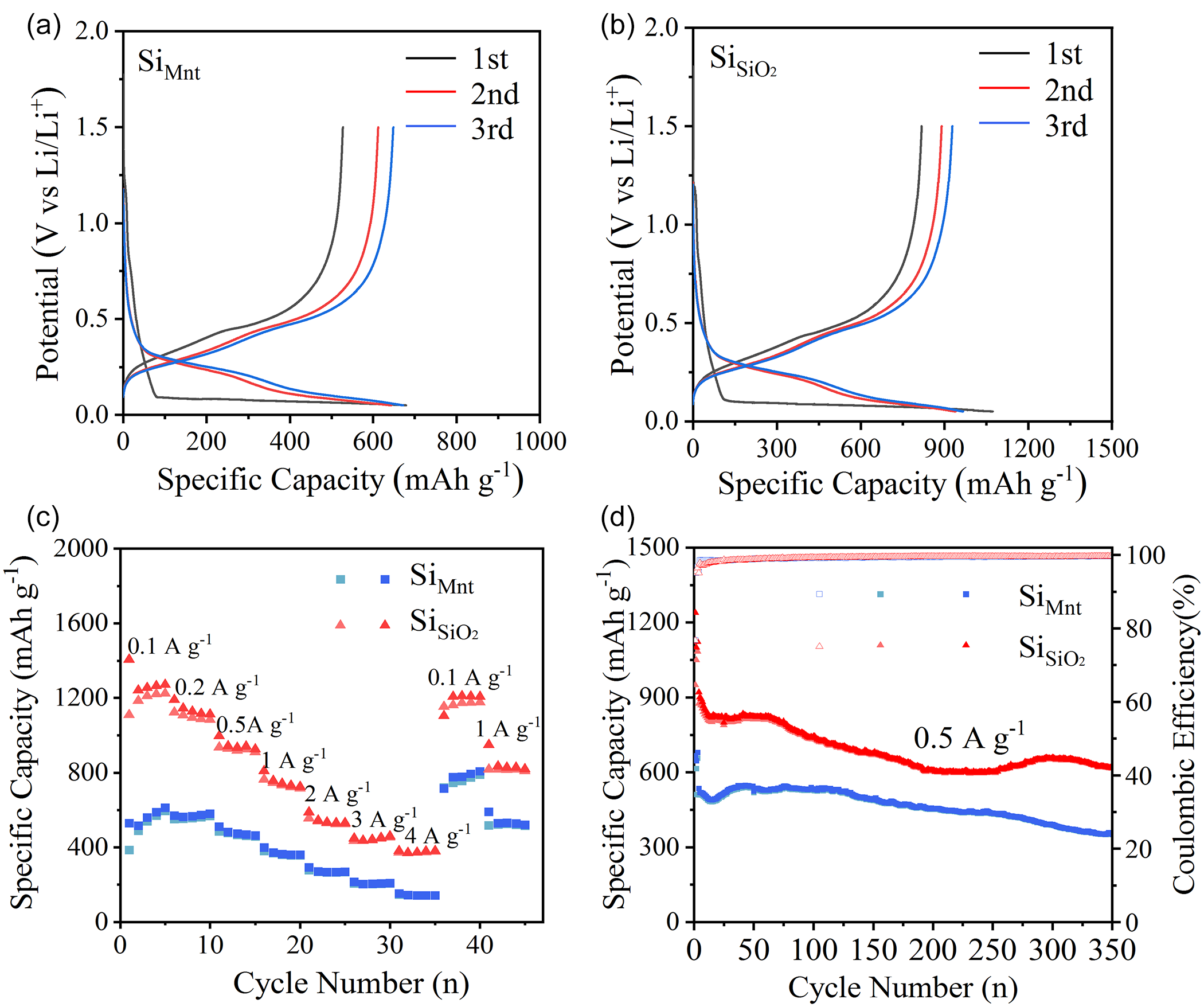
The electrochemical performance of nano-silicon as anodes for LIBs was evaluated by assembling CR2032 coin-type half cells. The galvanostatic charge/discharge curves of  ${\text{S}}{{\text{i}}_{{\text{Si}}{{\text{O}}_2}}}$ (Fig. 5a) and SiMnt (Fig. 5b) electrodes demonstrated a long and flat voltage plateau at 0.1 V during the initial discharge process, indicating the alloying reaction between lithium and crystalline silicon. In subsequent cycles, this voltage plateau was replaced by sloping curves attributed to the lithiation of the amorphous silicon phase formed during the initial lithiation/delithiation process (Ogata et al., Reference Ogata, Jeon, Ko, Jung, Kim, Ito, Kubo, Takei, Saito and Cho2018). The voltage profiles of both
 ${\text{S}}{{\text{i}}_{{\text{Si}}{{\text{O}}_2}}}$ and SiMnt electrodes resembled those of a typical silicon electrode. The initial discharge capacities of
 ${\text{S}}{{\text{i}}_{{\text{Si}}{{\text{O}}_2}}}$ and SiMnt electrodes were 1238 and 666 mAh g–1, respectively. The higher capacity of
 ${\text{S}}{{\text{i}}_{{\text{Si}}{{\text{O}}_2}}}$ compared to SiMnt can be attributed to its higher active silicon content. The initial Coulombic efficiency of
 ${\text{S}}{{\text{i}}_{{\text{Si}}{{\text{O}}_2}}}$ and SiMnt electrodes was comparable, with both reaching 77%. The rate performances of
 ${\text{S}}{{\text{i}}_{{\text{Si}}{{\text{O}}_2}}}$ and SiMnt electrodes are depicted in Fig. 5c. The
 ${\text{S}}{{\text{i}}_{{\text{Si}}{{\text{O}}_2}}}$ electrode displayed the discharge capacities of 1219, 1134, 935, 743, 534, 440 and 377 mAh g–1 at 0.1, 0.2, 0.5, 1, 2, 3 and 4 A g–1, respectively. The specific capacity of the
 ${\text{S}}{{\text{i}}_{{\text{Si}}{{\text{O}}_2}}}$ electrode was restored to 1205 mAh g–1 when the current density returned to 0.1 A g–1, demonstrating excellent reversibility. In comparison, the SiMnt electrode exhibited a lower specific capacity at various current densities. The long-term cycling stability of the
 ${\text{S}}{{\text{i}}_{{\text{Si}}{{\text{O}}_2}}}$ and SiMnt electrodes was evaluated at a current density of 0.5 A g–1 (Fig. 5d). After 350 cycles, the
 ${\text{S}}{{\text{i}}_{{\text{Si}}{{\text{O}}_2}}}$ electrode exhibited a specific capacity of 621 mAh g–1 with a capacity retention rate of 75%. In contrast, the SiMnt electrode showed a lower specific capacity of only 355 mAh g–1 and a reduced capacity retention rate of 72%. Overall, the electrochemical performance of the
 ${\text{S}}{{\text{i}}_{{\text{Si}}{{\text{O}}_2}}}$ electrode surpassed that of the SiMnt electrode due to its higher specific capacity and superior capacity retention. However, the measured specific capacities of both
 ${\text{S}}{{\text{i}}_{{\text{Si}}{{\text{O}}_2}}}$ and SiMnt electrodes were lower than anticipated, which was inconsistent with the silicon content they contain. This discrepancy may be attributed to the presence of Si–OH groups on the surface of the resulting
 ${\text{S}}{{\text{i}}_{{\text{Si}}{{\text{O}}_2}}}$ and SiMnt, which could accelerate electrolyte decomposition and consequently lead to an increase in charge resistance (Delpuech et al., Reference Delpuech, Mazouzi, Dupre, Moreau, Cerbelaud, Bridel, Badot, De Vito, Guyomard and Lestriez2014; Lin et al., Reference Lin, Jiang, Zhang, He, Ren, He, Pang, Xiao, Yang and Du2020).
The charge-discharge curves of SiMnt (a) and (b) SiSiO2 at a current density of 0.1 A g-1 with the voltage range of 0.05–1.5 V. (c) The rate performance of SiMnt and SiSiO2 at different current densities. (d) The cycling performance of SiMnt and SiSiO2 at a current density of 0.5 A g-1 (0.1 A g-1 for the initial three cycles).

To further enhance the specific capacity of  ${\text{S}}{{\text{i}}_{{\text{Si}}{{\text{O}}_2}}}$, the material was etched using a dilute HF solution to minimise surface silicon oxides and hydroxyl groups (Dawei et al., Reference Dawei, Xilu, Xianfeng, Yanan and Xiaoyan2023). The XRD pattern of
 ${\text{S}}{{\text{i}}_{{\text{Si}}{{\text{O}}_2}}}$-HF revealed the presence of a well-crystallised silicon phase. The average grain size of silicon in
 ${\text{S}}{{\text{i}}_{{\text{Si}}{{\text{O}}_2}}}$-HF was estimated to be 30 nm using the Scherrer equation (Supplementary Fig. S5a). The Si 2p XPS spectrum revealed that the molar proportion of silicon in
 ${\text{S}}{{\text{i}}_{{\text{Si}}{{\text{O}}_2}}}$-HF was estimated to be 93% (Fig. S5b), suggesting a decrease in oxygen content resulting from HF etching. On the basis of the N2 adsorption/desorption isotherms of
 ${\text{S}}{{\text{i}}_{{\text{Si}}{{\text{O}}_2}}}$-HF (Fig. S5c), the specific surface area of
 ${\text{S}}{{\text{i}}_{{\text{Si}}{{\text{O}}_2}}}$-HF was calculated to be 52 m2 g–1, while the total pore volume was measured as 0.13 cm3 g–1. In addition, the pore size distribution obtained from the NLDFT model indicated numerous micropores and mesopores within
 ${\text{S}}{{\text{i}}_{{\text{Si}}{{\text{O}}_2}}}$-HF (Fig. S5d). The TEM image revealed that
 ${\text{S}}{{\text{i}}_{{\text{Si}}{{\text{O}}_2}}}$-HF exhibited an irregular particle morphology with a particle size ranging from 50 to 100 nm (Fig. S6a). The corresponding element mapping demonstrated that Si and O elements were evenly distributed in
 ${\text{S}}{{\text{i}}_{{\text{Si}}{{\text{O}}_2}}}$-HF, and the mass proportion of O was 3% (Fig. S6b).
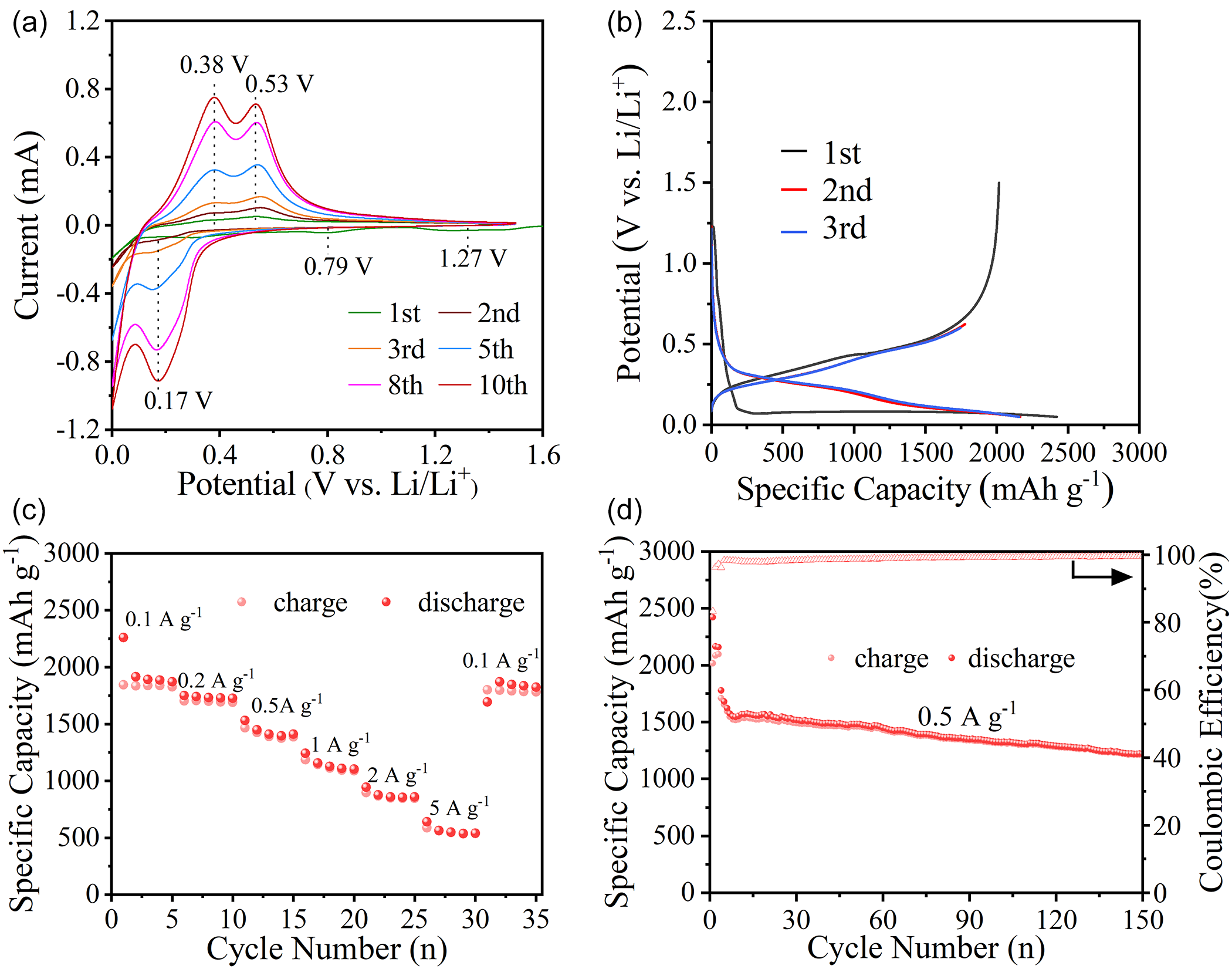
The cyclic voltammogram curves of the  ${\text{S}}{{\text{i}}_{{\text{Si}}{{\text{O}}_2}}}$-HF electrode are shown in Fig. 6a. During the first cathodic scan, broad and weak reductive peaks appeared at 1.27 and 0.79 V, which disappeared from the second cycle onwards, indicating electrolyte decomposition and the formation of a stable SEI on the electrode surface. A sharp reductive peak below 0.1 V emerged during the first cathodic scan, corresponding to the transformation of crystalline silicon into amorphous silicon. In subsequent cathodic scans, a new reductive peak at 0.17 V was observed, corresponding to the lithiation of amorphous silicon. Two oxidative peaks at 0.37 and 0.51 V were detected during the positive scans, corresponding to the delithiation from the LixSi alloy (Jerliu et al., Reference Liu, Lu, Chu, Luo, Zheng, Chen and Li2018; Wei et al., Reference Wei, Chen, Zhu, Du, Xie, Fu, Xiong, Liu and Zhu2024). The current density of the reductive and oxidative peaks gradually increased with the increasing number of scans, indicating a progressive activation process of the silicon electrode (Green et al., Reference Green, Fielder, Scrosati, Wachtler and Moreno2003). The galvanostatic charge/discharge curves of the
 ${\text{S}}{{\text{i}}_{{\text{Si}}{{\text{O}}_2}}}$-HF electrode are presented in Fig. 6b. All voltage platforms observed in the galvanostatic charge/discharge profiles match well with the reductive/oxidative peaks. The
 ${\text{S}}{{\text{i}}_{{\text{Si}}{{\text{O}}_2}}}$-HF electrode delivered an initial discharge capacity of 2434 mAh g–1 and an initial Coulombic efficiency of 83%, which was significantly higher compared to the
 ${\text{S}}{{\text{i}}_{{\text{Si}}{{\text{O}}_2}}}$ electrode. In contrast, the
 ${\text{S}}{{\text{i}}_{{\text{Si}}{{\text{O}}_2}}}$ electrode displayed an initial discharge capacity of 1238 mAh g–1 and an initial Coulombic efficiency of 77%. These results demonstrate the potential of using HF treatment to enhance the electrochemical properties of
 ${\text{S}}{{\text{i}}_{{\text{Si}}{{\text{O}}_2}}}$. At current densities ranging from 0.1 to 5 A g–1, the
 ${\text{S}}{{\text{i}}_{{\text{Si}}{{\text{O}}_2}}}$-HF electrode delivered specific capacities of 1870, 1722, 1454, 1131, 863 and 546 mAh g–1, respectively (Fig. 6c). Upon reverting to a current density of 0.1 A g–1, the specific capacity of the
 ${\text{S}}{{\text{i}}_{{\text{Si}}{{\text{O}}_2}}}$-HF electrode returned to 1847 mAh g–1, demonstrating an outstanding rate capability. The
 ${\text{S}}{{\text{i}}_{{\text{Si}}{{\text{O}}_2}}}$-HF electrode also exhibited a high specific capacity of 1222 mAh g–1 following 150 cycles at 0.5 A g–1 (Fig. 6d), corresponding to a capacity retention rate of 79%. For comparison, commercial nano-silicon with particle sizes ranging from 10 to 200 nm were tested under identical conditions (Supplementary Fig. S7). The commercial nano-silicon electrode demonstrated a specific capacity of only 372 mAh g–1 after 150 cycles at 0.5 A g–1, with a capacity retention rate of merely 40%. (Fig. S7c). The cyclic stability of the
 ${\text{S}}{{\text{i}}_{{\text{Si}}{{\text{O}}_2}}}$-HF electrode was superior to that of the commercial nano-silicon electrode, potentially attributed to its smaller particle size and more abundant pore structure. These features are conducive to maintaining the structural stability of silicon electrodes (Li et al., Reference Li, Gu, Hu, Kennard, Yan, Chen, Wang, Sailor, Zhang and Liu2014; Liu et al., Reference Liu, Lu, Chu, Luo, Zheng, Chen and Li2018). Additionally, the irregular morphology of nano-silicon derived from nano-silica can offer a larger specific surface area and naturally form internal voids or porosity, potentially enhancing initial capacity and long-term cycling performance.
(a) CV curves of SiSiO2-HF at a scan rate of 0.2 mV s–1 in the voltage range of 0.05–1.5 V (vs. Li/Li+). (b) Discharge and charge curves of SiSiO2-HF at a current density 0.1 A g–1. (c) Cycling performance of SiSiO2-HF at a current density of 0.5 A g–1 (0.1 A g–1 for the initial three cycles). (d) Rate capability of SiSiO2-HF.

To evaluate commercial viability, a coin-type full cell with  ${\text{S}}{{\text{i}}_{{\text{Si}}{{\text{O}}_2}}}$-HF as the anode and commercial LiCoO2 (LCO) as the cathode was assembled (Supplementary Fig. S8a). The specific capacity was calculated based on the weight of LCO. The areal capacity of full cells was ∼1 mAh cm–2. Figure S8b depicts the galvanostatic charge-discharge curves of the Si//LCO full cell for the initial three cycles at 0.05 C (1 C = 170 mA g–1), with an average discharge plateau at ∼3.75 V. The Si//LCO full cell delivered a high discharge specific capacity of 80 mAh g–1 at 0.5 C after 50 cycles (Fig. S8c). The Si//LCO full cell also demonstrated good rate performance, as shown in Fig. S8d. The discharge capacities reached 150, 138, 117, 99, 83 and 72 mAh g–1 at 0.05, 0.1, 0.2, 0.5, 1 and 2 C, respectively. Moreover, when the current density returned to 0.05 C, the discharge capacity could be fully recovered to its original value. These results suggest that the silicon anode derived from n-SiO2 holds great potential in the practical application of LIBs.
Conclusions
In this study, porous silicon nanoparticles were prepared successfully by molten salt-assisted magnesiothermic reduction using porous nano-silica derived from Mnt as the precursor. The efficiency of magnesiothermic reduction in converting silica into silicon was enhanced by reducing particle sizes and increasing the porosity of clay minerals through ball milling and acid activation. Additionally, compared to utilising raw clay minerals as a precursor, employing ball-milled and acid-activated clay minerals improved the purity and reduced the particle size of the nano-silicon. As anodes in LIBs, the fabricated nano-silicon showed good electrochemical performance in terms of capacity and recyclability owing to its smaller particle size and porous structure. The nano-silicon electrode exhibited a high specific capacity of 1222 mAh g–1 after 150 cycles at 0.5 A g–1. This work provides a simple, cost-effective and efficient extraction approach for nano-silicon from clay minerals, which could contribute to the practical production of silicon anodes.
Supplementary material
The supplementary material for this article can be found at https://doi.org/10.1180/mgm.2024.64.
Acknowledgements
This work was supported financially by the Key-Area Research and Development Program of Guangdong Province (2020B0101370003), Natural Science Foundation for Distinguished Young Scientists of Guangdong Province (2023B1515020006), Tuguangchi Award for Excellent Young Scholar GIG, CAS (TGC202302), Youth Innovation Promotion Association CAS (2020347), Science and Technology Planning of Guangdong Province, China (2023B1212060048), and Huizhou Key Areas of Science and Technology Research Projects. This is contribution No. IS-3614 from GIGCAS.
Competing interests
The authors declare none.