Introduction
Fear of falling is common among the elderly and is important because it can lead to curtailment of physical and social activities. Population-based studies show that between 21% and 55% of the community-dwelling elderly have reported a fear of falling (Howland et al., Reference Howland, Lachman, Peterson, Cote, Kasten and Jette1998; Friedman et al., Reference Friedman, Munoz, West, Rubin and Fried2002) and up to 56% of these people restricted their activities because of this fear (Howland et al., Reference Howland, Lachman, Peterson, Cote, Kasten and Jette1998).
A fear of falling is more common among those who have experienced falls, or have impaired physical function, depression, or chronic conditions requiring medical treatment (Arfken et al., Reference Arfken, Lach, Birge and Miller1994; Friedman et al., Reference Friedman, Munoz, West, Rubin and Fried2002; Murphy et al., Reference Murphy, Williams and Gill2002). Among the predictors of a fear of falling, a past fall is of particular interest because it appears to form a reciprocal causal association with the fear of falling. In a large prospective study, Friedman et al. (Reference Friedman, Munoz, West, Rubin and Fried2002) observed that falls at baseline predicted the development of a new fear of falling. Moreover, fear of falling at baseline was also an independent predictor of incident falls. The reciprocal causation between falling and fear of falling implies that one could result in the other, or vice versa, with a spiraling risk of both problems. This relationship also suggests that intervention targeted to improve one condition would result in improvement of the other.
Since the causal association between falls and fear of falling is important in identifying the target population for intervention, a more detailed investigation of this relationship is required. Various studies have been conducted on the relationship between the time since a fall and the fear of falling. A fall within the previous year was associated with a 2.5-fold increased frequency of fear of falling (Arfken et al., Reference Arfken, Lach, Birge and Miller1994). By contrast, in another study, a fall within the past five years was associated with a 1.9-fold increase in the fear of falling, without a significant association with activity curtailment (Howland et al., Reference Howland, Lachman, Peterson, Cote, Kasten and Jette1998).
If a fall experience results in a fear of falling, the effect is likely to be greatest in the period immediately after the fall, and should decrease over time. However, no such temporal relationship has been documented. Therefore, this study addressed the question directly and assessed the association between the time since a fall and the fear of falling. We hypothesized that the level of the fear of falling would vary according to the time since falling and that the fear would continue to some extent since a last fall. Time since falling should be associated with fear of falling after adjusting other covariates.
Methods
Study participants
Community-dwelling elderly in Ilsan City, Korea were recruited for an interview survey on their experiences of falling. The subjects were contacted between July and November 2003 and comprised participants in a health education session held in the community hospital and participants in the health examination service provided by the hospital at a community seniors’ center. Men and women aged 60 years and older, who were currently living in the community, and did not need a walking aid, were eligible for the study. More than 95% of the eligible persons participated in the interview. Of the 828 individuals who completed the interview, 43 were excluded because of missing information on demographic or fall-related variables. Another 53 subjects were excluded because they did not remember the exact month of their last fall. Finally, 732 subjects remained for the analysis.
Questionnaire
A structured questionnaire was administered by a trained interviewer. The participants were asked: “In the past 3 years, have you experienced any fall, including a slip or trip, in which you lost your balance and landed on the floor, ground, or a lower level?” A fall was defined as an unexpected event in which the participants come to rest on the ground, floor, or a lower level. We also asked the fallers about their frequency of falls over the past three years. Detailed information was asked about the latest fall, including the date, time of day, place, circumstances, and associated injury.
Fear of falling was assessed using a question similar to that used by Howland et al. (Reference Howland, Lachman, Peterson, Cote, Kasten and Jette1998): “How much are you afraid of falling?” with four graded answers “Not at all,” “Slightly,” “Somewhat,” and “Very much.” Subsequently, “Not at all” was recoded as “No fear of falling” and the others as “Fear of falling.” The participants were also asked to respond “Yes” or “No” to the question: “Do you ever limit your activities – either what you used to do or what you wish to do – because you are afraid of falling?” This activity restriction question was similar to that used in earlier studies (Tinetti et al., Reference Tinetti, Mendes de Leon, Doucette and Baker1994; Bruce et al., Reference Bruce, Devine and Prince2002). Information was also obtained concerning age, sex, number of other household members, current prescribed medications other than vitamin supplements, and physician's diagnoses for which any prescriptions were given.
Data analyses
Time since a fall was defined as the interval from the most recent fall in the previous three years to the date of the interview. The time since a fall was then categorized into four groups: 1–6 months, 7–12 months, 13–24 months, and 25–36 months. Those who had not fallen in the past three years were categorized as non-fallers, and served as the baseline comparison group.
Fear of falling status was categorized into three levels: no fear, fear without activity restriction, and fear with activity restriction. The distributions of fall experience and fear of falling status were compared across the strata of participant characteristics and patterns of fall; χ2 tests were used to assess whether significant associations existed.
Further analyses involved making two comparisons: “Fear” vs. “No fear,” “Fear with activity restriction” vs. “No fear.” With these approaches, multiple logistic regression analyses were used to estimate the association between fear of falling status and time since the last fall, adjusting for covariates. Models included the covariates age and sex because of their clinical importance. In addition, living with a spouse, number of falls, and number of medications taken were also considered for inclusion based on their statistical significance. None of the interaction terms was significant, and so not included in the model. Model fit was measured by comparing the observed and expected frequency, applying the Hosmer–Lemeshow goodness-of-fit test (Hosmer and Lemeshow, Reference Hosmer and Lemeshow2000).
Results
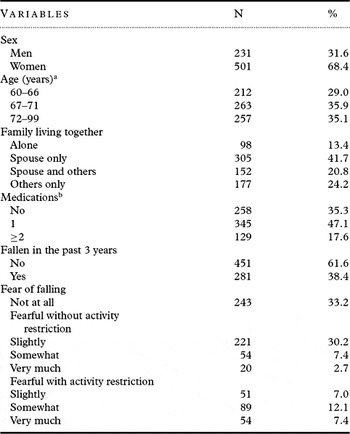
The characteristics of the participants and their fear of falling status are summarized in Table 1. The age of the study subjects ranged from 60 to 99 years, with a mean of 70.2 and a standard deviation of 5.8. More women (68%) than men participated. Only 13.4% were living alone, and the rest were living with someone else, most frequently a spouse. Approximately two-thirds had been prescribed one or more medications. Overall, two-thirds of our study participants had a fear of falling, of whom 39.7% (26.5% overall) also reported activity restriction. The prevalence of a fear of falling characterized as “somewhat” or “very much” was 29.5%. Of those who were only “slightly” afraid of falling, 19% (51/272) reported curtailing activities because of their fear.
Characteristics of the study participants (N = 732)

a The mean and standard deviation of age were 70.2 and 5.8 years, respectively.
b Any medications other than vitamin supplements.
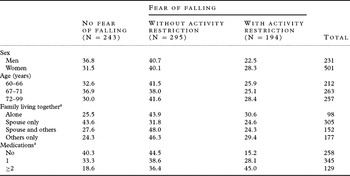
The distribution of fear of falling status varied across participant characteristics (Table 2). For example, the frequencies of fear with activity restriction were higher among women, the oldest age group, those without a spouse, and those who were taking two or more medications. Likewise, the frequencies of “No fear” were also lower in these groups. However, only family status and medication showed statistically significant associations with the fear of falling categories.
Percentage of the participants in each fear of falling category according to their characteristics

a p < 0.05, χ2 test for differences according to participant characteristics.
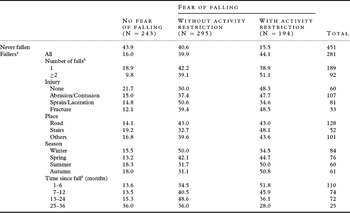
The distributions of fear of falling status were compared between fallers and non-fallers, as well as within the categories of fall characteristics (Table 3). Compared with non-fallers, those who had experienced a fall in the past three years had a significantly higher frequency of a fear of falling, particularly fear with activity restriction. Within the category of fall experience, the type of injury, place, or season of falling did not show a significant association according to χ2 tests. By contrast, multiple falls and the time since a fall were significantly associated with the fear of falling status. Moreover, the frequency of activity restriction tended to be higher among those who had fallen more recently.
Percentage of participants in each fear of falling category by the patterns of fall experience

a p < 0.001, χ2 test for the difference between fallers and non-fallers.
b p < 0.05, χ2 test for the difference among categories of fall experience.
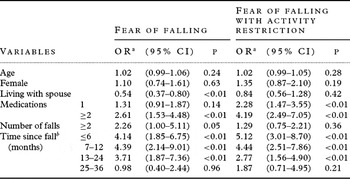
Multiple logistic regression analyses were performed to estimate the associations between the time since the last fall and fear of falling status (Table 4). Separate models were constructed for two outcomes of interest: overall fear of falling and fear of falling combined with activity restriction. Age, sex, and taking medications were adjusted for in all models.
Predictors of the fear of falling and activity restriction (N = number of participants included in the analysis)

a Odds ratios (and 95% confidence intervals) estimated using multiple logistic regression analysis.
b In comparison with non-fallers.
None of the models was rejected for goodness-of-fit, with P-values of 0.18 and 0.07, respectively, according to the Hosmer–Lemeshow test. The frequency of fear of falling predicted by the model can be considered close to the observed frequency as the p-value in the Hosmer–Lemeshow test indicated good adjustment of the model.
Time since the fall was a strong predictor of the outcomes in two models. In particular, the more recent falls were associated with a stronger fear of falling or activity restriction. Tests for linear trend across the time since fall categories were highly significant (p < 0.001) in all models.
Taking two or more medications other than vitamin supplements was a strong predictor of a fear of falling, especially fear with activity restriction. In our study population, being older and being female did not show any statistically significant associations with fear of falling status, although they had an odds ratio slightly greater than 1.
Discussion
In this study, we observed that recent falls were more strongly associated with a fear of falling, as well as with activity restriction, than distant falls. Those who had fallen within the previous six months had a fear of falling that was more than four times greater than those who had not fallen within the past three years. Similarly, fear combined with activity restriction was five times greater. The magnitude of the association decreased linearly over time, and became nonsignificant for falls that occurred 25–36 months before the survey. These results suggest that falls are initially very likely to induce a fear of falling, and then as time passes, the frequency of fear decreases. However, the possibility of an alternative explanation needs to be examined.
One possibility is the differential recall of past fall experiences. Since our study was cross-sectional, information on fear of falling status and past fall experiences were obtained at the same time. If for some reason, the participants who had a fear of falling at the time of the survey had recalled past falls more accurately than those who did not have a fear, the association would be greater for the more distant falls, and less for the more recent falls. However, our results show the opposite trend, and do not seem to be explained by such differential recall. In general, more distant falls might have been more difficult to recall regardless of fear of falling status. Forgetting more distant falls might contribute to the diminishing association between a longer time since a fall and fear of falling. Since falls that had been forgotten are unlikely to affect current fear of falling, such a reduction in the association might constitute part of the recovery process from fall-induced fear.
Another possibility is the overreporting of fall experiences by those who have a fear of falling. The prevalence of a fall history in our study was comparable to previous studies. Falls in the past year were reported by 25.1% (184/732) of our participants, which was slightly lower than the 27.8% in the study by Friedman et al. (Reference Friedman, Munoz, West, Rubin and Fried2002) in which the mean age of the participants was 72.6 years. Most other studies included older participants and reported higher prevalences of fall history. Our assessment of past fall experience was conducted by a trained interviewer using a structured questionnaire, and the meaning of “falling” was not likely to have varied significantly among the participants. In addition, overreported falls would have been mostly non-injurious. However, no significant association was found between injury and fear of falling status, and thus overreporting is not a likely explanation for our results.
The prevalence of a fear of falling among our participants was 67%, which was higher than reported in previous studies. Howland et al. (Reference Howland, Lachman, Peterson, Cote, Kasten and Jette1998) used the same definition as in our study and found a prevalence of 55%. Other studies using a simpler question (Yes/No) have generally reported a lower prevalence, ranging from 21 to 43% (Tinetti et al., Reference Tinetti, Mendes de Leon, Doucette and Baker1994; Friedman et al., Reference Friedman, Munoz, West, Rubin and Fried2002). In our assessment, the prevalence of fear of falling expressed as “Somewhat” or “Very much” was 29%, which is more comparable to the binary assessments. However, some of those who were only “slightly” afraid also had activity restrictions, which might have been a compensation mechanism that minimized their fear. One concern is that the study may not represent an average population of elderly because our participants were relatively young and had better physical function, which limits the ability to generalize on the prevalence of a fear of falling.
Time since a fall had a skewed distribution, with the highest frequency within six months and lower frequencies for more distant intervals. This pattern may have two causes. First, it might have been more difficult for the participants to recall the falls that occurred earlier. However, even if the participants remembered all of their falls, restricting the data collection to only the most recent falls would also have created a skewed distribution. Such patterns are typical for the distribution of time to events in general (Hosmer and Lemeshow, Reference Hosmer and Lemeshow1999). Intuitively, if the subjects have a similar risk of falling in a given time interval, fewer people could avoid falling.
The magnitude of the association between fear of falling and recent falls in our study appears striking. This is because our analysis compared the fallers with those who had not fallen for three years. Such a comparison shows the magnitude of the effect of a fall experience on the fear of falling. Our data are consistent with those of some other studies when we apply analyses similar to those studies. In the cross-sectional study by Howland et al. (Reference Howland, Lachman, Peterson, Cote, Kasten and Jette1998), any fall within the previous three months had an odds ratio of 2.5 associated with the fear of falling. In our data, any fall within the past three months had an odds ratio of 3.5 (95% CI: 1.4–6.6), when compared with all the other participants, including those who had fallen earlier. In the prospective study by Friedman et al. (Reference Friedman, Munoz, West, Rubin and Fried2002), falls that occurred 20–32 months before the follow-up survey were associated with a fear of falling with an odds ratio of 1.6 (95% CI: 1.2–2.0), whereas in our data, a fall experienced 13–36 months before the survey resulted in an odds ratio of 1.7 (95% CI: 1.1–3.2). Murphy et al. (Reference Murphy, Williams and Gill2002) reported an odds ratio of 1.4 (95% CI: 1.1–1.7) for the association between an injurious fall in the past year and activity restriction among those with a fear of falling. A similar analysis of our data gives an odds ratio of 2.3 (95% CI: 1.5–3.5). Therefore, our study shows a generally comparable, but somewhat greater, association between past falls and fear of falling. The difference might arise from the characteristics of our study participants.
Previous studies have observed that a fear of falling was independently associated with several predictors other than fall experience. The presence of chronic conditions requiring medication has consistently been a significant predictor in many studies (Tinetti et al., Reference Tinetti, Mendes de Leon, Doucette and Baker1994; Friedman et al., Reference Friedman, Munoz, West, Rubin and Fried2002; Murphy et al., Reference Murphy, Williams and Gill2002). Age and gender were significant predictors in some studies (Friedman et al., Reference Friedman, Munoz, West, Rubin and Fried2002), but not in others (Howland et al., Reference Howland, Lachman, Peterson, Cote, Kasten and Jette1998). Impaired physical function has been shown to be an independent predictor in some studies. Frailty attributes, such as impaired balance, inability to walk ten blocks, and requiring assistance to climb stairs, were significantly associated with a fear of falling (Arfken et al., Reference Arfken, Lach, Birge and Miller1994). Observed physical performance assessed using timed tests, including walking rapidly, turning in a circle, and rising from and sitting down in a chair, showed a significant association with fear of falling and activity restriction (Murphy et al., Reference Murphy, Williams and Gill2002). Visual impairment was also a significant predictor in some studies (Arfken et al., Reference Arfken, Lach, Birge and Miller1994; Tinetti et al., Reference Tinetti, Mendes de Leon, Doucette and Baker1994).
In this study, we did not obtain information on depression or physical function. Functional impairment in the elderly may increase both the risk of falls and fear of falling. Since our results were not adjusted for depression or physical function status, the magnitude of the association might have become larger than in other previous studies. However, this effect would have occurred across all of the categories of time since a fall, and the time trend in the association would not have changed. Most previous studies have not reported an interaction between the effects of fall experience and functional status on fear of falling. Therefore, it is not clear whether experiencing a fall would have a smaller impact on elderly persons with higher functional levels.
To summarize, our study has several limitations, as discussed above. It was cross-sectional and the recall of earlier falls might have been incomplete. In addition, the selection of participants was not population-based, and some chronic conditions requiring medications and some psychological and functional risk factors were not considered. Despite its limitations, the linear time trend of the association from the most recent fall to those longest ago is unlikely to have been affected. Therefore, our results suggest that recent falls have a much higher effect on fear of falling compared with more distant falls, and the effect gradually becomes smaller, until it becomes nonsignificant at two to three years.
This observation is particularly relevant if the faller already has some other functional or psychological risk factors for a fear of falling. The rehabilitation for a fear of falling would involve a program to boost psychological and physical functioning. Recently, randomized trials have shown that exercise programs and cognitive–behavioral interventions can improve physical function and reduce the fear of falling (Tennstedt et al., Reference Tennstedt, Lawrence and Kasten2001; Binder et al., Reference Binder2002; Baik et al., Reference Baik, Cho, Yang, Oh and Kang2003; Brouwer et al., Reference Brouwer, Walker, Rydahl and Culham2003; Sattin et al., Reference Sattin, Easley, Wolf, Chen and Kutner2005).
In conclusion, we observed that the experience of a fall is strongly associated with an increased frequency of a fear of falling, and this association gradually decreases with time. However, the association appears to persist for at least two to three years, suggesting that continuous attention and early intervention need to be provided for elderly people with a fall experience during that period in order to counter the fear of falling and prevent fear becoming a controlling factor in their everyday lives.
Conflict of interest
None.
Description of authors’ roles
Soong-Nang Jang formulated the research questions, carried out the study, and wrote the paper. Sung-Il Cho assisted with the study design and writing the paper. Sang-Woo Oh assisted with the study design. Eon-Sook Lee helped with the survey and statistical design of the study. Hyun-Wook Baik formulated the research design, and carried out the study.
Acknowledgments
This work was supported by the Korean Ministry of Health and Welfare Health Promotion Fund and the Brain Korea 21 Project (second stage).