INTRODUCTION
In many societies, breast cancer is the leading cause of death for women: in the United States, there are some 41,500 deaths per year (U.S. Cancer Statistics Working Group, 2005), in the United Kingdom 13,000 (Toms, 2004), and in Australia 2,500 (Australian Institute of Health and Welfare, 2003). However, even in the presence of metastases, breast cancer has a longer course of illness than many other common cancers.
A recurrence of breast cancer, with recognition of the incurable nature of the disease, is associated with greater distress than the diagnosis of primary breast cancer (Jenkins et al., 1991; Roberts et al., 1994; Hall et al., 2000). Although the disease may be treated, the challenge presented by this threat to life comes to the fore, along with the prospect of further demanding treatment regimens and debilitating side effects. For many women, the impact can result in emotional distress and reduced coping, which may reach the level of diagnosable psychiatric disturbance.
Although several studies have utilized the rigor of structured interviews to examine psychiatric morbidity in women with early breast cancer (Dean, 1987; Hughson et al., 1988; Ellman & Thomas, 1995; Foot & Sanson-Fisher, 1995; Ramirez et al., 1995; Kissane et al., 1998; Burgess et al., 2002), few have done so for women with advanced breast cancer. In one such study (Hopwood et al., 1991), the women selected had scored highly on psychological self-report scales, introducing a sample bias. However, 31/81 (39%) met criteria for depression, anxiety, or borderline mood disorder.
Knowledge about the nature and frequency of emotional distress is needed so that clinicians do not inadvertently miss psychological morbidity. Fulton (1998) reported that around one-third of a sample of 80 women with metastatic breast cancer were borderline or actual cases of anxiety or depression on the Hospital Anxiety and Depression Scale (Zigmond & Snaith, 1983) (rather than structured interview), yet, at most, only 6% were actually referred for psychiatric assistance. The impact of failing to detect and treat depression can be significant, possibly affecting length of hospital admission, compliance with cancer treatment, and functional independence (Berard et al., 1998).
The quality of life of patients with advanced breast cancer is also important. The European Organization for Research and Treatment of Cancer (EORTC) quality of life questionnaire QLQ-C30 (Aaronson et al., 1993) has been used in a number of samples of women with advanced breast cancer including psychological (McLachlan et al., 1998) and chemotherapy trials (including Hakamies-Blomqvist et al. 2000; Kramer et al. 2000; Riccardi et al. 2000; Wilson et al. 2000). The women in such studies are at varying stages of disease and treatment, confounding cross-study comparisons of quality of life. However, in all of these studies (and in the EORTC reference values; Cull et al., 2003), cognitive functioning scored highest, whereas global health and, less commonly, role functioning scored poorest.
In this article, our aim is to report the frequency of psychosocial morbidity and assess quality of life in 227 women with advanced breast cancer. Between May 1996 and March 2002, we recruited women with metastatic breast cancer into a replication of a randomized controlled trial (RCT) of the impact of supportive-expressive group therapy on survival (Spiegel et al., 1989). We present baseline psychological data collected before randomization or intervention.
METHODS
Sample
Inclusion criteria were the diagnosis of advanced breast cancer (Stage IV) using the TNM classification system (American Joint Committee on Cancer, 1992). Exclusion criteria included age over 70 years, geographic inaccessibility, a prior diagnosis of cancer except for basal cell skin cancer, minimal command of spoken English, dementia, psychosis, or intellectual disability.
Study Design
Ethical approval was granted by the research ethics committees at all seven participating hospitals.
Research assistants consulted with the women's clinicians to gain permission and confirm eligibility, and subsequently approached the eligible women to obtain informed consent. They then conducted a structured psychiatric interview and administered self-report questionnaires covering psychosocial state and quality of life.
Study Instruments
The following measures were used:
- The Monash Interview for Liaison Psychiatry (MILP) (Clarke et al., 1998) is a structured psychiatric interview specifically designed for use in the medically ill. Its interview process and diagnostic algorithms facilitate differentiation, and accurate attribution, of physical and psychological symptoms. Hence, the MILP is an appropriate choice in an oncology setting where physical and psychiatric comorbidity is expected. The MILP enables psychiatric diagnoses to be made in a standardized manner according to the DSM-IV (American Psychiatric Association, 1994) criteria within the full range of mood, anxiety, somatizing, and drug-abuse disorders. Interrater reliability and procedural validity compare favorably with other structured diagnostic procedures.
- The European Organization for Research and Treatment of Cancer (EORTC) quality-of-life questionnaire QLQ-C30 (Aaronson et al., 1993) and the EORTC QLQ-BR23 breast module (Sprangers et al., 1996) are validated, self-report measures containing core quality-of-life items covering physical, role, cognitive, emotional, and social domains and the disease-specific domains of body image, sexual functioning, perspectives on the future, arm and breast symptoms, and side effects of cancer treatments. Responses are rated on a 4-point scale as not at all, a little, quite a bit, or very much.
- Other self-report measures for monitoring mood, cognitive attitudes, coping, and family support.
The other scales used were the Hospital Anxiety and Depression Scale (HADS; Zigmond & Snaith, 1983), Affects Balance Scale (ABS; Derogatis, 1992), Mini-Mental Adjustment to Cancer Scale (MAC; Watson et al., 1989, 1994), Medical Coping Modes Questionnaire (MCMQ; Feifel et al., 1987), Family Assessment Device (General functioning; FAD; Epstein et al., 1983), Beck Depression Inventory (BDI)—Short Form (Beck & Beck, 1972), and Impact of Event Scale (IES; Horowitz et al., 1979). All are well validated.
Statistical Analysis
The Statistical Package for the Social Sciences (SPSS for Windows; SPSS Inc., 1999) was used for general statistical analyses. Confidence Interval Analysis (CIA) for Windows (Bryant, 2000) was used to compute confidence intervals (Wilson, 1927; Newcombe, 1998; Altman et al., 2000). Pearson product moment correlations, chi-square tests, independent samples t tests, and discriminant function analysis were used to examine factors associated with psychiatric disorders and quality of life, as well as clinical and demographic variables. High levels of significance were applied to avoid Type 1 errors as a result of multiple testing.
RESULTS
Respondents
Of 485 eligible women, 227 were enrolled in the RCT (a response rate of 47%). Of the 227 participants, 141 (62%) were recruited from public hospitals and 86 (38%) from private practitioners.
Reasons for refusal to participate included being “too busy” (27%), a “feeling of coping satisfactorily” (18%), “health and the demands of treatment” (20%), “practical issues such as child care and transport” (16%), “not being a ‘group’ person” (9%), and “wanting to get on with life” (10%), and 7% of eligible women died or were uncontactable before completion of informed consent. We had no way of confirming these stated reasons and could not ethically obtain clinical, sociodemographic, or psychomorbidity data for the women who refused to participate, so comparisons were not possible with the participants.
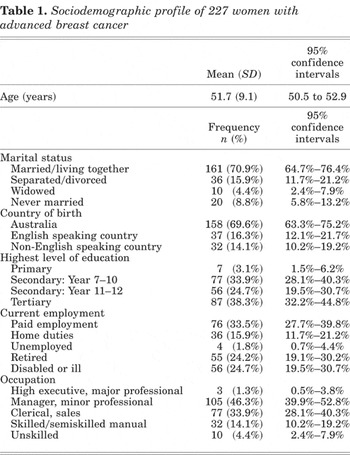
The mean age of the women was 51.7 years and most were married, Australian-born, and educated to senior high school or beyond (see Table 1 for the sociodemographic profile).
Sociodemographic profile of 227 women with advanced breast cancer

Clinical Features
Excluding those women whose initial breast cancer diagnosis was Stage IV, the median time elapsed between primary and metastatic diagnosis (i.e., disease-free interval) was 41 months (mean 54, SD 44). The median time between primary diagnosis and study entry was 53 months (mean 65, SD 47) and the median time from metastatic diagnosis to study entry (excluding those who were Stage IV at initial diagnosis) was 6 months (mean 10, SD 12).
Over half of the women were stage II, and 37 (16%) had metastatic disease at initial diagnosis. Mastectomy had been performed on 147 (65%) women and conservative breast surgery on 63 (28%), whereas 17 (7%) received no surgical management. Nearly half of the sample (102, 45%) had a tumor size greater than 20 mm and 83 (37%) of the women had a high grade (grade III or IV) tumor. Almost a third (68, 30%) had no nodal involvement at primary diagnosis, and 100 (44%) of the women had 1–10 nodes. Adjuvant chemotherapy had been given following primary diagnosis to 122 (54%), hormonal therapy to 76 (34%), and adjuvant radiotherapy to 87 (38%).
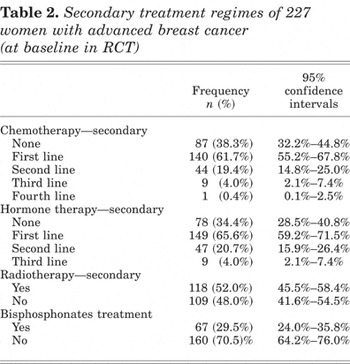
Local recurrence, prior to the diagnosis of distant metastases, had occurred in 39 (17%) women and regional in 18 (8%). Visceral metastases (with or without nonvisceral spread) had occurred in 124 (55%) and nonvisceral (only) in 103 (45%). Common sites for metastases were bone in 156 (69%), lung in 73 (32%), liver in 71 (31%), supraclavicular node or skin in 44 (19%), and brain in 8 (4%). Forty-one women (18%) had three or more metastatic sites at baseline. Table 2 gives a summary of the anticancer treatment given to the participants from the time of diagnosis of metastatic disease until entry to the study.
Secondary treatment regimes of 227 women with advanced breast cancer (at baseline in RCT)

Psychiatric Morbidity
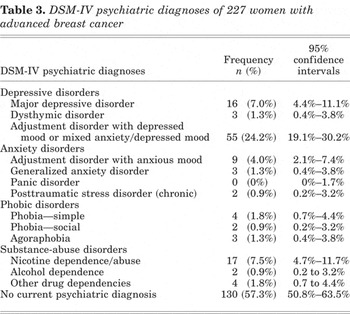
DSM-IV diagnoses derived from the structured MILP psychiatric interview showed that 97 (43%) of the women had a current psychiatric disorder; 81 (36%) had depression, anxiety, or both. Depression was present in 74 women (33%), of whom 16 (7% of the total sample) had a major depression and 58 (26%) a minor depression. An anxiety disorder was present in 14 women (6%), and 9 women (4%) had a phobic disorder (see Table 3).
DSM-IV psychiatric diagnoses of 227 women with advanced breast cancer

Adjustment disorder (including anxious, depressed, and mixed moods) was the most common psychiatric diagnosis (28%). Seventeen women (8%) had two or more psychiatric diagnoses, with nicotine dependence the second most common diagnosis. Identification of stressors in the MILP did not include having the cancer itself; only two women were assigned the diagnosis of chronic posttraumatic stress disorder.
Quality of Life
The mean scores on the EORTC QLQ-C30 included 67.7 (median 66.7) for role functioning, 69.1 (median 66.7) for social functioning, 72.4 (median 75.0) for emotional functioning, 79.1 (median 83.3) for cognitive functioning, and 64.7 (median 66.7) for global health. (The possible score range is 0–100, with higher scores representing better functioning.) All scores except role functioning were significantly associated with a diagnosis of depression (p ≤ .001).
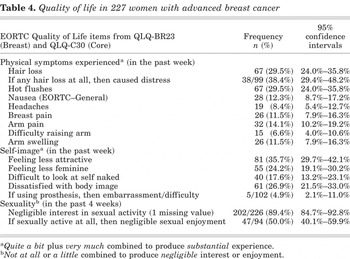
For the breast cancer module of the EORTC QLQ, the responses none and a little for the quality of life measures were combined to signify negligible, whereas quite a bit and very much were deemed substantial. Eighty-one women (36%) felt less attractive, 61 (27%) were dissatisfied with their body image, 55 (24%) felt less feminine, and 40 (18%) found it difficult to look at their naked body. Hot flushes occurred in 67 women (30%), nausea in 28 (12%), headaches in 19 (8%), phantom breast pain in 26 (12%), arm pain in 32 (14%), and arm swelling in 26 (12%). Substantial hair loss associated with treatment was present in 67 women (30%); of these, 38 (38%) were distressed about this (see Table 4).
Quality of life in 227 women with advanced breast cancer

The vast majority of the sample (89%) had lost interest in sex; of the 98 (43%) who were sexually active, 47 (50%) described it as unenjoyable.
Factors Associated with a Diagnosis of Depressive Disorder
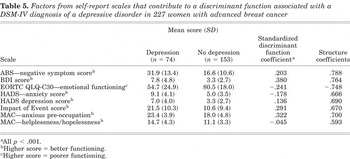
As many scores from the self-report scales were significantly correlated with a DSM-IV diagnosis of a depressive disorder, those scores that were the most highly correlated were chosen for inclusion as predictors in a discriminant function analysis (see Table 5). The overall Wilks' Lambda was significant (chi-square = 104.9; p = .000) with a canonical correlation of .619. The individual Wilks' Lambda (by the F test) was significant with p = .000 for all eight selected scores. The classification analysis showed that the presence or absence of a depressive disorder could be correctly determined by the function in 80.6% of cases. The small number of women diagnosed with anxiety (n = 14) limited any meaningful discriminant function analysis with this group of disorders. Although not included in the discriminant function analysis, other scores that significantly correlated (p ≤ .001) with a diagnosis of depression were the EORTC QLQ C-30 physical symptoms scores for insomnia, appetite loss, fatigue, and nausea/vomiting, as well as the family functioning score from the FAD.
Factors from self-report scales that contribute to a discriminant function associated with a DSM-IV diagnosis of a depressive disorder in 227 women with advanced breast cancer

Of the 74 women with a depressive diagnosis, 31 (42%) had a past history of depression, which was a statistically significant association (chi-square = 15.412, p = .000). Age differences between the depressed and nondepressed groups were significant, with depressed women being significantly younger (t = −4.73, p = .000). Younger age was also correlated with poor body image (r = .24, p = .01). Marital status, level of education, type of surgery, arm symptoms, hormone receptor status, and other treatment factors were not associated with a diagnosis of anxiety or depression.
DISCUSSION
Our finding of a rate of current psychiatric morbidity of over 40% for women with advanced breast cancer is similar to that reported in women with early stage breast cancer (Kissane et al., 1998). In both cases, this is more than twice the rate of overall psychiatric morbidity reported in a large community study of Australian adults (Australian Bureau of Statistics, 1998): 19.5% for females in the 45–54 years age range (the mean age of our sample being 51.7 years). In the Australian Bureau of Statistics survey, women in the community had a 12-month prevalence of depression of 6.8%, dysthymia 1.3%, anxiety 12.1%, and substance abuse 4.5%. Although these individual figures are not so dissimilar from our results, the Australian Bureau of Statistics survey rates were for 12-month prevalence, whereas our frequencies lie closer to more conservative point prevalences.
Psychological morbidity (especially minor, but still valid, forms of depression) presents a substantial clinical need in women coping with advanced breast cancer. Indeed, prevalence rates have not changed dramatically since the definitive U.S. collaborative study was conducted two decades ago (Derogatis et al., 1983); in a heterogeneous sample of cancer patients, 44% had a clinical syndrome. Much of this psychomorbidity was represented in the form of adjustment disorders, which had a prevalence of 32% (compared with 28.6% in our study). Other studies (Bukberg et al., 1984; Razavi et al., 1990) also reported a predominance of adjustment disorders rather than major mood disorders among cancer patients. Adjustment disorders are amenable to psychological therapies, and improvements in health can have a positive impact on their prevalence (Derogatis et al., 1983).
The rate of 7.0% for major depression in the women with advanced breast cancer is a slight improvement on the 9.6% figure we found in women with early stage disease (Kissane et al., 1998). Continued surveillance with ongoing management of the breast cancer is one possible explanation for this reduction. The relatively low prevalence of anxiety disorders may reflect the fact that the metastatic diagnosis was relatively recent and a diagnosis of generalized anxiety disorder requires symptoms to be present for at least 6 months (American Psychiatric Association, 1994). For many women, breast cancer has been present for some years, potentially tempering their anxiety.
Exploration of the factors associated with psychiatric morbidity provides insight into both predisposing and contributory aspects that may be amenable to intervention. Although causal relationships cannot be delineated in a cross-sectional study, troublesome somatic symptoms, together with emotional, cognitive, and social aspects of functioning, all correlated with the presence of a depressive state. Thus fatigue, persisting nausea, vomiting, and sleep disturbance were associated with an increased likelihood of psychiatric disorder developing. One advantage of the MILP, over some self-report scales, is its facility to attribute somatic symptoms to either physical or psychological causes.
Being younger, having a past history of depression, and continuing to be distressed by body image change are associated with developing a psychiatric disorder. In contrast, Pinder et al. (1993) did not find an association between age, or past psychiatric history, and the presence of current depression, although those findings were based on depression as determined by the HADS rather than by structured clinical interview. They suggested that in advanced disease, poor physical heath may have more impact than past psychiatric history or age. Our findings suggest that when personal vulnerability is highlighted through a prior history of difficulty in coping or continued distress about adjustment to changed self or body image is evident, clinical interventions are warranted.
A range of pessimistic or negatively constructed attitudes carried by patients are associated with the development of a psychiatric disorder. Thus a sense of hopelessness and helplessness about what is happening or worrying intensely over what might evolve contribute to psychological morbidity. Fortunately, meta-analyses of psychosocial interventions with cancer patients provide incontrovertible evidence for the efficacy of therapies in relieving such distress through attention to affective and cognitive states (Devine & Westlake, 1995; Meyer & Mark, 1995; Sheard & Maguire, 1996).
Poor family support is also associated with, and may perpetuate, depression. When the functioning of the family as a group is dysfunctional, greater psychosocial morbidity has been found among its members (Kissane et al., 1994). In modern societies, the family still most commonly represents the main source of social support. Intervention with the family unit is possible to optimize their functioning and support for their ill family member (Kissane & Bloch, 2002).
McLachlan et al. (1998) used the EORTC QLQ C30 to describe quality of life in women with metastatic breast cancer who were also recruited to a study of psychological intervention. This Canadian cohort (n = 150) was sampled like our own at various points after metastatic diagnosis and at different treatment stages. Similar scores were found on global heath (median of 67), social functioning (median of 67), and cognitive functioning (median of 83). The Canadian sample had a median score of 67 on emotional functioning and 50 on role functioning compared with 75 and 67, respectively, in the Australian sample. The similarity in perception of quality of life across these two studies is striking!
Femininity and sexual expression are aspects of quality of life that can be clearly impaired. Although sexual desire understandably wanes with cumulative treatment of breast cancer, health professionals can provide couples with encouragement regarding intimacy and affection. Lymphedema is another area of major concern to women. A rate of 4% for arm swelling (probably lymphedema) found 3 months after surgery in women with early stage disease (Kissane et al., 1998) rose to 12% in our sample of women with metastatic disease (who were an average of 4 years past primary surgery). In contrast, distress at hair loss is less than during adjuvant chemotherapy (Kissane et al., 1998). Although 29.5% of this sample experienced substantial hair loss compared with 31% with early stage breast cancer (Kissane et al., 1998), twice as many (77%) women with early disease were distressed by the loss compared with 38.4% with metastatic disease. Nevertheless, change in body integrity, sense of attractiveness, and confidence influence self-esteem and need to be understood clinically as key dimensions of the overall adaptation.
An important limitation of these findings is the origin of this cohort, recruited as it was for an RCT of supportive-expressive group therapy, generating frequencies but not formal prevalence rates that would be found in randomly sampled cohorts in epidemiology research. The eligibility criteria, recruitment rate, and nonrandom sampling design are potential sources of bias. A quarter of the women who refused to participate in the RCT were unwilling to commit to a time-consuming intervention. Only 18% of refusers volunteered that they were coping satisfactorily. On the other hand, 20% indicated health or treatment concerns; given the impact poor health can have on mood, it is reasonable to assume that a portion of refusers were experiencing psychiatric disorders. We had no means of identifying the precise level of psychosocial morbidity among the refusers, and the resultant impact, on our rates of disorder.
Nevertheless, the size of our cohort, the 95% confidence intervals, and the use of a standardized psychiatric interview to generate formal diagnoses provided methodological strength and a clinical utility that is not achieved by dimensional mood questionnaires alone. Additionally, as the MILP is more sensitive to minor mood disorders (Clarke et al., 1998), compared with other structured clinical interviews, it enhanced identification of minor forms of depression and anxiety.
Living with advanced breast cancer involves the cumulative burden of physical and emotional symptoms, functional losses, a negative impact on the quality of relationships and sexual functioning, plus existential concerns. The challenge is to transcend the illness and find continued meaning in life. The Clinical Practice Guidelines for the Management of Advanced Breast Cancer (National Breast Cancer Centre Advanced Breast Cancer Working Group, 2001) documents evidence of the ability of psychological counseling to improve quality of life. Nevertheless, there is still a widespread taboo about discussing dying and a related difficulty in open communication about authentic living. The recent publication of the Clinical Practice Guidelines for the Psychosocial Care of Adults with Cancer (National Breast Cancer Centre, 2003) provides substantial recommendations for appropriate professional responses.
Comprehensive supportive care is not yet available to many women with advanced breast cancer or their families. The emerging role of the breast care nurse is a promising development in many parts of the world. Clinical services also need social workers, psychologists, and psychiatrists—indeed, individual, group, and family therapists able to deliver programmatic rather than discipline-based services—to achieve the supportive care that we perceive women with breast cancer need and, indeed, for which they, themselves, are advocating.
ACKNOWLEDGMENTS
We thank the many clinicians who facilitated access to patients as well as Selma MacFarlane, Caroline Long, Kristen Barnes, Mary Harvey, and Kathryn Watty, who assisted with recruitment.
The National Health and Medical Research Council of Australia (Project Grant 990380), the Cancer Council of Victoria and the Kathleen Cuningham grants from the National Breast Cancer Foundation