Shyness has been defined as a “tendency to react with tension and discomfort to strangers and social-evaluative situations” (Asendorpf & Meier, Reference Asendorpf and Meier1993, p. 1072). Regarding the roots of shyness, the research is divided. Studies have shown that heredity makes a substantial contribution to shyness as a personality trait (e.g., Plomin & Daniels, Reference Plomin, Daniels, Jones, Cheek and Briggs1986). It is thought that about 15% of both adults and children are temperamentally shy. However, a striking 90% of the population report having experienced shyness at some point (Kagan, 1994; Zimbardo, Reference Zimbardo1977). It has also been suggested that the experience of shame or feeling different from others in a majority group undermines one's confidence to speak in social situations, explaining why shyness is more common among minority group members and individuals with language delays (Evans, Reference Evans, Rubin and Asendorpf1993). Similarly, self-efficacy has been shown to account for unique variance in the shyness levels of adolescents (Caprara, Steca, Cervone, & Artistico, Reference Caprara, Steca, Cervone and Artistico2003). Research has also shown that teachers tend to communicate differently with children who are temperamentally shy (Evans, Reference Evans1987; Evans & Bienert, Reference Evans and Bienert1992; Van Kleeck & Street, Reference Van Kleeck and Street1982), leading to the possibility that, to some degree, shyness is learned through socialization or reinforced by the differential behavior of adults. The above factors are not mutually exclusive, and may all play a role in the etiology and maintenance of shyness.
The purpose of the current study was to determine whether narrative skills differ between shy and nonshy children, and whether parents interact in a more directive fashion with shy children. Accordingly, a brief review follows on previous research documenting differences in language skills and parental interactions with shy children.
LANGUAGE SKILLS
In one of the earliest studies, Gewirtz (Reference Gewirtz1948) found that less socially apprehensive children aged 5 through 7 years performed better on rhyming, alliteration, naming, and disarranged sentence tasks than their more anxious peers, suggesting less developed linguistic abilities in shy children. More recently, Spere, Schmidt, Theall-Honey, and Martin-Chang (Reference Spere, Schmidt, Theall-Honey and Martin-Chang2004) found that the performance of shy children was below that of nonshy children on both receptive and expressive language tests. However, they noted that the performance of shy children was average, and therefore proposed that shyness does not hinder language development, but rather the practice that nonshy children receive with language through their more frequent and less inhibited interactions accelerates growth and leads to above-average test scores.
Van Kleeck and Street (Reference Van Kleeck and Street1982) compared the language used by shy and nonshy children when interacting with unfamiliar adults. This study contrasted two girls found to be shy through teacher ratings with two of their nonshy peers, all aged 3.5 years. Not only did shy children take shorter turns when speaking, as reflected in a lower mean length of utterance, but they also used less complex language in their speech. The shy children employed less lexical diversity and fewer complex sentences than the control children. The findings were extended by Evans (Reference Evans1987) in a study examining “sharing time” in a kindergarten classroom. Seven shy and seven nonshy children were observed on several occasions throughout an academic year. Overall, shy children took fewer turns at the floor and spoke on fewer topics per turn. In addition, shy children engaged in less complex speaking turns in that they more often described the object they brought to class using sparse and simple language, and less frequently offered personal narratives compared to their peers. Thus, in both naturalistic situations and on formal standardized tests, shy children appear less mature in their language use. However, results from both studies should be generalized with caution because of the study's small sample size.
ADULT INTERACTION STYLES
Questions are more common in conversations with children than with adults (Moerk, Reference Moerk1974). Possible reasons for this include adults' belief that questions capture a child's attention, test their knowledge, and train conversational skills such as turn taking (Evans & Bienert, Reference Evans and Bienert1992). One method of assessing the elicitation strategies employed by adults is to analyze the proportion of low- and high-power utterances they employ (see Wood & Wood, Reference Wood and Wood1983). Low-power elicitation styles involve the use of phatic comments (e.g. “Wow,” “I see”) and personal contributions (“I think your doll is pretty”) in an attempt to further the conversation. In contrast, high-power strategies entail questions that seek to elicit specific responses. Questions used in high-power elicitation styles includes open questions (e.g. “How did you feel the first time you saw your new doll?”), and closed questions of a choice (e.g. “Which of your doll's dresses is your favorite?”), or yes or a no (e.g., “Did your mommy buy you that doll?”) nature. These question types are combined into an overarching high-power category because it is defined by its response-requiring nature from the conversational partner. From the child's point of view, low-power comments are viewed as the adult potentially passing the conversational turn, whereas high-power strategies are a directive to speak.
Research has also shown that adult questions tend to account for a greater proportion of utterances directed to shy children and, when compared to collectivist nations, this is especially frequent among American parents (Toda, Fogel, & Kawai, Reference Toda, Fogel and Kawai1990). In the study by Evans (Reference Evans1987) on classroom “Sharing Time,” low-power remarks made up 42% of the teacher's utterances to nonshy children, but only 16% of those made to shy children. Shy children, in contrast, were the recipients of numerous high-power questions. In addition, many high-power open-ended questions were unanswered by the shy children, resulting in a chain of adult questions ending in a simple high-power yes/no question (Evans, Reference Evans1987).
Similarly, it has been shown that language delayed and autistic children receive many more questions than do their normally developing peers (Cross, Nienhuys, & Kirkman, Reference Cross, Nienhuys, Kirkman and Nelson1985). This difference remains when language-delayed children are engaged in shared book reading (Evans & Schmidt, Reference Evans and Schmidt1991). These more directive strategies may be employed with more reticent children because of an intuitive notion that increased questioning will increase responsiveness (Evans & Bienert, Reference Evans and Bienert1992). However, because significantly more of adults' comments to shy and language-delayed children are choice or yes/no questions that contain within them the correct response, it has been proposed that these children come to rely on this guidance rather than initiating turns themselves (Dillon, Reference Dillon1990; Evans, Reference Evans1987; Wood & Wood, Reference Wood and Wood1983).
Some support for this notion was gathered by Wood and Wood (Reference Wood and Wood1984). These researchers trained teachers in one of four conversational styles (two high-powered and two low-powered strategies), and observed these being employed in conversations with six preschool children. Results indicated that children showed the most initiative and spoke the longest utterances when teachers employed low-power elicitation strategies. Evans and Bienert (Reference Evans and Bienert1992) extended this research by training four kindergarten teachers in how to implement high- and low-power styles of conversing with their student during classroom sharing time and comparing children's speech between the conditions. When a low-power style was employed, children's fluency (indexed by the number of spontaneous words per turn) significantly increased, as did the length of their responses per teacher utterance when compared to a high-power style.
Together, the findings from these studies suggest that a high-powered and question laden elicitation style may be counterproductive, in that it places the child in the role of responder. For shy children, it is possible that taking less initiative and speaking less when conversing with adults reduces the amount of accumulated practice and corrective feedback they receive, and in turn, contributes to their less well-developed language skills.
NARRATIVE DEVELOPMENT
A frequent parent–child interactional context is that of story telling or narrative, occurring around either a book or an event in a child's life. A narrative has been defined as a sequence of clauses that are temporally related in a manner such that they could not be ordered any other way (Labov & Waletzky, Reference Labov, Waletzky and Helm1967). It is believed to be a joint process requiring both the understanding of perceived events and the production of language (Berman & Slobin, Reference Berman and Slobin1994). To perform well on a narrative task, children must be able to lexically encode information about the plot and characters, and then employ their knowledge of oral language to recount this information in a temporally coherent fashion (Reilly, Losh, Bellugi, & Wulfeck, Reference Reilly, Losh, Bellugi and Wulfeck2004). Thus, narratives provide an excellent method of assessing young children's oral language skill, and this language domain has been found to continue to develop after early childhood (Karmiloff-Smith, Reference Karmiloff-Smith1992). For example, among children with a history of language delay, differences continue to exist on narrative tasks up to and including Grade 1, long after an expressive vocabulary measure begins to yield normal scores (Paul, Hernandez, Taylor, & Johnson, Reference Paul, Hernandez, Taylor and Johnson1996). Kaderavek and Sulzby (Reference Kaderavek and Sulzby2000) found that the narratives produced by preschool children with specific language impairments were characterized by significantly less complex language (lesser use of past-tense verbs and of first-person pronouns) than those of normal controls. Furthermore, they contended that narrative features such as direct quotation and dialogue carrier can be regarded as markers of linguistic maturity (Kaderavek & Sulzby, Reference Kaderavek and Sulzby2000).
Just as the verbal behavior of shy children during sharing time was affected by manipulating the elicitation strategies employed by teachers (see Evans & Bienert, Reference Evans and Bienert1992), adult interactional styles may also play a key role in how children tell narratives and look at storybooks. Such scaffolding has been defined as an adult-facilitated process that enables a child to achieve a goal that would otherwise be beyond his or her ability (Clarke-Stewart & Beck, Reference Clarke-Stewart and Beck1999). In the context of shared storybook reading, mothers often use scaffolding strategies to support their child's interpretation of the story and their verbal expression in retelling its events. It has also been shown that the strategies naturally used by mothers during unstructured narratives are related to the way stories are later told by children when alone with a researcher. Children whose mothers routinely asked them only to describe people, places, and things in storybooks told stories that focused primarily on the orientation components of the story (person, place, setting) and were not well developed. In contrast, when mothers requested predictions, children created well-developed narratives with strong plots (Peterson & McCabe, Reference Peterson and McCabe1992). Clarke-Stewart and Beck (Reference Clarke-Stewart and Beck1999) presented children and their mothers with a 5-min segment of the movie Prancer, a film about a girl who becomes attached to one of Santa's reindeer. Following the film, mothers were told that their child would be asked to retell its story to an experimenter who had never seen it before. Mothers were then asked to talk to their child about the movie as they normally would, and dyads were then left to discuss the movie together for as long as they wanted. It was found that the number of scaffolding strategies mothers used when discussing the film with their child was directly related to the quality of the child's narrative upon retelling the story to an investigator. The most successful children were those whose mothers talked about the characters' emotions, prompted them with questions and explanations, corrected mistakes, and discussed at length key topics within the plot.
Finally, researchers have suggested that adults may have unique importance when scaffolding narratives with shy children. Specifically, Peterson contended that, because narrative ability is important for academic success, it is imperative that classroom teachers “provide numerous prompts for narration” and encourage reticent children to involve themselves in narrative tasks even if they have indicated they no longer wish to speak (Peterson, Reference Peterson1994, p. 264).
THE PRESENT STUDY
The current study sought to extend past research on narrative development and parental scaffolding, as it applies to shy and nonshy children in their home environment. Senior kindergarten children and their mothers were given the book Frog, Where Are You by Mercer Mayer (Reference Mayer1969), and they were asked to go through it as they normally would. Sessions were observed and audiotaped. Transcriptions were then created, in which both child and parental utterances were coded. The coding of parental utterances centred around high- and low-power dimensions, whereas coding of child utterances focused on linguistic quality (the amount spoken and the complexity of the language used), narrative completeness (the ability to express key story events), and narrative style (the ability to employ mental state verbs and dialogue, and to remain faithful to traditional narrative structure). Our general objectives were to determine (a) if shy and nonshy children perform differently on narrative tasks and (b) whether parents scaffold shy and nonshy children differently when eliciting narratives in a natural setting.
Given previous research suggesting that adults tend to coach shy children differently from their peers, it was hypothesized that parents of shy children would tend to use a more high-power style involving frequent questions, whereas parents of nonshy children would take a more low-power approach. In line with previous research on the language development of reticent children, differences in their narrative performance were also expected. Narratives produced by shy children were expected to be shorter and of poorer quality, reflected by a lower mean length of utterance, fewer words spoken, fewer modifiers used, and fewer complex sentences. With regard to the amount of information conveyed, the number of preidentified story units addressed by shy and nonshy children was not expected to differ. Consistent, however, with the prediction that parents of shy children would employ more high-power scaffolding strategies, a higher proportion of those units included in the narratives of shy children were predicted to result from parental elicitation rather than being spontaneously mentioned.
METHODS
Participants
Participants were recruited in junior kindergarten as part of a larger 3-year longitudinal study on emergent literacy. Informational letters and consent forms were sent home to the junior kindergarten students of four South Western Ontario boards of education. In the children's senior kindergarten year, parents completed the Shyness Scale of the Child Behavior Questionnaire (Rothbart, Ahadi, Hersey, and Fisher, Reference Rothbart, Ahadi, Hersey and Fisher2001), and the Children's Shyness Scale—Parent Version (Spooner, Reference Spooner2006). These two scales are highly correlated (r = .86), and were combined to form a reliable composite measure to identify the shy children. Children scoring one standard deviation or more above the mean for the total sample of 117 children were selected as the shy group. A sample 20 nonshy senior kindergarten children was also selected, for a total of 40 participants. The mean age of children in the shy group was 69.85 months and that of children in the nonshy group was 68.30 months. Both groups included 14 female and 6 male children.
Shy and nonshy groups were matched on gender and mother's educational attainment. In the four cases where exact matches on mother's education were not attainable, the closest possible matches were used without compromising gender or temperamental categorization. One father participated, and all other participating parents were mothers. Mother's education was measured using ordinal categories, with one indicating that elementary school had been completed and five indicating that a graduate level degree had been obtained. The mean score on mother's education for the shy group was 4.20 and the mean for the nonshy group was 4.55, indicating that, on average mothers had completed some postsecondary schooling. Family income was also measured using eight ordinal categories. The mean score for the shy group was 5.95 and that of the nonshy group was 6.53, where a score of 5 indicates a yearly income of $55,000–70,000 and a score of six indicates an income of $70,000–85,000. English was the dominant language spoken in the homes of all families.
Materials
Wordless storybook. Mercer Mayer's (Reference Mayer1969) wordless storybook, Frog, Where Are You, was used to elicit the narratives. The book consists of 24 pages, each displaying a black and white image. Mayer's book has an engaging story, which previous research has shown to successfully elicit verbal participation in children (Cameron & Wang, Reference Cameron and Wang1999). The book, which was first used for research purposes by Bamberg in 1985 (Berman & Slobin, Reference Berman and Slobin1994), describes the adventures of a young boy and his dog as they search for their missing frog. Throughout their journey the duo encounters several challenges, including a swarm of angry bees, a ride on the antlers of a deer, and a tumble into a river. Eventually the boy and his dog find their missing frog, who is resting with his mate and baby frogs. The story concludes with the boy and dog waving goodbye while holding a baby frog that is to become their new pet.
The temporally sequenced nature of the book is consistent with classical narrative structure, and the plot line provides ample opportunity for inferences about the motivations and emotions of the characters. The storyline is also relevant across ages and cultures, and Mercer Mayer's book has been found to be a powerful tool for learning about an individual's language abilities (Strömqvist & Verhoeven, Reference Strömqvist and Verhoeven2004). Because of these factors, Mayer's book has been used extensively in studies of both typically and atypically developing populations (Reilly et al., Reference Reilly, Losh, Bellugi and Wulfeck2004). Thus, Frog, Where Are You is an appropriate tool for assessing the narrative skills of children and concomitant parental scaffolding strategies in a naturalistic setting.
Shyness Scale of the Child Behavior Questionnaire. This scale (Rothbart et al., Reference Rothbart, Ahadi, Hersey and Fisher2001) consists of 13 shyness items, each rated on a scale from 1 (extremely untrue of your child) to 7 (extremely true of your child). Items tap behaviors that are known to be associated with shyness (e.g., “My child seems to be at ease with almost any person,” “My child is comfortable asking other children to play”). Items have been shown to have high internal consistency (.92), and this scale is regarded as being a valid measure of shyness.
Children's Shyness Scale—Parent Version. This scale (Spooner, Reference Spooner2006) is made up of 12 items, each rated on a 4-point scale from 1 (not at all like my child) to 4 (exactly like my child). Sample items include “he/she is quiet when meeting new people” and “he/she looks down or away when people are looking at him/her.” Items have been shown to have high internal consistency (.89), and this scale's validity as a measure of children's shyness can be seen in its correlation of .64 with Crozier's (Reference Crozier1995) Children's Shyness Questionnaire.
Procedure
Home visits took place in March of the children's senior kindergarten year. An observer arrived at the family's home at a prearranged time, and asked to set up in the location where the family would normally participate in shared book reading. Sessions most often took place in the kitchen or family room, and lasted less than an hour. The visits were tape recorded, and nonverbal behavior was recorded on observation sheets. After reading three to four short books with text, parent and child were presented with Frog, Where Are You (Mayer, Reference Mayer1969). The dyad was asked to go through this wordless storybook together as they normally would, with the child telling the story. Once the parent and child indicated that they were finished, audiotaping was stopped and the family was given a gift certificate to a local bookstore as a thank you gesture. Following the visit, the sessions were transcribed using the CLAN format used in the Child Language Data Exchange System (MacWhinney, Reference MacWhinney2000). Codes were later added to the transcripts for both parent and child utterances, as outlined in the following paragraphs.
Coding
Parental utterances. Following the method used by Evans and Bienert (Reference Evans and Bienert1992) parental utterances were first coded for high- versus low-power dimensions. High-power utterances were further broken down into open-ended questions (e.g., “How do you think the boy is feeling?”) and closed questions. The coding of closed questions included both yes–no (e.g., “Do you think the boy is angry?”) and choice questions (e.g. “Does the boy look angry or happy?”). Low-power remarks were separated into phatic remarks (comments not conveying content, such as “Good job!” and affirmative repetitions of the child's speech) and personal contributions (comments conveying story content, such as “I think the boy looks tired”).
Child utterances: Linguistic quality. To index the linguistic quality of children's narratives, the total number of words spoken, total number of utterances spoken, total number of incomplete utterances, and the total number of complex sentences spoken by the child were all computed. Three types of complex sentences were coded, and these were complement clauses, verb complements, and passive constructions. However, few complex sentences were found (means of less than two for both shy and nonshy children), and this variable was dropped from further analyses. Thus, a measure of mean length of utterance in words was added in order to partially capture the additional length of the occasional complex sentence that was uttered by the children. The total number of modifiers (adjectives and adverbs) used by children was also computed, as was the average frequency of the modifiers they employed to index their commonness. These frequencies were taken from Spoken Words: Effects of Situation and Social Group on Oral Word Usage and Frequency (Hall, Nagy & Linn, Reference Hall, Nagy and Linn1984), which includes a listing of the average frequency of words used by 5-year-old children.
Child utterances: Narrative completeness. Story content units provided by the child were identified. Then each content unit was coded as either solicited by the parent or volunteered by the child, allowing for an examination of the impact of scaffolding on the amount of information children conveyed. Children were not given credit for repeating content units previously mentioned by the parent. The content units provided a measure of narrative completeness, as adapted from the measure used by Norbury and Bishop (Reference Norbury and Bishop2003), who made a list of 51 pieces of information that a child could reasonably include in a narrative based on Mayer's (Reference Mayer1969) book. The current study employed this same list but divided the first preidentified content unit (Boy had a pet frog and a dog) into three separate units. Thus, children were given credit for mentioning each of the three main characters (the boy, frog, and dog), resulting in a total of 53 possible preidentified content units. Unlike Norbury and Bishop (Reference Norbury and Bishop2003), who awarded 2 points for each complete preidentified unit, 1 point was given for each unit mentioned by the child. Finally, to account for any additional or creative information mentioned by the child not captured by the 53 units, an “additional story unit” code was added. The total number of content units (both preidentified and additional) was calculated. This provided an indication of the completeness of narratives produced by children with regard to the total amount of relevant information they conveyed.
Child utterances: Global structure. Global narrative structure refers to a storyteller's ability to construct a narrative that is faithful to the temporal sequencing that defines narratives, while acknowledging key story elements such as setting and the internal states of characters (Norbury & Bishop, Reference Norbury and Bishop2003). To further assess the semantic completeness of the narratives produced by children, the 53 preidentified units were divided into six semantic episodes. The first episode involved discussion of the setting, the introduction of characters, and the initiating event (the frog escaping). Four search episodes followed, varying in the number of preidentified units they contained. Last, the resolution included content units addressing the conclusion of the boy's search, where he finds his frog and leaves with a new pet. Norbury and Bishop (Reference Norbury and Bishop2003) awarded children 1 or 2 points for each episode they discussed, depending on its completeness, but no reliability data for their coding was reported. To index the semantic focus of narratives produced by shy and nonshy children, as well as to determine which story episodes were given most focus by children of this age in general, the present study counted the number of units mentioned within each of these six episodes and calculated their percentage completeness. A higher percentage completeness of each of the six episodes reflects a greater ability to infer and narrate causal relationships between story events, as opposed to simply describing pictures.
The use of mental state verbs and references to emotions or intentions, as well as the inclusion of character speech, has been shown to demonstrate a child's global understanding of a story (Norbury & Bishop, Reference Norbury and Bishop2003). Previous research has also indicated that providing dialogue for a character within a story is a marker of linguistic maturity (Kaderavek & Sulzby, Reference Kaderavek and Sulzby2000). For these reasons, an additional code was added to child utterances containing direct character speech (e.g. “The boy said ‘be quiet’”). Child utterances containing mental state verbs, statements of intention, or references to emotions were also given an additional code. Together with performance on the six semantic episodes, these codes provided an overall measure of global narrative structure.
Reliability of coding system
To assess the reliability of the coding scheme, a second investigator coded 20% of the transcripts. Cohen's kappa was calculated for each coding category, as well as the percentage of events coded by one coder that were also coded by the second. Parental variables (the number of high- and low-power comments of each of the four categories) yielded a Cohen κ of .91, with a 94% agreement on events to be coded. The coding of story content (the number of units marked as preidentified vs. additional, as well as those volunteered by the child versus solicited or provided by the parent) also demonstrated strong reliability (Cohen κ = .86). A 94% agreement on events to be coded was obtained for this category. Cohen's kappa for the linguistic quality of children's narratives was 1.00, with an 87% agreement on events to be coded. Finally, because they have no logical counterpart to be compared with, no Cohen's kappa was calculated for the coding of volunteered dialogue or mental states. The percentage agreement on the detection of dialogue was 94%. One coder detected five instances where mental state verbs were used and the other detected six, for an interrater agreement of 83% on this variable.
RESULTS
Before analyses were conducted, all data were checked for normality and the presence of outliers. One score, pertaining to the number of volunteered and solicited preidentified content units within the first search episode, was changed from a 6 to a 5 to bring it within 3 standard deviations of that variable's mean. Unless otherwise stated, all data distributions were normal, and each comparison was carried out using an analysis of variance (ANOVA).
Linguistic quality and narrative style
A multivariate analysis using all six linguistic quality markers (number of words spoken, number of different modifiers used, number of incomplete utterances, mean length of utterance, total number of utterances spoken, and average frequency of modifiers used) revealed a significant difference between shy and nonshy children, F (5, 34) = 3.26, p < .02, and a moderate effect size (partial η2 = .32). Follow-up univariate tests showed that nonshy children spoke more words than shy children, F (1, 38) = 4.39, p < .05, partial η2 = .10, and used more different modifiers in telling their arrative, F (1, 38) = 5.71, p < .05, partial η2 = .13. A marginally significant difference was observed in the number of incomplete utterances made by children, with shy children uttering more incomplete sentences than their nonshy peers, F (1, 38) = 3.71, p = .062, partial η2 = .09. No significant differences were observed in the mean length of utterance, F (1, 38) = 2.49, ns, total number of utterances spoken, F (1, 38) = .65, ns, or frequency of modifiers employed, F (1, 38) = .02, ns. See Table 1 for descriptive statistics.
Descriptive statistics for children's linguistic quality variables

*p < .05. †p < .10.
Because many shy children did not include any dialogue in their narratives, the distribution of scores on this variable was not normal. Thus, a Mann–Whitney analysis was used. Nonshy children (M = 5.80, SD = 4.66) employed direct dialogue significantly more often than shy children (M = 1.75, SD = 3.31, U = 81.00, p < .01). No significant differences were observed between shy (M = 1.00, SD = 1.49) and nonshy (M = 1.20, SD = 1.15) children in the use of mental state verbs (U = 164.50, ns).
Sample narratives. The differences noted above are based on averages and variances within the two groups. Not all narratives of nonshy children nor all narratives of shy children exemplified the statistically significant effects above. However, the difference in quality of expression is shown in the following excerpts from transcripts of a shy and nonshy child respectively in which the final search episode and resolution are narrated.
• SHY: and they they falled off a cliff and went into the water.
• SHY: they almost found him but they didn't.
• SHY: but then they did and they had babies.
• SHY: aah!
• NON: he was soaking wet and fall in there and climbed back out.
• NON: they looked over the log.
• NON: they said “Oh frog.”
• NON: and then they saw the froggies.
• NON: they had their family, that's where they were.
• NON: the little boy was happy to let him go away.
Here, the shy child speaks fewer words in relating each of these two narrative units. Although the shy child adds the detail that the boy and his dog almost found the frog, the nonshy child includes modifiers to indicate that the boy was “soaking wet,” and later “happy” in finding the frog, and creates the dialogue of the character calling out of “oh frog.”
Semantic completeness
Shy and nonshy children compared on overall story completeness. A total of 741 preidentified story content units were volunteered by all the children combined, and 371 additional items not preidentified were provided. Hence, on average, each child volunteered 18.53 preidentified content units (SD = 8.77) and 9.27 additional units (SD = 5.82). An ANOVA revealed that the narratives voluntarily produced by shy children contained less semantic content than those put forth by their nonshy peers. Nonshy children volunteered a significantly higher number of story content units (both preidentified and additional; M = 31.65, SD = 10.65) than shy children (M = 23.95, SD = 13.17), F (1, 38) = 4.13, p < .05. (See Table 2 for details for each preidentified unit.)
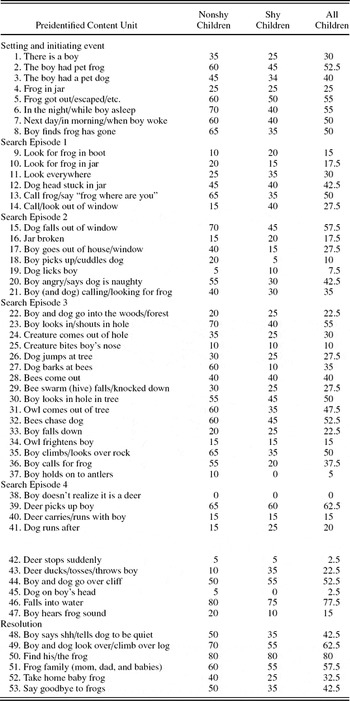
Percentage of children who volunteered each preidentified content unit

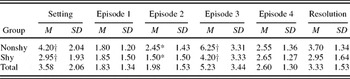
Each semantic episode was explored to determine if the finding that shy children volunteered less content than their nonshy peers reflects all aspects of Frog, Where Are You (see Table 3 for descriptive statistics). A marginally significant difference was found between shy and nonshy children in the number of story content units volunteered in narrating the setting, F (1, 39) = 4.0, p = .054. Groups did not differ in their development of the first search episode, but shy children volunteered fewer units again in search episode two, F (1, 39) = 4.19, p < .05. The groups were also marginally statistically different in their development of the third search episode, with shy children once again offering fewer units of story content compared to their nonshy peers, F (1, 39) = 3.81, p = .058. There were no differences for the story's resolution.
Descriptive statistics for children's volunteered units within each episode

*p < .05. †p < .10.
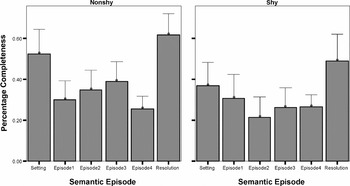
Shy and nonshy children compared on patterns of episodic focus. To compare the overall completeness of each episode and investigate group differences in focal patterns, the raw data were converted into percentages of the total number of units per episode. A repeated-measures ANOVA revealed a significant main effect of episode, indicating that some episodes were more fully developed than others, F (5, 190) = 13.66, p < .001. There was also a significant group by episode interaction, indicating that children's semantic focus differed between the two groups, F (5, 190) = 2.45, p < .05.
Pairwise comparisons revealed that shy children developed the story's resolution more fully than any of the four individual search episodes (p < .05). These children also developed the setting and first search episode (where the boy searches indoors for his frog) more fully than the second search episode (where the boy and his dog go out the window; p < .05). Nonshy children developed both the setting and resolution more fully than any of the four search episodes (p < .05). In addition, the third search episode (where the boy searchers in the forest) was related more fully than the first and fourth search episodes (where the boy is carried off by a deer; p < .05). See Figure 1 for a visual representation of the episodic focus of both groups.
The percentage completeness of semantic episodes for nonshy and shy children.

Prototypic narrations. To give some sense of what an “average” story from the two groups looked like, prototypic stories were created by including all preidentified units volunteered by 50% or more of the children from each group. These appear below.
Prototypic narration from nonshy children:
The boy had a pet frog. The frog got out/escaped/etc. in the night/while the boy was asleep. Next day/in morning/when the boy woke, the boy finds his frog is gone. He calls the frog/says “frog where are you.” The dog falls out of window. The boy is angry/says his dog is naughty. The boy looks in/shouts in a hole. The dog barks at some bees. The boy looks in a hole in tree. The owl comes out of the tree and the bees chase the dog. The boy climbs/looks over rock and calls for the frog. A deer picks up the boy. The boy and dog go over a cliff and fall into the water. The boy says “shh”/tells the dog to be quiet. The boy and his dog look over/climb over a log. The boy finds his frog with a frog family (mom, dad, and babies). They say goodbye to the frogs.
Prototypic narration from shy children:
The frog got out/escaped/etc. A deer picks up boy. The boy and dog go over a cliff and fall into the water. The boy and his dog look over/climb over a log. The boy finds his frog with a frog family (mom, dad, and babies).
These reconstructed narratives illustrate that at least half of the nonshy children provided both orienting information for the initiating events (that there was a boy who had a pet frog) and details about when the key event (the frog escaping) occurred and its immediate aftermath. At least 50% of them also related aspects of each search episode, especially the third in which the boy's search for his frog results in his dog being chased by bees. Finally, their resolution conveyed the character's stealth in directing his dog to be quiet, as well as the concluding event of the boy saying “good bye.” In contrast, all story units of the first three search episodes were narrated by fewer than 50% of shy children, and information about the setting and resolution was meagre.
Parental contributions, elicitations, and scaffolding styles
The obtained difference in the content volunteered by shy and nonshy children did not hold for the number of story units (both preidentified and additional), which were solicited by parents. Shy (M = 9.60, SD = 9.96) and nonshy children (M = 8.65, SD = 10.60) did not differ in the amount of information that they provided as the result of parental elicitation, F (1, 38) = .09, ns. Similarly, the number of content units provided by the parents of shy (M = 1.25, SD = 1.86) and nonshy (M = 1.00, SD = 1.65) children did not differ, F (1, 38) = .20.09, ns. An additional ANOVA revealed that shy children created less well developed narratives even after collapsing across preidentified content units that were both volunteered and provided as the result of parental elicitation (M shy = 22.35, SD shy = 6.11, M nonshy = 26.60, SD nonshy = 4.01), F (1, 38) = 6.773, p < .05.
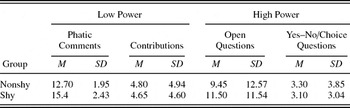
Further ANOVAs were conducted to determine how parents approached the task of supporting their shy and nonshy children in creating their narrative. Consistent with the above findings, no differences were observed in the number of low-power phatic comments, F (1, 38) = 0.75, ns, low-power contributions, F (1, 38) = 0.23, ns, high-power open questions, F (1, 38) = 0.29, ns, or high-power yes–no or choice questions, F (1, 38) = 0.03, ns, uttered by parents of children in the two groups (see Table 4 for descriptive statistics). Of the parental comments that could potentially contribute to the development of the narrative, the majority were high-power questions (74%) and of these, about 10 per narrative or roughly three-quarters in both groups were of an open nature. A supplementary analysis showed that the vast majority of these 10 questions centered around pictorial content and events within the book (87%), followed by questions that were posed to repair or confirm the child's understanding of the story (9%). Very few addressed internal states (3%) of the characters. ANOVAs revealed no significant differences between the groups in the number of high-power open questions asked in each of these categories: for content, F (1, 38) = .24, ns; for comprehension repairs, F (1, 38) = .05, ns; and for mental states of characters, F (1, 38) = .33, ns. Similarly parents offered low-power contributions about the story about five times per narrative and again the majority were concerning the book's content (72%). A further 12% were comments that repaired the child's rendition or understanding of the story and 5% addressed the characters' internal states. Again, ANOVAs revealed no significant differences between the groups: for content, F (1, 38) = .02, ns; for comprehension repairs, F (1, 38) = .00, ns; and for mental states of characters, F (1, 38) = .80, ns.
Descriptive statistics for parental comments accompanying children's narratives

DISCUSSION
The main objective of the current study was to examine the quality of narratives produced by shy and nonshy senior kindergarten children, as well as in the scaffolding strategies employed by their parents. The hypotheses that shy children would volunteer less content and use less advanced language and that parents of shy children would employ more high-powered scaffolding strategies were tested by coding the transcripts of 40 senior kindergarten children who created a narrative with their mothers from Frog, Where Are You. Overall, shy children spoke less than their peers, used less dialogue, and volunteered less story content. These differences were not associated with how adults scaffolded their child's speech turns, as parents did not differ in the extent to which they questioned shy and nonshy children nor in the way they contributed to the story. Thus, it appears that the narrative development of shy children is less advanced than that of their peers, despite similar guidance from adults. Specific findings that support this conclusion are discussed below.
Differences between shy and nonshy children's narratives
Shy children spoke less during the narrative session, were less likely to use dialogue and include a variety of modifiers, and were somewhat more likely (p < .10) to utter more incomplete utterances. Thus, even with the support of pictures and their parents, shy children's narratives evidenced less linguistic maturity. As such, the findings are in accordance with previous research documenting less well-developed language skills in shy children as evidenced by standardized test performance (e.g., Evans, Reference Evans1996; Spere et al., Reference Spere, Schmidt, Theall-Honey and Martin-Chang2004; for reviews of shyness and language development, see also Evans, Reference Evans, Rubin and Asendorpf1993, in press). In addition to differences in how the story was conveyed linguistically, shy children volunteered fewer preidentified and additional story content units than their peers. Although the groups did not differ in the extent to which they narrated the first episode in the boy's search for his frog in his room after it escaped, or final search episode and story's resolution of the boy finding the frog, groups were different in the second search episode, and marginally significantly different in the third search episode and setting.
Developmental research has shown that introductory information regarding a story's setting is more likely to be omitted by young children (Botvin & Sutton-Smith, Reference Botvin and Sutton-Smith1977; Umiker-Sebeok, Reference Umiker-Sebeok1979). Umiker-Sebeok (Reference Umiker-Sebeok1979), for example, found that the inclusion of an introduction increased from 37% to 60% in children's narratives from preschool to age 6. Similarly, integration of multiple events into a coherent whole requires a more sophisticated concept of narrative. The observed differences in recounting the story' setting and extended episodes may reflect less mature narrative schema or less skill in implementing it when story telling. Both interpretations are consistent with the speculation that shy children's more constrained verbal participation affords them less practice with language, as suggested by Evans (Reference Evans, Rubin and Asendorpf1993).
Shy children also volunteered fewer content units that were not preidentified during their narratives. Examples include giving the boy a name and describing additional actions of the main character that were not central to the plot. This may reflect shy children simply speaking less than their nonshy peers. However, it could also be due to a failure to elaborate beyond the explicit pictorial content. Shy children have been described as reluctant to take risks (see Levin & Hart, Reference Levin and Hart2003) and this sensitivity to uncertainty may constrain their creativity. In fact, Kemple, David, and Wang (Reference Kemple, David and Wang1996) found a negative relationship between mother's ratings of preschool children's shyness and teacher's ratings of their creativity.
Parental contributions and scaffolding strategies
Results demonstrated that parents did not differ in the amount of story information they contributed to the interaction, nor in the amount of information they succeeded in soliciting from the children through questioning. The vast majority of both open questions and contributions in both groups centered around the pictured material and events of the story, with very few addressing internal states of the characters. Furthermore, in contrast to results obtained in studies of teachers in classroom “Sharing Times” (Evans, Reference Evans1987; Evans & Bienert; Reference Evans and Bienert1992), the two groups of parents did not differ in the extent to which they used high-powered solicitation strategies. Although such questions may have been more common with repeated reading of the book, on this first reading Mayer's (Reference Mayer1969) storybook may have provided enough pictorial support that parents did not feel the need to prompt shy children as frequently as they would have during an open narrative. In addition, classroom teachers faced with a group of children and coverage of a curriculum may feel more pressure to keep the activities moving forward quickly and ensure that all children are being adequately engaged. Thus, teachers may prompt verbally reticent children more to minimize pauses, silence, and potential inattention.
Similarities between shy and nonshy children's narratives
Three measures of linguistic quality (mean length of utterance in words, total number of utterances spoken, and mean frequency of modifiers used) did not differ between groups. This is not consistent with some of the previous research on the language development of shy children, which shows less well-developed language skills in these children (Evans, Reference Evans1996; Gewirtz, Reference Gewirtz1948; Spere et al., Reference Spere, Schmidt, Theall-Honey and Martin-Chang2004; Van Kleeck & Street, Reference Van Kleeck and Street1982). It is possible that the use of a wordless book involving pictures that tell a specific story moderated existing differences. The vocabulary employed and events to be relayed are largely dictated by the items within its pictures. In contrast, the open narratives coded in studies investigating sharing time verbal behaviors (see Evans, Reference Evans1987; Evans & Bienert; Reference Evans and Bienert1992), neither support nor limit children in the same way.
Furthermore, competence is not all or none, but rather a function of context. The familiar setting and explicit coaching of parents in the current study may have boosted shy children's performance and not stretched them beyond their linguistic comfort zone. Previously observed differences between shy and nonshy children have appeared primarily on standardized tests (see Gewirtz, Reference Gewirtz1948; Spere et al., Reference Spere, Schmidt, Theall-Honey and Martin-Chang2004) that probe the upper limits of competence. In the current study, however, children were free to use whatever words they chose to describe the illustrations and were not asked to respond to increasingly difficult items as on standardized tests. In addition the illustrations themselves may have supported narrative performance. This may have masked differences in vocabulary and have attenuated differences between the groups.
Consistent with previous research, the data also showed that both groups of children volunteered more content units involving an action than any other type of content. This was shown by the prototypic narratives in the Results in which 6 out of the 7 units and 18 of the 23 units volunteered by at least half of the shy and nonshy children, respectively, were directly related to a character's action. In addition, on average, children volunteered less than half of the preidentified content units in each episode, so that the narratives of even the nonshy children were far from complete. Although children have been found to be capable of interpreting storybook illustrations as representations of dynamic events, they are far less effective in deducing links between illustrations, and struggle to properly interpret background events or character motivations (Berman & Slobin, Reference Berman and Slobin1994). As noted above, parents too infrequently made comments about the internal states of the characters or posed questions about this. Together, this partially accounts for the incomplete narratives provided by the children.
In addition, children of this age often miss or misinterpret the conventions used in storybook illustrations (Torr, Reference Torr2004). For example, the preidentified content unit “the dog licks the boy” was provided by only 7.5% of all children in the sample. This concrete piece of information is clearly conveyed in Mayer's (Reference Mayer1969) illustration of the dog's tongue visibly touching the boy's cheek. However, this detail may have been overshadowed by larger aspects of the picture or children may have failed to perceive the link between the dog falling out of the window and its subsequent comfort and joy in the boy's arms, illustrated on separate pages. As a second example, the preidentified unit “the boy doesn't realize it is a deer” was not mentioned by a single child. This is consistent with previous research by Berman and Slobin (Reference Berman and Slobin1994), who found that only 7 out of 72 preschool children (aged 3, 4, and 5 years) fully related this aspect of the story. Adults know that the boy is not aware of the animal's presence because the illustration shows him leaning on the deer's antlers while looking away to call his frog. Such false beliefs are difficult to convey pictorially, and the interpretation of this illustration is thought to require an “advanced theory of mind” (Strömqvist & Ludo Verhoeven, Reference Strömqvist and Verhoeven2004, p. 8; see Aksu-Koc & Tekdemir, Reference Aksu-Koc, Tekdemir, Strömqvist and Verhoeven2004). As such, wordless storybooks intended for young children should visually represent important pieces of information as saliently as possible, and highlight linkages between individual story events and pages to make the plot and intentions of the characters more explicit and aid interpretation.
Limitations
Although interesting findings were obtained, this study has limitations embedded within it. Having only 40 participants limited the study's statistical power, and may have contributed to the marginally significant findings described above. It is also possible that the presence of an observer and a tape recorder may have reduced the ecological validity of the parent–child reading session. Efforts were made to make the experience as noninvasive as possible by keeping the sessions informal, with the observer sitting well away from the dyad as they read and having the same observer work with the child each year of the study. Despite this, the mere presence of an outside individual may have altered the behaviors of the child or adult. Future research could partly address this by providing families with tape recorders to self-record their interactions. This would eliminate the influence of an observer, but that of the tape recorder would remain.
In collecting the data on children's narratives in interaction with their mothers, the study mirrored naturalistic interactions in which narratives are co-constructed in conversations, with the listener soliciting additional information. Nonetheless, a limitation here is that this methodology does not allow one to determine what the children could have narrated with only the support of pictures. It is likely that under such conditions, without the emotional support of parents, the stories of shy children would have been even more constrained and more pronounced group differences would have been found.
Finally, the study did not examine the effect of different interactional styles on shy children's narratives. Past research would suggest that a more high-powered approach in an attempt to solicit the child's ideas may lead to limited responses in the shy child. A low-power style with more frequent adult comments and contributions may model the co-construction of a more complete narrative. Future research should manipulate parental conversational style and examine the effect on the co-constructed narrative and on the child's subsequent independent retelling of it. Future research might also employ sequential analyses to investigate the specific types of responses each adult utterance-type elicits from young children in this context.
CONCLUSION
The overall picture created by the results of this study is that, despite similar parental questioning and contributions, shy children spoke less than their peers and created less well-developed narratives. As such, the study adds to a small but growing literature that suggests that increasing shyness in children is associated with less well-developed language skills. In addition, the incomplete narratives of both groups show that the creators of wordless storybooks must give careful consideration to the abilities of young children in interpreting the images. Although illustrations of the actions of characters are most likely to be verbally encoded by young children, illustrative conventions generally understood by adults (and the adult illustrator) are often missed.
ACKNOWLEDGMENTS
We gratefully acknowledge the Social Sciences and Humanities Research Council of Canada for funding this research through a grant to the second author. We also thank the families involved for their participation and support and the local school boards for assisting with the recruitment of participants. This research was previously presented at the International Society for the Study of Behavioral Development, Wurzberg, 2008.