INTRODUCTION
Maternal verbal interactive style has received considerable attention in the developmental literature – its prominence in the research attributable to reported links between mothers' styles and their children's developmental outcomes in social, cognitive and language domains (e.g. Beckwith & Cohen, Reference Beckwith, Cohen and Bornstein1989; Bornstein & Tamis-LeMonda, Reference Bornstein, Tamis-LeMonda and Bornstein1989; Tamis-LeMonda, Bornstein & Baumwell, Reference Tamis-LeMonda, Bornstein and Baumwell2001). In the linguistic realm, responsive, child-centered interactions have most often, but not always (e.g. Akhtar, Dunham & Dunham, Reference Akhtar, Dunham and Dunham1991), been associated with advances in children's language development. Positive correlations have been reported between aspects of maternal responsiveness and indices of children's language competencies, including measures of syntax, lexical development and verbal imitation (Tamis-LeMonda et al., Reference Tamis-LeMonda, Bornstein and Baumwell2001; Rollins, Reference Rollins2003; Masur, Flynn & Eichorst, Reference Masur, Flynn and Eichorst2005). Researchers have proposed that responsive verbal interactions may support the language learning process by decreasing attentional demands (Tomasello & Todd, Reference Tomasello and Todd1983), describing the immediate environment (Harris, Jones, Brookes & Grant, Reference Harris, Jones, Brookes and Grant1986; Tomasello & Farrar, Reference Tomasello and Farrar1986; Hampson & Nelson, Reference Hampson and Nelson1993) or engaging children in communicative exchanges (Hoff & Naigles, Reference Hoff and Naigles2002). Findings are notably inconsistent, however, with regard to the correlates of a more directive interactive style, often typified by attempts to regulate or command children's behaviour or attention. Some researchers have reported negative associations with children's language (Tomasello & Farrar, Reference Tomasello and Farrar1986; Hampson & Nelson, Reference Hampson and Nelson1993), whereas others have reported positive associations (Barnes, Gutfreund, Satterly & Wells, Reference Barnes, Gutfreund, Satterly and Wells1983; Akhtar et al., Reference Akhtar, Dunham and Dunham1991). Nonetheless, maternal stylistic differences appear to constitute a crucial element of the language learning environment for young children.
Despite the potential importance of maternal verbal style, and despite published studies spanning decades of research, several critical issues remain unresolved. Although most researchers distinguish between a more responsive and a more directive style, the characteristics defining each often differ greatly across studies, perhaps accounting for some of the inconsistencies in links to children's outcome measures, and, ultimately, restricting the usefulness of these concepts. Current research also fails to document adequately the continuity of style characteristics over time. Such stability would make it more likely that maternal speech characteristics would have a meaningful impact on the developing child and, therefore, make it a topic worthy of further study. An additional failure of the literature is the lack of studies that examine style across the various interactive contexts that make up the daily social context of parents and children. This study attempts to reconcile some of the inconsistencies in the research by investigating characteristics of mothers' verbal style across the crucial second year of children's language development and examining the extent to which mothers demonstrate stability of style across time and consistency across contexts.
Responsiveness
Some accounts of verbal responsiveness have focused on the pragmatic characteristics of maternal speech, particularly mothers' use of language to engage children in linguistic activities or to provide descriptions of objects and activities in the immediate environment (Della Corte, Benedict & Klein, Reference Della, Benedict and Klein1983; Nelson, Reference Nelson1985; Hampson & Nelson, Reference Hampson and Nelson1993). Supportive interchanges that focus on describing the observable environment may provide crucial input for language learning. Indeed, some studies have reported positive links between use of descriptive utterances and language outcomes for children who are in the beginning stages of language development (Della Corte et al., Reference Della, Benedict and Klein1983; Hampson & Nelson, Reference Hampson and Nelson1993; Masur et al., Reference Masur, Flynn and Eichorst2005).
Alternatively, researchers have stressed the importance of matching language input to children's current focus of attention (Harris et al., Reference Harris, Jones, Brookes and Grant1986; Tomasello & Farrar, Reference Tomasello and Farrar1986; Tamis-LeMonda et al., Reference Tamis-LeMonda, Bornstein and Baumwell2001; Hoff & Naigles, Reference Hoff and Naigles2002). From a theoretical perspective, a shared focus of attention should make it easier for children to know what it is that adults are talking about and, thus, to begin the task of connecting words to referents. Conversely, requiring young children to redirect attention would likely increase task difficulty and impede language development. Both naturalistic and experimental studies have demonstrated positive links between adult utterances that follow children's current focus of attention and the children's subsequent lexical growth (Tomasello & Todd, Reference Tomasello and Todd1983; Tomasello & Farrar, Reference Tomasello and Farrar1986; Harris et al., Reference Harris, Jones, Brookes and Grant1986; Rollins, Reference Rollins2003).
Both of these dimensions of verbal responsiveness – a focus on maternal pragmatic characteristics and an emphasis on attention regulation in language learning – are important considerations. The conjunction of these two aspects may represent the hallmark of maternal verbal responsiveness. Therefore, we have examined descriptive utterances about objects and events in the environment that are sensitively timed to the children's focus of attention as our measure of maternal responsive speech.
Directiveness
The characteristics of directive maternal speech are less well documented and certainly more controversial than those of responsive maternal speech. While directive speech has often been associated with poorer language outcomes for children (Nelson, Reference Nelson1973; McDonald & Pien, Reference McDonald and Pien1982; Pine, Reference Pine1992b; Hampson & Nelson, Reference Hampson and Nelson1993), results have sometimes been mixed. Some studies find no links to language development (Tomasello & Todd, Reference Tomasello and Todd1983; Carpenter, Nagell & Tomasello, Reference Carpenter, Nagell and Tomasello1998; Hoff & Naigles, Reference Hoff and Naigles2002), and a few report beneficial outcomes for at least certain types of directives (Barnes et al., Reference Barnes, Gutfreund, Satterly and Wells1983; Akhtar et al., Reference Akhtar, Dunham and Dunham1991). Such inconsistencies are likely partially due to the variety of ways that directives have been conceptualized and defined.
First, researchers with an interest in pragmatics have disagreed upon the need to distinguish between behavioural and attentional directives (Pine, Reference Pine1992b). Early research on pragmatics by Nelson (Reference Nelson1973) identified a group of mothers for whom frequent use of behavioural directives or commands appeared to reflect an underlying concern with control of children's behaviour. Some subsequent studies viewed behaviour-directing speech as indicative of maternal insensitivity (McDonald & Pien, Reference McDonald and Pien1982; Hampson & Nelson, Reference Hampson and Nelson1993). In other studies, however, directiveness has been used to describe utterances that control children's attention as well as their behaviour (Della Corte et al., Reference Della, Benedict and Klein1983; Hoff & Naigles, Reference Hoff and Naigles2002). A convincing argument against combining attention-directing and behaviour-directing utterances into a single pragmatic category was made by Pine (Reference Pine1992b). He contended that from an empirical perspective, rates of behavioural and attentional directives in maternal speech were unrelated to one another and from a theoretical perspective they were unlikely to serve the same function. As Pine noted, behavioural directives are frequently used to support an ongoing activity (e.g. Put the square one in there, when the child is engaged with the shape sorter) and, consequently, lack the intrusive quality of an attention-directing utterance. In contrast, he considered attention-directing utterances inherently intrusive; they acquire negative status because of their association with maternal insensitivity and lack of responsiveness. Therefore, in examining maternal directiveness, it would be critical to separate these two types of directives – behavioural versus attentional.
A second issue contributing to inconsistent findings regarding maternal directiveness is whether or not researchers consider children's focus of attention. Some researchers have taken into account the extent to which maternal utterances either follow or lead their children's attentional focus (e.g. Akhtar et al., Reference Akhtar, Dunham and Dunham1991; Masur et al., Reference Masur, Flynn and Eichorst2005), whereas others have not (e.g. Hoff & Naigles, Reference Hoff and Naigles2002). Akhtar et al. (Reference Akhtar, Dunham and Dunham1991) suggested that attention regulation rather than behaviour control may represent the fundamental form of maternal directiveness. Although their study initially collapsed across the pragmatic categories of attention and behaviour, it distinguished between directives that followed and those that led children's attention. In their study, those directives that followed children's attention were positively associated with later lexicons, whereas those that led children's attention demonstrated negative associations with vocabulary measures. Their findings provide support for the notion that sensitivity to children's attentional focus is a key aspect of maternal directiveness. Negative child outcomes associated with directive utterances may come about because they are commonly used to redirect children's attention, creating situations where young children experience difficulty matching linguistic information to environmental targets.
Clearly it is important to identify both the pragmatic intentions and the attentional demands inherent in maternal directives. When both dimensions are considered simultaneously, it appears that there are several types of directive utterances. There are behavioural directives used supportively to direct children in the course of ongoing activities in which they are already engaged, and there is a more intrusive type of behavioural directive used to constrain or redirect activity. Directing children's behaviour may be either supportive or intrusive, depending on children's ongoing focus of attention (Akhtar et al., Reference Akhtar, Dunham and Dunham1991). There are also attention-directing utterances which are intrinsically more intrusive, particularly so when leading children's attention away from the current activity or object of attention toward a new one. Unfortunately, although several studies have made relevant distinctions within either the pragmatic or the attentional domains, they have not considered both simultaneously. Reconceptualizing directiveness to consider both pragmatic and attentional dimensions may help to explain previously inconsistent relations between directiveness and children's outcomes. In an examination of maternal directiveness, including both dimensions should prove useful in integrating prior definitions and elucidating characteristics of maternal style. Thus, we have distinguished between supportive behavioural-directive speech which follows children's focus of attention and highly intrusive behavioural- or attentional-directive speech which leads their attentional focus.
Issues of developmental change, contextual differences, stability and consistency
In addition to examining the essential characteristics of maternal responsive and directive verbal styles, a thorough investigation should also address issues of developmental change, differences between contextual situations, and consistency across situations and stability over time in individual mothers' patterns of behaviour. First, it is necessary to explore the possibility that their expression may change over time. Because different input may be of value at various stages of development (Furrow, Nelson & Benedict, Reference Furrow, Nelson and Benedict1979), mothers may be particularly likely to make adjustments to their speech during their children's second year of life, when cognitive skills in general and language skills in particular are undergoing rapid transformation. It may be that critical characteristics of mothers' speech are linked to external factors that change over time and these changes may also have a bearing on certain inconsistent findings predicting children's developmental outcomes. Thus, it would be particularly valuable to see whether changes occur over the second year of life, a period of tremendous growth for children's language abilities.
Although several researchers have discussed the possibility that mothers modify their speech to correspond to their children's ages and developmental levels (e.g. Della Corte et al., Reference Della, Benedict and Klein1983; McDonald & Pien, Reference McDonald and Pien1982), rarely has this issue been examined in longitudinal samples. In one of the few studies that measured maternal speech characteristics at more than one point in time, Pan, Imbens-Bailey, Winner & Snow (Reference Pan, Imbens-Bailey, Winner and Snow1996) reported an increase in the proportion of maternal utterances considered child-centered acts, because they followed in to children's focus of attention, and a decrease in the proportion of utterances used to redirect children's focus of attention or prohibit behaviour. Although the time span was considerable, including the period from 1 ; 2 to 3 ; 1, they did not focus specifically on responsive speech as defined in the current study and they did not distinguish between behavioural and attentional directives, issues addressed in the present investigation.
Also, in their analysis of developmental changes in mothers' speech, Pan et al. (Reference Pan, Imbens-Bailey, Winner and Snow1996) employed proportions. Because proportions reflect the relative distribution of the different speech categories, they are often utilized and recommended for describing ‘the structure or quality’ of maternal speech styles (Pine, Reference Pine1992a: 245). Akhtar et al. (Reference Akhtar, Dunham and Dunham1991), for example, analyzed only the first 100 utterances from each mother, essentially examining proportions of speech. Hoff-Ginsberg (Reference Hoff-Ginsberg1992) pointed out, however, that measures of proportions neglect potentially valuable information on frequencies. She found that analyses of proportions and frequencies of particular utterance types yielded ‘substantially different pictures’ (Hoff-Ginsberg, Reference Hoff-Ginsberg1992: 240) of maternal speech when mothers' total verbal outputs varied considerably. Considering the possible merits of both measures, we have presented analyses employing both absolute and relative frequencies.
Furthermore, the study by Pan and her colleagues (Reference Pan, Imbens-Bailey, Winner and Snow1996) observed mothers' speech to their children in the laboratory as they played with specific sets of toys in a prescribed order. Although not well understood, the situational context may also influence speech to children. Clearly, both the setting and structure of the laboratory task differ from the home environment, and it is possible that these shaped both the behavioural and linguistic interactions of the participants. Studies that observe dyads in naturalistic settings are crucial to our understanding of typical maternal speech characteristics during language learning interactions.
It has also become clear that even within naturalistic studies of dyadic interactions there may be issues of context. Many studies of mothers' speech have examined their characteristics exclusively during toy play (e.g. Akhtar et al., Reference Akhtar, Dunham and Dunham1991; Dunham & Dunham, Reference Dunham and Dunham1992; Pine, Reference Pine1992b; Hampson & Nelson, Reference Hampson and Nelson1993). However, the social interactions of dyads and the opportunities for language learning are not limited to a single interactive context but instead comprise a multitude of situations, including caretaking routines, mealtimes, book reading and more. Thus, such reliance on free play interactions raises questions about the generalizability of current descriptions of maternal style. In fact, the few studies that include a context besides play suggest that maternal speech may indeed be influenced by context. For example, both Hoff-Ginsberg (Reference Hoff-Ginsberg1991) and Yont, Snow & Vernon-Feagans (Reference Yont, Snow and Vernon-Feagans2003) reported more directiveness by mothers during toy play than during book reading, and Hoff-Ginsberg also reported more directiveness during toy play than during mealtime or dressing. It is possible that the presence of a text during reading or the absence of toys during mealtime and dressing might have influenced these results. Examining mothers' speech in a natural interactive setting other than free play, but with toys still available, would help resolve this question. Thus, we have chosen bathtime, a universal caretaking context first utilized by Bruner (Reference Bruner1975), in which toys, at least in Western societies, are routinely present. In addition, distinguishing among supportive behavioural and intrusive behavioural and attentional speech, which has not been done in prior studies, should further our understanding of the role of context in shaping different kinds of verbal interactions.
Finally, besides developmental changes and contextual differences, there are questions about the stability over time and consistency across contexts of the responsive and directive speech styles of individual mothers. Only a few studies have examined maternal speech either over time or across different contexts, and none to our knowledge has looked at both simultaneously. Two studies reported very short-term stability for maternal directive speech. Olsen-Fulero (Reference Olsen-Fulero1982) found stability over several days in mothers' production of behavioural and attentional directives to two-year-olds; and Pine (Reference Pine1992b), in a study of eight dyads conducted when the children were near their first birthdays, reported stability in mothers' behavioural and attentional directives, but not descriptives, over a one month period. Whether similar relations would hold throughout the second year or for longer time intervals remains to be determined. Similarly, there are very few studies that address the issue of consistency of speech characteristics across contexts. Hampson & Nelson (Reference Hampson and Nelson1993) reported consistency in mothers' requests for actions and descriptions between the settings of toy play and mealtime. However, their study investigated speech only to children at 1 ; 1 and did not analyze attentional directives, a particularly salient pragmatic category in speech to one-year-olds. In order to determine whether maternal speech characteristics represent relatively enduring patterns of interaction or are instead transient features linked to the current situation, it would be valuable to assess stability across time and consistency across contexts for individual mothers.
The present study
The purpose of the present study was to investigate mothers' responsive and directive speech to their children in a longitudinal sample. Observations from the end of the first to the end of the second year, at 0 ; 10, 1 ; 1, 1 ; 5 and 1 ; 9, were designed to encompass dyadic interactions during a developmental period of dramatic social, cognitive and linguistic growth. The specific dimensions of responsive and directive speech were chosen to reflect both the essential pragmatic and the critical attentional characteristics previously identified but never simultaneously studied in existing research. Of specific interest to this study were responsive speech characteristics, defined by use of descriptions that followed children's focus of attention, as well as three types of directive utterances. These were behavioural directives used to support an ongoing activity (supportive directives) and two types of intrusive directives used to control and redirect children's behaviour or their attention. The longitudinal design allowed for assessment of developmental changes in maternal speech characteristics over time as well as an examination of the stability of behavioural patterns for individual mothers. Additionally, this study was one of a very few to investigate questions of similarity or difference and consistency or inconsistency between maternal speech characteristics in more than one interactive context – free play, the most widely examined context, and bathtime, a universal caretaking routine rarely studied. Because of discussions in the literature about measuring absolute versus relative frequencies of maternal utterances, analyses employing both were conducted. Finally, because some previous research has suggested that mothers may speak differently to girls and to boys, providing more speech and more responsive utterances to daughters than to sons (Leaper, Anderson & Sanders, Reference Leaper, Anderson and Sanders1998), this study also explored differences in speech to girls versus to boys.
METHOD
Participants
Participants in this study included 10 boys and 10 girls, 6 of each first-born, and their mothers, identified and recruited through published birth announcements to participate in a longitudinal, naturalistic study of normal infant development. Families lived in the small towns, rural areas and suburban communities surrounding a large mid-western state university. Nineteen of the dyads were European American, while one was African American; English was the native language for all of the households. All 20 infants appeared to be healthy and experiencing normal development at the time of the study. Home visits occurred when infants averaged 0 ; 10 (M=0 ; 10·14), 1 ; 1 (M=1 ; 1·15), 1 ; 5 (M=1 ; 5·19) and 1 ; 9 (M=1 ; 9·18). Seventeen of the participating dyads were observed at all four ages, and 3 – 2 girls and 1 boy – were recruited at 1 ; 1 to replace families who moved away or declined to continue.
Procedure
Home visits included dyadic interactions in two naturalistic contexts, free play with toys and bathtime. Dyads also participated in additional activities not used in the current analyses. Play and bath sessions were counterbalanced across children, and averaged 14·14 minutes (s.d.=1·97) for play and 13·78 minutes (s.d.=1·8) for bathtime. Mothers were instructed to interact with their children as they normally would during bathtime or when they had 10 to 15 minutes of free time to play with toys. The same sets of free play and bath toys were used at each visit.
Researchers videotaped the sessions and attempted to be as unobtrusive as possible and to minimize interactions with the participants during the recording sessions. Videotapes were later transcribed by observers working in pairs who recorded the vocalizations, words and actions of mothers and children; both observers had to agree in order for behaviours to be recorded. Utterance boundaries were determined by intonation contours and pauses; unintelligible utterances and false starts were omitted.
Coding
Four mutually exclusive categories of mothers' responsive and directive speech, defined below, were employed in this investigation – Responsive Utterances, Supportive Directive Utterances, Intrusive Behavioural Directives and Intrusive Attentional Directives. Because infants typically required a short time to settle into the interactions and sometimes became uninterested or fussy later in the sessions, to maintain uniformity mothers' utterances were coded from the beginning of the third minute until the end of the eleventh minute for a total of eight minutes of each interaction, separately in each context; utterances that fell entirely within this eight-minute period were coded. Each maternal utterance was included in or excluded from the four categories of interest based on the codes it received on two separate dimensions: (1) the mother's sensitivity, or not, to the child's focus of attention at the time of the utterance; and (2) the mother's pragmatic intent.
Sensitivity to focus of attention was determined by the child's visual focus and/or engagement at the start of the maternal utterance. In this mutually exclusive system derived from the work of Harris et al. (Reference Harris, Jones, Brookes and Grant1986), utterances that referred to an object, action or attribute on which the child was currently visually focused or with which the child was actively engaged at the start of the utterance were identified as following children's attention, while all others were designated as leading children's attention. Each utterance was coded as Following or Leading.
Consistent with the work of Pine (Reference Pine1992b), pragmatic categorization reflected the function of the utterance, independent of its syntactic construction. Three of Pine's (Reference Pine1992b) seven mutually exclusive categories were employed for these analyses:
(a) Descriptions provide descriptions of actions, objects or other aspects of the immediate environment (e.g. Those are bubbles. Is that block too big? You're playing music.). Utterances coded as both Descriptions and as Following the child's focus of attention were counted as Responsive Utterances.
(b) Behavioural Directives seek to control the physical behaviour of the child by suggesting, commanding or encouraging the child (e.g. Give me the soap. Can you turn the block this way? Let's play with the bunny.). Behavioural Directive utterances that were coded as Following the child's current attentional focus were counted as Supportive Directives. Behavioural Directive utterances that were coded as Leading the child's attentional focus, that is, directing the child away from the action or object with which the child is currently engaged and/or directing the child's behaviour in a new direction were counted as Intrusive Behavioural Directives.
(c) Attentional Directives attempt to direct or redirect the child's attention. (e.g. Look at the duck. See the ball.). Utterances coded as Attentional Directives and as redirecting or Leading the child's focus of attention were counted as Intrusive Attentional Directives.
Other utterances – ones not counted as Responsive Utterances, Supportive Directives, Intrusive Behavioural Directives or Intrusive Attentional Directives – occurring during the 8-minute periods are included in the mothers' total utterance frequencies but not otherwise examined. Because 11 of the 154 dyadic interaction sessions were slightly shorter (M=76 sec) than 8 minutes, for those sessions, the frequency of each of the 4 utterance categories as well as total utterances was prorated by time (by multiplying it by the factor of 8 minutes/its session time in minutes).
Play and bathtime transcripts were coded in two phases. Transcripts for the mothers at the 1 ; 1 and 1 ; 9 times of measurement were coded first. Working from both the videotapes and transcripts, a primary coder and an assistant established inter-rater reliability separately on pragmatic and attentional focus coding of the mothers' utterances using 16 randomly selected transcripts from mothers of 2 girls and 2 boys at each age and each context. Cohen's kappas averaged 0·85 for the pragmatic and 0·83 for the attentional focus coding systems. Disagreements were resolved through discussion prior to coding the remaining transcripts.
Transcripts of maternal utterances at the 0 ; 10 and 1 ; 5 measurement points were coded approximately a year later. In order to ensure consistency in the coding over time, the same primary coder recoded 8 randomly selected transcripts, using mothers of one boy and one girl in each context at ages 1 ; 1 and 1 ; 9. Cohen's kappas calculated between the original and subsequent coding averaged 0·90 for pragmatic and 0·89 for attentional focus coding. Following this procedure, the primary coder and a different assistant achieved reliability for the coding at 0 ; 10 and 1 ; 5 using 16 randomly selected transcripts – 2 girls and 2 boys at each age and in each context. Cohen's kappas averaged 0·85 for the pragmatic and 0·84 for the attentional focus coding. Disagreements were resolved through discussion.
Analyses
In the repeated-measures analyses of variance, missing data for the 3 mothers not present at the 0 ; 10 measurement were replaced by mean age group scores. Homogeneity of covariance assumptions in the repeated-measures analyses of variance were tested with Mauchly's test of sphericity; in the few cases assumptions were violated, the degrees of freedom in the F test were adjusted by the Greenhouse-Geisser epsilon (Howell, Reference Howell1987). Correlational analyses of measures at 0 ; 10 employed data from 17 mothers; correlations involving measures at all other ages employed data from all 20 mothers. All analyses report 2-tailed tests of significance.
RESULTS
Preliminary analysis
Before charting mothers' provision of responsive and directive speech, we conducted a preliminary examination of mothers' total utterance frequencies – all responsive, directive and other utterances. The 2 (Gender)×4 (Age: 0 ; 10, 1 ; 1, 1 ; 5 and 1 ; 9)×2 (Context) mixed analysis of variance with repeated measures on the last 2 factors yielded an interaction of gender and age (F(2, 34)=3·37, p<0·05). Although total numbers of utterances to boys did not change very much over time (Ms=87·1 at 0 ; 10, 89·8 at 1 ; 1, 87·0 at 1 ; 5 and 91·8 at 1 ; 9), mothers' utterance frequencies to girls rose from levels comparable to those to boys at 0 ; 10 and 1 ; 1 (Ms=93·5 and 89·8 respectively) to higher levels at 1 ; 5, especially (M=124·2) and at 1 ; 9 (M=107·6).
There was also a main effect for context (F(1, 18)=9·28, p<0·01), with more utterances produced during free play (M=103·4) than during bathtime (M=88·1). Despite these average differences, however, maternal utterance frequencies varied widely in each session, from as few as 33 to as many as 188 in free play and from as few as 9 to as many as 197 in bathtime.
Developmental changes in mothers' production of responsive and directive speech
Developmental changes in maternal responsive, supportive directive, intrusive behavioural directive and intrusive attentional directive utterances were assessed with two 2 (Gender)×4 (Age)×4 (Utterance category)×2 (Context) mixed analyses of variance with repeated measures on the last 3 factors, conducted with the repeated measures features of the SPSS MANOVA program. The first analysis utilized absolute frequencies of maternal utterance categories. Because of the wide variation in total maternal speech production and systematic differences by context and gender, the second analysis employed relative frequencies, adjusting for mothers' total verbal production by measuring each of the 4 utterance categories as a percentage of mothers' total (including Other) utterances.Footnote 1 Percentages derived from total utterance frequencies, including Other utterances, in the denominator were employed to minimize interdependence among the 4 categories.
The analysis of frequencies revealed a significant main effect for context (F(1, 18)=11·93, p<0·01), favouring free play (M=60·1 responsive plus directive utterances) over bathtime (M=47·3), and an interaction of gender and age (F(3, 54)=3·31, p<0·05), paralleling such findings for total utterances. Mothers provided similar numbers of responsive plus directive utterances to girls and to boys at 0 ; 10 (Ms=52·1 and 49·3 respectively) and 1 ; 1 (Ms=54·5 and 54·8 respectively), but more to girls than to boys at 1 ; 5, especially (Ms=68·0 and 45·3 respectively), and at 1 ; 9 (Ms=56·6 and 48·4 respectively).
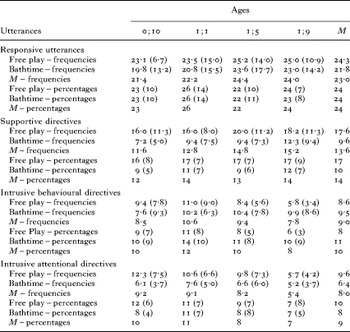
There was also a main effect for utterance category (F(2, 28)=27·28, p<0·0001). Despite individual scores varying from 0 to 76 per session, on average mothers produced 23 responsive utterances, nearly a quarter of their total speech. Supportive directives were next most frequent, with about 14 per session. Intrusive behavioural and attentional directives, at 9 and 8 per session respectively, even together were less frequently produced than responsive utterances (see Table 1).
Mean frequencies and percentages (and Standard Deviations) of mothers' responsive and directive utterances by age and context

Maternal production of utterance types differed by context as well (F(2, 33)=6·44, p<0·01). Intrusive behavioural directives were produced slightly more during bathtime than play, while the other speech types were more frequent during play than during bathtime. Supportive directives, in particular, occurred nearly twice as often during play (M=17·6) as bathtime (M=9·6), and intrusive attentional directives were 50% more frequent during play (M=9·6 ) than bathtime (M=6·4).
Mothers' frequencies of responsive and directive speech also changed developmentally (F(4, 84)=2·54, p<0·05). Provision of responsive and supportive directive utterances rose over time, with slight increases for responsive speech and more substantial increases for supportive directives. In contrast, production of intrusive utterances decreased over time. Frequencies of intrusive attentional directives declined especially sharply from 1 ; 5 to 1 ; 9, while intrusive behavioural directives increased from 0 ; 10 to 1 ; 1, but declined gradually thereafter.
Mothers also provided responsive and directive utterances differently to boys and to girls (F(2, 28)=7·36, p<0·01). Although overall boys and girls received similar frequencies of supportive directives (Ms=13·3 and 13·9 respectively), despite an interaction described below, and intrusive behavioural directives (Ms=9·3 and 8·2 respectively), mothers provided almost 50% more intrusive attentional directives to boys (M=9·4) than to girls (M=6·5). In contrast, girls received 75% more responsive utterances than boys (Ms=29·2 and 16·7 respectively).
Finally, there was also a 4-way interaction of Gender, Age, Utterance category and Context (F(9, 162)=2·22, p=0·02). Separate Gender by Age by Context follow-up ANOVAs for each utterance category were conducted to interpret this interaction. The follow-up analyses yielded a number of outcomes confirming previous findings, including: greater responsive speech to girls than boys (F(1, 18)=7·42, p=0·01); more supportive directives during free play than bathtime (F(1, 18)=21·85, p<0·001); a gradual increase then decline in intrusive behavioural directives with age, with the peak for boys at 1 ; 1 and the peak for girls at 1 ; 5 (F(3, 54)=2·80, p<0·05); more intrusive attentional directives to boys than to girls (F(1, 18)=4·58, p<0·05), and during free play than bathtime (F(1, 18)=9·77, p<0·01); and an overall decrease in intrusive attentional directives over time (F(3, 54)=4·11, p=0·01), especially in free play (F(3, 53)=3·04, p<0·05).
The follow-up analyses for intrusive attentional directives and for supportive directives yielded significant 3-way interactions, indicating the source of the 4-way interaction. The analysis for intrusive attentional directives uncovered Age by Context (F(3, 54)=4·17, p=0·01) and Gender by Age by Context interactions (F(3, 54)=3·01, p<0·05), showing declines with age in both contexts with greater initial production in free play, especially to boys. The analysis for supportive directives found Gender by Age (F(3, 54)=4·20, p=0·01) and Gender by Age by Context interactions (F(3, 54)=3·09, p<0·05). During bathtime, mothers provided more supportive directives to girls at 0 ; 10 and 1 ; 5, to boys at 1 ; 9, and nearly equivalent amounts to both girls and boys at 1 ; 1. In free play, however, boys received more supportive directives than girls at every age except 1 ; 5, when girls (M=25·7) received nearly twice as many as boys (M=14·4). This spike in supportive directives to girls at 1 ; 5 occurred when overall maternal production to girls also peaked sharply, as described earlier.
The replication of the overall Gender by Age by Utterance category by Context ANOVA using percentages revealed that assessment of developmental change by relative, rather than absolute, frequencies produced a similar pattern of findings, with one minor and one major exception. Main effects of Utterance category, with greater rates of responsive than directive utterances (F(2, 38)=37·79, p<0·0001), and Context, with greater relative production during play time than bathtime (F(1, 18)=11·31, p<0·01), were confirmed (see Table 1). Also paralleling the results for absolute frequencies were interactions of Utterance category and Context (F(2, 36)=6·27, p<0·01), showing considerably higher proportions of supportive directives during play than bathtime, and of Gender and Utterance category (F(2, 38)=8·54, p<0·001), demonstrating higher proportions of responsive speech to girls and higher proportions of intrusive behavioural and attention directives to boys. In contrast to the Gender by Age interaction in the analysis of frequencies, the analysis of percentages yielded a main effect for Age (F(3, 54)=9·53, p<0·0001), as the proportion of mothers' total speech consisting of all responsive plus directive utterances rose sharply from 0 ; 10 (M=0·55) to 1 ; 1 (M=0·63) then declined again (Ms=0·53 at 1 ; 5 and 1 ; 9). However, the clearest difference from the analysis of frequencies was the absence in the analysis of percentages of two interactions – between Age and Utterance category and the 4-way interaction. Thus, mothers' production demonstrated developmental changes in frequencies of utterance categories, but not in the proportions of their total utterances devoted to responsive, supportive directive and intrusive directive speech. In particular, despite the marked differences in frequencies of supportive directives to girls and to boys in free play at 1 ; 5 noted above, mothers provided quite similar rates of supportive directives to girls (19%) and to boys (17%).
Responsive and directive speech: Consistency across contexts
While the preceding analyses examined average trends over time, the next three sets of analyses considered individual differences in mothers' production of responsive and directive utterances. The first set assessed whether mothers' provision of the 4 categories of responsive and directive utterances was consistent across contexts at the same point in time. Consistency in absolute frequencies was investigated with Pearson correlations. To minimize interdependence of speech categories, consistency in relative frequencies was examined with partial correlations controlling for mothers' total utterances at each age in each context.
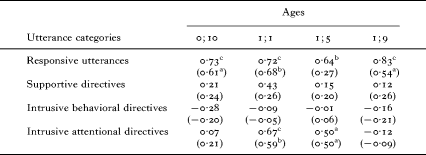
Only mothers' responsive utterances and their intrusive attentional directives, two diametrically opposed style characteristics, demonstrated any consistency (see Table 2). Pearson correlations showed that mothers who provided more responsive utterances in free play did so also during bathtime at all four ages (r⩾0·64, p<0·01). The across-context consistency in responsive speech remained significant at 0 ; 10, 1 ; 1 and 1 ; 9 (r⩾0·54, p<0·05), but not at 1 ; 5, when mothers' total speech was taken into account. In addition, mothers who produced more intrusive attentional directives in free play also provided significantly more of them during bathtime at 1 ; 1 and 1 ; 5 (r⩾0·50, p<0·05). Both of these relations remained significant when total maternal utterance frequencies were also controlled (r⩾0·50, p<0·05).
Consistency across contexts in maternal responsive and directive utterance frequencies: Pearson correlations (and partial correlations controlling for total utterance frequencies in each context)

a p<0·05.
b p<0·01.
c p<0·001.
Because previous analyses had revealed that girls received more responsive utterances than boys while boys received more intrusive attentional directives than girls, we repeated the partial correlations adjusting for gender as well as total maternal utterances to ensure that these gender differences were not influencing the results. For responsive speech, significant across-context consistency remained at 0 ; 10 and 1 ; 1 (r⩾0·52, p<0·05), but not at 1 ; 9; consistency also remained significant for intrusive attentional directives at 1 ; 1 and 1 ; 5 (r⩾0·48, p⩽0·05). The similar findings with gender also controlled indicated that the gender differences were not, for the most part, affecting the findings of consistency across contexts.
Responsive and directive speech: Stability over time in each context
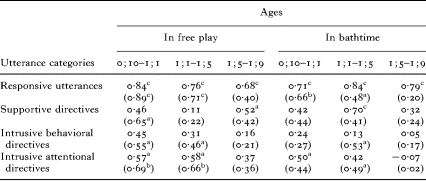
The next set of analyses examined stability in mothers' responsive and directive utterances over the three time intervals – 0 ; 10 to 1 ; 1, 1 ; 1 to 1 ; 5 and 1 ; 5 to 1 ; 9 – in each context separately. Pearson correlations of frequencies and partial correlations controlling for total utterances in each context at both times are presented in Table 3.
Stability of maternal responsive and directive utterance frequencies over time: Pearson correlations (and partial correlations controlling for total utterance frequencies at each time)

a p⩽0·05.
b p⩽0·01.
c p<0·001.
Stability was greatest for the two speech categories exhibiting consistency, responsive utterances and intrusive attentional directives, although all categories showed some stability. Pearson correlations demonstrated significant stability in mothers' production of responsive speech across every time interval in both contexts (r⩾0·68, p⩽0·001). Partial correlation, adjusting for total maternal utterance frequencies, found that relative rates of responsive speech remained significantly stable for the first two time intervals in each context (r⩾0·48, p<0·05), but not for the third interval.
Among the three kinds of directive utterances, maternal production of intrusive attentional directives was the most stable. Mothers remained higher or lower both absolutely and relatively in their production of intrusive attentional directives across the first two time intervals in free play (r⩾0·57, p<0·05). In the bathtime context, provision of intrusive attentional directives was stable during the first interval in the Pearson correlations and during the second interval in the partial correlations (r⩾0·49, p<0·05). Stability disappeared from 1 ; 5 to 1 ; 9 as maternal provision of intrusive attentional directives declined.
Mothers' production of behavioural directives, both supportive and intrusive ones, was intermittently stable. Maternal frequencies of supportive directives showed significant stability during the third interval in play and the second interval in bathtime (r⩾0·52, p<0·05). With total maternal utterances taken into account, mothers' rates of supportive directives showed significant stability only across the first time interval during free play (r=0·65, p<0·01). Absolute frequencies of intrusive behavioural directives were not significantly stable in any interval in either context. But with maternal utterance frequencies controlled, mothers' relative rates of intrusive behavioural directives demonstrated stability from 0 ; 10 to 1 ; 1 in free play and from 1 ; 1 to 1 ; 5 in both contexts (r⩾0·46, p<0·05).
Additional partial correlations controlling for gender as well as mothers' total utterance frequencies were also conducted. With the exception of the stability of intrusive behavioural directives from 1 ; 1 to 1 ; 5 in the play context, all the significant results for stability across time with utterance frequencies controlled were found with gender also controlled (r⩾0·48, p⩽0·05). Gender differences were not, for the most part, affecting the findings of stability across time.
Relations among responsive and directive speech production in each context
The final set of analyses investigated relations among mothers' responsive and directive utterances in each context at each age; both Pearson correlations of frequencies and partial correlations controlling for mothers' total utterances were again computed.
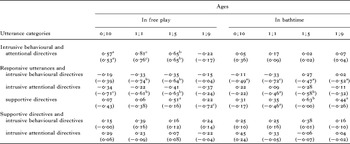
The first question addressed was whether mothers' production of the two measures of intrusive directiveness, behavioural and attentional, were related. As Table 4 shows, the two were significantly positively related in both kinds of correlations at 0 ; 10, 1 ; 1 and 1 ; 5 in free play (r⩾0·53, p<0·05), but not at any time in the bathtime context; additional partial correlations controlling for gender as well as utterance frequencies found the same results (r⩾0·64, p<0·01). Despite the context difference in their relations to each other, however, the two measures of intrusive directiveness evidenced substantially similar patterns of relationship to other utterance categories in both play and bathtime situations.
Relations among maternal responsive and directive utterance frequencies in each context: Pearson correlations (and partial correlations controlling for total utterance frequencies)

a p⩽0·05.
b p⩽0·01.
c p⩽0·001.
In analyses examining the relation between responsive and directive speech, the two kinds of correlations revealed markedly different results. Relations between mothers' responsive and intrusive directive speech were non-significantly negative in both contexts at several ages, but strongly and significantly negatively only in the partial correlations when total maternal speech was taken into account: Mothers' relative rates of responsive speech were significantly inversely associated with their rates of intrusive behavioural directives during free play at 1 ; 1 and 1 ; 5 and during bathtime at all four ages (r⩽−0·49, p⩽0·05) and with their rates of intrusive attentional directives during free play at 0 ; 10, 1 ; 1 and 1 ; 5 and during bathtime at 1 ; 1 and 1 ; 5 (r⩽−0·46, p<0·05). Additional partial correlations controlling for gender as well as total utterances similarly found such inverse relations in bathtime at 1 ; 1, 1 ; 5 and 1 ; 9 for intrusive behavioural directives and at 1 ; 5 for intrusive attentional directives and in free play at 0 ; 10, 1 ; 1 and 1 ; 5 for both kinds of intrusive directives (r⩽−0·49, p⩽0·05). Thus, mothers' use of a relatively responsive style was negatively related to their provision of intrusive directiveness in both contexts, even though the two measures of intrusiveness were unrelated to each other in the bathtime context.
We had expected that mothers' responsive speech might be positively related to their supportive directiveness, as both are attuned to children's current activity and focus of attention. The expected positive relations were found at 1 ; 5 in free play and at 1 ; 5 and 1 ; 9 in bathtime in the correlations of absolute frequencies (r⩾0·44, p⩽0·05). However, in the partial correlations examining relative frequencies, responsiveness was unrelated to supportive directiveness at most times, but negatively related at 1 ; 9 in free play and 1 ; 1 in bathtime (r⩽−0·46, p<0·05); partial correlations adjusting for gender as well found the same results (r⩽−0·55, p<0·05).
The final issue addressed was the relation between the two kinds of directiveness – supportive and intrusive. Maternal provision of supportive behavioural directives was unrelated to their production of intrusive behavioural and intrusive attentional directives in both contexts at all ages. These results support distinguishing between supportive and intrusive directiveness.
DISCUSSION
The present investigation is the first reported study to examine both responsiveness and directiveness in mothers' speech to their children in more than one kind of interactive context and at more than one age. Dyadic interactions were observed during two situations frequent and natural to mothers and children, free play and bathtime, at four times of measurement from the end of the first to the end of the second year of life. The goal was to assess developmental change, contextual differences, consistency across contexts and stability over time in maternal production of different kinds of utterances related to children's language competence – responsive, supportive directive and intrusive directive. Responsive utterances and supportive behavioural directives have been shown to be positively associated with or predictive of children's development, while intrusive directives have sometimes been negatively related to their language proficiency (Tomasello & Farrar, Reference Tomasello and Farrar1986; Akhtar et al., Reference Akhtar, Dunham and Dunham1991; Hampson & Nelson, Reference Hampson and Nelson1993; Tamis-LeMonda et al., Reference Tamis-LeMonda, Bornstein and Baumwell2001; Rollins, Reference Rollins2003; Masur et al., Reference Masur, Flynn and Eichorst2005). The findings from this study revealed both general patterns and individual differences in maternal provision of these utterance types as well as influences of context and child gender on aspects of maternal verbal style.
In terms of both absolute and relative frequencies, these mothers provided more responsive utterances, describing aspects of the environment to which the children were currently attending, than any of the other categories of speech. Next most often produced were supportive behavioural directives, which follow into the child's focus of attention and request or suggest behaviours that may extend and elaborate on current actions. Mothers provided these two kinds of utterances that have been associated with positive outcomes in children twice as frequently as intrusive utterances aimed at redirecting children's behaviour or attention, which have often been negative developmental predictors. Overall frequencies of responsive and supportive directive utterances increased slightly over time, while both kinds of intrusive utterances decreased as the children developed, a pattern consistent with others' reports (e.g. Pan et al., Reference Pan, Imbens-Bailey, Winner and Snow1996; Masur, Reference Masur1997). However, the analysis by percentages demonstrated that, although frequencies changed, mothers did not change in their rates of providing responsive and directive speech. These contrasting results underscore the value of considering not only absolute but also relative speech production, an approach not always taken, when examining maternal speech style.
The context also affected the mothers' speech. Even though the amount of time was held constant, mothers spoke more during free play than during bathtime, producing about 17% more utterances overall during play than bathtime. Mothers' provision of these utterance types varied by context as well. Although more directive speech has been previously reported during play than other situations (Hoff-Ginsberg, Reference Hoff-Ginsberg1991; Yont et al., Reference Yont, Snow and Vernon-Feagans2003), these results show that that is not the case for all types of directive utterances. Supportive behavioural directives, encouraging actions on objects to which the children were currently attending, were considerably more likely to be produced, both absolutely and relatively, during free play than bathtime. Although bathtime was chosen as an appropriate contrast to free play because toys could be provided naturally in both contexts, thus minimizing one possible confounding variable, it is apparent that the goal-directed agenda of bathing diverted some of the mothers' attention away from promoting the children's further activities during the interaction. The requirements of bathing also seem to have heightened their intrusiveness, because intrusive behavioural directives were provided more frequently and at a greater rate during bathtime than play. Such marked differences between two typical and naturally occurring interactive contexts should make researchers more aware of the limitations inherent in studying parent–child interactions in only one particular setting.
The influence of children's gender on maternal speech was also evident in several ways. Mothers supplied more speech overall to girls than to boys at the two older ages, especially at 1 ; 5, a time when children's vocabulary growth is typically accelerating (Goldfield & Reznick, Reference Goldfield and Reznick1990). Also, girls received greater numbers and rates of responsive utterances than did boys. Although mothers produced supportive directives similarly to sons and daughters, sons received substantially more intrusive behavioural and attentional directives. This configuration of results is especially intriguing. The features girls tended to receive more of – overall and responsive utterances – are those predictive of greater linguistic competence, while the reverse is true for boys (Huttenlocher, Haight, Bryk, Seltzer & Lyons, Reference Huttenlocher, Haight, Bryk, Seltzer and Lyons1991; Tamis-LeMonda et al., Reference Tamis-LeMonda, Bornstein and Baumwell2001; Masur et al., Reference Masur, Flynn and Eichorst2005). Whether this difference might account for at least some of the advantage girls show in vocabulary development (Fenson, Dale, Reznick, Bates, Thal & Pethick, Reference Fenson, Dale, Reznick, Bates, Thal and Pethick1994) deserves attention.
An explanation for these differences cannot be determined from this study. Gender differences in maternal speech, almost all favouring girls, have occasionally been reported (e.g. Leaper et al., Reference Leaper, Anderson and Sanders1998; de Sousa Braz & Salomao, Reference de Sousa and Salomao2003). Unfortunately, however, other studies of mothers' speech have not always looked for gender effects (e.g. Akhtar et al., Reference Akhtar, Dunham and Dunham1991; Pan et al., Reference Pan, Imbens-Bailey, Winner and Snow1996), a practice that might be useful to adopt routinely. Whether gender-related expectations and perceptions by the mothers or discrepant behavioural and attentional competence by the children motivated this pattern remains to be determined. It would be valuable to see whether there are discrepancies between these boys and girls in the behaviours they exhibit which might evoke contrasting kinds of maternal utterances. We plan to investigate this issue in the future.
Individual mothers' responsive and directive production varied widely, and not only by gender. For example, in free play at 1 ; 1, mothers of girls produced as few as 11 or as many as 76 responsive utterances, while mothers of boys produced as few as 1 or as many as 21 intrusive attentional directives. To assess these individual differences, we examined whether mothers were consistent across contexts and stable across time intervals in their varying provision of these utterance categories. There was no consistency across contexts at any time in supportive or intrusive behavioural directiveness, perhaps because of differences in mothers' behavioural goals in the two situations. But there was consistency across the contexts in mothers' production of two diametrically opposed categories, intrusive attentional directives at 1 ; 1 and 1 ; 5 and responsive utterances at all ages in absolute frequencies and at all ages except 1 ; 5 for relative frequencies. Responsive speech and intrusive attentional directiveness were also the most stable over time. Mothers' absolute frequencies of responsive utterances demonstrated stability across all intervals in both contexts, although their relative rates did not remain significantly stable across the final interval. Mothers' absolute and relative production of intrusive attentional directives was stable across the first two intervals in the play context; in the bathtime context, stability was evident in the first interval for absolute frequencies and in the second interval for relative frequencies. Even provision of supportive and intrusive behavioural directives evidenced some, albeit intermittent, stability in each context. The relatively comparable stability in each context, even sometimes in the absence of consistency between contexts, suggests that mothers and children may be developing routine but divergent stylistic patterns of verbal interaction in the two contexts. Similarities or differences in the children's verbal interactive behaviours in the two contexts would also be worth exploring.
Finally, the analyses of interrelations among mothers' productions of various utterance types yielded two important findings that highlight the value of distinguishing between supportive and intrusive directiveness. First, mothers' supportive directive speech was unrelated to their intrusive behavioural or attentional directiveness at all ages and in both contexts in all analyses. These results bolster the position that directiveness is multi-faceted and underscore the merit of contrasting directives by both behavioural versus attentional (Pine, Reference Pine1992b) and attention-following versus attention-leading (Akhtar et al., Reference Akhtar, Dunham and Dunham1991) dimensions. Greater clarity in distinguishing more supportive from more intrusive directiveness, whether behavioural or attentional, may contribute to explaining previous contradictory research on the developmental consequences of maternal directiveness (see Masur et al., Reference Masur, Flynn and Eichorst2005).
Second, the distinction between supportive and intrusive directiveness is further emphasized by their divergent relations to responsive speech. In the analyses of absolute frequencies, mothers' responsive and supportive directive utterances, both of which express sensitivity to children's ongoing behaviour and attentional focus, were significantly positively related at 1 ; 5 in both contexts and at 1 ; 9 in bathtime. The analyses of relative frequency, however, indicated that responsiveness and supportive directiveness were alternative stylistic means of conveying such sensitivity. In contrast, relations between maternal production of responsive utterances and intrusive directive utterances were generally negative but non-significant in analyses of absolute frequencies, but significantly negative in analyses of relative frequencies in both contexts at the majority of ages. Although mothers' use of intrusive behavioural and attentional directives was unrelated at any age during bathtime, these two kinds of intrusive directives showed the same negative relation to responsive speech. Mothers who provided their children with higher rates of responsive speech also presented less intrusive speech, while those who produced greater proportions of intrusive directive utterances also furnished less responsive speech. Despite divergent rates of responsive and intrusive attentional utterances by mothers of girls and mothers of boys, the equivalent pattern of results with child gender also controlled demonstrates that the negative relation between responsiveness and intrusive directiveness typically held for all mothers.
The inverse association between responsiveness and intrusive directiveness raises two questions. One involves implications for investigations of predictions from maternal behaviours to child outcomes: is it possible that positive relations between mothers' greater responsiveness and children's higher competence (e.g. Tamis-LeMonda et al., Reference Tamis-LeMonda, Bornstein and Baumwell2001) may have been influenced by the same mothers' lower rates of intrusiveness? And conversely, might lower maternal rates of responsiveness have contributed to negative associations between mothers' greater intrusiveness and children's lesser developmental levels (e.g. Akhtar et al., Reference Akhtar, Dunham and Dunham1991)? It would be important to consider both responsiveness and intrusiveness together and attempt to elucidate their independent links to children's development, especially to ascertain whether intrusive directiveness makes a contribution to the prediction above and beyond that of responsiveness (cf. Masur et al., Reference Masur, Flynn and Eichorst2005). The second question involves cause: what are the origins of these mothers' linguistic tendencies? High levels of responsiveness and of intrusive directiveness are stylistic features employed for the most part by different mothers. Do these separate tendencies arise from distinct maternal dispositions? Or are they more likely to be reactions to divergent child behaviours? These kinds of questions should motivate future investigations.