1. Introduction
The interest in diglossia as a subject and the attention it received has increased considerably since Ferguson first published his seminal article in Word (Ferguson 1959). In general, however, practically all scholarly works on diglossia investigate the features, speakers, and evolution of the L-variety, that is, the field is characterized by a lack of scientific dis-course about H-varieties and their speakers. This seems a rather curious omission since H-speakers in the 21st century do not only constitute the overall majority in several diglossic speech communities, but their per-ceptions of L often shape and even determine the fate of the L-variety.
The purpose of this paper is to examine—on the basis of two sociolinguistic field studies that I conducted in 2003–2004 and in 2009 in the Grafschaft Bentheim (a county in Lower Saxony)—the general lan-guage attitudes and perceptions of High German speakers (H-speakers) toward Low German, the region's L-variety. The second purpose is to determine to which extent the results are compatible with Ferguson's principle of prestige (second diglossic rubric) that he observed in all four diglossic speech communities he researched, namely that “H is somehow more beautiful, more logical, better able to express thoughts” (Ferguson 1959:330).Footnote 1 The third purpose is to investigate whether and how much the role of both community and situation-specific factors needs to be considered when discussing the dynamics of diglossic speech com-munities.
Section 2 of this paper discusses the term diglossia and the various contributions to the field since Ferguson's (1959) article, including Auer's (2005) typology of dialect/standard constellations in Europe. Section 3 examines two of the most significant previous surveys of Low German, and section 4 addresses the status and acceptance of language-attitudinal studies in Germany. In sections 5 through 9, I discuss the methodology of my field studies and the responses to some of the main questions I asked the participants. In section 10, I analyze my findings within the fields of diglossia and Low German.
2. Diglossia
Since Ferguson's original article from 1959, the concept of diglossia has undergone so many modifications, redefinitions, transformations, and extensions that it has become rather problematic (or easy, depending on one's viewpoint and references) to define or label a speech community as diglossic. In fact, a bibliography on diglossia published by Fernándenz (1993) lists more than 3,000 entries; and contributions to the subject matter have grown exponentially since then. As Kaye (2001:121) points out: “no other sociolinguistic topic has generated such a prodigious research effort over the same forty-year span.”Footnote 2 It would go beyond the scope of this paper to examine or analyze all of these modifications. This section provides a brief general overview of some of the most crucial revisions to Ferguson's initial approach, examines specifically the state of Low German in the target area based on Auer's (2005) typology of European dialect/standard constellations, and finally, discusses whether the term diglossia can still be employed in northern Germany at all.
2.1 Definitions and Extensions of Diglossia
Britto (1986) mentions that between 1959 and 1967 the amount of re-search on diglossia remained relatively small. In fact, in the years following Ferguson's article, diglossia seemed to be more or less synonymous with bilingualism. For example, in his work on the functional distribution of Creole and French in Haiti, Stewart (1963:159) concluded:
Eventually, if the term “diglossia” is not to degenerate into just a some-what fancy synonym for bilingualism, it will be necessary for linguists to formalize a little more definitely the ways in which diglossia differs from other kinds of bilingualism.
Stewart's call for a more precise definition concerning the difference between diglossia and bilingualism foreshadows in a way Kloss's (1966) and Fishman's (1967) contributions to the field. The main feature of Kloss's and Fishman's approach is the issue of the genetic relatedness between H and L, which is not a diglossic criterion per se but rather, according to Ferguson, a prerequisite for the existence of diglossia. Recall that Ferguson (1959:325) defines diglossia as a linguistic situation within a community where “two or more varieties of the same language are used” (my italics). He also explicitly exempts bilingual communities from being diglossic: “No attempt is made in this paper to examine the analogous situation where two (related or unrelated) languages are used side by side throughout a speech community” (1959:325).
Based on Ferguson's work, Kloss (1966) introduced the terms in-diglossia and out-diglossia in an attempt to characterize and cate-gorize multilingual communities. The former refers to a situation within speech communities where two related languages are spoken as H and L, for example French and Creole in Haiti. Kloss's term in-diglossia is thus identical to diglossia in Ferguson's sense. Out-diglossia, however, refers to speech communities where two unrelated languages are used as H and L. Kloss (1966:138) uses Spanish and Guaraní, an indigenous language, in Paraguay as examples and defines out-diglossia as follows: “mono-lingual nations when viewed from the standpoint of ‘mothertongueness’ but bilingual in terms of cultural setting and equipment.”
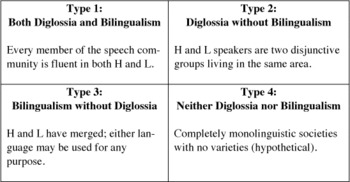
The term out-diglossia—that is, the coexistence of genetically unrelated languages serving as H and L within the same community, such as Spanish and Guaraní in Paraguay—was extended by Fishman (1967:30), who argued that the term diglossia should include societies “which are multilingual in the sense that they employ separate dialects, registers, or functionally differentiated language varieties of whatever kind.” His four-fold model for speech communities significantly extends Ferguson's approach by including both bilingual communities and gene-tically unrelated languages and is summarized in table 1.
Fishman's extension of diglossia.

Fishman's inclusion of genetically unrelated languages functioning as H and L in diglossia widened the scope of inquiry considerably, and its application led to constellations that differed substantially from Ferguson's original model. Based on Fishman's Type 2 Diglossia without Bilingualism, for instance, Rindler-Schjerve & Vetter (2003) suggest a model of diglossia that incorporates several national languages coexisting in the same community. As an example of such a state Rindler-Schjerve & Vetter (2003:47) mention 19th century Galicia (present-day Poland) during the Hapsburg Empire with German, Italian, and Polish (a West Slavic language) functioning—to various degrees—as H languages, while Slovenian (a South Slavic language) and Ukrainian (an East Slavic language) were employed as L languages. Fishman's own model for Diglossia without Bilingualism was illustrated by 19th century Russia, with Russian serving as the L-variety and French as the H-variety (that is, spoken by the Russian nobility).
In his 1985 discussion of the sociolinguistic situation of Hamito-Semitic languages, Fellman proposes a diglossic model based on Fishman's Type 1 Both Diglossia and Bilingualism. Fellman's proposal represents a significant junction in the interpretability of Fishman's para-digm by including H and L varieties that are not only genetically unrelated, but that also belong to two unrelated language families (Semi-tic and Indo-European). According to Fellman, Maltese, an Arabic language, and Italian were used as L and H languages, respectively during medieval times on the island of Malta before giving way to English as one of the official languages during the 19th century:Footnote 3
Throughout the medieval period and well into modern times Maltese existed in a diglossic relation with Italian, Maltese serving as the “low” language of everyday life, and Italian serving as the “high” language of Church and State. (Fellman 1985:221)
Not surprisingly, these approaches did not pass without criticism. Timm (1981) offers several points of critique with regard to Fishman's model. One of her main foci is Fishman's over-emphasis on the “domain complementarity” (that is, the functional distribution) of H and L for defining diglossic speech communities. According to Timm, Fishman neglects in his approach most of Ferguson's original nine rubrics in favor of the functional distribution of H and L (Ferguson's first rubric):
Of the nine original criteria for defining diglossia, Fishman focuses on just one: role or domain complementarity of the two languages. This is the only feature which appears throughout the diglossic situations dis-cussed by Fishman. (Timm 1981:362)
As Timm points out, if language communities with two unrelated languages acting as H and L are defined as diglossic, then some of the original diglossic criteria, such as the shared lexical and phonological systems of H and L (Ferguson's rubrics eight and nine), become irrele-vant.
With regard to Fishman's own example of Russian and French in 19th century Russia as Diglossia with Bilingualism, Timm remarks that the supposed simplicity of L's grammar if compared to H's grammatical structures (rubric seven in Ferguson's original model) is also rendered moot if one considers the grammatical complexities of Russian. As Timm (1981:362) comments:
In reviewing Fishman's treatment of diglossia, it can be seen that most of the original criteria diagnostic of diglossia have become otiose: features such as the largely shared lexical and phonological inventories of H and L and the relatively greater simplicity of L grammatical structures compared with their respective H varieties are hardly relevant across language boundaries.
Furthermore, if one really suggests that in 19th century Czarist Russia, the function of Russian was that of an L-variety, then diglossic features such as literary tradition (Ferguson's rubric number three) may equally well characterize the L-variety instead of only the H-variety; a point which Timm (1981:362) summarizes as follows:Footnote 4
Literary tradition, prestige, and standardization, all features previously linked with the H variety, may [in Fishman's model] characterize the L language as well.
Similarly to Timm, Britto (1986:42) criticizes the fact that Fishman's model of diglossia “has loosened Ferguson's conditions relating to the structure of the diglossic codes [that is, the genetic relatedness between H and L].” According to Britto, this has resulted in a situation where the concept of diglossia can practically be applied to any two-language situation:
Fishman's theory, by imposing no limit on the structural relationship of diglossic codes, permits practically every language community to be called diglossic. Any pair of identifiable varieties can form a diglossia in Fishman's theory, regardless of the extent of their linguistic related-ness. (Britto 1986:42)
Ferguson himself discussed the issue of genetic relatedness in an article published in 1991. He admits that in his original formulation he failed to “make clear how far apart (or how close together) the high and low varieties have to be in a language situation to be characterized as di-glossia” (Ferguson 1991:223). He dismisses, however, cases of unrelated languages coexisting within the same speech community as nondiglossic because they would produce different results:
My feeling was that if you have two varieties in this H-L relationship that are fairly closely related to one another, one kind of outcome will result (e.g. certain kinds of lexical borrowings will take place, certain forms of phonological and syntactic convergence will be likely, and so forth). However, if the H and L varieties are unrelated languages, then the outcomes will ultimately be quite different; different kinds of bor-rowing will take place and different types of intermediate forms will result, and the overall history of the language situation will be different.
(Ferguson 1991:223)
Fishman's extension was regarded by some scholars (Daltas 1993: 342) as a contribution that obfuscated diglossic research rather than facilitated it: “It [Fishman's extension] went so far that it caused di-glossia to be pushed back into the undifferentiated sociolinguistic mass out of which it had emerged only eight years earlier thanks to Ferguson.” Daltas’ (1993:342) claim that Fishman's concept of diglossia “has caused over the years far more confusion than its predecessor ever did” is confirmed, for instance, by Aguirre's (1982:280) comments in his dis-cussion of language patterns of adolescent Hispanics in California: “In 1959 Charles Ferguson introduced the term diglossia to refer to situations in which either two varieties of the same language or two different lan-guages are used coextensively in a society” (my italics). Accordingly, at the beginning of the new millennium, Hudson (2002:1) summarized the state of research as follows: “Forty years after the publication of the late Charles Ferguson's historic paper on diglossia, a coherent and generally accepted theory of diglossia remains to be formulated.”
In an attempt to assess the vast research on diglossia and to develop a workable definition of the term itself, in 2002 Hudson wrote Outline of a Theory of Diglossia, which was received with great praise by several of the most prominent scholars in the field (Fishman, Schiffman, Kaye, Fasold). Fasold (2002:85) described it as “the most thorough and well-argued [article] since Ferguson's original 1959 article.” In his effort to identify diglossia, that is, to determine which factors contribute to the existence of a diglossic speech community and which do not, Hudson differentiates between pure diglossia in the Fergusonian sense and societal bilingualism (diglossia according to Fishman's model). Although Hudson (2002:2–3) restricts his definition of diglossia to Ferguson's original 1959 model from the outset, he believes that “too much has been made of the degree of structural proximity between con-stituent codes [that is, the genetic relatedness between H and L] …. as a diagnostic of diglossia” (Hudson 2002:14). According to Hudson (2002:14), genetic relatedness between H and L is not really a defining feature of diglossia but rather its natural pattern, and any genetic comparison between H and L is “an arbitrary gesture in itself [that] contributes nothing of value to sociolinguistic theory.”
Although Hudson places himself in the more “traditional” camp (that is, diglossia in the Fergusonian sense) with regard to the genetic related-ness between H and L, he does not explicitly condemn other, more encompassing approaches (which, however, should not be understood as call for eclecticism either). Hudson does not offer a “fix-it-all” solution to the problem but rather believes that a common middle ground is needed in this matter and concludes with an appeal for further research:
What is actually called for in the further study of diglossia is the establishment of a balance […] between two complementary ap-proaches: one, a universalist approach [Fishman's model and its practitioners], which emphasizes the similarities between diglossia and other sociolinguistic situations, and another, particularistic approach, which focuses upon the differences. (Hudson, 2002:14)
More importantly, perhaps, Hudson (2002:14) points out that “the em-phasis on asymmetric functional differentiation of codes as the common denominator […] has resulted in the surface merger of fundamentally distinct sociolinguistic situations.”
In other words, by trying to establish theoretical generalizations it is easy to overlook concrete, specific factors in speech communities that are situationsbedingt (that is, situation-specific). Indeed, factoring in situation-specific elements that emphasize the distinct and peculiar social dynamics of diglossic speech communities (in this case, community-specific language attitudes and language perception) constitutes an ap-proach that may produce new and interesting results. One finds such situation-specific circumstances in northern Germany.
2.2 The Situation of Low German in Northern Germany: Auer's Typology
Auer's (2005:7) comprehensive typology of dialect/standard constel-lations in Europe uses the term diglossia “as a purely relational concept” without intention to provide a conclusive definition of diglossia. How-ever, Auer's model holds several facets that are conducive to its use as a basis for examining the present situation of Low German, since it is a) restricted to Europe, b) supplemented by a historical component (which is essential for understanding the situation of Low German), and c) enjoys a relatively broad acceptance and prominence.
Still, even given the suitability of Auer's typology, this section shows that present-day Low German does not conform strictly to one or the other constellation type but rather possesses elements from several types. One of the most significant reasons for this is the peculiar evolution of diglossia in northern Germany, particularly the speakers’ respective commands of H and L, which went from classical in the Fergusonian sense to an almost complete reversal in the 20th century. For several hundred years in northern Germany High German was nobody's mother tongue but was usually learned later in life through formal education. The grammarian Justus Georg Schottelius (1612–1676), for instance, who had been living in northern Germany for all of his life, summarized the linguistic situation in his homeland as follows: “Hochdeutsch ist eine Sprache, die kunstmäßig erlernt werden muß” (Bichel 1985:1868).Footnote 5
This situation remained relatively unchanged until well into the early 20th century.Footnote 6 However, the enormous political and historical changes that Germany underwent in the latter part of the 20th century, particu-larly those resulting from World War II and its aftermath, brought profound linguistic changes to northern Germany. Its diglossic situation in the 21st century is characterized by the fact that everyone knows and can speak the H-variety, but the number of L-speakers has eroded dramatically. In fact, in 1995 the European Union added Low German to its list of endangered languages in Europe. This development is unique in the sense that it is atypical for diglossic speech communities. According to Ferguson (1959:332–333), if the stability of diglossia is shaken, then the equilibrium between H and L will be affected in such a way that either L or a mixed variety of L and H becomes standard. Also, the development of Low German does not involve the growth that some of Ferguson's original L-varieties have experienced:
Colloquial Arabic, Dhimotikí [the L variety in Greece], and Schwyzer-tüütsch [Swiss German] have all gained ground in the twentieth century, to one degree or another, at the expense of their coterritorial elevated counterparts. (Hudson 2002:8)
Another factor that needs to be taken into consideration when asses-sing the linguistic situation of Low German is the fact that, even in Old Saxon times, there has never been a Standard Low German language (see Auer 2005:11–12), and that the present distribution of Low German is extremely uneven, that is, some areas in northern Germany have a very high concentration of Low German speakers, while others have only a few speakers or none at all.
The target area of my study, Grafschaft Bentheim, is a small county situated in the far northwest corner of Niedersachsen (Lower Saxony) and borders the Netherlands to the west, south, and north. It is commonly divided into a northern, more rural part, the Niedergrafschaft (Lower Grafschaft), and a southern, more industrialized part, the Obergrafschaft (Upper Grafschaft). In 2009, there were 132,497 inhabitants, with about 53,000 living in Nordhorn, the biggest city of the county and seat of administration.
Like other counties in northern Germany, the Grafschaft can be considered a diglossic speech community with Low German (Platt-deutsch or Platt) as the L-variety, and High German as the H-variety. Their concomitant use extends into the present, and both varieties of German are spoken and can be heard in the area on a daily basis. The Grafschaft may thus be viewed as a diglossic speech community in the truest sense of Ferguson's original definition to the extent that Low German and High German are two varieties of the same language with Low German being the older and “genuine” mother tongue of the region. Although, as mentioned, both varieties are still used on a daily basis at present, the target area is characterized by an ever-growing dominance of the H-variety and shrinking numbers of L-speakers. Until the turn of the 20th century and even beyond, however, Low German was spoken far more than High German, which was a language acquired mainly through formal education. Küpers (1997:289) confirms this aspect of classical diglossia:
Als sicher darf angenommen werden, daß die überwältigende Mehrheit der Grafschafter Bevölkerung bis zur Jahrhundertwende sich des Plattdeutschen bediente. Das galt sowohl für die Land als auch die Stadtbevölkerung ohne Ansehen des Standes.Footnote 7
Given this linguistic environment, it would be tempting to apply Auer's Type A Medial Diglossia with an Endoglossic Standard to the situation in Grafschaft Bentheim. This type is characterized by Auer (2005:10) as
resembl[ing] Ferguson's diglossia in that (a) the two varieties are clearly delimited from each other in the perception of the speakers, (b) the varieties are genetically closely related to each other, (c) the standard represents the H-variety and is used for writing and (if spoken at all) for formal situations, whereas the dialect as the L-variety is not (usually) written, (d) the H-variety is not the language of primary socialization (first language acquisition).
There are, however, several problems with applying this type to the target area. While criteria (a) and (b) are met, criterion (c) is now only satisfied by members of the older generation in the most rural regions of the Grafschaft Bentheim. In fact, the H-variety nowadays is so prevalent among the younger generation in the target area that the term diglossia might not really be applicable anymore. It is, however, Auer's criterion (d) that causes the most problems. While it, too, was still (mostly) met until the 1960s, it is no longer the case that parents raise their children in Low German. Although Fasold (2002:90) emphatically states that “[n]o one gives up L in favor of H because no parents would ever use H exclusively with their children,” starting in the mid-1960s, many parents in the Grafschaft Bentheim made a conscious decision to raise their children monolingually in High German. This was and is done mostly out of fear of interfering with their children's education, which, unlike education in Switzerland, is dominated by Standard German as the sole medium of communication. The parents’ decision to not expose their children to the L-variety has resulted in a negative impact not only on their children's command of the L-variety, but also on their attitudes toward it (see Wiggers 2011:157–173).
Auer's Type B, Spoken Diglossia, does not apply to Low German since it presupposes a standard variety of the dialect spoken by large seg-ments of the population. In fact, Auer cites the lack of success of the Lübecker Norm (the Low German city dialect of Lübeck during the heyday of the Hanseatic League that was used in writing far beyond Lübeck) to develop into a spoken standard variety as an example of failed spoken diglossia.
The most important feature of Auer's Type C constellation, Di-glossia, is the presence of one or several “intermediate variants between standard and dialect. The term regiolect (or regional dialect) is often used to refer to these intermediate forms” (Auer 2005:26). As Auer (2005:26) explains, the existence of a regiolect usually suggests erosion of the L-variety or at least “a good degree of leveling of the base dialect [….] which at the same time implies advergence to the standard.” The concept of a regiolect plays quite an important role in Dutch dialect research (Heeringa 2011) to the extent that in many regions in the Netherlands (Drente, Twente, Overijssel), the Dutch regiolects no longer constitute a tussentaal ‘intermediate language’ (or Zwischensprache in German) but have actually replaced or are in the process of replacing the L-variety. As Heeringa points out, “De verschillen tussen de dialecten en het Nederlands worden steeds kleiner. Je ziet dat dialecten verkleuren en vernederlandsen” (Radio Nederland Wereldomroep, January 2011).Footnote 8
This observation carries a certain importance for the situation in the target area since Twents (or Twents-Grafschaps), spoken just west of the Grafschaft Bentheim on the Dutch side, is the sister dialect of Graf-schafter Platt. On the German side, the concept of a regiolect sometimes finds its equivalent in the so-called Umgangssprache (Eichhoff 2000, Schiffman 2002), a vernacular, regionally colored form of the H-variety that has in many instances supplanted the L-variety: “Hochdeutsch, or a vernacular version of it (known as Umgangssprache), is now the mother tongue of many Germans, having replaced the local L-varieties, particu-larly in urban areas” (Schiffman 2002:145).
Eichhoff (2000:82) draws a similar conclusion with regards to the rise of the Umgangssprache:
Dialektabbau und Dialektverlust haben in den letzten Jahrzehnten die deutsche Sprachlandschaft nachhaltig verändert. Anstelle von Dialek-ten, die um die Mitte des 19. Jahrhunderts noch verwendet wurden, bil-den heute die Umgangssprachen das weit überwiegende Medium der Kommunikation.Footnote 9
This type of development is characteristic of Auer's (2005:34) Type D, Dialect Loss, where the base dialect (L-variety) heavily erodes and ultimately disappears: “The base dialect loses its function as a marker of local belonging (Ortsloyalität), which is transferred to the regiolect.” According to Auer (2005:34), “this type of repertoire is found in the Ruhr, in the Berlin area, and also in Upper Saxony in Germany” and represents the end stage of his typology.
The fact that Low German and its situation-specific circumstances do not correspond wholly to any of Auer's types perhaps demonstrates the limitations of typology models. It highlights the unique situation of this L-variety and warrants an assessment of its present-day diglossic individuality.
2.3 Does Diglossia Still Exist in Northern Germany?
Section 2.2 demonstrated that certain criteria of Auer's typology are still satisfied in the target area and that others have disappeared or have become highly unstable. The profound changes that Germany underwent since the end of World War II (such as the huge influx of Ethnic German refugees, increased mobility, the impact of mass media, etc.) have led many scholars (for example, Hudson 2002, Schiffman 2002, Fasold 2002) to question whether diglossia still exists at all in Germany proper. In fact, the erosion of the L-varieties has been so strong that many areas in Germany are by now virtually “dialect-free,” a situation commented on by Eichhoff (2000:82):
In vielen Städten und ganzen Landschaften von Westfalen über Nord-hessen bis Sachsen werden die autochtonen Dialekte praktisch nicht mehr gesprochen, in anderen Gegenden sind sie stark zurück-gegangen.Footnote 10
Eichhoff (2000:83) points out that knowledge of an L-variety in Germany proper is strongest in the south (Bavaria, Southern Baden-Würtemberg, Saarland, and Rheinland-Pfalz), and weakest in the center regions (Southern Lower Saxony, Nordrhein-Westfalen, Southern Bran-denburg). In contrast, knowledge of Platt is strongest in the northernmost state of Germany, Schleswig-Holstein. Von Polenz (1999:459) thinks that diglossia has become a peripheral phenomenon with only the northernmost and southern parts of German-speaking countries still being characterized by classical diglossia in the Fergusonian sense:
Nur in bestimmten Gebieten (vor allem deutschsprachiger Teil der Schweiz, Südtirol, Norddeutschland) gibt es noch eine scharfe Di-glossie [..] mit konsequentem Wechsel zwischen Dialekt und Standard ohne vermittelnde Zwischenstufen.Footnote 11
However, it must be added that despite these geographical classify-cations, pockets of diglossia remain outside these areas. The target area, as mentioned, still exhibits significant characteristics of diglossia, such as the concomitant use of Low and High German on a daily basis and a relatively stable compartmentalization of domains where the two vari-eties are used. Although more and more warning signs of a possible erosion of Low German have appeared in the last 15 years in the Graf-schaft Bentheim—a traditionally conservative area (Menge 1997, Wirrer 1998)—its present situation might still be characterized as diglossic, albeit with a strong tendency of Low German eroding in favor of High German in almost all domains.
3. Documentation and Surveys of Low German
Diglossic research in northern Germany mainly comprises a rather large body of descriptive work analyzing the phonological, morphological, and lexical aspects of Low German and its numerous local varieties. Only two comprehensive surveys have been attempted to establish the number of Platt speakers in the region: the 1984 GETAS study (Stellmacher 1987) and a 2007–2008 survey by the Institut für Niederdeutsche Sprache (INS; Institute for Low German Language) in Bremen.Footnote 12 The most recent survey by the INS was carried out by using RDD (random digital dialing) and interviewed a total of 800 participants (14 years and older) in the federal states of Schleswig-Holstein, Niedersachsen, Mecklenburg-Vorpommern, Hamburg, Bremen, and parts of Nordrhein-Westfalen, Brandenburg, and Sachsen-Anhalt.
Similar to the GETAS study, the INS survey relied on the participants’ self-evaluation of their language competence. According to Möller (2008:27), some 18.98 million people lived in the area at the time of the survey.Footnote 13 Of these, 14% stated that they can speak Platt “well” or “very well,” which amounts to approximately 2.6 million active Platt speakers in 2007. Möller (2008:33) points out that these numbers con-firm the precarious state of the language: “Tendenziell hat sich die Anzahl derer, die Platt “sehr gut” oder “gut” sprechen können, mehr als halbiert” [since the GETAS study].Footnote 14
While the number of Platt speakers will be, without doubt, subject to more surveys, there are no studies at all with regard to the region's H-speakers. In fact, language attitudinal or dialect prestige studies are in general largely absent from the Low German diglossia corpus. Before I discuss the findings of my field study in the target area, in the next section I address the status and acceptation of language attitudinal studies in Germany as well as examine two of the few studies that do exist.
4. Language Attitude Studies in Germany
Unlike Great Britain, the United States, or indeed most other countries, Germany is for the most part lacking a structured and sophisticated body of language attitude studies, as Hundt (1996:226) points out:
Generell kann festgehalten werden, dass ein erhebliches Ungleich-gewicht besteht zwischen dem deutsch-und dem englischsprachigen Raum was die Forschungen zu Einstellungen gegenüber Dialekten oder—allgemeiner—gegenüber Sprachvarietäten betrifft.Footnote 15
In fact, socio-psychological matters such as dialect prestige, are still regarded as a Randgebiet (peripheral area) within the discipline of dia-lectology in Germany: “Die Erfassung von Dialektbewertungen […] ist kein zentrales Thema der deutschen Dialektologie” (Hundt 1996: 224).Footnote 16
As Anders (2010:42) points out, it was only in the new millennium that the term Wahrnehumgsdialektologie (perceptual dialectology) be-came a subject within German dialectology research:
Laienlinguistische Aspekte [werden] eigentlich erst in der gegenwärtigen deutschsprachigen Dialektologie nicht mehr nur punktuell berücksichtigt, sondern zum zentralen Untersuchungsgegenstand gemacht.Footnote 17
While Christen (1998) and Berthele (2006) have provided important approaches for Swiss German perceptual dialectology, the two most important, empirical perceptual dialect studies from Germany come to us from Hundt (1992) and Anders (2010). In 1992, Hundt, by using a matched-guise technique, conducted a study in Germany to test language attitudes toward speakers who speak the H-variety (Hochdeutsch or High German) with a dialectal coloring. The dialects Hundt chose were Bavarian, Swabian, Pfälzisch (the dialect of the Palatinate), and Ham-burgisch. Hundt's main research question was whether evaluators from southern Germany show negative attitudes toward a speaker who speaks High German with a northern accent and vice versa. His methodology consisted of having four speakers reading short texts in Standard German colored by one of the four dialects mentioned above. Hundt's evaluators consisted of 73 male and female German college students, all of them speakers of the H-variety, that is, Standard German.
In order to determine his judges’ dialect attitudes, Hundt had his guises read the texts to the northern group of judges (33 evaluators) and to the southern group of judges (40 evaluators). The results of Hundt's study proved to be somewhat surprising because his participants did not rate the four dialects according to the much-expected Nord-Süd-Gefälle (North-South divide).Footnote 18 On the contrary, both the northern and the south-ern group of judges rated the guise speaking with a Hamburg dialect (a northern dialect) and the guise speaking with a Bavarian dialect (a southern dialect) as the two most likeable dialects. Swabian (a southern dialect) was consistently ranked third by all participants, while Pfälzisch, the dialect of the Pfalz (a mid-southern dialect), was rated the least attractive.
The fact that both the northern and southern judges ranked Standard German with Hamburgisch and Bavarian coloring first, made Hundt conclude that the prestige of the four tested dialects is connected with the H/L-variety distribution in Germany. Hamburgisch and Bavarian were both recognized by his judges as relatively “light” dialects, since they differ minimally from the H-variety, High German. In other words, the participants were able to comprehend these two dialects at (almost) all times. In contrast, Swabian and especially Pfälzisch often differ from High German to such a degree that it was considerably more difficult for Hundt's judges to comprehend their respective guises. Hundt (1992:77) concludes: “Es bleibt festzuhalten, dass die Tendenz, eine Sprachvarietät, die nahe am sogenannten Hochdeutsch liegt, besser zu bewerten […] in der vorliegenden Untersuchung bestätigt wurde.”Footnote 19
In 2006–2007, Anders conducted a comprehensive sociolinguistic study of Obersächsisch (Upper Saxon German) and its speakers. The Upper Saxon-Thuringian dialect group belongs to the Central German dialects and is probably the most stigmatized dialect in Germany. As Anders (2010:51) points out, it is regarded as synonymous with “DDR-Sprache” (GDR-language), and its speakers are frequently seen as simpletons:
Es hat sich ein negatives Stereotyp entwickelt, das bis heute stabil aufrecht erhalten wird und sich sowohl in negativen Fremdbewertungen als auch in zahlreichen negativen Eigenbewertungen der obersächsi-schen Sprecher niederschlägt.Footnote 20
It was therefore interesting to see how the 180 participants in Anders’ study would rate their own manner of speaking. Anders’ results show that the majority of her informants had a quite positive view of their use of Upper Saxon because they consider themselves to be “schwach ausgeprägte Dialektsprecher” (speakers of a light dialect; 2010:365). In fact, the closer Anders’ informants perceived their dialect use to resemble Standard German, the more positive their self-assessment turned out. Anders (2010:366) concludes:
So kann festgestellt werden, dass sich die positive Eigenbewertung der Sprechweise der Informanten überwiegend auf eine mehr standardnah eingestufte Sprechweise bezieht, die wahlweise durch eine leichte regionale Färbung charakterisiert wird.Footnote 21
Hundt's and Anders’ studies are significant for research on diglossia because they illustrate how in Germany, too, the H-variety—High German or Standard German—is regarded by speakers of German as the most acceptable and most prestigious form of German. In addition, Hundt's study shows that L-dialects that differ considerably from the H-variety, such as Schwäbisch (Swabian) or Pfälzisch, were judged as inferior (common attributes from the judges were “ugly,” “primitive,” “vulgar,” “sloppy,” and “backwards”), while Anders’ study indicates that adherence to the H-variety can go so far that L-speakers would distance themselves from their own dialect if it is associated with negative stereotypes. Finally, Hundt's study demonstrates that L-dialects that only differ only slightly from the accepted norm are approved of much more by H-speakers and are given a higher rating in terms of prestige.
There are comparable studies from other countries that affirm Ferguson's principle of H's perceived superiority over L. For example, participants in Kristiansen's (2003) study of Danish dialects judged rigsdansk (Standard Danish, H-variety) to be “good, natural, and proper” (Kristiansen 2003:61) and far superior than the popular københavsnk dialect of Copenhagen (L-variety). Similarly, evaluators in Papapavlous’ (1998) study of language attitudes toward Standard Modern Greek (SMG, the H-variety) and the Greek dialect of Cyprus (Cypriot Greek, the L-variety) considered the H-variety as “more attractive, more ambi-tious, more intelligent, more interesting, more modern, more dependable, and more pleasant” (Papapavlou 1998:22).
5. Language Attitudes of H-Speakers toward Platt: Methodology
In the spring of 2003, I conducted a sociolinguistic field study in the Grafschaft Bentheim to determine its diglossic situation in the new mil-lennium. With the help of the local newspaper and private contacts I investigated three groups of speakers:
(a) 88 Platt speakers (age: 16–91; 59% male, 41% female)
(b) 35 non-Platt speakers/monolingual High German speakers (Age: 18–63; 40% male, 60% female)
(c) 573 students (age: 12–19, 47% male, 53% female)
My field study consisted of oral interviews with most participants and questionnaires (one designed for the Platt speakers, one for the non-Platt speakers, and one for the students) for all participants except for the stu-dents, who received only questionnaires. I concluded the study in June 2003, and the evaluation in late 2004. With regards to Group B, 16 non-Platt speakers volunteered for the study (45.7%), while 19 speakers (54.3%) were recruited by me.
All non-Platt speakers in my target area are of German origin, and had been living in the Grafschaft Bentheim for at least 15 years. About 60% were refugees from World War II, that is, they mainly came from former eastern territories, such as Pomerania or Silesia, or they moved to the Grafschaft from other parts of Germany in the last decades.Footnote 22 The other 40% were born in the Grafschaft but never learned to speak Platt.
In light of the quite considerable phonological and lexical differences between Low German and High German, one of the most important research questions was to find out whether the use of the L-variety in the presence of H-speakers is regarded as a social barrier. The following section explores the question of whether knowledge of the L-variety is seen in the Grafschaft Bentheim as a necessary requirement for social integration.
6. Knowledge of the L-Variety as a Requirement for Social Integration
The nonrefugees among the H-speakers mainly moved to the Grafschaft Bentheim during the 1960s and 1970s, that is, at a time when L was still the predominant language of communication. Mrs. E. (59, born in the Ruhr Area) first visited the target area in 1964 with her future husband, a native of the Grafschaft Bentheim, and moved there for good in 1972. She describes her first encounter with Platt as follows:

Couple C. (56 and 59, a teacher and a speech therapist, respectively), who moved from southern Lower-Saxony to the Grafschaft in 1975, likened their first experience with Platt to being confronted with a com-pletely different language:
Indeed, many people who moved to the Grafschaft in the 1960s and 1970s experienced at first a considerable language and culture shock.Footnote 25 The language barrier of not knowing the L-variety often led to frustration that sometimes lingered on for several years. In fact, some of the H-speakers who moved to the Grafschaft reported a sort of “us versus them” mentality that made it difficult for them to integrate into their respective communities. A good example is Mrs. D.’s experience:
(Nordhorn, March 11, 2003)
Mrs. E. confirms this experience, and relates how even after having lived in the Grafschaft for several years she still felt like a stranger:
An important factor contributing to the H-speakers’ continuing difficulty to integrate seems to be the L-speakers’ reluctance to speak the L-variety with non-natives or to even try to explain L-words or L-phrases to them. Although several H-speakers reported having received consider-able help from L-speakers with regards to comprehending Platt, others complained that no attempt whatsoever was made on behalf of L-speakers to include them in conversations carried out in L. Mrs. C. states:
Mrs. E. confirms this fact and adds:
The L-speakers in my survey, incidentally, often confirmed these last statements by insisting that certain anecdotes, jokes, sayings, etc., simply cannot be rendered in the H-variety. This admission by the L-speakers also confirms Ferguson's distribution of domains, that is, the H-variety clearly does not belong to the domain Conversation with family and friends.
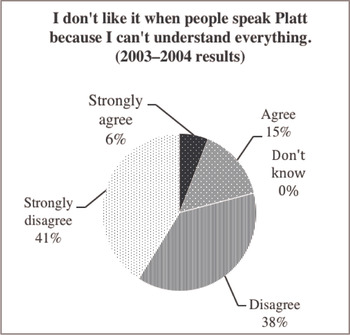
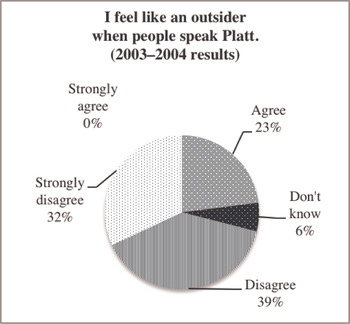
Two of the questions from the questionnaire for the H-speakers directly inquired about their reactions when other people around them spoke the L-variety. Given Ferguson's assumption that H-speakers see the L-variety as inferior, Hundt's (1996) study, and finally the initial language problems H-speakers encountered in the Grafschaft, it was to be expected that many H-speakers in my study would confirm Ferguson's theory. Figures 1 and 2 show the reactions of H-speakers toward the use of Platt in their presence.
Figures 1 and 2 clearly show that the H-speakers’ attitudes toward the L-variety, despite their initial language problems, are quite positive. Seventy nine percent of all H-speakers stated that they are not bothered by L's daily presence in conversations (figure 1), and 70% declared that they do not feel like outsiders when people around them use the L-variety (figure 2). These positive perceptions with regards to hearing Platt were reaffirmed when I asked the H-speakers of my study to evaluate the L-variety.
Platt spoken in the presence of L-speakers.

Distribution of Norwegian dialects.

7. H-Speakers’ Evaluations of the L-Variety
Ever since the decline of Platt as a written and official language in the 16th and 17th centuries, Platt has been regarded by many H-speakers as a Bauernsprache ‘peasant language’ and its speakers—as rückständig ‘backwards’. Closely connected to these negative evaluations is the constant claim that one cannot express oneself as efficiently or as elegantly in Platt as in High German. In fact, its lack of sophistication is one of the most persistent arguments against the use of Platt and, indeed, against any L-variety. Figure 1 illustrates whether the belief in the super-iority of H over L is based on language sophistication.
Platt is not a sophisticated language.

The results presented in Figure 3 show that more than 50% of H-speakers disagree with the statement that the H-variety is more sophisticated than the L-variety. A quite high number of H-speakers, 35%, did not seem sure whether H and L are equal in terms of sophistication, while only 12% claimed that H is indeed more sophisticated than L.
The answers of the H-speakers in my study stand in contradiction to Ferguson's observation that L is regarded as inferior and unsophisticated by both H-and L-speakers. Ferguson's claim is further challenged by the H-speakers’ emotional assessment of L. The participants in my study were asked whether they associated the term Heimat more with Platt or with High German.Footnote 30 Their answers appear in figures 4 and 5.
Platt and Heimat.

High German and Heimat.

Figures 4 and 5 show that 81% of the H-speakers clearly have an emotional attachment to the L-variety and connect its presence to the idea of Heimat. In fact, one can draw the conclusion that the Grafschaft would not feel like home to them without the L-variety. This is particularly evident, as 19% of the H-speakers do not associate the H-variety—which is, after all, their own language—with the term Heimat at all. These results are, indeed, remarkable, since, according to Ferguson (1959:330), H-speakers’ aversion to the L-variety is usually such that they do not even acknowledge the existence of L. The results of my study, however, prove that H-speakers not only openly acknowledge the existence of the L-variety, but also regard it as a positive contribution to their quality of life. In other words, the H-speakers’ Heimat would not be what it is if L did not exist.
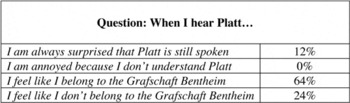
The H-speakers’ positive attitude toward the L-variety also showed when asked about their general emotional response to hearing the L-variety. Their answers appear in table 2.
H-speakers’ emotional response to hearing the L-variety.

The results shown in figures 4 and 5, and in table 1 suggest that there is a significant association between the notion of Heimat, that is, a feeling of belonging to a certain region, and the region's native language, which is the L-variety. Even the H-speakers who experienced consider-able communication problems, such as couple B. and Mrs. E., reported positive emotions when hearing the L-variety:
Mrs. E. agrees and adds:
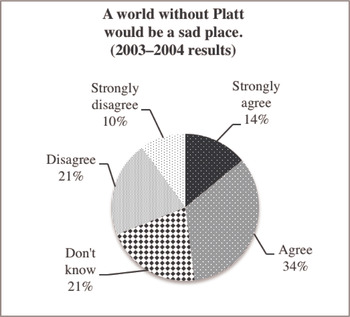
Finally, I asked the H-speakers a hypothetical question: How would they feel in a world without Platt? Their answers illustrate that the L-variety has, indeed, become a positive element in most H-speakers’ daily lives, as can be seen in figures 6 and 7.
The results presented in figures 6 and 7 show once more the emotional attachment of the H-speakers to the L-variety. Almost half of all surveyed H-speakers, namely 48%, would find a world, in which the L-variety did not exist, sad; 80% of them think the world would be worse off without the presence of L.
A world without Platt I.

A world without Platt II.

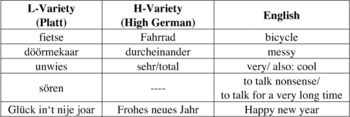
The presence of Platt and the positive attitudes of H-speakers toward it have led to a rather interesting phenomenon, namely, that many H-speakers reported to have incorporated certain L-words and phrases into their daily speech. In fact, some L-words are so omnipresent in the Grafschaft that their equivalents in H are almost never used. Table 3 lists some of the most-used L-words from the H-speakers’ daily speech (based on their own account of the 2003–2004 survey).
L-words and phrases used by H-speakers.

While the words and phrases in table 3 are expressions indicative of a “Pan-Grafschafter-Variety,” it is worth noting that 50% of all surveyed H-speakers reported to use L-words in their daily speech in order to show that they are echte Grafschafter ‘real Grafschafter’, that is, people who live in the Grafschaft Bentheim and genuinely belong there. The fact that the H-speakers prefer certain L-words to their respective H-counterparts provides evidence that the L-variety has become a part of the H-speakers’ identity as citizens of the Grafschaft Bentheim. The last part of my questionnaire explored the relationship between the L-variety and the H-speakers’ children, that is, whether the H-speakers would find it worthwhile for their children to learn L.
8. H-Speakers’ Children and the L-Variety
One of the most common arguments against the use of Platt with children is the concern that they would not learn to speak “proper High German.” In other words, parents worry that the L-variety would contaminate their children's use of H. As Stellmacher (1987:33) notes,
Die Bedenken, mit Kindern und Enkeln plattdeutsch zu sprechen, er-geben sich zweifelsfrei aus der allgemeinen Erziehungshaltung: Kinder sollen zu einem guten Hochdeutsch geführt werden und der Mundart wegen in der Schule keine Nachteile erfahren.Footnote 33
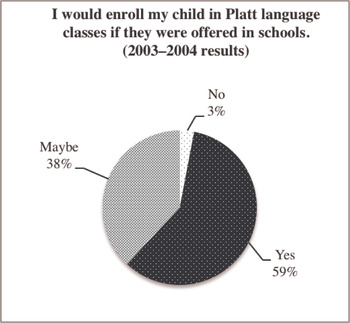
In the Grafschaft Bentheim, like in so many other regions of northern Germany, acquisition of Standard German as a first language, and edu-cation in Standard German has become universal. My question to H-speaking and L-speaking parents then was whether they would want their children to still learn the L-variety. Since most parents are either un-willing or unable to act as transmitters of the L-variety, I asked a theoretical question about whether or not public schools should promote and teach the L-variety. According to Ferguson 1959, Britto 1986, and Hudson 2002, parents’ reactions would be very negative if their children were taught to speak or to appreciate the L-variety in public schools. It was therefore to be expected that H-speaking parents would not want the L-variety to interfere with the education of their children. However, this expectation is not borne out as seen in figures 8 and 9.
Platt and public education.

Platt offered as a school subject.

While the results in figure 8 show that H-speaking parents want their children to appreciate the L-variety, with 83% stating that Platt should be promoted in public schools, the results in figure 9 illustrate that many H-speaking parents would vote for Platt as an actual subject, with 59% stating that they would want their children to learn the L-variety in schools. These answers show that the H-speakers see the L-variety as a regional convention, worthy of being passed on to their children, which is, again, not in accordance with the classical model of diglossia.
9. The 2009 Survey
In the summer of 2009, I revisited the Grafschaft Bentheim and conducted another, smaller field study that focused on H-speakers only. Instead of a rigid set of questions I used an open, informal interview format that centered on the speakers’ views of Platt. During June and July 2009, I interviewed a total of 21 H-speakers (12 female, nine male, aged 16–64). It must be pointed out that I refrained from attempting a real-time study, that is, none of the 2009 subjects participated in the 2003–2004 survey. This time 13 H-speakers volunteered for the study (62%), while I recruited eight (38%).
Overall, the idea that Platt belongs to the Grafschaft resurfaced in many of the interviews with H-speakers. A total of 17 participants stated that they could not imagine the Grafschaft Bentheim without Platt, a standpoint that is reflected in the following accounts:
Participant A, 48, male, Emlichheim
Also, ich finde, dass Platt einfach zur Grafschaft gehört. Das war schon immer so, das gehört doch einfach dazu, wenn man hier lebt.Footnote 34
(June 9, 2009)
Participant B, 61, male, Uelsen
Ohne Platt könnte ich mir die Grafschaft gar nicht richtig vorstellen. Das ist nun mal so, dass Leute hier Platt sprechen, und das finde ich auch gut so.Footnote 35
(June 17, 2009)
Table 4 shows the results of the 2009 survey with regards to H-speakers’ attitudes toward Low German.
H-speakers’ attitudes toward Low German (2009 survey).

A new element in almost all interviews (20 out of 21) was the issue of the survival of Platt as a spoken language in the Grafschaft Bentheim in the 21st century. Of the 20 H-speakers who commented on this subject, 16 judged the chances of Platt's survival as ziemlich schwach ‘very slim’ and only four as relativ gut ‘relatively good’. Table 5 shows H-speakers’ predictions regarding the future of Platt in the Grafschaft Bentheim.
The future of Low German in the Grafschaft Bentheim (H-speakers’ predictions, 2009 survey).

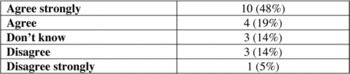
Similar to the responses in the 2003 survey, most H-speakers deplored the continuing erosion of Platt in the Grafschaft. Table 6 shows their responses to the hypothetical scenario already presented in 2003: “A world without Platt would be a sad place.”
The Grafschaft Bentheim would be a sad place without Platt.

Interestingly, 13 H-speakers in the 2009 survey saw the main danger to Platt's continued existence not so much in the fact that Platt is no longer passed down generations in the Grafschaft Bentheim but rather in the ubiquitous use of communication technologies, specifically the Internet. Participant C, for example, stated:
Participant C, 34, female, Nordhorn
Das Internet macht doch alles kaputt. Dadurch stirbt die Sprache [Platt] am Ende aus.Footnote 36
(June 8, 2009)
Participant D concurred and asserted:
Participant D, 59, male, Emlichheim
Ja, ich meine, das Internet ist eigentlich faszinierend und oft auch hilfreich, aber im Grunde genommen bist du aufge-schmissen, wenn du kein Englisch kannst.Footnote 37
(June 9, 2009)
The issue of minority languages and the Internet has been the subject of many articles and books (see, for example, Crystal 2006, Garland 2006). In general, scholars and experts disagree as to whether the Inter-net is a boon or a danger for minority languages. On the one hand, critics like Erickson (1998:34) point out that it will accelerate the demise of minority languages at the cost of English:
While the Internet if often looked upon as a channel for informational community building, it also has the potential to hasten an already rapid shift toward a dominant global language—English. It is the default language of choice.
On the other hand, linguists like Crystal (2006:234) believe that “it [the Internet] is the ideal medium for minority languages, given the relative cheapness and ease of creating a web page.”
Marcel Grangier, Head of the French Section of the Central Linguistics Service (Section française des services linguistiques centraux), agrees and considers the dominance of English on the Web as exaggerated:
Multilingualism on the Internet can be seen as a happy and above all irreversible inevitability. In this perspective we have to make fun of the wet blankets who only speak to complain about the supremacy of English. (in Crystal 2006:235)
Although Crystal (2006:231) reports that Alta Vista, a web search engine owned by Yahoo, predicted that “by 2002 less than 50% of the Web would be in English,” a survey from the same year by the OCLC (Online Computer Library Center, a worldwide consortium of libraries) found that 72% of all websites were in English followed by German (7%). While the number of non-English websites may have increased in the last five to six years, these numbers nonetheless demonstrate that the pre-sence of minority languages online is precarious at best. This is particularly true for those minority languages that do not have a stan-dardized orthography or a well-established literature, including present-day Low German. For instance, websites whose content is primarily in Low German can pose—however well intended—a problem, since many Low German speakers have difficulty reading the language. Möller (2008:38–39) points out that only 27% of the Platt speakers in his 2008 survey considered their reading abilities in Platt to be “very good” or “good.” Of these, 44% stated that it had been longer than six months since they last read something in Platt.
Not all H-speakers in the 2009 survey, however, saw the Internet as a threat to the survival of Platt. Mr. D., 36, a member of the local Heimat-verein thinks that the surge in websites in or about Low German can help expose people, particularly young adults, to the region's L-variety:Footnote 38
While Mr. D.’s views about the Internet are aligned with those who regard the Internet primarily as a tool for learning and disseminating information, the question whether websites in or about a minority lan-guage can provide a motivation to learn that particular language or to introduce it to a broader audience needs to be further investigated.Footnote 40
10. Conclusion
The results of the 2003 and 2009 surveys on Platt in the Grafschaft Bentheim demonstrate that diglossia in the target area has a unique character. The main findings of the survey can be summarized as follows:
1) Knowledge of L (that is, understanding and speaking it) is a factor contributing to successful integration in the community of the target area; it can play an important role in creating and overcoming social barriers.
2) Despite the (initial) language barrier, most H-speakers regard neither L's existence as vexing nor its daily presence as a communicative hurdle.
3) Contrary to the classical model of diglossia, most H-speakers re-vealed a strong emotional attachment to and fondness of the L-variety.
4) H-speakers want their (H-speaking) children to be at least reasonably informed about L and view a potential competence in L as desirable for them.
5) H-speakers can show as much concern as L-speakers about the sur-vival of the L-variety.
6) While seen as convenient or enriching on a personal level, newer communication technologies are viewed by many H-speakers as a threat to the survival of the L-variety, particularly since the L-variety serves primarily as an oral medium.
It should be mentioned here that those participants who volunteered for the two surveys (45.7% in 2003–2004 and 62% in 2009) perhaps already had a positive disposition toward Platt, which is, however, part of the greater dilemma of any survey that relies on volunteers instead of recruits. Yet the number of recruits in both surveys and the fact that their language attitudes toward Platt remained consistent over the course of six years demonstrate that these results are no chance occurrence; rather they confirm that H-speakers’ opinions and beliefs concerning the L-variety may be in general far less negative than previously assumed. These results call into question the premise of diglossic models that H-speakers consistently express a belief in the superiority of H over L, particularly in terms of prestige. However, more studies in other diglossic speech com-munities (both according to Ferguson's and Fishman's definition) need to be carried out in order to further investigate H-speakers’ attitudes toward L-varieties.
It is interesting to note that the positive language attitudes reflected in my regional studies are matched by Möller's national study from 2007 (which included both H-speakers and L-speakers). Ninety one percent of all participants associated Low German with heimatlich, 85% with humorvoll, and 79% with gemütlich (Möller 2008:24–25). These findings are important not only because they demonstrate a reversal of Ferguson's second diglossic rubric; H-speakers’ positive attitude towards the L-variety is also an important factor contributing to diglossia in general, in the Grafschaft Bentheim and other regions in northern Germany. There are, obviously, important additional factors involved, such as the wide-spread use of Low German in rural areas. One has to wonder, however, what the diglossic situation in the target area and beyond would be if H-speakers displayed language attitudes according to the classical model of diglossia, that is, if a majority of them were really to regard High German as “somehow more beautiful, more logical, better able to express thoughts” (Ferguson 1959:330). At the same time, Möller's results could be interpreted as an indicator that such a process might already be under-way, since attributes such as heimatlich, humorvoll, and gemütlich seem to suggest that H-speakers do not necessarily associate Low German with eloquence and sophistication. Such an interpretation, however, would not alter the emotional attachment to Low German that many H-speakers ex-pressed.
A final point that this paper stresses is the possibility that endangered languages will likely play a greater role in future diglossic research. Hudson (2002:8) points out that even if a sharp functional compart-mentalization exists, it does not automatically contribute to language maintenance:
It has been tempting to conclude […] that the attainment and main-tenance of sharp functional compartmentalization of codes may be the key to minority-language maintenance and even reversal of language shifts within multilingual or multilectal speech communities.
At the same time, however, Hudson (2002) as well Romaine (2002) regard stability as a relative matter: “Moreover, stability is relative […]” (Hudson 2002:8). “Everyone admits that stability is a notoriously relative notion to begin with” (Romaine 2002:136). This may be true, but Low German's stability is no longer relative. Although not (yet) absolute, it has become undisputed (see Wirrer 1998) that the language is not only eroding but is in danger of extinction. Möller's (2007) survey concluded that the number of active Low German speakers has been reduced by more than half in the last 23 years (Möller 2008:12).
In his discussion of diglossia in Greece and Tanzania, Fasold (1984:57) observes diglossic changes in these two countries but concludes: “Diglossia never ends; it is a human universal.” Whether it is the unique situation of Low German, the lack of its intergenerational transmission, the rise of national languages in Europe, the ubiquitous mass media, or globalization, it is—regrettably—foreseeable that di-glossia, and with it part of the West Germanic dialect continuum, will end in the target area.
The belief in the superiority of H is, according to Ferguson (1959:329–330), sometimes so strong that the existence of L is denied altogether. At the very least, my studies prove that there need not be antagonism or competition—whether real or perceived—between the H-and L-varieties and their respective speakers, but that “living with L” can rather be an enriching and enjoyable aspect of H-speakers’ lives, and indeed for all members of diglossic speech communities.