INTRODUCTION
In the literature on morphosyntactic development, key debates pertain to the nature of early knowledge and its role in the acquisition process. The issue of whether and to what extent early linguistic representations are productive lies at the core of these debates. The present investigation first highlights three methodological challenges that have impeded the resolution of the debate on this issue and proposes a methodological approach to address them. Second, it presents a study that relies on the proposed methodological approach and focuses on the acquisition of subject–verb agreement in French. Third, by focusing on a productive, yet infrequent, morphosyntactic pattern and by comparing children's comprehension of both known verbs and pseudo-verbs at the same age (2;6), we test the limits of the claim made by usage-based approaches to language acquisition that “early knowledge is item-based and becomes (partially) productive only gradually” (Behrens, Reference Behrens2009, p. 393).
Usage-based approaches to language acquisition have relied on two different concepts of cues children may rely on in the input in order to eventually draw generalizations and construct their grammars (e.g. Bates & MacWhinney, Reference Bates, MacWhinney, Wanner and Gleitman1982; Dabrowska & Szczerbinski, Reference Dabrowska and Szczerbinski2006). The first one, cue availability, refers to the frequency of the cue in the input (e.g. the number of verbs ending in -ing in English, for instance). The second one, cue reliability, refers to the consistency of the cue, or its semantic transparency (e.g. the proportion of -ing as a verb suffix indicating progressive aspect as in playing, as opposed to -ing that is unanalyzable as a separate morpheme, e.g. thing). Cue availability and cue reliability are thought to be relevant to lexical and grammatical development as well as to other aspects of cognitive development. Studies investigating the production/comprehension of inflectional morphology and assignment of participant roles to pseudo-words (e.g. Dabrowska & Szczerbinski, Reference Dabrowska and Szczerbinski2006) have shown, for example, that two-year-olds are influenced by cue availability while slightly older children (between ages three and four) show the additional influence of cue reliability.
According to (some) generativist theories (e.g. Hyams, Reference Hyams2008), syntactic development is driven neither by lexical development nor by the sole properties of the input. Instead, toddlers are thought to have the (possibly innate) capacity to form abstract syntactic representations that apply to whole lexical categories (e.g. Noun, Verb, etc.) and not only to familiar words. These abstract representations are independent of lexical development and are constrained by a set of (innate) universal structural principles (UG/Universal Grammar) as well as a set of parameters regulating whether a structural principle is on/off in a given language; the value (on/off) of these parameters is fixed during development on the basis of linguistic exposure, and so is the lexicon. What is particularly relevant to the present investigation is the claim, embraced by all generative theories, that very early linguistic representations are abstract and reflect productive syntactic principles at a stage of development where, comparatively speaking, usage-based theories posit lexically specific knowledge.
The term ‘productive’ refers both to a characteristic property of certain morphosyntactic features and to the ability of the user of a given language. With respect to the first dimension, the progressive suffix -ing in English is said to be productive: all English verbs can undergo -ing suffixation. In contrast, the past tense marker -ed is less productive: a subset of English verbs do not undergo -ed suffixation (e.g. went instead of *goed, rode instead of *rided; e.g. Taylor, Reference Taylor2002).
The second dimension of productivity refers to the fact that the understanding and production of combinations of linguistic items are underpinned by principles that enable the individual to analyze linguistic items as separate and use linguistic rules/constraints to combine them, e.g. the ability to parse books as two separate morphemes, the Noun book and the plural marker -s (e.g. Taylor, Reference Taylor2002). A consequence of having a productive grammatical rule is that one is able to analyze items to which one has never been exposed before, and to understand and produce them, including the ability to parse gorp as referring to a novel object, to infer that more than one of these objects would be referred to as gorps, and to infer that gorp, upon hearing it, only refers to one while gorps refers to more than one (Berko, Reference Berko1958; Taylor, Reference Taylor2002). Both dimensions of productivity are relevant to the present investigation on French subject–verb agreement. First, the morphosyntactic feature that is expressed through a particular phonological phenomenon (‘liaison’, described below) is productive, but not frequent: liaison applies to all vowel-initial verbs and nouns (e.g. Durand & Lyche, Reference Durand and Lyche2008) but only ~25% of French verbs are vowel-initial (20% in the standard reference (Bescherelle, Reference Bescherelle1998), vs. 26% in the MANULEX database (Ortéga & Lété, Reference Ortéga and Lété2010)). The proportion is even smaller when only those verbs are considered that start with a vowel and follow the regular first conjugation or -er verb paradigm (i.e. no distinct suffixal subject–verb agreement marking for third person singular vs. plural): the proportion obtained is 22·5% (Ortéga & Lété, Reference Ortéga and Lété2010). The latter concept of productivity is the focus of the present study. The fact that the debate on the nature of toddlers' linguistic representations has remained unresolved is in part due to three methodological issues. The first methodological issue pertains to the difficulty in inferring representations from young children's early multiword production, which is not always adult-like due to a variety of potential factors, including immature or unstable linguistic representations, but also limited planning abilities and/or motor control (e.g. Bernal, Dehaene-Lambertz, Millotte & Christophe, Reference Bernal, Dehaene-Lambertz, Millotte and Christophe2010). The examination of toddlers' developing receptive language skills goes a long way towards overcoming this limitation of analyses of speech production samples and taps young children's cognitive capacities in contexts in which limited planning abilities and/or motor control do not interfere as much with children's performance.
The second methodological factor that limits the theoretical interpretation of many studies (including those that focus on comprehension and preference) concerns the selection of stimuli that most include frequent and productive items. For instance, studies that test the comprehension of verb frames/argument structure focus on the most frequent verb types, i.e. transitive verbs (e.g. kick in The bull kicked the horse) and/or extremely frequent intransitive verbs such as go (e.g. Naigles, Reference Naigles1990). Morphological studies typically investigate the default inflectional systems of a language, e.g. the verbal third person singular present -s and regular nominal plural -s markers, which both have very few irregulars in English. The study of the acquisition of syntactic dependencies in English has also focused on the 100% regular progressive marker -ing (e.g. Tincoff, Santelmann & Jusczyk, Reference Tincoff, Santelmann, Jusczyk, Howell, Fish and Keith-Lucas2000). This exclusive focus on productive and/or frequent forms is problematic because adult linguistic representations encompass the mastery of both frequent and infrequent forms, of both productive and non-productive forms.
The third common methodological issue is tied to an early focus on production, where the interpretation of experimental findings is often confounded with respect to whether the child's performance follows from frequent items or combinations of items identified in the input, or reflects precocious productive grammatical abilities. Production studies conducted within the usage-based approach systematically examine the properties of the input but not the acoustic/perceptual properties of the stimuli (e.g. Abbot-Smith, Lieven & Tomasello, Reference Abbot-Smith, Lieven and Tomasello2008; Dabrowska & Szczerbinski, Reference Dabrowska and Szczerbinski2006), while experimental studies investigating comprehension have not systematically characterized the input or the acoustic characteristics of the stimuli (e.g. Brandt-Kobele & Höhle, Reference Brandt-Kobele and Höhle2010; Johnson, De Villiers & Seymour, Reference Johnson, de Villiers and Seymour2005).
We propose to adopt a multidimensional methodological (MDM) approach which considers experimental results in relation to characteristics of the input, including its perceptual properties, and also considers the acquisition of both productive and non-productive as well as frequent and infrequent forms. The approach is multidimensional because it encompasses factors that are typically examined in isolation of one another. Thus we investigate the acquisition of subject–verb agreement in a language which has two subsystems, one that is productive, predictable, and involves preverbal liaison, e.g. the contrast between singular /i.la.riv/ and plural /i.za.riv/, while the other is unpredictable and involves suffixes, e.g. the contrast between singular /il.prã/ and plural /il.pren/. We focus here on the infrequent but productive one (leaving the other, unproductive, subsystem for a forthcoming study), we analyze diverse facets of speech, comprehension as well as spontaneous production, and we investigate comprehension of agreement with pseudo-verbs (Berko, Reference Berko1958) in comparison with real verbs. Finally, we analyze parental questionnaires, input frequency, and the reliability of markers, as well as other perceptual (acoustic) factors. Our hope is that a comprehensive approach of this sort will yield new insights and contribute to a more nuanced view of the debate than is currently available.
A few studies have attempted to at least partly circumvent the limitations mentioned above by employing pseudo-words in their stimuli. Since Berko's (Reference Berko1958) seminal study the use of pseudo-words has been considered the most robust method to identify whether and to what extent children's linguistic knowledge is productive (as defined above). Early pseudo-word studies focused on production, but this technique has recently been successfully used to tap receptive abilities. It is important to note that since Berko (Reference Berko1958), when studies have tested the same linguistic principle with both real and pseudo-words, better results have often been found on real words in the youngest age groups, compared to pseudo-words. This is a clear indication that the use of pseudo-words makes the task harder for children, perhaps due to the increased processing load that the use of words never heard before places on the child. The implication of these results is that for a given age a similar or weaker performance is expected on a task involving pseudo-words than on the same task involving real words.
For French, the target language of the present investigation, early studies have tended to examine non-adult-like patterns in spontaneous production by the age of two (e.g. Bassano & Mendes Maillochon, Reference Bassano and Mendes-Maillochon1994; Pierce, Reference Pierce1992). Recently, pseudo-words have been used to examine the nature of toddlers' receptive language abilities, focusing on their use of morphosyntactic cues to infer the lexical categories Noun and Verb. Although these studies employ slightly different research strategies incorporating pseudo-words (e.g. Bernal, Lidz, Millotte & Christophe, Reference Bernal, Lidz, Millotte and Christophe2007) and/or existing words (e.g. Bernal et al., Reference Bernal, Dehaene-Lambertz, Millotte and Christophe2010), their findings provide converging evidence that French-learning two-year-olds are able to make use of morphosyntactic cues in order to distinguish between both existing nouns and verbs, and pseudo-nouns and pseudo-verbs. Taken together, these results are more compatible with the generative perspective emphasizing productivity and abstract representations very early, than with the input-driven perspective (e.g. Lieven, Pine & Baldwin, Reference Lieven, Pine and Baldwin1997; Tomasello, Reference Tomasello2001), according to which successful performance on pseudo-words may not be expected at such an early age, partly because in the early stages of the production of multi-word combinations, children are not though to break down these combinations into different elements but “to reproduce not adult words but whole adult utterances” (Tomasello, Reference Tomasello2001, p. 61).
A prior comprehension study of number agreement in French verbal dependencies was conducted by Legendre, Barrière, Goyet, and Nazzi (Reference Legendre, Barrière, Goyet and Nazzi2010a). An innovative aspect of this study, compared to those previously conducted on number agreement in English (Johnson et al., Reference Johnson, de Villiers and Seymour2005), German (Brandt & Höhle, Reference Brandt-Kobele and Höhle2010), Spanish (Childers, Fernandez, Echols & Tomasello, Reference Childers, Fernandez, Echols, Tomasello, Almgen, Bareña, Ezeizabarrena, Idiazabal and MacWhinney2001; Pérez-Leroux, Reference Pérez-Leroux and Gurski2005), and Xhosa (Gxilishe, de Villiers & de Villiers, Reference Gxilishe, de Villiers, de Villiers, Belikova, Meroni and Umeda2007), was the use of dynamic video stimuli rather than still images in both a preferential looking task and a pointing task, that are typically thought to better illustrate the dynamic aspect of verbs referring to actions.
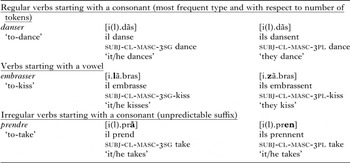
The stimuli involved the combination of a present tense verb with a subject clitic (or weak subject pronoun with distributional properties distinct from strong pronouns and lexical subjects; see Legendre, Culbertson, Barrière, Nazzi & Goyet, Reference Legendre, Culbertson, Barrière, Nazzi, Goyet, Torrens, Escobar, Gavarro and Gutierrez2010b). It exploited a single number cue provided by unique morphophonological properties of the French system of verb conjugations presented in Table 1. In the first conjugation verb class (-er ending in the infinitive) third person singular and plural forms are homophonous, although their orthographic forms may differ. For example, /i(l)dãs/ corresponds to either singular il danse ‘he dances’ or plural ils dansent ‘they dance’. Both il and ils are pronounced /il/ when the verb is consonant-initial. The paradigm to which these verbs belong is regular and productive according to the two criteria introduced earlier: all verbs with infinitive -er show the homophony and 90% of French verbs belong to the class of -er verbs. When the verb is vowel-initial, however, il and ils are pronounced differently (e.g. singular il embrasse /i.lã.bras/ ‘he kisses’, versus plural ils embrassent /i(l).zã.bras/ ‘they kiss’; dots mark syllable boundaries). The presence of preverbal il/ils uniquely affects the beginning of the verb, resulting in the obligatory realization of the last segment (/l/ or /z/) of the clitic (/z/ is otherwise silent when the verb is consonant-initial, thus resulting in the same non-contrastive phonological forms for the singular and the plural for most verbs except for the very small class that exhibits suffixal contrasts) and resyllabification with the initial vowel of the verb, regardless of register or sociolinguistic context.
Distribution of third person singular and plural markers across different verb paradigms in French

notes: subj indicates Subject; cl indicates Clitic/Weak Pronoun; masc indicates Masculine; 3 indicates Third Person; sg indicates Singular; pl indicates Plural; characters in bold indicate phonological differences between the Singular and the Plural forms.
Obligatory liaison in either the nominal domain (determiner (adjective) noun combinations) or the verbal domain illustrated above entails mismatched lexical and phonological representations and raises separate issues for processing and acquisition. Two models have been proposed, one emphasizing lexical development and a usage-based perspective (e.g. Chevrot, Dugua, Harnois-Delpiano, Siccardi & Spinelli, Reference Chevrot, Dugua, Harnois-Delpiano, Siccardi and Spinelli2013) and the other abstract knowledge of liaison at a very early age (e.g. Wauquier & Shoemaker, Reference Wauquier and Shoemaker2013). Two empirical patterns of results are directly relevant to our study. One is that production of liaison in the targeted verbal domain (subject clitic + verb) is error-free in early production. Buerkin-Salgado, Culbertson, Legendre, and Nazzi (unpublished observations) report a level of 99·97% of correct liaison by age three out of 1150 instances analyzed from the phonologically transcribed Lyon Corpus (Demuth & Tremblay, Reference Demuth and Tremblay2007). The other is that two-year-olds are able to segment liaison, at least in the nominal domain (Babineau & Shi, Reference Babineau, Shi, Davis, Mesh and Sung2011).
The ten sentential verbal stimuli in Legendre et al. (Reference Legendre, Barrière, Goyet and Nazzi2010a) contained a subject clitic (il or ils), a verb, and an object noun phrase (definite masculine determiner le plus pseudo-noun beginning in a consonant, hence not itself triggering liaison). The same verbal and visual stimuli were used in the Intermodal Preferential Looking Paradigm (henceforth IPLP) and a pointing task. IPLP data were obtained from two- and three-year-old monolingual French-speaking children. Two-and-a-half-year-olds, but not two-year-olds, were found to look significantly longer at the matching visual stimuli in both the singular and plural conditions. Pointing data were obtained from another group of participants aged 2;6. They pointed significantly more often to the matching video, in both the singular and the plural conditions, confirming the robustness of the results obtained in the IPLP task. In both experiments, the participants were only tested on verbs with which they were familiar prior to testing.
Overall, this study provided evidence that French-speaking children aged 2;6 are able to pay attention to a single agreement cue when they are familiar with the verb – both its form and its meaning. To test the hypothesis that lexical abilities are associated with grammatical development, correlations were calculated between the results on the task (overall score, singular score, and plural score) and six measures of an adaptation of the French MacArthur-Bates Communicative Development Inventory (Kern, Reference Kern2003): total vocabulary understood/produced, total number of verbs understood/produced, and total number of pronouns understood/produced for the two age groups, 2;0 and 2;6. The only correlation that was identified was between the results of the IPLP task on the singular stimuli and the total number of verbs understood. These results suggest a relatively weak link between general vocabulary knowledge and receptive grammatical skills. However, based on Legendre et al.'s (Reference Legendre, Barrière, Goyet and Nazzi2010a) results, it is unclear whether children succeed at comprehending the agreement marker because they already know the singular/plural verb forms tested or because they are successful in identifying the agreement morphemes independently from the specific familiar verbs and assigning them adult-like meaning.
The comprehension study in Legendre et al. (Reference Legendre, Barrière, Goyet and Nazzi2010a) included a quantitative analysis of the input in five CHILDES (MacWhinney, Reference MacWhinney2000) corpora (Bassano & Mendes-Maillochon, Reference Bassano and Mendes-Maillochon1994; Hunkeler, Reference Hunkeler2005; Plunkett, Reference Plunkett, Push and Raible2002; and Champaud Corpus), totaling 54,000 utterances. Singular and plural clitic–verb combinations of the type used in their experimental study were shown to be quite rare in parental speech directed at young children (between 0·23 and 0·7% of all utterances for the singular, and 0% and 0·12% for the plural across corpora), as well as displaying a clear number asymmetry in favor of singular agreement. The authors concluded that input frequency could not explain the early comprehension success, nor the absence of a singular–plural asymmetry in comprehension. Whether these results could be explained by the cue validity of the French subject–verb agreement marker tested is examined in the follow-up corpus study – Study 2 – below.
The study of Legendre et al. (Reference Legendre, Barrière, Goyet and Nazzi2010a) exhibits two limitations. First, it does not test whether and to what extent the principles that underpin toddlers' developing grammars are productive or whether they only operate in the context of frequently heard linguistic material for which toddlers may have developed strong semantic representations. As mentioned above, one of the ways to test the productivity of a grammatical principle is to investigate toddlers' responses in the context of unfamiliar material, for instance pseudo-words. According to generative theories, provided that toddlers are able to assign pseudo-words to appropriate lexical categories – which French-learning infants are able to do on the basis of morphosyntactic cues by at least two years of age (e.g. Bernal et al., Reference Bernal, Lidz, Millotte and Christophe2007), they are expected to be able to use the same grammatical principles in the context of familiar and unfamiliar lexical items at the same age, that is by 2;6 in the case of the liaison-based subject–verb agreement. In contrast, both the constructivist and emergentist hypotheses predict delayed performance on the same grammatical principles for unfamiliar compared to familiar lexical items.
A second limitation of Legendre et al. (Reference Legendre, Barrière, Goyet and Nazzi2010a) pertains to the analyses of the input. These only considered the verbs and combinations with subject clitics used in the stimuli, not the frequency of the actual subject–verb agreement markers, as reliable indicators of singular subject–verb agreement in the case of the liaison consonant /l/ and plural subject–verb agreement in the case of /z/. The present investigation takes a step beyond that of Legendre et al. (Reference Legendre, Barrière, Goyet and Nazzi2010a) by testing children aged 2;6 for comprehension of the same combination type (subject clitic–Verb–Determiner le + Pseudo-noun, e.g. il embrasse le douk ‘he kisses the douk’), but using pseudo-verbs (Study 1). The descriptions of the verbal stimuli include a detailed characterization of their acoustic properties. Furthermore, detailed new corpus analyses investigate the frequency of the formal subject–verb agreement markers and their likelihood to be mapped to singular and plural agreement in the input (Study 2).
STUDY 1: COMPREHENSION OF VERBAL NUMBER MARKED ON PSEUDO-VERBS
METHOD
Participants
Participants included twenty-four monolingual French-speaking children aged 2;6 (13 males, 11 females; M = 30 months, 7 days; range: 29 months, 8 days to 30 months, 30 days). An additional twelve children were tested but excluded for not contributing data to all conditions (3) or for not pointing (9). Children were all recruited in the Paris area and overall represented diverse socioeconomic backgrounds.
Stimuli
Eight pseudo-verbs were created to match the familiar verbs used in Legendre et al. (Reference Legendre, Barrière, Goyet and Nazzi2010a): transitive verbs, belonging to the dominant or first conjugation class, with their characteristic phonological properties, including comparable number of syllables and endings, and with few phonological neighbors. They were all vowel-initial, with phonologically identical third person singular and third person plural forms, number agreement being signaled only by obligatory ‘liaison’ between the subject clitic and the verb. They included /akrum/, /aloʃ/, /aruv/, /atym/, /ãbip/, /ãtav/, and /esop/.
These pseudo-verbs were embedded in short sentences consisting of the third person subject clitic in either singular (il ‘he’) or plural (ils ‘they’) form, the verb, and an object noun phrase (determiner le ‘the’ + noun). Pseudo-nouns, rather than real nouns, were used as direct objects of the transitive verbs to allow direct comparison with the results using familiar verbs obtained by Legendre et al. (Reference Legendre, Barrière, Goyet and Nazzi2010a). Sixteen different pseudo-nouns, which all had a Consonant–Vowel–Consonant structure (e.g. /gef/) were used. The audio stimuli were delivered live by the experimenter, a female native speaker of French. However, in order to analyze the acoustic properties of the kind of stimuli delivered by the experimenter, she also recorded the singular and plural versions of each sentence once, resulting in sixteen different sentences.
Acoustic differences have been reported to have an effect in early speech perception and discrimination abilities, with duration having a facilitating effect (e.g. Bradlow et al., Reference Bradlow, Kraus, Nicol, McGee, Cunningham, Zecker and Carrell1999). The duration, pitch, and intensity of the French liaison consonants /l/ and /z/, which respectively mark singular and plural number for five pairs of the stimuli produced by the experimenter the same way she produced them in the experiment, were analyzed (with the /l/ realized in both the singular where it is obligatory and the plural in which case it is optional). While no significant differences in pitch (t(7·505) = 1·5621, p = ·1594) and intensity (t(6·204) = 0·607, p = ·5654) were found, syllables with initial /z/ were found to be significantly longer than those starting with /l/ (t(7·856) = –5·4329, p = ·0006609). We also checked whether these acoustic patterns hold across speakers, including among those who only pronounce the /l/ in the singular version of the stimuli. A similar pattern emerges: syllable with initial /z/ exhibited significantly longer duration (t(27) = 2·7125, p = ·0115).
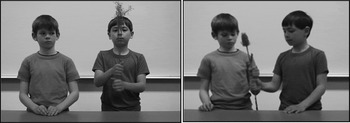
Visual stimuli were produced by recruiting two eight-year-old boys and filming them performing one of eight simple unfamiliar actions on unfamiliar objects. The unfamiliar actions were chosen so that they could not be described by a verb likely to be known by children aged 2;6, and the unfamiliar objects were chosen so that the children aged 2;6 would not have a name for them. For each action, either one boy performed the action alone while the other boy was standing immobile next to the first boy (singular video), or the two boys performed the action together and simultaneously (plural video). Figure 1 shows characteristic still images from the actual videos used for one unfamiliar action. For each action, different unfamiliar objects were used in the singular and plural conditions (a total of 16 unfamiliar objects were used). Thus, similar actions were performed on different objects by the single boy (singular video) versus the two boys (plural video). The rationale behind the use of different objects comes from the fact that if identical actions were performed with the same objects by one boy in the singular video and two boys in the plural video, (i) the mapping of the singular verbal stimulus to the plural video is semantically plausible (if it is true that more than one agent are performing the same action, it is also necessarily true that one agent is performing that action), so children might point to either screen in response to a singular stimulus sentence, and (ii) when the actions and objects are identical on both screens, it is plausible to interpret the ‘sum’ of both screens as depicting a plural event, so children might have trouble selecting one of the two videos when presented with a plural stimulus sentence. The duration of each video sequence was 6 seconds.
Still images from the videos used for unfamiliar action (singular version on the left and plural version on the right).

As in Legendre et al. (Reference Legendre, Barrière, Goyet and Nazzi2010a), parents were asked to complete a French version of the CDI (Kern, Reference Kern2003), adapted for the purpose of this investigation to include more verbs and verb types. The CDI is a reliable, parent-friendly tool for assessing the number of lexical and function words a child understands and produces spontaneously.
Procedure
To allow comparison of the results with those reported in Legendre et al. (Reference Legendre, Barrière, Goyet and Nazzi2010a), the procedure was exactly the same as the one used in their Experiment 2. Each child was tested individually in a soundproof booth for about 10 minutes, using a pointing task. Children sat on a parent's lap during the whole session. The parent, wearing dark glasses rendered opaque by covering the inside of the lenses, was blind to the video stimuli. The (female) experimenter sat to the immediate right of the child. When pronouncing the target utterance, the experimenter was careful not to look at the child or the screens; rather, she stared at the central light between the two screens so as not to influence the child's pointing.
The session started with up to four training trials intended to set up the pointing game. The child's attention was first centered by flashing a central light located between the two presentation screens (the child facing the whole display). Once the child looked at the central light, a pair of pictures of bright, easily recognizable objects was shown in silence for 6 seconds. Then the screens turned black and the experimenter named one of the two objects and asked the child to point to it (e.g. “Tu as vu la pomme? Montre-moi avec ton doigt où elle se trouve la pomme, montre-moi la pomme.” ‘Did you see the apple? Show me with your finger where the apple is, show me the apple.’). The two images immediately reappeared on their respective screens for 6 seconds. The child's task was to point to the matching screen. If the child did not point within the first few seconds, the experimenter repeated the invitation once to give the child another chance at responding, and then, regardless of response, moved onto the next trial. Each trial ended with a 3-second-long eye-catching video displayed on the matching screen, following Legendre et al. (Reference Legendre, Barrière, Goyet and Nazzi2010a). The structure of the trials was the same for the training and test trials.
Each child was then presented with eight trials of pseudo-verbs. The 6-second-long singular/plural versions of the actions were presented simultaneously, once in silence and then once following the experimenter's request (e.g. “Tu as vu? Ils arrouvent le mic /izaruv lə mik/, montre-moi avec ton doigt où ils arrouvent le mic /izaruv lə mik/, montre-moi où ils arrouvent le mic /izaruv lə mik/, or, in a literal translation of French grammatical sentences: ‘Did you see? They are pseudo-verb-ing the pseudo-noun, show me with your finger (the screen) where they are pseudo-verb-ing the pseudo-noun show me where they are pseudo-verb-ing the pseudo-noun’”).
For each child, the target was the singular action four times and the plural action the other four times (in random order). The order of presentation of the different unfamiliar actions was randomized by the experimenter, and the side of the matching video was counterbalanced within participants for each condition (singular/plural).
Coding
Coding of children's pointing was done on-line by the experimenter, and the sessions were also videotaped using a digital video camera placed between the two screens. Each trial was coded as correct (score = 1) or incorrect (score = 0). A response was coded as correct only if the child clearly and decisively pointed to one screen. Any hesitation, double pointing, or refusal to point resulted in the elimination of the corresponding trials. Overall, children clearly pointed on 6·96 out of 8 trials. The data were first coded on-line, then entirely recoded offline for fourteen children by a research assistant unfamiliar with the study and blind to the conditions of each trial. Inter-rater reliability was 90% and discrepancies were resolved by a second review of the videos by the coders followed by discussion and agreement.
RESULTS AND DISCUSSION
Overall, children pointed at the matching video 61·21 % (SD = 16·37) of the time, which is significantly above the 50% chance level (t(23) = 3·35; p = ·003, 2-tailed, d = ·68), and similar to the performance on real verbs (M = 61·93%) found in Legendre et al. (Reference Legendre, Barrière, Goyet and Nazzi2010a). There was no significant difference between the singular and plural conditions (t(23) = 1·86, p = ·07, 2-tailed, d = ·52), although children tended to show better performance for plural trials (M = 67·71%, SD = 24·37, above chance level, t(23) = 3·56, p = ·002, 2-tailed, d = ·73) than for singular trials (M = 55·56 %, SD = 21·93, at chance level, t(23) = 1·24, p = ·23, 2-tailed, d = ·25). Performance on singular items was not correlated with performance on plural items (Pearson's r = 0·045, t(22) = 0·21, p = ·83, 95% CI = [–0·36, 0·44]). The same was true for the known verb study (Legendre, Reference Legendre, Barrière, Goyet and Nazzi2010a) (Pearson's r = –0·31, t(14) = –1·22, p = ·24, CI = [–0·70, 0·22].
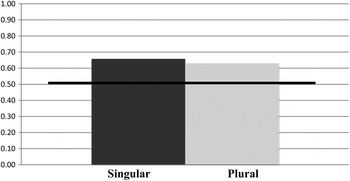
Following Johnson et al. (Reference Johnson, de Villiers and Seymour2005), we also analyzed children's sensitivity to singular and plural agreement. Sensitivity is calculated by taking the proportion of correct points to total points to the singular and plural videos separately. This measure corrects for any bias a child might have toward singular or plural videos and for the possibility that a child might have a low mean accuracy score in one condition, simply because she points to the corresponding video infrequently, even if all of her points to that video are correct. Children's mean sensitivity scores for singular and plural items (see Figure 2) were significantly greater than chance (singular: mean sensitivity = ·66, t(22) = 3·23, p = ·002, CI = [0·57, ∞]; plural: mean sensitivity = ·63, t(22) = 3·13, p = ·002, CI = [0·56, ∞]). The difference between the singular and plural sensitivity scores did not differ significantly (mean of the differences = ·03, t(22) = 0·58, p = ·567, CI = [–0·07, 0·13]). This result on the sensitivity measure demonstrates that the better performance on accuracy for the singular comes from the fact that children tend to select the plural video more often on the whole, but that the proportions of accurate versus accurate responses in the singular and plural condition do not differ.
Sensitivity scores obtained in the experiments on pseudo-verbs, in the singular (left bar) and plural (right bar) conditions.

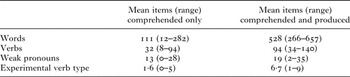
Lastly, 16 (out of 24) parental questionnaires were returned completed. Totals for relevant categories are presented in Table 2. In addition to total number of words, verbs, and subject clitics understood and produced by children, we also tabulated their knowledge of the ten specific real verbs used as experimental items in Legendre et al. (Reference Legendre, Barrière, Goyet and Nazzi2010a), and on the basis of which the eight pseudo-verbs in the present experiment were created. Overall, 81% of the children produced multiword combinations.
Language profiles of the participants based on the CDI data

Correlation analyses were performed using each child's total pointing score, pointing score for singular trials, pointing score for plural trials, and each of the CDI categories reported in Table 2. No significant correlations (Pearson r's from –0·254 to 0·379, p values > 0·148) were found between the CDI results and the results in the pointing task.
Overall, the present findings indicate that French-speaking children aged 2;6 are able to pay attention to a single verbal number agreement cue marked on a pseudo-verb and match the marker with the appropriate number of agents of an action. No reliable singular/plural difference was found. These findings provide evidence of a rule that is at least partly productive in French-speaking toddlers' morphosyntactic representations, and which enables them to generalize their understanding of liaison-based number agreement involving two adjacent elements to novel verbs at the same age as familiar ones (Legendre et al., Reference Legendre, Barrière, Goyet and Nazzi2010a).
Lexicalist studies of acquisition have identified two characteristics of the input that may impact the timing of acquisition and are relevant to the present study and the learning strategies used at different points of development. The first one – cue availability – was examined in Legendre et al. (Reference Legendre, Barrière, Goyet and Nazzi2010a), at least with respect to the third person singular versus plural marking of different types of verbs, including those exhibiting the same morphophonological properties as used in the present study (that is, vowel-initial verbs). The Legendre et al. (Reference Legendre, Barrière, Goyet and Nazzi2010a) study revealed the extreme rarity in parental input of the verbs tested with plural markers, both with respect to types and tokens (between 0 and 0·0009% of the total number of utterances across the corpora, and with respect to types less verbs that start with vowels and do not show variation in agreement suffix make-up) and the relatively higher frequency of the singular forms (between 0·001% and 0·02% of the total number of utterances across corpora), which could have resulted in lower performance for the plural conditions. Legendre et al. (Reference Legendre, Barrière, Goyet and Nazzi2010a) did not, however, consider cue reliability – whether the consistency of the mapping between liaison consonants /l/ and /z/ and a specific number category is high in the input. In other words, despite the fact that plural subject–verb agreement is less frequent in the input, it is possible that the association between /z/ and plural number is as consistent (semantically transparent, in emergentist terms, or reliable, in usage-base terms) as, or more so than, the association between /l/ and singular. If so, cue reliability could, in conjunction with raw frequency, contribute to the similar level of performance found in the singular and plural conditions on both known and pseudo-verbs (Study 1). In order to evaluate the frequency with which the underlying /z/ phoneme overtly realized in cases of liaison is a reliable predictor of plural number in the French input, we undertook a corpus analysis (Study 2) which specifically explored the relationship between morphophonemic phenomena across word boundaries and number features, specifically in relation to /l/ and /z/, the phonemes implicated in the grammatical contrast tested in the present study.
STUDY 2: FOLLOW-UP CORPUS ANALYSIS OF AGREEMENT MARKERS
METHOD
Material
The files for Anne from the York database on CHILDES (MacWhinney, Reference MacWhinney2000; Plunkett, 2002) were analyzed from age 1;10-2, and a total of 3269 input utterances were extracted.
Procedure
The purpose of the present analysis was to determine the reliability of /l/ and /z/ as phonological cues of number features, specifically the feature singular for /l/, as in our experimental item /ilaruv/ Il arrouve, and the plural feature for /z/, as in our experimental plural item /ilzaruv/ Ils arrouvent. Accordingly, every instance of the phonemes /l/ and /z/ in word-initial position was isolated in the non-child utterances. These include words that have a lemma starting with an /l/ or a /z/, as well as words starting with an /l/ or a /z/ as the result of resyllabification processes. Moreover, given possible resyllabification effects, we also isolated every instance of the phonemes /l/ and /z/ in word-final position when it was followed by a vowel-initial word (thus excluding those followed by consonant-initial words). All word-final instances were coded for whether they entail resyllabification or not, and whether resyllabification is obligatory or optional in adult native speech. Finally, for all instances, we coded whether the context in which the phoneme occurred is consistently associated with a singular or plural number feature. For example, while the determiners le and la are consistently associated with a singular number feature and the plural determiner les is consistently associated with a plural feature, agreement is often not systematically marked in these contexts: in a noun such as livre /livr/ ‘book’, because the singular livre /livr/ and the plural livres /livr/ are homophonous, then the same form can be preceded by either le /lə/ indicating singular or les /le/ indicating plural.
RESULTS AND DISCUSSION
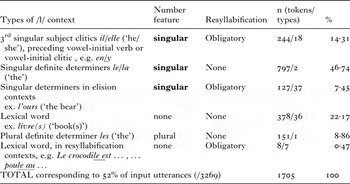
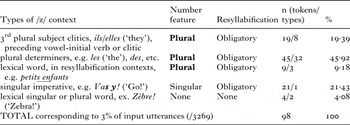
The results are presented in Table 3 for /l/ and Table 4 for /z/. A first observation is that the asymmetry in the input between singular and plural forms reported for subject NPs in Legendre et al. (Reference Legendre, Barrière, Goyet and Nazzi2010a) is also found in the distribution of /l/ and /z/ phonemes at word boundaries in general. In the 3269 utterances analyzed, the phoneme /l/ occurred at a word boundary 1705 times, while the phoneme /z/ only occurred 98 times.
Corpus analysis of /l/ as a word-initial cue for singular number

Corpus analysis of /z/ as a word-initial cue for plural number

The numbers in Tables 4 and 5 refer to the l-initial or z-initial words and the resulting ‘word’ after resyllabification, with /l/ or /z/ surfacing in word-onset position. For example, the categories for lexical words beginning with /z/ are words like zèbre, while the categories for third plural subject clitics preceding vowel-initial verbs or clitics are combinations like ils ont, ils en, elles étaient. The reasoning behind calculating numbers in this way is that we employ the most conservative criteria and do not assume that children at the ages we are testing are systematically taking liaison processes into account when segmenting words (even though at this age children probably know how to do so, at least for determiners and nouns, according to Babineau & Shi, Reference Babineau, Shi, Davis, Mesh and Sung2011). They may in fact be analyzing ils ont as izont or i zont, for example.
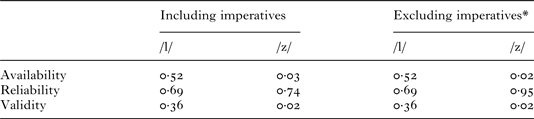
Cue availability, reliability, and validity of /z/ and /l/ as subject–verb agreement marker (*Imperatives were 21 tokens of the single type Vas y!; see Table 4)

Regarding cue reliability or the association of either morpheme with its corresponding number feature, the correspondence is not perfect for either /l/ or /z/. The phoneme /l/ was associated with singular number in 68·5% of occurrences (i.e. tokens), and with plural in 8·86% of cases, while /z/ was associated with plural number 74·49% of the time, and with singular number 21·43% of the time. These results suggest that the phoneme /z/ is more than twice as likely to be associated with a singular noun (21%, see fifth column and sixth row of Table 4) than /l/ is to be associated with a plural noun (9%, see fifth column and sixth row of Table 3), making /z/ less reliable as a plural marker than /l/ of a singular marker. There is also far more input to the child of the /l/-singular relationship than of the /z/-plural relationship.
In order to characterize more precisely the nature of the cues that /l/ and /z/ potentially provide to children with respect to singular versus plural subject–verb agreement, we calculated their availability and validity in addition to their reliability. Following Sokolov (Reference Sokolov1988) and Dittmar, Abbot-Smith, Lieven, and Tomasello (Reference Abbot-Smith, Lieven and Tomasello2008), cue availability was defined as the proportion of the total number of utterances analyzed (n = 3269) that include the target phoneme (/l/ or /z/) in word-boundary position (see Tables 3 and 4). Reliability was defined as the proportion of the utterances that include the target phonemes in word-boundary position in which those phonemes correspond to singular (for /l/) and plural number (for /z/). Cue validity is the product of cue availability and cue reliability. The results of these analyses are presented in Table 5.
Although the cue reliability of word-initial /z/ as a plural marker is similar to that of /l/ as a singular marker, the availability of /z/ is very low, only 3% in the corpus of child-directed utterances we analyzed, and therefore the validity of /z/ as a plural cue is also very low, compared to the availability and validity of /l/ (Table 5, left panel). It is unclear whether cases of /z/ in imperatives (combinations of a second person singular verb + non-subject clitic pronoun y or en (e.g. Vas[z]y! ‘go!’, Prends[z]en! ‘take some’) should be included in the count. The French imperative is a marked structure, both syntactically and prosodically; the clitic follows the verb (subject clitic pronouns are elsewhere always preverbal) and the combination displays the characteristic accentual pattern of French bisyllabic words, with a pitch accent on the final syllable consisting of z + clitic. These forms might be perceived as a single bisyllabic word with a medial /z/ on a par with words like mais[z]on ‘house’. In contrast, the stimuli items used in Study 1 do not carry a pitch accent either on the subject clitic or on the syllable resulting from resyllabification of the number marker. With these cases of /z/ excluded, cue reliability reaches 95% for /z/ as a plural marker and 69% for /l/ as a singular marker (Table 5, right panel). While the exclusion of the imperative increases the reliability of /z/ as a plural marker, it has little effect on its availability and validity (both reach 0·02, as presented in the last row of Table 5, on both the right and the left panels). Therefore, the results obtained in Legendre at al. (Reference Legendre, Barrière, Goyet and Nazzi2010a) and in the present Study 1 – equal comprehension of singular and plural markers – may be accounted for either by the fact that cue reliability is the main factor influencing performance (if imperatives are excluded), or that both cue availability and reliability influence comprehension, possibly in independent ways and/or that acoustic properties of the plural marker such as its duration facilitates its acquisition.
GENERAL DISCUSSION
The main finding that emerges from the experimental study is that French-learning toddlers aged 2;6 are able to map subject–verb agreement markers expressed through liaison in an infrequent verb type (vowel-initial verb, first conjugation class) in the context of pseudo-verb stimuli (i.e. sound combinations they could not have heard before) to the appropriate number of agents of an action. A particularly striking result is the absence of significant difference in comprehension of singular vs. plural markers. The acoustic analyses revealed that the two agreement markers have distinct properties, with the plural marker /z-/ exhibiting significantly longer duration, a factor that has been independently found to facilitate acquisition in previous studies (e.g. Bradlow et al., Reference Bradlow, Kraus, Nicol, McGee, Cunningham, Zecker and Carrell1999). The asymmetry in acoustic behavior is not matched by a singular/plural asymmetry in the experimental results. The analyses of the experimental comprehension results in relation to questionnaire data collected on individual children revealed that comprehension of the singular /l/ and plural /z/ marker is not facilitated by familiarity with this specific morphophonological class of verbs, the only one to which the agreement markers /l/ and /z/ apply. The corpus analyses suggest that, at age 2;6, children's interpretation of these markers in the context of the use of familiar verbs (Legendre et al., Reference Legendre, Barrière, Goyet and Nazzi2010a) and pseudo-verbs (the present study) is not impeded by the lack of frequency of /l/ and /z/ as singular and plural agreement markers, respectively. The cue reliability of /l/ and /z/ displays an asymmetry which again is not matched by the experimental results. The cue analysis results also differ from those obtained on the use of cue availability and reliability reported in usage-based studies. First, in the context of a production study, cue reliability was found to have a facilitating effect on acquisition when combined with cue availability (Dabrowska & Szczerbinski, Reference Dabrowska and Szczerbinski2006; Sokolov, Reference Sokolov1988), not on its own. Our results demonstrate that cue reliability may have a facilitating effect on its own: cue reliability for the plural marker investigated was found to be high, while cue availability was extremely low, but this did not prevent children from succeeding in the comprehension task at age 2;6. It is possible that the responses of our participants to a plural marker that exhibits low cue availability but high cue reliability were facilitated by the salience of this marker as revealed by the acoustic analyses reported in the description of the stimuli. In contrast, former studies have reported a strong effect of cue availability in two-year-olds (e.g. Dabrowska & Szczerbinski, Reference Dabrowska and Szczerbinski2006) and mixed results with respect to the effect of reliability. Second, the results of usage-based studies report different patterns for real and pseudo-words, with performance on the latter exhibiting a substantial delay in both production (Dabrowska & Szczerbinski, Reference Dabrowska and Szczerbinski2006) and comprehension (Dittmar et al., Reference Dittmar, Abbot-Smith, Lieven and Tomasello2008), in support of the conclusion that generalization of morphosyntactic representations is dependent on specific lexical items or specific subclasses of lexical items in the early stages of development. Our findings also add to recent studies on the acquisition of French liaison, and in this respect also cast doubts on a constructivist/lexicalist interpretation of our findings. While studies on the acquisition of liaison in nominal contexts primarily based on production of real words have been correlated with vocabulary development and familiarity with relevant words and word types (e.g. Chevrot et al., Reference Chevrot, Dugua, Harnois-Delpiano, Siccardi and Spinelli2013), our findings reveal that French-learning toddlers aged 2;6 are able to assign meaning to agreement-marking liaison affixed to unfamiliar verbs instantiating an infrequent morphophonological subtype (i.e. start with a vowel and with no suffixal agreement marker – 22·5% of French verbs; Ortéga & Lété, Reference Ortéga and Lété2010) with which they are very unlikely to have become highly familiar, based on both analyses of the input and individual parental questionnaires.
Overall, the present study casts serious doubts on the general conclusion that children's grammar at age three is deprived of productive morphosyntactic principles. In fact, the new results add to the body of knowledge that has been accumulating with respect to toddlers' early grammatical abilities, including two-year-olds' abilities to pay attention to (i) morphosyntactic cues in assigning both familiar and pseudo-words to the appropriate lexical categories of Noun or Verb (Bernal et al., Reference Bernal, Lidz, Millotte and Christophe2007), (ii) singular versus plural third person subject–verb agreement expressed through irregular suffixes (les garçons boivent /legarsõbwav/ ‘the boys drink’ versus *les garcons boit /legarsõbwa/ ‘the boys drinks’; Nazzi, Barrière, Goyet, Kresh & Legendre, Reference Nazzi, Barrière, Goyet, Kresh and Legendre2011), (iii) the preference of children aged 1;6 for grammatical verbal agreement when the stimuli involve real verbs, but not pseudo-verbs exhibiting similar morphophonological properties (Nazzi et al., Reference Nazzi, Barrière, Goyet, Kresh and Legendre2011), and (iv) the comprehension of children aged 2;6 of verbal number agreement on existing and familiar verbs that do not reflect the learning of infrequent constructions (Legendre et al., Reference Legendre, Barrière, Goyet and Nazzi2010a). While it was unclear whether toddlers at the same age would be able to succeed in the same task when exposed to stimuli involving novel verbs, what emerges from the present study is that children aged 2;6 do not need to be familiar with specific verbs and/or highly familiar with the morphophonological type they exemplify in order to demonstrate understanding of the agreement cue (expressed through liaison) used in Legendre et al. (Reference Legendre, Barrière, Goyet and Nazzi2010a).
In the larger context of language acquisition by French-learning infants, the following developmental pattern is emerging. Before their first birthday, infants are able to segment monosyllabic and polysyllabic words (Gonzalez-Gomez & Nazzi, Reference Gonzalez-Gomez and Nazzi2012; Nazzi, Mersad, Sundara, Iakimova & Polka, Reference Nazzi, Mersad, Sundara, Iakimova and Polka2014). By age 1;6, they prefer sentences that involve grammatical subject–verb agreement marking over ungrammatical ones (Nazzi et al., Reference Nazzi, Barrière, Goyet, Kresh and Legendre2011). By age 2;0, they demonstrate the ability to distinguish between nouns and verbs based on morphosyntactic cues, including pseudo-verbs (Bernal et al., Reference Bernal, Lidz, Millotte and Christophe2007, Reference Bernal, Dehaene-Lambertz, Millotte and Christophe2010) and they are able to segment liaison in determiner–noun combinations (Babineau & Shi, Reference Babineau, Shi, Davis, Mesh and Sung2011). Lastly, by age 2;6, they show evidence of understanding subject–verb agreement marking on verbs (Legendre et al., Reference Legendre, Barrière, Goyet and Nazzi2010a; present study). That subject–verb agreement comprehension emerges after the ability to represent lexical categories is not surprising. The former ability is more complex in the sense that in addition to requiring the identification of verbs bearing the agreement marker and the paradigm they exhibit, subject–verb agreement also requires the ability to relate two linguistic items in a sentence and understand that they are dependent on each other. The results of Legendre et al. (Reference Legendre, Barrière, Goyet and Nazzi2010a) demonstrated that children aged 2;6 showed evidence of comprehension of this dependency relation and of the agreement markers involved in the context of familiar verbs. The present study demonstrates that the principle that children use in order to do so is productive at age 2;6. The acoustic and corpus analyses also reveal that the singular and the plural cues examined have different phonological and distributional properties (with respect to their availability and cue reliability) and that the low availability of the plural marker may be overridden by its longer acoustic duration and/or higher reliability, which may explain why its comprehension is not hindered in young children.
These results do not fit well with input-driven and lexically driven approaches to the early representation of inflectional markers and words. As in the study by Legendre et al. (Reference Legendre, Barrière, Goyet and Nazzi2010a), no correlation was found between vocabulary scores and number of pronouns understood and/or produced and children's performance. No correlation between the number of verbs that exhibit the same morphophonological patterns as the pseudo-verb stimuli and the experimental results was found either. Moreover, the results of our study contrast with the conclusions of a few usage-based studies that examined the effects of cue availability and reliability on young children's productions (e.g. Dabrowska & Szczerbinski, Reference Dabrowska and Szczerbinski2006). Two-year-olds were found to rely on availability/frequency while three- and four-year-olds gradually moved to relying on the reliability of cues, while in the present study cue reliability seems to override availability/frequency for children aged 2;6. The results of the present study cast a novel light on this developmental trajectory with respect to toddlers' comprehension in that it documents possible effects of cue reliability and of acoustic salience.
From a cross-linguistic perspective, early sensitivity to number agreement has been reported for English-learning children aged 1;4 (Soderstrom, White, Conwell, & Morgan, Reference Soderstrom, White, Conwell and Morgan2007). A recent study has revealed comprehension of a single regular and frequent cue in the context of plural but not singular nominal number in Spanish-learning two-year-olds (Arias-Trejo, Cantrell, Smith & Alva Canto, Reference Arias-Trejo, Cantrell, Smith and Alva Canto2014). Studies that have examined the comprehension of a single agreement cue in the context of real verbs in English (Johnson et al., Reference Johnson, de Villiers and Seymour2005; Legendre et al., Reference Legendre, Culbertson, Zaroukian, Hsin, Barriere, Nazzi and Perez-Leroux2014), Spanish (Childers et al., Reference Childers, Fernandez, Echols, Tomasello, Almgen, Bareña, Ezeizabarrena, Idiazabal and MacWhinney2001; Legendre, Culbertson, Zaroukian, Hsin, Barriere & Nazzi, Reference Legendre, Culbertson, Zaroukian, Hsin, Barriere, Nazzi and Perez-Leroux2014; Pérez-Leroux, Reference Pérez-Leroux and Gurski2005) and Xhosa (Gxilishe et al., Reference Gxilishe, de Villiers, de Villiers, Belikova, Meroni and Umeda2007) have reported comprehension at a much later age – not before five; German-learning three- to four-year-olds were able to match subject–verb agreement stimuli to the matching visual stimuli in a looking behavior task but not in a task that also involved pointing (Brandt-Kobele & Höhle, Reference Brandt-Kobele and Höhle2010), and it is only after age five that German-learning toddlers are able to rely on single case-marking cues in order to assign appropriate participants' roles (Dittmar et al., Reference Dittmar, Abbot-Smith, Lieven and Tomasello2008), pointing to a developmental trajectory that Ambridge, Kidd, Rowland, and Theakston (Reference Ambridge, Kidd, Rowland and Theakston2015) describe as “a shift from the influence of highly frequent SVO word order, to less-frequent but highly reliable case marking” (p. 251). These cross-linguistic results speak to the limitation of possible frequency effects. For instance, the Spanish subject–verb agreement markers investigated in experimental comprehension studies similar to the present one making use of animated videos are as productive as and more frequent than the French subject pronouns undergoing liaison investigated in the present study, yet they are understood by older (3;6) children when affixed to real transitive verbs followed by the generic el objeto ‘the object’ (Gonzalez-Gomez, Hsin, Culbertson, Barrière, Nazzi & Legendre, Reference Gonzalez-Gomez, Hsin, Culbertson, Barrière, Nazzi, Legendre, Orman and Valleau2014), but not a pseudo-noun like el miso (Legendre et al., Reference Legendre, Culbertson, Zaroukian, Hsin, Barriere, Nazzi and Perez-Leroux2014). In the same vein, degree of markedness cannot account for the cross-linguistic results: the Spanish subject–verb agreement markers were less marked (productive across a higher percentage of verbs and higher in frequency) than the French ones investigated in this study that apply to a morphophonologically constrained class of verbs that is marked compared to most French verbs (that exhibit syncretism in the third person singular and plural forms), yet French-speaking children understand these marked agreement markers a year before their Spanish counterparts, including in the context of constructions that involve pseudo-nouns in object position (the present study and Legendre et al., Reference Legendre, Barrière, Goyet and Nazzi2010a) and pseudo-verbs (the present study). Future studies will have to investigate why such cross-linguistic differences are found. One possible explanation is that the differences in acquisition results stem at least in part from the language-particular expression of subject–verb agreement: in English, German, and Spanish, the contrast between third person singular and plural is expressed with verbal suffixes, and in Xhosa, although number and person markers occur preverbally – as in the verbal stimuli in French (in both the present study and Legendre et al., Reference Legendre, Barrière, Goyet and Nazzi2010a) – they tend to be separated from the verbal stem by several other suffixes which may render the identification of the relevant prefix difficult for toddlers. Future cross-linguistic studies on subject–verb agreement should help assess the precise contribution of the language-particular expression of subject–verb agreement to the acquisition process, including the acoustic salience of the markers involved, their availability/frequency, and reliability/semantic transparency.
Do our results overall provide evidence of a productive mechanism that underpins subject–verb agreement in toddlers' grammar? Evidence of the understanding of subject–verb agreement at age 2;6 is borne out in the context of (i) the use of vowel-initial pseudo-verbs exhibiting the morphophonological characteristics of real French verbs and bearing an infrequent but reliable plural marker; (ii) adjacent elements; and (iii) a phonological contrast expressed through liaison and based on a single phoneme indicating plural number. This result is important in relation to prior studies in three regards. First, our study reveals that French-learning toddlers aged 2;6 are able to map the meaning of a single agreement cue to the appropriate plural interpretation (see also discussion in Ambridge et al., Reference Ambridge, Kidd, Rowland and Theakston2015, and references cited therein on the possible positive contribution of multiple cues as opposed to a single cue to early stages of acquisition). Second, the age at which French-learning toddlers are able to do so differs from the results reported in the studies on the comprehension of single subject–verb agreement cues in English (Johnson et al., Reference Johnson, de Villiers and Seymour2005), German (Brandt-Kobele & Höhle, Reference Brandt-Kobele and Höhle2010), Spanish (Childers et al., Reference Childers, Fernandez, Echols, Tomasello, Almgen, Bareña, Ezeizabarrena, Idiazabal and MacWhinney2001; Gonzalez-Gomez et al., Reference Gonzalez-Gomez, Hsin, Culbertson, Barrière, Nazzi, Legendre, Orman and Valleau2014; Legendre et al., Reference Legendre, Culbertson, Zaroukian, Hsin, Barriere, Nazzi and Perez-Leroux2014; Pérez-Leroux, Reference Pérez-Leroux and Gurski2005), and Xhosa (Gxilishe et al., Reference Gxilishe, de Villiers, de Villiers, Belikova, Meroni and Umeda2007), using real verbs. Finally, the fact that French-learning toddlers are able to do so in the context of pseudo-verbs representing an infrequent type challenges acquisition accounts that emphasize the important contribution of type frequency (see Ambridge et al., Reference Ambridge, Kidd, Rowland and Theakston2015, and references cited therein) to the acquisition process.
Therefore, the results of our study are more compatible with theories emphasizing the abstract nature of morphosyntactic representations as well as liaison at a very young age rather than item-based knowledge becoming partially productive only gradually, though they do not inform the particular details of a generative approach over another. Methodologically, our findings highlight the need to broaden this type of investigation beyond the traditional foci of the generative approach and characterize target phenomena not only in relation to the underlying grammatical principles at work but also in terms of their perceptual properties which may affect the course of their acquisition (see Morgan & Demuth, Reference Morgan and Demuth1996).
In the future, the present research should be extended in several directions, in order to determine whether the productive principle applied in our task extends to the use of pseudo-verbs expressing agreement contrasts through verbal suffixes, e.g. the second conjugation class in French, in particular if consonant-initial (e.g. singular il finit /ilfini/ ‘he finishes’ versus plural ils finissent /ilfinis/ ‘they finish’), and/or irregular French verbs (e.g. singular il fait /ilfe/ ‘he does/makes’ versus plural ils font /ilfõ / ‘they do/make’). Syntactic dependencies that involve non-adjacent elements could also be explored. Moreover, our study focused on the third person singular/plural contrast, and future studies will have to explore the acquisition of contrasts between different persons (first, second, and third). The multidimensional methodology we adopt emphasizes the need to carefully examine the role of methodological factors (i.e. use of videos versus still pictures, investigation of frequent vs. infrequent linguistic items), of acoustic properties of the markers, and of their availability and reliability in order to better address the key theoretical debates in the field. Last, the study could also be expanded into a more fine-grained analysis of the temporal relationship between the application of grammatical representations in the comprehension of agreement with real verbs and its application to pseudo-verbs, and the identification of the factors –cue reliability and/or phonological saliency – that impact early comprehension.