Introduction
Previous research shows that socio-economic status (SES) identity (Goodman et al. Reference Goodman, Huang, Schafer-Kalkoff and Adler2007), also referred to as perceived social status or subjective social status (see e.g. Adler et al. Reference Adler, Singh-Manoux, Schwartz, Stewart, Matthews and Marmot2008; Collins and Goldman Reference Collins and Goldman2008; Demakakos et al. Reference Demakakos, Nazroo, Breeze and Marmot2008; Hu et al. Reference Hu, Adler, Goldman, Weinstein and Seeman2005; Singh-Manoux, Adler and Marmot Reference Singh-Manoux, Adler and Marmot2003; Singh-Manoux, Marmot and Adler Reference Singh-Manoux, Marmot and Adler2005; Woo et al. Reference Woo, Lynn, Leung and Wong2008; Wright and Steptoe Reference Wright and Steptoe2005) predicts current and future wellbeing, including cognitive function, depression, poor (self-rated) health, functional limitations, difficulty with activities or instrumental activities of daily living, the presence of chronic conditions, and some biological markers of health (Adler et al. Reference Adler, Epel, Castellazzo and Ickovics2000, Reference Adler, Singh-Manoux, Schwartz, Stewart, Matthews and Marmot2008; Collins and Goldman Reference Collins and Goldman2008; Demakakos et al. Reference Demakakos, Nazroo, Breeze and Marmot2008; Hu et al. Reference Hu, Adler, Goldman, Weinstein and Seeman2005; Singh-Manoux, Adler and Marmot Reference Singh-Manoux, Adler and Marmot2003; Singh-Manoux, Marmot and Adler Reference Singh-Manoux, Marmot and Adler2005; Woo et al. Reference Woo, Lynn, Leung and Wong2008; Wright and Steptoe Reference Wright and Steptoe2005). Study findings also show that an adult's SES identity is shaped by objective measures of status such as educational attainment, occupational prestige, income and assets, and by socio-cultural influences and psychological attributes (Adler et al. Reference Adler, Singh-Manoux, Schwartz, Stewart, Matthews and Marmot2008; Franzini and Frenandez-Esquer Reference Franzini and Frenandez-Esquer2006; Goldman, Cornman and Chang Reference Goldman, Cornman and Chang2006; Singh-Manoux, Adler and Marmot Reference Singh-Manoux, Adler and Marmot2003; Singh-Manoux, Marmot and Adler Reference Singh-Manoux, Marmot and Adler2005). Research to date, however, has not examined whether SES identity in later life changes over time or what effect changes in SES identity may have on wellbeing. This study takes the first step to fill in these gaps by ascertaining whether older adults adjust their SES identity.
Theories on the concept of the self suggest that identities or views of the self may be dynamic over the lifecourse (Demo Reference Demo1992; Markus and Wurf Reference Markus and Wurf1987; Whitbourne Reference Whitbourne, Ryff and Marshall1999). Turner (1968, as summarised in a review of the literature by Demo Reference Demo1992) suggests that the self is comprised of both ‘self-conceptions’ that consist of a core set of attributes, such as personality traits, that are stable throughout life and ‘self-images’ that reflect an individual's self-views at a particular time, in a particular situation or environment (Demo Reference Demo1992: 305). These self-images are shaped, in part, by social experiences and shifting social roles and, therefore, may change from time to time (Demo Reference Demo1992). Markus and Wurf also suggest that the self is made up of numerous ‘self-representations’ but that not all of these representations are accessed in every circumstance (1987: 306). Different facets of the self may vary in perceived importance from one situation to the next, leading to revised assessments of the self-concept (Markus and Wurf Reference Markus and Wurf1987). Therefore, as older adults experience changes in social roles, such as retirement or the loss of a spouse, or changes in health that accompany ageing, they may re-evaluate their position in the social hierarchy depending on the perceived impact these changes have on their lives and the perceived relevance of the changes for their identities (Whitbourne Reference Whitbourne, Ryff and Marshall1999).
In this study, we use two assessments of subjective social status measured six years apart (2000 and 2006) in a nationally representative sample of older adults in Taiwan. These longitudinal data allow us to examine whether Taiwanese adults report changes to their SES identity in later life. The data, described later in more detail, indicate that 9 per cent of respondents become widowed and 15 per cent leave work during the study period. Many respondents also experience a decline in health. Thus, the six-year time frame is an adequate amount of time to capture changes in SES identity. In line with the dynamic view of the self, we hypothesise that older adults will make adjustments to their SES identity during the six-year period.
To the extent that SES identity changes, we are also interested in determining the characteristics of respondents who are most likely to change their assessments. While we hypothesise that leaving work and becoming widowed will have negative effects on SES identity, we do not hold any a priori expectations about other characteristics of individuals who would be likely to revise their perceptions of their social standing. Accordingly, we examine social, demographic, and economic factors and psychological attributes that previously have been shown to influence SES identity. We also assess whether physical health influences change in subjective social status. Prior studies of SES identity have not extensively explored the influences of physical health, but evidence suggests that physical health can affect objective indicators of SES such as income, wealth and savings (House, Lantz and Herd Reference House, Lantz and Herd2005; Smith Reference Smith1999, Reference Smith2004). Insofar as evaluations of SES identity include consideration of these measures of socio-economic position, physical health may influence subjective assessments of social rank.
Data and methods
Data
This study used data from the Social Environment and Biomarkers of Aging Study (SEBAS) and its parent study, the Taiwan Longitudinal Study of Aging (TLSA), which was first conducted in 1989 with follow-up interviews approximately every three years. The original TLSA sample was a national probability sample of persons aged 60 and over in 1989; it was extended twice to include a national sample of adults aged 50–66 in 1996 and a national sample of adults aged 50–56 in 2003. In 2000, a sample of respondents interviewed in the 1999 wave of TLSA was selected to participate in the first wave of SEBAS, which included both an in-home interview and a hospital-based physical examination (Goldman et al. Reference Goldman, Weinstein, Cornman, Singer, Seeman and Chang2004). A second wave of SEBAS was conducted in 2006; it included the surviving examination participants from SEBAS I and a sample of younger respondents who were first interviewed in 2003.
The analyses presented here focused on the respondents who were interviewed in both SEBAS I (2000) and II (2006). Of the 757 respondents interviewed in 2000 and 2006, 62 respondents were missing assessments of their social status at one or two waves; interviews with 54 of these 62 respondents were conducted with a proxy who was not asked the subjective social status question. We excluded all respondents who did not provide a social status assessment at both waves as well as one respondent who reported an ethnic identification other than Fukien, Hakka or Mainlander (the three main ethnic groups in Taiwan). The resulting sample size was 694. There were an additional 199 respondents who were missing covariates of interest. We retained these respondents in the analysis, imputing the data that were missing. Imputation procedures are described below in greater detail as are analyses that test the sensitivity of our results to this treatment of the missing data.
Measures
SES identity
To capture evaluations of SES identity, we used the MacArthur Scale of Subjective Social Status (Adler et al. Reference Adler, Stewart, John and Catherine2007). In both waves of the study, respondents were shown a picture of a ladder with rungs numbered 1 to 10 and were read the following question:
Here is a ladder. There are ten stairs in total from the bottom to the top.
Think of the first ladder as representing where people stand in Taiwan where the top of the ladder are the people who are the best off – those who have the most money, the most education and the most respected jobs. At the bottom are the people who are the worst off – who have the least money, the least education, and the least respected jobs or no jobs.
The higher up you are on this ladder, the closer you are to the people at the very top; the lower you are the closer you are to the people at the very bottom.
If you consider your current situation and compare it with all other people in Taiwan, where would you place yourself on this ladder? Please indicate it to me. [Interviewers were instructed to circle the rung that the respondent indicates.]
Predictors of change in subjective social status
Unless otherwise specified, predictors were measured at the baseline wave of data collection in 2000. Demographic variables included age, gender, ethnicity, having one or more living sons in 1999, and a dichotomous measure that indicated whether the respondent lived in an urban area.
We examined six measures of SES. The number of years of schooling completed by the respondent and occupational prestige based on the primary lifetime occupation of male respondents and the husbands of female respondents were measured during the respondent's first interview in the study. The measure of occupational prestige was derived from Tsai and Chiu's (Reference Tsai, Chiu, Althauser and Wallace1991) socio-economic index (SEI) for Taiwan. We used husband's occupation because the cohorts of women included in our sample had low levels of labour force participation and because previous research has suggested that women who were not employed or who had not worked outside the home used the status of their husbands in their assessments of their position in the social hierarchy (Davis and Robinson Reference Davis and Robinson1988; Goldman, Cornman and Chang Reference Goldman, Cornman and Chang2006; Simpson, Stark and Jackson Reference Simpson, Stark and Jackson1988). SEI ranged from 55.1 (farm owners and labourers) to 76.1 (doctors and dentists).
Four other socio-economic measures came from the 1999 TLSA survey: the number of years of completed schooling for the most educated child of the respondent; the respondent's income and his or her spouse's income if married; the total value of all assets, including the value of savings, stocks, other assets, and a home, farm, or business if owned; and whether the respondent owned a car.
We combined responses to two items measured in 2000 to create an indicator that reflected the respondent's economic outlook: (1) how often respondents felt anxiety about finances (never, sometimes, usually); and (2) respondents’ evaluation of their ability to meet living expenses and other expenditures (respondent had enough money with some left over, just enough money with none left over, some difficulty meeting expenses, or much difficulty meeting expenses). Each variable was coded so that higher values represented more positive assessments. The observed range for this economic outlook indicator was 0–5.
Our measure of social involvement reflected the number of social activities in which a respondent participated. Activities comprised membership in a neighbourhood, religious, farmers’, or a political or village association; membership in a social service group; membership in a club for the elderly; and partaking in educational opportunities for the elderly. The observed number of activities ranged from 0 to 7.
We examined three psychological attributes (life satisfaction, depressive symptoms, personal mastery) and two measures of physical health (chronic conditions and functional limitations). Life satisfaction, measured in 1999, was derived from a single question that asked respondents whether they were satisfied with their lives. Depressive symptoms were measured using a ten-item subset of the 20-item Center for Epidemiologic Studies – Depression Scale (CES-D; Radloff Reference Radloff1977); similar short-form versions of the CES-D have been validated among older Chinese (Boey Reference Boey1999; Cheng and Chan Reference Cheng and Chan2005). Respondents reported whether and how often they: had a poor appetite; were exhausted; had poor sleep; felt depressed; were lonely; felt others were unfriendly; felt anguished; were unable to get going; felt joyful; and felt that life was going well. The depressive symptoms scale was the sum of the individual items (each coded 0–3) with the scores for the last two items reversed so that higher values for all items indicated worse symptom severity. The observed range for the depressive symptoms scale was 0 to 28.
Personal mastery was treated as a seven-item index that reflected the degree to which respondents felt that their life chances were under their own control rather than left up to fate (Pearlin and Schooler Reference Pearlin and Schooler1978). Respondents were asked how strongly they agreed or disagreed that: they had little control over things; there was no way they could solve some problems they had; there was little they could do to change important things in their life; they often felt helpless in dealing with problems in life; they felt that what happened to them in the future mostly depended on themselves; and they could do just about anything they really set their minds to do. All items were coded so that higher values reflected more control. We used the average score across the items for respondents who provided answers to four or more of the seven items. The observed index ranged from 0.1 to 3.0.
Physical health was assessed with a count of the number of current chronic conditions and a count of the number of functional limitations the respondent reported. Chronic conditions comprised high blood pressure, diabetes, heart disease, cancer, respiratory problems, arthritis, ulcers, liver disease, cataracts, kidney disease, gout and spinal problems. The number of chronic conditions in the sample ranged from 0 to 6. Functional limitations included difficulty with standing for 15 minutes, standing for two hours, squatting, raising hands overhead, grasping, lifting 11–12 kilos, running a short distance, walking 200–300 metres, and climbing stairs. The observed number of functional limitations ranged from 0 to 9.
We also included indicators of two life events that are likely to affect SES identity: becoming widowed and changing work status. We used a dichotomous indicator for whether a respondent became widowed during the study period. The measure for change in work status captured whether a respondent shifted from working at the first wave to not working at the second wave. The surveys ascertained the work status of respondents as either (a) currently working, which included currently working full- or part-time or had a job but was temporarily not working or (b) not currently working, which encompassed being retired, helping with a family business, unemployed, doing housework or other non-working situation. We did not include changes in the other covariates in the model for two reasons. First, although our analysis did not allow us to establish causality, we expected that the relationship between these two variables and changes in the ladder score were less likely to be confounded by reverse causality than the corresponding associations involving other variables of interest. Leaving work and becoming widowed were much more likely to lead to changes in ladder scores than the reverse. For variables such as mental and physical health, personal mastery, and life satisfaction, changes in these measures could have led to changes in the ladder rankings, but changes in ladder rankings also could have resulted in changes in these measures. Second, while it would have been useful to examine the effects of changes in income, assets, car ownership and the number of living sons on changes in ladder score, data on these measures were not collected in the 2006 wave of the study.
Analytic strategy
We first present descriptive statistics for the predictors and change in the predictors. Next, we investigate change in ladder scores between 2000 (T1) and 2006 (T2). We present a description of the ladder rankings at T1 and T2 and of change in ladder rankings between T1 and T2, keeping in mind that the latter results may reflect true change as well as measurement error. Although formal tests for distinguishing true change from measurement error are not possible with only two waves of data, it seems plausible that moderate to large changes in ladder scores (greater than one baseline-ladder-score standard deviation) reflect more than measurement error.
Finally, to determine the characteristics of respondents who are most likely to revise their ladder score, we use ordinary least squares (OLS) regression to run a lagged dependent variable model. Inclusion of the ladder ranking in the first wave reduces concerns about regression toward the mean (i.e. respondents who report extremely low or high values at the first wave are very likely to provide values closer to the centre at the subsequent wave). In this model, T2 ladder ranking (Y i2006) is regressed on T1 ladder ranking (Y i2000) and the predictors previously described (X i):

Note that this model is equivalent to the model for which the outcome is the change score (Y i2006 − Y i2000):

The value of λ in Equation (2) is simply one less than the corresponding value in Equation (1), whereas the estimates of α and β are the same in both models. The β coefficients, therefore, can be interpreted as the association between each predictor and change in ladder score, controlling for other predictors in the model. For example, a significant positive coefficient for being female indicates that, controlling for other covariates in the model, women revise their assessment of their social position upward, on average, compared with men. Similarly, significant coefficients for continuous predictors, such as years of completed education, indicate the amount of increase or decrease in ladder rankings over time for each unit increase in the variable of interest.
We used the ‘ice’ and ‘mim’ procedures in Stata 11.1 to impute missing data and estimate the OLS regression model just described (StataCorp 2009). These procedures created ten datasets with imputed values for the missing data, estimated the model described above using each dataset, and pooled the results from each of the ten individual analyses to produce a single estimated model (Marchenko and Royston Reference Marchenko and Royston2009). We tested the robustness of the results to the treatment of missing data by performing an additional set of analyses using the sample consisting of the 495 respondents with complete data. We found that the magnitudes of the significant coefficients were similar to the results based on the sample of respondents with complete data. We have, therefore, presented the results based on the imputed data, but also discuss differences between the two models.
Results
Respondent characteristics
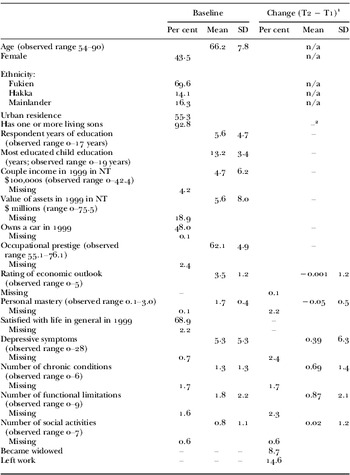
At baseline the average age of respondents was about 66 years, less than half were female (43.5%), and most were Fukien (69.6%), lived in an urban area (55.3%), and had one or more living sons (92.8%; see Table 1). The average number of years of education for respondents was 5.6 years compared with 13.2 years for their most educated child. The mean couple income was NT $470,000 (about $14,524 in 1999 US dollars) and the average value of assets was NT $5,600,000 (or $161,112 in 1999 US dollars). Just less than half of the respondents owned a car (48.0%) and the mean occupational prestige score was 62.1, the approximate score for a semi-skilled worker.
Descriptive statistics for baseline predictors and change in predictors between T1 (2000) and T2 (2006)

Notes: Sample size: 694. SD: standard deviation. n/a: variable does not change over time.
1. Note that an additional 22 respondents were missing data on the covariates in 2006. The 2006 data are not utilised in the remainder of the study, so these additional missing cases do not affect other results.
2. A dash (–) indicates that change in the variable cannot be calculated because the variable is not measured in 2006.
Generally, respondents seemed to have positive outlooks and were in good mental and physical health, but their involvement in social activities was low. The mean of the economic outlook indicator was 3.5 out of 5. The average personal mastery score was 1.7 out of 3.0 and 69 per cent of respondents reported being satisfied with their lives. Depressive symptom severity averaged 5.3 out of a possible 30 and respondents had on average 1.3 chronic conditions and 1.8 functional limitations. The mean number of social activities was less than one (0.8).
Some of these characteristics changed over time. The most notable changes were for chronic conditions, which increased on average by a little more than half of a condition (0.69), and functional limitations, which increased on average by nearly one limitation (0.87). In addition, 9 per cent of respondents became widowed and 15 per cent left work (Table 1).
Change in subjective social status
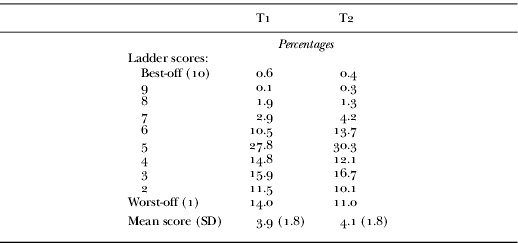
Overall, the average ladder ranking increased significantly from 3.9 to 4.1 (p value for a two-tailed t-test=0.0049; Table 2). At both waves, respondents were most likely to rank themselves in the lower of the two middle categories (i.e. 28–30% of respondents reported a ranking of 5). The distribution of the ladder scores was skewed toward the bottom of the scale in both years, although compared with T1, fewer respondents placed themselves on the lowest two rungs at T2. At T1, 56 per cent of respondents placed themselves on rungs 1–4 and only 6 per cent on rungs 7–10. At T2, 50 per cent of respondents ranked themselves between 1 and 4 and about 6 per cent between 7 and 10. The Pearson correlation between the T1 and T2 ladder scores was 0.40.
Description of subjective social status at T1 (2000) and T2 (2006)
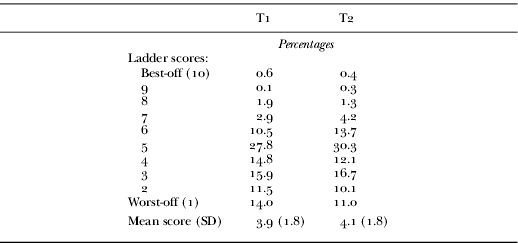
Notes: Sample size: 694. SD: standard deviation.
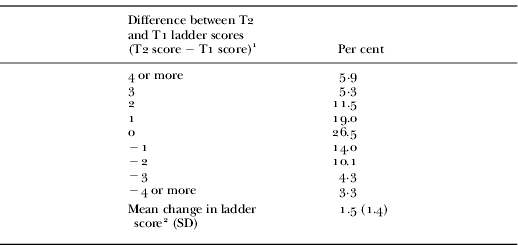
On average, respondents changed their ladder scores by 1.5 rungs (Table 3). Although the majority of respondents (60%) increased or decreased their rank by one rung or less (about 0.5 of the standard deviation of the ladder score at baseline), 22 per cent changed their scores by two rungs (about 1 baseline-ladder-score standard deviation) and 19 per cent changed their scores by three or more rungs (1.5 or more baseline-ladder-score standard deviations).
Description of change in ladder score
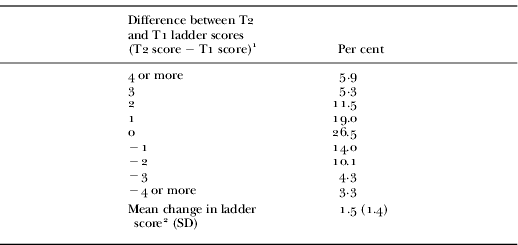
Notes: Sample size: 694. SD: standard deviation.
1. Observed range −8 to +8.
2. The mean reflects the mean of the absolute difference between ladder scores at T1 (2000) and T2 (2006).
Who revises their ladder rankings?
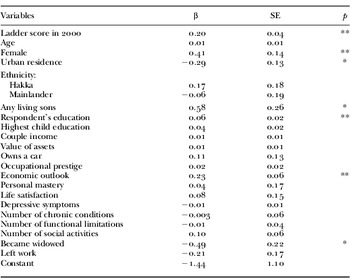
After controlling for T1 ladder scores and other covariates, six factors were significantly associated with T2 rankings (Table 4). Women increased their ladder score more than men (by just less than half a rung) and those with higher levels of education increased their score more than those with less education. For each one step increase in the economic outlook indicator, the ladder score at T2 increased by about one-quarter of a rung relative to the score at T1. Becoming widowed had a negative effect on the ladder score: respondents who became widowed during the study period reduced their ladder rankings by half a rung, on average, compared to those who did not become widowed. Although ladder scores also decreased for urban compared to rural residents and increased for respondents who had living sons versus respondents who did not, we need to be cautious in interpreting these results as these factors were not significantly related to change in ladder score in analyses based on the complete (i.e. non-imputed) data. Psychological attributes and physical health status measured at T1 and leaving work during the period were not significantly associated with change in subjective social status.
Ordinary least squares (OLS) regression coefficients for the effects of T1 (2000) ladder score and other covariates on T2 (2006) ladder score

Notes: Sample size: 694. SE: standard error.
Significance levels:
* p<0.05,
** p<0.01.
Conclusions
While several studies have examined the determinants of SES identity and its relationship to wellbeing, this is the first study that has examined whether older adults reassess their views of their social rank over time. Because older adults experience changes in social roles, health and finances, we hypothesised that older adults would revise their SES identity during the six-year study period. Our findings suggest that many older Taiwanese adults reassess their SES identity, changing their ladder scores by 1.5 baseline-ladder-score standard deviations or more, but most respondents show small to moderate levels of change, modifying their ladder score by 1.0 or fewer baseline-ladder-score standard deviations.
Our results also show that even though many respondents may change their perceptions of their social rank, the tendency to use the middle or lower part of the ladder rather than the top remains. These assessments differ from those using similar measures of SES identity in Western populations where the distributions are generally symmetrical or positively skewed (Kelley and Evans Reference Kelley and Evans1995; Singh-Manoux, Adler and Marmot Reference Singh-Manoux, Adler and Marmot2003). In a previous evaluation of ladder scores in Taiwan, Goldman, Cornman and Chang (Reference Goldman, Cornman and Chang2006) show that this propensity to report relatively low rankings persists across social strata defined by education and income. These low self-assessments of social status may be related to the importance of modesty and humility in traditional Chinese culture (Crittenden Reference Crittenden1991; Goldman, Cornman and Chang Reference Goldman, Cornman and Chang2006; Lee and Seligman Reference Lee and Seligman1997).
Although respondents revise their SES identity over time, only a handful of the characteristics that we examined are significantly associated with this change in assessment. Females, more highly educated respondents, and those who have a positive economic outlook tend to revise their assessments upward. Those who become widowed lower their views of their social standing. Psychological attributes and physical health measured at baseline do not appear to play a role in the revision of subjective social status assessments. Finally, although the direction of the effect of leaving work on change in SES identity is in the hypothesised negative direction, leaving work does not significantly affect views of social rank.
Several factors could account for the association between gender and change in ladder score. Traditionally, Taiwanese women gained status within the family over the lifecourse as they gave birth to a son and, later, as the family head's wife who directs and controls household resources and labour, particularly those of her daughter-in-law (Gallin Reference Gallin1986, Reference Gallin1994). However, with economic development and more opportunities for men and women to work outside the family, some members of the younger generation have become less dependent on familial resources for their economic wellbeing, shifting power and control away from the older generation (Gallin Reference Gallin1994). An older woman's status in the family, then, may be tied more to the support provided to children and grandchildren (Gallin Reference Gallin1994). Thus, women's perceptions of their social rank in later-life may improve as their daughters and daughters-in-law have children and grow to rely upon their older mothers for help with raising children and other daily tasks.
Data from SEBAS (not shown) reveal that not only are older women more likely than older men to improve assessments of SES identity over time, but men are also more likely than women to lower theirs. This tendency for men to revise downward their perceived social status could be related to the division of family property. Property may be important for a man's status, particularly within the family, because inheritance and care and respect for the elderly can be closely linked (Ikles Reference Ikles, Maddox and Lawton1993; Li, Xie and Lin Reference Li, Xie and Lin1993). Family property and resources are generally controlled by the oldest living male, primarily the father, and ideally are not divided among members of the younger generation until the death of this senior male (Ikles Reference Ikles, Maddox and Lawton1993). However, for a variety of reasons, property division often occurs prior to the death of the male family head (Ikles Reference Ikles, Maddox and Lawton1993; Sung Reference Sung, Ahern and Gates1981). Once property is divided, the father may experience a loss of power or influence in the family and become dependent on his children, mostly sons, for support (Sung Reference Sung, Ahern and Gates1981). This belief in the link between property and status in the family remains strong in Taiwan: 75 per cent of TLSA respondents in 1999 and nearly 80 per cent of TLSA respondents in 2003 believe that the elderly should hold on to some property or savings to ensure respect from their children (data not shown).
The finding that having more education is associated with an increase in subjective social rank may reflect a change in the importance placed on education in the assessment of social rank and the possibility that more highly educated respondents may have more complex notions of the self. Theories of the dynamic self (e.g. Markus and Wurf Reference Markus and Wurf1987) suggest that different aspects of self-conceptions may be drawn upon at any particular time when individuals evaluate their identities. With the many changing roles that accompany ageing, educational attainment may take on a more prominent role in the SES identity of older adults in Taiwan. In addition, the knowledge that comes with and the experiences afforded by a higher level of education have been associated with a more complex view of the self (Franks et al. Reference Franks, Herzog, Holmbert, Markus, Ryff and Marshall1999), perhaps allowing for more fluid evaluations of the self over time among more highly educated adults. As a result, older educated adults may improve their assessments of their social position relative to their less-educated counterparts.
Results regarding the positive association between economic outlook and improvements in perceptions of social rank are consistent with cross-sectional findings from Singh-Manoux, Adler and Marmot (Reference Singh-Manoux, Adler and Marmot2003). The authors report that satisfaction with standard of living and feeling financially secure are associated with higher assessments of social rank, suggesting that SES identity may reflect, in part, an evaluation of current and future economic and material conditions (Sing-Manoux, Adler and Marmot Reference Singh-Manoux, Adler and Marmot2003). As such, positive feelings regarding economic wellbeing at baseline could be translated into improved assessments of social position over time. Although it is also possible that individuals with the most positive outlooks provide high assessments of their social rank at baseline, leaving little room for improvement, this is not the case for respondents in this study. Respondents with the best economic outlook are similar to highly educated and wealthy respondents in their tendency to primarily use the lower and middle portions of the ladder measure (Goldman, Cornman and Chang Reference Goldman, Cornman and Chang2006). There is, therefore, the opportunity for improvement in evaluations of social rank for respondents holding positive views of their economic situation.
Although we hypothesised that two transitions, widowhood and leaving work, would have a negative effect on SES identity, only widowhood is negatively associated with changes in views of social position. Widowhood may lead to worse evaluations of social position over time because it can affect control of and access to familial property and resources (Chen, Dai and Parnell Reference Chen, Dai and Parnell1992; Fricke, Chang and Yang Reference Fricke, Chang, Yang, Thornton and Lin1994; Good Reference Good1963). Soon after widowhood, management of family property may revert to the younger generation, particularly married sons (Fricke, Chang and Yang Reference Fricke, Chang, Yang, Thornton and Lin1994; Wolf Reference Wolf and Dupaquier1981). As a result, older men and women may sense a loss of position or a loss of control, leading to a decline in their perception of their overall social standing.
The absence of a relationship between leaving work and SES identity change could be attributable to the varied experiences related to retirement. The meaning and relevance of life changes for the self-concept can vary from individual to individual (Whitbourne Reference Whitbourne, Ryff and Marshall1999) and can depend on the characteristics of the change itself, such as its expectedness, duration or appeal (Filipp 1981, in Diehl Reference Diehl, Ryff and Marshall1999: 160, 163). In the case of leaving work, research shows that the timing of retirement as well as the availability of post-retirement financial support, reasons for retirement, and expectations for and involvement in post-retirement activities vary widely in Taiwan (Hermalin et al. Reference Hermalin, Chan, Biddlecom, Ofstedal and Hermalin2002; Ofstedal et al. Reference Ofstedal, Chan, Chayovan, Chuang, Perez, Mehta, Hermalin and Hermalin2002). The large variation in the retirement process could result in a multitude of individual interpretations of the meaning of stopping work, which in turn could account for the non-significant relationship between leaving work and change in SES identity.
There are several limitations to our study. First, by having only two assessments of SES identity, analyses cannot distinguish between measurement error and true change. Thus, some of the reported changes in SES identity could simply reflect measurement error. However, a substantial minority of respondents (19%) changed their assessments by 1.5 or more standard deviations of the baseline ladder score. Such large changes may reflect more than measurement error. Second, the ladder rankings are measured six years apart, during which time many factors related to subjective social status could have changed. However, because both predictors and our outcome are measured simultaneously, we are unable to establish the timing of changes in predictors vis-à-vis changes in subjective assessments of social status. Therefore, we are unable to examine the effects of changes in most covariates on changes in ladder rankings. Finally, these analyses generalise only to older adults in Taiwan. Because the MacArthur Scale of Subjective Social Status is a nuanced measure that captures socio-cultural aspects of social position, future analyses involving other populations would further enhance our understanding of SES identity in later life.
Overall, these results suggest that many older adults are likely to reassess their SES identity in later life, highlighting the importance of collecting information on SES identity at multiple points in the lifecourse. As individuals adapt to events such as retirement or widowhood or to changes in health or economic wellbeing and encounter new social roles, re-evaluations of identity may occur (Demo Reference Demo1992; Whitbourne Reference Whitbourne, Ryff and Marshall1999). Relying on a cross-sectional view of SES identity may provide an incomplete picture of older adults’ social standing. Future analyses should explore whether these changes in SES identity have an effect on wellbeing. Changes in identity may influence wellbeing because individuals act, react, interpret experiences, and make choices that are consistent with their perceptions of who they believe and want themselves to be (Markus and Wurf Reference Markus and Wurf1987; Whitbourne Reference Whitbourne, Ryff and Marshall1999). A worsening view of social standing, therefore, could be a risk factor for declining health and a stable or improving view could be protective.
Acknowledgements
We gratefully acknowledge support for this project from the Demography and Epidemiology Unit of the Behavioral and Social Research Program of the National Institute of Aging (Grants R01AG16790 and R01AG16661) and the Eunice Kennedy Shriver National Institute of Child Health and Human Development (Grant R24HD047879).